Disclosure: As an Amazon Associate, dailyhomedecorating.com earns from qualifying purchases. Links to Amazon on this page are affiliate links; they cost you nothing extra. Prices and availability change often, so check the current Amazon listing before you buy.
The best hot tubs for New England have to earn their place against the region’s defining fact: winter is not a season here, it is a stress test. A spa in Vermont or Maine lives through months of sub-freezing nights, nor’easters that bury it in snow, freeze-thaw cycles that hunt for every weak seal, and heating bills that punish poor insulation without mercy. A tub that delights a Phoenix owner can be a cracked, bankrupting liability in Bangor. This guide ranks the verified pool with New England’s winter as the head judge — and it is honest about where the pool’s inflatable format reaches its limit.
The structure of the answer matters. The two SaluSpa picks carry Freeze Shield technology — automatic heating that protects pump and liner when temperatures drop — and that single feature separates them from every fair-weather inflatable. The Intex follows on package completeness. Then the guide does something New England buyers deserve: it includes two large indoor soaking tubs as the winter-proof complement, because the region’s oldest soaking tradition is a deep bath indoors while the storm does what it wants outside. Two prose-only hard-shell picks close the list for households ready for the region’s definitive answer, a full-foam insulated permanent spa. The portable winter discipline in Best Portable Hot Tubs For Winter is required companion reading for any inflatable owner north of Hartford.
Where to Buy
Every linked pick in this guide is sold on Amazon, where you can check the current price, delivery options, and listing details before you buy. New England buyers: time delivery before the ground freezes if the spa must cross a yard, and confirm the included cover specification — the cover is half your winter system.
- Coleman SaluSpa Miami Energy-Efficient AirJet Inflatable Hot Tub — Check on Amazon
- Bestway SaluSpa Cancun Energy-Efficient Inflatable Hot Tub — Check on Amazon
- INTEX 28425EH PureSpa Bubble Massage Spa Set — Check on Amazon
- WOODBRIDGE Acrylic Freestanding Contemporary Soaking Tub — Check on Amazon
- Streamline 75″ Freestanding Soaking Bathtub — Check on Amazon
- Hard-shell spa with full-foam insulation and a locking cover (prose-only pick — see review)
In this guide
Quick Picks
| Pick | Badge | Why it earns its place |
|---|---|---|
| Coleman SaluSpa Miami AirJet Inflatable Hot Tub | Best Overall | Freeze Shield protection plus efficient insulation — the inflatable best built for the region. |
| Bestway SaluSpa Cancun Inflatable Hot Tub | Best Compact | The same Freeze Shield formula in the smaller footprint for tight yards and decks. |
| INTEX 28425EH PureSpa Bubble Massage Spa Set | Best for Shoulder Seasons | Roomiest inflatable, complete package — glorious spring through late fall. |
| WOODBRIDGE Acrylic Freestanding Soaking Tub | Best Indoor Winter Soak | Double-walled, insulated, 55 gallons — a storm-proof soak that ignores the forecast. |
| Streamline 75″ Freestanding Soaking Bathtub | Best Premium | 82 gallons of indoor heat-retaining soak for the deepest winter evenings. |
| Hard-shell spa, full-foam insulation | Best for Serious Winter Soaking | Prose-only: the region’s definitive outdoor answer, described honestly. |
Key Takeaways
- Freeze protection is the dividing line in New England: systems with automatic freeze defense can winter outdoors; systems without it need a storage plan.
- Insulation is the heating bill. In a New England winter, the cover and walls decide what a soak costs more than the heater does.
- Even Freeze Shield inflatables have a deep-freeze limit — sustained extreme cold calls for the winterizing decision, made early.
- The indoor soaking tub is New England’s pressure valve: a guaranteed soak on the nights the outdoor spa is snowed in or shut down.
- Snow load, ice dams on covers, and frozen steps are operational realities to plan, not surprises to discover.
- The region’s definitive outdoor spa is a full-foam hard-shell with a serious cover; everything else is a negotiated compromise — sometimes a smart one.
How These Picks Were Chosen
Scoring began with freeze resilience, because in New England a spa’s first job is surviving its own winter. The SaluSpa pair’s Freeze Shield — an automatic heating function that protects the pump and liner from cold damage — put them at the top of the inflatable class, and their insulated walls and covers, rated by their makers as substantially more energy-efficient than comparable models, addressed the region’s second question: what it costs to hold 104 degrees against a January night. The Intex, lacking a named freeze-protection system, was ranked honestly as a three-season-plus pick: superb from spring through the shoulder season, with winter possible only under the disciplined conditions described below and in the portable winter guide.
The indoor tubs were included under a clear label. They are not hot tubs and this guide does not call them that; they are the region’s traditional complement, and both chosen models are double-walled or thick-acrylic designs whose heat retention suits long winter soaks. The WOODBRIDGE’s double-walled construction and 55-gallon capacity and the Streamline’s 82 gallons and thick acrylic made them the pool’s two strongest indoor winter picks. Excluded: the cold plunge pod — cold-plunge framing only, and nobody in New England needs help finding cold water in February — the baby tubs, and the faucet trim kit in the pool data, which is not a tub. The single prose-only pick names the hard-shell format the pool lacks. No prices appear anywhere; tier context is in Best Hot Tubs Under $6000.
The 6 Best Hot Tubs for New England — Reviewed

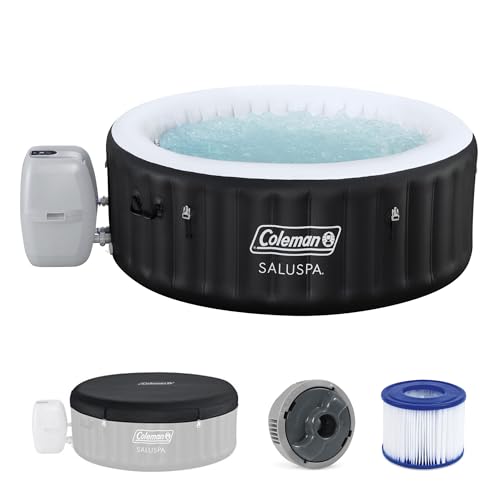
Coleman SaluSpa Miami Energy-Efficient AirJet Inflatable Hot Tub
Our badge: Best Overall
The Coleman SaluSpa Miami Energy-Efficient AirJet Inflatable Hot Tub leads a New England list for one reason that outweighs jets, capacity, and finish combined: Freeze Shield. When the temperature falls, the system automatically engages heating to protect the pump and liner from freeze damage — the exact failure that kills unprotected inflatables in their first northern winter. Wrap that protection in insulated walls and a cover designed to hold heat up to 40% more efficiently than similar models, add 120 AirJets and heating to 104 degrees Fahrenheit, and you have the inflatable most honestly suited to this region.
Strengths
- Freeze Shield automatic heating protects pump and liner in cold snaps.
- EnergySense insulated walls and cover fight the region’s heating costs directly.
- Power-saving timer schedules heat up to 40 days ahead — plan around cold fronts.
Trade-offs
- Freeze Shield protects against cold weather, not against the whole of a Maine January at its worst; extremes still demand judgment.
- Two-to-four-person size is a couple’s spa, not a gathering.
- Holding peak heat through deep winter costs real electricity even with good insulation.
| Color | Black |
| Size | Energy Efficient 2.0 |
| Dimensions | 71 x 71 x 26 inches |
| Weight | 101.2 pounds |
Operating the Miami through a New England winter is a craft with four rules. First, never let the water sit unheated in a freeze: the system’s protection assumes power, so the spa’s circuit should be as reliable as your refrigerator’s, and a mid-winter outage plan — who checks, who drains if the outage stretches — should exist before it is needed. Second, manage the cover like roofing: brush snow off before its weight pools meltwater, keep the seam clear of ice, and never pry a frozen cover with force. Third, shorten the dash: a cleared, sanded path and a robe hook by the door turn a bracing sprint into a ritual. Fourth, respect the deep-freeze threshold: when a polar outbreak settles in for a week, the honest options are vigilant full-heat operation or a planned drain-down, and the portable winter guide in Best Portable Hot Tubs For Winter walks that decision in detail.
The rewards for this discipline are the region’s best soaking: steam rising into black January air, snow on the cover’s edge, water at full heat. New Englanders who winter an inflatable successfully tend to become evangelists, and the Miami is the model that makes the story plausible. Its ChemConnect dispenser keeps chlorine steady between the tests that cold-weather owners sometimes skip — do not skip them; winter water is still standing water, and the routine in Best Hot Tubs For Families about assigning care to a named person applies with double force in February.
Best for: Couples and small households wanting a genuine four-season inflatable attempt / Not suited for: Anyone unwilling to manage power, snow, and a deep-freeze decision
Choose it if you will run the winter craft honestly. Skip it if your winters include long absences from the house — an unattended spa in a New England freeze is a liability, not an amenity.

Bestway SaluSpa Cancun Energy-Efficient Inflatable Hot Tub
Our badge: Best Compact
The Bestway SaluSpa Cancun Energy-Efficient Inflatable Hot Tub carries the same winter credentials as the Miami — Freeze Shield, insulated walls and cover, 120 AirJets, heating to 104 degrees — in the same 71 by 26-inch footprint with a grey wicker finish. It earns its separate place for New England’s smaller properties: the Boston triple-decker’s pocket yard, the Portland cottage garden, the deck that must also hold the grill, the snowblower’s turning circle, and four cords of wood.
Strengths
- Full Freeze Shield protection in the pool’s most placement-friendly spa.
- MaxHold beams hold shape and pressure through freeze-thaw shoulder seasons.
- Smaller water volume heats faster after a cold snap or a refill.
Trade-offs
- Pool data lists placeholder dimensions; features confirm 71 x 26 inches — verify on the listing.
- Compact volume means temperature dips faster during long, cover-off winter soaks.
- Shares the inflatable class limit in sustained extreme cold.
| Color | Grey Wicker |
| Size | Energy Efficient 2.0 |
Small volume cuts both ways in the cold, and the Cancun’s review is where to learn the arithmetic. Less water means less thermal mass: the spa recovers temperature quickly after use and costs less to hold, but a long January soak with the cover off will spend its heat faster than a big tub’s. The family tactic is the short, hot, deliberate soak — twenty glorious minutes, cover back on, inside to the wood stove — which happens to be exactly how New Englanders have always used winter water. The power-saving timer supports the pattern: schedule the heat peak for the evening window rather than holding maximum temperature through the working day.
Placement in a small New England yard has a winter geometry: close enough to the door that the dash stays short, clear of the roof’s snow-shed line — a roof avalanche onto a spa cover is a real regional event — and off the path the snowblower throws. The placement guide in Best Place For Hot Tubs covers structure and sightlines; add the roof-line rule as the regional amendment. Under a porch roof or a simple pergola, the Cancun’s snow burden halves and its season stretches at both ends.
Best for: Small New England properties wanting Freeze Shield in a tight footprint / Not suited for: Groups, or exposed sites under a roof’s snow-shed line
Choose it if space is tight and winter is non-negotiable. Skip it if your household soaks in groups — the Intex below trades freeze automation for room, a trade some households should make with eyes open.

INTEX 28425EH PureSpa Bubble Massage Spa Set
Our badge: Best for Shoulder Seasons
The INTEX 28425EH PureSpa Bubble Massage Spa Set is the finest three-season spa in this pool: 210 gallons, four-person room, an energy-efficient cover, hard water treatment, and saltwater-ready design. Its New England ranking carries an explicit condition — the pool data names no automatic freeze-protection system for it — so this guide recommends it as the region’s spring-through-late-fall champion, with winter use reserved for owners who will operate it heated, attended, and with a drain-down trigger decided in advance. Honesty about that condition is worth more than a fourth-place shrug; for three seasons of the year, this is the spa to beat.
Strengths
- Roomiest inflatable here — four adults fit, families spread out.
- Complete package: cover, hard water treatment, saltwater-ready system.
- Fiber-Tech construction gives the firmest inflatable walls in the pool.
Trade-offs
- No named freeze-protection system in the verified data — winter demands vigilance or storage.
- Largest inflatable volume costs the most to heat in cold weather.
- Bubble massage only, no directional jets.
| Color | Tan |
| Size | 4-Person |
| Dimensions | 22.25 x 25.375 x 32.75 inches (package); spa outer 77 x 28 inches per features |
| Weight | 99.66 pounds |
Consider the ownership pattern this pick suits: the household that soaks from April’s first warm evening through the last football Sunday of November, then drains, dries, and stores the spa in the barn or basement before the deep freeze — and spends January with the indoor tubs further down this list. That pattern is not a compromise in New England; it is how generations have handled every seasonal pleasure the region offers, from sailboats to screen porches. Storage frees the owner from outage anxiety entirely, and the spa’s lifespan stretches when its hardest season is spent indoors.
For owners who do push into early winter, the rules are strict: continuous heating without interruption, daily checks during cold snaps, a cover kept clear of snow load, and a hard trigger — a forecast threshold or a power failure of a set length — at which the spa is drained without debate. The saltwater-ready design and hard water treatment keep its three-season water care the easiest in this guide, and the family analysis in Best Hot Tubs For Families covers its group-soaking virtues in full. In Florida trim the same spa leads for opposite reasons — see Best Hot Tubs For Florida — which tells you the Intex is a genuinely versatile platform whose only enemy is a New England January left unattended.
Best for: Three-season soakers and households happy to store a spa for deep winter / Not suited for: Set-and-forget four-season outdoor use in the northern tier
Choose it if your soaking calendar runs April to November. Skip it if mid-winter outdoor soaking is the entire point — the SaluSpas above or the hard-shell below are the honest tools.
WOODBRIDGE Acrylic Freestanding Contemporary Soaking Tub
Our badge: Best Indoor Winter Soak
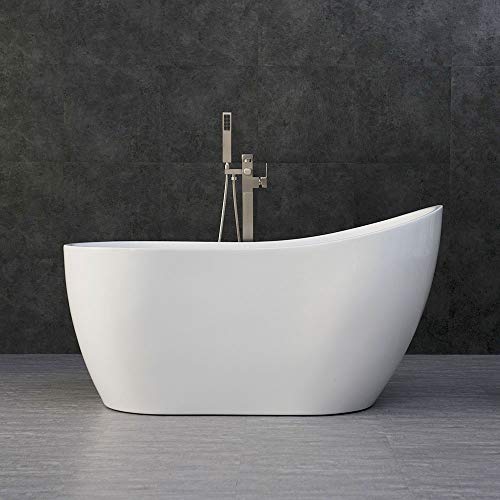
The WOODBRIDGE Acrylic Freestanding Contemporary Soaking Tub is this guide’s pressure valve: a 54-inch freestanding soaker whose double-walled construction — Lucite acrylic reinforced with resin and fiberglass — is explicitly designed to keep water at its desired temperature longer. When the nor’easter cancels the outdoor spa for the third night running, this tub is the soak that still happens: 55 gallons, a non-slip surface meeting ASTM slip-resistance standards, and a bearing capacity rated to 1000 pounds on its stainless bracket.
Strengths
- Double-walled insulation holds bath heat through long winter soaks.
- Non-slip surface and high capacity rating suit confident, unhurried bathing.
- Compact 54-inch footprint fits the region’s older, smaller bathrooms.
Trade-offs
- It is an indoor bathtub — no jets, no outdoor ritual, no apology for either.
- Freestanding faucet is a separate purchase and placement decision.
- 54 inches is a solo soak for taller bathers.
| Color | Brushed Nickel |
| Size | 54 inches long |
| Dimensions | 54 x 29 x 29 inches |
| Weight | 75 pounds |
New England housing stock makes this pick more relevant here than anywhere else in the country. The region’s bathrooms are famously compact — farmhouse and colonial layouts where a 54-inch tub fits and a 67-inch statement does not — and its winters make the bathroom the warmest room in the house by design. A deep, insulated soak in that room is not a consolation; it is the region’s original hydrotherapy, older than the hot tub industry by a century. The Woodbridge’s gently sloping lines follow the body’s curves, its high-gloss surface cleans with the mild routine in Best Cleaner For Bath Tubs, and its fresh-fill nature deletes the entire winter water-care burden: no testing, no freeze anxiety, no standby bill.
Pairing strategy is the sophisticated New England play: an inflatable outside for three or four seasons, this tub inside for the deep-winter guarantee. The combined commitment still sits below a hard-shell installation, the household soaks 365 days a year in one venue or the other, and neither asset is asked to do the job it is worst at. The value framing in Best Bang For Your Buck Hot Tubs runs the ledger version of the same argument.
Best for: Older New England homes and as the deep-winter partner to an outdoor spa / Not suited for: Buyers whose dream is specifically outdoor winter soaking
Choose it if your bathroom fits 54 inches and your winters are serious. Skip it if the outdoor ritual is non-negotiable — then budget for the hard-shell format below.

Streamline 75″ Freestanding Soaking Bathtub
Our badge: Best Premium
The Streamline 75″ Freestanding Soaking Bathtub is the indoor winter soak at full scale: 75 inches of oval, 82 gallons of capacity, 3.2mm acrylic over a reinforced stainless-steel frame with fiberglass insulation, and a bamboo tray across the rim for the book and the mug. In a New England primary bathroom — especially the kind created by the region’s barn conversions and farmhouse renovations — this tub turns the storm window into theater seating: snow against the glass, water at full heat, nowhere to be until spring.
Strengths
- 82 gallons and 75 inches — the deepest, longest indoor soak in the pool.
- Thick acrylic and insulated frame hold heat through unhurried soaks.
- Reinforced frame and internal drain included; a complete premium package.
Trade-offs
- Needs a genuinely large bathroom and a planned freestanding faucet.
- At 134.5 pounds, delivery and placement are a crew job.
- 82-gallon fills are the priciest indoor water habit on this list.
| Color | Polished Chrome |
| Dimensions | 74.8 x 35.4 x 27.6 inches |
| Weight | 134.5 pounds |
The premium case here is experiential and regional at once. New England winters are long enough that an indoor ritual earns investment the way a deck earns it in milder states; a household that will soak indoors ninety nights a year should buy the best indoor soak it can house. The Streamline’s heat story is its quiet headline: insulation plus thermal mass means the fill you draw is the temperature you finish at, and the included tray and internal drain keep the whole ritual self-contained. Two bathers fit its length honestly, which connects it to the couple’s analysis in Best Two Person Hot Tubs For Sale — for many northern couples, this is the two-person hot tub, with a roof doing the insulating.
Installation counsel for the region: place it where the floor structure is verified — a filled Streamline with two bathers is a serious point load — and where the faucet plan accounts for the house’s freeze-prone plumbing runs; an exterior-wall water line in a New England bathroom is a pipe-burst story waiting for its winter. Interior placement and a competent plumber close both questions before they open.
Best for: Renovated primary bathrooms and serious indoor winter soakers / Not suited for: Small bathrooms, unverified floors, or outdoor-ritual seekers
Choose it if the indoor soak is a pillar of your winter life. Skip it if the space or structure is in doubt — the Woodbridge delivers the same idea at a friendlier scale.
Hard-Shell Spa with Full-Foam Insulation and a Locking Cover
Our badge: Best for Serious Winter Soaking
This pick is prose-only: the pool contains no hard-shell spas, so the region’s definitive format is described, not listed. A full-foam hard-shell spa — molded acrylic shell, cabinet insulated throughout with foam, a thick locking cover, freeze-protection programming in the control system — is what New England dealers sell to people who soak outdoors in February without a second thought. It holds heat at a fraction of an inflatable’s winter energy cost, its plumbing is buried in insulation rather than exposed to the air, and its failure modes are a technician’s visit, not a total loss.
Strengths
- Full-foam insulation is the region’s gold standard for winter running costs.
- Real hydrotherapy jets and molded seating for genuine four-season luxury.
- Built-in freeze protection logic plus thermal mass rides out outages more gracefully.
Trade-offs
- A capital project: pad, electrical service, delivery by crane or crew in tight New England yards.
- Repairs are professional events with professional invoices.
- It is permanent — siting mistakes are decade-long.
| Type | Prose-only — hard-shell format, no pool product |
| Format | Permanent outdoor spa, full-foam insulated |
| Best pairing | Owned homes with a long northern horizon |
Shopping counsel for the format, New England edition: weight the cover and the insulation story above jet counts, because February invoices come from heat loss, not from insufficient bubbles. Ask how the control system behaves at minus ten, what the freeze-protection cycle does on its own, and whether the dealer’s service trucks run in your town in winter — a spa is only as four-season as its support. The tier framing in Best Hot Tubs Under $6000 helps place the investment against the inflatable ladder in this guide. Households that make this purchase well describe it the way Vermonters describe a good wood stove: expensive once, comforting forever.
Best for: Homeowners committing to outdoor soaking as a permanent winter ritual / Not suited for: Renters, movers, or anyone still testing whether they like hot tubs
Choose this format if the habit is proven and the house is long-term. Skip it if either is still a hypothesis — the inflatables exist to test hypotheses cheaply.
Comparison Table
| Pick | Format | Capacity / Size | Winter strength | Check price on Amazon |
|---|---|---|---|---|
| Coleman SaluSpa Miami | Inflatable spa | 2-4 person, 71 x 26 inches | Freeze Shield + insulation | Check price on Amazon |
| Bestway SaluSpa Cancun | Inflatable spa | 2-4 person, 71 x 26 inches | Freeze Shield, compact volume | Check price on Amazon |
| INTEX PureSpa | Inflatable spa | 4-person, 210 gallons | Three-season excellence | Check price on Amazon |
| WOODBRIDGE Soaking Tub | Indoor freestanding | 55 gallons, 54 inches | Double-wall heat retention | Check price on Amazon |
| Streamline 75″ | Indoor freestanding | 82 gallons | Insulated frame, thermal mass | Check price on Amazon |
| Hard-shell full-foam spa | Prose-only format | Permanent, multi-seat | Definitive winter system | Check price on Amazon |
How to Choose the Best Hot Tubs for New England
Decide your winter posture first: operate, store, or go hard-shell
Every New England spa purchase is secretly this decision. Operating an inflatable through winter demands power reliability, snow discipline, and a deep-freeze plan. Storing it demands space and a November weekend. A hard-shell demands capital. Choose the posture your household will actually sustain — the region punishes aspirational answers.
Price winter energy honestly
Ask what holding temperature costs in January, not in the showroom’s September. Insulated walls, a serious cover, and a sheltered, wind-blocked site are the three levers; wind exposure alone can dominate the bill, which is why the placement analysis in Best Place For Hot Tubs matters more in New England than anywhere else.
Plan the outage before it happens
Ice storms cut power in this region as a matter of course. Know your spa’s freeze timeline without heat, who can check it, and at what hour-count the drain decision triggers. Freeze Shield and control-system protections buy time; they do not repeal physics during a three-day outage.
Site for snow, not for summer
Keep the spa out of the roof’s shed line, off the plow’s throw path, and within a short, clearable dash of the door. A site that is charming in July and unreachable in February is a three-season site wearing a costume.
Consider the indoor partner from the start
The region’s most satisfied owners often run the two-venue system: outdoor spa for the long season, deep indoor tub for the deep freeze. If a bathroom renovation is anywhere in your plans, the insulated soakers in this guide belong in the same conversation as the spa — and the region’s garden water features, down to Best Solar Bird Bath Water Pumps, all live by the same rule: respect the winter or store the asset.
How Do You Winterize — or Winter-Run — a Hot Tub in New England?
To winter-run an inflatable: confirm the freeze-protection system is active, keep the spa heated continuously, maintain water chemistry on schedule (cold water still needs sanitizer), brush snow from the cover before it loads and melts into seams, keep the path cleared and sanded, and watch the forecast for the deep-freeze threshold at which your model should be drained rather than trusted. To winterize: drain fully, run the pump’s purge per the maker’s method, dry every surface and the filter housing, deflate without forcing frozen material, and store the whole system indoors — a barn or basement shelf, never an unheated shed floor where mice and deep cold both find it.
For hard-shell spas, winter-running is the design assumption; winterizing one is a professional-grade drain-and-blow-out procedure, because water left in buried plumbing lines is the region’s most expensive spa mistake. Owners who shut a hard-shell down should hire the procedure or follow the maker’s steps with religious care.
Problem: The cover is frozen to the shell — Never force it. Pour warm — not boiling — water along the seam, wait, and lift gently. Prevent recurrence by keeping the seam dry and the cover’s skirt clear of meltwater at closing time.
Problem: Temperature is falling despite the heater running — Check the obvious winter culprits first: a snow-loaded or waterlogged cover, a filter clogged enough to restrict flow, or wind exposure overwhelming the heater. Each has a fix cheaper than a service call.
Problem: A multi-day outage is forecast with a hard freeze — Decide early. If the spa cannot be kept powered, draining an inflatable is the safe play; for hard-shells, follow the maker’s outage guidance and consider professional help before the freeze, not after.
Problem: Ice is forming on the spa steps and path — Sand, not salt, near the spa; keep a robe-and-towel station at the door so the dash is one trip. Most winter spa injuries are falls on the way, not events in the water.
The Energy Question: What a New England Winter Really Costs
Owners deserve the shape of the truth even without printed numbers. A spa’s winter energy use is driven by the temperature difference between the water and the air, the insulation quality of walls and cover, wind exposure, and how often the cover comes off. In a New England January, that difference is the largest on the continent’s eastern seaboard, which is why the region’s hierarchy — full-foam hard-shell most efficient, insulated inflatables next, uninsulated anything a bonfire of money — is not snobbery but arithmetic. The timer strategy matters too: holding a moderate temperature continuously is usually cheaper and safer than letting the spa crash cold and reheating, because reheating pays the full gradient at maximum draw, and freeze risk lives in the cold hours.
The indoor tubs invert the equation entirely: their heat comes from the house’s water heater, in water drawn fresh and drained away, inside a room already heated. Their per-soak cost in January is the most predictable number in this guide, and for households watching a winter budget, that predictability is a feature on par with the soak itself.
Spring Start-Up and the Mud-Season Routine
New England’s fifth season — mud season — is when stored spas return to service, and the start-up ritual decides the summer. Inspect the stored liner and pump before inflating: rodent damage and cold-cracked folds announce themselves now or under pressure later. Inflate, fill, and balance before the first soak, run a full filtration day, and treat the first fill as a system flush if anything looks or smells doubtful. Check the cover that spent winter wherever it spent winter; a mildewed or waterlogged cover taxes the whole season. Outdoor electrical connections deserve a look after a winter of ice — corrosion at outdoor outlets is a regional specialty.
Households running the two-venue system get a graceful handoff here: the indoor tub’s season never ended, the outdoor spa’s season simply resumes, and the household’s soaking calendar has no gap to mourn. It is, in the end, the most New England solution imaginable — layered, redundant, and quietly proud of both.
Common Buying Mistakes
Buying a fair-weather inflatable for a four-season promise
Without freeze protection, an inflatable left filled into a hard freeze risks a cracked pump and a split liner. Match the product to the posture: protect it, store it, or do not buy it for winter.
Underestimating wind exposure
A spa on an open, windy knoll can cost dramatically more to heat than the same spa in a sheltered corner. Site for wind first; the view is a summer consideration.
Ignoring the roof’s snow-shed line
A season’s roof snow arriving on a spa cover in one slide can destroy the cover and stress the shell. Walk the roof lines before you place the spa — this mistake is invisible until the day it is total.
Letting the cover die quietly
A waterlogged cover doubles its weight, halves its insulation, and strains every lifter and back that touches it. In New England’s long heating season, a dead cover is the single largest avoidable energy cost. Replace it on evidence, not on hope.
Skipping the outage plan
The region’s ice storms are scheduled by nobody and attended by everybody. Owners without an outage plan make their worst decisions at midnight in the dark. Write the plan in October.
Final Recommendation
New England’s best overall buy in this pool is the Coleman SaluSpa Miami Energy-Efficient AirJet Inflatable Hot Tub: Freeze Shield for the cold snaps, real insulation for the heating bill, and an honest size for the region’s couples and small yards. The runner-up is its Bestway sibling — Check on Amazon — and the connoisseur’s move is pairing either with the WOODBRIDGE indoors for the nights winter wins. When the habit and the house are ready, the full-foam hard-shell is the region’s forever answer. The best hot tubs for New England are the ones still running — and still loved — in February.
The Wood Stove Principle: New England’s Native Theory of Winter Comfort
There is a regional philosophy underneath this guide’s product rankings, and naming it helps buyers trust their own judgment. New England has always heated its pleasures locally and deliberately: the wood stove that warms one room gloriously rather than the whole house adequately, the sauna culture the region’s Finnish and Scandinavian settlers brought to its lakesides, the winter carnival’s ice palace built to be enjoyed in the cold rather than despite it. A hot tub fits that philosophy exactly — a small volume of serious heat, maintained with craft, enjoyed as a deliberate ritual rather than a background utility. The buyers who thrive here are the ones who adopt the stove-keeper’s mindset toward their spa: tend it on a rhythm, respect its fuel costs as the price of a chosen pleasure, prepare it for the season in autumn, and never apologize for its scale. The region’s failed spas, by contrast, are almost always philosophy failures before they are equipment failures — tubs bought with a mild-climate, set-and-forget expectation and abandoned at the first January that graded them honestly. Choose the philosophy with the product, and the product rankings in this guide will serve you in the order printed.
Coastal, Mountain, and City: The Region’s Three Winters
“New England winter” is itself three climates wearing one name, and placement within the region refines the buying answer. The coastal winter — Boston, Providence, the Maine shore — is moderated by the ocean into something wetter and windier: fewer extreme lows, more freeze-thaw cycles, salt-laden air that corrodes as it does in Florida, and nor’easters that arrive as rain before they arrive as snow. Freeze Shield inflatables fare best here, and hardware inspection joins the coastal owner’s calendar. The mountain and northern winter — Vermont, New Hampshire’s high country, interior Maine — is the region’s true examination: prolonged deep cold, serious snow loads, and outages measured in days, where the hard-shell and storage strategies earn their sternest respect and indoor soakers stop being a complement and become the main event for weeks at a time. The city winter — the triple-decker’s yard, the condo’s terrace — adds structure and permission to the physics: loads, sightlines, and association rules govern what the climate allows. Read your own winter honestly before reading any ranking, including this one; the best hot tub for New England is, in the end, the best hot tub for your New England.
The First Thaw Audit: What Winter Taught Your Spa
When the season finally breaks, walk the whole system before the first celebratory soak. The cover tells the winter’s story first — its weight, its seams, its underside — and a cover that survived honorably deserves its cleaning and drying day before the spring routine begins. The liner or shell, the pump’s voice, the fittings’ dryness under a paper towel’s test: each is a line in the audit. Chemistry resets with a partial or full water change more cheaply in April than it can be chased through May. And the log — soak count, energy notes, the nights the trigger plan was consulted and the nights it was used — deserves its annual reading, because it is the document that will choose next winter’s strategy with evidence instead of hope. Owners who audit in the thaw own their spas; the rest are merely present for them.
A Final Word on Regional Pride
It is fitting to end a New England guide by admitting that the region’s spa owners are, by national standards, slightly unreasonable people — and that this is their distinction. They soak in weather that closes schools. They maintain systems through storms that make the national news. They regard a February evening in the water not as an eccentricity but as a heritage, continuous with the sauna benches and lake plunges and wood-stove philosophies their region has kept for two centuries. The equipment in this guide is ranked to serve that unreasonableness safely: protection where protection exists, honesty where it does not, and a warm indoor alternative for the nights when even New Englanders concede the round to winter. Concede a night, never the season — that is the whole guide in a sentence, and the region would not have it any other way.
Frequently Asked Questions
Can an inflatable hot tub really survive a New England winter?
A Freeze Shield model, operated heated and attended, can — that protection exists precisely for cold climates. Sustained extreme cold and long power outages remain its limits; owners need a drain-down trigger decided in advance. Models without freeze protection should be stored for deep winter.
What temperature should I keep a spa at in winter?
Most owners hold their soaking temperature continuously rather than reheating from cold, which is harder on energy and equipment and risks freeze in the cold hours. Use the timer to trim around your actual soak windows rather than letting the water crash.
How do I protect a hot tub during an ice-storm outage?
Keep the cover on and undisturbed — the water’s thermal mass is your reserve — and monitor the temperature. If the outage stretches toward the maker’s freeze window, follow their emergency guidance; for inflatables, draining is the safe endgame.
Is a hard-shell spa worth it in New England?
For committed year-round outdoor soakers, yes: full-foam insulation delivers the region’s lowest winter running costs and the fewest weather worries. For households still proving the habit, an inflatable season or two is the rational apprenticeship.
Why include indoor bathtubs in a New England hot tub guide?
Because the region’s soaking reality is two-venue: outdoor spas for the long season, deep indoor tubs for the deep freeze. The indoor picks are labeled as what they are and chosen for heat retention — they guarantee the ritual on the nights no outdoor spa should be opened.
When should I drain an inflatable for the season?
Before sustained hard freezes arrive if you are storing it — in much of the region, that means deciding by late fall. Drain, dry, and store indoors; a spa stored dry in November is a spa ready in April.


