Where to buy
Check the latest price, availability and delivery on Amazon. Orders are placed on Amazon. We may earn a commission from qualifying purchases.
- Best overall: Philips Hue Solo Lightstrip Base Kit, 33 ft, White and Color Ambiance — Check on Amazon
- Govee COB LED Strip Light Pro, 16.4 ft, RGBICW with Matter — Check on Amazon
- Philips Hue Play Gradient Lightstrip, 65-inch TV — Check on Amazon
- Govee RGBWWIC Strip Light 2 Pro with Matter, 16.4 ft — Check on Amazon
See 2 more Amazon options
- Govee LED Strip Light M1, 16.4 ft, RGBICW with Matter — Check on Amazon
- PAUTIX Addressable CCT Smart IC COB LED Strip Lights, 32.8 ft, 2700K–6500K, Alexa Voice Control — Check on Amazon
Read the full guide ↓
Disclosure: As an Amazon Associate, dailyhomedecorating.com earns from qualifying purchases. Links to Amazon on this page are affiliate links; they cost you nothing extra. Listing details such as price and availability change often, so check the current Amazon listing before you buy.
This guide starts with two findings. The first: there is effectively no single smart light strip on Amazon that costs between $200 and $300. The ceiling of the ordinary market sits well below this budget — Philips Hue’s Gradient lightstrip at the top of the ordinary market at lighting retailers, Govee’s newest COB flagship at its maker’s store, Hue’s longest Solo lightstrip, and Govee’s COB Strip Light Pro — check price on Amazon for each linked pick. Above those, the shelf is bare until one specialty family — Hue’s Play Gradient TV strips, launched as a premium specialty line — which cannot do the job it is famous for inside this budget at all, as its review below shows. The second finding is the one this lens adds: a small room shrinks the job again. A small room has one, maybe two, runs worth lighting — a desk wall, a headboard, a bank of shelves, the wall behind a screen — and each run is short: six to sixteen feet covers nearly everything a small room can ask for. So the flagship lengths overshoot the room itself — the 33 ft Solo is two to three times the footage a small room can use, and even the 16.4 ft kits leave offcuts. Together the findings define the budget: $300 for one small room is surplus by design. Spent well, it finishes one small room properly and keeps the change — or it stops pretending to be a one-room budget and lights two or three small rooms instead.
Because these are smart strips, three honesty notes matter more here than raw light output. First, control is a ladder, and every rung has a price or a catch. Bluetooth works across one room and nothing more. Wi-Fi adds voice assistants and schedules that run while you are out. Matter adds cross-platform reach — and then, on the Govee strips below, quietly reduces a segmented color strip to a single-color one outside its maker’s app, because the Matter standard has no vocabulary for segments or effects. And Hue’s full feature set — routines, out-of-home control, grouping, entertainment sync — lives behind a Bridge that is a separate purchase; the honest Hue price is the strip plus the Bridge. Second, brightness has no common measurement standard behind it: where a maker publishes a figure — Hue states 1,700 lumens for the Solo over its length — we report it as the maker’s figure; where none exists, we print none. Third, density decides how a strip looks, and small rooms are where density is decided. Spaced emitters read as dots, 60 LEDs per meter blends at a distance, COB strips erase the dots altogether — but in a small room there is no distance: you live three to six feet from the strip, inside the range where a beaded line still looks beaded. That fact reorders this guide’s priorities: footage is nearly worthless here; the quality of the light line is almost everything.
One configuration warning belongs up front. The Hue Solo pick is the 33 ft size on its listing family — select it before ordering, because the same family sells 10 ft and 16 ft kits that belong to lower-budget guides.
Quick Picks
Each row below names a buyer type and the strip that suits it, with a link to the listing.
| Buyer type | Pick | Why it stands out | Link |
|---|---|---|---|
| Best overall | Philips Hue Solo Lightstrip, 33 ft | The longest premium room strip Hue sells — check price on Amazon; with a Bridge, sold separately, the system still fits this budget as a system purchase; buy it when the system will grow past this one room | Check on Amazon |
| Best dotless color | Govee COB LED Strip Light Pro, 16.4 ft | 1,260 LEDs per meter of RGBICW COB with a real warm-white channel and Matter — in a small room you sit close enough that this is the pick that looks like a fixture — check price on Amazon | Check on Amazon |
| Best for TV walls | Philips Hue Play Gradient Lightstrip, 65-inch | Blended color zones shaped for a 65-inch TV — check price on Amazon; the pick only when the small room is the house’s media room, and screen sync still needs a Bridge and a Sync Box (see its review) | Check on Amazon |
| Best build-out platform | Govee Strip Light 2 Pro, 16.4 ft | 60 LEDs per meter of RGBWWIC with Matter — check price on Amazon; one kit plus its extensions can wrap two walls of a small room as a single continuous run | Check on Amazon |
| Best multi-room allocation | Govee LED Strip Light M1, 16.4 ft | Govee’s proven Matter flagship, positioned well below the top of this budget — check price on Amazon; one kit per small room, so two or three kits can finish two or three small rooms within this budget | Check on Amazon |
| Best white-light system | PAUTIX Addressable CCT Smart IC COB Strip, 32.8 ft | Thirty-two feet of dotless, animated tunable white — check price on Amazon; one run wraps a small room’s cove or a whole small kitchen’s cabinets; two kits can light two rooms well within this budget | Check on Amazon |
How These Picks Were Chosen
The six picks are the same six as the main under-$300 guide in this series — every one has a real Amazon listing verified from at least two independent sources — re-judged against small-room geometry. In a large room you ask how much strip the money buys. In a small room you ask how much of the strip you buy will ever be lit, how the line of light looks from three feet away, and whether the purchase is secretly a multi-room purchase wearing a one-room budget. For current pricing, check the live Amazon listing for each linked pick, as noted in each review and plan below.
The small-room filter had four tests the main guide did not need. The first was used length versus bought length. Consider every strip below in two ways: across the footage in the box, and across the footage a small room will actually light. The second figure is brutal to long strips, because of the category’s universal rule: a smart strip trims at marked points, and a cut-off section cannot be reconnected and lit again. The second test was density at arm’s length: in a small room the strip is furniture-distance away, so density outweighs footage. The third was one kit per room: a single roll cannot be split into two powered runs — the offcut has no controller and no supply — so every multi-room plan below is counted in whole kits, never in shared rolls. The fourth was the standing smart-home test — what the strip does out of the box versus only after a hub — whose answers shape every review below; its sharpest edge is the verified caveat carried by all three Govee picks: over Matter, a segmented Govee strip presents as a single-color light, and the gradients, scenes and music modes live only in Govee’s app. The sixth pick, the PAUTIX, is the white-light play — the only strip here that refuses color entirely and spends everything on dotless, animated white.
We did not use these strips ourselves. We read the maker listings, manuals, datasheets and specification pages, and compared what decides whether a smart strip works in a real small room: footage in the box against footage a small room can use; emitter density and whether the light reads as dots, blends, or a continuous line at small-room distances; the power arrangement (every pick runs on a 24V adapter included in the box); whether white comes from mixing red, green and blue or from a dedicated white channel; how control works, rung by rung — Bluetooth app, Wi-Fi app and voice, Matter, or a hub; and where the run can start, because every run begins within reach of an outlet and small rooms have the fewest outlets to spare. Adhesive got the same honesty pass: peel-and-stick backing is the weakest part of every strip here, and mounting clips or aluminum channel are treated as part of the purchase — which the leftover money in these plans conveniently covers.
Two strips you may expect here are discussed in prose rather than linked, for verification reasons, not quality. Hue’s Gradient lightstrip — the 80-inch multi-color sibling of the Solo, available at lighting retailers — could not be pinned to our two-source standard on its current US Amazon listing, so it appears in the plans as a prose-only option, unlinked. Govee’s newer COB Strip Light 2 Pro (1,344 LEDs per meter; available at Govee’s own store) is in the same position.
The 6 Best Smart Light Strips for Small Rooms Under $300
Philips Hue Solo Lightstrip Base Kit, 33 ft
Who it suits: Hue households whose small room is the first room of a whole-home system — buyers who want the longest premium strip Hue makes and finally have the budget to buy the Bridge in the same order.
The Solo 33 ft is an excellent strip, and its review starts with the configuration warning from the introduction: this recommendation is for the 33 ft size — select it on the listing before ordering. The same listing family sells 10 ft and 16 ft kits; those belong to lower-budget guides. Check the current price on Amazon for the 33 ft kit, and it buys ten meters of RGBWW strip in a silicone sleeve that diffuses the emitters into a soft line, stated by Signify at 1,700 lumens at 4000K and 1,500 at 2700K — a first-party figure, reported as the maker’s figure like every brightness number here. The whites are produced, not mixed: dedicated white emitters sit alongside the color ones. The strip trims at marked intervals of about 13 inches and runs over Bluetooth in the Hue app out of the box. Then the Bridge changes it: the Bridge is sold separately on Hue’s own store and on Amazon — check the current price on Amazon — so plan for the complete system, strip plus the hub that unlocks out-of-home control, routines, grouping, entertainment areas and Matter, as a system purchase that fits this budget.
Now the small-room problem, stated in the only terms that matter here: used feet. A small room’s best run — behind a headboard, along a desk wall, around a shelf bank — measures roughly 10 to 16 feet. Buy the 33 ft kit for that run and you will trim it to fit, and the 17 to 20 feet you trim off cannot be reconnected and cannot be lit; it is a dead offcut of the most expensive strip in this guide. Divide honestly and the picture turns: at 13 ft actually lit, much of what you pay for is length that lights nothing — the least efficient use of this budget on this page. The system math can still justify it: the Bridge is not a small-room purchase at all, it is a whole-home one, and it will run every Hue light you add for years. If this room starts a Hue house, buy both and let the offcut be the tuition; if it is the whole project, step down to the family’s 16 ft kit — same light, same app, no dead footage.
- The longest premium smart room strip: 33 ft of RGBWW in a diffusing silicone sleeve, maker-stated at 1,700 lumens.
- The Bridge fits the budget: strip plus Bridge fits this budget as a system, unlocking routines, grouping, sync and Matter.
- Cuttable at roughly 13-inch marks, 24V adapter included, and backed by the deepest support ecosystem.
Honest limitation: One color along its whole length — no segments or gradients; it cannot be extended, cut sections cannot be reconnected, and in a small room most of its 33 ft will be cut away and thrown out. Its adhesive is the line’s most-complained-about part, so plan on channel or clips. Order the 33 ft configuration specifically; the 10 ft and 16 ft sizes on the same listing family are different purchases.
Choose it if the Bridge will run lights well beyond this room. Skip it if this small room is the whole project — the 16 ft kit on the same listing is the same light, and the Govee COB Pro below is flawless at exactly small-room scale.

Govee COB LED Strip Light Pro, 16.4 ft
Who it suits: The small room’s one visible run — a desk wall, a mirror, a headboard, a shelf edge — that will be seen from three feet away and must look like a fixture, not a string of lights.
The COB Pro is what the money buys when footage stops being the point and the strip itself will be seen. COB construction packs 1,260 LEDs into every meter under a continuous phosphor inside a soft silicone sleeve — more than twenty times the density of the conventional premium strips — so there are no dots to hide and no cove required; the strip is a single unbroken line of light, mounted in plain sight. The chips are RGBICW: segmented addressable color with a dedicated warm-white emitter alongside, so whites are produced by a white diode instead of approximated by red, green and blue arguing with each other. Control is the full modern set: the Govee Home app over Wi-Fi, Alexa and Google voice, and Matter, which joins the strip to Apple Home and SmartThings — with the standing caveat that Matter carries a single color while the gradients and scenes live in Govee’s app. Check price on Amazon — it sits at the premium end of this guide per foot of strip.
That per-foot figure is exactly why this is the small room’s flagship rather than its extravagance. In a large room, a premium per-foot position punishes you across a long run. In a small room, the run is 16.4 ft or less — you buy precisely the feet you will light, and the waste the Solo throws away never happens. Meanwhile the small room’s defining condition — you are always close to the strip — is the condition this construction exists for: across a living room a 60-LED-per-meter strip blends into a line, but at the three-to-six-foot distances a small room imposes, those same emitters still read as individual beads reflected in a desk surface or a glossy door. The COB Pro’s continuous line does not. The compromises are flexibility and finality. Flexibility first: unlike the M1 and the Strip Light 2 Pro, this line has no extension path — 16.4 ft is what there is, which a small room rarely minds. Finality second: it trims at its cut marks, and the cut-off piece cannot be reconnected and lit — measure twice, because the offcut of a premium strip is expensive waste. Govee publishes no CRI figure we could verify, and its brightness figures are maker figures. Check the current price on Amazon before ordering.
- Truly dotless color: COB construction at 1,260 LEDs per meter under a continuous phosphor — no diodes to hide or reflect, at exactly the distances a small room forces on you.
- RGBICW chips with a real warm-white channel, segmented effects, and Matter over Wi-Fi alongside the Govee app and voice control — no hub required.
- Complete kit: strip, control box and 24V adapter in the box; cuttable at the marks; 16.4 ft is a small room’s whole run.
Honest limitation: Sixteen feet is the whole run — no extensions exist for this line; cut pieces cannot be reconnected; over Matter it is a single-color strip; and check the current price on Amazon before ordering.
Choose it if one visible run in a small room deserves the finest light Govee makes. Skip it if your run measures past 16 ft — the Strip Light 2 Pro extends, and the Solo starts at 33.

Philips Hue Play Gradient Lightstrip, 65-inch
Who it suits: Exactly one kind of small room — the small room that is the house’s media room, a den or bedroom built around a 65-inch TV — and, within that room, buyers who already own a Hue Bridge and a Play HDMI Sync Box.
Small media rooms are real, and they are this strip’s only honest home in this guide. A small room with a big screen and a short viewing distance is precisely where bias lighting earns its keep: the wall behind the screen is close and the glow fills your peripheral vision. The Play Gradient is genuinely excellent at it — a diffuser-sleeved strip built to mount on the back of a 65-inch television with the included brackets, producing several blended colors at once along its length, so the wall washes in gradients rather than a single flat hue. It covers the top and two sides of the TV — not the bottom, a gap owners notice and the listing does not hide. This is also the only strip family here in the higher premium tier for this 65-inch size. Check price on Amazon — its pricing is the most variable in this guide, so check the live listing rather than planning around any past figure.
The compromise is not a limitation of the strip; it is the price of its purpose, and it is disqualifying for anyone starting from zero. The Play Gradient’s headline job — light that syncs with what is on the screen — requires both a Hue Bridge and a Hue Play HDMI Sync Box, each sold separately, as the listing itself states in its own title. The Bridge is sold separately. The Sync Box is a second, larger purchase of the same order as the strip itself — a bundle of this strip with the current 8K Sync Box is sold on Amazon, and that bundle still does not include the Bridge. Add the pieces honestly and the working system lands well past this $300 budget — so within this budget the Play Gradient cannot do the thing it is sold for. What buying the strip alone inside $300 buys is: beautiful static gradients on your small media room’s wall, app-controlled color, and a promise the budget cannot keep. Buyers who already own both boxes should ignore this paragraph and buy it — check price on Amazon. Buyers whose small room is a bedroom, an office or a study should skip this pick entirely: with no big screen to serve, it is a category error at any price.
- The best TV light there is: multiple simultaneous blended colors from a diffuser-sleeved strip shaped and bracketed for a 65-inch TV.
- A premium flagship TV strip — check price on Amazon, as its pricing varies more than any other pick here.
- Power supply and mounting brackets in the box; full Hue app and voice control once it is on a Bridge.
Honest limitation: Screen sync — its headline feature — requires a Hue Bridge, sold separately, and a Play HDMI Sync Box, both sold separately; the complete working system costs well over $300. It also lights only the top and sides of the TV, not the bottom edge, and its price is the most volatile in this guide.
Choose it if your small room is a media room and you already own the Bridge and Sync Box, or are budgeting for them separately. Skip it if the small room has no 65-inch TV at its center, or $300 is your whole TV-lighting budget — the COB Pro above finishes a small room completely within this budget.
Govee Strip Light 2 Pro, 16.4 ft
Who it suits: Small rooms with a route, not a run — a strip that turns a corner from a desk wall to a shelf wall, or wraps a small room’s two lit walls as one continuous line.
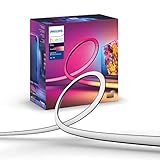
The Strip Light 2 Pro is Govee’s current mainstream flagship in conventional form: RGBWWIC chips at 60 LEDs per meter — double the density of standard strips, with a dedicated white channel alongside the color emitters — segmented effects, the full Govee Home scene and music library, DreamView sync with other Govee lights, and Matter over Wi-Fi, no hub required. The 16.4 ft kit is sold by Govee’s own storefront — check price on Amazon. In a large-room guide, its selling point is that it extends. In a small room, the extension path reads differently: the base kit connects with Govee’s own extension sections — 3.28 ft extensions — up to a 32.8 ft maximum, so a small room’s entire route — say 16 ft along the desk wall, then 7 ft returning along the shelf wall — can be built as one run: one controller, one adapter, one entry in the app. The alternative, two separate kits, doubles the hardware clutter in the room least able to hide it — or buys two complete small rooms of light within this budget.
The compromises are the familiar Govee ones, plus one that small rooms sharpen. The effects live in Govee’s app: Matter carries the strip as a single-color light, so the gradients and music modes depend on Govee’s software and your 2.4GHz Wi-Fi staying up. Extensions are proprietary — only this line’s own sections, only to 32.8 ft — and cutting remains one-way, so settle the route before cutting. The sharpened compromise is density in direct view: 60 LEDs per meter blends at viewing distance and inside a cove, but a small room keeps you at arm’s length, where the emitters still read as a beaded line where the COB Pro reads as a bar of light. Route this strip behind a furniture edge, inside a cove or under a shelf lip — anywhere the wall, not the diode, is what you see — and the difference mostly disappears; mount it bare on a wall you face from four feet away and it does not. Govee publishes no CRI figure we could verify.
- Near-flagship light: 60 LEDs per meter of RGBWWIC with a real white channel, segmented effects and Matter — check price on Amazon for the 16.4 ft kit.
- Built to route: extends with maker sections toward a 32.8 ft maximum — a small room’s whole two-wall route under one controller — or doubles as two complete small rooms of light within this budget.
- DreamView sync with other Govee lights, scene and music library, voice control — no hub.
Honest limitation: Segmented effects live in Govee’s app — Matter sees a single-color strip; extensions are proprietary and capped at 32.8 ft; and at arm’s length — a small room’s permanent condition — its emitters still bead where the COB Pro’s do not.
Choose it if your small room’s light has to turn a corner, or your $300 is really two small rooms. Skip it if one short run in direct view is the whole job and it must be flawless — that is the COB Pro above.

Govee LED Strip Light M1, 16.4 ft
Who it suits: Buyers with two or three small rooms and one honest question — why should one small room eat a $300 budget when a proven flagship kit sits well below the top of that budget?
The M1 earned its place in the under-$75 guide as that tier’s quality pick, and it returns here as the natural unit of small-room lighting. The strip itself is unchanged and still excellent — four-in-one RGBICW chips at 60 LEDs per meter with a dedicated warm-white channel, 24V mains power with the adapter included, Matter over Wi-Fi alongside the Govee Home app’s scenes and music sync, and independent testing coverage that called it the brightest strip in its class. It trims at its marked points and extends with Govee’s extension kits toward a 32.8 ft maximum. Check price on Amazon — it is positioned well below the top of this budget, which is what makes the multi-room reading work. One kit is a small room’s whole job — 16.4 ft is generous for a headboard run, a desk wall or a shelf bank, with trim waste measured in inches, not in the Solo’s tens of feet. Two kits finish two small rooms inside the budget, with room to spare for channel and clips. Three kits — a bedroom, an office nook and a nursery, each independently controlled — can also fit inside the budget, but they approach the top of it, so count the live total for all three kits before ordering.
The compromises carry over from its under-$75 review, repeated rather than revised. Over Matter, the M1 behaves as a single-color strip — brightness and white temperature adjustable, but the gradients, segments and music modes that justify its price live only inside the Govee app; multiple independent reviews make exactly this point. Cutting is one-way: the manual is explicit that detached pieces cannot be reconnected — which is also why one kit cannot serve two rooms, however short both runs are; each room needs its own controller and supply, counted in the plans above. The multi-room plan depends on live pricing when you buy; check price on Amazon for each kit, and compare with the Strip Light 2 Pro above as the build-out alternative. Govee publishes no CRI figure we could verify. And a three-kit plan means three adapters and three control boxes to place in rooms with the fewest outlets and the least furniture to hide them behind.
- The proven flagship: 60 LEDs per meter of RGBICW with a real white channel, Matter, and the deepest independent testing coverage in its class.
- The small-room unit: one kit finishes one small room — two or three kits can stay inside this budget; check price on Amazon.
- Extendable with Govee kits toward 32.8 ft per run; 24V adapter included.
Honest limitation: Over Matter it is a single-color strip — the segmented effects live only in Govee’s app; cut pieces cannot be reconnected, so one kit can never cover two rooms; and the multi-room plan depends on live pricing, since three kits can approach the top of the budget and leave little for mounting.
Choose it if two or three rooms of proven, premium light beat one room of ultimate light. Skip it if the job is one small room with one visible run — the COB Pro is the same company’s answer, at a higher per-kit position in the range and none of the leftovers.

PAUTIX Addressable CCT Smart IC COB LED Strip Lights, 32.8 ft
Who it suits: White-light small rooms — a small kitchen’s cabinet run, a narrow hallway cove — and buyers lighting two small rooms in white on one budget.
Take the white-light argument of the under-$75 guide and give it this lens’s arithmetic. The strip is 32.8 feet of COB at 560 LEDs per meter — a continuous, dotless line with no diodes to reflect in a countertop or a glossy floor — built on addressable IC control, so the white itself can move: chasing, flowing and gradient effects rendered in whites from 2700K to 6500K instead of in colors. It is powered by a 24V supply with the maker’s smart controller in the kit and Alexa voice control on top of the app, and check price on Amazon — it offers the lowest per-foot position in this guide by a wide margin. In a small room, that length is not the excess it first looks like: a small kitchen’s full cabinet run, or a cove carried around two or three walls, is one of the few small-room jobs that genuinely consumes 20 to 30 continuous feet, and this strip does it as a single run under a single controller. And the two-room version is the most economical plan in the guide: two of these kits can fit well within this budget, leaving more than half the budget unspent.
The compromises are price volatility, platform size and the white-only brief. Variation first, because it follows this strip from the under-$75 guide: its pricing varies, so check the current price on Amazon on the day you buy, not from this page — the two-kit plan has enough headroom in this budget to survive typical variation. Platform second: the chasing effects and voice control run through PAUTIX’s controller and app ecosystem, a smaller operation than Govee’s or Hue’s, and the effects live there rather than in Alexa. White-only third: its animation is done in shades of white, which reads as elegant in a cove and as a limitation at a party. The output and CRI figures are maker figures, attributed rather than endorsed, and a 32.8 ft run deserves mounting clips or channel rather than faith in adhesive — in a small kitchen, heat and steam are exactly what peel-and-stick backing handles worst.
- Dotless and animated at once: 560 LEDs per meter of addressable COB, with chasing and flowing effects in tunable white, 2700K–6500K.
- The coverage pick: 32.8 ft with the lowest per-foot position here — two complete kits can fit well within this budget; check price on Amazon.
- 24V supply, smart controller and Alexa voice control in the kit; the cove-and-perimeter specialist.
Honest limitation: Its pricing varies, so check the current price on Amazon before planning; effects live in PAUTIX’s app rather than in the voice assistants, and it is white-only by design.
Choose it if you are lighting a small kitchen, a hallway or a cove in white and want it smart, animated and bought once per room. Skip it if you want any color at all — every other pick in this guide does color; this one refuses to.
Comparison Table
| Product | Format & length | Light & control | Small-room verdict | Link |
|---|---|---|---|---|
| Philips Hue Solo Lightstrip, 33 ft | Diffused strip, 33 ft, not extendable | Single-color RGBWW; Bluetooth app, full features via Bridge | A whole-home system anchor — most of its length is waste in one small room | Check on Amazon |
| Govee COB LED Strip Light Pro | COB strip, 16.4 ft, 1,260 LEDs/m | Segmented RGBICW with real white channel; Matter + Govee app, no hub | The one visible run, flawless at arm’s length — and half the budget left over | Check on Amazon |
| Philips Hue Play Gradient Lightstrip | Shaped TV strip, 65-inch size | Multiple blended zones; sync requires Bridge + Sync Box | Only for the small room that is a media room — and only with the boxes owned | Check on Amazon |
| Govee Strip Light 2 Pro | Standard strip, 16.4 ft, 60 LEDs/m | Segmented RGBWWIC; Matter + Govee app, extendable to 32.8 ft | One continuous route around two walls of a small room, under one controller | Check on Amazon |
| Govee LED Strip Light M1 | Dense strip, 16.4 ft, 60 LEDs/m | RGBICW with real white channel; Matter + Govee app | One kit per small room — two or three rooms inside the budget | Check on Amazon |
| PAUTIX Addressable CCT COB Strip | COB strip, 32.8 ft, 560 LEDs/m | Animated tunable white only; app + Alexa voice | A small kitchen or cove in dotless white — two rooms’ worth well within this budget | Check on Amazon |
How to Choose a Smart Light Strip for a Small Room Under $300
Count rooms before strips. The first decision at this budget is not which strip but how many rooms the money is really for. One kit lights one room — a roll cannot be split into two powered runs, because the cut-off piece has no controller and no supply. If the honest answer is one room, the plans below keep most of your $300 in your pocket. If it is two or three small rooms, price the plan in whole kits from the start.
Measure the run you will actually light, then price per used foot. Small-room runs are furniture-scale: a headboard is about the width of the bed, a desk wall is 5 to 8 feet, a shelf bank similar. Walk the route with a tape before you shop, then judge each candidate by the feet you will actually light — not the feet in the box. That single calculation is this guide in miniature: it makes the 33 ft Solo the least efficient light here and the 16.4 ft COB Pro, bought at a premium per-foot position in the box, one of the most efficient per foot actually used.
Spend density where your eyes actually are. A strip hidden in a cove can be a spaced-emitter model and still read as a line of light. A strip in direct view shows every diode it owns — and a small room guarantees direct view at close range: at arm’s length, 60 LEDs per meter still beads; COB at 560–1,260 LEDs per meter does not. In a small room, density money is almost never wasted; footage money almost always is.
Insist on a real white channel if the strip will ever be a light. Plain RGB strips fake white by mixing red, green and blue into a cold, blue-leaning wash. Every color pick in this guide carries a dedicated white emitter (RGBWW, RGBICW or RGBWWIC) or is white-only by design (the PAUTIX). If a strip’s whites matter, that letter W is worth more than any effect library.
Decide the ecosystem before the strip. At this budget the strip is the cheap part of the decision; the platform is the commitment. Hue’s strips are the best-supported lights in the category, but their full feature set — routines, out-of-home control, grouping, sync — sits behind a Bridge, sold separately — check the current price on Amazon and on Hue’s own store. (The newer Bridge Pro sits at the premium end of Hue’s hub line — check its current price, and it is not the value route here.) Govee’s strips need no hub and speak Wi-Fi and Matter out of the box, but their best effects are rented from Govee’s app; PAUTIX is a smaller platform still. Choose the app you are willing to open for five years, then the strip inside it. And understand the Matter asterisk before you pay for it: Matter makes one strip visible to Alexa, Google Home, Apple Home and SmartThings at once, but the current standard treats a strip as one light with one color — every gradient, segment and chase on the Govee picks is invisible to Matter and lives in the maker’s app.
Budget the install, not just the strip — and let the leftover do it. Peel-and-stick adhesive is the weakest component in every box in this guide: it sags on textured paint, lets go in warm kitchens, and is effectively one-shot — a strip peeled up rarely sticks well twice. Aluminum channel or mounting clips turn a gadget into a fixture; in a small room they come out of the surplus the room hands you. Spend it.
What $300 Actually Buys in Small Rooms: Four Plans, Priced
Plan 1 — One small room, finished properly, money kept. This is the honest default, and it is deliberately not a full-budget plan. The visible run gets the COB Pro — check price on Amazon — the finest line of light in the guide, at exactly small-room scale. If the room has a second, hidden run — under a shelf, behind a desk — add a Strip Light 2 Pro, check price on Amazon, and the room is complete well within this budget, with money left for channel and clips. If it does not, the COB Pro alone is the finished room, and a substantial part of the budget stays unspent. No product in this guide justifies forcing the full $300 into one small room; any plan that tries is inventing spending. Keeping the money is the correct answer for most single small rooms.
Plan 2 — The Hue system that outgrows the room. The 33 ft Solo plus a Hue Bridge — check price on Amazon for both — together fit this budget as a system purchase. The strip is the part that fits the room worst — most of its 33 ft will be trimmed away — and the Bridge is the part that justifies it, because the Bridge serves the whole home’s future lights, not this room. Buy it only when that future is real. A variation worth knowing: Hue’s Gradient lightstrip — 80 inches of blended zones, maker-stated up to 1,800 lumens, extendable toward 33 ft with 40-inch extensions — is available at lighting retailers as a prose-only option; add the Bridge and the system can still fit this budget — check the current prices before ordering. At 80 inches it is, ironically, the right length class for a small room — but it is discussed in prose rather than linked because its current US Amazon listing could not be pinned to our verification standard.
Plan 3 — Two or three small rooms, one ecosystem. Counted in whole kits, because one kit per room is the rule. Two Govee M1 kits — check price on Amazon for each — finish two small rooms of 60-LED-per-meter, real-white, Matter-speaking light inside this budget; three kits can finish three, approaching the top of the budget, with some room left for channel and clips if live pricing allows. The white-light version is more economical still: two PAUTIX kits fit well within this budget. Two Strip Light 2 Pro kits land between those approaches in budget terms.
The plan that does not work — the small media room trap. The Play Gradient plus a Bridge can fit under $300 on the strip and Bridge alone — and the light still does not sync, because the Sync Box is a third purchase: a bundle of the strip with the current 8K Sync Box sits well above this budget, before any Bridge. A small media room does not shrink that math at all. The Play Gradient is a strip for people who already own the boxes; everyone else should buy Plan 1 and enjoy the change.
If Your Small Room Is Part of a Bigger Plan
Small rooms rarely sit alone, and the right shortlist depends on what surrounds yours. If the small room is a whole small home — a studio or a rental the strip may have to leave with you — the deposit-and-restoration trade-offs are scored in Best Smart Light Strip For Apartments Under $300. If it is a bedroom, the priorities shift: minimum brightness at 2 a.m. and a control box’s standby glow are chosen for in Best Smart Light Strip For Bedrooms Under $300. If the room is small but design-led — the strip as its only visible light source, judged like furniture — the style-first scoring lives in Best Smart Light Strip For Modern Homes Under $300. And if your rooms are not small at all, this guide’s parent — Best Smart Light Strip Under $300 — runs the same six picks and plans at full-room scale, where the Solo’s 33 ft stops being waste and starts being the point.
Common Buying Mistakes
- Buying 33 ft for a 13 ft run. Trim a premium Solo to a small room’s run and the discarded length — which cannot be reconnected or lit — is the most expensive waste in this guide.
- Splitting one roll between two rooms. A cut-off section has no controller and no power supply; it will never light. Every room needs its own kit — price multi-room plans in kits, not in feet.
- Spending the whole $300 because it is the budget. No single strip fills the $200–$300 band. A finished small room well below the top of the budget, with the rest kept, beats forced spending every time.
- Buying spaced emitters for a room you sit inside. Density that blends across a living room still beads at three feet. In a small room, visible runs need 60 LEDs per meter at minimum, and COB if the strip faces you.
- Buying the Play Gradient for a media room you cannot sync. The strip’s headline feature needs a Bridge and a Sync Box. If you own neither, buying the strip alone buys static gradients only, and the working system costs well over $300 — in a room of any size.
- Trusting the adhesive with a premium strip. Peel-and-stick backing is one-shot and heat-shy; a flagship strip deserves channel or clips, and the leftover budget pays for them.
Final Recommendation
For one small room, buy the Govee COB Pro — check price on Amazon — mount it in channel, and keep the rest of the budget; the keeping is the point. If this purchase is really the start of a Hue home, the 33 ft Solo lightstrip plus a Hue Bridge — check price on Amazon for both — fit this budget as a system and buy the platform, not just the room — Check on Amazon. If the honest job is two or three small rooms, Govee M1 kits — check price on Amazon — finish each room for flagship money per room — Check on Amazon. And if even those numbers feel rich for the room in front of you, trust that instinct — the picks in Best Smart Light Strip Under $100 cover most single small rooms outright.
Frequently Asked Questions
Is there actually a smart light strip that costs $300?
No — not a general-purpose one we could verify. The most expensive single room strips sit well below this budget: Hue’s Gradient lightstrip, Govee’s COB flagship at its maker’s store, and Hue’s 33 ft Solo are all premium picks below the top of this budget. The only strip family in a higher premium tier — Hue’s Play Gradient TV strips — is a television product whose sync feature needs two further boxes. For a small room the gap doubles: not only does no $300 strip exist, the room could not use one if it did.
Can I cut a long strip to fit my small room and use the rest in another room?
No. You can cut every strip in this guide at its marked points, but a cut-off section cannot be reconnected and lit again on any pick here — Hue states it for the Solo, Govee states it for its COB lines, and the M1’s manual is explicit. Extendable strips grow only by adding the maker’s extension sections to the powered run. Two rooms means two kits; measure twice and make one cut.
Does the Play Gradient make sense in a small media room?
Only if you already own the hardware it needs. Syncing with the screen requires both a Hue Bridge and a Play HDMI Sync Box, each sold separately; a bundle of the strip with the current 8K Sync Box sits well above this budget, before the Bridge. Inside a $300 budget, the strip alone shows static gradients and nothing more.
Why does my Matter strip only show one color in Apple Home or Google Home?
Because that is all the current Matter standard can describe: one light, one color, one brightness. Segmented effects — gradients, chases, per-section colors — have no Matter vocabulary yet, so on the Govee COB Pro, Strip Light 2 Pro and M1 those effects exist only inside the Govee Home app.