Where to buy
Check the latest price, availability and delivery on Amazon. Orders are placed on Amazon. We may earn a commission from qualifying purchases. One pick below is sold through authorized dealers rather than Amazon, and we say so plainly where it appears.
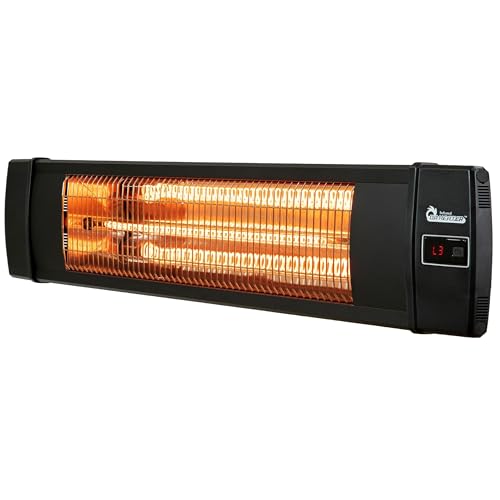
- Best for most small patios: Dr. Infrared Heater DR-238 Carbon Infrared Heater, 1500W 120V — Check on Amazon
- Cuisinart Portable Tabletop Patio Heater, 11,000 BTU (COH-500) — Check on Amazon
- Dr. Infrared Heater DR-239 Carbon Infrared Heater, 3000W 240V — Check on Amazon
- EAST OAK 48,000 BTU Patio Heater with Round Table Design (UR48BN1) — only for the largest “small” patios; read the review — Check on Amazon
- EAST OAK 50,000 BTU Patio Heater with Sand Box Base (UR50BN2) — included for honesty about what to skip; read the review — Check on Amazon
- Bromic Tungsten Smart-Heat Electric 6000W — sold through authorized Bromic dealers, not as a stable Amazon listing; the mounted, zero-floor-space premium option, see the review.
Read the full guide ↓
Disclosure: As an Amazon Associate, dailyhomedecorating.com earns from qualifying purchases. Links to Amazon on this page are affiliate links; they cost you nothing extra. Listing details such as price and availability change often, so check the current Amazon listing before you buy.
A small patio inverts the usual heating advice, and finding the best outdoor heater for small patios under $1500 starts with accepting the inversion: on a small patio, output is abundant and space is the scarce resource. A footprint measured in single-digit feet cannot spare the square meter a tower heater stands on, cannot honor the clearances a big burner demands from its fences and furniture, and does not need a fraction of the heat those burners produce — two people on an eight-by-ten patio sit close to everything, including whatever warms them. The $1500 in this keyword is, frankly, far more than the problem requires, and this guide will not pretend otherwise to fill a page. The best small-patio heaters cost a modest slice of that budget, mount on walls instead of standing on floors, and aim modest, well-placed radiant heat at the two or three seats that exist.
So the picks below are ranked by a small-patio logic that larger-space guides would find heretical. First place goes to a plug-in infrared bar that occupies zero floor space and warms its two chairs completely. Second goes to a tabletop unit that turns the patio’s one table into the warmest seat in the house. The hardwired infrared bar follows for owners whose small patio is covered and permanent. The two big propane towers appear at the end of the list — deliberately, and labeled with the sizes at which they stop being mistakes — because some “small patios” are twelve feet wide with open sky and a dining set for six, and those readers deserve the honest threshold rather than a blanket ban. The dealer-sold Bromic closes the guide as the premium expression of the guide’s own thesis: heat that lives in the architecture and consumes no floor at all.
Our short answer, for the typical small patio: buy the DR-238, mount it over the chairs, and stop shopping. Add the Cuisinart if your patio life is a table. Keep the rest of the $1500 — a small patio rewards restraint more than any other space in this series, and readers working to a tighter ceiling will find the same conclusions at the Best Outdoor Heater For Small Patios Under $500 and Best Outdoor Heater For Small Patios Under $700 tiers, while balcony readers should cross-check the rules-first analysis in our guide to the Best Outdoor Heater For Apartments Under $1500.
In this guide
Quick Picks
Ranked for small patios specifically: floor space and clearances first, output second.
| Buyer type | Pick | Why it stands out | Link |
|---|---|---|---|
| Best for most small patios | Dr. Infrared Heater DR-238, 1500W 120V | Wall-mounted infrared: zero floor space, complete warmth for two chairs | Check on Amazon |
| Best for a one-table patio | Cuisinart Tabletop Heater (COH-500) | The table becomes the heater — 11,000 BTU at seated height | Check on Amazon |
| Best for covered small patios, owners | Dr. Infrared Heater DR-239, 3000W 240V | Double output, permanently mounted, nothing stored anywhere | Check on Amazon |
| Only if the patio is dining-sized | EAST OAK 48,000 BTU Round Table (UR48BN1) | A tower that replaces a table — viable from about 12 ft of width, open sky only | Check on Amazon |
| Usually too much heater | EAST OAK 50,000 BTU (UR50BN2) | Excellent tower, wrong scale for most small patios — read before buying | Check on Amazon |
| Premium zero-footprint system | Bromic Tungsten Smart-Heat Electric 6000W | Recessed or ceiling-mounted dealer system — heat with no appliance visible | Dealer only — see review |
How These Picks Were Chosen
We measured candidates against a small patio’s real constraints, in order. Floor footprint first: anything standing on the patio pays rent in the scarcest currency, so mounted and tabletop designs started with an advantage no burner could overcome. Clearances second: every heater publishes minimum distances to combustible materials, and a small patio is precisely where those distances are hardest to honor — a pick that cannot keep its clearances in a ten-foot space was disqualified for that space regardless of quality. Output third, and inverted: the question was not “how much heat” but “how appropriately little, how well aimed” — radiant heat delivered to two seats beats a bonfire of BTU roasting one side of a guest while the fence smolders metaphorically behind them.
Within that frame we verified the usual evidence: manufacturer specifications and manuals, safety hardware (tilt switches, tip-over shutoffs, flame-failure protection, weather ratings), and prices checked against the tier — every linked pick costs a small fraction of $1500, which is itself a finding of this guide. We screened the category against U.S. Consumer Product Safety Commission recalls; gas patio heaters have been recalled for component failures that release gas and create fire and burn hazards, and in a small space, where every appliance sits close to people and fences, an unverifiable gas product is doubly unwelcome. No recalled product appears here.
We did not hands-on test these heaters. We did something a small-patio buyer needs more: we stated, for each pick, the patio size and layout at which it works and the size at which it becomes a mistake — including two excellent towers whose honest reviews in this guide mostly explain when not to buy them.
Best Outdoor Heater for Small Patios Under $1500: The 6 Picks
Dr. Infrared Heater DR-238 Carbon Infrared Heater, 1500W 120V — Best for Most Small Patios
Who it suits: The archetypal small patio — eight to twelve feet, two or three chairs, a wall or cover to mount on, and an owner who wants warmth without giving the heater a permanent share of the floor.
The DR-238 wins this guide on a single structural fact: it does not stand on your patio. This carbon infrared bar mounts on the wall or under the patio cover, aims down at the seating, and leaves every square inch of floor to the furniture and the people. On a small patio that is not a convenience, it is the whole ballgame — the difference between a heater that serves the space and a heater that competes with it. Its heat is equally well-matched to the scale: three settings of 900, 1,200 and 1,500 watts thrown in a directed radiant beam that warms the occupants of two chairs completely and personally, the way sunlight does, rather than attempting to heat an air volume that a small open patio cannot hold anyway. Fifteen hundred watts is roughly 5,100 BTU, a number that looks frail beside a tower’s 50,000 and outperforms it in this application, because all of it lands on people at close range.
The supporting details suit small-space life. It plugs into an ordinary 120-volt outlet — no electrician, no installation project — though its 12.5-amp draw at full setting means it wants most of a 15-amp circuit, and its lower settings exist for circuits shared with the patio’s lighting. A remote control and a shutoff timer of up to nine hours mean it is operated from the chair and never left burning by accident. Being electric, it produces no flame and no carbon monoxide, so it works under the covers and against the walls where small patios concentrate their lives, subject always to the maker’s mounting height and clearance instructions — the element face runs hot, and on a small patio the distance from the bar to the nearest cushion, plant or stored item must be the manual’s distance, not an estimate. Its weather-rated aluminum housing lives outdoors year-round, and at season’s end there is nothing to store, because there was never anything standing anywhere.
If your small patio has one more ambition — a table where meals happen — pair it with the tabletop pick below and the two together, for a fraction of this budget, warm every seat the patio owns.
- Zero floor footprint: wall or ceiling mounting gives the space back to you.
- Three settings (900/1,200/1,500W) on a standard outlet; remote and timer included.
- Radiant beam warms people directly — right-sized heat for two or three seats.
- No flame, no fuel, no carbon monoxide; nothing to store, ever.
Honest limitation: Its beam is its boundary — a third chair outside the aim is a cold chair, and the maker’s minimum mounting height must fit your wall or cover. On a patio with no mountable surface at the right height, the tabletop pick below becomes the lead recommendation.
Choose it if you have a wall or cover above your chairs and an outlet within cord’s discipline. Skip it if your patio is an open slab with nothing to mount on — start with the Cuisinart instead.
Cuisinart Portable Tabletop Patio Heater, 11,000 BTU (COH-500) — Best for a One-Table Patio
Who it suits: Small patios organized around a single table — bistro sets, four-person dining squares, the card table that comes out on Fridays — especially where there is nothing suitable to mount a bar on.
On a small patio, the table is usually the room: it holds the meals, the drinks, the work-from-home afternoons and the games. The COH-500’s insight is to heat from the middle of that room. Set at the table’s center, it radiates 11,000 BTU outward at seated height across roughly 30 square feet — which, on a small patio, is not a zone within the space, it is the space. Hands, faces and plates all sit inside its circle. It runs on a one-pound propane cylinder screwed into the unit, so there is no 20-pound tank squatting in the corner consuming the patio’s scarcest resource and no hose crossing the floor; when the table is needed bare, the heater lifts away one-handed to a shelf.
Its safety kit addresses its exact risks: a tilt switch that cuts the gas if the unit is knocked — the plausible accident on a small, crowded table — and a screen guard between burner and fingers. The owner’s disciplines complete the picture, and on a small patio they deserve emphasis, because smallness compresses every distance: a stable, level, non-flammable table surface; the center of the table kept clear of napkins, paper and decorations, which on a small table means a deliberate rule rather than a hope; clearance above from covers, umbrellas and low branches; and open air always — this is a combustion appliance making carbon monoxide, and it never runs in a garage, a tent or an enclosed porch, however small the gathering that rain tried to move. Cylinders store outdoors, cool and upright, in the smallest of stocks.
For the one-table patio it is not merely an alternative to the mounted bar; on patios with no mountable wall it is the better answer, and its price is the smallest in this guide — proof, if the tier needed it, that small-patio warmth is an aim problem, not a money problem.
- 11,000 BTU at seated height — the table’s occupants are the heated zone.
- One-pound cylinder: no floor-standing tank eating patio space.
- Tilt switch and burner screen guard fitted for crowded-table duty.
- Lifts away for storage; the patio returns to full size in seconds.
Honest limitation: A flame at the center of a small table is close to everything on it — households with small children, and tables that accumulate paper and clutter, should choose the electric bar instead. One-pound cylinders also need spares staged, or the evening ends at the cylinder’s convenience.
Choose it if your patio is a table with chairs around it. Skip it if your seating is lounge-style with no central table, or if a wall mount is available and toddlers are not — the DR-238 is then the cleaner answer.
Dr. Infrared Heater DR-239 Carbon Infrared Heater, 3000W 240V — Best for Covered Small Patios (Owners)
Who it suits: Owners whose small patio is covered and permanent — a porch, a roofed terrace, a built-in outdoor nook — and who want the mounted solution with double the plug-in output and nothing left to plug, store or move.
Small and covered is a specific architectural condition: the roof that makes the patio usable in rain also caps its size and rules out combustion entirely, since exhaust has nowhere to go. The DR-239 is the strong form of the correct answer. It delivers 3,000 watts — 10,260 BTU — of carbon infrared heat from a slim 41-inch housing rated IP55, mounted once on the wall or ceiling and aimed at the seats forever. Double the DR-238’s output matters in a covered space because the cover usually signals a bigger ambition: a dining table for four to six rather than two chairs, a porch used as a room. One DR-239 over a small covered dining set is a complete heating system, with a remote offering two heat levels and no floor presence of any kind — the small patio keeps its full floor plan and gains a season.
The admission price is electrical. The unit’s cord ends in a NEMA 6-15 plug, so an existing 240-volt receptacle makes it a mounting job; otherwise a licensed electrician installs a dedicated circuit, and in a $1500 guide that labor is the main event — the heater itself is a minor line. That arithmetic is why this pick ranks below its plug-in sibling despite the stronger specs: for a two-chair patio, the DR-238 delivers the same felt result with no electrician at all. For the covered dining nook, the calculation reverses — the installation buys decades of invisible, fuel-free, storage-free heat, and the per-evening cost of that permanence rounds to nothing.
Renters should admire it from a distance: hardwired appliances are owners’ purchases, and no small patio justifies a lease negotiation over a circuit. Owners renovating a small covered space should put this heater — or the dealer-grade version at the end of this guide — on the drawings early, while walls and ceilings are open and the electrician is already coming.
- 3,000W / 10,260 BTU — covers a small dining set, not just two chairs.
- Permanently mounted: zero floor space, zero storage, zero fuel.
- IP55 weatherproof housing; remote with two heat levels.
- No flame and no exhaust — the covered patio’s only correct heat type.
Honest limitation: It needs a 240-volt supply and an owner’s authority; without an existing receptacle, the electrician’s visit is the real purchase. For a two-chair patio it is also simply more heater than the seats can use.
Choose it if your small patio is covered, owned and used as a dining room. Skip it if you rent, or if two chairs are the whole story — the DR-238 matches that story at a fraction of the installed cost.
EAST OAK 48,000 BTU Patio Heater with Round Table Design (UR48BN1) — Only at the Big End of Small
Who it suits: The largest patios that still call themselves small — roughly twelve feet or more of open-sky width with a dining set for four to six — where a tower’s footprint and clearances can genuinely be honored.
We include this tower to draw a line rather than to sell one. Below a certain size it is the wrong product, and its review below explains why; at and above that size, it becomes a clever one, because its defining feature directly answers the small-patio objection to towers. A freestanding heater normally consumes floor and returns only heat; this one’s pole carries a wide round table, so the footprint it takes is a footprint that works — the serving surface, the drinks landing, the board-game board. On a twelve-foot patio with a dining set, heater-plus-table can occupy less total space than the side table and heater it replaces, while its 48,000 BTU burner warms the whole dining group from the center of it.
The conditions are not negotiable, and a small patio makes them harder, not easier. Open sky above: under a cover, a tower’s exhaust and reflector heat violate its clearances, full stop. Side clearance per the manual — think in terms of roughly three feet from fences, walls, furniture and plantings — which on a twelve-foot patio leaves a workable but honest margin, and on a nine-foot patio leaves none at all; measure your space against the manual’s numbers before this pick is even a candidate. Level hardscape under its weighted base, tip-over and flame-failure protection verified working, and a 20-pound tank whose storage — outdoors, upright, ventilated — also needs a home on a patio that has no spare corners. The double-layer stainless burner and wheels are genuine virtues, but they serve a patio that has already passed the size test.
If your measurements pass, this is a delightful solution and the only tower we endorse for the category. If they fail by a foot, they fail — the mounted and tabletop picks above exist precisely for you, and they cost less in money as well as space. Compare the mid-size options in our guide to the Best Outdoor Heater Under $500 if your patio passes the size test but your budget prefers a smaller commitment.
- 48,000 BTU with a built-in table — the one tower whose footprint earns its keep.
- Double-layer stainless burner; weighted base; wheels.
- Tip-over and flame-failure protection fitted.
- Complete dining-group heat for the largest “small” patios.
Honest limitation: It needs open sky, roughly three feet of clearance in every direction and a tank’s worth of storage — three things most genuinely small patios cannot supply. Its size is a threshold, not a suggestion.
Choose it if your patio measures twelve feet or more across, is uncovered, and dines four to six. Skip it if any of those three facts is missing — the picks above were chosen for you.
EAST OAK 50,000 BTU Patio Heater with Sand Box Base (UR50BN2) — Usually the Wrong Scale
Who it suits: Almost no small patios — and we say so in its own review, because a guide that cannot tell you what to skip is a catalog, not a guide. Its reader is the shopper hovering over the strongest tower in the category, wondering if more is safer. On a small patio, more is worse.
Understand that this is an excellent product being declined, not a poor one being exposed. The UR50BN2 is the strongest residential tower in our pool — 50,000 BTU, a sand-fillable base that gives it superb stability, a double-layer stainless burner, and a triple protection system of tip-over shutoff, flame-failure protection and anti-tilt safeguards. In our base and backyard guides it anchors whole systems, deservedly. The small-patio problem is geometry, not quality. Its comfort circle is engineered for a seating group spread across a patio; compress that circle into nine or ten feet and the seats sit at the scorching edge of it, too close to a very hot column, with the heater’s clearances pressing against every fence and chair the space owns. The base, filled with sand as it must be, claims the floor a small patio cannot spare, and the 20-pound tank inside it claims the storage the patio does not have.
There is also an economic absurdity to name: this tower costs a fraction of the guide’s budget, and the budget was never the obstacle. The obstacle is that a small patio’s warmth problem is solved by aim, not force — a 1,500-watt beam on the two chairs outperforms 50,000 BTU arranged around them, in comfort, in safety margins and in the space left over for living. If your “small patio” is in truth a modest yard terrace of fifteen feet or more, reclassify it honestly and buy this tower with our blessing — the backyard guide in this series will even help you place it. But buy it for the space you measured, not the space the keyword flattered.
- 50,000 BTU and a sand-filled base — superb, and superbly oversized here.
- Triple protection and a double-layer stainless burner.
- The right anchor for medium and large patios in this series’ other guides.
- Included so its threshold is explicit rather than discovered after delivery.
Honest limitation: Scale. Its heat circle, clearances, footprint and storage needs all exceed what a genuinely small patio can honor, and no setting on the dial shrinks a physical appliance.
Choose it if your patio is fifteen feet or more and mislabeled. Skip it if your patio is actually small — which is to say, if you are reading this guide for its stated purpose.
Bromic Tungsten Smart-Heat Electric 6000W — The Premium Zero-Footprint System (Prose Only)
Who it suits: Owners building or renovating a small covered patio to a high standard, who want the strongest version of this guide’s thesis: heat that occupies no space because it is part of the building.
It may seem paradoxical to close a small-patio guide with the most powerful heater in it, but the Bromic Tungsten’s power is not the point — its placement is. This dealer-sold infrared line mounts on walls and ceilings or recesses flush into a patio cover’s ceiling, and in a small space that architectural integration is transformative: no appliance on the floor, none on the table, nothing stored, nothing tripped over — just warmth arriving from the structure itself, dimmable and zoned through Bromic’s controllers. The 6000W model, with two independently switchable elements, a manufacturer-rated heat area around 160 square feet and a 240-volt draw of 25 amps, would be run at half power or less over most small patios; its smaller siblings in the same series exist for exactly this scale, and a dealer will steer you to the right wattage — one of the reasons the dealer channel, rather than a marketplace listing, is how this product is sold, and why there is no Amazon link here.
The honest costs: the heater, its controller and a licensed electrician’s dedicated circuit together can consume this guide’s entire $1500 for a single installed unit, mounting clearances on this series (96 inches for ceiling mounting) must fit your cover, and the purchase only makes sense inside a renovation or a permanent, owned space. Infratech’s W-Series is the peer alternative through the same dealers — its manuals document clearances of 36 inches in front and 18 inches at the sides, numbers worth checking against a small patio’s dimensions before any commitment. For a small patio being built once and used for decades, this is the ceiling of the category in every sense. For everyone else, the DR-238 delivers the same zero-footprint idea at plug-in scale for a small fraction of the money — which is why it leads this guide and Bromic closes it.
- Recessed, ceiling or wall mounting — heat with literally no footprint.
- Dual elements and dimming zone control; run at partial power for small spaces.
- Commercial build quality, dealer-verified installation and support.
- The premium expression of the mounted-infrared approach this guide recommends.
Honest limitation: Installed cost can consume the whole budget for one unit, it is permanent and owner-only, and its mounting clearances rule out low covers. Most small patios are better served — sooner and cheaper — by the plug-in bar.
Choose it if you are renovating an owned, covered patio and want heat built into it. Skip it if you rent, or if a plug-in mount already solves your space.
No Amazon link for this pick — it is sold through authorized Bromic dealers; ask a local heating specialist for the Tungsten Smart-Heat Electric range.
Comparison Table
| Product | Type | Output | Floor space used | Link |
|---|---|---|---|---|
| Dr. Infrared DR-238 | Electric infrared, plug-in, mounted | 900–1,500W | None — wall/ceiling | Check on Amazon |
| Cuisinart COH-500 | Propane tabletop, 1 lb cylinder | 11,000 BTU | Table center only | Check on Amazon |
| Dr. Infrared DR-239 | Electric infrared, 240V, mounted | 3,000W / 10,260 BTU | None — wall/ceiling | Check on Amazon |
| EAST OAK 48,000 BTU (UR48BN1) | Propane tower with table | 48,000 BTU | One footprint, works as a table | Check on Amazon |
| EAST OAK 50,000 BTU (UR50BN2) | Propane tower, sand base | 50,000 BTU | Full tower footprint — usually too much | Check on Amazon |
| Bromic Tungsten Electric 6000W | Electric infrared, hardwired, dealer | 6,000W / 240V | None — recessed/ceiling | Dealer only |
How to Choose an Outdoor Heater for a Small Patio: Space Is the Specification
Measure three numbers before you shop. The patio’s width and length, obviously — but the decisive measurement is the clearance envelope: the distance from your intended heater position to the nearest fence, wall, cushion, plant and stored object, in every direction including up. Every heater in this guide publishes minimum clearances, and a small patio is where they bite. Mounted infrared units in the Infratech class specify 36 inches in front of the face and 18 inches at the sides and ends; tower heaters want roughly three feet around and open sky above; a tabletop flame wants a cleared zone on and above the table. Plot those envelopes on your measurements and the candidate list shortens itself — what remains is not the heaters you like, it is the heaters your patio can lawfully and safely hold, and shopping from that list is the entire method.
Spend floor space last. Rank your options by what they cost in footprint. Mounted infrared costs zero floor and should be your default wherever a wall or cover exists at the maker’s required height. A tabletop unit costs the center of a table you already own. A tower costs a full standing footprint plus its clearance circle, and on a small patio that purchase is only rational when the tower replaces furniture — the round-table model — or when the patio is at the category’s large end. If a product’s footprint forces you to remove a chair, the product has heated one seat by deleting another, and the arithmetic of comfort has gone backwards.
Right-size the heat, then aim it. Small patios concentrate people; two or three seats at close range need a beam, not a bonfire. A 1,500-watt infrared bar aimed at the chairs delivers more felt warmth than a tower several times its output whose circle mostly lands on fences and sky. Whatever you choose, placement is a bigger variable than specification: mount the bar so its beam crosses the seats from the sheltered side, put the tabletop at the table’s true center, and resist the instinct to oversize “for guests” — guests on a small patio sit in the same two chairs your household does, only more of them take turns.
Keep combustion’s rules at full strength in small spaces. A small patio shrinks every safety margin a gas heater assumes. Carbon monoxide from a tabletop or tower must disperse into genuinely open air — never under a closed cover, never in a screened corner with the screens down, never in the garage the patio adjoins. Clearances to fences and furnishings are the manual’s numbers, not the space’s leftovers; if the patio cannot give a gas heater its full envelope, the patio has voted for electric. Tip-over and tilt protection matter more, not less, where every passerby brushes past the appliance — verify the tilt switch on a tabletop unit works before its first evening, and fill a tower’s base before its first gust. And check any gas model against the CPSC recall database before purchase: gas patio heaters have been recalled for component failures that release gas and create fire and burn hazards, and a small patio puts people closest to exactly that failure.
Plan storage and circuits like a small-space native. Where does it live in January? The mounted bars live where they hang — the correct answer. The tabletop needs one shelf and an outdoor spot for its cylinders. A tower needs a corner, a cover and a tank’s outdoor storage, all of which a small patio must find from the same square feet it lives in. Electrically, a 1,500-watt plug-in draws 12.5 amps — most of a small home’s patio circuit, which may also feed the lights; the DR-238’s lower settings are the negotiation. Hardwired options need an electrician and an owner; if you are renting a small patio, plug-in and tabletop are your whole menu, and as this guide has shown, they are a complete one. If open flame for atmosphere is part of your small-space plan at all, weigh it separately in our guide to the Best Fire Pit For Small Patios Under $1500 — with the same clearance discipline applied twice as strictly.
Common Mistakes
Buying the biggest tower “to be safe.” On a small patio, oversizing is not safety — it is a clearance violation with a receipt. The strongest tower’s heat circle, footprint and storage needs all exceed the space, and its low settings do not shrink the appliance. Safe is the heater whose envelope fits, aimed at the seats.
Measuring the patio but not the clearances. A tower “fits” in the corner in the sense that it physically stands there — while its reflector sits eighteen inches from the fence the manual wanted three feet from. Fit is a property of the clearance envelope, not the base diameter. Measure the envelope or do not buy the heater.
Putting a tower under the patio cover to keep it dry. Covers and combustion are opposites: exhaust pools, reflector heat scorches, and the arrangement violates the maker’s clearances in the direction with the least forgiveness. Covered small patios are mounted-electric territory — that is not a preference in this guide, it is the physics of the space.
Letting the tabletop share its table with everything. A flame centerpiece plus napkins, mail, paper plates, a child’s drawing and a centerpiece of dried flowers is a fire looking for a schedule. The tabletop’s zone is a cleared zone, maintained for the whole evening, and on a small table that discipline is the product’s real operating cost.
Solving a cold third chair with a second heater. Small patios rarely have the clearances, circuits or floor for two appliances, and they rarely need them: re-aim the beam, rearrange the chairs into it, or rotate seats like a civilized household. The correct second purchase for most small patios is a throw blanket, and this guide is comfortable saying so in a $1500 keyword.
Forgetting that small patios are shared with the indoors. A small patio usually sits directly outside a door or a wall of windows, and everything about its heater reaches the rooms behind the glass: a propane tower’s exhaust drifting in through the open door, an infrared bar’s glow through the curtains, heat loss every time the door opens to the warm zone you built. Place combustion so its exhaust path never crosses the doorway, aim infrared at the seats rather than at the glass, and treat the door as part of the heating plan — a small patio’s warmth leaks indoors and indoors’ warmth leaks out, and the households that notice this heat one combined space instead of fighting at the threshold.
Ignoring the outlet’s reality. The patio outlet is often at ankle height behind the planter, on a circuit shared with the kitchen. Discovering that after the mounted bar arrives — and solving it with a long indoor extension cord — converts a good plan into a bad installation. Check the outlet, the circuit and the cord rules in the manual first; where a cord is permitted at all, it is short, outdoor-rated, adequately gauged and fully uncoiled.
Final Recommendation
For the typical small patio, the answer is the DR-238 and a short shopping list: mount the bar over the chairs, aim it once, and let a fraction of this budget do the whole job. Add the Cuisinart if the patio is a table, choose the DR-239 if the patio is covered, owned and dines a group, and admit the EAST OAK table tower only if your tape measure — not your optimism — confirms twelve feet and open sky. Treat the big tower and the Bromic as what they are in this category: a fine product at the wrong scale, and a premium idea awaiting a renovation. A small patio’s warmth was never locked behind $1500; it was locked behind aim, clearance and restraint, and all three are free.
FAQ
What is the best heater type for a small patio?
Mounted electric infrared, for structural reasons: it uses no floor space, produces no flame or carbon monoxide, and aims modest heat precisely at the few seats a small patio has. A plug-in 1,500-watt bar covers two or three chairs completely. Tabletop propane is the strong alternative where there is nothing to mount on; towers are the exception, not the rule.
Is a 50,000 BTU tower too much for a small patio?
Yes, in almost every case. Its comfort circle, clearance envelope, footprint and tank storage all assume a larger space; squeezed into a small patio it puts seats too close to a hot column and its clearances against every boundary. The exception is a patio at the category’s large end — roughly twelve feet or more, open sky — where the round-table tower can work because its footprint doubles as furniture.
How much should I actually spend if the budget is $1500?
What the space needs, which is usually a few hundred dollars: one mounted plug-in bar, or a tabletop unit, or both together for a table-plus-lounge layout. The remainder of the tier only becomes relevant for owners installing hardwired infrared — where the electrician, not the heater, is the expense — or for a dealer-grade recessed system in a renovation.
Can I use a propane heater on a small covered patio?
Not safely as a rule. Covers trap combustion exhaust — a carbon monoxide hazard — and tower and tabletop clearances to the cover itself typically fail in small covered spaces. Covered small patios are the natural home of mounted electric infrared, which makes no exhaust at all. If a space can be enclosed, treat it as a room and keep combustion out of it.
Where do I store a heater on a small patio in winter?
The mounted picks answer this by not moving — they live on the wall year-round. A tabletop unit needs one shelf, with its cylinders stored separately, outdoors, upright and cool. A tower is the storage problem: it needs a corner, a cover and outdoor tank storage, which is one more reason it ranks last for genuinely small spaces.
What clearances should I check before buying?
The manufacturer’s figures for your exact model, in every direction. As reference points: mounted infrared units in the Infratech class specify 36 inches in front of the face and 18 inches at the sides and ends, with minimum mounting heights around six to eight feet; propane towers generally want about three feet around and open sky above; tabletop units need a cleared, level, non-flammable table and open air above. If your patio cannot produce a candidate’s envelope, that candidate is out — the space has voted.


