Where to buy
Check the latest price, availability and delivery on Amazon. Orders are placed on Amazon. We may earn a commission from qualifying purchases.
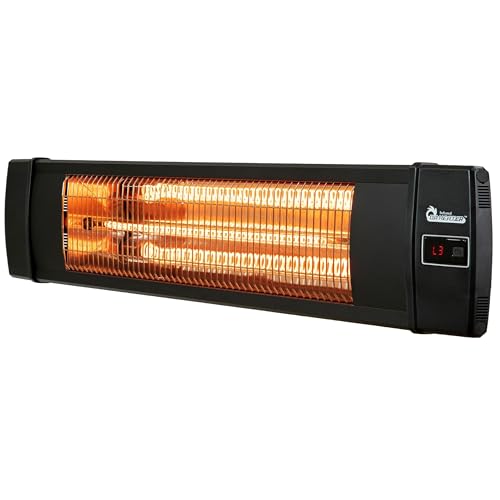
- Best overall for small patios: Dr. Infrared Heater DR-238 Carbon Infrared Heater, 1,500W — Check on Amazon
- Best tabletop for a bistro setup: Cuisinart Portable Tabletop Patio Heater, 11,000 BTU (COH-500) — Check on Amazon
- Best tower if the space honestly fits one: EAST OAK 48,000 BTU Patio Heater with Round Table Design — Check on Amazon
- Best value tower for a corner spot: Amazon Basics 46,000 BTU Outdoor Propane Patio Heater with Wheels — Check on Amazon
See 2 more options
- Dimplex DLW Series 1,500W Radiant Heater (DLW1500B12) — covered in prose below; we could not verify an Amazon ASIN for this model at checking time, so it appears without a link.
- Bromic Tungsten Smart-Heat Electric 2,000W — covered in prose below; recent listings for this hardwired heater have sat above this guide’s ceiling, so it appears without a link.
Read the full guide ↓
Disclosure: As an Amazon Associate, dailyhomedecorating.com earns from qualifying purchases. Links to Amazon on this page are affiliate links; they cost you nothing extra. Listing details such as price and availability change often, so check the current Amazon listing before you buy.
The search for the best outdoor heater for small patios under $700 starts with a liberating fact: a small patio does not need much heat, it needs the right heat in the right place. Two to four people, seated within a couple of metres of each other, in a space perhaps three metres by four — that is a modest warming job, and it is one the heater industry is oddly bad at selling, because modest jobs do not photograph as well as 91-inch towers. What a generous budget buys in a small space is not power. It buys placement freedom: a heater that mounts on the wall and consumes no floor, a tabletop unit that warms faces instead of the sky, materials and ignition that stay pleasant for years, and money left over for the furniture the warmth serves. Spend this tier on bigness and you will own a tower that crowds the door, violates its own clearances, and heats the neighbours’ airspace more than your chairs.
This guide compares six heaters through a small-patio lens, and it is deliberately stern about fit. Every pick is judged first on footprint, clearance honesty and storage, and only then on output. Four picks have verified Amazon listings at or under the ceiling and are linked so you can check price on Amazon. Two are covered in prose only, with the reasons stated — a wall-mount radiant panel we could not verify with an Amazon ASIN, and a hardwired premium fixture whose recent listings sat above the ceiling. Every pick was verified against manufacturer or major-retailer specifications and screened against U.S. Consumer Product Safety Commission recall notices for fire, burn, carbon monoxide and tip-over hazards; any model with an open recall was excluded entirely and is not named in this guide.
A measurement exercise runs through the whole guide, because small patios are where clearance rules go to be fudged. Before any pick can work, your space must give it what its manual demands — commonly at least three feet from combustible materials on the sides for towers, more above — while still leaving room for chairs, a table and a human path to the door. On many small patios, that arithmetic eliminates floor-standing propane entirely and crowns the wall-mounted electric picks, and this guide says so without apology. Where a tower genuinely fits — a corner with open sky, hard ground and honest clearances — it is here too, table and all. If your patio is small but your project is the whole outdoor setup, our Best Adirondack Chair For Small Patios Under $700 guide covers seating scaled to the same spaces, and the wider tier context is in our Best Outdoor Heater Under $700 guide.
In this guide
Quick Picks
| Pick | Best for | Type / fuel | Output | Where to check |
|---|---|---|---|---|
| Dr. Infrared Heater DR-238 | Best overall | Electric carbon infrared, 120V | 1,500W | Check price on Amazon |
| Dimplex DLW1500B12 | Best zero-glare mount | Electric radiant, 120V | 1,500W | Prose only — no ASIN verified |
| Cuisinart COH-500 | Best tabletop | Propane tabletop | 11,000 BTU | Check price on Amazon |
| EAST OAK 48,000 BTU | Best tower, if it fits | Propane tower with table | 48,000 BTU | Check price on Amazon |
| Amazon Basics 46,000 BTU | Best value corner tower | Propane tower | 46,000 BTU | Check price on Amazon |
| Bromic Tungsten 2,000W | Best hardwired premium | Electric, hardwired 240V | 2,000W | Prose only — recently above ceiling |
How These Picks Were Chosen
Small-patio selection inverts the usual order. We began with dimensions and clearances, not output: each candidate’s footprint, height and manual clearances were tested against a realistic small patio — roughly three by four metres, one door, one seating group, often a wall on one side and a railing or fence on another. Candidates that only fit such a space by ignoring their own manuals were excluded or explicitly demoted to “if it fits” status with the measurements stated. Storage was the second filter: a small patio usually belongs to a small home, so a heater that cannot live on a wall, on a shelf or under a cover in its own corner is a year-round tax on the space it was bought to improve. Output came third, and at this scale it nearly takes care of itself — any pick here can warm two to four seated people; the contest is over direction, placement and comfort, not capacity.
The standing verification rules of this series applied in full. A linked pick required a verified Amazon listing for the exact model and a recent price sighting at or under $700. Products verifiable as real but not as buyable in-budget listings stayed as labelled prose — in this guide, a dealer-channel panel with no verifiable ASIN and a hardwired fixture recently listed above the ceiling. Specifications came from manufacturers or major retailers; where sources disagreed on a figure, we used the manufacturer’s and recorded the disagreement in the sources file. All candidates were screened against CPSC recall records for fire, burn, carbon monoxide and tip-over hazards, and recalled models were excluded completely. We also refused a temptation specific to this brief: recommending a tower and quietly assuming the reader’s patio is bigger than “small.” If your measurements disagree with a pick’s requirements, the pick is wrong for you, whatever its other virtues — the guide repeats the relevant dimensions inside each review so the check takes seconds.
Best Outdoor Heater for Small Patios Under $700: The 6 Picks, Reviewed in Detail
Dr. Infrared Heater DR-238 Carbon Infrared Heater — Best Overall
Who it suits: Most small-patio owners: two to four people, fixed seating, a wall or beam available, and no desire to give a heater any floor.
The DR-238 wins this guide the way small spaces are usually won — by disappearing. It is a 1,500W carbon infrared bar on a 120V plug with three heat levels, a remote, a timer and an IP55 weather rating, and it mounts on the wall above your seating or stands on its feet when mounting is impossible. Mounted, its floor footprint is zero, its clearance problem reduces to the manual’s distances from the wall and ceiling, and its beam covers exactly the zone a small patio contains: the chairs. Infrared warms people directly, so the warmth arrives instantly and personally, with no flame, no exhaust, no tank stored in the corner, and no warm-up ritual. The remote matters disproportionately in a small space, where the heater is always within arm’s reach of the evening’s whole geography: heat adjusted from the chair is heat that gets used nightly, not just at gatherings.
Pros: Zero floor space when wall-mounted; no flame or fuel, so it suits covered small patios where towers fail their overhead clearance; IP55 rating handles exposed mounting; silent; the low price leaves most of the budget for scaled seating and storage — the things small patios actually lack.
Honest limitation: The beam is the boundary: anyone seated outside it feels little, so a sprawling or frequently rearranged layout defeats it. It needs a proper outdoor outlet within cord reach, and a heater on a light extension cord is a fire risk, not a workaround. One bar covers one small zone; a patio with two separate seating corners may eventually want two, which this budget, happily, allows.
Choose it if your seating is a fixed arrangement against a wall — the default small-patio shape. Skip it if your patio furniture migrates constantly or there is no suitable wall, beam or outlet.
Check on Amazon — check price on Amazon; a silver-finish variant exists under a separate listing.
Dimplex DLW Series Radiant Heater (DLW1500B12) — Best Zero-Glare Mount (Prose Only)
Who it suits: Small covered patios and loggias where a glowing infrared bar would visually dominate the space, and owners who want the heater to read as architecture.
The Dimplex DLW is a 1,500W, 120V radiant panel — DLW1500B12 in black — that mounts to a wall or ceiling and emits long-wave infrared with no visible glow: the panel warms, the people beneath warm, nothing shines. Its manufacturer’s coverage figures are the most honest in this guide — roughly 40 square feet indoors, about 32 in an enclosed outdoor space, about 26 exposed — which is to say, precisely one small patio’s seating zone, stated without inflation. At about 11 pounds it mounts easily, it is weatherproofed for outdoor use, and its 12.5-amp draw is the one electrical figure to check against an older patio circuit.
Pros: Zero-glare heat suits small covered spaces where light pollution from a bar would be constant; conservative, believable coverage claims; wall or ceiling mounting keeps every centimetre of floor; no flame or fuel.
Honest limitation: It is prose-only because we could not verify an Amazon ASIN for it at checking time; buy it through an electrical or heating retailer and search the exact model number. Its zone is honestly small — a two-to-four-person arrangement is the whole brief — and there is no freestanding option if mounting proves impossible.
Choose it if your patio is covered and the panel’s discretion suits it. Skip it if you want Amazon ordering or a heater that can move to a new spot each season.
This pick is prose-only: no Amazon link is provided because no ASIN could be verified at checking time. Search model DLW1500B12 at heating retailers.
Cuisinart Portable Tabletop Patio Heater (COH-500) — Best Tabletop
Who it suits: Bistro-table patios: two people, a small table, long coffees and longer dinners, in a space where the table is the whole world.
On a small patio, the tabletop format has a geometric elegance: the heater occupies the one surface that is already committed — the table’s centre — and delivers its 11,000 BTU at the height of the faces and hands around it. The COH-500 carries an anti-tilt auto shut-off and a burner screen guard, runs on a 1-lb cylinder for an evening or a 20-lb tank via adapter for a season, and stores on a shelf indoors, returning the patio to full size the moment it is put away. For renters and small-home owners, that storage profile is not a detail; it is the difference between a heater and a burden.
Pros: No floor footprint at all; heat at seated height; anti-tilt shutoff and burner guard fitted; stores on a shelf; portable to other venues; the adapter option fixes fuel economics for regular use.
Honest limitation: It is still a propane flame appliance: it needs its manual’s clearances from walls, overhangs and anything combustible, which some small patios — especially covered or balcony-like ones — cannot honestly give it, and local or building rules may prohibit it where they prohibit any fuel-burning heater. It warms the table only, and on 1-lb cylinders its fuel cost per hour is the highest here.
Choose it if your patio life is table-centred and open-air, with clearances that work on paper and in fact. Skip it if your space is covered, enclosed or rule-restricted — that is the electric picks’ territory.
Check on Amazon — check price on Amazon, and budget for the adapter hose for weekly use.
EAST OAK 48,000 BTU Patio Heater — Best Tower, If It Honestly Fits
Who it suits: The minority of small patios with a genuine tower spot: a corner on hard ground, open sky above, and a full clearance circle that still leaves the seating and the door path intact.
Where that spot exists, the EAST OAK is the tower to put in it, for a small-space reason: its round table design means the heater replaces a piece of furniture instead of merely adding an appliance. On a patio where every surface counts, a drinks table that also delivers 48,000 BTU earns its footprint twice. Tip-over and flame-failure protections are fitted, wheels allow seasonal repositioning, and the output — far more than a small zone needs — simply means the heater loafs at lower settings, where towers run quieter and longer per tank.
Pros: The table surface justifies the footprint in a way no plain tower can; strong output run at part-throttle is calm and long-lasting; full safety shutoffs; wheels for the seasonal shuffle small patios require.
Honest limitation: The measurements are unforgiving: roughly 91 inches tall plus the manual’s overhead clearance, and a side clearance circle — commonly at least three feet from combustibles — that consumes most of a genuinely small patio. If seating must squeeze past it, or the only spot is under a cover, it does not fit, and no enthusiasm changes that. Measure first; the returns process is not a sizing strategy.
Choose it if your corner, sky and clearances all honestly check out. Skip it if any one of them fails — the wall-mounted picks above were chosen for exactly your patio.
Check on Amazon — check price on Amazon after measuring, not before.
Amazon Basics 46,000 BTU Patio Heater — Best Value Corner Tower
Who it suits: The same fits-a-tower minority, spending less: a proven tower in the corner, and the rest of the budget on the patio itself.
The Amazon Basics tower offers the format’s essentials without premium cost: 46,000 BTU, a published 9-foot heating radius, a water- or sand-filled base reservoir for stability, piezo ignition, a tip-over shut-off valve and wheels, in powder-coated finishes including the Havana Bronze listing linked here. In a small patio its value compounds: the money it saves buys the correctly scaled seating, the cover that keeps a coated finish alive through wet winters, and the spare tank that keeps evenings unbroken. Its parts are generic and its foibles are the best-documented in the category, which suits an appliance that will be stored in tight quarters and serviced on a kitchen table.
Pros: Proven, repairable and inexpensive; honestly stated coverage radius; weighted base suits a hard corner; leaves the budget for everything else a small patio needs.
Honest limitation: Every tower caveat applies at full strength — height, overhead clearance, side clearances, hard level ground, filled base — and in a small patio each is more likely to fail than on a big one. The powder coat also needs its cover discipline in wet climates. Treat this review as conditional: the condition is your tape measure.
Choose it if a tower fits and value leads. Skip it if the fit is marginal; a marginal tower on a small patio is worse than no tower, because it consumes the space and the clearance budget while delivering arguments.
Check on Amazon — check price on Amazon; confirm the finish on the listing you open.
Bromic Tungsten Smart-Heat Electric 2,000W — Best Hardwired Premium (Prose Only)
Who it suits: Owners of small covered patios being built or renovated as permanent outdoor rooms, who want heat with literally no footprint and no storage, ever.
The Bromic Tungsten single-element fixture — 2,000W, hardwired at 240V, wall- or ceiling-mounted — is the commercial benchmark for overhead infrared, pushing focused radiant heat across a footprint of roughly 65 square feet, which is to say a whole small patio from a single fixture that occupies none of it. For a small covered space, that combination is theoretically perfect: silent, flameless, switched at the wall, immune to rearrangement. It is prose-only here for the reason stated wherever it appears in this series: recent listings for this model have sat above this guide’s $700 ceiling, and the fixture price is only the beginning — 240V hardwired installation is licensed electrical work, and the installed total will pass the ceiling in most cases.
Pros: Zero footprint with whole-patio coverage for small spaces; permanent and silent; commercial build and element support; no fuel, storage or seasonal handling at all.
Honest limitation: The true budget is the installed budget, and it exceeds this guide’s tier. It is fixed forever where it is mounted, useless to renters, and overkill — in cost, not comfort — for a patio that a plug-in bar would serve.
Choose it if you are building the covered patio as a permanent room and pricing the whole job. Skip it if the ceiling is real — the DR-238 delivers the same flameless, mounted concept at a fraction of the commitment.
This pick is prose-only: no Amazon link is provided because recent listings exceeded the guide’s ceiling at verification time. Price it through authorised dealers, installed, before budgeting.
Comparison Table
| Heater | Fuel | Output | Footprint | Safety highlights | Link status |
|---|---|---|---|---|---|
| Dr. Infrared DR-238 | Electric, 120V plug-in | 1,500W | Zero when wall-mounted | IP55 rating, timer, remote | Linked — check price on Amazon |
| Dimplex DLW1500B12 | Electric, 120V | 1,500W | Zero — wall/ceiling panel | Zero-glare, weatherproofed | Prose only — no ASIN verified |
| Cuisinart COH-500 | Propane, 1-lb or 20-lb via adapter | 11,000 BTU | Table surface only | Anti-tilt auto shut-off, burner guard | Linked — check price on Amazon |
| EAST OAK 48,000 BTU | Propane, 20-lb tank | 48,000 BTU | Tower plus clearance circle | Tip-over shutoff, flame-failure valve | Linked — check price on Amazon |
| Amazon Basics 46,000 BTU | Propane, 20-lb tank | 46,000 BTU | Tower plus clearance circle | Tip-over shut-off valve | Linked — check price on Amazon |
| Bromic Tungsten 2,000W | Electric, 240V hardwired | 2,000W | Zero — mounted fixture | No flame or fuel; fixed install | Prose only — recently above ceiling |
How to Choose an Outdoor Heater for a Small Patio
Measure first, and measure the right things. You need four numbers: the patio’s length and width, the height of any cover or overhang, and the size of the seating arrangement the heat must serve. Then take the candidate heater’s manual clearances — commonly at least three feet from combustible materials at the sides for towers, plus substantial overhead clearance — and draw the heater’s legal footprint on your patio, in chalk if necessary. If chairs, the door path and the heater’s circle cannot coexist on the drawing, they cannot coexist in life. This five-minute exercise is the entire secret of small-patio heating, and it is why this guide’s default recommendations are mounted and tabletop formats. Readers at lower budgets will find the same measurement-first logic in our Best Outdoor Heater For Small Patios Under $300 and Best Outdoor Heater For Small Patios Under $500 guides.
Prefer heat that aims. In a small space, directional infrared beats ambient power: a 1,500W beam on two chairs delivers more comfort than 48,000 BTU rising past them into the sky. Fixed seating is the small patio’s natural state, and aimed heat matches it perfectly. If your layout genuinely has two distinct seating spots, two small aimed sources — well inside this budget — beat one large omnidirectional one.
Count storage as a feature. Ask of every candidate: where does it live in January, and where does it live during the barbecue when it is off? Wall-mounted and panel heaters answer “nowhere.” The tabletop answers “a shelf.” Towers answer “in the way, unless there is a corner and a cover.” On a small patio, the honest answer to that question is worth more than any specification below it.
Spend the surplus on the space. The discipline of this tier is resisting the upgrade the space cannot use. A small patio heated by a mid-priced mounted bar, with the remainder spent on correctly scaled seating, a small storage piece and lighting, will host more comfortable evenings than the same patio dominated by a premium tower. The budget’s job is the evening, not the appliance — a principle the next tier up, surveyed in our Best Outdoor Heater For Small Patios Under $1500 guide, tests severely, because at that level nearly everything for sale is bigger than a small patio needs.
Respect the electrical reality. A 1,500W heater draws about 12.5 amps — most of a household circuit. Confirm the patio outlet is outdoor-rated and protected, keep connections dry, and never run a heater on a light extension cord threaded through a door. If no suitable outlet exists where the heater must go, the choices are an electrician, a tabletop propane unit where rules and clearances allow, or a different layout — in that order of preference.
Three Small Patios, Worked Through
The balcony-shaped patio: 2 by 3 metres, sliding door, two chairs, a bistro table. The most common small patio in the world, and the one towers were never designed for. Run the arithmetic honestly: a tower’s clearance circle alone would evict either the chairs or the table, and the door path crosses every possible position. The build that works is the DR-238 mounted on the wall above the chairs, aimed down at the two seats, with the bistro table unheated and unbothered — coffee stays warm from the cup, people stay warm from the beam. If the wall cannot take a mount, the Cuisinart on the bistro table is the alternative, provided the space is open-air and its clearances from the wall and door genuinely hold. Total floor surrendered to heating: none. That is what winning looks like at this size.
The covered terrace corner: 3 by 4 metres under a solid roof, sofa arrangement against the house. Coverage changes everything: towers fail on overhead clearance, and the contest becomes electric. The Dimplex DLW panel on the wall or ceiling above the sofa is the connoisseur’s build — zero glare, zero footprint, heat falling exactly on the arrangement. The DR-238 is the same idea at a lower price with a remote and a visible glow, and choosing between them is honestly an aesthetic decision, which this guide is comfortable saying. What neither needs is help: at this scale, a second source is money spent warming the same four cushions twice.
The ground-floor garden patio: 3.5 by 5 metres, open sky, paving, a fence corner. The one small patio where the full menu opens. The fence corner, sheltered from the prevailing breeze, can hold a tower with its clearances intact — and here the EAST OAK’s table earns its place, giving a patio with no room for a side table a surface at its centre. Alternatively, the disciplined build pairs the wall-mounted DR-238 over the bench with the Cuisinart on the table, covering both of the patio’s micro-zones for less total money and zero clearance anxiety. Both builds are right; the difference is whether the household’s evenings are tower evenings — standing, drifting, gathering — or seated ones. The patio cannot tell you. Your calendar can.
Notice what never appeared in any of the three builds: the biggest heater the budget allows, placed hopefully in the middle. Small patios reward the opposite instinct — the smallest sufficient heat, placed exactly, with the money and the space both left over for living.
What the Budget Buys at Small Scale
It is worth pausing on the economics, because an under-$700 ceiling in a three-by-four-metre space invites a particular waste: buying capacity the space cannot absorb. Heat for a small patio saturates quickly. Two people in a 1,500W infrared beam are as warm as physics lets them be; a second 1,500W aimed at the same chairs adds glare, not comfort. This is why the honest spend at small scale moves sideways instead of up — from output to placement (the mount, the bracket, the properly installed outlet), from placement to permanence (materials that survive the patio’s weather without a storage room), and from the heater to the heated life around it: chairs that fit the space, a table sized to it, lighting that makes the warm corner the inviting corner. A small patio done this way, for this budget, is not a compromised version of a big one. It is a finished room.
The counter-argument deserves its paragraph: some small patios belong to cold climates and tall people in thin jackets, and their owners reasonably ask whether a tower’s brute output, run from a legal corner, beats a beam. Sometimes, yes — a windy, open, genuinely cold small patio is the one case where surplus output earns its footprint, because the wind taxes every format and the tower has more to give after tax. The guide’s structure already honours that case: the towers are here, measured and caveated, not banned. What the budget never justifies at small scale is the combination of maximum output and minimum thought — the premium appliance bought because the money was there, heating a space that a tape measure would have described better than a brochure did.
Safety: Fire, Carbon Monoxide and Small-Space Discipline
Small patios concentrate every heater hazard, because everything — walls, furniture, people, the door — is close to the heat. Propane heaters produce carbon monoxide and belong only in open outdoor air: never indoors, in a garage, or in an enclosed or screened patio where exhaust can accumulate. On a small patio the clearance rule does the heavy lifting: keep any heater at least the manual’s specified distance from walls, furniture, cushions, plants and overhangs — treat three feet as a common minimum for towers, not a guarantee — and never place a heater where anyone must pass within arm’s reach of a hot surface, which on a small patio usually means not between the seating and the door. If anyone near a running propane heater feels headache, dizziness or nausea, turn it off and move to fresh air.
Electric heaters remove flame and exhaust but demand their own discipline: outdoor-rated outlets, dry protected connections, cords routed where feet and chair legs cannot damage them, and the heater off when the evening ends — the timers on the electric picks here are a genuine safety feature in a space you can cross in three steps. Tanks, where propane is used at all, live upright and outdoors, never inside the home; connections get a soapy-water leak test at every swap; and every heater cools fully before a cover goes on. The tip-over shutoffs fitted across this guide are backstops. In a small space, the plan is placement — measured, chalked and respected.
Common Buying Mistakes
Buying the tower because the budget allowed it. The defining small-patio mistake. A 91-inch tower plus its clearances can consume half a small patio and still fail its overhead rule under a cover. The budget permitting a thing is not the space permitting it.
Fudging clearances “just a little.” Clearances are the manufacturer’s tested distances, not aspirations. A heater that only fits by shaving them does not fit; choose the format that fits honestly — mounted, panel or tabletop.
Heating the sky. Tower heat rises past seated people before radiating down; in a small space with fixed seating, aimed infrared at the chairs is worth more than triple the nominal output pointed at the neighbourhood.
Forgetting January. A heater with no storage answer becomes patio furniture of the worst kind — tall, fragile and in the way — for the two-thirds of the year it is not running.
The extension-cord solution. A continuous 12-amp load on a light cord, pinched in a door, is how small patios have big fires. Use the real outlet, install one properly, or change heater type.
Skipping the recall check. Fire, gas-leak and tip-over recalls recur in this category. Verify your exact model against CPSC records before purchase and each season — two minutes, every time.
Final Recommendation
For most small patios, mount the Dr. Infrared DR-238 above the seating and be done: zero floor space, instant aimed warmth for the two-to-four-person zone a small patio actually is, no fuel or flame to manage, and most of the under-$700 budget released to the seating and storage that will improve every evening, heated or not. Choose the Dimplex DLW through a heating retailer if the patio is covered and zero glare matters. Add the Cuisinart tabletop if your evenings live at a bistro table in the open air. Admit a tower — the EAST OAK for its furniture-earning table, the Amazon Basics for value — only when your chalk drawing says it fits with clearances intact, and treat the Bromic as the benchmark for a permanent covered build whose true installed cost will pass this tier. The small patio’s secret is that it was never asking for much heat. It was asking for heat that fits — measured, aimed and out of the way. Spend accordingly, and if the wider comparison helps, our Best Outdoor Heater Under $500 guide covers the mid-tier mounted options that pair well as a second source.
Frequently Asked Questions
What is the best heater type for a small patio?
A wall-mounted electric infrared heater, for most small patios. It uses no floor space, aims its heat at fixed seating, produces no flame or exhaust, and sidesteps the overhead-clearance failure that rules out tall towers under covers. A tabletop propane unit is the strong alternative for open-air, table-centred patios.
Can a small patio fit a full-size patio tower?
Sometimes — a corner on hard, level ground, open sky above, and the manual’s full clearance circle coexisting with your seating and door path. Measure all of it before ordering: tower height is around 91 inches before overhead clearance, and side clearances commonly start at three feet. If any element fails, the honest answer is a mounted or tabletop heater.
How much power does a small patio actually need?
Less than marketing suggests. Two to four seated people inside a 1,500W infrared beam are genuinely warm; a tabletop’s 11,000 BTU at table distance feels generous. What small patios need is aim and placement, not capacity — which is why this guide spends its budget on format rather than output.
Are tabletop heaters safe on a small patio?
With discipline, yes: the COH-500’s anti-tilt shut-off and burner guard are real protections, but it remains an open-flame appliance needing its manual’s clearances from walls, overhangs and combustibles — and on covered or enclosed small patios, or where rules prohibit fuel-burning heaters, the answer is an electric pick instead.
Where do I store a heater for a small patio?
Mounted electric heaters store in place — their decisive advantage. A tabletop unit stores on an indoor shelf, with its propane cylinder stored upright outdoors, never inside. A tower needs a corner and a fitted cover, cooled fully before covering; if no corner exists, that is the space voting against the tower.
Can I use a pyramid flame heater on a small patio?
Almost never, and this guide excluded it from the picks for that reason. A pyramid is roughly 91 inches tall, needs the same overhead and side clearances as a tower, and delivers its gentle warmth in a small radius — the worst ratio of space consumed to comfort delivered of any format, in the one context where space is the scarcest resource. If the flame is what you want, a tabletop fire feature sized to the table is the proportionate answer; the pyramid belongs on patios with room to admire it from.
What if my small patio has no outdoor outlet?
Then the electric picks need help before they need buying. The legitimate routes are: have an outdoor outlet installed by an electrician (with landlord or HOA permission where applicable), or choose the tabletop propane pick if your space is open-air, your clearances hold and no rule prohibits fuel-burning appliances. The illegitimate route — a light extension cord through a door or window, under a rug, across a walkway — is a fire and trip hazard carrying a continuous heavy load, and no heater in this guide should ever be run that way.
Can I just use a small fire pit instead of a heater?
You can, and on an open-air small patio many households do — but know the trade. A fire pit warms by radiation in a small circle and gives real flame, at the cost of smoke that drifts exactly where people sit, sparks that small spaces cannot dilute, ash and wood storage, and frequently stricter local or building rules than any appliance in this guide. Its heat is also the least controllable here: no levels, no timer, no off switch. As a deliberate ambience choice it is legitimate; as a heating appliance for a small patio, every pick in this guide outperforms it on control, cleanliness and neighbour relations.
Do electric patio heaters work in the rain?
The heater can; the evening usually cannot. The DR-238 carries an IP55 weather rating and the Dimplex DLW is weatherproofed for outdoor mounting, so both tolerate rain exposure as equipment, provided connections stay protected and the manufacturer’s mounting instructions are followed. But infrared heat does not make a rainy patio comfortable — it warms wet people efficiently. The realistic use of the rating is shoulder-season drizzle under a cover and survival of weather between uses, not hosting through a downpour.
Is a hardwired heater worth it for a small patio?
Only as part of a permanent covered build, priced as an installed job. The fixture’s recent listings already sit above this guide’s ceiling before the electrician, and a plug-in mounted bar delivers the same zero-footprint concept for a fraction of the total. For a permanent outdoor room, it is the benchmark; for every other small patio, it is the exception that proves the budget rule.
To close with the perspective the whole guide argues for: a small patio is not a failed big patio. It is a room with a low ceiling of sky, and rooms are furnished by fit, not by force. The heaters that respect that — mounted, aimed, tabletop, or honestly measured into a corner that can hold them — will make the space feel larger every evening they run, because nothing in it is fighting for room. That feeling, repeated across a season, is what this budget is actually buying.
If you take one tool from this guide to the shops, make it the tape measure rather than the budget. Measure the patio, the cover height, the seating, the door’s swing; write the candidate’s clearances beside your numbers; and let that single page of arithmetic choose the format before any brand is discussed. Small patios decided that way almost never produce returns, regrets or scorched cushions — and the heater that survives the arithmetic will feel, every evening, as though the patio had been designed around it.
And a last reassurance for readers whose measurements ruled out the heater they wanted: that outcome is the guide working, not failing. Every format excluded by your patio’s arithmetic is represented here by the format your arithmetic crowned, and the evenings ahead — warm, uncramped, unworried — will not miss the appliance that never belonged in the space.


