Disclosure: As an Amazon Associate, dailyhomedecorating.com earns from qualifying purchases. Links to Amazon on this page are affiliate links; they cost you nothing extra. Prices and availability change often, so check the current Amazon listing before you buy.
Finding the best office chairs for 400 lbs is harder than it should be, because most office chairs quietly top out at 250–300 lb and the ones that go further rarely say so clearly. If you need a chair honestly rated at or near 400 lb, you are shopping for reinforced frames, wider seats, stronger gas lifts and bases that do not flex — and you deserve listings that state the number instead of hinting at it. This guide is blunt about that: only one chair in our verified pool states a 400 lb limit, so it leads the list as a linked pick, and the remaining five picks are prose-only heavy-duty archetypes described qualitatively, with exactly what to verify on any listing before you buy.
That honesty matters more than a long link list. A chair that fails under daily use is not a bargain at any price, and big-and-tall seating is precisely where marketing adjectives (“sturdy,” “heavy duty”) substitute for engineering. Below you will find the one verified 400 lb chair, the archetypes that genuinely serve this need, and a buying guide that teaches you to audit any chair’s capacity claim in two minutes. For adjacent needs, see Best Office Chairs For Large People and Best Office Chairs For Long Term Sitting; for room context, Best Sofas For Older Adults covers supportive seating beyond the desk.
Where to Buy
The verified linked pick in this guide is sold on Amazon, where you can check the current price and availability: the FLEXISPOT ErgoX Premium Ergonomic Office Chair — Check on Amazon. The other five picks are prose-only by design: they describe real heavy-duty chair types you can search for on Amazon, but we do not link a specific listing whose 400 lb rating we could not verify in our pool data.
In this guide
Quick Picks
| Pick | Badge | Why it earns its place |
|---|---|---|
| FLEXISPOT ErgoX Premium Ergonomic Office Chair | Best Overall | The only pool chair with a stated 400 lb maximum, plus dynamic lumbar support, a 3D headrest and a nap footrest. |
| Steel-Frame Big-and-Tall Executive Chair (prose-only) | Best Executive Style | The classic reinforced executive archetype — wide padded seat, steel base, high back — for a traditional office look. |
| Heavy-Duty Mesh Task Chair, 400 lb Class (prose-only) | Best Breathable | Reinforced mesh chairs built on steel frames for hot rooms and long days. |
| Wide-Seat Guest/Operator Chair with Fixed Arms (prose-only) | Best for Shared Desks | Simple, overbuilt operator chairs that survive hot-desking and shared workstations. |
| Big-and-Tall Gaming Chair, Steel Frame (prose-only) | Best for Work and Play | Bucket-seat gaming chairs in their reinforced big-and-tall variants, with recline and footrest options. |
| Heavy-Duty Drafting Stool, 400 lb Class (prose-only) | Best for Standing Desks | Tall, reinforced stools for sit-stand workstations where a standard chair cannot reach. |
Key Takeaways
- Trust only a stated, numeric capacity on the listing — the FLEXISPOT ErgoX states 400 lb; adjectives like “heavy duty” without a number are not a rating.
- Seat width matters as much as capacity: look for roughly 22 inches or more between the arms for comfortable all-day sitting.
- A metal (steel or aluminum) base and a class-4 gas lift are the hardware signatures of chairs honestly built for this class.
- Prose-only picks below are real chair types, not links — use the audit checklist in the buying guide to verify any specific listing’s rating before purchase.
- Leave headroom: a chair rated exactly at your weight will wear faster than one rated comfortably above it.
How These Picks Were Chosen
The filter for this keyword was the strictest in our chairs program: a linked pick had to state a maximum weight of 400 lb in its own verified listing data. Exactly one chair in the pool cleared that bar. Rather than pad the list with 275–330 lb chairs and hope nobody noticed — the usual trick in this category — we linked the one honest match and completed the six with prose-only archetypes: real, searchable chair types that manufacturers do build in 400 lb classes, described by their construction signatures so you can recognize a genuine one. Each archetype entry tells you which numbers and materials to confirm on the listing page before buying.
What got filtered out: every standard ergonomic chair in the pool rated 300 lb or below, however good it is for other readers (several appear in Best Office Chairs For Back And Neck Support, where they belong). Also filtered: chairs whose capacity appears only in review comments or Q&A answers rather than the manufacturer’s own data. Comfort throughout this guide is discussed as comfort and fit only, never as medical advice. If your needs overlap with a home-office build-out, Best Sofas For Homes With Kids is a reminder that the whole household’s seating deserves the same verify-first approach.
The 6 Best Office Chairs for 400 Lbs — Reviewed

FLEXISPOT ErgoX Premium Ergonomic Office Chair
Our badge: Best Overall
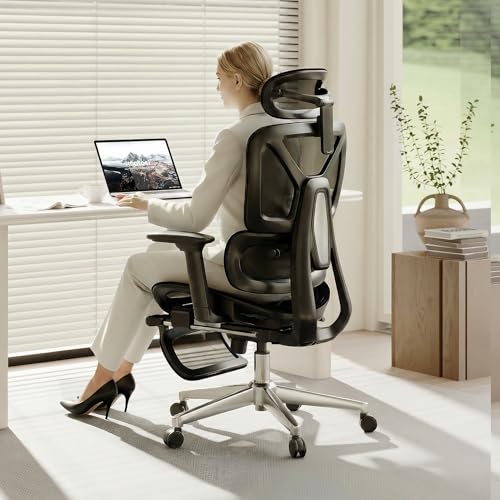
The FLEXISPOT ErgoX Premium Ergonomic Office Chair earns the lead here on a single decisive fact: its listing states a maximum weight limit of 400 lb, for users between 5’1″ and 6’2″. Around that rating it builds a genuinely premium ergonomic package — dynamic lumbar support, a five-level adjustable back, a 3D adjustable headrest, 3D armrests, adjustable seat depth from 17 to 20 inches, and a nap footrest, all on a class-4 gas lift.
Strengths
- Stated 400 lb maximum weight limit — the verified rating this entire keyword turns on.
- Dynamic lumbar support and a five-level back height adjustment fit a wide range of torso lengths.
- Seat depth adjusts from 17 to 20 inches, so larger users can set real thigh support instead of perching.
Trade-offs
- The stated fit range tops out at 6’2″; taller users should look at the big-and-tall archetypes below.
- It is the premium option in this guide — check the current listing price against your budget.
- Mesh and foam seat variants exist; confirm which configuration the current listing describes.
| Color | Black |
| Weight | 38 pounds |
In daily use, the ErgoX’s advantage is that its adjustments actually span the ranges larger bodies need. The lumbar support moves with you rather than pressing at one fixed point, the headrest adjusts in three dimensions to meet the back of your head instead of your shoulder blades, and the footrest turns the chair into a legitimate break seat between tasks. The tilt and recline functions let you shift position through the day, which matters more, the longer each sitting session runs. FLEXISPOT positions it for office, bedroom and gaming-room use, and the build — premium materials, class-4 lift — matches that ambition. If you buy one chair from this page, this is the one whose rating we could verify end to end.
Best for: Anyone who needs a stated 400 lb rating plus full ergonomic adjustment / Not suited for: Users taller than about 6’2″ or those who prefer a wide executive-style padded seat
Choose it if you want the verified rating and modern ergonomics in one chair; skip it if you are very tall or want a traditional executive look — read the archetypes below first. Check on Amazon
Steel-Frame Big-and-Tall Executive Chair (Prose-Only)
Our badge: Best Executive Style
The big-and-tall executive chair is the oldest honest answer to this keyword: a wide, deeply padded seat and high back, bonded leather or fabric upholstery, and — in the genuine versions — a steel-reinforced frame and metal base under the padding. We describe it prose-only because our verified pool contains no executive chair with a stated 400 lb rating, and linking a 300 lb chair here would betray the entire point of the guide.
Strengths
- The widest, most cushioned seats in the category — the archetype is designed around generous proportions.
- A traditional executive look that suits formal offices and client-facing rooms.
- Simple mechanisms (tilt, lock, height) mean fewer parts to fail under load.
Trade-offs
- Padded upholstery sleeps warm and offers less airflow than mesh on long days.
- Padding compresses over years of use; dense foam quality varies enormously between brands.
- Many look-alike chairs borrow the style without the reinforced frame — the stated rating is the only tell.
What to verify on any listing: a numeric capacity of 400 lb or more in the manufacturer’s specifications (not the Q&A), a metal base in the materials list, a seat width of roughly 22 inches or more, and a warranty that does not exclude commercial or heavy use. Real versions of this archetype are sold by established office-furniture brands with big-and-tall lines; if a listing hides its capacity behind the word “sturdy,” keep scrolling. Set up with the seat height so your feet rest flat and the arms clear your desk, this style remains the comfort-first choice for readers who dislike mesh.
Best for: Traditional offices and readers who prefer deep padding to mesh / Not suited for: Hot rooms or anyone who cannot verify a numeric rating on the listing
Choose this archetype if you find a listing that states its 400 lb class plainly; skip any version that will not commit to a number.
Heavy-Duty Mesh Task Chair, 400 lb Class (Prose-Only)
Our badge: Best Breathable
Mesh is the material heavy users in warm rooms ask for, and manufacturers do build reinforced mesh task chairs in the 400 lb class: steel or aluminum bases, reinforced mesh tensioned over metal frames, and seat pans rated for the load. We describe the archetype prose-only because the mesh chairs in our verified pool state lower limits (275–330 lb), and presenting one of them here would mislabel its rating.
Strengths
- Airflow that padded chairs cannot match — the difference is obvious by hour three.
- Reinforced mesh holds its tension and shape better than budget foam holds its loft.
- A professional, low-profile look that suits shared and client-facing offices.
Trade-offs
- True 400 lb class mesh chairs are a niche — expect a smaller selection and longer comparison shopping.
- Mesh seat variants can feel firm; some users add a cushion, which changes the rated geometry.
- Frame-reinforced models are heavier to move and assemble.
Verification checklist for this archetype: the capacity stated in the manufacturer’s spec block; a base described as steel or aluminum rather than nylon; a seat width figure, not just overall width; and mesh described as reinforced or high-tension. Set the lumbar support into the small of your back and keep the seat height so your feet are flat — at higher loads, a footrest or correct height matters for circulation comfort during long sits. If a listing for a mesh chair will not state its class, treat it as a 250 lb chair regardless of its photographs.
Best for: Warm rooms and long daily hours where airflow is non-negotiable / Not suited for: Anyone who prefers a deeply cushioned, executive-style sit
Choose this archetype when you find a listing that states its rating and base material plainly; skip vague listings entirely.
Wide-Seat Operator Chair with Fixed Arms (Prose-Only)
Our badge: Best for Shared Desks
Operator chairs — the simple, overbuilt seats used at shared workstations, dispatch desks and training rooms — are an underrated answer for heavy-duty needs. In their big-and-tall variants they pair a wide seat with fixed loop arms, a steel five-star base and minimal mechanisms, which is exactly the recipe for surviving multiple users and daily abuse. We cover the type prose-only; no pool listing states this archetype in a verified 400 lb class.
Strengths
- Few moving parts means few failure points — the durability strategy is simplicity.
- Fixed arms cannot wobble loose the way budget adjustable arms do.
- Wide seats and upright geometry suit shared, short-to-medium duration sitting.
Trade-offs
- Fixed arms fit some bodies and desks poorly; measure arm height against your desk underside.
- Minimal recline — these chairs are for working, not lounging.
- Utilitarian looks; this is equipment, not décor.
When auditing a listing, look for the same signatures: numeric 400 lb class capacity, metal base, seat width at or above roughly 22 inches, and a commercial-use mention in the warranty. These chairs are often sold through office-supply channels under contract-furniture brands, and their listings tend to be refreshingly plain about specifications. For a home office that doubles as a household workstation used by several family members, that plainness is a feature.
Best for: Shared workstations, training rooms and durability-first buyers / Not suited for: Anyone who wants recline, a headrest or a styled look
Choose this archetype for multi-user reliability; skip it for a personal all-day chair, where the ErgoX’s adjustability wins.
Big-and-Tall Gaming Chair, Steel Frame (Prose-Only)
Our badge: Best for Work and Play
Gaming chairs are built for long sessions, and the major gaming brands sell big-and-tall variants with steel frames, wider bucket seats and higher stated capacities than their standard models. The archetype is real and popular; we keep it prose-only because the gaming chairs in our verified pool state limits of 275–300 lb, below this keyword’s bar, and their standard-size seats run narrower than big-and-tall users need.
Strengths
- High backs with headrest pillows suit users who sit through work and gaming in one chair.
- Recline ranges are generous, and footrest models exist in the archetype.
- Big-and-tall variants widen the seat and raise the capacity in one step.
Trade-offs
- Standard gaming chairs are narrower than they look — only the explicit big-and-tall variants qualify here.
- PU leather upholstery runs warm and needs gentle care.
- Bolstered bucket seats restrict cross-legged and side sitting positions.
To buy this archetype safely, shop the variant, not the model line: the listing title or spec block should say big and tall (or XL) and state a capacity in the 400 lb class, with a steel frame in the materials. Check the seat width between bolsters, not the overall chair width, and confirm the gas lift class. Done right, this is the most entertaining chair in the guide; done by guessing, it is the most common disappointment in the category. Readers who game at a desk all evening may also enjoy the crossover picks in Best Office Chairs For Computer Work.
Best for: Gamers who need the big-and-tall variant and want recline plus style / Not suited for: Anyone buying the standard-size version and hoping it stretches
Choose the verified big-and-tall variant or do not choose this archetype at all — there is no safe middle option.
Heavy-Duty Drafting Stool, 400 lb Class (Prose-Only)
Our badge: Best for Standing Desks
Standing-desk users sit high, and standard chairs cannot follow a desk to counter height. Heavy-duty drafting stools solve this with extended gas lifts, a foot ring and reinforced bases, and they are manufactured in 400 lb classes for lab, studio and workshop use. No pool product matches this type, so it is prose-only — included because sit-stand workers are a real slice of this keyword’s audience and are poorly served by standard-chair lists.
Strengths
- Seat heights that meet standing desks and counters where normal chairs cannot reach.
- Foot rings give tall sitting a place for your feet, keeping posture sustainable.
- Compact footprints suit studios, labs and workshop benches.
Trade-offs
- Backrests are small or absent — this is perch-and-work seating, not all-day lounging.
- Tall lifts amplify any base weakness; the metal-base rule matters even more here.
- Foot rings need adjustment to your leg length to be comfortable.
Verify the extended lift’s stated class, the base material and the foot ring’s adjustability on any listing, and confirm the maximum seat height reaches your desk’s sitting position with your feet supported by the ring. Used in rotation with standing, a good drafting stool makes a sit-stand setup genuinely usable at this weight class instead of a standing-only compromise.
Best for: Sit-stand desk users, studios and workshops / Not suited for: Anyone wanting a full backrest and recline for long seated sessions
Choose it as a companion to a standing desk; skip it as your only chair if you sit more than you stand.
Comparison Table
| Pick | Type | Capacity Evidence | Seat Style | Check price on Amazon |
|---|---|---|---|---|
| FLEXISPOT ErgoX | Ergonomic office chair | 400 lb stated in listing | Mesh/foam, adjustable depth | Check price on Amazon |
| Big-and-Tall Executive (prose-only) | Executive chair | Verify 400 lb class on listing | Wide padded | Check price on Amazon |
| Heavy-Duty Mesh Task (prose-only) | Mesh task chair | Verify 400 lb class on listing | Reinforced mesh | Check price on Amazon |
| Wide-Seat Operator (prose-only) | Operator chair | Verify 400 lb class on listing | Wide, fixed arms | Check price on Amazon |
| Big-and-Tall Gaming (prose-only) | Gaming chair | Verify XL variant rating | Bucket, high back | Check price on Amazon |
| Heavy-Duty Drafting Stool (prose-only) | Drafting stool | Verify 400 lb class on listing | Tall, foot ring | Check price on Amazon |
How to Choose an Office Chair Honestly Rated for 400 Lbs
Demand the number in the manufacturer’s own data
The single most important habit in this category: find the capacity in the manufacturer’s specification block, not in a review, a Q&A answer or a headline adjective. Listings that state “400 lbs” in their specs — as the FLEXISPOT ErgoX does — can be held to it. Listings that say “heavy duty” and nothing else are asking for your trust without offering evidence.
Read the base and lift like an engineer
At this class, the base should be steel or aluminum and the gas lift class 4. Nylon bases and class-2 or class-3 lifts belong to lighter chairs. These two lines in a spec sheet predict more about a chair’s survival than any photograph of its padding, a principle that also separates the durable picks in Best Office Chairs For Large People from the merely wide ones.
Measure seat width between the arms
Overall chair width flatters; the number that matters is the clear width between armrests and, for bucket seats, between bolsters. Around 22 inches or more gives most larger users room to sit naturally rather than perched. If a listing will not publish a seat width, treat that silence as information.
Leave headroom above your weight
A rating is a maximum, not a target. A chair rated 400 lb used daily by a 400 lb person lives at its limit; where possible, choose a rating comfortably above the heaviest regular user. Headroom buys years of service and a firmer, quieter chair throughout them.
Check the warranty’s fine print
Some warranties shrink or vanish for users above a stated weight or for commercial use. Read the warranty summary on the listing before purchase, and favor brands that publish big-and-tall support channels — they expect your questions and have engineered for them.
How Do You Set Up a Heavy-Duty Office Chair?
Assemble on a firm, clear floor and torque every bolt fully — under-torqued fasteners are the top cause of early wobble at any weight, and the stakes are higher here. Set the seat height so feet rest flat with knees near 90–100 degrees; use a footrest if the desk height forces the chair higher. Position lumbar support in the small of the back, set armrests to support forearms without lifting your shoulders, and confirm casters suit your flooring. Re-check bolt tightness after the first week of use, and again quarterly — a two-minute habit that keeps a heavy-duty chair feeling new.
Problem: The chair creaks when you shift position — re-torque base and mechanism bolts first; persistent creaks after that warrant a warranty conversation, not lubricant experiments.
Problem: The seat feels like it tilts forward — check that the gas lift is fully seated in the base and mechanism, and that the floor is level; a rug edge under one caster is a common culprit.
Problem: Armrests dig into your thighs — the seat is too narrow for the arm spacing; width-adjustable arms or a wider model are the fix, not posture willpower.
Problem: Casters chew up the floor — switch to flooring-appropriate casters or add a heavy-duty chair mat rated for higher loads.
Why So Many Chairs Stop at 300 Lbs
The 250–300 lb plateau is an artifact of standard testing and standard components: common gas lifts, nylon bases and seat foams are certified in that band, and most buyers fit inside it. Building honestly beyond it requires upgraded lifts, metal bases, reinforced mechanisms and wider tooling — real costs that many brands skip while borrowing the “big and tall” label for styling. That is why verified 400 lb chairs are rare, why this guide links only one, and why the audit skills in the buying-guide section are worth more than any single recommendation: they let you evaluate next year’s models with the same rigor. The category is slowly improving as major brands formalize big-and-tall lines, and the listings that state their numbers plainly are the ones driving it.
Comfort Strategies for Long Days at Higher Loads
Fit is the first strategy: a chair at the right height, with lumbar support placed correctly and armrests that meet your forearms, distributes load the way its designers intended. Movement is the second: use the tilt, shift position hourly, and stand regularly — comfort over a long day is a rhythm, not a posture frozen at 9 a.m. The third is the environment: a supportive foot position, a desk at elbow height and a screen at eye level do as much for end-of-day comfort as the chair itself. None of this is medical advice; it is the practical ergonomics every seating maker in this guide builds around, and it is explored from the posture side in Best Office Chairs For Comfort And Posture.
Measuring Yourself for a Big-and-Tall Chair
Catalog dimensions only help if you know your own. Four personal measurements turn chair shopping from guesswork into matching. First, seat height: sit in a firm dining chair with feet flat and measure from the floor to the back of your knee — your office chair’s seat should adjust to roughly that height, an inch lower at most. Second, seat depth: measure from the back of your hip to the back of your knee while seated; the chair’s seat depth should be about two inches shorter, so the edge does not press into your calves. The ErgoX’s 17-to-20-inch adjustable depth exists precisely because this number varies so much between bodies.
Third, seat width: measure your hip width across the widest point while seated, then add at least two inches of clearance — that is your minimum clear width between armrests. Fourth, back height and lumbar position: note where the curve of your lower back sits above the seat of your dining chair, and compare it with the lumbar adjustment range of any chair you consider; a support that cannot reach your curve is decoration. Torso length, not overall height, decides headrest fit, which is why two people of the same height can disagree completely about the same chair.
Armed with those four numbers, a listing’s spec sheet becomes a yes-or-no document in under a minute. This is also the honest way to shop the prose-only archetypes in this guide: the executive, mesh, operator, gaming and drafting types all publish these dimensions in their genuine big-and-tall versions, and the match — or mismatch — will be obvious. If a listing withholds any of the four dimensions, that is your answer about the listing, if not about the chair.
Two of those measurements deserve emphasis because they are the ones buyers most often guess. Seat depth is the silent fit-killer: a seat even an inch too deep pushes you into a slouch as your back leaves the lumbar support to let your knees bend, and no amount of lumbar adjustment compensates. If you fall between sizes, a chair with adjustable depth — again, the ErgoX’s party trick — resolves the dilemma outright. Arm height is the other guess: arms set too high lift your shoulders toward your ears all day, while arms too low are simply furniture you carry around. Width-adjustable arms, common on genuine big-and-tall models and rare on standard chairs wearing the label, solve both the width and the height problem for shared chairs, and their presence on a listing is one more quiet sign of a manufacturer who actually designed for this category.
When One Chair Is Not the Whole Answer
Some heavy-duty seating needs are really two needs wearing one coat. A worker who sits eight hours and then games for three asks one chair to be both an upright task seat and a recliner; the ErgoX’s footrest and tilt make it a credible single answer, but a two-piece strategy — a supportive task chair for work hours plus a sturdy recliner or lift chair for the evening — can serve both halves better and spread wear across two frames. Households where two people of very different sizes share one desk have the same shape of problem: a chair adjusted daily between extremes wears its mechanisms faster, and a second, simpler operator-style chair often pays for itself in the first chair’s extended life.
Budget honestly for this. Two mid-priced chairs bought for distinct jobs usually outlast and out-comfort one expensive compromise, and they remove the nightly negotiation about whose settings the chair is on. The principle generalizes beyond this category — it is the same reason the deck guide elsewhere in our chairs coverage pairs a fixed lounger with a portable one rather than asking either to be everything. Buy for the jobs you actually have, verify each chair’s rating for the person who will use it, and let specialization do the work that adjectives cannot.
Casters, Floors and Heavy-Duty Chairs
At higher loads, the five small wheels under the chair stop being an accessory and become a wear surface. Standard twin-wheel casters concentrate load on narrow contact patches, which is why heavy-duty chairs on hardwood or laminate can leave tracks that lighter chairs never would. The fixes are well understood: soft-tread casters designed for hard floors spread the contact and roll quieter; a chair mat rated for higher loads protects both the floor and the caster bearings; and on carpet, larger-diameter wheels roll with noticeably less effort, which matters across a full day of small movements. When you audit a listing, check whether the manufacturer names a caster type or floor pairing — the same verify-first habit as the capacity itself.
Rolling resistance is also a comfort issue. A chair that needs a shove to move trains its user to twist at the waist instead of rolling and turning, and over months that habit is its own source of end-of-day stiffness. Test your setup in the first week: you should be able to roll from desk to printer and back with a gentle push. If you cannot, the casters or the floor — not your posture — are the first suspects, and both are cheap to change relative to the chair. This is ordinary comfort ergonomics, offered as practical setup guidance rather than medical advice.
Warranties and Support: Reading the Fine Print That Matters
A heavy-duty chair’s warranty is part of its specification, and in this category it deserves the same two-minute audit as the capacity number. Look for four things. First, duration by component: frame and base warranties should run longest, mechanisms and lifts in the middle, upholstery and foam shortest — a single blanket duration for everything usually means the shortest interpretation wins. Second, weight language: some warranties quietly cap coverage at a user weight below the chair’s marketed capacity, and that clause, not the headline number, is the real rating. Third, parts availability: brands that sell or ship replacement lifts, bases and arm pads turn a year-four failure into a repair instead of a replacement. Fourth, the support channel itself — a named service team with published contact routes, of the kind FLEXISPOT and the other established brands in our wider chairs coverage maintain.
Keep the paperwork. Save the order confirmation, the listing’s specification page and the warranty summary somewhere you can find them in three years; screenshots are fine. When something does fail, a claim that begins with the model, the purchase date and a photograph of the failed part is usually resolved in days, while a claim that begins with a search through old email often dies of neglect. None of this is glamorous, but in a category where the honest products distinguish themselves precisely by standing behind their numbers, the warranty file is where that promise either materializes or evaporates.
A Two-Minute Listing Audit, Worked Step by Step
Here is the audit this guide keeps recommending, slowed down into a routine you can run on any chair listing in about two minutes. Minute one is the specification block. Find the capacity figure: if it is absent, stop — the chair is a standard-class chair whatever its photographs suggest. Note the base material and the gas lift class; you want metal and class 4 for this category. Note the seat width and depth as published, and be alert to listings that publish overall dimensions only, a classic way to make a narrow seat sound generous. If the manufacturer publishes a suitable height range, check it against your own height honestly rather than hopefully.
Minute two is the corroboration pass. Read the warranty summary for weight caps and component durations. Scan the manufacturer’s own answers in the Q&A section — brands that engineer for this class answer capacity questions directly, while resellers of generic chairs deflect them. Look at the lowest-effort photographs: buyer photos of the base and mechanism tell you more about construction than studio shots of the upholstery. Finally, compare the chair against the one verified benchmark in this guide — the ErgoX’s published figures — and ask whether the listing you are reading offers the same level of specificity. Specificity is the tell. Manufacturers who have done the engineering publish the numbers; manufacturers who have done only the styling publish adjectives. In a category where a failure is not an inconvenience but a fall, that distinction is the entire purchase, and two minutes is a small price for it.
Common Buying Mistakes
Trusting “heavy duty” without a number
The phrase has no standard meaning. If the listing does not state a capacity in its specifications, assume the standard 250 lb class regardless of the chair’s size in photographs.
Confusing a wide seat with a strong chair
Width and strength are different specifications. A wide chair on a nylon base with a light lift is a wide chair that will fail early; check both the seat width and the hardware.
Buying exactly at your weight
Maximum ratings assume occasional peak loads, not a permanent working load. Headroom is the cheapest durability you can buy in this category.
Ignoring arm and desk clearance
Big-and-tall chairs are bigger in every dimension. Measure the desk opening and the room’s turning space, or the strongest chair in the world becomes a daily frustration.
Skipping the bolt re-check
Heavy-duty chairs settle under load in their first weeks. The five-minute re-torque in the setup section prevents the wobble-and-creak spiral that owners misread as a defective chair.
Final Recommendation
The verified choice is the FLEXISPOT ErgoX Premium Ergonomic Office Chair: a stated 400 lb limit, dynamic lumbar support, a 3D headrest and an adjustable seat depth in one modern package. If its style or fit range does not suit you, the runner-up route is the steel-frame big-and-tall executive archetype — shop it through the audit checklist above and buy only from a listing that states its rating, starting your search with a Check on Amazon comparison against the ErgoX’s spec sheet. In this category, the number on the page is the product; everything else is upholstery. That may sound like a narrow way to shop for something you will sit in for thousands of hours, but it is the opposite: once the rating, the base, the lift and the seat dimensions check out, every remaining choice — mesh or padding, executive or gaming, footrest or none — becomes a matter of honest preference, and preference is where a chair turns into your chair. Do the two-minute audit first, trust it, and then enjoy choosing among the chairs that passed it. The readers who get this category right are not the ones who found a secret product; they are the ones who refused to buy a secret specification.
Frequently Asked Questions
Why does this guide link only one chair?
Because only one chair in our verified pool states a 400 lb maximum in its own listing data. Linking chairs rated 275–330 lb under this keyword would mislead exactly the readers who most need accuracy.
What does “400 lb class” mean for the prose-only picks?
It means the archetype is manufactured in versions rated at or near 400 lb by established brands. You must confirm the rating on the specific listing you buy — the checklist in the buying guide shows how, in about two minutes.
Is a gaming chair a good option at this weight?
Only its explicit big-and-tall (XL) variant with a stated rating and steel frame. Standard gaming chairs are narrower and rated lower than their styling suggests.
What seat width should I look for?
Around 22 inches or more between the arms suits most larger users for all-day sitting. Measure the clear width, not the overall chair width, and be skeptical of listings that publish only the latter.
Does a higher capacity rating make a chair better for lighter users too?
It signals stronger hardware, which usually means a firmer, longer-lived chair. But fit still rules: a smaller user in a very wide seat may find the armrests too far apart to use comfortably.
Are there heavy-duty chairs without wheels for carpeted rooms?
Yes — four-legged and sled-base operator chairs exist in big-and-tall versions and suit rooms where rolling is a nuisance, such as carpeted offices where casters dig in or workstations on slopes. They trade mobility for absolute stability, and their listings should be audited with the same rigor: a stated capacity, a metal frame and honest seat dimensions. For most desk workers, though, a five-star base with the right casters for the floor remains the more flexible answer, because the ability to roll and swivel is what lets you turn instead of twisting through the day. If you do choose a fixed-base chair, pair it with a desk layout that keeps everything you need within arm’s reach, so the missing mobility never becomes a strain.
Should I assemble a heavy-duty chair myself or get help?
Two people make the job safer and truer: the parts are heavy, the bolts deserve even torque on both sides, and a second pair of hands keeps the frame square while the fasteners set. However you assemble it, re-torque everything after the first week of use — the frame settles under real load, and the chair you re-tighten is the chair that stays silent and solid for years.
How can I make a heavy-duty chair last longer?
Torque bolts fully at assembly, re-check them after the first week and quarterly after that, match casters to your flooring, and stay within the stated rating. Those habits matter more than any accessory. One more deserves emphasis: use the chair as a chair. Heavy-duty ratings assume seated loads distributed across the seat, not standing on the seat to reach a shelf, not two people sharing it as a joke, and not a child swinging on the armrests. The fastest way to void both a chair and its warranty is an afternoon of loads it was never designed around. Treat the rating as an engineering boundary rather than a challenge, keep the heaviest regular user comfortably inside it, and a well-chosen 400 lb class chair should give you the most uneventful years of service in your office — which, for a piece of equipment you sit on for a third of your life, is exactly the outcome worth buying. Uneventful is not a small thing in this category: it means no mid-meeting sink, no crack from the base at month nine, no slow wobble that turns into a replacement search every year. It means the chair disappears into the background of your working life and simply holds, day after day, which is all anyone has ever honestly wanted from a chair built for this job.


