Where to buy
Check the latest price, availability and delivery on Amazon. Orders are placed on Amazon. We may earn a commission from qualifying purchases.
- Walker Edison 60in 3-Drawer Console: Walker Edison Mid-Century Modern TV Stand Console with 3 Drawers, 60 Inch, Walnut — Check on Amazon
- Modway Render 70in Low Profile: Modway Render 70 Inch Mid-Century Modern Low Profile TV Stand, Walnut — Check on Amazon
- Walker Edison 70in Slatted Console: Walker Edison Modern Slatted Wood TV Stand, 70 Inch, Dark Walnut — Check on Amazon
- Sauder Palladia Corner Console: Sauder Palladia Corner TV Stand Console, Vintage Oak — Check on Amazon
- Nathan James Dylan 47in Cabinet: Nathan James Dylan Media Console Cabinet with Herringbone Doors, Oak and Matte Black — Check on Amazon
- Bush Key West Tall 60in Stand: Bush Furniture Key West Tall TV Stand for 65 Inch TV, Linen White Oak — Check on Amazon
Disclosure: As an Amazon Associate, dailyhomedecorating.com earns from qualifying purchases. Links to Amazon on this page are affiliate links; they cost you nothing extra. Listing details such as price and availability change often, so check price on Amazon before you buy.
Finding the best media console under $700 starts with a pleasant surprise: this is the budget where media furniture stops being a compromise. Below it, you trade away width, doors and cable management. At it, you can have a 70-inch console with sliding slatted doors, a corner design that reclaims wasted space, drawers that finally end remote-control archaeology, and finishes — walnut, oak, linen white — that look like furniture rather than packaging. This guide compares six verified consoles across the shapes real living rooms need, and judges them on the unglamorous things that decide whether you still like them in year three: width against TV size, ventilation for hot gear, cable routes, storage that matches what you actually own, and assembly that does not consume a weekend.
We have organised the guide so you can shop by constraint. If your TV is huge, start with the wide picks. If your room is small, start with the compact and corner picks. If clutter is your enemy, start with the drawers. Every pick below was chosen because it does at least one of those jobs better than the general run of consoles at this price, and every pick has an honest limitation stated plainly — because at $700 you should not have to discover the catch after the box is open.
One framing note: prices on furniture move with finish, size and promotion, so this guide prints no static prices. Each pick was researched inside the under $700 framing; confirm the current figure with check price on Amazon on the exact finish you intend to order.
In this guide
Quick Picks: the best media console under $700 shortlist
If you are short on time, start here. The table below summarises all six consoles in this guide, what each one does best, and who should look at it first. Every pick sits inside the under $700 framing of this guide at the time of research; because furniture pricing moves with finishes, sizes and promotions, always check price on Amazon on the exact finish you want before ordering.
| Pick | Best for | Width and TV fit | Storage style | Check |
|---|---|---|---|---|
| Walker Edison 60in 3-Drawer Console | Best overall balance of drawers and cabinets | 60 in, up to 65 in TVs | Three drawers plus closed cabinet storage | Check on Amazon |
| Modway Render 70in Low Profile | Best for larger TVs on a low profile | 70 in, up to 70 in TVs | Slatted sliding doors with open shelving and cable routing | Check on Amazon |
| Walker Edison 70in Slatted Console | Best wide option for TVs up to 80 inches | 70 in, up to 80 in TVs | Storage cabinets and open shelves | Check on Amazon |
| Sauder Palladia Corner Console | Best corner solution | corner profile, up to 60 in TVs | Adjustable shelves, two glide drawers, corner display shelves | Check on Amazon |
| Nathan James Dylan 47in Cabinet | Best compact design statement | 47 in, up to 50 in TVs | Push-to-open doors, adjustable shelves, three cord holes | Check on Amazon |
| Bush Key West Tall 60in Stand | Best tall storage for coastal and farmhouse rooms | 60 in, up to 65 in TVs, 75 lb top capacity | Center cubby with cable cutout plus cabinet storage | Check on Amazon |
Two honest notes before the detail. First, width matters more than almost anything else: a console should be at least as wide as the TV above it, and ideally a few inches wider on each side, or the setup looks top-heavy and feels unstable. Second, none of these six is solid heirloom furniture; they are well-chosen flat-pack and ready-to-assemble consoles, which is exactly why a $700 ceiling buys so much at this level. Spend the savings on a soundbar, a proper surge protector and wall anchors rather than chasing a logo.
How the picks were chosen
Width and TV fit came first. Each pick states the TV sizes it genuinely suits, from the 47-inch Nathan James Dylan for TVs up to 50 inches to the 70-inch Walker Edison slatted console rated up to 80 inches. A console that is too narrow for its TV fails visually and practically, so no pick was admitted without a clear, honest size pairing.
Storage had to match real gear. We looked for a mix across the guide — drawers for small clutter, closed cabinets for boxes, open shelves for consoles that need air, and cord holes or cable cutouts on every pick that hides equipment. A beautiful console that forces a cable waterfall down its front was not admitted.
Ventilation was judged per pick, not assumed. Slatted doors, open bays and generous interiors score for heat-producing gear; fully closed cabinets are recommended here only for streamers, players and storage, and their reviews say so.
Build and assembly realism mattered. These are flat-pack and ready-to-assemble pieces; we favoured established furniture brands — Walker Edison, Modway, Sauder, Nathan James and Bush Furniture — with published dimensions, stated TV capacities and warranty or testing backing where offered, over anonymous listings with unverifiable claims.
Detailed reviews: best media console under $700 picks in depth
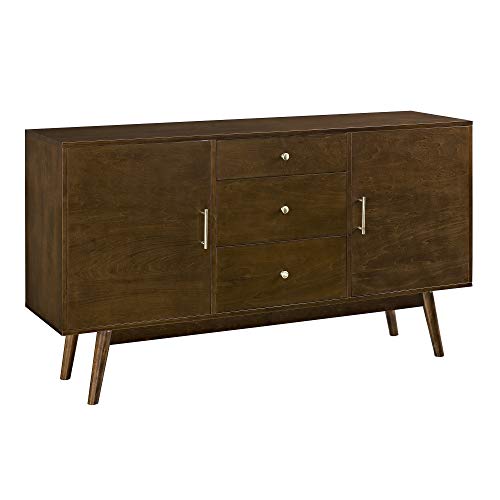
Walker Edison Mid-Century Modern TV Stand Console with 3 Drawers, 60 Inch, Walnut
The Walker Edison 60-inch console earns the top spot in this base guide because it solves the two jobs a media console actually has — holding the TV at the right height and swallowing everyday clutter — without specialising so hard that it stops suiting normal rooms. The three drawers are the headline: remotes, chargers, game controllers, coasters and the tangle of small things that otherwise live on the coffee table all get a divided home, while the closed cabinets take the bigger, uglier boxes.
In walnut, the mid-century profile — tapered legs, clean drawer fronts, a low horizontal line — sits comfortably under TVs up to 65 inches and pairs with both fabric sofas and leather seating. Assembly is a two-person, take-your-time job typical of the brand; the payoff is a console that looks settled and intentional rather than assembled-yesterday.
Long-term ownership of the three-drawer console centres on the drawers themselves: they are the component you will touch daily, so during assembly seat the runners carefully and evenly, and the drawers will glide for years; rush them and every drawer will remind you daily. The walnut laminate wipes clean, the cabinet bays fit standard component widths, and the 60-inch top leaves honest room at each end of a 65-inch TV for a speaker or a plant without crowding the screen. Owners consistently find the third drawer becomes the household’s unofficial headquarters — the place keys, chargers and the one good cable live — which is a compliment to the layout rather than an accident.
Who it suits: Most households with a 55 to 65 inch TV who want drawers as much as shelves.
Pros
- Three real drawers for small-item clutter
- Closed cabinets hide boxes and cables
- Classic walnut mid-century look suits most rooms
Honest limitation: Drawers are sized for accessories, not bulky game collections or large board games.
Choose it if you want one console that handles both gear and clutter. Skip it if your TV is larger than 65 inches or you need open ventilation for a hot-running receiver.
Check on Amazon — check price on Amazon for the current finish and delivery options.
Modway Render 70 Inch Mid-Century Modern Low Profile TV Stand, Walnut
At 70 inches wide and deliberately low, the Modway Render is the console for the household whose TV has quietly grown. The low profile keeps a big screen at seated eye level instead of perched, and the slatted sliding doors let remote signals through while keeping the interior visually calm — a trick borrowed from far more expensive AV furniture.
Inside, open shelving plus the sliding-door bays handle a soundbar setup, a streamer and a console without forcing everything into one hot compartment. The walnut finish photographs warm and reads warmer in person, and the long uninterrupted top gives a soundbar or a pair of bookshelf speakers proper breathing room.
Living with the Render is about discipline rewarded: the sliding doors glide on their track with a fingertip, the slatted bays keep a streamer and console invisible yet responsive, and the low top becomes the calmest surface in the room if you defend its emptiness. Check your tallest component against the interior height before ordering, keep the soundbar centred, and the piece delivers the composed media wall its photographs promise. The walnut tone warms noticeably under evening light, and the long top ages gracefully because there is so little hardware on show to date it.
Who it suits: Owners of 65 to 70 inch TVs who want a low, calm, design-led console.
Pros
- 70-inch width suits today’s larger TVs
- Slatted sliding doors pass remote signals
- Low height keeps big screens at eye level
Honest limitation: The low profile leaves limited vertical room for tall AV receivers — measure component height first.
Choose it if your TV is 65 inches or more and you dislike tall entertainment furniture. Skip it if you run a tall receiver or need deep, high interior compartments.
Check on Amazon — check price on Amazon for the current finish and delivery options.
Walker Edison Modern Slatted Wood TV Stand, 70 Inch, Dark Walnut
The Walker Edison slatted 70-inch console in dark walnut is the widest mainstream pick here, rated for TVs up to 80 inches, and it uses that width properly: cabinets for closed storage, open shelving for the gear that needs air, and a slatted front that adds texture without adding visual noise.
Dark walnut is the forgiving finish in this lineup — it hides dust longer between cleans and anchors light-coloured walls and sofas. For open-plan rooms where the console is visible from the kitchen and the hallway as well as the sofa, that composed, furniture-first look matters more than any single feature.
The slatted Walker Edison rewards owners who use its two storage types deliberately: open bays for the gear that breathes, closed cabinets for everything unsightly. Its dark walnut finish is the lowest-maintenance in this guide — dust shows late, marks show later — and its 70-inch span means it will anchor the room through the next TV upgrade as well as this one, provided the wall genuinely fits it. The slatted front also hides the minor scuffs of daily life better than any flat door, because the eye reads the rhythm of the slats rather than the surface between them.
Who it suits: Large-TV owners who want width, airflow and a darker, grounding finish.
Pros
- Rated for TVs up to 80 inches
- Mix of open and closed storage
- Dark finish hides dust and minor marks
Honest limitation: At 70 inches wide it overwhelms short walls; it needs a genuinely wide placement.
Choose it if you have the wall width and a 70 to 80 inch TV. Skip it if your wall is under about 80 inches wide — it will dominate the room.
Check on Amazon — check price on Amazon for the current finish and delivery options.
Sauder Palladia Corner TV Stand Console, Vintage Oak
Corners are the most wasted square footage in most living rooms, and the Sauder Palladia is built specifically to reclaim one. Its corner profile pushes the TV into the angle of the room, freeing both adjoining walls, while the raised-panel doors and Vintage Oak finish give it a traditional, furniture-store character the flat-pack crowd rarely manages.
Storage is the quiet strength: adjustable shelves for components, two smooth glide drawers for media and games, and small corner display shelves that give photos and plants a home that is not the top of the TV. The enclosed back includes cord access, so the corner does not become a cable nest.
Owning the Palladia is owning a solved corner: the drawers take the media library, the adjustable shelves adapt as components change, and the display shelves quietly become the room’s photo ledge. Traditional finishes like Vintage Oak age gracefully in real homes, and the enclosed back keeps the corner — the place dust and cables conspire most — the easiest corner in the house to keep clean. It is also the pick most likely to be mistaken for a furniture-store piece rather than a flat-pack one, which in a traditional room is precisely the point.
Who it suits: Rooms where a corner is the only sensible TV position, and traditional styling is welcome.
Pros
- Purpose-built corner footprint frees both walls
- Drawers plus adjustable shelves plus display shelves
- Traditional styling suits classic interiors
Honest limitation: It fits TVs up to 60 inches, and corner placement limits viewing angles for wide seating arrangements.
Choose it if your room layout points the TV into a corner. Skip it if you have a TV over 60 inches or a wide sectional that views from sharp angles.
Check on Amazon — check price on Amazon for the current finish and delivery options.
Nathan James Dylan Media Console Cabinet with Herringbone Doors, Oak and Matte Black
The Nathan James Dylan proves a media console does not need to be wide to be interesting. At 47 inches, with herringbone-pattern doors in oak and matte black, it is the piece visitors comment on — and behind those push-to-open doors sit adjustable shelves and three cord holes, so the pretty front is backed by genuinely tidy storage.
It suits TVs up to 50 inches, which makes it a considered pick for smaller rooms, dens and bedrooms rather than the main family screen. The push-to-open mechanism keeps the front handle-free and flat, which also means one less thing to snag clothing or a passing hip in a tight walkway.
The Dylan’s ownership pleasure is disproportionate to its size: the herringbone front draws compliments, the push-to-open doors keep the silhouette clean, and its modest footprint means it redeploys effortlessly — living room today, bedroom or entry cabinet in the next home. Treat it as the design piece it is, keep the gear list to its honest capacity, and it will be the last piece you consider replacing. Its scale also makes it the easiest pick here to move, deep-clean around, and rearrange on a whim, which in real homes is a feature used monthly.
Who it suits: Smaller rooms and secondary viewing spaces with TVs up to 50 inches.
Pros
- Herringbone doors make it a design piece
- Compact 47-inch footprint
- Push-to-open doors, adjustable shelves, cord holes
Honest limitation: Capacity is modest — a full receiver, console and game library will outgrow it quickly.
Choose it if you want a compact console that looks like decor first. Skip it if your TV exceeds 50 inches or your gear collection is large.
Check on Amazon — check price on Amazon for the current finish and delivery options.
Bush Furniture Key West Tall TV Stand for 65 Inch TV, Linen White Oak
Most consoles go wide and low; the Bush Key West goes tall, and for some rooms that trade is exactly right. At 60 inches wide with a taller cabinet body, it offers more enclosed volume for media, games and blankets, supports TVs up to 65 inches and 75 pounds on top, and brings a Linen White Oak farmhouse finish with X-pattern accents that brightens a room instead of darkening it.
The centre cubby with its cable cutout is sized for a player or console, and the tested, warranty-backed construction is a step above the flimsiest flat-pack tier. In bright, coastal or cottage-leaning rooms it looks native in a way the walnut mid-century pieces never quite do.
The Key West asks one thing of its owner — respect the height. Check seated eye level before ordering, and in return it delivers the deepest enclosed storage in this guide, a bright finish that lifts the room, and tested, warranty-backed construction that shrugs off daily use. The centre cubby keeps the everyday player reachable while everything else lives behind doors. The linen-toned finish is also the most forgiving of bright rooms: it neither glares in sun nor darkens at night, and its X-pattern doors give the piece a crafted presence that flat fronts cannot match.
Who it suits: Farmhouse and coastal rooms that need enclosed storage volume more than extra width.
Pros
- Taller body means more enclosed storage
- Bright finish lifts darker rooms
- Tested construction with manufacturer warranty
Honest limitation: The taller stance raises the TV; check seated eye level, especially with low sofas.
Choose it if your style is coastal or farmhouse and storage volume matters. Skip it if you sit low and need the screen as low as possible.
Check on Amazon — check price on Amazon for the current finish and delivery options.
Comparison table
| Console | Width | TV fit | Style | Storage |
|---|---|---|---|---|
| Walker Edison 60in 3-Drawer Console | 60 in | up to 65 in TVs | Mid-century modern, walnut finish | Three drawers plus closed cabinet storage |
| Modway Render 70in Low Profile | 70 in | up to 70 in TVs | Mid-century modern, low profile, walnut | Slatted sliding doors with open shelving and cable routing |
| Walker Edison 70in Slatted Console | 70 in | up to 80 in TVs | Modern slatted wood, dark walnut | Storage cabinets and open shelves |
| Sauder Palladia Corner Console | corner profile | up to 60 in TVs | Traditional raised-panel doors, Vintage Oak finish | Adjustable shelves, two glide drawers, corner display shelves |
| Nathan James Dylan 47in Cabinet | 47 in | up to 50 in TVs | Herringbone-pattern doors, oak and matte black | Push-to-open doors, adjustable shelves, three cord holes |
| Bush Key West Tall 60in Stand | 60 in | up to 65 in TVs, 75 lb top capacity | Modern farmhouse and coastal, X-pattern accents | Center cubby with cable cutout plus cabinet storage |
Read the table by constraint, not by taste. Start with the wall width you actually have, then the TV size you own today — not the one you might buy in three years — then the amount of gear that genuinely needs a home. The console that survives all three filters is almost always the right one, even if it was not your favourite photograph.
How to choose a media console that fits your room
Start with the TV you own. Its width — not its diagonal — sets the minimum console width, and its weight sets the capacity you need. Then measure the wall honestly: the widest picks here need a genuinely wide run, while the corner and compact picks exist precisely for rooms where that run does not exist.
Measure the wall, the TV and the gear — in that order, with a tape, not an estimate. The console should be at least as wide as the TV and ideally a few inches wider each side; its depth must clear your deepest component plus cable bend room behind it; and its height should place the centre of the screen close to seated eye level, roughly 42 inches from the floor for most sofas.
Plan cables before the console arrives. List every device, every connection and every power brick, then confirm the console gives each one a route: cord holes, an open back, or a cable channel. A power strip inside a closed cabinet needs ventilation; a strip behind the console needs reach. Ten minutes of planning here saves the visible cable waterfall that ruins otherwise good rooms.
Choose your storage mix by inventory, not aspiration. Count the devices, then count the clutter. Households with more devices need open or slatted bays; households with more clutter need drawers and doors. Most need both, which is why the top of this guide mixes the two.
Think about heat honestly. Games consoles and AV receivers are small heaters. Open shelving, slatted doors and mesh-friendly fronts exist because closed solid doors trap heat and shorten component life. If your setup includes a current-generation console or a receiver, weight ventilation as heavily as storage in your final choice.
Finally, assemble where the console will live, level it, and anchor it if your household includes children or large pets. Flat-pack furniture rewards patience: sort the hardware, follow the sequence, and do not fully tighten until the frame is square. The hour you spend here decides whether the piece feels solid for a decade or wobbles from week one.
Common mistakes to avoid
Mistake zero, specific to this budget: spending the whole $700 on width and nothing on the setup around it. At this level the consoles are good; the weak points are usually the unanchored TV, the bargain power strip and the missing cable raceway. Budget a little of the total for those and the result feels a class higher.
Mistake one: buying by photograph instead of by tape measure. Consoles photograph smaller than they are; the 70-inch picks in this guide are genuinely wide furniture. Measure the wall, mark it with painter’s tape, and live with the outline for a day before ordering.
Mistake two: trapping hot gear behind solid doors. If a console or receiver runs warm in an open rack, it will run hotter in a closed cabinet. Choose slatted, open or ventilated storage for heat-producing gear, or leave the door of that bay open during long sessions.
Mistake three: ignoring the soundbar. A soundbar needs width on top or a shelf of its own, and it must not be sealed inside a cabinet unless the doors are acoustically transparent. Measure the bar, then check the console top or centre shelf against it.
Mistake four: forgetting the back. Cable bend radius, power bricks and ventilation all live behind the console. Leave the gap the gear needs rather than pushing the cabinet flush and crushing every connector you own.
What the under $700 budget buys — and what it does not
Understanding this tier makes the choice calmer. Below this budget, consoles shrink: widths fall to 58 inches and under, doors become open shelves, cable management becomes a hope, and finishes thin out. At under $700, the category’s real furniture begins — 70-inch widths, sliding and slatted doors, drawers, corner engineering, brand-tested construction — and the six picks in this guide are drawn from that step-up. What the tier does not buy is solid hardwood throughout, soft-close everything, or designer provenance; if those are your requirements, the honest advice is to double the budget rather than to hunt for them here, because no listing at this level delivers them truthfully.
The smart allocation inside the budget is width first, storage second, finish third. Width cannot be added later; storage can be supplemented with a basket or a side cabinet; finish is the preference most likely to change with the next sofa anyway. Households that allocate in that order report the fewest regrets, and it is the order this guide’s rankings quietly follow. Reserve a small part of the total for the unglamorous completions — anchor hardware, a proper surge protector, a cable raceway, felt pads — because a $700 console finished with $30 of setup hardware outperforms a $700 console left raw on every evening that follows.
Finally, judge value over the console’s whole life, including its second one. The pieces here redeploy as sideboards, entry cabinets and bedroom storage when the media room changes, and a console that serves twelve years in two roles costs less per year than a cheaper piece that serves four years in one. That arithmetic, more than any single feature, is why this budget is the category’s sweet spot.
Final recommendation
If you buy one console from this guide, make it the Walker Edison 60-inch three-drawer model: it is the balance point of the under $700 field — wide enough for the TVs most households own, drawer-equipped for the clutter every household has, and styled to survive several sofa changes. The Modway Render is the better buy only if your TV is 65 inches or more and you want the low modern line; the Sauder Palladia is the better buy only if your room’s geometry says corner. Everything else is refinement on those three decisions.
Our first call for most readers is the Walker Edison 60in 3-Drawer Console — Check on Amazon. If that shape does not fit your room, the Modway Render 70in Low Profile (Check on Amazon) and the Walker Edison 70in Slatted Console (Check on Amazon) cover the next most common situations in this guide.
Matching the console to your TV size
Work through the sizes honestly. For a 43 to 50 inch TV, the Nathan James Dylan is the proportionate choice and the wide consoles would swamp the screen. For 55 to 65 inches — the mainstream of current living rooms — the Walker Edison three-drawer, the Sauder Palladia at the top of its range and the Bush Key West all sit correctly, with the Walker Edison offering the best storage mix. For 70 inches and above, only the two 70-inch consoles in this guide keep the composition balanced, and the slatted Walker Edison is the one rated to carry an 80-inch screen.
Height deserves the same arithmetic. Screen centre should sit near 42 inches from the floor for typical sofa seating; low consoles suit big screens precisely because they hold that line as screens grow. If your sofa is unusually low or your seating is a sectional with a reclined posture, favour the lowest console that fits your TV; if you watch from dining-height chairs or a bed, a taller piece like the Key West earns its stance.
And leave a path for the next TV. Screens grow at replacement time, almost never shrink. A console one size above today’s TV — within the proportions of your wall — is the purchase that survives the next upgrade, which is why the 70-inch picks are recommended even to some 55-inch owners with the wall to hold them.
Setting up your media console properly
Unbox in the room where the console will live and inventory every panel and hardware bag against the parts list before a single screw turns. Flat-pack furniture punishes the discovery of a missing cam lock at step fourteen; five minutes of inventory at step zero is the cheapest insurance in the whole purchase. Build on carpet or the flattened box to protect the finish, keep a second person for any panel longer than your arm span, and resist the impact driver: hand-tighten first, square the frame, then snug everything in sequence.
Placement deserves the same care as assembly. Centre the console on the seating, not on the wall — rooms are rarely symmetrical, and the sofa is the reference point that matters every evening. Leave a working gap behind the cabinet for cable bend and airflow; a console pushed hard against the skirting crushes connectors and traps the warm air your gear is trying to shed. Once placed, level the piece: most floors slope more than you think, and a door that will not sit true is usually a floor problem wearing a furniture costume.
Wire the setup in a deliberate order: power strip first, placed where it can be reached without moving the cabinet; then the TV connection; then sources from largest to smallest. Label both ends of every cable with a strip of tape and a pen. It feels excessive on day one and feels genius on the day you swap a streamer in ninety seconds without pulling the console out. Coil surplus cable inside the cabinet, never behind it on the floor, where it becomes a dust farm and a trip line for the vacuum.
Finish with the safety pass. If the household includes children or large pets, fit the anti-tip anchor now, while the tools are out. Route the TV’s power so it cannot be pulled, check that no cable is pinched by a door or drawer, and run the hottest device — usually the games console — for an hour with the doors in their normal position, then feel the air inside the bay. Warm is fine; hot means rearrange for airflow before it becomes a reliability problem.
Materials, care and long-term ownership
Most consoles in this price band are engineered wood — MDF or particleboard — finished in laminate or veneer, and that is an honest construction at under $700 provided you treat it as furniture rather than as solid oak. The practical implications are simple: use coasters, wipe spills the day they happen rather than the week after, keep the piece out of sustained direct sun where finishes fade unevenly, and never drag a loaded console across the floor — lift it, or empty it first, because racking forces are what loosen flat-pack joints over time.
Day-to-day care is a microfibre cloth, slightly damp for sticky marks, and a strict no-abrasives rule on laminate finishes. Walnut-tone finishes forgive dust and minor marks; pale finishes like linen oak show less dust but more scuff, so a touch-up marker in a matching tone is a sensible drawer item in busy households. Slatted and herringbone fronts collect dust in their texture — a soft brush attachment on the vacuum keeps them honest in seconds.
Ownership economics favour this tier more than buyers expect. A console at this level that is assembled carefully, anchored, kept dry and not overloaded will serve a decade of ordinary use, and its cost per year undercuts both the disposable tier below it — replaced twice in the same period — and the designer tier above it, whose extra money buys material romance rather than extra function. When the room changes, these pieces also move rooms gracefully: today’s media console is tomorrow’s sideboard, entry cabinet or bedroom dresser-height storage, which is the quiet second life that makes a good under $700 buy a genuinely good one.
Finally, keep the assembly hardware. A small labelled bag with the spare cams, screws and the Allen key, taped inside a cabinet door, turns every future house move from a furniture risk into a twenty-minute job — and keeps a good console in service instead of in a skip.
Four common rooms, four right answers
The mainstream living room. A 65-inch TV, a streamer, a soundbar, a games console and a sofa that seats the household plus guests: this is the room the Walker Edison three-drawer console was built for. Drawers take the small chaos, cabinets take the boxes, the soundbar sits centred on top, and the walnut line suits the room through its next two sofa changes. If this description matches your home, the guide’s top pick is your pick, and the remaining decision is only whether your wall prefers the darker slatted alternative.
The big-screen room. When the TV is 75 inches or the wall is the room’s whole purpose, scale decides: the slatted Walker Edison, rated to 80 inches, keeps the composition grounded and gives consoles room to breathe during long sessions. Resist pairing a screen this size with a 60-inch console to save money; the visual instability will bother you every single evening, which is the most expensive kind of saving there is.
The awkward room. Fireplaces off-centre, radiators mid-wall, a door where the TV should go: awkward rooms are why the corner Palladia exists. Placing the media centre in the angle resolves layouts that defeat flat furniture, and its drawers and display shelves make the solution feel intentional rather than apologetic. Measure the corner’s two wall runs, confirm the seating can aim at the angle, and the awkward room usually becomes the cosiest one.
The quiet room. Dens, bedrooms and second sitting rooms run smaller TVs and simpler setups, and they reward the Dylan’s approach: furniture first, media second. A 50-inch screen on a herringbone-fronted cabinet, one streamer hidden, cables invisible — the room stays a room, and viewing feels like a choice rather than the room’s only function. Choose this pattern whenever the space has another job to do by day.
Pre-purchase checklist
Run this checklist in order before ordering any console in this guide; it takes ten minutes and prevents nearly every return this category generates.
One: measure the TV’s actual width and weight, not its advertised diagonal, and match both against the console’s stated capacity. Two: measure the wall run and mark it with painter’s tape at the console’s true width and height, then live with the tape for a day. Three: measure your deepest component and tallest component, and confirm the intended bay clears both with room for cables behind. Four: count power outlets within reach of the console’s position and confirm the power strip plan works without an extension lead crossing a walkway. Five: check the delivery path — door widths, hallway turns, stairs, lift size — against the box dimensions on the listing, because the best console in this guide is worthless if its box cannot reach the room.
Six: confirm the finish against your room in your light, using the listing’s room photographs rather than the studio shot; walnut reads darker in north-facing rooms and paler under warm evening bulbs. Seven: read the assembly requirement honestly — tools, time, second pair of hands — and schedule the build when you have all three. Eight: decide the anchor plan for the TV and console before the box arrives, not after the piece is loaded. Nine: photograph your current cable setup before dismantling it; the photograph is the fastest wiring diagram you will ever own. Ten: keep the receipt, the hardware spares and the instructions together inside the console itself, where future-you will actually find them.
None of this is glamorous, and all of it is the difference between the households who love their console for a decade and the households who list theirs for sale within the year. The furniture at this price is genuinely good; the outcomes differ on preparation, not on product.
FAQ
What size media console do I need for a 65 inch TV?
A 65 inch TV is about 57 inches wide, so choose a console at least 60 inches wide; the 60 and 70 inch picks in this guide all work, with the wider options leaving room for speakers or decor at each end.
Is $700 enough for a good media console?
Yes. At under $700 you can buy wide, well-finished consoles with real storage, sliding or slatted doors and proper cable management. Spending more mostly buys solid-wood construction and designer branding rather than better function.
Should a media console be wider than the TV?
Ideally yes, by a few inches on each side. A console narrower than the TV looks unstable and risks feeling top-heavy; matching or slightly exceeding the TV width is the safe, settled look.
Can I put a games console inside a closed cabinet?
Only with ventilation. Slatted doors, open bays or leaving clearance around the console all help; a fully sealed cabinet traps heat. When in doubt, use an open shelf for the console and closed storage for everything else.
Do these consoles need assembly?
Most flat-pack picks here require home assembly with basic tools; allow one to two hours and a second pair of hands for the wider models. Check the listing for the exact assembly and weight details before ordering — and check price on Amazon for current delivery options.
Should I wall-mount the TV or stand it on the console?
Both work with every pick here. Standing the TV is simpler and renter-friendly; mounting frees the console top for a soundbar and decor and lets you set the screen height independently. If you mount, keep the screen’s lower edge close to the console top so the composition stays unified.
How much weight can these consoles hold?
Capacities vary by model — the Bush Key West, for example, states a 75 pound top capacity — so check the exact figure on the listing for the pick you choose, and keep the TV comfortably inside it rather than at the limit.
Related guides
- Best Media Console Under $300
- Best Media Console Under $1000
- Best Media Console Under $2000
- Best Media Console For Families Under $700
- Best Bookcase Under $300
Browse those companion guides if your room needs more than a console: the right neighbours for a media wall are storage, seating and cable order, in that order.