Where to buy
Check the latest price, availability and delivery on Amazon. Orders are placed on Amazon. We may earn a commission from qualifying purchases.
- Best overall — no assembly, real wood presence: POVISON Fully Assembled Slatted TV Stand for 75-Inch TV, Walnut — Check on Amazon
- Best statement piece — curved solid oak veneer: Walker Edison Maya Large Curved 70-Inch Sideboard TV Stand, Medium Brown Oak
- Best warm texture — rattan doors, family-friendly storage: Walker Edison Sasha 4-Door Sideboard with Arched Rattan Panels, 70 Inch, Coastal Oak
- Best mid-century value — glass shelves, dark walnut: Walker Edison Saxon Mid Century Modern 2-Door TV Stand, 70 Inch, Dark Walnut
- Best smaller footprint — fully assembled, solid ash top: POVISON Fully Assembled Mid Century Modern TV Stand for 65-Inch TV, Slatted
- Best AV-first engineering — a cabinet built around components: Salamander Designs AV Basics SDAV2 7224 Cabinet, Wenge Espresso
- Prose-only benchmark — the designer tier above this budget: BDI Tanami 7109 Media Console — prose-only pick, sold mainly direct and through authorized dealers; no Amazon link (see the review below)
Read the full guide ↓
Disclosure: As an Amazon Associate, dailyhomedecorating.com earns from qualifying purchases. Links to Amazon on this page are affiliate links; they cost you nothing extra. Listing details such as price and availability change often, so check the current Amazon listing before you buy.
Finding the best media console under $2000 is a different exercise from shopping the budget tiers, because at this level you stop paying for survival and start paying for the things that decide whether a living room feels finished: real wood instead of printed foil, doors that close softly and stay aligned, ventilation that lets an amplifier live behind closed doors, and proportions that make a 75-inch screen look intentional rather than parked. This guide covers the full width of that tier — a fully assembled slatted console in solid ash, a curved oak statement piece, a rattan-fronted four-door cabinet, a restrained mid-century classic, a smaller pre-assembled option for 65-inch TVs, an AV-specialist cabinet from Salamander, and one honest prose-only benchmark from BDI that usually sits above the ceiling and shows what the next tier adds.
A note on honesty before the picks: a $2000 ceiling does not mean every pick costs $2000, and it should not. Several consoles below sit comfortably in the middle of the tier, and that is a feature — the right move at this budget is to buy the console that fits your TV, your components and your room, and keep the change for the soundbar, the bias lighting or the seating. What the ceiling buys you is the right to ignore the compromises of the cheap tiers: no wobbling cam-lock frames, no doors that meet in the middle only approximately, no back panels you have to butcher with a utility knife to pass a cable through. Every pick here was chosen because it removes one of those compromises completely.
Start with the POVISON 78.74-inch slatted console if you want the simplest recommendation: it arrives fully assembled, it is built from solid ash with a walnut finish, and its slatted doors solve the oldest media-console problem — hiding components without imprisoning them — in one move. Choose the Walker Edison Maya if the console is also your room’s statement piece, the Sasha if you want warmth and four-bay family storage, the Saxon for a low mid-century line in dark walnut, the smaller POVISON if your TV is 65 inches and your room is not huge, and the Salamander SDAV2 if your equipment list, not your decor, is writing the brief. The BDI Tanami closes the list as a prose-only benchmark: usually above this budget, sold mainly direct, and useful precisely because it shows what extra money does and does not buy.
In this guide
Quick Picks
Short on time? Each row names the buyer this pick suits and why it stands out.
| Buyer type | Pick | Why it stands out | Link |
|---|---|---|---|
| Best overall — no assembly, real wood presence | POVISON Fully Assembled Slatted TV Stand for 75-Inch TV, Walnut | Arrives fully assembled — unbox, level the legs, load your gear | Check on Amazon |
| Best statement piece — curved solid oak veneer | Walker Edison Maya Large Curved 70-Inch Sideboard TV Stand, Medium Brown Oak | Curved front with no sharp corners and no visible hardware | Check on Amazon |
| Best warm texture — rattan doors, family-friendly storage | Walker Edison Sasha 4-Door Sideboard with Arched Rattan Panels, 70 Inch, Coastal Oak | Woven rattan doors ventilate closed storage and soften the room | Check on Amazon |
| Best mid-century value — glass shelves, dark walnut | Walker Edison Saxon Mid Century Modern 2-Door TV Stand, 70 Inch, Dark Walnut | Classic low mid-century profile suits almost any room | Check on Amazon |
| Best smaller footprint — fully assembled, solid ash top | POVISON Fully Assembled Mid Century Modern TV Stand for 65-Inch TV, Slatted | Fully assembled — the single biggest quality-of-life feature at this size | Check on Amazon |
| Best AV-first engineering — a cabinet built around components | Salamander Designs AV Basics SDAV2 7224 Cabinet, Wenge Espresso | Designed around AV gear: ventilation, depth and access come first | Check on Amazon |
| Prose-only benchmark — the designer tier above this budget | BDI Tanami 7109 Media Console | Reference-grade AV engineering: ventilation, cable routing, safety strap included | Prose-only — see review |
How These Picks Were Chosen — Finding the Best media console under $2000
At the under-$2000 tier the first filter was construction, and it eliminated most of the catalog. We looked for solid wood or real veneer where hands and eyes actually land, frames that do not depend on a dozen cam locks for their rigidity, and doors — sliding, soft-close or woven — that will still align after a year of daily use. The second filter was AV competence: a media console is not a sideboard with ambitions. It needs ventilation or signal-friendly fronts for closed storage, shelf space that fits a real receiver and a center speaker, cable access that does not require vandalizing a back panel, and a top rated for the TV class it claims. The third filter was honesty about channels: several famous AV furniture names sell direct or through dealers at prices above this ceiling, so rather than invent an Amazon link, those pieces appear here as clearly labeled prose-only context. Finally, we checked every pick against recall databases — no pick in this guide is a recalled product — and we favored consoles whose dimensions and capacities are published by the maker or the listing, not guessed.
Detailed Reviews
POVISON Fully Assembled Slatted TV Stand for 75-Inch TV, Walnut
Who it suits: Best overall — no assembly, real wood presence.
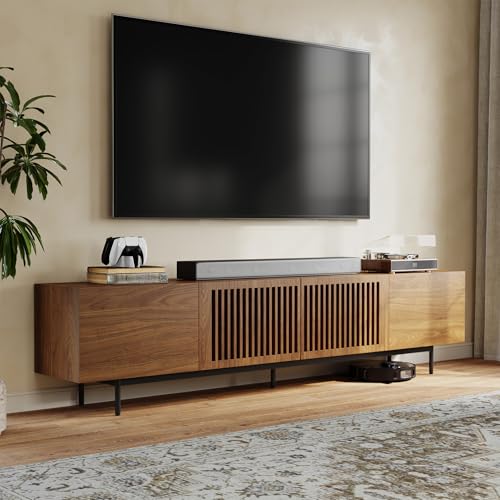
This is the 78.74-inch-wide POVISON slatted console: the listing gives dimensions of 78.74 x 15.75 x 21.65 inches, a walnut finish, tall cast-metal legs, slatted sliding doors and — the detail that changes the whole ownership experience — it arrives fully assembled. The frame uses solid ash construction with a walnut finish rather than a printed paper foil, so the grain you see is wood, the doors slide on real tracks instead of swinging into your walkway, and the slatted fronts let remote signals and air reach the components inside while the clutter stays hidden. Inside there is room for a full receiver, a game console and a streaming box side by side, with removable shelving so a tall center-channel speaker can stand where a shelf would otherwise cut the space in half.
Pros
- Arrives fully assembled — unbox, level the legs, load your gear
- Slatted doors hide components but pass remote signals and air
- Solid ash construction feels and ages like furniture, not flat-pack
- 78.74-inch top suits TVs up to the 75-inch class with breathing room
Ownership details decide whether a console like this delights or nags. The slatted doors slide rather than swing, so the console can sit closer to a coffee table or a walkway without a clearance arc, and the slats themselves are spaced for the two jobs they do — passing infrared remote signals to the components inside and letting warm air escape upward instead of pooling around an amplifier. Behind the doors, plan your layout left to right by heat: receiver or game console in the bay with the most open slat area, streaming boxes and disc players in the quieter bays. The tall cast-metal legs lift the cabinet enough for a robot vacuum to pass beneath, which sounds trivial until you have lived with a low plinth cabinet and the dust ridge it grows. Because the piece arrives assembled, inspect it at the door: check the door slide on both tracks, the leg levelers on your actual floor, and the finish in daylight before the delivery team leaves — with a pre-assembled piece, delivery-day inspection replaces the assembly-day quality control you would otherwise do yourself.
Honest limitation: At 78.74 inches wide it needs a genuinely long wall; measure before you fall for it, and the 15.75-inch depth is shallower than deep AV receivers with banana plugs sometimes want, so check your deepest component plus cable bend room.
Choose it if it matches your TV size, component list and room from the checks below; skip it if its stated limitation is the one thing your room cannot forgive. Check on Amazon — and check price on Amazon for the current listing before you decide.
Walker Edison Maya Large Curved 70-Inch Sideboard TV Stand, Medium Brown Oak
Who it suits: Best statement piece — curved solid oak veneer.
The Maya is Walker Edison’s design-led 70-inch console: Amazon lists it at 17 inches deep, 70 inches wide and 30 inches high, weighing 137 pounds, in a medium brown oak finish over solid oak veneer, with soft-close doors, adjustable shelves behind them and support for TVs up to 80 inches. The curved, rounded silhouette is the point — there are no sharp front corners and no visible hardware, so the piece reads as a sculptural sideboard that happens to hold a television rather than a TV stand that happens to store things. At 30 inches high it sits taller than most media consoles, which raises a wall-mounted screen to a comfortable height and gives the storage inside real vertical volume for vinyl, board games and taller components.
Pros
- Curved front with no sharp corners and no visible hardware
- Soft-close doors and adjustable shelves behind them
- Solid oak veneer over a substantial 137-pound build
- 30-inch height gives generous storage volume and a higher screen line
The Maya rewards a little staging thought. Its 30-inch height puts the top at sideboard level, which is why it works best under a wall-mounted screen: the TV floats at seated eye level while the cabinet below reads as a proper piece of dining-room-grade furniture, tall enough to hold vinyl upright, board games flat and a soundbar on top without crowding. The curved front is not only a safety and style feature — it changes how light moves across the room, softening the hard rectangular shadow a straight cabinet throws. Soft-close doors on a piece this size are a genuine quality marker, because long doors are the first to sag on cheap hinges; check the close on every door at setup and again after a month, and adjust once the cabinet has settled under load. At 137 pounds, decide its final position before the box is opened, measure that position twice, and recruit a second person for the placement — this is furniture you position, not furniture you nudge.
Honest limitation: The 30-inch height is too tall for a TV sitting on top in a low-seating room — it suits wall-mounted screens best — and at 137 pounds this is a two-person delivery and placement job, not a solo afternoon project.
Choose it if it matches your TV size, component list and room from the checks below; skip it if its stated limitation is the one thing your room cannot forgive. Check on Amazon — and check price on Amazon for the current listing before you decide.
Walker Edison Sasha 4-Door Sideboard with Arched Rattan Panels, 70 Inch, Coastal Oak
Who it suits: Best warm texture — rattan doors, family-friendly storage.
The Sasha is a 70-inch, four-door sideboard that doubles as a media console: Amazon lists it at 18 inches deep, 70 inches wide and 27 inches high, 128 pounds, with woven rattan door panels in arched frames, a coastal oak laminate finish over warp-resistant MDF, a pine frame, three shelves, built-in cable management and support for TVs up to 80 inches. The rattan is not just decoration — the woven panels breathe, so components behind closed doors get more air than they would behind solid MDF, and the texture softens a room full of black screens and boxes in a way flat-front cabinets never do. Four doors mean four separate bays: media in one, games in another, the everyday clutter of a living room in the rest.
Pros
- Woven rattan doors ventilate closed storage and soften the room
- Four separate bays keep media, games and clutter apart
- Built-in cable management and a scratch-resistant surface
- Supports TVs up to 80 inches on a full 70-inch top
The Sasha’s party trick is division of labor. Four doors sounds like a styling detail until you assign them: bay one for the receiver and streamer, bay two for game consoles and controllers, bay three for the living room’s soft overflow — blankets, cushions, the good candles — and bay four for the household’s paper and charging clutter that otherwise lives on the coffee table. The woven rattan fronts breathe better than solid doors, which is why the hottest component should claim the middle bay where air movement is best, and the cable-management cutouts keep the inevitable spaghetti behind the cabinet rather than spilling from its sides. The coastal oak laminate wipes clean and shrugs off the daily scuffs of a working living room, and the scratch-resistant top takes keys, remotes and drink rings in stride — though coasters remain cheaper than regret. Assembly is a two-person, unhurried job at 128 pounds of panels; build it in the room it will live in, because a finished 70-inch cabinet does not enjoy doorways.
Honest limitation: Rattan is a natural woven material — it does not love being poked, prodded or used as a climbing surface, and the laminate finish, while tough, will never develop the patina of real veneer; this is a style-and-practicality buy, not an heirloom buy.
Choose it if it matches your TV size, component list and room from the checks below; skip it if its stated limitation is the one thing your room cannot forgive. Check on Amazon — and check price on Amazon for the current listing before you decide.
Walker Edison Saxon Mid Century Modern 2-Door TV Stand, 70 Inch, Dark Walnut
Who it suits: Best mid-century value — glass shelves, dark walnut.
The Saxon is the long-running mid-century entry in this group: a 70-inch, two-door console in dark walnut, model W70NORDW, rated by Walker Edison for TVs up to 80 inches, with glass-shelf storage behind its doors and the tapered-leg, low-slung profile that defines the style. Where the Maya and Sasha spend your budget on silhouette and texture, the Saxon spends it on proportion and restraint — a long, low cabinet that disappears under a big screen and lets the room, not the furniture, do the talking. The glass shelves are a practical touch for components: they do not sag, they wipe clean, and they let a status light be seen from above instead of trapping heat the way a solid shelf can.
Pros
- Classic low mid-century profile suits almost any room
- Glass shelves are sag-proof, easy to clean and heat-friendly
- 70-inch top rated for TVs up to 80 inches
- The restrained design ages well as tastes and TVs change
The Saxon is the diplomat of this group: a long, low, dark-walnut line that has been settling arguments between big TVs and traditional rooms for years. Its two wide bays suit component stacks arranged as towers — receiver below, console above on the glass shelf — and glass shelving earns its place here, because it neither sags under a heavy amplifier nor traps a layer of heat the way a solid board can, and a status light remains visible through it when you are hunting a standby glow at midnight. The low profile keeps a large screen’s center near seated eye level when the TV stands on top, which is the ergonomic detail most buyers only appreciate six months in. Dark walnut is the honest trade: it grounds a room beautifully and shows every speck of dust for the privilege, so keep a microfiber cloth in the right-hand bay and make peace with a weekly thirty-second ritual. As a flat-pack piece it rewards a methodical build — sort the hardware, keep the driver torque low, and level it on the floor it will actually live on.
Honest limitation: Two doors mean fewer, wider bays than the four-door Sasha, so small-item organization needs baskets or boxes of your own, and the dark walnut finish shows dust and pale scratches more readily than the lighter oak finishes here.
Choose it if it matches your TV size, component list and room from the checks below; skip it if its stated limitation is the one thing your room cannot forgive. Check on Amazon — and check price on Amazon for the current listing before you decide.
POVISON Fully Assembled Mid Century Modern TV Stand for 65-Inch TV, Slatted
Who it suits: Best smaller footprint — fully assembled, solid ash top.
This is POVISON’s smaller slatted console, model TS8002ADW180, built for the 65-inch TV class with a solid ash top, multi-layer ash solid-wood board construction, slatted doors and removable shelves — and, like its bigger sibling, it arrives fully assembled. Think of it as the same idea at an apartment-friendlier scale: real wood surfaces, doors that hide the component stack while letting it breathe and be controlled, and none of the cam-lock, two-hour, allen-key ritual that flat-pack furniture demands on moving day. The removable shelves matter more than they sound — pull one out and a tall soundbar or center speaker fits; leave them in and you have two tidy tiers for a console and a streaming box.
Pros
- Fully assembled — the single biggest quality-of-life feature at this size
- Solid ash top and slatted, signal-friendly doors
- Removable shelves adapt to a soundbar or taller gear
- Scaled for 65-inch TVs and the rooms they actually live in
This smaller POVISON makes its argument in the first ten minutes of ownership: it comes out of the box finished. No parts inventory, no cam locks, no Sunday afternoon — unbox, place, load, watch. That matters beyond convenience, because factory assembly is also factory quality control; the door alignment and slat spacing you receive are the maker’s, not yours at hour two with a tired wrist. The solid ash top is the surface your hands and eyes meet daily, and it feels like it — cool, dense, with real grain under the finish. The removable shelves are the flexibility story: both in for a two-tier component stack, one out for a tall center speaker or a soundbar stored below the screen line, and the slatted fronts keep remotes working and air moving either way. Sized for the 65-inch class, it leaves wall on either side for a plant, a floor lamp or simply air — and in most rooms, that margin is what makes the setup look designed rather than squeezed.
Honest limitation: It is built around the 65-inch class, so it is the wrong buy if a 75-inch upgrade is already planned, and the premium for pre-assembly means a flat-pack rival of similar size will always look cheaper on paper — you are paying to skip the build and to get solid wood where it counts.
Choose it if it matches your TV size, component list and room from the checks below; skip it if its stated limitation is the one thing your room cannot forgive. Check on Amazon — and check price on Amazon for the current listing before you decide.
Salamander Designs AV Basics SDAV2 7224 Cabinet, Wenge Espresso
Who it suits: Best AV-first engineering — a cabinet built around components.
The SDAV2 7224 comes from Salamander’s AV Basics line, and it is the one pick here designed by an AV furniture company rather than a furniture company: a wide, low cabinet in wenge espresso built around the unglamorous things that decide whether a system is pleasant to live with — ventilation for warm amplifiers, room for a full-size receiver and center speaker, and access that does not require dragging the whole cabinet away from the wall every time a cable changes. Salamander builds on an aluminum-frame philosophy across its ranges, and the AV Basics line is its most accessible expression of it. If your living room doubles as a serious listening or home-theater room, this is the console that starts from the equipment list and works outward.
Pros
- Designed around AV gear: ventilation, depth and access come first
- Wide, low stance suits large screens and center speakers
- Wenge espresso finish pairs with dark, theater-leaning rooms
- From a specialist AV furniture maker, not a generalist brand
Living with the Salamander teaches you what AV-first design actually means in practice. It means reaching a cable without moving the cabinet. It means an amplifier that runs for a four-hour film session and comes out merely warm, because the cabinet was designed around airflow instead of treating it as an afterthought. It means a center speaker that fits as a planned resident rather than an awkward guest. Salamander’s AV Basics line strips the company’s aluminum-chassis philosophy to its essentials, and the wenge espresso finish keeps the whole apparatus visually quiet — in a darkened room the cabinet disappears and only the screen performs, which is precisely the point. The trade-offs are real: you are buying engineering over ornament, and the specialist distribution means you should confirm the exact configuration, finish and delivery terms on the listing with care. For a household whose system includes a serious receiver, separates or a growing console collection, this is the pick that stops the furniture from being the system’s weakest component.
Honest limitation: The styling is purposeful rather than decorative — it will not give you the Maya’s sculpture or the Sasha’s texture — and Salamander’s distribution means finishes and availability vary, so confirm the exact configuration on the listing before you plan the room around it.
Choose it if it matches your TV size, component list and room from the checks below; skip it if its stated limitation is the one thing your room cannot forgive. Check on Amazon — and check price on Amazon for the current listing before you decide.
BDI Tanami 7109 Media Console
Who it suits: Prose-only benchmark — the designer tier above this budget.
The Tanami 7109 is included honestly as a prose-only benchmark, because BDI sells primarily through its own site and authorized dealers rather than a standard Amazon US listing we can link with confidence, and its pricing typically sits above the under-$2000 ceiling of this guide — it fits this budget only conditionally, when a dealer sale or promotion brings it down, which is exactly how we are positioning it. What you would be stretching for is real: BDI’s own specification sheet gives 32 x 79.25 x 18 inches, support for TVs up to 85 inches, a 175-pound top capacity, four compartments with adjustable shelves, flow-through ventilation, cable management and an included TV safety strap. It is the reference point that shows what the next tier buys — and, for most rooms, how close the picks above already get.
Pros
- Reference-grade AV engineering: ventilation, cable routing, safety strap included
- 79.25-inch top supports TVs up to 85 inches with a 175-pound top capacity
- Four compartments with adjustable shelving for 6–10 components
It is worth being precise about what the Tanami’s usual above-budget pricing buys, because it clarifies what to demand from every other pick. The specification sheet reads like a checklist written by someone who has installed systems for a living: flow-through ventilation so components can live behind closed doors indefinitely, internal cable routing with wire wraps so the back of the cabinet is as organized as the front, adjustable shelves on fine increments so a shelf sits exactly one component high with air above it, floor levelers for real-world floors, and a safety strap in the box because the maker assumes a large TV and a real household. The four compartments swallow six to ten components, and the 175-pound top capacity means the largest screens are a specification, not a hope. None of this makes the linked picks poor relations — the POVISON consoles answer with solid wood and zero assembly, the Walker Edison range with storage and style per dollar — but if a dealer sale ever brings the Tanami inside your ceiling, you will know exactly what the extra engineering is worth, and if it does not, you will know exactly what you are not missing.
Honest limitation: Typically priced above this guide’s ceiling and sold mainly direct or through dealers, so there is no standard Amazon link here — treat it as the stretch benchmark, check BDI and its dealers for current pricing, and do not blow the budget for it if a pick above already fits your gear.
Choose it if a dealer promotion brings it honestly inside your budget and AV engineering tops your list; skip it if you need a straightforward Amazon purchase today — every linked pick above is ready to order. This pick is prose-only: no Amazon link is offered for it anywhere in this guide.
Comparison Table
| Pick | Standout strength | Watch out for |
|---|---|---|
| POVISON Fully Assembled Slatted TV Stand for 75-Inch TV, Walnut | Arrives fully assembled — unbox, level the legs, load your gear | At 78. |
| Walker Edison Maya Large Curved 70-Inch Sideboard TV Stand, Medium Brown Oak | Curved front with no sharp corners and no visible hardware | The 30-inch height is too tall for a TV sitting on top in a low-seating room — it suits wall-mounted screens best — and at 137 pounds this is a two-person delivery and placement job, not a solo afternoon project. |
| Walker Edison Sasha 4-Door Sideboard with Arched Rattan Panels, 70 Inch, Coastal Oak | Woven rattan doors ventilate closed storage and soften the room | Rattan is a natural woven material — it does not love being poked, prodded or used as a climbing surface, and the laminate finish, while tough, will never develop the patina of real veneer; this is a style-and-practicality buy, not an heirloom buy. |
| Walker Edison Saxon Mid Century Modern 2-Door TV Stand, 70 Inch, Dark Walnut | Classic low mid-century profile suits almost any room | Two doors mean fewer, wider bays than the four-door Sasha, so small-item organization needs baskets or boxes of your own, and the dark walnut finish shows dust and pale scratches more readily than the lighter oak finishes here. |
| POVISON Fully Assembled Mid Century Modern TV Stand for 65-Inch TV, Slatted | Fully assembled — the single biggest quality-of-life feature at this size | It is built around the 65-inch class, so it is the wrong buy if a 75-inch upgrade is already planned, and the premium for pre-assembly means a flat-pack rival of similar size will always look cheaper on paper — you are paying to skip the build and to get solid wood where it counts. |
| Salamander Designs AV Basics SDAV2 7224 Cabinet, Wenge Espresso | Designed around AV gear: ventilation, depth and access come first | The styling is purposeful rather than decorative — it will not give you the Maya’s sculpture or the Sasha’s texture — and Salamander’s distribution means finishes and availability vary, so confirm the exact configuration on the listing before you plan the room around it. |
| BDI Tanami 7109 Media Console | Reference-grade AV engineering: ventilation, cable routing, safety strap included | Typically priced above this guide’s ceiling and sold mainly direct or through dealers, so there is no standard Amazon link here — treat it as the stretch benchmark, check BDI and its dealers for current pricing, and do not blow the budget for it if a pick above already fits your gear. |
Living With Your Console
Living with a console at this tier is mostly about the absences: the absence of a wobble when you lean on the top to reach a plug, the absence of a door gap that catches the light, the absence of a fan-noise hum because the amplifier can finally breathe. Plan the installation like a small project, not an unboxing. Decide where the power strip lives before the console goes against the wall, because at 128 to 137 pounds for the larger Walker Edison pieces — and a fully assembled POVISON that arrives as one heavy unit — ‘just slide it out’ stops being a plan. Route cables while you can still walk behind the cabinet, label both ends of every HDMI run, and leave one empty bay if you possibly can: the console you fill completely on day one is the console you will be performing surgery on the day a new console, streamer or turntable arrives. Dust behind slatted and rattan fronts with a soft brush attachment monthly; woven and slatted doors breathe, and breathing works both ways.
How to Choose
Measure the TV, not the marketing
TV sizes are diagonals; what matters is the actual width of your screen and the footprint of its feet. A 75-inch TV is roughly 66 inches wide, so a 70- to 79-inch console gives it the visual margin it needs, while a 65-inch TV sits happily on the smaller POVISON. Check foot spacing and depth against the top, and if the TV is wall-mounted, match the console width to the screen width or go slightly wider — a console narrower than the screen always looks like an apology.
Count components before doors
List everything that must live in the cabinet — receiver, center speaker, game consoles, streamer, router, disc player — with heights. A center speaker needs a bay tall and wide enough to sit unobstructed; a receiver needs air above it. Four-door cabinets like the Sasha divide space into more, smaller bays; two-door designs like the Saxon give fewer, wider ones. Neither is better — the right one is the one your tallest and widest components fit.
Take ventilation seriously
Closed cabinets and warm amplifiers are natural enemies. Slatted fronts (both POVISON picks), woven rattan (the Sasha) and AV-first design (the Salamander) all exist to solve this. If you choose a solid-door console, plan to leave doors ajar during long sessions or add a quiet cabinet fan — and never stack a game console directly on top of a receiver.
Decide assembled versus flat-pack honestly
Two of the strongest picks here arrive fully assembled, which removes the largest single source of disappointment in furniture buying: the build. What it adds is delivery weight and the need for a clear path from door to wall. Flat-pack picks like the Walker Edison range assemble well but reward patience, a second person and a powered screwdriver kept on a low torque setting.
Anchor it
Any console under a large TV in a home with children, pets or earthquakes in its future should be anchored to the wall with the maker’s strap or a furniture anti-tip kit. BDI includes a safety strap with the Tanami; with the other picks, add a strap kit to the order and use it the day the console lands, not someday.
Common Mistakes
Buying the screen size on the box
Shoppers match ‘for 75-inch TV’ claims to their TV’s diagonal and never check foot width or depth. A TV whose feet span wider than the top, or hang over its depth, is a tip risk and a visual mess. Measure the feet, not the diagonal.
Sealing an amplifier in a box
A receiver behind solid, unventilated doors will thermal-throttle or cook itself slowly. If your system runs warm, choose slatted, woven or AV-designed storage — or leave the receiver on top and let the cabinet store everything else.
Ignoring the center speaker
The center channel is the most placement-sensitive speaker you own. Consoles bought without a bay that fits it end with the speaker perched on top in front of the screen, or exiled to a shelf where dialogue goes to die. Measure it first.
Forgetting cable bend radius
Cabinet depth on a spec sheet is not usable depth. HDMI and power cables need inches behind each component to bend without strain. The 15.75-inch-deep consoles here suit most gear, but a deep receiver plus stiff cables deserves a test fit on paper before ordering.
Skipping the wall anchor
Tall, loaded consoles and large TVs are a known tip-over hazard. The five minutes and the strap kit are not optional extras; they are part of the purchase.
Spending the Budget Well
A word about how to spend within this ceiling, because ‘under $2000’ is a budget, not a target. The consoles in this guide span the tier deliberately: the Saxon and Sasha sit in its middle, the POVISON pair and the Salamander toward its upper reaches, and the BDI benchmark beyond it. The right spend is the one that covers your TV class, your component list and your room’s style with construction to spare — and not a dollar more. Money saved against the ceiling is not money wasted; in a living room it converts directly into the soundbar that will transform your films more than any cabinet can, the seating you actually live in, or the lighting that makes the room feel finished at night. What you should never do at this tier is pay premium prices for budget construction — printed-foil finishes, cam-lock frames and unventilated boxes wearing a designer name. Every pick here was chosen to make that mistake impossible: the materials are stated, the dimensions are published, the channels are honest, and the one pick we could not verify on Amazon is labeled prose-only instead of dressed up with a link it has not earned. Buy the console once, buy it correctly, and let it disappear under a decade of films.
Final Recommendation
For most buyers, the POVISON 78.74-inch slatted console is the recommendation to beat: fully assembled, solid ash, signal-friendly doors and a top sized for the biggest TVs most living rooms will ever hold. If design leads your decision, the Maya’s curved oak silhouette is the piece guests will ask about; if family storage leads it, the Sasha’s four rattan-fronted bays are the most livable layout here. The Saxon remains the quiet mid-century answer, the smaller POVISON the right scale for 65-inch TVs, and the Salamander the specialist’s choice. The BDI Tanami, prose-only and usually above budget, is the benchmark to stretch for only if a sale brings it into reach and AV engineering tops your list.
Start your shortlist with the POVISON Fully Assembled Slatted TV Stand for 75-Inch TV, Walnut — Check on Amazon — and compare it against the pick above that matches your room.
FAQ
Is it worth spending up to $2000 on a media console?
It is worth spending what gets you solid construction, doors that stay aligned and ventilation your components need — for many rooms that point arrives well below the ceiling, which is why this guide includes mid-tier picks alongside the premium ones. Spend the remainder on sound before spending it on a more expensive cabinet.
What size console do I need for a 75- or 85-inch TV?
Match or exceed the screen’s actual width: roughly 66 inches for a 75-inch TV and 74 inches for an 85-inch. The 78.74-inch POVISON and the 79.25-inch BDI benchmark cover the largest screens here; the 70-inch Walker Edison models are rated for TVs up to 80 inches.
Are slatted or rattan doors really better for components?
For closed storage, yes. Both let air move and remote signals through, which solid doors block. They are the difference between hiding your gear and imprisoning it — especially for game consoles and receivers that run warm.
Fully assembled or flat-pack at this price?
Fully assembled removes build quality from the lottery entirely and is worth a premium if your time or patience is scarce. Flat-pack from an established maker like Walker Edison is a sound buy too — just budget two people and an unhurried afternoon.
Can a media console replace a dedicated AV rack?
For most living-room systems, yes — that is the point of AV-first designs like the Salamander and the slatted POVISON consoles. Only very large separates systems, with multiple amplifiers and processors, still genuinely need open rack shelving.
How do I keep cables invisible?
Route them before the console reaches the wall, use the built-in cable management where offered, keep power and signal runs separated where you can, and leave slack loops labeled at both ends. Invisible and maintainable beats invisible and permanent.
Related Guides
- Best Tv Stand Under $2000
- Best Coffee Table Under $2000
- Best Bookcase Under $2000
- Best Accent Chair Under $2000
- Best Console Table Under $2000