Where to buy
Check the latest price, availability and delivery on Amazon. Orders are placed on Amazon. We may earn a commission from qualifying purchases.
- Walker Edison 60in 3-Drawer Console: Walker Edison Mid-Century Modern TV Stand Console with 3 Drawers, 60 Inch, Walnut — Check on Amazon
- Bush Key West Tall 60in Stand: Bush Furniture Key West Tall TV Stand for 65 Inch TV, Linen White Oak — Check on Amazon
- Walker Edison 70in Slatted Console: Walker Edison Modern Slatted Wood TV Stand, 70 Inch, Dark Walnut — Check on Amazon
- Modway Render 70in Low Profile: Modway Render 70 Inch Mid-Century Modern Low Profile TV Stand, Walnut — Check on Amazon
- Sauder Palladia Corner Console: Sauder Palladia Corner TV Stand Console, Vintage Oak — Check on Amazon
- Nathan James Dylan 47in Cabinet: Nathan James Dylan Media Console Cabinet with Herringbone Doors, Oak and Matte Black — Check on Amazon
Disclosure: As an Amazon Associate, dailyhomedecorating.com earns from qualifying purchases. Links to Amazon on this page are affiliate links; they cost you nothing extra. Listing details such as price and availability change often, so check price on Amazon before you buy.
The best media console for families under $700 has a harder job than any other console in this batch: it must survive childhood. That means storage that swallows the daily debris of family viewing, doors that keep gear away from small hands without making the remote useless, a stance stable enough for a house with climbers, and finishes that forgive sticky fingers and snack-based cinema. This guide judges six verified consoles through that family lens — drawers, enclosed volume, corner layouts that return floor space to play, and low profiles that put the screen at a height everyone from grandparents to floor-cushion toddlers can enjoy.
Family shopping also has a hidden trap: the console that suits a household with teenagers is wrong for a household with a two-year-old, and both are wrong for the multigenerational room. So each review below names the family stage it serves best, and the honest limitation is stated in family terms — fingerprints, viewing angles, growth room — rather than generic caveats.
As throughout this batch, no static prices are printed; each pick was researched within the under $700 framing, and you should check price on Amazon for the current figure on the finish you choose.
In this guide
Quick Picks: the best media console for families under $700 shortlist
If you are short on time, start here. The table below summarises all six consoles in this guide, what each one does best, and who should look at it first. Every pick sits inside the under $700 framing of this guide at the time of research; because furniture pricing moves with finishes, sizes and promotions, always check price on Amazon on the exact finish you want before ordering.
| Pick | Best for | Width and TV fit | Storage style | Check |
|---|---|---|---|---|
| Walker Edison 60in 3-Drawer Console | Best overall for family clutter control | 60 in, up to 65 in TVs | Three drawers plus closed cabinet storage | Check on Amazon |
| Bush Key West Tall 60in Stand | Best enclosed volume for games and blankets | 60 in, up to 65 in TVs, 75 lb top capacity | Center cubby with cable cutout plus cabinet storage | Check on Amazon |
| Walker Edison 70in Slatted Console | Best for big family movie-night screens | 70 in, up to 80 in TVs | Storage cabinets and open shelves | Check on Amazon |
| Modway Render 70in Low Profile | Best low profile for safer big-screen viewing | 70 in, up to 70 in TVs | Slatted sliding doors with open shelving and cable routing | Check on Amazon |
| Sauder Palladia Corner Console | Best corner layout for play-space rooms | corner profile, up to 60 in TVs | Adjustable shelves, two glide drawers, corner display shelves | Check on Amazon |
| Nathan James Dylan 47in Cabinet | Best for a parents’ retreat or teen room | 47 in, up to 50 in TVs | Push-to-open doors, adjustable shelves, three cord holes | Check on Amazon |
Two honest notes before the detail. First, width matters more than almost anything else: a console should be at least as wide as the TV above it, and ideally a few inches wider on each side, or the setup looks top-heavy and feels unstable. Second, none of these six is solid heirloom furniture; they are well-chosen flat-pack and ready-to-assemble consoles, which is exactly why a $700 ceiling buys so much at this level. Spend the savings on a soundbar, a proper surge protector and wall anchors rather than chasing a logo.
How the picks were chosen
Safety and stability were judged first: low, wide stances score best, every pick should be wall-anchored in a home with young children, and sliding doors earn credit for eliminating swing hazards in play space. Storage was judged on family inventory — games, blankets, controllers and the small clutter of shared viewing — not on component shelving alone.
Forgiveness of finishes mattered. Dark walnut hides a multitude of family evidence; bright linen oak wipes clean and hides scuffs; glass and gloss were avoided entirely in this lens. Remote usability behind closed doors — slatted fronts, open bays for the everyday device — was checked so that child-proofing does not become parent-annoying.
Growth room was the final filter: families change TVs and add consoles faster than any other household type, so picks that only fit today’s exact setup were marked down, and each review says plainly when a pick is a stage-specific buy rather than a decade buy.
Detailed reviews: best media console for families under $700 picks in depth
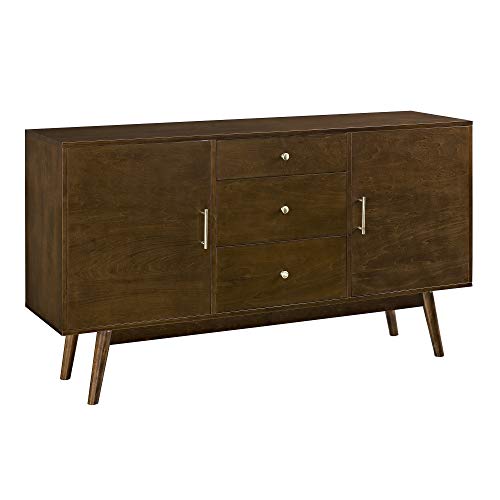
Walker Edison Mid-Century Modern TV Stand Console with 3 Drawers, 60 Inch, Walnut
For a family room, the Walker Edison 60-inch console wins on drawers. Three drawers means the daily debris of family viewing — remotes for three devices, controllers, charging cables, coasters, the good scissors nobody can ever find — stops living on the coffee table and starts living in divided, closable spaces. Closed cabinets hide the router, the streamer and the cable box from small hands and from view.
The mid-century walnut body is sturdy once assembled, and the low, wide stance is inherently stable. Anchor it to the wall with the anti-tip hardware you should use on any console in a house with climbing-age children, keep the heaviest items in the lowest compartments, and it becomes one of the calmest pieces of furniture in the house.
Long-term ownership of the three-drawer console centres on the drawers themselves: they are the component you will touch daily, so during assembly seat the runners carefully and evenly, and the drawers will glide for years; rush them and every drawer will remind you daily. The walnut laminate wipes clean, the cabinet bays fit standard component widths, and the 60-inch top leaves honest room at each end of a 65-inch TV for a speaker or a plant without crowding the screen. Owners consistently find the third drawer becomes the household’s unofficial headquarters — the place keys, chargers and the one good cable live — which is a compliment to the layout rather than an accident.
Who it suits: Families with a 55 to 65 inch TV and a permanent small-clutter problem.
Pros
- Three drawers tame family small-item chaos
- Closed storage keeps gear away from toddlers
- Wide, low, stable stance
Honest limitation: Drawer fronts and cabinet doors will show sticky fingerprints; the walnut finish wipes clean but you will wipe it often.
Choose it if your coffee table is currently a storage unit. Skip it if you need open, ventilated space for a large hot receiver.
Check on Amazon — check price on Amazon for the current finish and delivery options.
Bush Furniture Key West Tall TV Stand for 65 Inch TV, Linen White Oak
Family viewing generates bulk: board games, blankets, a games console per child, a library of films nobody streams. The Bush Key West’s taller 60-inch body simply holds more of it behind doors than the low consoles here, and its bright Linen White Oak finish with farmhouse X-accents survives family-room light without showing every scuff the way dark gloss does.
It supports TVs up to 65 inches and 75 pounds, the centre cubby with cable cutout keeps a player accessible for family movie night, and the construction is tested and warranty-backed — reassuring when the piece will be opened forty times a day by people of very different sizes and levels of care.
The Key West asks one thing of its owner — respect the height. Check seated eye level before ordering, and in return it delivers the deepest enclosed storage in this guide, a bright finish that lifts the room, and tested, warranty-backed construction that shrugs off daily use. The centre cubby keeps the everyday player reachable while everything else lives behind doors. The linen-toned finish is also the most forgiving of bright rooms: it neither glares in sun nor darkens at night, and its X-pattern doors give the piece a crafted presence that flat fronts cannot match.
Who it suits: Families who need maximum enclosed storage in a bright, farmhouse-leaning room.
Pros
- Largest enclosed volume in this lineup
- Bright finish hides everyday scuffs well
- Tested construction, manufacturer warranty
Honest limitation: The taller body raises the screen; measure seated eye level for younger viewers on low seating.
Choose it if board games and blankets need a real home. Skip it if your sofa sits very low and screen height is already marginal.
Check on Amazon — check price on Amazon for the current finish and delivery options.
Walker Edison Modern Slatted Wood TV Stand, 70 Inch, Dark Walnut
When the family TV has grown to 70 or 80 inches, the Walker Edison slatted console is the pick that keeps up: 70 inches wide, rated for TVs up to 80 inches, with open shelving that lets games consoles breathe during long holiday gaming sessions and cabinets that swallow everything else.
The dark walnut finish is the most forgiving in this guide for family life — dust, light scratches and the evidence of snack-based cinema all show less. The slatted front adds texture that distracts the eye from the minor marks any family console collects.
The slatted Walker Edison rewards owners who use its two storage types deliberately: open bays for the gear that breathes, closed cabinets for everything unsightly. Its dark walnut finish is the lowest-maintenance in this guide — dust shows late, marks show later — and its 70-inch span means it will anchor the room through the next TV upgrade as well as this one, provided the wall genuinely fits it. The slatted front also hides the minor scuffs of daily life better than any flat door, because the eye reads the rhythm of the slats rather than the surface between them.
Who it suits: Families with a very large TV and a wide wall to place it on.
Pros
- Handles TVs up to 80 inches
- Open shelves ventilate games consoles
- Dark finish forgives family wear
Honest limitation: Its width and visual weight need a genuinely large room; in a small family room it crowds everything else out.
Choose it if movie night happens on a 70 inch plus screen. Skip it if your family room wall is short or the room doubles as a play space needing floor area.
Check on Amazon — check price on Amazon for the current finish and delivery options.
Modway Render 70 Inch Mid-Century Modern Low Profile TV Stand, Walnut
The Modway Render’s low 70-inch profile puts a big family screen at a comfortable height for viewers of all sizes — adults on the sofa, children on the floor cushions in front — without a wall mount, drilling, or a TV perched at adult-standing eye level. The slatted sliding doors pass remote signals, so the streamer stays behind a door and out of reach of curious toddlers while remaining fully usable.
Sliding doors deserve a family-specific mention: they cannot swing into a passing child, they cannot be left hanging open as a head-height hazard, and they need no clearance in front — useful when the floor in front of the TV is prime play territory.
Living with the Render is about discipline rewarded: the sliding doors glide on their track with a fingertip, the slatted bays keep a streamer and console invisible yet responsive, and the low top becomes the calmest surface in the room if you defend its emptiness. Check your tallest component against the interior height before ordering, keep the soundbar centred, and the piece delivers the composed media wall its photographs promise. The walnut tone warms noticeably under evening light, and the long top ages gracefully because there is so little hardware on show to date it.
Who it suits: Families with a 65 to 70 inch TV who prefer low, mount-free placement.
Pros
- Low height suits mixed-age viewing
- Sliding doors are child-friendly and clearance-free
- Remote-friendly slatted doors hide gear safely
Honest limitation: Interior height is limited for tall receivers; check component dimensions first.
Choose it if you want the big screen low and the gear behind doors. Skip it if your AV receiver is tall or you need high interior compartments.
Check on Amazon — check price on Amazon for the current finish and delivery options.
Sauder Palladia Corner TV Stand Console, Vintage Oak
In a family room that must also be a play room, floor space is the scarcest resource in the house. The Sauder Palladia’s corner design moves the TV — up to 60 inches — into the room’s least useful square footage and hands both walls and the centre of the room back to play, seating and the inevitable fort construction.
Storage is family-practical: glide drawers for films and games, adjustable shelves for components, and display shelves up high for the photos and ornaments that need to live beyond toddler reach. The enclosed back with cord access keeps cables out of the corner where small hands explore.
Owning the Palladia is owning a solved corner: the drawers take the media library, the adjustable shelves adapt as components change, and the display shelves quietly become the room’s photo ledge. Traditional finishes like Vintage Oak age gracefully in real homes, and the enclosed back keeps the corner — the place dust and cables conspire most — the easiest corner in the house to keep clean. It is also the pick most likely to be mistaken for a furniture-store piece rather than a flat-pack one, which in a traditional room is precisely the point.
Who it suits: Families trading floor space for play area, with a TV up to 60 inches.
Pros
- Corner fit returns floor space to the family
- Drawers and shelves organise media and games
- Display shelves keep breakables up high
Honest limitation: Corner viewing angles suit a sofa facing the corner; wide side seating sees the screen at an angle.
Choose it if floor space matters more than a flat-wall layout. Skip it if your seating wraps widely around the room.
Check on Amazon — check price on Amazon for the current finish and delivery options.
Nathan James Dylan Media Console Cabinet with Herringbone Doors, Oak and Matte Black
Not every family screen is the main screen. The Nathan James Dylan, at 47 inches for TVs up to 50 inches, is the pick for the second family viewing space — a parents’ bedroom retreat, a teen room, a den — where the herringbone doors make it feel like chosen furniture rather than overflow storage.
Push-to-open doors keep the front clean, adjustable shelves handle a streamer and a console, and three cord holes keep the small setup honest. For families, its honest role is decompression space: one calm, good-looking corner where the small screen lives.
The Dylan’s ownership pleasure is disproportionate to its size: the herringbone front draws compliments, the push-to-open doors keep the silhouette clean, and its modest footprint means it redeploys effortlessly — living room today, bedroom or entry cabinet in the next home. Treat it as the design piece it is, keep the gear list to its honest capacity, and it will be the last piece you consider replacing. Its scale also makes it the easiest pick here to move, deep-clean around, and rearrange on a whim, which in real homes is a feature used monthly.
Who it suits: Second family viewing rooms with TVs up to 50 inches.
Pros
- Decorative herringbone front suits bedrooms and dens
- Compact footprint for secondary rooms
- Tidy cord management for simple setups
Honest limitation: Too small for the main family TV and gear collection — it is a secondary-room piece.
Choose it if you are furnishing a second viewing space. Skip it if this is for your main 65 inch family screen.
Check on Amazon — check price on Amazon for the current finish and delivery options.
Comparison table
| Console | Width | TV fit | Style | Storage |
|---|---|---|---|---|
| Walker Edison 60in 3-Drawer Console | 60 in | up to 65 in TVs | Mid-century modern, walnut finish | Three drawers plus closed cabinet storage |
| Bush Key West Tall 60in Stand | 60 in | up to 65 in TVs, 75 lb top capacity | Modern farmhouse and coastal, X-pattern accents | Center cubby with cable cutout plus cabinet storage |
| Walker Edison 70in Slatted Console | 70 in | up to 80 in TVs | Modern slatted wood, dark walnut | Storage cabinets and open shelves |
| Modway Render 70in Low Profile | 70 in | up to 70 in TVs | Mid-century modern, low profile, walnut | Slatted sliding doors with open shelving and cable routing |
| Sauder Palladia Corner Console | corner profile | up to 60 in TVs | Traditional raised-panel doors, Vintage Oak finish | Adjustable shelves, two glide drawers, corner display shelves |
| Nathan James Dylan 47in Cabinet | 47 in | up to 50 in TVs | Herringbone-pattern doors, oak and matte black | Push-to-open doors, adjustable shelves, three cord holes |
Read the table by constraint, not by taste. Start with the wall width you actually have, then the TV size you own today — not the one you might buy in three years — then the amount of gear that genuinely needs a home. The console that survives all three filters is almost always the right one, even if it was not your favourite photograph.
How to choose a media console for families that fits your room
Shop for the family you have this year, with one eye on the next stage. Toddlers need doors, anchoring and gear out of reach; school-age children need game and blanket storage; teenagers need console ventilation and charging order. The picks above are tagged by stage — match the tag, not just the photograph.
Put the heaviest storage low, always. Games, books and the console itself belong in the lowest compartments; light and soft things go high. Combined with a wall anchor, that weight distribution is what makes a family console genuinely stable rather than merely heavy.
Plan cables before the console arrives. List every device, every connection and every power brick, then confirm the console gives each one a route: cord holes, an open back, or a cable channel. A power strip inside a closed cabinet needs ventilation; a strip behind the console needs reach. Ten minutes of planning here saves the visible cable waterfall that ruins otherwise good rooms.
Think about heat honestly. Games consoles and AV receivers are small heaters. Open shelving, slatted doors and mesh-friendly fronts exist because closed solid doors trap heat and shorten component life. If your setup includes a current-generation console or a receiver, weight ventilation as heavily as storage in your final choice.
Create one family charging and remote station inside a drawer or cabinet bay and defend it for a month; families who do this stop losing remotes entirely. The drawer-equipped picks in this guide make that system effortless.
Common mistakes to avoid
Mistake zero for families: leaving the console unanchored because it feels heavy. Weight is not anchoring; a determined climber generates leverage no cabinet weight resists. Fit the anti-tip strap the day the console is built.
Mistake one: buying by photograph instead of by tape measure. Consoles photograph smaller than they are; the 70-inch picks in this guide are genuinely wide furniture. Measure the wall, mark it with painter’s tape, and live with the outline for a day before ordering.
Mistake two: trapping hot gear behind solid doors. If a console or receiver runs warm in an open rack, it will run hotter in a closed cabinet. Choose slatted, open or ventilated storage for heat-producing gear, or leave the door of that bay open during long sessions.
Mistake five: buying a beautiful low console for a toddler household without checking door mechanics. Swing doors at toddler head height, left ajar, are a daily hazard; sliding or push-to-open fronts are the family-friendly mechanics.
What the under $700 budget buys a family
For families, this budget is where consoles stop being fragile. Below it, doors vanish, spans narrow, and construction lightens to a degree that daily family use exposes within a year. At under $700 a family buys width that fits the real TV, doors that close on the real clutter, drawers that survive ten thousand openings, and — on the tested picks — construction a manufacturer will warrant. What it does not buy is immunity: no console at any price survives being a climbing frame unanchored, a drinks coaster unprotected, or a cabinet sealed around a hot console. The family’s part of the bargain is the anchor, the coaster and the ventilated bay.
Spend the budget in family order: stability first, enclosed storage second, forgiveness of finish third, beauty fourth — beauty still matters, because a room the adults enjoy is a room the family gathers in, but it is the only one of the four that can wait for the next purchase. Keep a small reserve from the total for the safety and order accessories: anti-tip hardware if the kit is incomplete, interior child latches, a cable raceway, and the drawer organisers that turn three drawers into a system.
Judged over a childhood, the economics are kind. One well-chosen console bought at this level serves the toddler years, the gaming years and the film-night years with rearrangements rather than replacements, and then redeploys to a bedroom or hallway when the family room finally upgrades. Few purchases in a family home work that long for that little per year.
Delivery, warranty and returns — the family notes
Furniture this size arrives in one or two heavy flat-pack boxes, and family households should plan the delivery like any other logistics: clear the room corner where the box will live until build day, because a 70-inch console’s carton in a hallway is a climbing object with staples. Build it the same week it arrives, while the return window is wide and any transit damage can still be photographed, reported and resolved without argument. Photograph the unboxing if a panel arrives damaged; the established brands in this guide — Walker Edison, Sauder, Bush Furniture among them — run proper parts-replacement services, and a photograph plus the part number from the manual resolves most issues with a shipped panel rather than a returned console.
Keep the warranty paperwork with the assembly manual inside the console itself. Bush Furniture backs its tested construction with a manufacturer warranty, Sauder has a long-standing parts programme, and Walker Edison and Nathan James both support replacement parts through their listings and websites — but every one of those routes starts with the model information printed in the manual you were about to throw away. Families register products late or never; the two minutes it takes to note the model and purchase date on the manual’s cover is the whole system, and it works.
If the pick proves wrong for the room — too wide, too tall, wrong dialect of family chaos — act inside the return window rather than adapting around it for years. Consoles are too large to live with apologetically. The checklist earlier in this guide prevents most of those outcomes; the return window exists for the rest.
Final recommendation
For most families the Walker Edison three-drawer console is the answer: drawers for the chaos, cabinets for the gear, and a stable walnut stance that anchors the room. Families whose real problem is bulk — games, blankets, everything — should step to the taller Bush Key West, and families whose real problem is floor space should let the Sauder Palladia give the corner a job. All three decisions are about which family problem you actually have.
Our first call for most readers is the Walker Edison 60in 3-Drawer Console — Check on Amazon. If that shape does not fit your room, the Bush Key West Tall 60in Stand (Check on Amazon) and the Walker Edison 70in Slatted Console (Check on Amazon) cover the next most common situations in this guide.
Family-proofing the setup around the console
The console is the centre of family-proofing, not the whole of it. Anchor the console and, if the TV stands on it, secure the TV according to its maker’s guidance. Route every cable inside the cabinet or in a raceway so no loop hangs where a toddler can grab it, and put the power strip inside a ventilated bay or behind the console out of reach — never on the floor in front, where it becomes a fascinating object with switches.
Set the room’s rules into the furniture itself: one drawer or basket is the remote home, one shelf is the games shelf, and the top of the console is a no-drinks surface enforced by coasters living visibly on it. Families keep systems that the furniture makes easy and abandon systems that require tidiness as a virtue. That is why the drawer and door picks dominate this guide’s family rankings — they make the tidy behaviour the lazy behaviour.
Revisit the arrangement at each family stage. The bay that held a baby monitor receiver becomes the charging bay; the games shelf becomes the homework shelf near the TV room’s desk corner. A family console earns its decade by being rearranged, not replaced, and the adjustable shelves in these picks exist for exactly those transitions.
Setting up your media console properly
Unbox in the room where the console will live and inventory every panel and hardware bag against the parts list before a single screw turns. Flat-pack furniture punishes the discovery of a missing cam lock at step fourteen; five minutes of inventory at step zero is the cheapest insurance in the whole purchase. Build on carpet or the flattened box to protect the finish, keep a second person for any panel longer than your arm span, and resist the impact driver: hand-tighten first, square the frame, then snug everything in sequence.
Placement deserves the same care as assembly. Centre the console on the seating, not on the wall — rooms are rarely symmetrical, and the sofa is the reference point that matters every evening. Leave a working gap behind the cabinet for cable bend and airflow; a console pushed hard against the skirting crushes connectors and traps the warm air your gear is trying to shed. Once placed, level the piece: most floors slope more than you think, and a door that will not sit true is usually a floor problem wearing a furniture costume.
Wire the setup in a deliberate order: power strip first, placed where it can be reached without moving the cabinet; then the TV connection; then sources from largest to smallest. Label both ends of every cable with a strip of tape and a pen. It feels excessive on day one and feels genius on the day you swap a streamer in ninety seconds without pulling the console out. Coil surplus cable inside the cabinet, never behind it on the floor, where it becomes a dust farm and a trip line for the vacuum.
Finish with the safety pass. If the household includes children or large pets, fit the anti-tip anchor now, while the tools are out. Route the TV’s power so it cannot be pulled, check that no cable is pinched by a door or drawer, and run the hottest device — usually the games console — for an hour with the doors in their normal position, then feel the air inside the bay. Warm is fine; hot means rearrange for airflow before it becomes a reliability problem.
Materials, care and long-term ownership
Most consoles in this price band are engineered wood — MDF or particleboard — finished in laminate or veneer, and that is an honest construction at under $700 provided you treat it as furniture rather than as solid oak. The practical implications are simple: use coasters, wipe spills the day they happen rather than the week after, keep the piece out of sustained direct sun where finishes fade unevenly, and never drag a loaded console across the floor — lift it, or empty it first, because racking forces are what loosen flat-pack joints over time.
Day-to-day care is a microfibre cloth, slightly damp for sticky marks, and a strict no-abrasives rule on laminate finishes. Walnut-tone finishes forgive dust and minor marks; pale finishes like linen oak show less dust but more scuff, so a touch-up marker in a matching tone is a sensible drawer item in busy households. Slatted and herringbone fronts collect dust in their texture — a soft brush attachment on the vacuum keeps them honest in seconds.
Ownership economics favour this tier more than buyers expect. A console at this level that is assembled carefully, anchored, kept dry and not overloaded will serve a decade of ordinary use, and its cost per year undercuts both the disposable tier below it — replaced twice in the same period — and the designer tier above it, whose extra money buys material romance rather than extra function. When the room changes, these pieces also move rooms gracefully: today’s media console is tomorrow’s sideboard, entry cabinet or bedroom dresser-height storage, which is the quiet second life that makes a good under $700 buy a genuinely good one.
Finally, keep the assembly hardware. A small labelled bag with the spare cams, screws and the Allen key, taped inside a cabinet door, turns every future house move from a furniture risk into a twenty-minute job — and keeps a good console in service instead of in a skip.
Four family stages, four right answers
The toddler household. Priorities are anchoring, closed storage and doors that cannot swing. The Modway Render’s sliding slatted doors and low stance, or the Walker Edison’s cabinets with latches added, serve this stage best. Keep every cable inside the furniture, the power strip out of reach, and the top of the console a display-free zone until small hands stop using it as a climbing aid — because they will test it as one.
The school-age household. The inventory explodes: two consoles, a library of games, blankets for film night, chargers for everyone’s devices. This is the Bush Key West’s stage — maximum enclosed volume, a cubby for the everyday player, and a finish that survives the traffic. Add one defended drawer for remotes and chargers and the room’s daily reset takes ninety seconds.
The teenager household. Ventilation and screen size take over: long gaming sessions on a large TV need the slatted Walker Edison’s open bays and 80-inch capacity. The social centre of the house has moved to this room, so choose the console that keeps it handsome under heavy, daily, not-always-gentle use — dark finishes and closed storage for everything except the gear that breathes.
The multigenerational room. When grandparents and grandchildren share the screen, comfort is a height question and a clarity question: a low console that centres the screen for every seat, storage that keeps shared spaces calm, and nothing precious within reach of the youngest viewers. The three-drawer Walker Edison is the consensus pick — the room’s Switzerland, suiting every generation’s habits at once.
Pre-purchase checklist
Run this checklist in order before ordering; for families it doubles as a safety audit, and it takes ten minutes at most.
One: measure the TV’s actual width and weight, not its advertised diagonal, and match both against the console’s stated capacity. Two: measure the wall run and mark it with painter’s tape at the console’s true width and height, then live with the tape for a day. Three: measure your deepest component and tallest component, and confirm the intended bay clears both with room for cables behind. Four: count power outlets within reach of the console’s position and confirm the power strip plan works without an extension lead crossing a walkway. Five: check the delivery path — door widths, hallway turns, stairs, lift size — against the box dimensions on the listing, because the best console in this guide is worthless if its box cannot reach the room.
Six: confirm the finish against your room in your light, using the listing’s room photographs rather than the studio shot; walnut reads darker in north-facing rooms and paler under warm evening bulbs. Seven: read the assembly requirement honestly — tools, time, second pair of hands — and schedule the build when you have all three. Eight: decide the anchor plan for the TV and console before the box arrives, not after the piece is loaded. Nine: photograph your current cable setup before dismantling it; the photograph is the fastest wiring diagram you will ever own. Ten: keep the receipt, the hardware spares and the instructions together inside the console itself, where future-you will actually find them.
None of this is glamorous, and all of it is the difference between the households who love their console for a decade and the households who list theirs for sale within the year. The furniture at this price is genuinely good; the outcomes differ on preparation, not on product.
FAQ
What is the safest type of media console for toddlers?
A low, wide console with closed storage, sliding or push-to-open doors, no glass, and a fitted anti-tip wall anchor. Keep heavy items in the lowest compartments and hot gear behind slatted or ventilated doors that still pass remote signals.
How do I stop family clutter taking over the TV area?
Drawers. A console with two or three drawers gives remotes, controllers and chargers a permanent home; households consistently keep drawer systems tidier than open-shelf systems because closing a drawer is easier than arranging a shelf.
Can a family console handle games consoles safely?
Yes, with ventilation. Use open shelves or slatted-door bays for games consoles, leave clearance around the vents, and avoid sealing a running console in a solid closed cabinet.
What TV height works for children and adults?
A low-profile console that centres the screen near seated adult eye level also serves children on floor cushions well. Very tall consoles raise the screen for everyone and are the first thing to check with low family sofas.
How long should a family media console last?
Choose for a five-to-ten-year horizon: a TV size up from today’s, storage beyond today’s inventory, and a finish your room will still suit after the next sofa. Stage-specific picks like a compact second-room console are the exception — buy those for the stage.
How do I keep children from opening the cabinets?
Choose sliding or push-to-open fronts, which resist toddler leverage better than knobbed doors, and add adhesive child latches inside the bays that hold anything fragile or electronic. Keep the everyday device in a remote-friendly bay so adults are not fighting the system nightly.
What finish hides family wear best?
Mid and dark wood tones — the walnut finishes in this guide — hide dust, light marks and fingerprints longest between cleans. Pale finishes wipe clean easily and brighten the room, but show scuffs sooner in high-traffic family use.
Related guides
- Best Media Console Under $700
- Best Media Console For Families Under $300
- Best Media Console For Families Under $1000
- Best Storage Ottoman Under $300
- Best Media Console For Small Spaces Under $700
Browse those companion guides if your room needs more than a console: the right neighbours for a media wall are storage, seating and cable order, in that order.