Disclosure: As an Amazon Associate, dailyhomedecorating.com earns from qualifying purchases. Links to Amazon on this page are affiliate links; they cost you nothing extra. Prices and availability change often, so check the current Amazon listing before you buy.
Finding the best futon mattresses for sleeping is a different job from finding a futon pad that merely survives the occasional guest. A pad that feels fine for one weekend on a friend’s floor can turn into a nightly complaint once you are sleeping on it five, six, seven nights a week: it packs down, it bottoms out against the slats, and you start waking up with a line of pressure across your hips or shoulders that a thicker, better-built sleep surface would have spread out. If your futon is your bed — in a studio, a small apartment, a dorm-adjacent rental, or a spare room that doubles as your bedroom — the mattress on it has to do real mattress work, not occasional-guest work.
This guide treats the futon as a primary bed. Every pick below was judged on how it sleeps night after night: thickness enough to keep your body off the frame, foam or coils that recover between nights, and a build that tolerates being folded, rolled, or left flat without falling apart. A few of the strongest options are purpose-built folding mattresses; others are slim bed-in-a-box mattresses that behave well on futon frames kept in the flat position. Where the verified pool ran out of honest futon options, we say so and fill the remaining slots with prose-only picks described qualitatively, with no links and no invented specifications.
Where to Buy
Every linked pick in this guide is sold on Amazon, which is where you should check the current price, size options, and availability before buying — futon-friendly sizes sell out unevenly, and the twin and full sizes matter more here than queen. Start with the Milliard Trifold Mattress if you need a true folding sleep surface, and use its Check on Amazon link to confirm the size you need. The remaining picks: Best Price Mattress 6 inch Bed-In-A-Box — Check on Amazon; Linenspa 8 Inch Hybrid Mattress — Check on Amazon; Lucid 10 Inch Gel Memory Foam Mattress — Check on Amazon; a classic cotton futon pad (prose-only pick, described below); and a natural latex futon mattress (prose-only pick, described below).
In this guide
Quick Picks
| Pick | Badge | Why it earns its place |
|---|---|---|
| Milliard Trifold Mattress | Best Overall | A genuine folding mattress with memory foam comfort, a washable cover, and a tri-fold design that stores in a closet — the closest thing to a futon pad that sleeps like a bed. |
| Best Price Mattress Full Mattress 6 inch Bed-In-A-Box | Best Budget | Six inches of green-tea memory foam in a slim profile that sits well on a futon frame left flat and does not overwhelm a small room. |
| Linenspa 8 Inch Hybrid Mattress | Best Compact | A twin hybrid with real coils under memory foam, light enough to move, and supportive enough for nightly use in tight spaces. |
| Lucid 10 Inch Gel Memory Foam Mattress | Best for Full-Time Futon Frames | For futons that stay flat as permanent beds: gel foam cooling, a full layered build, and adjustable-base compatibility. |
| Classic Cotton Futon Pad (prose-only) | Best Traditional Feel | The firm, dense, floor-sleeping feel many futon sleepers actually want — described qualitatively below, no link. |
| Natural Latex Futon Mattress (prose-only) | Best Premium | Responsive, durable latex over a futon frame for sleepers who dislike memory foam’s slow hug — described qualitatively below, no link. |
Key Takeaways
- For nightly sleeping, thickness is protection: six inches is the floor for a primary futon bed, and eight to ten inches is kinder if your frame stays flat.
- A tri-fold mattress is the only pick here that truly folds away daily; the bed-in-a-box picks suit futon frames that live in the bed position.
- Memory foam futon surfaces isolate motion and cushion shoulders and hips, but they sleep warmer and recover slowly after folding.
- Hybrid and latex builds feel more responsive and breathe better, which matters in small rooms where a futon is also the sofa.
- Rotate and air out any futon mattress weekly; folding foam that never breathes is where odor and flat spots start.
- If you are comparing sleep surfaces broadly, our guide to Best Mattresses For Pressure Relief explains why cushion depth matters so much on hard frames.
How These Picks Were Chosen
We started from the verified product pool for this topic and filtered hard for futon reality. Anything over ten inches thick was excluded from the linked picks unless the article angle justified it, because a very thick mattress on a folding futon frame either will not fold or will strain the frame’s hinges and your back every time you force it. Anything without a plausible small-space story — heavy queen builds meant for permanent platform beds — was also set aside. What survived had to meet three tests: a profile a futon frame or floor setup can actually carry, a comfort layer thick enough for nightly rather than occasional sleep, and construction details we could verify from the pool data rather than invent.
Two slots are prose-only, and we want to be transparent about why. The pool is strong on conventional bed-in-a-box mattresses and thin on traditional futon pads and latex futon builds, both of which real futon shoppers ask about constantly. Rather than pretend a twelve-inch queen foam mattress is a futon pad, we describe those two categories qualitatively — what they feel like, who they suit, what to look for — with no links and no specifications we cannot verify. Everything linked below is a pool product with a verified ASIN, and the mini spec boxes use only the verified specifications supplied for each product.
Our research method is desk research: manufacturer listings, verified specifications, and category knowledge about how futon sleepers actually live with these products. We do not claim hands-on testing we did not do. Where a product has a genuine limitation for futon use — and several do — it is stated in its Trade-offs list, not buried.
The 6 Best Futon Mattresses for Sleeping — Reviewed

Milliard Trifold Mattress
Our badge: Best Overall
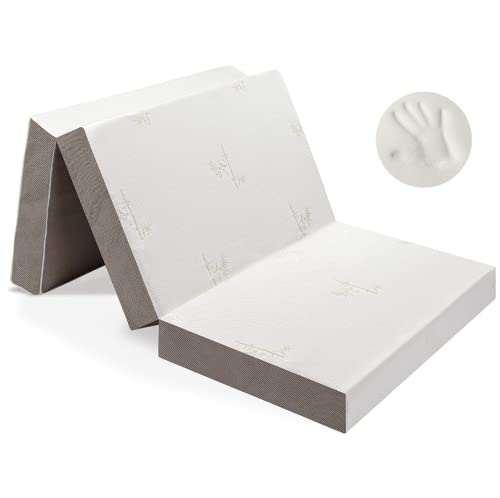
The Milliard Trifold Mattress is the one pick in this guide that was designed from the first sketch for exactly the life a futon leads: it folds. The tri-fold design splits the mattress into three sections that stack neatly in seconds, so a studio dweller can sleep on it at night, fold it against a wall or into a closet in the morning, and get their floor back. Under the cover is high-density memory foam that contours to the body and relieves pressure points, giving full-body support that feels far closer to a real bed than the thin cotton pads most people picture when they hear the word futon.
Strengths
- True tri-fold portability — folds in seconds for closets, corners, and car trunks
- Memory foam comfort layer cushions shoulders and hips against hard floors and slats
- Removable, machine-washable cover keeps a daily-use folding bed genuinely cleanable
Trade-offs
- At six inches, heavier side sleepers may still feel the floor through it on very hard surfaces
- The pool listing is a Twin XL footprint, so couples and wide sleepers should check size options carefully
- Memory foam folds best when given a few minutes to relax after unfolding; it is not instant
| Color | White |
| Size | Twin XL |
| Dimensions | 78 x 38 x 6 inches |
Sleep on it nightly and the Milliard’s virtues compound. Because it folds, it also airs: standing the folded mattress on edge for an hour while you clean gives the foam a breathing cycle that flat mattresses never get, and that habit alone fights the musty smell that plagues futons in small apartments. The washable cover is not a minor feature on a bed that doubles as seating and floor furniture — it is the difference between a surface you can keep fresh with a laundry cycle and one you can only spot-clean and hope. Guests, sleepovers, dorm rooms, RV trips, and camping all appear in this mattress’s natural resume, but its best trick is being a legitimate everyday bed for one person in a small space.
Durability expectations should be honest: a six-inch folding foam mattress asked to work every night will compress faster than a ten-inch stationary bed, and rotating which fold section takes your hip weight — flipping it head-to-foot weekly — spreads that wear. Pair it with a thin rug or mat underneath on hardwood to stop sliding and add a whisper of insulation in winter. If you are also weighing a folding bed against a sleeper sofa, our notes on Best Mattresses For Sleeper Sofas cover the other half of that small-space decision.
Best for: studio and small-apartment sleepers who must reclaim their floor every morning / Not suited for: couples or anyone who needs a wide, permanent sleep surface
Choose it if folding is non-negotiable; skip it if your futon frame stays flat permanently and you can carry more thickness. Check on Amazon

Best Price Mattress Full Mattress 6 inch Bed-In-A-Box
Our badge: Best Budget
The Best Price Mattress 6 inch Bed-In-A-Box earns its slot by being the slim, simple answer for a futon frame that lives flat. Six inches of layered foam — memory foam over support and high-density layers — in a full-size footprint gives a small bedroom or guest room a real sleep surface without the bulk, weight, or cost structure of a thick flagship mattress. The memory foam is infused with green tea, a freshness touch aimed at keeping the mattress smelling neutral, and the foams are CertiPUR-US certified.
Strengths
- Slim six-inch profile sits naturally on futon frames and low platforms
- Light for its size, so one person can unbox, place, and rotate it without help
- Layered foam build balances contouring with a supportive base for nightly use
Trade-offs
- Six inches is the minimum for nightly sleeping; heavier sleepers will want more depth
- It does not fold, so it only suits futons kept in the bed position
- The full-size footprint is narrower than a queen for two sleepers
| Color | White |
| Size | 6 Inch |
| Dimensions | 75 x 54 x 6 inches |
| Weight | 30.42 pounds |
Think of this mattress as the sensible default for the spare-room futon that has quietly become someone’s actual bed — a college graduate’s first apartment, a home office that hosts a long-term guest, a teenager’s room where the futon is both couch and bed. The foam layers mold to the body and relieve pressure points in the way memory foam does best, and because the whole thing weighs barely thirty pounds, the practical chores of futon life — rotating it, lifting it to clean underneath, moving it to a new apartment — stay one-person jobs. That lightness is an underrated quality-of-life feature in small spaces, where every furniture decision is also a moving decision.
Set expectations on feel: this is a thinner, firmer-leaning foam bed. Back sleepers and stomach sleepers generally adapt fastest; strict side sleepers with sharp hip or shoulder pressure may want a thin topper after a trial week, which is still a cheaper total package than most thicker mattresses. The green tea infusion addresses freshness at the foam level, but your habits matter more — a washable protector and a weekly airing will do more for long-term freshness than any infusion. Shoppers comparing slim foam beds across budgets will also want to see Best Mattresses Under $200, where this style of mattress is the main event.
Best for: budget-conscious sleepers furnishing a futon frame that stays flat / Not suited for: anyone who needs to fold the mattress away daily
Choose it for value and simplicity; skip it if you are a heavier side sleeper who already knows six inches is not enough. Check on Amazon
Linenspa 8 Inch Hybrid Mattress
Our badge: Best Compact
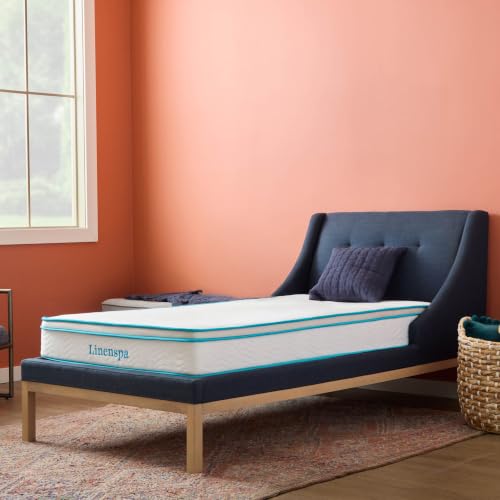
The Linenspa 8 Inch Hybrid Mattress brings something the foam picks cannot: springs. Its hybrid build pairs a memory foam comfort layer with durable steel innerspring coils, which gives a twin-size futon or daybed a responsive, slightly bouncy feel that many sleepers — especially those raised on traditional mattresses — find far more natural than slow-sinking foam. At eight inches in a twin footprint and thirty-six pounds, it is compact, movable, and honestly built for the guest rooms, youth rooms, and small spaces where futons earn their keep.
Strengths
- Coil support adds responsiveness and airflow that all-foam futon pads lack
- Medium-firm feel suits back and stomach sleepers and growing teenagers well
- Twin footprint and modest weight make it the easiest full mattress here to maneuver
Trade-offs
- Twin size only in this listing — a one-sleeper solution by design
- Coils transfer more motion than foam, though a twin futon rarely hosts two sleepers
- An eight-inch hybrid on a folding frame should stay flat; it is not a fold-away pick
| Color | Mattress Only |
| Size | Twin |
| Dimensions | 74 x 39 x 8 inches |
| Weight | 36 pounds |
The Linenspa’s real-world appeal is how unremarkable it feels — in the good way. You lie down and it feels like a mattress, not a compromise: the coils push back, the foam softens the top, and getting up in the morning does not involve climbing out of a foam crater. For a futon in a teen’s room, a bunk-adjacent daybed, a trundle, or a narrow guest nook, that normalcy is the point. The manufacturer suggests allowing one to three days for full expansion after unboxing, faster in a warm room, and that patience pays off in edge support and even feel.
Care is straightforward: a protector against spills, a rotation every few months, and a frame or foundation with slats close enough to support the coil unit. Because it breathes better than all-foam rivals, it is also a sensible pick for warm rooms and for sleepers who found memory foam futon pads uncomfortably hot by 3 a.m. If your small-space bed must also impress a visiting parent, this is the futon-adjacent pick least likely to draw a complaint at breakfast.
Best for: single sleepers, teens, and guest nooks wanting a traditional mattress feel in a compact size / Not suited for: couples or daily fold-away routines
Choose it for springy, breathable support in a twin; skip it if you need queen width or true folding. Check on Amazon

Lucid 10 Inch Gel Memory Foam Mattress
Our badge: Best for Full-Time Futon Frames
The Lucid 10 Inch Gel Memory Foam Mattress is our pick for the large group of futon owners whose frame never folds at all — the futon is simply the bed, full stop. At ten inches with three working layers (three inches of gel-infused memory foam, a transition layer, and a high-density base), it delivers the closest thing to a conventional mattress experience in this guide, and its gel infusion plus bamboo charcoal are aimed squarely at memory foam’s traditional weakness: sleeping hot.
Strengths
- Three inches of gel memory foam cushions pressure points while drawing heat away
- Bamboo charcoal helps absorb moisture and regulate temperature through the night
- Compatible with adjustable bases, platform frames, and slatted frames
Trade-offs
- Ten inches and nearly fifty-eight pounds end any thought of folding it away
- Medium feel may read soft to strict stomach sleepers who like a plank-firm surface
- Needs a frame with adequate slat support; a worn futon frame with wide gaps will let it sag
| Color | White |
| Size | Queen |
| Dimensions | 79 x 59 x 10 inches |
| Weight | 57.9 pounds |
On a sturdy futon frame kept flat, the Lucid stops feeling like a futon compromise within a night or two. The comfort layer is thick enough that side sleepers’ shoulders sink in rather than perch on top, the transition layer keeps that sink from becoming a swallow, and the base holds spinal alignment in the steady way high-density foam does. The cooling story is measured but real: gel foam does not make a mattress cold, yet combined with the charcoal’s moisture handling it takes the edge off the trapped-heat feeling that drives people away from memory foam futon pads. It is CertiPUR-US certified, fiberglass free, and backed by a ten-year warranty, which matters when this is your every-night bed rather than a guest afterthought.
Practical notes: unbox it directly on the frame, give it room to expand, and check that your futon frame’s slats are closely spaced — foam mattresses telegraph every gap. If your futon still moonlights as a sofa, know that a ten-inch mattress makes a deep, lounge-like seat that some people love and shorter people find awkward to rise from. For nightly sleep quality per dollar of frame you already own, though, this is the upgrade pick. Sleepers whose futon is really a pressure-relief project should also read Best Mattresses For Joint Pain for how cushion depth interacts with sore joints.
Best for: futon owners whose frame stays flat and who want a real-mattress feel with cooling help / Not suited for: anyone who folds the futon daily or needs to carry the mattress between rooms
Choose it for the fullest sleep experience on a stationary frame; skip it if portability is the whole point of your futon. Check on Amazon
Classic Cotton Futon Pad (Prose-Only Pick)
Our badge: Best Traditional Feel
Some futon sleepers do not want foam at all, and this prose-only pick is for them. A classic cotton futon pad — layers of cotton batting, sometimes blended with a thin foam core, inside a cotton twill cover — delivers the firm, dense, close-to-the-floor feel that traditional futon sleeping is built on. There is no sink and no hug: you lie on it more than in it, and many back sleepers, floor-sleeping enthusiasts, and people raised on firm beds find that honesty deeply comfortable. We describe it qualitatively because the verified pool contains no cotton futon pad to link.
Strengths
- Firm, stable surface that back sleepers and floor-sleeping fans genuinely prefer
- Natural fibers breathe well and avoid the warm-up period foam needs
- Rolls or folds for storage in the traditional futon manner
Trade-offs
- Cotton packs down over time and needs regular rolling, flipping, and sunning to stay even
- Offers the least pressure cushioning of any pick here — side sleepers often feel it at the hip
- Heavier than its size suggests once the batting is dense enough for nightly use
No verified specifications are listed for this prose-only pick, and we will not invent any. What to look for when shopping one: batting dense enough that you cannot easily pinch the pad flat between two fingers, a cover you can remove or at least spot-clean thoroughly, and a thickness toward the upper end of the futon range if it will be your nightly bed. Cotton futons reward ritual — the traditional routine of rolling the pad each morning is not fussiness, it is maintenance that redistributes the batting and airs the fibers. Sleepers who maintain that ritual get years of firm, even support; sleepers who leave a cotton pad folded on a frame for months get lumps. If firm simplicity appeals but you want a little more give, the latex pick below splits the difference.
Best for: firm-bed traditionalists and back sleepers who like sleeping on, not in, their futon / Not suited for: side sleepers needing real pressure cushioning
Choose it for the authentic firm futon experience and maintain it faithfully; skip it if you already know you wake sore on hard surfaces.
Natural Latex Futon Mattress (Prose-Only Pick)
Our badge: Best Premium
The premium end of the futon world belongs to latex, and this prose-only pick describes the category rather than a linked product, because the verified pool holds no latex futon mattress. A natural latex futon build — a latex core, sometimes over a thin foam or cotton base, in a washable or wipeable cover — feels instantly responsive where memory foam feels slow: you press in, it presses back, and changing position takes no effort at all. For combination sleepers who roll from back to side all night on a futon, that responsiveness is the difference between sleeping and wrestling.
Strengths
- Responsive, buoyant support that never traps you in a body-shaped crater
- Latex is famously durable, resisting the permanent body impressions foam develops
- Open, breathable structure sleeps temperature-neutral for most people
Trade-offs
- The most expensive route to a good futon bed, by a wide margin
- Latex is heavy and floppy to move despite folding or rolling for storage
- The buoyant feel is wrong for sleepers who specifically love memory foam’s hug
Shopping guidance, kept qualitative on purpose: look for latex described as natural rather than blended if purity is your priority, a core thick enough to stand between you and the slats on its own, and a cover that comes off for washing, because a premium futon mattress is a long-term possession worth protecting. Latex also pairs well with the futon lifestyle in one subtle way — it tolerates being rolled and stored better than thick memory foam, which can crease and tear at fold lines over years of daily folding. If your budget stretches and your futon is a five-year bed rather than a one-year stopgap, latex is where futon shoppers land when they decide to stop compromising.
Best for: long-term futon sleepers who want responsive, durable, premium comfort / Not suited for: tight budgets or anyone who loves slow memory-foam contouring
Choose it as the buy-once futon upgrade; skip it if your futon is a temporary arrangement you will replace within the year.
Comparison Table
| Pick | Profile | Size (verified) | Folds Away? | Check price on Amazon |
|---|---|---|---|---|
| Milliard Trifold Mattress | 6 inch | Twin XL | Yes — tri-fold | Check price on Amazon |
| Best Price Mattress 6 inch | 6 inch | Full | No | Check price on Amazon |
| Linenspa 8 Inch Hybrid | 8 inch | Twin | No | Check price on Amazon |
| Lucid 10 Inch Gel Memory Foam | 10 inch | Queen | No | Check price on Amazon |
| Classic Cotton Futon Pad | Varies | Prose-only | Yes — rolls/folds | Check price on Amazon |
| Natural Latex Futon Mattress | Varies | Prose-only | Rolls with effort | Check price on Amazon |
How to Choose the Best Futon Mattress for Sleeping
Decide First: Does It Fold or Stay Flat?
This single answer eliminates half the market. A futon that converts daily — sofa by day, bed by night, or floor bed that stores in a closet — needs a mattress built to bend: a tri-fold foam design or a traditional pad. Forcing a thick conventional mattress to fold stresses its foams, voids warranties, and can damage frame hinges. A futon that stays flat forever should be shopped like a normal bed, where thickness and layer quality matter more than flexibility. Be honest about your actual routine, not the routine you imagine: most “convertible” futons in real homes settle into one position within a month.
Thickness Versus Your Body and Sleep Position
On a hard frame or floor, thickness is your only suspension system. Six inches is the practical minimum for nightly use, and it suits back and stomach sleepers and lighter bodies best. Side sleepers concentrate their weight on a shoulder and a hip, and on thin futon surfaces those points find the slats fast — eight to ten inches, or six inches plus a topper, is the kinder range. Heavier sleepers compress any given thickness further, so they should shop one step thicker than a lighter sleeper in the same position. Our deeper discussion in Best Mattresses For Sore Backs covers how this thickness logic plays out when you are already waking up stiff.
Foam, Hybrid, Cotton, or Latex Feel
Memory foam contours and isolates motion, at the cost of warmth and slow response. Hybrids add coil bounce and airflow, at the cost of foldability. Cotton is firm, traditional, and maintenance-hungry. Latex is responsive, cool, and durable, at the cost of price and weight. None of these is “best” in the abstract — the right answer is the feel your body already prefers on conventional beds, translated into a futon-compatible build. If you have never liked memory foam on a regular mattress, a memory foam futon will not convert you.
Frame Fit and Slat Spacing
Measure your frame before ordering anything. Futon frames come in twin, full, and queen widths, and a mattress that overhangs the slats will break down at the unsupported edges. Check slat spacing too: foam mattresses need closely spaced support, and wide gaps let foam sag into stripes that you will feel through the surface. A thin bunkie board or a sheet of pegboard over widely spaced slats is a legitimate, cheap fix that rescues many futon setups. Also confirm the frame’s weight rating if you are adding a heavier mattress plus two sleepers.
Cleaning and Freshness Features
A futon mattress lives closer to daily life than a bedroom mattress — it is sat on, folded, stored, and sometimes eaten near. A removable washable cover, like the Milliard’s, is therefore worth real money. Failing that, budget for a washable protector from day one. Freshness infusions such as green tea in foam help at the margins, but airing, sunlight when possible, and prompt spill cleanup do the heavy lifting. If freshness is a top concern because of allergies or a small, humid apartment, pair this guide with Best Mattresses For Allergies for the hygiene side of the decision.
How Do You Keep a Futon Mattress Fresh and Even?
Futon mattresses age from compression and moisture, and both enemies are fought with routine rather than products. Flip and rotate the mattress weekly if its design allows — head-to-foot at minimum — so the same foam is not carrying your hips every night. Air it whenever you can: stand a folding mattress on edge, drape a pad over a frame in its upright position, or open windows near a flat futon for an hour. Sunlight is a traditional and effective freshener for cotton pads in particular. Keep a washable protector on the sleep surface, wash bedding weekly, and never fold a futon mattress away while it is even slightly damp from a humid night — that trapped moisture is where musty odors are born.
Problem: a permanent dip where your hips sleep — rotate the mattress 180 degrees and, if it is a folding model, change which section sits under your hips; add a thin topper to redistribute load if the dip returns.
Problem: musty smell after humid weeks — air the mattress outdoors or by an open window for several hours, sprinkle and vacuum off plain baking soda, and store it only when fully dry.
Problem: feeling the slats through the mattress — your comfort layer is too thin for your position; add a topper, tighten slat spacing with a bunkie board, or step up in thickness at replacement time.
Problem: the mattress slides on the frame or floor — place a non-slip rug pad underneath and check that the frame’s retainer bars or pins are in place.
Problem: fold lines feel like ridges — give folded foam a few hours flat before sleeping, and rotate which fold takes your torso weight each week.
Futon Sleeping in Small Spaces: Making One Room Do Everything
The futon sleeper’s real challenge is rarely the mattress alone — it is the room. A studio where the bed is also the sofa, the guest room, and the visual center of the home rewards choices that reduce friction: a mattress light enough to move without dread, a cover that survives being sat on in street clothes, bedding that stores in the same closet the mattress folds into. Think in systems. If the mattress folds, keep a dedicated shelf or corner for it so folding away takes two minutes, not twenty; routines that are easy get done, and done routines are what keep a small space livable. Lighting and a small side surface matter too — a futon bed with nowhere to put a glass of water or a book will always feel like camping, however good the mattress is.
There is also a sleep-quality argument for the ritual itself. Converting the room from living mode to sleep mode — folding the seating away, laying the mattress flat, changing the lighting — is a wind-down cue your body learns. People who sleep on futons in studios often report that this deliberate transition helps them fall asleep in a room where they also work and watch screens, provided the transition is consistent. The mattress is the anchor of that ritual, which is another reason to buy one you genuinely like sleeping on rather than the cheapest pad that technically fits.
Futon Mattresses Versus Sleeper Sofas and Air Mattresses
Every small-space sleep solution compromises somewhere, and the futon mattress’s compromise is visibility: your bed is in the room, being a bed. A sleeper sofa hides the bed but gives you a thinner mattress folded around bars, plus a mechanism that adds weight and failure points. An air mattress stores smallest of all but brings pump noise, slow leaks, and a surface few people love nightly. The futon mattress wins on sleep quality per inch of storage and on simplicity — no mechanism, no pump, nothing to puncture. It loses on disguise. For a primary bed in a small home, sleep quality should usually win that argument; for a twice-a-year guest solution, the calculus flips toward whatever stores smallest, and our guide to Best Air Mattresses For Car Camping shows how far the inflatable end of the spectrum can stretch when portability is everything.
Setting Up a Brand-New Futon Mattress the Right Way
Most futon mattresses that arrive compressed need a patient first day, and rushing it is the quiet cause of many “this mattress feels wrong” reviews. Carry the box to the room where the mattress will live before opening it — expanded foam is far harder to move through doorways than the box is. Open it on the frame or floor where it will sleep, not across the room, and let it expand in a warm, ventilated space; foam expands faster and more completely in warmth, and the faint new-foam smell that most bed-in-a-box products carry fades far quicker with a window open. The listings for the picks above suggest anywhere from a few hours to a full day or more for complete expansion, and the thickest foam layers are always the last to recover their full height at the corners.
Resist sleeping on it the first night if you possibly can, and if you cannot, expect the feel to keep improving over the following week — judging a futon mattress in its first twelve hours is like judging a pair of boots in the store. Once expanded, fit the protector before the sheets, check that the mattress sits fully within the frame’s retainers, and confirm the slats underneath are evenly spaced. Take a photo of the setup and keep your order details somewhere findable: if a warranty question ever arises, the brands in this guide ask about the foundation and setup first, and having the answer ready turns a frustrating claim into a short one. Finally, put the first rotation on your calendar a week out — starting the rotation habit immediately is far easier than starting it after the first dip appears.
How Long Does a Futon Mattress Actually Last?
Honest lifespan expectations separate a good futon purchase from a recurring one. A cotton futon pad used nightly compresses measurably within the first year and typically serves two to four years before its loft — and with it, its comfort — is spent; regular flipping, rolling, and sunning can push toward the top of that range, while a pad that lives folded in sofa mode ages at the fold line fastest of all. Foam and hybrid futon-style mattresses from this guide’s linked picks carry mainstream mattress lifespans instead: the dense foam cores and coil builds are engineered for the same multi-year service as any bed-in-a-box, which is precisely why this guide weighted them for nightly sleepers. The practical rule: the more your futon is a bed that occasionally becomes a sofa, the more its lifespan should be judged by mattress standards; the more it is a sofa that occasionally hosts a guest, the more pad economics apply. Either way, the replacement signal is the same — a surface that no longer returns to level after a day unloaded has finished its work, and one more season on it costs more sleep than the replacement costs money.
Common Buying Mistakes
Buying a Guest-Thin Pad for a Nightly Bed
The most common futon mistake is shopping by the word “futon” instead of by use. A four-inch pad is a guest solution; on night thirty it is a back complaint. Match thickness to nightly reality, and if the budget forces a thin mattress, plan the topper purchase alongside it rather than after a month of poor sleep.
Forcing a Thick Mattress to Fold
Wrestling a ten-inch bed-in-a-box onto a folding frame damages the foam, the frame, and eventually your patience — and a mattress that is hard to convert simply stops being converted, which defeats the futon entirely. If you fold daily, buy a mattress designed to fold.
Ignoring the Frame Underneath
A good mattress on a sagging, wide-slat frame feels like a bad mattress. Inspect the frame first: tighten it, fix the slats, add a support board if needed. Sometimes the cheapest “new mattress” is a fifty-dollar frame repair that lets your current mattress do its job.
Skipping the Washable Cover or Protector
Futon mattresses sit, fold, and store in ways bedroom mattresses never do, collecting dust and spills from every role. An unprotected futon mattress in daily service ages in dog years. A washable cover or protector is not an accessory here; it is part of the product.
Guessing the Size
Futon frames are not all standard bed sizes, and tri-fold and traditional pads have their own footprints. Measure the frame’s sleeping platform, not the sofa’s outer dimensions, and compare against the mattress’s listed dimensions before ordering — returns of expanded foam mattresses are a hassle nobody needs.
Final Recommendation
For most people searching for the best futon mattresses for sleeping, the Milliard Trifold Mattress is the right answer: it folds like a futon should, sleeps like a real mattress, and its washable cover respects the reality of small-space living. If your futon frame never folds and your priority is the fullest, coolest foam sleep on it, step up to the Lucid instead — Check on Amazon to confirm sizing for your frame. Budget shoppers furnishing a flat futon should take the Best Price Mattress seriously, and traditionalists should follow the cotton and latex guidance above with confidence. Whatever you choose, pair it with the weekly flip-and-air routine, and your futon will sleep like a bed for years. For a final cross-check on bedding to complete the setup, see Black Friday Bedding Deals 2026 when sale season rolls around.
Frequently Asked Questions
Can you sleep on a futon mattress every night?
Yes, provided the mattress is built for it: at least six inches of quality foam or dense batting, a supportive frame or floor setup, and a weekly rotation routine. Millions of people sleep on futon-style beds nightly. The failures come from guest-grade pads used as primary beds, not from the futon concept itself.
How thick should a futon mattress be for sleeping?
Six inches is the working minimum for nightly use, eight inches is more forgiving, and ten inches suits frames that stay flat and side sleepers who need cushion depth. Beyond ten inches you gain little for futon use and lose all foldability.
Why does my futon mattress feel hard after a few months?
Foam and cotton both compress under nightly load, and the compression concentrates where your hips and shoulders rest. Rotating and flipping spreads the wear; a topper restores surface softness. If the core itself has collapsed into a permanent trough, replacement — not another topper — is the honest fix.
Is a futon mattress okay on the floor without a frame?
Yes, and floor sleeping is the traditional futon arrangement. Use a breathable mat or rug underneath to limit moisture transfer from the floor, air the mattress frequently, and never store it folded while damp. Very cold floors argue for an extra insulating layer in winter.
How long does a futon mattress last with nightly use?
A quality foam tri-fold or bed-in-a-box used nightly typically gives several years of good service before compression wins; cotton pads last longer with faithful rolling and sunning; latex lasts longest of all. Rotation habits can easily add a year to any of them.
What is the best futon mattress for a bad back?
Comfort framing only: most back-sensitive futon sleepers do best on a medium-firm surface thick enough to keep the spine level — the hybrid and thicker foam picks here are the usual starting points. Persistent back pain deserves a clinician’s input, not just a mattress change; treat the mattress as one part of sleep comfort, not a treatment.


