Disclosure: As an Amazon Associate, dailyhomedecorating.com earns from qualifying purchases. Links to Amazon on this page are affiliate links; they cost you nothing extra. Prices and availability change often, so check the current Amazon listing before you buy.
The best air mattresses for car camping solve a specific puzzle: your vehicle is both transport and bedroom, its cargo floor is not flat, its interior is not insulated like a tent, and whatever you sleep on must share space with the cooler, the duffel, and the dog. Car campers split into tribes — SUV back-seat sleepers, hatchback flat-floor sleepers, truck-bed sleepers, and van lifers — and each tribe’s right answer looks different. This guide works through all of them honestly. Our verified pool for this topic is a mattress pool, not a camping-gear pool, so the inflatable picks below are prose-only: real product categories described qualitatively, with no links and no invented specifications. The pool contributes two linked picks that genuinely belong in a vehicle — a folding foam mattress that many car campers prefer to air entirely, and a slim foam option for truck beds and vans — and we flag the distinction clearly rather than pretend a queen bed-in-a-box fits in a sedan.
Why would a car camper choose foam over air at all? Because air mattresses fail in car-camping-specific ways: they lose pressure as night temperatures drop, they squeak against cargo liners, and a single puncture from a seat rail ends the trip’s sleep. Foam never deflates. The trade is bulk. This guide weighs both honestly so you can pick your failure mode — or avoid both with a self-inflating pad, the hybrid technology that splits the difference.
Where to Buy
The two linked picks are sold on Amazon — check current price, size, and availability there before buying. Start with the Milliard Trifold Mattress, the folding foam favorite for hatchbacks, wagons, and vans; confirm your size via this Check on Amazon link. The other linked pick: Best Price Mattress 6 inch Bed-In-A-Box — Check on Amazon (a truck-bed and van-platform foam option). The inflatable picks — an SUV back-seat air mattress, a self-inflating camping pad, a truck-bed air mattress, and a built-in-pump car air bed — are prose-only recommendations described in their review sections; shop them by the feature guidance given there.
In this guide
Quick Picks
| Pick | Badge | Why it earns its place |
|---|---|---|
| Milliard Trifold Mattress | Best Overall | Memory foam that folds into the cargo area, never deflates, never squeaks, and comes home to serve as the guest bed. |
| SUV Back-Seat Air Mattress (prose-only) | Best for Back-Seat Sleepers | Shaped to bridge the seat and footwell gap, turning a rear bench into a flat bed for one or two. |
| Self-Inflating Camping Pad (prose-only) | Best Insulation | Foam-core pads that insulate against cold vehicle floors while packing to a fraction of an air bed’s bulk. |
| Best Price Mattress Full Mattress 6 inch Bed-In-A-Box | Best for Truck Beds and Vans | Six inches of real foam for platform builds and long-stay basecamps where the vehicle is a cabin. |
| Truck-Bed Air Mattress (prose-only) | Best for Pickup Beds | Cut around the wheel wells to use the full width of a truck bed, with a 12V pump for camp setup. |
| Built-In-Pump Car Air Bed (prose-only) | Best Convenience | Inflates from the car’s own outlet in minutes — the set-up-and-sleep option for road-trip one-nighters. |
Key Takeaways
- Measure your vehicle’s actual flat sleeping length before buying anything — brochures lie, tape measures do not.
- Air loses pressure as temperatures fall; top up at bedtime, not at setup, and expect a softer bed by dawn.
- Insulation matters as much as cushion in a vehicle: cold soaks up through the floor, so pads and foam beat bare air in shoulder seasons.
- Foam options never puncture and never squeak, at the cost of cargo space — the Milliard’s fold is the compromise.
- Your car’s battery is a finite resource: pumps should run with the engine on or from a power station, never draining the starter battery overnight.
- Level ground is half the mattress: parking nose-slightly-uphill and chocking level does more for sleep than any upgrade — the same set-up discipline we recommend for Best Blow Up Mattresses For Camping applies double in a vehicle.
How These Picks Were Chosen
Method first, because this keyword’s pool fit is partial and we will not hide it. The verified pool contains home mattresses; exactly two of them — a folding tri-fold foam mattress and a slim six-inch foam mattress — have genuine car-camping lives, and both are reviewed as linked picks with their real limitations stated. The remaining four picks are the inflatable categories car campers actually buy, written as prose-only guidance: what the category is, who it suits, what to look for, what fails. No ASINs, no specifications, no prices are offered for them, because we cannot verify any.
Selection criteria across all six: fit to real vehicle geometries, insulation adequacy, setup burden at a dark campsite, durability against vehicle interiors (seat rails, cargo hooks, pet claws), and dual-use value at home. Car camping gear that only works in a car is a storage burden eleven months a year; picks that also serve guests, kids, and power outages earn their garage space.
The 6 Best Air Mattresses for Car Camping — Reviewed

Milliard Trifold Mattress
Our badge: Best Overall
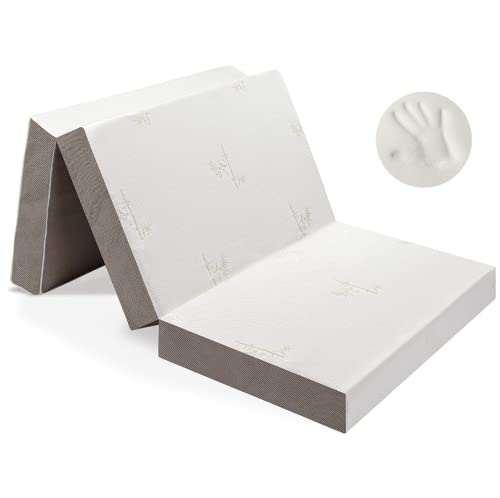
The Milliard Trifold Mattress is our top pick for car camping despite containing no air at all, and the reasoning is the trip report of every air-mattress owner: it cannot leak, sag, squeak, or care about altitude and temperature. The tri-fold memory foam mattress folds into a compact stack that rides in the cargo area, unfolds across a folded-flat hatchback or wagon floor, and delivers genuine memory foam comfort — contouring, pressure-relieving, full-body support — that inflatable campers describe wistfully. Its cover is removable and machine-washable, which after a dusty weekend is worth more than any pump feature.
Strengths
- Zero failure modes: no punctures, no pressure loss, no pump, no noise
- Real memory foam comfort, a class above any inflatable’s sleep quality
- Folds for transport and storage; washable cover for post-trip cleanup
Trade-offs
- Folded bulk is real — it claims cargo space an air bed would not
- Twin XL footprint in this listing suits one sleeper or cozy two in a wide cargo area
- Foam on a cold vehicle floor still needs an insulating layer beneath in cold weather
| Color | White |
| Size | Twin XL |
| Dimensions | 78 x 38 x 6 inches |
Vehicle fit is the Milliard’s home turf: seventy-eight inches of length covers most folded-flat cargo areas in midsize SUVs and wagons, and the fold lines let it adapt to slight floor steps that defeat rigid pads. In a van or a hatchback with the seats down, it turns the vehicle into a one-person camper with a bed you would happily sleep on at home — because at home, it is also your guest bed, your kids’ sleepover mattress, and your floor bed. That dual citizenship is the strongest economic argument in this guide: the cost-per-night collapses when the mattress works fifty weeks a year.
Cold-weather honesty: foam insulates better than air but a metal vehicle floor is a heat sink, so slide a closed-cell pad, a moving blanket, or even flattened cardboard beneath it in shoulder seasons. With that layer, the Milliard sleeps four-season warm. Campers whose trips center on a tent rather than a vehicle should cross-shop its role against the inflatables in Best Blow Up Mattresses For Camping — the fold travels between both worlds better than any air bed travels into a home.
Best for: hatchback, wagon, SUV, and van campers who prioritize sleep quality and zero fuss / Not suited for: back-seat sleepers or anyone whose cargo space is already spoken for
Choose it for the best sleep in any vehicle it fits; skip it if your only flat space is a rear bench. Check on Amazon
SUV Back-Seat Air Mattress (Prose-Only Pick)
Our badge: Best for Back-Seat Sleepers
This prose-only pick describes the category built for the most common car-camping geometry of all: the rear bench. SUV back-seat air mattresses are shaped to span the seat and the footwell gap, usually with an inflatable support block or extended section that fills the footwell so the surface lies flat instead of dipping where legs would go. Inflated, the bench becomes a bed wide enough for one adult comfortably or two cozily, without folding any seats — which means the cargo area stays packed and the front seats stay ready for a fast departure.
Strengths
- Uses space no other pick can: the back seat, with seats and cargo untouched
- Footwell-filling designs create a genuinely flat surface from a stepped bench
- Packs to a small roll when deflated — the least cargo cost of any full bed here
Trade-offs
- Width is bench width: tall sleepers curl, and two adults is an intimacy exercise
- All air-mattress physics apply — pressure loss on cold nights, puncture risk from seat hardware
- Headroom above a bench is minimal; sitting up in bed is not happening
No verified specifications are listed for this prose-only pick. Shopping guidance: look for a design whose footwell support is a separate, sturdy chamber rather than a flap; flocked top surfaces that keep bedding from skating; a pump that runs from the vehicle’s 12V outlet; and reinforced seams at the seat-edge fold, which is where this category fails first. Test-inflate it in your own vehicle in the driveway before any trip — bench geometries vary more than product photos admit, and a return is easier from home than from a trailhead. For one-night road-trip stops, festival weekends, and the “drive until you are tired, then sleep” style of travel, this category is the pragmatic champion: the bed deploys in minutes inside a locked, weatherproof vehicle.
Best for: solo road-trippers and couples in SUVs who sleep on the rear bench / Not suited for: tall sleepers, claustrophobes, or multi-night basecamp comfort seekers
Choose it for unbeatable space efficiency; skip it if you have a flat cargo floor that fits a better bed.
Self-Inflating Camping Pad (Prose-Only Pick)
Our badge: Best Insulation
The self-inflating pad is the technology car campers borrow from backpackers and never give back. Inside its airtight shell is open-cell foam; open the valve and the foam expands, drawing air in until the pad is most of the way inflated, needing only a few breaths or a tiny pump to firm up. The foam core is the point: it insulates. Where a pure air mattress lets your body heat conduct into a cold vehicle floor all night, a foam-core pad interrupts that loss, and in shoulder-season car camping insulation — not cushion thickness — is what separates sleeping from shivering. We describe the category qualitatively, with no linked product.
Strengths
- Foam-core insulation keeps you warm on cold metal floors where air beds fail
- Valve adjustment fine-tunes firmness precisely, and small leaks degrade it gracefully instead of catastrophically
- Packs far smaller than a foam mattress; two pads side by side make a couple’s bed
Trade-offs
- Thinner than the other picks — side sleepers may feel the floor through it on hard surfaces
- Costs more per inch of cushion than any air bed; quality pads are buy-once purchases
- Two singles for a couple introduces the classic middle-gap problem without a coupling kit
Shopping guidance, kept qualitative: prioritize the pad’s insulation rating (the industry uses an R-value scale; for three-season car camping, aim for the middle of the range or above, and higher for winter), a width you can actually roll on without falling off, and a valve you can operate with cold fingers in the dark. In a vehicle, a pair of wide pads on the flat cargo floor is many experienced car campers’ endgame setup: warm, quiet, adjustable, and nearly indestructible. It is also the only pick here that follows you out of the car — into tents, onto friends’ floors, under a hammock — which is why gear-heads consider it the default answer and everything else a specialization.
Best for: cold-weather and shoulder-season car campers, and anyone who also camps outside the vehicle / Not suited for: sleepers who need thick, plush cushion above all
Choose it for warmth and versatility; skip it if maximum cushion is the whole brief.

Best Price Mattress Full Mattress 6 inch Bed-In-A-Box
Our badge: Best for Truck Beds and Vans
The Best Price Mattress 6 inch Bed-In-A-Box is the basecamp pick: six inches of layered memory foam in a full-size footprint, for vehicles that function as cabins — pickup beds under a camper shell, van builds with a platform, and long-stay setups where the mattress lives in the vehicle for a season rather than a weekend. Memory foam over support and high-density layers contours and relieves pressure like a home bed, green tea infusion keeps it fresh, and at thirty pounds it is light enough to haul out for airing and cleaning between trips.
Strengths
- Real home-mattress foam comfort for long stays and platform builds
- Full-size footprint suits truck beds and van platforms sized for it
- Light for its size — removable for cleaning, airing, and vehicle reconfiguration
Trade-offs
- It does not fold or pack: the vehicle dedicates permanent space to it
- Six inches is adequate, not plush, for heavier side sleepers on hard platforms
- Foam must be kept dry — a leaking camper shell or spilled cooler is a real threat
| Color | White |
| Size | 6 Inch |
| Dimensions | 75 x 54 x 6 inches |
| Weight | 30.42 pounds |
The use case deserves precision: this is not a mattress you toss in for a Saturday night. It is the mattress of the truck-bed camper who spends September weekends at the lake, the van dweller between apartments, the hunting-camp rig that parks for a week. In those lives, inflatables are a recurring chore and a recurring failure risk, while a foam slab on a platform is simply the bed. Insulate beneath it (foam board or a closed-cell layer on the platform), protect it with a washable cover, and ventilate the vehicle regularly to keep moisture from taking up residence.
Its CertiPUR-US foams and ten-year warranty are home-mattress credentials that camping gear rarely offers, and its home second life — guest bed, futon base, kids’ room — mirrors the Milliard’s dual-use economics. If your vehicle camping is measured in weeks per year rather than nights, this is the pick that respects that math.
Best for: truck-bed campers, van platforms, and long-stay basecamps / Not suited for: occasional one-night sleepers who need their cargo space back Monday morning
Choose it for semi-permanent vehicle builds; skip it for spontaneous weekend packing. Check on Amazon
Truck-Bed Air Mattress (Prose-Only Pick)
Our badge: Best for Pickup Beds
Pickup beds look flat and are not: the wheel wells intrude exactly where a rectangular mattress wants to be. Truck-bed air mattresses solve the geometry with cutouts — the mattress is shaped around the wheel wells so the full width of the bed becomes sleepable surface, with the wells’ tops often serving as built-in side tables once the mattress is inflated around them. Paired with a 12V pump and a camper shell or a clear night sky, the setup turns a work truck into a two-person camper in minutes. This is a prose-only category pick; no verified product is linked.
Strengths
- Wheel-well cutouts reclaim the bed’s full width for two sleepers
- Deflates to nothing when the truck needs to be a truck again
- Elevated bed floor keeps sleepers off ground water and campsite mud entirely
Trade-offs
- Fit is bed-length and model specific — a short-bed mattress in a long bed wastes the concept
- Open-air sleeping is weather-exposed without a shell or canopy
- Air physics apply: cold-night pressure loss and puncture risk from bed hardware and cargo residue
Shopping guidance: measure your bed’s length and the wheel-well spacing before anything else, and confirm the mattress is cut for your bed size class. Look for heavy-gauge material — truck beds hide screws, splinters, and gravel — and sweep and inspect the bed before every inflation; a fitted bed liner or a tarp under the mattress is cheap insurance. Valve placement matters: you want to top up pressure at bedtime without climbing fully in. For anglers, hunters, and festival-goers who already own the truck, this category is the lowest-investment route to sleeping at the site instead of driving home in the dark.
Best for: pickup owners who camp at events and trailheads a few weekends a year / Not suited for: daily-driver trucks that cannot spare the setup ritual, or winter camping without insulation layers
Choose it to make the truck you own a camper; skip it if you camp weekly enough to justify a foam platform build.
Built-In-Pump Car Air Bed (Prose-Only Pick)
Our badge: Best Convenience
The final prose-only pick is the convenience play: full-size car air beds with a built-in electric pump that runs from the vehicle’s 12V outlet or a USB power source, inflating the bed in minutes while you stand outside the door. These beds typically span a folded-flat cargo area or a rear-seat-plus-trunk space in sedans and crossovers, often with a headboard section and flocked top. Their promise is the road-trip ideal — drive until tired, press a button, sleep — and for one-night stops that promise is honestly kept.
Strengths
- Fastest setup in the guide: minutes, no manual pumping, no separate pump to lose
- Full cargo-area coverage gives the most bed-like surface of the inflatable picks
- Deflates and stores in a small bag — the trunk keeps its day job
Trade-offs
- Built-in pumps are the failure point: when the pump dies, the bed is done
- Power draw demands the engine running or a healthy power station during inflation
- Thin flocked surfaces sleep warm in summer and cold in winter without added layers
Shopping guidance: prefer designs where the pump is detachable or the valve also accepts a standard pump, so a pump failure does not orphan the bed; check that the inflated dimensions match your cargo floor with the seats folded, not the brochure’s optimism; and look for repair patches included in the box — a brand that ships patches understands its product. Manage the power question like an adult: inflate with the engine idling, never run accessories off a marginal battery overnight, and remember the mattress needs no power after setup, which is the correct division of labor between car and camper.
Best for: road-trippers and festival campers who value minutes-fast setup for one-night stops / Not suited for: multi-night basecamps or cold-weather trips without insulation planning
Choose it for speed and simplicity; skip it if your trips are long, cold, or far from help.
Comparison Table
| Pick | Type | Vehicle Fit | Insulation Character | Check price on Amazon |
|---|---|---|---|---|
| Milliard Trifold | Folding foam (linked) | Hatchback, SUV, van floors | Good with a base layer | Check price on Amazon |
| SUV Back-Seat Air Mattress | Inflatable (prose-only) | Rear bench + footwell | Low — add layers | Check price on Amazon |
| Self-Inflating Pad | Foam-core pad (prose-only) | Any flat surface | Best in guide | Check price on Amazon |
| Best Price Mattress 6″ | Foam slab (linked) | Truck beds, van platforms | Good with platform insulation | Check price on Amazon |
| Truck-Bed Air Mattress | Inflatable (prose-only) | Pickup beds, wheel-well cut | Low — add layers | Check price on Amazon |
| Built-In-Pump Car Air Bed | Inflatable (prose-only) | Cargo areas, sedans/SUVs | Low — add layers | Check price on Amazon |
How to Choose the Best Air Mattress for Car Camping
Measure the Vehicle, Not the Marketing
Fold the seats, close the hatch, and measure the flat floor’s length, width between wheel wells or armrests, and the height to the ceiling. Then measure again diagonally if you are tall — many car campers sleep at an angle to buy inches. Your mattress must fit the smallest of these numbers with the doors closed, and the sleeper must fit the mattress. This ten-minute ritual prevents the category’s most common return. Bring the measurements, not the vehicle model name, when you shop: model-year changes quietly alter cargo geometry.
Decide Your Failure Tolerance: Air, Foam, or Hybrid
Air beds fail suddenly (punctures, valves, pumps) but pack to nothing. Foam never fails suddenly but consumes space forever. Self-inflating pads degrade gracefully — a small leak means a slightly softer pad, not a floor — and pack moderately. Choose by trip style: a one-night stop near civilization tolerates air’s risks; a week in the backcountry argues for foam-core or folding foam; a season-long van build argues for the foam slab. There is no universal answer, which is why this guide contains all three.
Insulation Is a Specification, Not an Accessory
A vehicle floor is a refrigerator shelf in cold weather. Pure air is a poor insulator because air circulates inside the mattress, carrying your heat down. Foam cores and foam mattresses interrupt that circulation; adding a closed-cell pad, an insulated blanket, or even a wool layer beneath any pick in this guide transforms cold-weather performance. In summer the problem inverts — vehicles trap heat — and ventilation (cracked windows with bug screens, a small fan) matters more than the mattress. Buy for your season, and layer for the shoulder seasons. Tent campers face the identical physics; our Best Futon Mattresses For Sleeping guide’s floor-sleeping insulation advice transfers directly to vehicle floors.
Power Discipline: Pumps and Batteries
Every inflatable here depends on power at setup. Run pumps with the engine on or from a separate power station; never inflate repeatedly off a resting starter battery, and never leave accessories drawing overnight. A manual backup pump or a pad that self-inflates is insurance against the dead-battery-at-the-trailhead story, which is only funny in retrospect. Test the whole system — mattress, pump, outlet — in the driveway before the first trip.
Think About Monday Morning
The best car camping mattress is the one that stores gracefully in your real life. If it becomes the guest bed (Milliard), the kids’ floor bed, or the pad that also serves tent trips, its cost-per-use collapses and it earns its storage. If it is a single-purpose inflatable, it must pack truly small and survive the closet. Buy for the household you have, not the expedition you imagine, and the gear will get used — which is the only metric that matters.
How Do You Set Up a Car Camp Sleep System?
Park as level as the site allows — a slight nose-uphill tilt keeps blood from pooling in your head and rain from pooling at the hatch — and chock a wheel if the ground is soft. Clear the sleep area completely; the pebble or seat bolt you ignore at setup is the one your hip finds at midnight. Lay your insulation layer first, mattress second, bedding third. Inflate air beds at setup for a leak check, then top up at bedtime when the air inside has cooled to night temperature — this single habit fixes most “my mattress deflated” complaints, which are usually just physics: cooling air contracts. Crack two windows an inch for ventilation (condensation is the car camper’s silent enemy; a vehicle full of exhaled moisture will rain on you by dawn), fit bug screens if insects are out, and keep keys, light, and shoes in the same place every night so a 3 a.m. exit is a drill you have rehearsed.
Problem: the air bed is soft by 2 a.m. — top up at bedtime after the air cools, check the valve cap is fully seated, and if softness persists, hunt the leak with a spray of soapy water in daylight.
Problem: condensation drips from the windows and roof — increase ventilation; two cracked windows beat one, and a small battery fan moving air across the glass helps more than wiping.
Problem: you slide toward the hatch all night — the vehicle is not level; reposition, use leveling blocks or a flatter spot, and put the pillows at the high end.
Problem: the mattress squeaks against the cargo liner — a blanket or sheet between mattress and liner silences it; foam picks like the Milliard skip this problem entirely.
Problem: cold from below despite a thick mattress — thickness is not insulation for air beds; add a closed-cell or foam layer beneath the mattress, not more blankets above you.
Car Camping Sleep: Safety and Comfort Basics Nobody Puts on the Box
Never sleep in a vehicle with the engine running for heat or power — carbon monoxide is odorless and vehicle exhaust systems leak; warmth comes from insulation and bedding, not idling. Crack windows for ventilation even in cold weather; the moisture and stuffiness of a sealed car degrade sleep and health alike. Park legally and safely: know the rules of the land you are on, keep the driver’s seat and controls accessible in case you need to move at night, and lock doors with keys reachable. Keep a light, water, and layers within arm’s reach. These basics are unglamorous and absolute, and they matter more than any mattress decision in this guide — the mattress decides how well you sleep; these decide that you sleep safely at all.
Foam Versus Air: The Car Camper’s Honest Ledger
After enough trips, most car campers settle the argument empirically, and their conclusions rhyme. Air wins the packing contest and loses the reliability contest; every air bed eventually meets the sharp thing, the tired valve, the cold night. Foam wins every night it is used and loses every morning it is packed. Self-inflating pads split the ledger so evenly that they dominate among people who camp monthly. The deciding variable is trip frequency: the more you go, the more reliability compounds and bulk fades as a concern, because the gear simply lives in the vehicle. The less you go, the more storage dominates. Read your own calendar before you read any review — including this one — and the right column of the comparison table will choose itself.
Car Camping Sleep Systems: Pairing the Pad With the Rest of the Kit
A car mattress never sleeps alone, and the campers who rest best treat the vehicle as a small bedroom whose other systems matter as much as the pad. Insulation is the first partner: an air mattress insulates poorly from below — cold air inside the chamber steals heat all night — so a closed-cell foam pad, a blanket layer, or an insulated sleeping pad beneath or above the air bed transforms the same mattress from a July solution into a three-season one. The sleeping bag or quilt rates for the temperature you will actually meet, not the one the brochure photographed, and a pillow — even a stuff sack of clothes — keeps the neck’s angle honest on a flat vehicle floor. Ventilation is the second partner: cracked windows with mesh screens manage both condensation (two sleepers fog a sealed car by 2 a.m.) and the carbon dioxide stuffiness that fragments sleep, and they do it without compromising the warmth the insulation built. Lighting, a headlamp within reach, and a strict shoes-outside-the-sleep-zone rule complete a system that turns a parking spot into a room.
The morning after is the system’s audit: condensation patterns tell you about ventilation, cold spots tell you about insulation gaps, and the pad’s pressure tells you about overnight leaks while they are still patchable at home. Campers building the home side of the same comfort story — the guest room that hosts the friends you camp with — will find Best Blow Up Mattresses For Camping covers the inflatable category from the tent side, and Best Mattresses For Sleeper Sofas handles the indoor convertible version. The through-line of all three is this guide’s thesis: sleep quality is a system property, and the cheapest component to upgrade is usually the one you have not thought about yet.
Choosing the Vehicle Sleep Setup by Trip Type
Not all car camping is the same sport, and the sleep setup should be specced to the trip the way the mattress was specced to the vehicle. The overnight en route — the long-drive stop where the car is a motel substitute — rewards speed and simplicity: a pad that inflates in minutes, bedding that deploys without unpacking the car, and a morning strike measured in moments, because the trip’s purpose is the destination. The basecamp trip inverts the values: the vehicle is a cabin for a week, comfort compounds nightly, and the heavier linked picks in this guide — the trifold especially — justify their cargo space with sleep that lets the days be spent on the trail rather than on recovery. The festival and event trip adds social geometry: sleeping in a field among other vehicles, where privacy screens, earplugs, and a setup that does not require opening all the doors at midnight matter as much as the pad. The winter trip is the specialist case, where insulation stops being an accessory and becomes the system: the pad’s job narrows to pressure and level, while closed-cell layers, rated bags, and ventilation discipline do the thermal work.
Reading your own calendar honestly — which of these trips do you actually take, and how often — prevents the classic error of buying for the expedition you imagine and storing it through the weekends you live. The guide’s picks span the range deliberately, and the cheapest correct setup for your real trip type will out-sleep the finest wrong one. Spec the trip, then the vehicle, then the pad — in that order, every time.
Solo vs Duo: Sleeping Arrangements in a Shared Vehicle
Vehicle geometry changes with occupancy, and the sleep setup should be chosen for the crew that actually travels. The solo camper owns the diagonal: a single pad angled across the flattened rear gives the longest lie the vehicle can offer, the remaining space organizes gear within arm’s reach, and the whole setup strikes in minutes — solo travel is where car camping’s simplicity shines brightest, and where the linked trifold’s bed-like quality feels most luxurious per pound. The duo setup is an exercise in negotiated inches: two pads side by side with a plan for the center seam (a shared blanket layer bridges it better than any pad accessory), a strict agreement about the door-side sleeper’s exit route, and ventilation doubled, because two sleepers fog a sealed cabin twice as fast and wake twice as grumpy about it. Families add the third geometry — children across the front seats’ footwell level or in a tent of their own while the vehicle serves the adults — and the rule that governs all three arrangements is identical: rehearse the layout in the driveway, in daylight, before the trip grades it in the dark.
Whichever geometry you run, assign the roles before the first night: who inflates, who levels, who owns the midnight top-up. Camp mornings are made of small courtesies performed half-asleep, and a crew that has divided them sleeps like it.
The Driveway Rehearsal: A Tradition Worth Starting
Every recommendation in this guide converges on one ritual: the driveway rehearsal. One evening before the season’s first trip, set the vehicle up completely in the driveway — pads inflated, bedding laid, screens fitted, gear stowed — and sleep in it there, or at minimum lie in it through a full evening’s routine. The rehearsal surfaces every failure while the house is ten steps away: the pad that fights the wheel well, the pump whose cord will not reach, the window screen that will not stay, the pillow that lives in a bag you did not pack. Each discovery costs nothing at home and would have cost a night’s sleep on the road.
The rehearsal also calibrates expectations for new crew members — a partner, a child, a friend joining their first car-camping trip — who can learn the setup as participants rather than as audience at a dark trailhead. Make it a tradition, with the season’s first barbecue attached, and the vehicle stops being transportation that sometimes hosts sleep and becomes what this guide has treated it as throughout: a small, well-run bedroom that happens to have wheels.
Common Buying Mistakes
Buying by Vehicle Name Instead of Measurements
“Fits most SUVs” fits no specific SUV. Cargo geometries differ by model and year, and a mattress two inches too long fits zero inches too long. Tape measure first, product second — always.
Ignoring the Cold-Floor Problem
Shoppers buy a thick air bed for a October trip and freeze from below while warm above. Insulation is a separate purchase from cushion; budget for the layer beneath the mattress from the start.
Inflating Once at Noon and Judging at Midnight
Air inflated in warm afternoon sun contracts as night cools, and the bed feels half-deflated by 2 a.m. This is physics, not a leak. Top up at bedtime, every time, and the problem mostly vanishes.
Draining the Starter Battery
Running pumps, lights, and fans off the car’s battery all evening is how a camping trip becomes a jump-start request. Engine on for inflation, separate power for accessories, no exceptions worth making.
Skipping the Driveway Test
The first inflation should happen at home, with time to find the leak, learn the valve, and discover the mattress is four inches too long. Every failure is cheaper in the driveway than at the trailhead.
Final Recommendation
If your vehicle has a flat floor that fits it, the Milliard Trifold Mattress is the car camping bed we recommend without reservation: real foam sleep, zero failure modes, and a second career as your home guest bed. Truck-bed and van builders should commit to the foam slab approach — Check on Amazon for the Best Price Mattress as the platform option. Back-seat sleepers and road-trippers should take the prose-only inflatable guidance above seriously: measure your bench, buy the footwell-filling design, and top up at bedtime. Whatever you choose, add the insulation layer, run the driveway test, and keep the engine off at night. The vehicle is already the hard part of car camping; the bed should be the easy part. For the home basecamp version of the same comfort, Black Friday Bedding Deals 2026 is where the spare bedding for these setups goes on sale.
Frequently Asked Questions
What size air mattress fits in an SUV?
It depends entirely on your vehicle’s folded-flat cargo dimensions, which vary by model and year — measure length, width between obstructions, and ceiling height with the hatch closed, then match the mattress to those numbers. Most midsize SUVs sleep one adult on a twin-scale surface or two on a carefully fitted wider one.
Why does my car air mattress lose air overnight?
Usually physics, not a leak: air inflated at warm setup temperatures contracts as it cools to night temperatures, lowering pressure. Top up at bedtime. If the bed still softens dramatically, check the valve seal first, then hunt for punctures with soapy water in daylight.
How do I stay warm sleeping in a car in cold weather?
Insulate beneath you first — a foam-core pad, foam mattress, or closed-cell layer between you and the vehicle floor — then use a sleeping bag or blankets rated for the temperature, and ventilate slightly to control condensation. Never run the engine for heat while sleeping.
Is it legal and safe to sleep in a car?
Rules vary by place: many campgrounds, rest areas (with time limits), and public lands allow it, while some cities restrict overnight parking. Research your specific stop, park legally, keep the driver’s seat accessible, lock up, and ventilate. Safety basics are covered in the dedicated section above.
Foam or inflatable for car camping?
Foam (folding or slab) sleeps better and never fails suddenly but consumes cargo space; inflatables pack tiny but carry puncture and pressure-loss risks; self-inflating foam-core pads split the difference and insulate best. Frequent campers drift toward foam solutions; occasional campers toward inflatables.
Can I run the pump off my car battery?
Briefly, with the engine running, yes — that is what 12V pumps are designed for. The mistake is repeated or prolonged accessory use on a resting battery. Inflate with the engine on, or use a separate power station, and never leave loads drawing overnight.


