Disclosure: As an Amazon Associate, dailyhomedecorating.com earns from qualifying purchases. Links to Amazon on this page are affiliate links; they cost you nothing extra. Prices and availability change often, so check the current Amazon listing before you buy.
There is a specific kind of morning that sends people shopping for the best firm mattresses for back pain: you wake up feeling folded. Your lower back is compressed and stiff, your hips have spent the night sinking into a soft valley, and it takes a hot shower and twenty minutes of movement to feel like yourself. Soft mattresses are the usual suspect, because a surface that lets the pelvis drop below the ribcage holds the lumbar spine in flexion for hours, and the muscles around it spend the night bracing instead of recovering. Firmness, correctly delivered, is the corrective — it keeps the body’s line long and level so the back can actually rest.
But firm is a word that needs handling carefully, because a hard surface is not the same as a supportive one. A plank leaves the lumbar curve hanging unsupported and creates fresh pressure at the shoulders and hips. The six mattresses in this guide are firm with engineering behind them: contouring layers that fill the curve, support cores that refuse to sag, zoned densities, pocketed coils, and in one case a flippable design that lets you choose your firmness after the mattress arrives. None of this is medical treatment, and persistent pain deserves a clinician — but if your current bed is soft, tired, or both, this is the shortlist most likely to change your mornings. For the wider picture, our main guide to Best Mattresses For Back Pain covers softer options too, and Best Mattresses For Lower Back Pain narrows in on the lumbar band specifically.
Where to Buy
Every pick here is sold on Amazon, where the listing carries current pricing, sizes, and trial terms. Start with our top pick, the Nectar 12” Memory Foam Mattress — Check on Amazon. The other five picks are the GhostBed Classic — Check on Amazon; the Layla 10” Copper Infused Memory Foam Mattress — Check on Amazon; the Sealy Dreamlife 12” Hybrid — Check on Amazon; the Casper Sleep Original — Check on Amazon; and the Signature Design by Ashley Chime 12 Inch Hybrid — Check on Amazon. Prices move with promotions, so confirm the current figure on the listing.
In this guide
Quick Picks
| Pick | Badge | Why it earns its place |
|---|---|---|
| Nectar 12” Memory Foam Mattress | Best Overall | Firm feel with a touch of contour — the balanced corrective for soft-bed sufferers |
| GhostBed Classic 11 Inch Queen Memory Foam Mattress | Best for Stomach Sleepers | High-density core keeps the pelvis up so stomach sleepers do not arch all night |
| Layla 10” Copper Infused Memory Foam Mattress | Best Adjustable Firmness | Flippable soft/medium-firm design gives you two firmness chances in one mattress |
| Sealy Dreamlife 12” Hybrid Mattress-in-a-Box | Best Hybrid | Encased coils deliver firm, independent support with airflow and easier movement |
| Casper Sleep Original 11″ Memory Foam Queen Mattress | Best for Combination Sleepers | Zoned firmness under the hips with shoulder give for position changers |
| Signature Design by Ashley Chime 12 Inch Hybrid Full Size Mattress | Best for Targeted Lumbar Support | Gel lumbar layer plus sturdy wrapped coils in a firm-leaning full-size build |
Key Takeaways
- Firm helps backs when it keeps hips level with shoulders; hard helps nobody when it leaves the lumbar curve unsupported.
- Contour over firm support is the winning stack: fill the curve, refuse the sink.
- Stomach sleepers benefit most from firmness, because the pelvis is the first thing a soft bed drops.
- Flippable and zoned designs de-risk firmness shopping by giving you more than one feel per mattress.
- Heavier sleepers experience every mattress as softer — shop a step firmer than the label suggests.
- Give a firm mattress two to three weeks; backs adapted to a soft valley often protest briefly before they approve.
How These Picks Were Chosen
We filtered a verified product pool for firmness with a support mechanism behind it. Each pick had to explain how it stays supportive: a firm-rated contouring foam over dynamic support foam, a high-density core, zoned densities, encased or wrapped coils under gel foam, or a flippable two-sided build. We favored medium-firm to firm feels, meaningful profile depth for adult bodies, and features that keep firm beds comfortable — gel infusions and breathable covers against heat, transition layers against the hard-shelf sensation, and trials long enough to adapt through. Certifications such as CertiPUR-US were treated as baseline hygiene.
Filtered out: extra-firm slabs with no comfort layer at all, soft and plush designs riding on back-pain keywords, and thin profiles that bottom out. Method honesty: this is a research guide built from manufacturer-verified specifications and documented features, not a sleep lab, and firmness labels are unstandardized across brands — which is why we describe each bed’s construction and likely behavior rather than ranking by label alone. Readers still deciding between construction families should read our explainer on the Best Type Of Mattresses For Back Pain before committing.
The 6 Best Best Firm Mattresses for Back Pain — Reviewed

Nectar 12” Memory Foam Mattress
Our badge: Best Overall
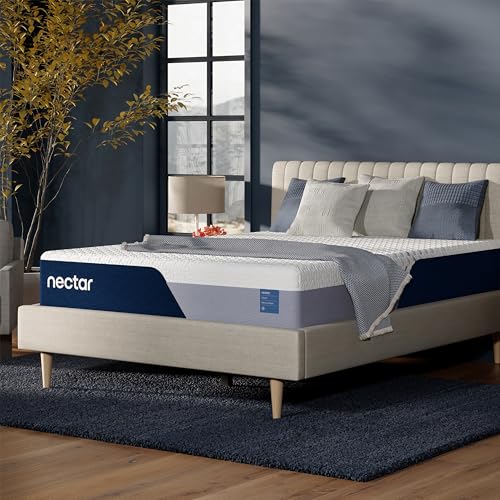
The Nectar 12” Memory Foam Mattress defines this category’s sweet spot in Nectar’s own words: firm, with a touch of comfort. The contouring memory foam relieves pressure and reduces stress on high-tension areas like the hips and back, while the adaptive support layer beneath promotes spinal alignment — so the surface fills your lumbar curve instead of leaving it bridged, and the base refuses the hip sink that makes soft beds a back problem. For the classic firm-mattress shopper, escaping a valley and wanting structure without a plank, this is the most complete answer we verified.
Strengths
- Firm-leaning support with genuine contour — structure and curve-fill in one build
- Cooling top layer tempers the warmth dense foam can hold
- Generous trial and warranty terms on the listing lower the risk of going firmer
Trade-offs
- Slow foam response makes position changes deliberate, especially in week one
- Petite side sleepers may find the firmness assertive at the shoulder
- Seventy-eight pounds in queen needs two people for setup and rotation
| Color | White |
| Size | Queen |
| Dimensions | 80 x 60 x 12 inches |
| Weight | 78 pounds |
The first week on the Nectar is a recalibration. Sleepers arriving from a soft bed often report the surface feels unyielding for three or four nights, then their mornings start improving as the back stops bracing against a moving surface. That sequence is normal and is exactly why the long trial matters: judge this mattress at week three, by stiffness scores, not at night two by first impression. Back sleepers feel the benefit as a filled lumbar curve and level hips; stomach sleepers as a pelvis that stays up where it belongs.
The cooling fabric in the top layer of the Nectar sleep system deserves its mention, because firm foam beds have a heat reputation earned by dense, sealed surfaces. Nectar’s breathable cooling top keeps the surface composed for average-temperature sleepers, though the very hottest sleepers should still compare the Sealy’s coil airflow below. Motion isolation is classic foam — a partner’s movements stay on their side of the bed.
Longevity is the quiet argument for this pick. A firm foam bed with a dense support core at 12 inches resists the hip-zone softening that turns medium beds into valleys, which is the entire disease this category exists to cure. Rotate it seasonally, protect it from day one, and keep it on a rigid foundation, and the firmness you trial is the firmness you keep.
Best for: back and stomach sleepers escaping a soft or sagging bed who want firm support with contour / Not suited for: plush-loving side sleepers and bounce fans
Choose the Nectar if your current bed folds you. Skip it if you know you sleep best on coils. Check on Amazon

GhostBed Classic 11 Inch Queen Memory Foam Mattress
Our badge: Best for Stomach Sleepers
The GhostBed Classic is the firm pick with a spring in its step. A high-density foam core supports spinal alignment and relieves stiffness, while cooling gel memory foam and aerated latex in the comfort stack keep the response quick rather than swampy. Stomach sleepers get the headline benefit: the firm core holds the pelvis at surface level, preventing the lumbar arch that makes stomach sleeping the hardest position on a back. If you wake up needing to stretch out a compressed spine, this bed’s personality is your corrective.
Strengths
- High-density core delivers firm, alignment-first support
- Aerated latex adds response and ventilation rare in all-foam beds
- Light for a queen at 50 pounds — rotation is kinder to the back you are protecting
Trade-offs
- Firm-leaning feel can press on lighter side sleepers’ shoulders
- Light build may drift on slick platform frames without a non-slip pad
- Less deep contour than the memory foam specialists in this guide
| Color | White |
| Size | Queen |
| Dimensions | 80 x 60 x 11 inches |
| Weight | 50 pounds |
GhostBed describes the feel as soft, supportive, and springy with minimal motion transfer, and the aerated latex explains the paradox: the surface yields a little, rebounds immediately, and never holds you in a mold. For combination sleepers with back pain, that response speed is a feature with daily value — every position change lands on support that is already there, rather than waiting for slow foam to re-form. The gel memory foam at the surface handles pressure and draws heat; the latex’s pinhole structure ventilates beneath it.
The mattress is CertiPUR-US certified and made in the USA and Canada per the listing. Eleven inches is a versatile profile for standard bedding and most frames, and the modest weight makes this the easiest queen in the guide to set up, rotate, and move between rooms — no small thing when the person doing the rotating has a bad back.
One caution: firmness perception scales with body weight. Heavier stomach sleepers will find the GhostBed’s core properly assertive; very light sleepers may find the whole bed firmer than intended and should consider the Casper’s zoning instead. Use the trial to learn which side of that line you live on.
Best for: stomach and back sleepers who want firm support with quick, springy response / Not suited for: lightweight side sleepers seeking deep sink
Choose the GhostBed if soft beds compress you. Skip it if you love the slow memory foam hug. Check on Amazon

Layla 10” Copper Infused Memory Foam Mattress
Our badge: Best Adjustable Firmness
The Layla 10” Copper Infused Memory Foam Mattress solves the firm shopper’s biggest anxiety — what if I choose wrong? — with a flippable design: soft on one side, medium-firm on the other. For back pain, the medium-firm side is the working surface, but the soft side is not wasted: it serves partners with different preferences, changing needs over the years, and the simple insurance of a second chance built into the same purchase. Firmness shopping is guesswork; Layla lets you hedge it physically.
Strengths
- Two firmness options in one mattress — flip to change the prescription
- Copper-gel particles firm up under load, supporting where you press deepest
- Copper infusion also conducts heat away for a cooler firm surface
Trade-offs
- Neither side is extra-firm; maximum-firmness seekers should look at the Nectar or GhostBed
- Flipping a 69-pound queen is a two-person, twice-a-year event
- Ten and a half inches is a moderate profile for heavier sleepers
| Color | Natural |
| Size | Queen |
| Dimensions | 80 x 60 x 10.5 inches |
| Weight | 69 pounds |
The copper story is more than marketing garnish. Layla’s copper-gel particles condense under body weight and respond with increased firmness, so support rises where you load the mattress most — a passive, mechanical version of zoning that suits back sleepers whose hips need the extra vote. The same particles form a thermal pathway that pulls heat through the foam, addressing the warm-surface complaint that follows firm memory foam around. It is a genuinely clever material choice for this category.
Practical firmness strategy: start on the medium-firm side, give it two full weeks, and score your mornings. If stiffness persists and you suspect the surface is still too yielding at the pelvis, you are already on the firmer option and should look to the Nectar class next; if the medium-firm side feels too assertive at the shoulders, flip to soft for a week and compare scores. That A/B test, run in your own bedroom with your own back, is worth more than any firmness chart — and almost no other mattress lets you run it without a return.
The Layla is made in the USA, lists a 120-night trial, and includes two memory foam pillows in this queen listing per its title. Couples with divergent firmness needs will find the flip particularly valuable across a mattress’s lifespan, since preferences drift with age, weight, and injury history.
Best for: uncertain firmness shoppers and couples whose preferences differ or change / Not suited for: shoppers who know they want maximum firmness
Choose the Layla if you want the firmness decision to be reversible. Skip it if your preference is settled and firm. Check on Amazon

Sealy Dreamlife 12” Hybrid Mattress-in-a-Box
Our badge: Best Hybrid
The Sealy Dreamlife 12” Hybrid delivers firmness the traditional way: seven inches of individually encased coils providing push-back support, topped with gel memory foam and a transition layer so the firmness arrives cushioned rather than raw. Encased coils respond independently, holding the hip zone at its own height instead of averaging your whole body into one compromise, and they do not soften with body heat the way foam marginally can — the support at 3 a.m. equals the support at 11 p.m., which matters for backs that sink as foam warms.
Strengths
- Encased coils give firm, independent, temperature-stable support
- Responsive surface eases position changes and morning exits for stiff backs
- Coil airflow plus gel foam suits warm sleepers who find foam beds hot
Trade-offs
- Heaviest pick in the guide at just over 80 pounds in queen
- A touch more motion transfer than dense foam
- Firm hybrid feel will not satisfy shoppers seeking a deep foam cradle
| Color | Dreamlife |
| Size | Queen |
| Dimensions | 80 x 60 x 12 inches |
| Weight | 80.604164 pounds |
For firm-mattress shoppers, the hybrid’s hidden virtue is honesty over time. Foam firmness is a moving target across years as cells fatigue; coil firmness is comparatively stable, so the bed you trial is close to the bed you keep. The transition foam layer prevents the hard-shelf feel under the hips that budget hybrids can produce, and the gel foam surface handles pressure at the shoulder when you roll to your side. Surface-Guard antimicrobial technology and CertiPUR-US certified foams cover the hygiene side.
Morning mechanics favor this pick strongly. A stiff lower back’s hardest daily moment is the exit — rolling out of a foam impression, sitting, standing. Coils assist each stage with returned energy instead of resistance. If your current routine involves sitting on the bed’s edge gathering resolve, the Sealy’s combination of responsive surface and stable support changes that minute of your day.
Check frame weight capacity before ordering, rotate seasonally, and use a protector. For shoppers whose firmness preference is really a preference for traditional bed behavior — lift, bounce, airflow — this is the guide’s natural home.
Best for: firmness shoppers who want coil lift, airflow, and stable long-term support / Not suited for: shoppers who prize motion isolation above all
Choose the Sealy if every foam bed has felt like a trap. Skip it if your partner’s movement is your main complaint. Check on Amazon

Casper Sleep Original 11″ Memory Foam Queen Mattress
Our badge: Best for Combination Sleepers
The Casper Sleep Original earns its firm-guide place through zoning rather than overall hardness: Zoned Support uses firmer foam under the hips, waist, and lower back, with softer foam at the shoulders, inside a medium-firm build. For combination sleepers — back for half the night, side for the rest — uniform firmness is a compromise that fails both positions, while zoning firmness where the pelvis sits and softness where the shoulder lands serves each position on its own terms.
Strengths
- Zoned firmness supports the pelvis without punishing the shoulders
- Breathable open-cell foam keeps the surface fresher than dense memory foam
- Excellent motion isolation for couples with different schedules
Trade-offs
- Medium-firm overall may underwhelm shoppers seeking a distinctly firm bed
- Strict stomach sleepers get less hip lift than from the GhostBed or Nectar
- Foam edges compress for sitting, as foam does
| Color | Light Gray |
| Size | Queen |
| Dimensions | 80 x 60 x 11 inches |
The honest framing: if you sleep only on your back or stomach, the Casper is not the firmest tool in this guide and the picks above it will serve you better. Its constituency is the large group of back-pain sufferers who also side-sleep, for whom a uniformly firm bed trades lumbar relief for shoulder ache by 2 a.m. Zoning ends that trade. The breathable foam addresses the other common foam complaint, heat, by moving air through open cells rather than trapping it.
Durability is engineered where it matters: the firmer hip-zone foam is also the slowest to fatigue, and Casper positions the build against sinking and sagging, with a 100-night trial and 10-year limited warranty on the listing. Rotate without flipping — the zones have a correct orientation — and support it evenly.
Households with two different backs will find this the easiest shared purchase in the guide: firm where both sleepers need it, forgiving where they differ.
Best for: combination sleepers who need firm pelvic support plus shoulder give / Not suited for: single-position sleepers wanting maximum firmness
Choose the Casper if your night involves more than one position. Skip it if you are a committed stomach sleeper. Check on Amazon

Signature Design by Ashley Chime 12 Inch Hybrid Full Size Mattress
Our badge: Best for Targeted Lumbar Support
The Signature Design by Ashley Chime 12 Inch Hybrid combines firm-leaning hybrid support with the guide’s most specific feature: a high-density gel memory foam layer targeting the lower back, over 13-gauge wrapped coils with reinforced perimeter rows. If your back pain has a precise address and you want firmness aimed at it rather than spread evenly, the Chime is the specialist pick — in a full size that suits solo sleepers and smaller rooms.
Strengths
- Dedicated lumbar gel layer concentrates support where firmness matters most
- Sturdy wrapped coils and reinforced edges give a stable, sit-able perimeter
- Adjustable-base compatible for position experiments
Trade-offs
- Full size only in this listing — couples should check size options
- The lumbar emphasis can feel assertive to very light sleepers initially
- Medium-firm is firm-leaning, not extra-firm
| Color | White |
| Size | Full |
| Dimensions | 74.4 x 53.3 x 12 inches |
| Weight | 62 pounds |
The coil gauge is worth translating: 13-gauge wire is on the sturdy end of pocketed-coil practice, and the nine-inch coil height gives the support system real travel to absorb load without bottoming. Doubled perimeter rows mean the firmness does not quit at the edges, so the full width of this full size is usable sleep surface and the sit-to-stand edge is trustworthy — a daily concern for stiff backs. Pocketing keeps motion transfer low for a coil bed.
Adjustable-base compatibility adds the knee-elevation experiment: a slight lift under the knees while back sleeping relaxes lumbar tension for many sleepers, and a firm hybrid that flexes with the base lets you test it without fighting the mattress. The Chime lists a 180-night trial and 10-year warranty, with CertiPUR-US certified foams.
In a guest room that doubles as your recovery room, or a first apartment where one bed must do everything, the Chime’s targeted firmness is a lot of engineering for the footprint.
Best for: solo sleepers with localized lower back pain in smaller rooms / Not suited for: couples needing queen width
Choose the Chime if your pain has an address. Skip it if you need maximum sleeping width. Check on Amazon
Comparison Table
| Pick | Firmness mechanism | Feel | Size listed | Profile | Check price on Amazon |
|---|---|---|---|---|---|
| Nectar Memory Foam | Firm foam + dynamic support | Firm | Queen | 12 inches | Check price on Amazon |
| GhostBed Classic | High-density core + latex | Medium-firm, firm-leaning | Queen | 11 inches | Check price on Amazon |
| Layla Copper Memory Foam | Flippable two-sided foam | Soft / Medium-firm | Queen | 10.5 inches | Check price on Amazon |
| Sealy Dreamlife Hybrid | Encased coils + gel foam | Medium-firm hybrid | Queen | 12 inches | Check price on Amazon |
| Casper Sleep Original | Zoned foam | Medium-firm | Queen | 11 inches | Check price on Amazon |
| Ashley Chime Hybrid | Lumbar gel + wrapped coils | Medium-firm | Full | 12 inches | Check price on Amazon |
How to Choose the Best Firm Mattress for Your Back
Separate firm from supportive in your mind
Support is the ability to keep your spine level; firmness is how the surface feels in the first inch. You need the first absolutely and the second only as a means. Shop constructions that name their support mechanism — dense cores, coils, zones — and treat any mattress that is merely hard as a plank with good marketing.
Calibrate by position and weight
Stomach sleepers need the firmest pelvis support; back sleepers, firm with lumbar fill; side sleepers, zoned or medium-firm so the shoulder survives. Heavier bodies compress more and should shop firmer than labels; lighter bodies should beware the firmest picks, which may never compress enough to engage their comfort layers.
Decide foam versus coils by temperature and movement
Foam isolates motion and contours closely but responds slowly and sleeps warmer. Coils lift, breathe, and keep their firmness regardless of body heat, at the cost of some motion transfer. If you are stiff in the morning and struggle to move on foam, coils are not a preference — they are an accessibility feature. Bedding refreshes timed with events like Black Friday Bedding Deals 2026 and extras such as Best Throw Pillows Under $500 can round out the new setup.
Use reversibility where it exists
A flippable mattress like the Layla converts the firmness gamble into an experiment. If you have burned money on the wrong firmness before, that reversibility is worth real money. Otherwise, treat the trial period as your reversibility and keep the packaging until week three.
Interrogate the foundation
Firm mattresses expose weak foundations mercilessly, because they do not drape over flex the way soft foam does. Slats must be rigid and close, center rails firm, and any adjustable base matched to a compatible mattress. A firm bed on a sagging base is a hammock with better PR.
Check the return logistics before you need them
Firm mattresses are returned for feel more than any other category, because firmness is the hardest property to judge from a listing. Before you buy, read the trial terms as if you will use them: how many nights are required before a return opens, who arranges pickup or donation, and whether the mattress must be stain-free — a protector guarantees that last point, which is why we repeat it in every guide. The picks here carry trials from 100 nights upward, and the honest way to use them is fully: three weeks of logged mornings before any verdict, and a decision made while the window is still comfortably open rather than in its final anxious days. A firm bed is a decade-long posture decision; the trial is the only version of a test drive this industry offers, and declining to use it out of optimism is how households end up sleeping on expensive mistakes.
While you are reading terms, note the warranty’s definition of failure as well. Most warranties measure unloaded sag against a threshold, which means a mattress can feel meaningfully softer to your back before it qualifies as defective on paper. That gap is another argument for buying support mechanisms with slow fatigue — coils, dense cores, zoning — rather than buying a warranty’s length. The paper protects you against defects; the construction protects you against time.
Plan the adaptation honestly
Your back adapted to your old bed over years, even if the adaptation was harmful. A correct firm surface can feel wrong for a week. Score mornings for three weeks before judging, change nothing else in the same window, and let the trend — not nostalgia for the valley — decide.
How Should You Break In and Test a Firm Mattress?
Unbox in the bedroom, let expansion finish fully — a day for most foam, longer for thick builds — and ventilate. Then break the surface in deliberately: walk on it in socks for a few minutes daily during the first week, which accelerates foam softening where your body will lie, and rotate it after the first month. Keep a one-line morning log: stiffness score, main position, anything unusual. By week three the trend line is your verdict, and it is far more trustworthy than any single night’s impression.
Keep the protector on throughout the trial, keep other variables — pillow, routine, exercise — constant, and test the longest sleeps of your week as the sternest examiners. If scores plateau at “still too soft at the hips,” the answer is a firmer class, not more time. If scores improve steadily, you have found your surface and the remaining job is maintenance: seasonal rotation, protector discipline, and foundation checks. Households setting up a firm guest bed for a sore-backed relative can apply the same testing to convertible options in Best Mattresses For Sleeper Sofas.
Problem: the firm mattress feels like a board in week one — expected; foam breaks in and bodies adapt. Walk the surface, keep logging, and judge at week three.
Problem: your shoulders ache on the new firm bed — you may need zoning or a touch more comfort layer; side sleepers should check pillow loft and consider the Casper’s approach.
Problem: your hips still sink by morning — foam softens with heat overnight; a coil hybrid or the firmest foam picks hold their line better.
Problem: the bed feels firmer on your partner’s side — check for foundation differences beneath each side and confirm the mattress sits centered and fully supported.
Problem: you miss your old soft bed despite better mornings — trust the scores. Comfort memory is nostalgia; stiffness trends are data.
Firmness Is a Dial, Not a Destination
The deeper truth this category teaches is that firmness needs change. Weight shifts, injuries heal, positions drift with age, and a mattress bought as a rigid prescription can become wrong in either direction. The smartest firm-bed purchases therefore build in adjustment: a flippable design, a trial long enough to be honest, a budget that leaves room for a topper to soften an overshot purchase by half a step. A thin, dense topper over a too-firm bed is a legitimate fine-tuning tool — the reverse rescue, firming a too-soft bed, barely exists, which is why erring firm within reason is the safer shopping error for back pain specifically.
It also means firmness should be revisited, not worshipped. If a bed that served you at 35 protests at 50, the bed did not betray you; the dial moved. The sleepers who stay comfortable across decades are the ones who treat support as a periodic review rather than a one-time purchase.
Couples complicate the dial further, because two backs rarely want the same setting and a single surface must serve both. The workable strategies are few and worth naming plainly. Zoned designs help when the difference is positional rather than absolute. A flippable mattress helps when preferences are close and the flip becomes a seasonal negotiation. Split arrangements — two twin XL mattresses on one king frame — are the honest endgame when one partner needs firm and the other genuinely cannot sleep on it, and several designs in our wider pool are sold in those sizes. What does not work is the silent compromise in which one partner simply sleeps badly for a decade; back pain compounded by resentment is still back pain. Shop as a household, trial as a household, and let both partners keep morning scores during the trial window, because the bed that wins should win on both sides.
There is a budget dimension to the dial as well. Firmness fine-tuning after purchase — a quality topper to soften, an adjustable base to change angles — costs less when the original purchase left room in the budget for it. The most expensive firm mattress in this guide is not automatically the best prescription; the best prescription is the one whose support mechanism matches your body and whose purchase leaves you able to adjust. That is why this guide spans a deliberate range, from the accessible Ashley Chime to the premium-feeling builds, and why we rank by fit rather than by price in either direction.
What Firm Does to Sleep Positions, Position by Position
Back sleeping on a firm, contouring surface is the textbook case: hips level, lumbar curve filled, muscles off duty. Stomach sleeping is firmness’s strongest argument and its limit — the pelvis stays up, but the neck rotation stomach sleeping requires is untouched by any mattress, which is why many clinicians nudge stomach sleepers toward the side or back over time. Side sleeping is where firm goes to be humbled: without shoulder give, the spine bends the other way and the ribs protest. Combination sleeping rewards the zoned middle. Read your own position mix honestly — including the position you end in, not just the one you start in — and let it veto picks no matter how good their reviews sound.
Weight distribution within a single body matters as much as the position label. A back sleeper with heavy hips and narrow shoulders loads a firm bed differently from a broad-shouldered athlete of the same weight: the first needs the support core to win at the pelvis, the second needs the comfort layer to yield at the shoulder blades without collapsing the waist. This is why two sleepers can share a position and need different picks from this guide, and why the comparison table lists mechanisms rather than verdicts — your job is to match the mechanism to your load pattern. When in doubt between two picks, choose the one whose support story is strongest at the point where your body is heaviest, because that is where the night is won or lost.
Finally, remember that firmness interacts with everything else on the bed. A firm mattress under a thick, soft duvet and a high pillow is a different system from the same mattress with minimal bedding: the pillow alone can undo a level spine by propping the head into flexion. When you change the mattress, re-audit the pillow’s loft against the new surface height at your shoulder, and expect to adjust it. The sleepers who get the full benefit of a firm bed are the ones who tune the whole stack — mattress, pillow, and foundation — as one alignment system rather than three separate purchases.
Firmness shoppers deserve one more piece of physics before the mistakes section, because it explains most firm-mattress disappointment: a mattress feels firm or soft at the interface, but it supports at the core, and the two age differently. Comfort foams soften with use — measurably in the first year — while cores and coils hold their character far longer. A mattress bought at the firm edge of your preference will drift toward your center as its surface breaks in; a mattress bought already at your center drifts past it into too-soft within a couple of years. This is the practical case for the firm-leaning picks in this guide: they are not a toughness test, they are a starting position chosen so that the mattress you own in year three is the mattress you meant to buy in week one.
It is also why the trial should be spent partly in skepticism of week one. A firm mattress that feels almost too firm on night two and merely honest by night fourteen is behaving exactly as designed — your body and its surface are negotiating toward a long equilibrium. Judge the negotiation at week three, with mornings logged, and let the firmness you keep be the one that has already survived its own break-in.
Common Buying Mistakes
Buying the hardest mattress in the store
Hard is not supportive. A surface that bridges the lumbar curve creates the very muscle bracing you are trying to sleep off.
Ignoring your ending position
You may fall asleep on your back and live on your side. Shop for the sleeper you are at 3 a.m.
Judging by the first three nights
Firm beds break in and backs adapt. Three weeks of morning scores or the trial is wasted.
Putting a firm mattress on a tired foundation
Firm surfaces expose base flex immediately. Inspect slats, rails, and center supports first.
Assuming firmness labels transfer between brands
One maker’s firm is another’s medium-firm. Shop construction and trial terms, not adjectives.
Firm-mattress ownership has one more rhythm worth adopting: the seasonal re-check. Twice a year — when the clocks change is a memorable cue — rotate the mattress, inspect the foundation for new bows or gaps, and spend one night consciously auditing your own geometry: pelvis level, lumbar filled, shoulders neither perched nor buried. Firm support fails slowly and announces itself politely, in mornings that drift rather than crash, and the household that audits on a calendar catches the drift while it is still a foundation adjustment rather than a replacement purchase. Firmness was never a set-and-forget virtue; it is a maintained one, and the maintainers sleep on their purchases longest.
And when the firm mattress is finally chosen, protect the decision from its commonest saboteur: the well-meaning topper added in week one “just to soften it a touch.” A firm mattress bought for its support architecture should be trialed as designed for the full three weeks before any layer modifies the experiment; soften later if the evidence demands it, with the diagnosis the trial provided. Firmness was the prescription — take it as prescribed first.
Final Recommendation
For most shoppers, the Nectar 12” Memory Foam Mattress is the firm bed to beat: structure with contour, a cooling top, and trial terms generous enough to adapt through. Stomach sleepers should look hard at the GhostBed, the undecided at the flippable Layla, and traditionalists at the runner-up — Check on Amazon for the Sealy Dreamlife Hybrid, whose coils keep their firmness honestly for years. Whichever you choose, buy the support mechanism, test it for three weeks with a morning log, and let the trend in your stiffness scores — not the first night’s surprise — make the final call.
Frequently Asked Questions
Is a firm mattress always better for back pain?
No. Firm helps when a soft bed is letting your hips sink, but an overly hard surface leaves the lumbar curve unsupported and adds shoulder and hip pressure. The target is firm support with contour — level hips plus a filled lumbar curve.
How firm should a mattress be for a stomach sleeper with back pain?
The firmest end of comfortable. The pelvis must stay at surface level so the lumbar spine does not arch for hours. The GhostBed and Nectar in this guide are the firmest-leaning picks here.
Will a firm mattress feel softer over time?
Somewhat. Foam comfort layers break in over the first weeks and soften gradually over years, which is why coil hybrids hold their character longest. Seasonal rotation slows uneven softening at the hip zone.
Can I make a firm mattress softer if I overshoot?
Yes — a thin, dense topper adds a half-step of cushion without destroying support, which is why erring slightly firm is the safer mistake. The reverse, firming a soft bed, is nearly impossible.
How long should I trial a firm mattress before deciding?
Three weeks minimum, tracked with morning stiffness scores. Bodies adapted to soft beds often protest for the first week on correct support before the trend turns.
When is back pain not a mattress problem?
When it radiates, brings numbness or weakness, follows trauma, or persists for weeks on a supportive surface. Those patterns deserve medical evaluation; a mattress improves sleep mechanics, not diagnoses.


