Disclosure: As an Amazon Associate, dailyhomedecorating.com earns from qualifying purchases. Links to Amazon on this page are affiliate links; they cost you nothing extra. Prices and availability change often, so check the current Amazon listing before you buy.
The best chairs for adhd are built for the restless sitter, for whom the standard office chair is a quiet adversary: rigid, upright, and designed for a body that wants to stay still — which is precisely the body many people with ADHD do not have. Legs bounce, posture migrates, the chair gets sat in sideways, backwards, and on one foot, and the friction between the sitter’s need to move and the chair’s demand for stillness burns exactly the attention the sitter was trying to spend on work. The best chairs for adhd do not fight that energy. They give it somewhere to go — recline to lean into, a footrest to brace against, a swivel that absorbs the fidget, a seat deep enough for crossed legs, and support that survives being sat in six different ways before lunch.
This guide reviews six chairs chosen for movement-friendly sitting: gaming chairs built for marathon sessions and constant micro-adjustment, ergonomic chairs whose support holds through every posture migration, and one enormous foam lounger that redefines what a “seat” can be during breaks and floor-level work. The framing is comfort and fit throughout — a chair cannot treat ADHD, and this guide claims nothing of the kind; what a well-matched chair can do is remove a daily source of friction, so the sitter’s energy goes to the task instead of the furniture. Programmers and other long-session sitters face a cousin of the same problem, covered in Best Chairs For Computer Programmers, and the quiet-chair criteria in Best Chairs For Podcasting matter to anyone whose fidgeting happens near a microphone or a sleeping household.
Where to Buy
Every pick below is sold on Amazon, where you can check the current price, color options, and availability before you buy.
- Homall Gaming Chair — Check on Amazon
- Respawn 110 Pro Ergonomic Gaming Chair with Footrest and Recline — Check on Amazon
- SIHOO M18 Ergonomic Office Chair — Check on Amazon
- FLEXISPOT ErgoX Premium Ergonomic Office Chair — Check on Amazon
- Big Joe Fuf 8Ft Giant Foam Bean Bag Chair — Check on Amazon
- Steelcase Series 1 Ergonomic Office Chair — Check on Amazon
In this guide
Quick Picks
| Pick | Badge | Why it earns its place |
|---|---|---|
| Homall Gaming Chair | Best Overall | Recline, slide-out footrest, swivel, and a massage lumbar pillow — a chair with a dozen ways to sit in it, at a friendly price. |
| Respawn 110 Pro Ergonomic Gaming Chair with Footrest and Recline | Best for Long Sessions | 155-degree recline with an infinite angle lock and a reinforced footrest, built for hours that change shape as they pass. |
| SIHOO M18 Ergonomic Office Chair | Best Budget | Adjustable lumbar, headrest, and a wide cushion with a 330 lb rating — real ergonomic support at an entry price. |
| FLEXISPOT ErgoX Premium Ergonomic Office Chair | Best Premium | Adjustable seat depth, dynamic lumbar, a 3D headrest, and a nap footrest — the most adjustable chair in this guide. |
| Big Joe Fuf 8Ft Giant Foam Bean Bag Chair | Best for Movement Breaks | Eight feet of shredded-foam freedom: sit, sprawl, perch, or burrow — the anti-chair for breaks, reading, and floor work. |
| Steelcase Series 1 Ergonomic Office Chair | Best for Focused Desk Work | Weight-activated controls that adjust themselves as you move, in a compact, quality frame for serious desk hours. |
Key Takeaways
- Movement-friendly beats movement-proof: recline range, footrests, swivel freedom, and seats that tolerate crossed legs and sideways sitting serve restless sitters best.
- Gaming chairs dominate this category honestly — they were designed for people who sit for hours and shift constantly, which is the exact brief.
- Support still matters: lumbar systems that work across postures (dynamic or adjustable) beat fixed support that only helps in one position.
- A break seat is part of the system — the Big Joe’s sprawl-space resets a body between desk sessions.
- Comfort framing only: no chair treats ADHD. The right chair removes friction; strategies, routines, and professional guidance do the rest.
How These Picks Were Chosen
The selection brief was written from the restless sitter’s day rather than the ergonomist’s diagram. Chairs needed range: a recline worth using, a footrest or the depth to tuck legs up, a base that swivels and rolls without complaint, and construction that tolerates being sat in creatively — perched on an edge, cross-legged, sideways with legs over an arm — because that is how the chair will actually be used, whatever the manual imagines. Support had to be posture-agnostic: lumbar that adjusts, follows, or can be repositioned, rather than a fixed curve that only supports the one position the sitter rarely holds.
The final six divide the solutions: two gaming chairs with footrests and deep reclines, two adjustable ergonomic chairs at budget and premium poles, one self-adjusting professional chair for focused work, and one giant foam lounger as the system’s break seat. Capacities run from 275 to 400 lb where stated, and each review names its number.
Specifications come from the verified pool, and the comfort claims are kept to comfort — fit, movement, support, and session endurance — because that is the honest vocabulary for what furniture offers any sitter, with or without a diagnosis.
The 6 Best Best Chairs for Adhd — Reviewed

Homall Gaming Chair
Our badge: Best Overall
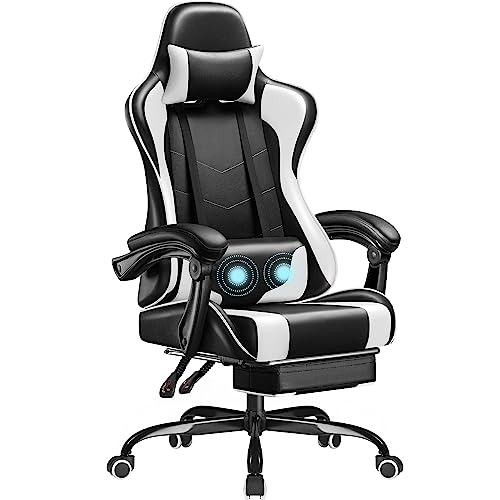
The Homall Gaming Chair leads because it offers the most ways to sit per dollar in this guide: a backrest that reclines to 135 degrees, a slide-out footrest that turns the chair into a lounger, a 360-degree swivel on a BIFMA-certified metal base, high-density foam under PU leather, a flexible headrest, and a massage lumbar pillow that vibrates gently against the lower back — a small, pleasant sensory input many restless sitters find genuinely settling during long sessions. Capacity is 300 lb, and the class 3 gas lift adjusts height across desk setups.
Strengths
- Recline plus footrest plus swivel: three movement outlets in one chair.
- Massage lumbar pillow adds adjustable sensory comfort to the support.
- High-density foam and a certified base tolerate creative sitting.
Trade-offs
- PU leather warms up in summer rooms; fabric-sitters should note it.
- The gaming silhouette is loud for formal offices.
- Armrests are less adjustable than the premium ergonomic picks.
| Color | White |
| Size | 19.7 inches x 18.5 inches x 50.4 inches |
| Dimensions | 18.5 x 20.9 x 50.4 inches |
| Weight | 39.7 pounds |
The Homall’s real virtue for this keyword is permission. Every feature says the chair expects to be used dynamically: lean back mid-thought, pull the footrest out for the reading chapter, swivel to the side table without the scoot-and-drag, sit cross-legged in the wide seat when the work turns contemplative. The massage pillow deserves its honest framing — it is a comfort feature, pleasant and mild, not a therapy device — and as comfort it earns its place, giving the lower back a gentle, changeable input during the hours when stillness would otherwise accumulate into restlessness.
Assembly is letter-and-number guided and quick, and the chair’s price position means a household can put one at the desk and call the seating question answered without a committee. For students, remote workers, and gamers whose sitting style is motion, it is the natural default.
Choose the Homall if you want maximum movement freedom at a friendly price. Skip it if you need fabric breathability or a chair that disappears visually into a corporate office.
Best for: Restless sitters who want recline, footrest, and swivel in one affordable chair / Not suited for: Formal offices or hot rooms

Respawn 110 Pro Ergonomic Gaming Chair with Footrest and Recline
Our badge: Best for Long Sessions
The Respawn 110 Pro Ergonomic Gaming Chair with Footrest and Recline stretches the movement brief further: a backrest that reclines to 155 degrees with an infinite angle lock — stop anywhere, not at preset notches — a reinforced retractable footrest on multi-point brackets, dual-density foam, lumbar support, a cushioned headrest, tilt control, and 360-degree swivel, supporting up to 275 lb. The gray fabric finish breathes better than leatherette and reads calmer in a home office.
Strengths
- Infinite-lock recline to 155 degrees: any angle your body requests, held securely.
- Reinforced footrest built for daily use, not occasional novelty.
- Fabric upholstery stays cooler across marathon sessions.
Trade-offs
- 275 lb capacity is the lowest ceiling among this guide’s desk chairs.
- At 46 pounds it is a settle-in chair, not a move-between-rooms chair.
- Fabric asks more of spill-prone sitters than wipe-clean leatherette.
| Color | Gray Fabric |
| Size | 28.50″ D x 26.75″ W x 51.50″ H |
| Dimensions | 28 x 26.4 x 51.2 inches |
| Weight | 46.3 pounds |
Respawn designs for the session that changes shape: upright for the focused sprint, tilted for the meeting, deep-reclined with the footrest out for the video, the review, the thinking pause. For a sitter whose attention runs in chapters, that shapeshifting is the feature — the chair follows the work’s rhythm instead of imposing its own. The dual-density foam deserves mention too: firmer where support lives, softer where contact happens, which is why the chair stays comfortable in hour four of a posture it met in hour one.
Students in long study blocks and remote workers in long meeting days are its natural owners, and its fabric calm makes it the gaming chair most welcome in shared living spaces.
Choose the Respawn if your sessions are long and your postures rotate. Skip it if you are near its capacity ceiling or need maximum armrest adjustability — the FLEXISPOT below is that chair. Long-session desk workers should also compare the workstation logic in Best Task Chairs For Home Office.
Best for: Long, shape-changing sessions at desk or console / Not suited for: Users near 275 lb

SIHOO M18 Ergonomic Office Chair
Our badge: Best Budget
The SIHOO M18 Ergonomic Office Chair is the budget ergonomic done properly: four support points — head, back, hips, hands — with an adjustable lumbar support, an adjustable headrest, 2D armrests, a wide cushion, breathable mesh back, tilt lock, and a frame tested to hold 330 lb, sized for sitters roughly 5’6″ to 6’2″. For a restless sitter on a budget, its virtues are the adjustable kind: the lumbar moves to where your back actually is today, and the mesh keeps a warm, active sitter cooler than foam-and-vinyl alternatives.
Strengths
- Adjustable lumbar and headrest at an entry price.
- Breathable mesh suits warm, active sitters.
- 330 lb rating and BIFMA-tested build outclass its price band.
Trade-offs
- No footrest; leg-tuckers will improvise with a box or stool.
- 2D armrests adjust less than the 3D sets above and below.
- Sized for average-to-tall sitters; petite users should check the fit notes.
| Color | Charcoal |
| Size | Pack of 1 |
| Dimensions | 27.5 x 21 x 11 inches |
| Weight | 31.526103466 pounds |
The SIHOO’s tilt deserves a restless sitter’s attention: a chair that rocks gently against your weight, and locks when you want it still, gives the legs-and-core fidget a sanctioned channel that a rigid chair denies. Paired with the wide cushion — room to sit cross-legged, which this guide counts as a legitimate working posture when the sitter chooses it — the M18 covers the budget brief completely: support that adjusts, air that flows, and a price that leaves room in the budget for the break-seat half of the system.
Assembly is an eight-step, instructions-included affair, and the three-year parts warranty in the maker’s terms is unusual reassurance at this price.
Choose the SIHOO if the budget is real and the sitting is long. Skip it if a footrest is non-negotiable — that is the Homall and Respawn’s territory.
Best for: Budget ergonomic support for active sitters / Not suited for: Footrest devotees or petite sitters

FLEXISPOT ErgoX Premium Ergonomic Office Chair
Our badge: Best Premium
The FLEXISPOT ErgoX Premium Ergonomic Office Chair is adjustability as a philosophy: seat depth adjustable from 17 to 20 inches, seat height from 20.1 to 22.4 inches, a five-level adjustable back, dynamic lumbar support that responds as you move, a 3D adjustable headrest, 3D armrests, a nap footrest, and tilt — rated to a remarkable 400 lb and fitted for users 5’1″ to 6’2″. For a sitter whose body asks different questions every hour, this is the chair with the most answers.
Strengths
- Seat depth adjustment — the rare feature that fixes cross-legged and perched sitting alike.
- Dynamic lumbar follows posture changes instead of punishing them.
- 400 lb rating and a footrest complete the premium brief.
Trade-offs
- Premium position in this guide’s range.
- Many adjustments mean a setup session; this chair rewards the patient.
- The pool lists package-style dimensions for this model; rely on the fit ranges in its features when planning.
| Color | Black |
| Size | Overall Depth 44″ |
| Weight | 38 pounds |
The ErgoX’s seat-depth adjustment is the sleeper feature for restless sitters. Slide the seat forward and the chair supports an upright, feet-planted work posture; slide it back and there is room to tuck a leg up without the seat edge arguing with your thigh. Combined with the nap footrest, the chair spans the full range from sprint posture to break posture without the sitter ever leaving it — the whole movement menu, in one piece of furniture, at one desk.
Choose it if you know your sitting is a moving target and you want the chair that moves with it. Its natural comparison set is the posture-first chairs in Best Chairs For Neck Support, where its headrest logic also competes.
Choose the FLEXISPOT if adjustability is your love language. Skip it if you want a chair that is right with zero setup — the Steelcase below self-adjusts instead.
Best for: Sitters who want every dimension adjustable / Not suited for: Set-and-forget buyers

Big Joe Fuf 8Ft Giant Foam Bean Bag Chair
Our badge: Best for Movement Breaks
The Big Joe Fuf 8Ft Giant Foam Bean Bag Chair is the system’s pressure valve: roughly eight feet of shredded-foam seating — it arrives compressed and expands over up to 48 hours — with a removable, washable cover, sewn-in handles, and no structure whatsoever beyond the foam’s own give. Sit in it, sprawl across it, perch on its edge, burrow into it with a laptop or a book: it is the chair that imposes no posture at all, which is exactly what a body needs between desk sessions.
Strengths
- Total postural freedom — the anti-chair for breaks, reading, and floor-level work.
- Shredded foam never goes flat like bead fill; fluff it and it recovers.
- Washable cover survives the snacks and pets that breaks attract.
Trade-offs
- It is enormous — about 71 x 58 inches of floor — and at 72 pounds it stays where it lands.
- No back support for desk work; it is a break seat, not a work chair.
- Rising from deep foam is a maneuver; plan its placement accordingly.
| Color | Vanilla Latte |
| Size | 8 foot |
| Dimensions | 71 x 58 x 39 inches |
| Weight | 72.75 pounds |
The Fuf’s role in an ADHD-friendly room deserves precise framing: it is not where work happens, it is where the worker recovers — the reading chair, the video chair, the think-it-through chair, the place a body goes when the desk chair’s structure has become the problem. Many restless sitters find their best reading and brainstorming happens at floor level in a seat with no rules, and the Fuf is that seat at maximal scale. In family rooms it becomes the most contested furniture in the house within a week; the lounging analysis in Best Chairs For Lounging covers its full-time cousins.
Give it a corner with a lamp and a side surface, let it expand fully before judging it, and fluff it weekly — foam chairs are maintained by enthusiasm, and this one rewards it for years.
Choose the Big Joe if your sitting system needs a genuine break seat. Skip it if your room is small or your desk chair must be your only chair.
Best for: Breaks, reading, and floor-level sprawling / Not suited for: Desk work or small rooms

Steelcase Series 1 Ergonomic Office Chair
Our badge: Best for Focused Desk Work
The Steelcase Series 1 Ergonomic Office Chair answers restlessness differently: instead of offering adjustments, it removes them. Its weight-activated controls sense the sitter and set the recline resistance automatically, so every posture migration — lean in, lean back, shift, settle — is met with the right support without a single lever being touched. Adaptive bolstering and flexible edges keep the sit pressure-free, assembly takes under two minutes with no tools, and this configuration ships with carpet casters. For a sitter who will never adjust a chair — because adjusting is one more demand on a busy mind — the self-adjusting chair is the honest solution.
Strengths
- Weight-activated support follows movement with zero fiddling.
- Compact, space-efficient frame suits small home offices.
- Steelcase build quality and research pedigree at the range’s sensible end.
Trade-offs
- This configuration is specified for carpet; hard floors want the appropriate caster version.
- No footrest and a task-chair silhouette; break posture happens elsewhere.
- Optional arms and headrest configurations vary — check the listing’s exact build.
| Color | Graphite |
| Size | Carpet (Pack of 1) |
| Dimensions | 23.75 x 27 x 41.25 inches |
| Weight | 29 pounds |
The Series 1 suits the focused-work chapter of a restless sitter’s day: the hours when the task has captured attention and the chair’s job is to vanish. Its support is quiet, automatic, and consistent, and its modest footprint leaves floor room for the break seat beside it. In a two-chair system — this at the desk, the Fuf in the corner — it is the professional half, and for sitters whose work is client-facing or camera-facing, its graphite restraint is welcome.
Choose the Steelcase if your focus hours deserve a chair that adjusts itself. Skip it if your sitting style needs a footrest and a deep recline at the desk itself.
Best for: Focused desk work with zero-adjustment support / Not suited for: Recline-and-footrest desk sitters
Comparison Table
| Pick | Color | Dimensions | Weight | Check price on Amazon |
|---|---|---|---|---|
| Homall Gaming Chair | White | 18.5 x 20.9 x 50.4 inches | 39.7 pounds | Check price on Amazon |
| Respawn 110 Pro Ergonomic Gaming Chair with Footrest and Recline | Gray Fabric | 28 x 26.4 x 51.2 inches | 46.3 pounds | Check price on Amazon |
| SIHOO M18 Ergonomic Office Chair | Charcoal | 27.5 x 21 x 11 inches | 31.526103466 pounds | Check price on Amazon |
| FLEXISPOT ErgoX Premium Ergonomic Office Chair | Black | — | 38 pounds | Check price on Amazon |
| Big Joe Fuf 8Ft Giant Foam Bean Bag Chair | Vanilla Latte | 71 x 58 x 39 inches | 72.75 pounds | Check price on Amazon |
| Steelcase Series 1 Ergonomic Office Chair | Graphite | 23.75 x 27 x 41.25 inches | 29 pounds | Check price on Amazon |
How to Choose the Best Chairs for Adhd
Inventory your movement before you shop
Spend one workday noticing how you actually sit: how often you shift, whether your legs tuck, perch, or pace, whether you lean back to think or lean in to focus, and what your current chair punishes. That inventory is your specification sheet. Leg-tuckers need seat depth and width; lean-back thinkers need recline range and a headrest that meets them there; pacers need a chair that is right instantly when they return to it, which argues for the Steelcase’s self-adjustment or a gaming chair left in a favorite position. Shopping against your observed habits beats shopping against an ideal sitter who does not exist.
Give the fidget a channel, not a fight
The features that serve restless sitters are the ones that convert movement into comfort: a tilt that rocks, a swivel that turns, a footrest that gives feet a job, a recline that changes the body’s geometry without ending the session. A chair with none of these forces the movement into the sitter’s joints and the chair’s frame — the wobble, the perch, the tipped-back two-leg balance that wrecks chairs and floors. Choose the chair whose design assumes motion, and the motion stops being a problem to manage.
Keep support posture-agnostic
Fixed lumbar curves support exactly one posture. If your sitting migrates — and this entire guide assumes it does — choose support that migrates with it: dynamic lumbar that follows, adjustable lumbar you can reposition, or pillows that move. The test is simple: adopt your three most-used postures in the chair and ask, in each, whether your lower back is met. A chair that passes in all three is your chair; a chair that passes in one is a lecture.
Build the two-seat system if you can
Desk chair plus break seat outperforms either alone for restless sitters, because the day itself has two modes. The desk chair handles the focused chapters with support and adjustability; the break seat — the Fuf’s rule-free sprawl — handles recovery, reading, and the floor-level thinking that desks inhibit. Even a modest version of the system (a good chair and a floor cushion) beats a premium single chair asked to be two things. Budget accordingly: this guide’s SIHOO-plus-Fuf combination costs less than many single premium chairs.
Mind the sensory details
Temperature, texture, and sound are comfort inputs too. Mesh and fabric breathe for warm sitters; leatherette wipes clean but warms and can squeak against clothing — a real consideration near microphones and in quiet rooms. Casters on hard floors add a rolling outlet some sitters love and others find distracting. Run your own sensory inventory alongside the movement one; the chair that fits both is the chair that disappears.
How Do You Set Up a Desk for a Restless Sitter?
Arrange the desk so movement is easy and return is instant. The chair needs floor room to swivel and roll without striking furniture — a chair that bumps the desk leg at every turn teaches its sitter to sit still and resent it. Put the day’s objects in a swivel’s arc: water, notebook, phone charger, the fidget tools of your choice, all reachable from the chair’s rotation, because a setup that requires standing for every small need fragments attention, while a setup that requires nothing lets the sitter surface only for real breaks. Keep a footrest option under the desk — the chair’s own, or a simple rest — because feet that have a place to press and brace settle the whole body above them.
Then protect the break: a defined place, even the Fuf’s corner or a mat by the window, where sitting means recovering. The desk setup’s job is to make the work posture sustainable; the break place’s job is to make leaving it restorative. A restless sitter with both places arranged rarely fights either one.
Problem: You keep ending up perched on the chair’s front edge — Your seat is likely too deep or your desk too far. Slide an adjustable seat forward, move closer, or accept the perch and choose a chair whose edge is cushioned for it.
Problem: Your legs fall asleep from tucking them up — The posture is fine; the duration is not. Alternate tucked chapters with feet-down or footrest chapters, and let the chair’s recline change the geometry between them.
Problem: The chair’s adjustments never stay where you set them — Choose positive-locking mechanisms and infinite-lock reclines over friction-only designs, or remove the problem with a self-adjusting chair like the Steelcase.
Problem: You focus better standing but your desk is fixed — Alternate with the break seat for reading and calls, and treat the desk chair as the writing-and-screen seat. A riser for the laptop is a small purchase with an outsized effect for pacers.
Problem: Your chair squeaks and the household hates it — Tighten every bolt — squeaks are loose joints announcing themselves — and favor fabric over leatherette at the contact points. The podcasting guide’s quiet-chair criteria go deeper.
The Sensory Side of Sitting
Sitting is a sensory experience before it is a postural one, and restless sitters are often managing input as much as position. Pressure is input: a seat that distributes it evenly — foam that supports without bottoming, mesh that suspends — gives the body a calm baseline to work from. Motion is input: the gentle rock of a tilt mechanism or the give of a foam lounger provides the low-level stimulation that many sitters unconsciously seek through leg-bouncing and chair-tipping, in a form the furniture was built to deliver. Temperature is input: a breathable back prevents the slow warm discomfort that reads, by afternoon, as an inability to concentrate on anything except leaving the chair.
None of this is therapy, and this guide does not dress it as such. It is furniture selection with the senses included in the specification — which, for the sitters this keyword serves, is simply what “comfortable” has always meant, stated completely.
Chairs for Kids and Students With Big Energy
Much of this keyword’s searching is done by parents and students, so the translation deserves a paragraph. For a young student, the principles hold at smaller scale: a chair that allows some movement, fits the desk’s height so feet can rest on the floor or a rest, and survives being sat in creatively without tipping or breaking. Homework happens better in a defined seat at a defined desk than in a rotating cast of kitchen chairs, and the break-seat logic applies with even more force — floor cushions and bean bags are the young sitter’s Fuf, and reading done sprawled is reading done willingly. For shared family desks, an adjustable chair like the SIHOO or FLEXISPOT serves the student now and the parent later, which is the budget-honest way to buy for a growing sitter.
The First Month: Dialing In a Chair That Moves With You
A movement-friendly chair is not finished when it is assembled; it is finished when its settings have survived a month of your real sitting. Week one is for the big geometry — seat height, lumbar position, arm height — set once, properly, by the sequence in this guide’s posture companions. Weeks two and three are for the micro-habits: notice which recline angle your thinking actually uses and leave the chair parked near it; notice whether the footrest comes out for reading or for everything, and let that knowledge arrange the desk’s floor space; notice the hour at which restlessness peaks and pre-empt it with the break seat rather than fighting it in the work chair. By week four, the chair should feel less like equipment and more like a habitat — a place whose defaults match your defaults, requiring no negotiation at the start of a session.
Keep a small log if your brain likes data: which setting changed, what improved, what got worse. Restless sitters often discover counterintuitive truths about themselves — that the locked tilt focuses them better than the free rock, or the reverse; that the massage pillow earns its keep only in the afternoon; that the Fuf’s sprawl is where the reading actually happens and the desk chair should stop pretending otherwise. The log turns a purchase into a fitted system, and a fitted system is what this keyword’s shoppers are really buying: not a chair that promises focus, but a sitting life with the friction designed out of it.
The Family Dimension: Shared Rooms and Shared Chairs
Many restless sitters work where they live, which puts the movement-friendly chair in family territory. A gaming chair in the living room becomes the household’s contested seat by the weekend; a Fuf in the family room becomes everyone’s, which the family-room logic of Best Sofas For Homes With Kids treats as a feature when the furniture is chosen for it. The practical settlements are simple: the work chair’s settings are the worker’s, reset without apology after family use; the break seat is communal by design; and a second, simpler chair for the household’s other sitters costs less than the daily renegotiation of the one perfect seat. Students in shared dorms face the same arithmetic at smaller scale — a chair that fits under the desk, survives roommates, and gives its owner one fully personal square meter of the world. In every version, the principle holds: movement-friendly furniture serves restless bodies best when the household’s expectations are arranged as deliberately as the chair’s settings.
What the Research-Minded Sitter Should Know About Movement and Attention
It is worth pausing on why movement-friendly seating feels so different, because understanding the mechanism helps a buyer choose between this guide’s philosophies. Sitting is not a passive act for the body: muscles hold, circulation pools, and the brain monitors a rising background of small discomforts. For many sitters — and disproportionately for restless ones — that background competes directly with the foreground task. Every micro-adjustment a chair permits is a small discharge of that background: the tilt’s rock resets the hips, the swivel answers the urge to turn, the footrest gives the legs a new geometry, the recline changes the entire load map. A rigid chair does not eliminate those urges; it merely forces them to accumulate until they are discharged as a full break — the wander, the phone, the abandoned session. The movement-friendly chair’s real function is to let the discharges happen in miniature, in place, without leaving the work.
That model also explains this guide’s two-seat system in its cleanest form. The desk chair handles the micro-discharges; the break seat handles the macro one — the full change of posture, altitude, and texture that a body eventually demands no matter how good the desk chair is. Sitters who try to make one chair do both discover that the desk chair’s structure eventually becomes the complaint and the break’s sprawl cannot support work at all. The system is not indulgence; it is load management, and it is why the SIHOO-plus-Fuf combination appears in this guide’s advice as often as the premium singles: it covers both discharge scales for less money than one chair that compromises between them.
A final, practical corollary: because the mechanism is personal, the return window is part of the product. A chair’s movement story cannot be judged in a showroom minute — it declares itself across days of real sessions, in whether the afternoon’s restlessness arrives later, softer, or not at all. Buy from listings with sane returns, run the chair through two honest weeks of your actual work, and keep the evidence of your own sitting as the deciding review. No guide — this one included — can feel your fidget for you; the best it can do, and has tried to do, is point you at the chairs whose designs take movement seriously, and then insist you verify the fit against the only laboratory that matters: your own working day, in your own room, at your own desk.
A Closing Word on Fit, From the Sitters Themselves
Talk to restless sitters who have found their chair — the one they no longer think about — and a common thread runs through their stories that no specification sheet captures: the chair stopped being an opponent. Before, there was a low daily negotiation — the shift, the perch, the ache, the wander — consuming a small tax of attention on every hour. After, the tax simply stops being collected, and the sitters describe the difference not as comfort, exactly, but as quiet: the body no longer interrupts. That is the honest promise this guide can make for its six picks, each in its dialect — the Homall’s many positions, the Respawn’s endless recline, the SIHOO’s cool adjustability, the FLEXISPOT’s total tunability, the Steelcase’s invisibility, the Fuf’s unconditional sprawl. None of them will organize a desk, build a routine, or treat a condition. Each of them will, if matched to the right sitter, retire one daily adversary — and for the sitters this keyword serves, one adversary fewer is not a small thing. It is, on the evidence of every story like theirs, the difference between a workday fought on two fronts and a workday fought on one. Choose by your own movement, verify across your own two weeks, and let the chair disappear. Disappearing, for a chair like these, is the highest praise there is.
One last encouragement belongs in this guide, addressed to the sitter who has been told — by teachers, by managers, by the furniture itself — that the problem is their stillness, or rather their lack of it. The evidence of your own working life almost certainly says otherwise: you have done your best thinking in motion, your best reading sprawled, your best problem-solving mid-pace. A chair that honors that evidence is not an indulgence or a workaround. It is a tool fitted to its user, which is what every tool in every trade is supposed to be. Buy it without apology, set it up without guilt, move in it without negotiating with anyone’s idea of how sitting should look — and let the work, which was always the point, have the whole of your attention at last.
Common Buying Mistakes
Buying the rigid “posture” chair as a discipline device
A chair chosen to force stillness will be fought, perched on, and abandoned. Choose the chair that channels movement; discipline was never furniture’s job.
Ignoring seat depth
Too-deep seats punish short legs and invite the slump; too-shallow seats punish tuckers. Adjustable depth, or a measured match to your legs, is the quiet specification that decides daily comfort.
Forgetting the break seat
One chair asked to serve focus and recovery serves both poorly. Even a modest second seat transforms the system’s comfort.
Choosing leatherette for a warm, active sitter
Heat accumulates, and with it restlessness. Fabric and mesh exist for exactly this sitter; the gaming category’s fabric models are the proof.
Expecting the chair to do the whole job
A chair removes friction; it does not build routines, treat conditions, or organize a desk. Buy it for what it honestly does, and let your strategies do the rest.
Final Recommendation
For most restless sitters, the Homall Gaming Chair is the answer: recline, footrest, swivel, and a massage lumbar pillow in one affordable, movement-friendly package. If your sessions run long and your postures rotate, the Respawn’s infinite-lock recline is the step up — compare it on its Check on Amazon listing. For focused desk hours, let the Steelcase adjust itself; for the fullest adjustability, the FLEXISPOT; and whatever desk chair you choose, give the system its break seat. Match the chair to your movement, and sitting stops being the hardest part of the work.
Frequently Asked Questions
What type of chair is best for restless sitters?
One designed for movement: a recline with a footrest, a swivel base, a seat wide and deep enough for varied postures, and support that adjusts or follows. Gaming chairs like the Homall and Respawn were built to exactly this brief, which is why they lead this guide.
Is sitting cross-legged in a chair bad?
It is a posture, like any other — comfortable for chapters, unwise as a permanent address. A chair with the width and depth for it, alternated with feet-down and reclined chapters, serves the sitter better than a chair that forbids it and gets fought all day.
Can a chair help with focus?
A chair can remove distractions — discomfort, heat, the fight against rigidity — and that is a real contribution to focus. It cannot create focus or treat any condition, and this guide recommends it only as what it is: one well-chosen piece of a larger system of routines and support.
Gaming chair or ergonomic chair for long sitting?
For movement-rich sitting, the gaming chairs’ recline-footrest combinations are hard to beat at their prices. For structured desk work with self-adjusting support, the ergonomic chairs — Steelcase, SIHOO, FLEXISPOT — hold posture better across the day. Many restless sitters run one of each: gaming chair for the long sessions, ergonomic for the focused ones, or the reverse, by taste.
What if I share the chair with a still sitter?
Choose adjustability you can both reset quickly — the FLEXISPOT’s ranges, or the Steelcase’s automatic controls, which need no resetting at all. Avoid chairs whose comfort depends on a single fixed setup one of you must undo daily.
How big a deal is the break seat, really?
Bigger than it looks. Sitters who have a sanctioned sprawl place take their breaks fully and return to the desk reset; sitters without one take their breaks in the work chair, in work posture, and wonder why the afternoon feels unbroken. The Fuf is the maximal version; a floor cushion is the minimal one; either beats none.


