Disclosure: As an Amazon Associate, dailyhomedecorating.com earns from qualifying purchases. Links to Amazon on this page are affiliate links; they cost you nothing extra. Prices and availability change often, so check the current Amazon listing before you buy.
Anyone who has lifted a hot tub cover to find a head of foam sitting on the water understands why best anti foam for hot tubs is such a common search. Foam is what happens when soaps, lotions, detergents, and body oils get whipped into standing, jetted water that stays in the tub for weeks. The honest starting point of this guide is a fact worth knowing before you buy anything: the verified product pool for this topic contains no bottled defoamer at all. What it contains is the other half of the answer — fresh-fill soaking tubs, which are filled for each bath and drained afterwards, and which therefore never develop the standing-water foam problem in the first place.
So this article does two jobs. First, it explains anti-foam products properly — the silicone-based defoamer types sold for hot tubs, how they work, and how to use them — as prose-only guidance, because we will not invent a link or a specification for a product we cannot verify. Second, it reviews six fresh-fill soaking tubs for readers whose foam frustration has them reconsidering the whole format: if you mostly soak alone or as a pair, a fresh-fill tub removes the foam, the defoamer, and most of the water-chemistry routine in one move. Readers committed to a jetted spa should also read our guidance alongside Best Silicone For Hot Tubs for seal care and Best Salt Water Hot Tubs For Sale if a salt system is part of the plan.

Where to Buy
The six fresh-fill soaking tubs reviewed below are sold on Amazon, where you can check the current price, delivery options, and listing details before you buy. Bottled hot tub defoamers are also widely sold on Amazon; choose them by the prose guidance in this article, since we link only the verified tub picks.
- Empava 59 Inch Freestanding Bathtub — Check on Amazon
- WOODBRIDGE Acrylic Freestanding Soaking Tub — Check on Amazon
- FerdY Tahiti 55″ Acrylic Freestanding Bathtub — Check on Amazon
- DeerValley 55″ Acrylic Freestanding Bathtub — Check on Amazon
- Vanity Art 67 Inch Freestanding Bathtub — Check on Amazon
- Streamline 75″ Freestanding Soaking Bathtub — Check on Amazon
In this guide
Quick Picks
| Pick | Badge | Why it earns its place |
|---|---|---|
| Empava 59 Inch Freestanding Bathtub | Best Overall | Fresh fill, anti-slip floor, and double-wall warmth — the complete foam-free soak. |
| WOODBRIDGE Acrylic Freestanding Soaking Tub | Best Compact | 54-inch footprint and a non-slip surface for smaller bathrooms. |
| FerdY Tahiti 55″ Acrylic Freestanding Bathtub | Best for Couples | Sized and shaped to fit one or two bathers, fresh water every time. |
| DeerValley 55″ Acrylic Freestanding Bathtub | Best Budget | The simplest route out of standing-water chemistry at a modest size. |
| Vanity Art 67 Inch Freestanding Bathtub | Best for Tall Bathers | 67 inches of stretch-out length with easy-clean acrylic. |
| Streamline 75″ Freestanding Soaking Bathtub | Best Premium | 82 gallons of deep, fresh water — the closest soak to a private spa. |
Key Takeaways
- Hot tub foam comes from contaminants — soap, lotion, detergent residue — aerated by jets in water that is kept, not replaced.
- Silicone-based defoamers knock foam down on contact but treat the symptom; they do not remove the contaminants causing it.
- Persistent foam is a water-care signal: the lasting fixes are shocking the water, cleaning or replacing filters, and eventually draining and refilling.
- Fresh-fill soaking tubs cannot develop standing-water foam because the water leaves with the bather.
- If your soaking is mostly solo or two-person, switching formats can delete the defoamer, the test strips, and most of the chemistry shelf.
- Never add bath oils or bubble products to a jetted hot tub and then reach for defoamer — prevention is the only reliable anti-foam.
How These Picks Were Chosen
We state the method plainly because this keyword demands it. The verified pool for this topic contains thirteen products, all of them indoor bathtubs, plus one faucet trim kit that is not a tub at all. There is no bottled anti-foam, no defoamer concentrate, and no jetted outdoor spa in the pool. Inventing a defoamer brand and attaching specifications to it would be exactly the kind of fabrication this guide series refuses to do, so the defoamer guidance in this article is prose-only: real product types, described qualitatively, with no links and no invented numbers.
The six linked picks were chosen as the closest honest fit for the reader behind this search: someone tired of fighting foam. Each is a fresh-fill soaking tub, assessed on the qualities that make the switch satisfying rather than a downgrade — soaking depth and capacity, heat retention across a long soak, floor traction, ease of cleaning (a tub that wipes clean needs no chemical help), and footprint. The Empava leads because it combines an anti-slip floor, double-wall construction, and a mid-size footprint; the Streamline closes the list as the premium, high-capacity option for readers who want the fullest soak. Every specification in the mini spec boxes comes from the verified pool data, and the sources file for this article records the pool gap explicitly for the coordinator’s final review.
What we filtered out: the alcove tubs in the pool, which are excellent renovations but a bigger project than most foam-frustrated readers are contemplating, and the walk-in tub, whose jetted combo format reintroduces exactly the recirculating-water maintenance this reader is trying to escape. If you keep your hot tub — and many readers should, especially families, as Best Hot Tubs For Families discusses — the prose defoamer guidance and the troubleshooting section below are the parts of this article written for you.
The 6 Best Anti Foam for Hot Tubs — Reviewed

Empava 59 Inch Freestanding Bathtub
Our badge: Best Overall
The Empava 59 Inch Freestanding Bathtub leads this guide because it answers the foam problem by subtraction: 45 gallons of fresh water per bath, drained when you are done, with nothing left standing to foam, sour, or demand a chemistry routine. Its double-wall acrylic keeps that fresh water warm across a long soak, and the textured anti-slip bottom keeps the bather steady without any additive in the water at all.
Strengths
- Fresh-fill format eliminates standing-water foam, defoamer, and routine water balancing.
- Double-wall acrylic retains heat for long soaks without topping up.
- Textured anti-slip bottom and ergonomic back support for a controlled, comfortable bath.
Trade-offs
- No jets — readers who love hydrotherapy massage will miss them.
- Requires an externally installed faucet, an added purchase and plumbing choice.
- A 59-inch tub serves one bather generously, two bathers snugly at best.
| Color | White |
| Size | 59 Inch |
| Dimensions | 59.1 x 29.5 x 26.8 inches |
| Weight | 66.1 pounds |
Consider what a hot tub asks of its owner each week: testing, balancing, shocking, filter rinsing, and the occasional defoamer dose when a guest arrives with freshly laundered swimwear full of detergent. The Empava asks for a wipe-down. The non-porous, high-gloss surface releases soap film readily — and note that the soap film here is on a drained, dry surface, where it is a cleaning matter of seconds rather than a water-chemistry problem. The adjustable leveling feet ensure the tub drains completely to its center outlet, so no residual puddle sits in the tub between baths either. Complete drainage is the whole anti-foam philosophy in one design trait: water that leaves cannot foam.
The 15-inch soaking depth is the specification that decides whether a former hot tub owner feels at home. Fifteen inches of water over a seated bather, with the back supported at a reclined angle, delivers the shoulder-deep immersion people associate with a spa, and the double wall means the last ten minutes of the soak are as warm as the first. Owners who soak for joint comfort or post-exercise recovery — the majority of daily hot tub users, in practice — generally find the experience equivalent and the ownership radically simpler. The cUPC certification and included drain and overflow also mean the installation is a plumber’s routine job rather than a spa technician’s project.
Who should not switch? Anyone whose hot tub is a social appliance — the place four adults gather on a Friday — because no 59-inch tub replicates that, and anyone devoted to powerful jet massage. For the solo and couple soakers who make up most hot tub usage, though, this is the pick that makes the defoamer bottle genuinely unnecessary, which is the most honest answer this guide can give to its own title.
Best for: Solo and couple soakers who want hot-tub-style immersion with zero standing-water chemistry / Not suited for: Hosts who soak socially or bathers who need jet massage
Choose it if your foam fight is really a maintenance fight and your soaking is one or two people. Skip it if the jets and the gathering are the point — keep the spa and use the defoamer guidance below instead.
WOODBRIDGE Acrylic Freestanding Soaking Tub
Our badge: Best Compact
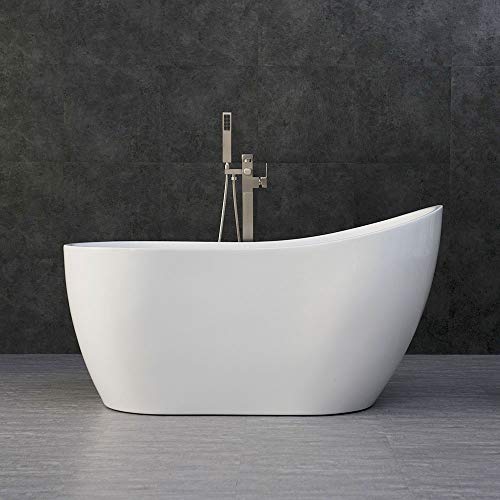
The WOODBRIDGE Acrylic Freestanding Soaking Tub makes the same fresh-fill argument in a 54-inch footprint, for bathrooms where the Empava’s extra five inches do not fit. Its non-slip surface meets ASTM slip-resistance standards, its double-walled Lucite acrylic holds heat, and its 55-gallon capacity is generous for its size — more water, in fact, than the larger-looking Empava holds.
Strengths
- Fresh fill and full drainage: no standing water, no foam, no defoamer shelf.
- Double-walled construction keeps a 55-gallon soak warm to the end.
- Non-slip surface verified to ASTM standards, in the smallest footprint here.
Trade-offs
- 29-inch wall height is a tall step-over for shorter or less mobile bathers.
- Compact interior suits shorter bathers best; tall users sit with knees bent.
- Freestanding format needs a floor- or wall-mounted faucet bought separately.
| Color | Brushed Nickel |
| Size | 54 inches long |
| Dimensions | 54 x 29 x 29 inches |
| Weight | 75 pounds |
There is a water-economics point worth making for compact fresh-fill tubs. A hot tub holds its water for months, which sounds efficient until the chemistry, heating, and filter costs of keeping that water alive are counted — and until a foam or clarity failure forces a full drain and refill anyway, usually at the least convenient moment. A 55-gallon fresh fill, heated on demand and drained after use, is a predictable, modest utility cost with no failure mode. Households that have watched a spa’s running costs climb often find the arithmetic of a tub like this surprisingly favorable, a theme the value-focused reader will also find in Best Bang For Your Buck Hot Tubs.
The build quality supports the switch. Lucite acrylic reinforced with resin and fiberglass, a stain- and scratch-resistant surface that keeps its gloss, and a reinforced bottom that feels solid underfoot — these are the traits that make a tub a ten-year appliance rather than a novelty. The surface care is the mild, non-abrasive routine described in Best Bathtub Cleaner For Plastic Tubs, and because the tub is dry between uses, there is no waterline scum ring of the kind that plagues standing-water spas.
Size the bather to the tub honestly. At 54 inches, this is a soak for someone who bathes with knees comfortably bent or who is of average height or below; the sloping lines follow the body’s curves, but physics is physics. In a small bathroom, though, it delivers the essential spa experience — deep, hot, still, fresh water — in the space a linen closet would otherwise occupy.
Best for: Small bathrooms and solo soakers who want the foam-free format at a compact size / Not suited for: Tall bathers who want to stretch out fully
Choose it if the room is small and the soaking is solo. Skip it if you are tall or the step-over height is a concern — the longer, lower picks on this list fit better.

FerdY Tahiti 55″ Acrylic Freestanding Bathtub
Our badge: Best for Couples
The FerdY Tahiti 55″ Acrylic Freestanding Bathtub is shaped and sized to fit one or two bathers, which makes it the natural pick for couples whose hot tub use was really two-person soaking with occasional foam management. Its double-walled, fiberglass-insulated construction holds heat, the sloped lumbar support suits a reclined pair, and — the point of this guide — every soak starts with clean water and ends with an empty tub.
Strengths
- Ergonomic oval interior honestly sized for one or two bathers.
- Double-walled insulation keeps shared soaks warm without reheating.
- Fresh-fill format: no jets to aerate contaminants into foam.
Trade-offs
- 14-inch water depth is shallower than the deepest picks here.
- Two bathers in 55 inches is intimate; larger couples will feel the squeeze.
- Toe-tap drain is convenient but is one more mechanism to keep clean.
| Color | Brushed Nickel Drain |
| Size | Tahiti 55″ |
| Dimensions | 55.31485 x 30.90545 x 23.42515 inches |
| Weight | 72.84 pounds |
Couples are the hot tub demographic most betrayed by foam, because two bathers double the lotions, hair products, and detergent residues entering standing water, and the foam appears precisely when the tub is being used as intended. In the FerdY, the same evening produces a fresh fill, a soak, and a drain — the contaminants leave with the water instead of accumulating across weeks until a defoamer dose becomes the pre-soak ritual. The glossy, pure-white acrylic wipes clean in moments, and the surface is described as easy to care for without aggressive products.
The design details suit the use. A toe-tap drain lets a bather drain the tub without reaching or bending at the end of the soak. The integrated slotted overflow and pre-installed brushed nickel drain simplify installation, and the drain finish can be personalized with separately sold kits if the bathroom’s hardware runs to chrome, matte black, or another finish. At just under 73 pounds, it is also one of the more manageable freestanding installations in this guide — relevant for upstairs bathrooms where spa-weight loads are a structural question, a point developed in Best Place For Hot Tubs.
Be clear-eyed about depth: 14 inches of water is a comfortable soak, not a plunge. Couples who loved the chest-deep immersion of a spa should compare the Empava’s 15-inch soak and the Streamline’s capacity before deciding. But for the couple whose actual ritual is a shared half-hour unwind, the Tahiti delivers it nightly with no test strips, no shock, and no foam — ever.
Best for: Couples who soak together and want spa evenings without spa chemistry / Not suited for: Bathers who want maximum water depth or room for more than two
Choose it if two-person soaking is the ritual you are protecting. Skip it if depth is your priority — read on to the premium pick.
DeerValley 55″ Acrylic Freestanding Bathtub
Our badge: Best Budget
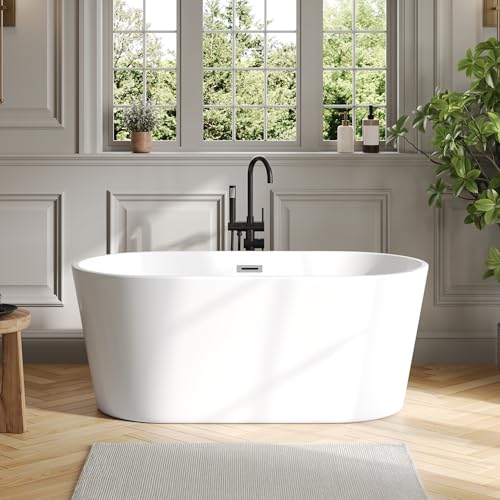
The DeerValley 55″ Acrylic Freestanding Bathtub is the simplest version of this guide’s argument: a compact, clean-lined soaking tub that replaces a foam-prone standing-water appliance with fresh water and a wipe-clean surface, at the accessible end of the range. Its 55-inch length is aimed at apartments, guest bathrooms, and smaller layouts — exactly the homes where a full outdoor spa was never practical anyway.
Strengths
- Compact footprint brings the fresh-fill format to apartments and small bathrooms.
- Smooth acrylic surface resists stains and cleans without chemical help.
- Center drain and integrated overflow included, with corrosion-resistant fittings.
Trade-offs
- The verified pool data lists no weight for this model, so floor-load planning needs the listing’s current details.
- Single-wall description: heat retention is good acrylic, not the double-wall standard of pricier picks.
- 55 inches is a solo soak for most adults.
| Color | White |
| Size | 55 Inch |
| Dimensions | 55.12 x 29.53 x 22.05 inches |
The DeerValley’s design brief — maximize interior soaking space within a compact exterior — is precisely what a former inflatable-spa owner needs. Inflatable and portable spas are where foam frustration peaks: small water volume, heavy use, and filters that struggle to keep up, a combination we examine in Best Portable Hot Tubs For Winter. A rigid acrylic tub of similar footprint holds its shape, drains fully through a real drain rather than a garden-hose valve, and never asks its owner to choose between another defoamer dose and draining the whole thing in frustration.
Three size options exist in this model line (55, 59, and 67 inches per the verified features), and the honest advice is to buy the largest your bathroom fits, because soaking room is the one specification you cannot retrofit. The 55-inch reviewed here is the apartment answer; a household with the floor space should price the larger variants on the same listing. Installation is straightforward freestanding placement, compatible with most freestanding faucets, and the lightweight structure eases positioning — though, as flagged above, confirm the current listing for the weight figure the pool data does not carry.
As the budget pick, it also makes the cleanest financial case in the guide: the purchase replaces not just a spa but the spa’s entire consumables tail — sanitizer, balancer, shock, filters, and yes, defoamer — with a water bill line item. For a renter-adjacent or first-home bathroom, that simplicity is the feature.
Best for: Apartment and small-bathroom soakers who want out of the foam-and-chemistry cycle cheaply and simply / Not suited for: Bathers who want deep, stretched-out, or two-person soaks
Choose it if footprint and simplicity lead your decision. Skip it if you have the room and budget for a longer, double-walled model.

Vanity Art 67 Inch Freestanding Bathtub
Our badge: Best for Tall Bathers
The Vanity Art 67 Inch Freestanding Bathtub answers the tall bather’s version of the foam complaint: the spa was the only vessel long enough, so the foam fight felt unavoidable. At 67 inches with gently sloping lines that follow the body’s curves, this fresh-fill tub gives the tall soaker the stretch without the standing water — and its stain- and scratch-resistant acrylic keeps the surface easy to maintain for years.
Strengths
- 67-inch length lets tall bathers stretch out fully in fresh water.
- Durable acrylic construction with stain and scratch resistance.
- All mounting hardware included, with a manual for floor mounting.
Trade-offs
- At 178.2 pounds it is the heaviest freestanding pick here — plan the installation crew accordingly.
- The larger footprint rules out genuinely small bathrooms.
- Freestanding placement flexibility still requires the faucet decision and cost.
| Color | Pure White |
| Size | L (67″) |
| Dimensions | 67 x 31.5 x 23.6 inches |
| Weight | 178.2 pounds |
Length changes the soaking experience in ways capacity numbers do not capture. A tall bather in a short tub chooses between submerged shoulders and bent knees; in 67 inches, neither compromise applies, and the soak becomes the full-body immersion that spa owners describe when they explain why they tolerate the maintenance. The Vanity Art’s UPC certification adds a compliance reassurance that matters when a fixture of this size is plumbed into a home, and the included pop-up drain and overflow mean the box contains the complete wet-end hardware rather than a shopping list.
Weight is the planning item. At over 178 pounds before water, this tub wants two capable installers, a clear carry path, and a floor you are confident in — although it is worth noting that even this, the heavyweight of the guide, plus its water and a bather, totals far less than a filled multi-person spa, which is one reason indoor fresh-fill tubs solve placement problems that defeat spas, as discussed in Best Place For Hot Tubs. Once placed, the easy-placement design and included hardware make the actual setting comparatively painless.
For the tall reader whose foam war was fought in defense of the only long soak available, this is the exit: same stretch, same depth of relaxation, and water that is new every single time.
Best for: Tall bathers who kept a spa mainly because nothing else was long enough / Not suited for: Small bathrooms or installations with difficult carry access
Choose it if length is non-negotiable and the room can take it. Skip it if the bathroom or the stairwell says no — the 59-inch Empava is the fallback.

Streamline 75″ Freestanding Soaking Bathtub
Our badge: Best Premium
The Streamline 75″ Freestanding Soaking Bathtub is the maximalist answer: 82 gallons of fresh water in a 75-inch oval, with thick acrylic that insulates like a spa shell and a bamboo tray across the rim for the book and the drink. If the fear behind your foam search is that giving up the spa means giving up luxury, this is the tub that retires that fear — every soak is a full, deep, private spa session with water that was drawn minutes ago.
Strengths
- 82-gallon capacity and 75-inch length deliver genuine full-body immersion.
- Thick acrylic construction provides excellent heat retention across long soaks.
- Reinforced stainless-steel frame and fiberglass insulation for durability.
Trade-offs
- 82 gallons per fill is a real water and heating cost per soak — the opposite of economical.
- At 134.5 pounds plus 82 gallons of water, floor loading must be verified.
- Its scale dominates a bathroom; it is a centerpiece, not an addition.
| Color | Polished Chrome |
| Dimensions | 74.8 x 35.4 x 27.6 inches |
| Weight | 134.5 pounds |
The honest accounting for this pick runs both ways. Per soak, it uses more water than any other pick here — roughly double the Empava’s fill. Per year of ownership, though, it uses no sanitizer, no shock, no filter cartridges, no defoamer, and no standby heating electricity, and it never presents the spa owner’s worst bill: the full drain, scrub, and refill after a water-care failure. Readers in the premium tier, comparing against the ownership costs tallied in Best Hot Tubs Under $6000, often find the Streamline’s simplicity is itself the luxury they were paying spa prices to approximate.
The construction details support a long service life: scratch-, stain-, and discoloration-resistant acrylic over a reinforced frame, with a pre-installed internal drain in a brushed finish. The bamboo tray is a small thing that signals the intended use — this tub expects you to stay a while. Heat retention from the thick shell makes that realistic: a 45-minute soak stays warm without the bather running a hot tap and disturbing the stillness that is, after all, the product being bought.
Reserve this pick for the primary bathroom of a committed soaker with verified floor structure and the water heater capacity to fill 82 gallons without the household’s showers going cold. Within those conditions, it is the most complete foam-free soak in the guide.
Best for: Committed soakers with a large primary bathroom who want spa-scale immersion without spa ownership / Not suited for: Water-conscious households or rooms that cannot carry the load
Choose it if the soak is a daily ritual and the room is built for it. Skip it if fills will be occasional — a smaller tub delivers the same chemistry-free benefit at half the water.
Comparison Table
| Pick | Length | Dimensions | Heat retention | Check price on Amazon |
|---|---|---|---|---|
| Empava 59 Inch | 59 inches | 59.1 x 29.5 x 26.8 inches | Double-wall acrylic | Check price on Amazon |
| WOODBRIDGE 54 Inch | 54 inches | 54 x 29 x 29 inches | Double-walled | Check price on Amazon |
| FerdY Tahiti 55″ | 55 inches | 55.31485 x 30.90545 x 23.42515 inches | Double-walled, fiberglass insulated | Check price on Amazon |
| DeerValley 55″ | 55 inches | 55.12 x 29.53 x 22.05 inches | Acrylic | Check price on Amazon |
| Vanity Art 67 Inch | 67 inches | 67 x 31.5 x 23.6 inches | Acrylic with fiberglass reinforcement | Check price on Amazon |
| Streamline 75″ | 75 inches | 74.8 x 35.4 x 27.6 inches | Thick insulated acrylic | Check price on Amazon |
How to Choose the Best Anti Foam Approach for Hot Tubs
Understand what a defoamer actually does
Hot tub defoamers are almost always silicone-based liquids. A small dose spread across the water’s surface breaks the surface tension that lets bubbles persist, and visible foam collapses within moments. That is the entire mechanism: the defoamer does not remove the soap, lotion, or detergent that caused the foam, does not sanitize, and does not rebalance anything. It is a cosmetic reset with a short half-life — if the contaminant load stays, the foam returns, sometimes within the same evening’s soak. Buy a defoamer as a spot treatment for a guest-night emergency, not as a water-care strategy.
Diagnose before you dose
Foam has causes, and the cause decides the cure. Foam after a party usually means a contaminant spike: shock the water, rinse the filters, and let the system clear. Foam that appears in an empty, freshly balanced tub points at detergent residue in swimwear — wash suits in water only. Foam with a sour smell or cloudy water is a sanitation failure, and defoamer over it is perfume on a problem that needs a drain and refill. A useful rule: if you have dosed defoamer twice in one fill of water, the water itself is the problem.
Compare defoamer formats honestly
Prose-only guidance, since our verified pool carries no defoamer: liquid silicone defoamers are the standard format, sold in squeeze or spray bottles for dosing across the surface; spray formats distribute more evenly and reduce over-dosing; a minority of products market themselves as enzyme-based, but enzymes work on oils over hours, not on foam in minutes, and are better understood as clarifier maintenance than as anti-foam. Whatever the format, the label direction that matters is dosage restraint — more defoamer than directed can cloud water and coat filters, manufacturing the next problem while solving this one.
Decide whether the format still fits your life
The deeper choice this keyword hides is format. Standing-water appliances make sense when soaking is frequent, social, and jet-driven. They make less sense when soaking is a solo or couple ritual a few times a week — the exact pattern where fresh-fill tubs deliver the same water experience with no chemistry shelf at all. Readers weighing a replacement spa against a soaking tub should compare total ownership: the running costs in Best Hot Tubs Under $2000 and the placement freedom of indoor tubs both shift the answer. Foam is often the first annoyance that makes owners do this math; it is rarely the last.
Protect the water you keep
If you keep the spa, prevention outperforms every product: shower before soaking, keep swimwear detergent-free, keep bath products out of the spa entirely, maintain sanitizer in range so organics are oxidized before they accumulate, and rinse filters on schedule so the system can actually remove what you introduce. A spa with disciplined inputs needs defoamer a few times a year. A spa without them needs it weekly, and no bottle wins that fight.
How Do You Use a Hot Tub Defoamer Correctly?
Technique matters more than brand. Run the jets to gather the foam in one place, dose the smallest amount the label allows directly onto the foam, and give it a few minutes to spread and work before adding more. Most over-dosing happens from impatience in the first sixty seconds. Apply with the jets running so the silicone distributes through the water rather than pooling, and skim any collapsed residue that collects at the waterline — that residue is the contaminant load leaving the water, and removing it is the one genuinely curative part of the process. Wipe the waterline ring afterwards; left in place, it re-dissolves into the next soak.
After dosing, run the filtration cycle fully and check the water again the next day. If foam returns within a day, stop dosing and escalate to the real fixes in order: test and rebalance, shock, clean or replace the filter, and if the water is more than a few months old or has survived several foam episodes, drain and refill. Fresh water is the only true anti-foam, which is the principle the fresh-fill picks in this guide are built on.
Keep a small foam log for one fill cycle and the pattern will usually name the cause for you. Note the date, who soaked, whether swimwear came straight from the laundry, and what you dosed. Most owners discover their foam is not random at all: it follows the weekend the grandkids visited, the switch to a new detergent, or the week the sanitizer test got skipped. That record turns defoamer use from a reflex into a diagnosis, and it also tells you when the honest middle fix is a partial drain — replacing roughly a third of the water after a heavy-use weekend dilutes the surfactant load enough that the remaining water behaves, at a fraction of the cost and downtime of a complete refill.
Problem: Foam returns within hours of dosing — The contaminant load exceeds what surface treatment can hide; shock the water, rinse the filter, and plan a drain and refill if it persists.
Problem: Water turns cloudy after defoamer use — Classic over-dosing. Stop adding product, run filtration, clean the filter, and let the system clear; dose smaller next time.
Problem: Foam appears only when the jets run — Aeration is whipping a mild contaminant load; check sanitizer level first, since under-sanitized water foams earliest, then shock.
Problem: A greasy ring forms at the waterline — That is the oil load made visible. Wipe it away with a spa surface cleaner, rinse filters more often, and enforce the pre-soak shower.
Problem: Foam in a tub that sat unused — Stagnant, under-sanitized water degrades on its own; test before use, shock, and do not soak until levels read correctly.
Why Hot Tub Water Foams: The Chemistry in Plain Language
Foam needs three ingredients: water, air, and a surfactant — a molecule that lowers surface tension and stabilizes bubbles. Hot tubs supply all three generously. The water is kept for months. The jets inject air constantly. And the surfactants arrive on bathers: shampoo and conditioner residue in hair, lotions and sunscreens on skin, and above all laundry detergent clinging to swimwear, which is engineered to foam and does so enthusiastically at spa temperatures. Body oils and dead skin add to the load, and every bather-hour concentrates it further because the water, unlike a bath, does not leave.
Sanitizer fights this load by oxidizing organics, which is why foam is often the first visible symptom of sanitizer running low: the oxidizer falls behind, surfactants accumulate, and the jets announce it. Temperature accelerates everything — warm water holds reactions faster and skin sheds more oils into a hot soak. Understanding this chain explains why the durable fixes are input discipline, filtration, oxidation, and periodic fresh water, and why a defoamer, which touches none of the four, can only ever be a pause button. It also explains the fresh-fill tub’s immunity completely: with water measured in hours rather than months, surfactant concentration never reaches foaming threshold.
Fresh-Fill Soaking Versus Standing Water: An Honest Comparison
Advocates of each format tend to argue past each other, so here is the balanced version. A hot tub offers jets, seating for a group, outdoor placement, and water that is ready at any hour without a fill wait. Its costs are continuous: standby heating, a chemical routine that cannot be skipped without consequences, filters and consumables, a cover that ages, and failure modes — foam, cloudiness, odor — that arrive on the water’s schedule, not yours. A fresh-fill soaking tub offers water quality that is perfect by construction, zero routine, and indoor placement in rooms that already exist. Its costs are a fill wait before every soak, no jets in the models reviewed here, and capacity for one or two bathers rather than a gathering.
The deciding question is your actual usage pattern over the last year, not your imagined one. Daily solo soaks and couple soaks map almost perfectly onto the fresh-fill format; the spa’s advantages sit unused while its maintenance runs at full rate. Weekly group gatherings map onto the spa; a soaking tub would disappoint every guest. Many households, honestly audited, discover their spa is a two-person appliance with a four-person maintenance bill — and that discovery, usually triggered by a foam outbreak, is what this guide exists to serve. Those keeping the spa should bookmark the prevention routine above; those switching should measure the bathroom against the comparison table and pick the largest fresh-fill tub the room honestly fits.
Common Buying Mistakes
Treating defoamer as water care
Defoamer hides foam; it does not clean water. Owners who dose weekly instead of fixing inputs end up soaking in increasingly loaded water that eventually forces a drain anyway — after weeks of unpleasant soaks. Use defoamer for occasions, and inputs discipline for the season.
Over-dosing when foam appears
The instinct to add more when the first dose seems slow manufactures cloudy water and coated filters. The consequence is a second problem stacked on the first. Dose small, wait, skim, and escalate to shocking rather than to more silicone.
Adding bath products to a jetted spa
Bubble bath, bath oils, and scented soaks are formulated to foam or emulsify — in standing jetted water they guarantee an outbreak. The better move is to keep spa water plain and save the products for a fresh-fill bath, where they rinse away with the water.
Ignoring the filter’s role in foam
A clogged or aged filter cannot remove the oils that become foam, so every other fix underperforms. Owners replace chemicals when they should replace the filter. Rinse on schedule and replace on the manufacturer’s interval, not on visible failure.
Buying a bigger spa to escape maintenance
More water dilutes contaminants slightly but multiplies heating, chemistry, and cover costs. If maintenance is the complaint, the fix is a format change or a routine change — never more gallons of the same routine.
Final Recommendation
If you keep your hot tub, keep it with discipline: a silicone defoamer used sparingly for occasions, honest inputs, a maintained filter, and fresh water on schedule. But if the foam fight is what brought you here and your soaking is solo or two-person, the lasting answer is the format change — and our top pick for making it is the Empava 59 Inch Freestanding Bathtub, whose double-wall warmth, anti-slip floor, and fresh-fill simplicity retire the defoamer bottle entirely. The runner-up for smaller rooms is the WOODBRIDGE: Check on Amazon for its current listing. Whichever direction you choose, choose the one that makes foam a non-event — either a spa maintained well enough that it rarely forms, or water so fresh it never can.
Frequently Asked Questions
What is the best anti foam for hot tubs?
Silicone-based liquid defoamers are the standard, effective type: a small dose breaks surface tension and collapses foam on contact. No specific bottled product is linked in this guide because our verified product pool contains none, and we do not invent products or specifications. Choose a silicone-based defoamer from a spa-care brand, dose minimally, and treat recurring foam as a water-care problem, not a dosing problem.
Why does my hot tub foam when the jets turn on?
Jets inject the air; the foam itself comes from surfactants — detergent in swimwear, shampoo residue, lotions — accumulated in standing water, often worsened by low sanitizer. The jets merely reveal a load that has been building since the last refill.
Is hot tub foam harmful?
The foam itself is mostly cosmetic, but it signals a contaminant load and frequently under-sanitized water, which is the real concern. Treat persistent foam as a prompt to test, shock, and clean filters — and to drain and refill if the water is old.
How often can I use defoamer?
Occasionally, at the smallest effective dose. Needing it more than rarely means the water needs attention: rebalance, shock, filter care, or fresh water. Chronic dosing clouds water and coats filters, creating new problems.
Will a fresh-fill soaking tub really never foam?
Correct in the standing-water sense: because the water is drawn fresh and drained after each bath, surfactants never concentrate enough to sustain foam, and there are no jets in these models to aerate the water anyway. Bath products used in a fresh-fill tub rinse away with the water instead of accumulating.
What is the quickest fix before guests arrive?
Run the jets, skim existing foam, dose a minimal amount of silicone defoamer onto the foam, wipe the waterline, and run a full filtration cycle. Then fix the cause the next day — the quick fix buys an evening, not a season.
Can I use fabric softener or other household products instead of defoamer?
No — and the attempt usually makes the next episode worse. Fabric softener is itself a surfactant-rich product: it coats filter media and adds to the very load that stabilizes foam, while detergent and dish soap are engineered to produce foam in hot, agitated water. Cooking oils and similar home remedies may flatten bubbles briefly, but they leave a film on the shell and inside the plumbing that must then be shocked and filtered out. A purpose-made silicone defoamer, dosed at the smallest amount that works, is the only shortcut that does not bill you later.


