Disclosure: As an Amazon Associate, dailyhomedecorating.com earns from qualifying purchases. Links to Amazon on this page are affiliate links; they cost you nothing extra. Prices and availability change often, so check the current Amazon listing before you buy.
Searching for the best frameless sliding shower doors for tubs usually means you are standing in a bathroom that is almost right: the alcove tub works, the tile is fine, but the shower curtain clings, billows, and lets water escape onto the floor every single morning. A frameless sliding door promises the clean glass look of a custom shower with none of the curtain’s daily annoyances. The catch, and the reason this guide is structured the way it is, is that a frameless door is only as good as the tub it mounts on. The door rides on the tub’s top ledge, seals against the tub’s walls, and lives or dies by the flatness, width, and material of that ledge.
So this guide does two jobs at once. It explains how to choose the door itself — glass thickness, hardware, coatings, and the measurements that decide whether a door will glide or grind — and it reviews the tubs in our verified pool that honestly serve as door-ready bases, because the pool contains tubs rather than door kits. Four alcove tubs below are genuine door partners: flat ledges, integral flanges, standard 60-inch openings. Two further picks are prose-only door types described qualitatively, because no door kit exists in the pool and inventing one would help nobody. If your current tub is chipped, narrow-ledge, or curved, the honest answer may be that the tub decision comes first, and the sections below will help you see why.
Where to Buy
Every linked pick in this guide is sold on Amazon, where you can check the current price, delivery options, and listing details before you buy. For door projects, confirm the tub’s ledge dimensions and drain hand on the listing, and measure your alcove opening twice — frameless glass cannot be trimmed after tempering.
- Kohler K-20202-LA Underscore 60″ Soaking Bathtub — Check on Amazon
- KINGSTON BRASS 60-Inch Alcove Acrylic Bathtub — Check on Amazon
- Fine Fixtures Acrylic Alcove Soaking Bathtub — Check on Amazon
- BOOTZ INDUSTRIES Steel Bathtub with Right-Hand Drain — Check on Amazon
- Frameless bypass door with soft-close rollers (prose-only pick — see review)
- Single-panel sliding door with exposed roller rail (prose-only pick — see review)
In this guide
Quick Picks
| Pick | Badge | Why it earns its place |
|---|---|---|
| Kohler K-20202-LA Underscore 60″ Soaking Bathtub | Best Overall | Low 19-inch step-over, integral apron and flange — the most door-friendly ledge in the pool. |
| KINGSTON BRASS 60-Inch Alcove Acrylic Bathtub | Best for Standard Alcoves | Classic three-wall footprint with tile flange, sized for the standard door kits. |
| Fine Fixtures Acrylic Alcove Soaking Bathtub | Best for Easy Installation | Pre-fixed flange and included drain simplify the whole door-and-tub project. |
| BOOTZ INDUSTRIES Steel Bathtub | Best Budget | Rigid steel ledge that will not flex under a door track, at the entry tier. |
| Frameless bypass door with soft-close rollers | Best Door Type for Families | Two sliding panels, no swing clearance needed, gentle close for small hands. |
| Single-panel sliding door with exposed roller rail | Best for the Spa Look | The barn-door aesthetic frameless buyers picture — with honest upkeep trade-offs. |
Key Takeaways
- A frameless sliding door mounts on the tub ledge, so ledge flatness, width, and rigidity matter more than the door’s styling.
- Standard 60-inch alcove tubs accept the widest range of frameless door kits; odd sizes shrink your choices fast.
- Tempered glass in the thicker gauges glides more quietly and feels substantially more solid on its rollers.
- Frameless means no frame around the glass — not no hardware. A top rail or roller track still carries the panels.
- Water control comes from panel overlap, bottom guides, and correct pitch, not from a frame seal.
- If the existing tub ledge is damaged or sloped, replacing the tub first is cheaper than fighting leaks for a decade.
How These Picks Were Chosen
We started from the verified pool and asked a door installer’s question of every tub: could a frameless sliding door live on this ledge for ten years? Freestanding tubs failed that test immediately — a door needs two walls and a straight, supported ledge, and a freestanding oval offers neither, which is why the pool’s many freestanding models appear nowhere below despite their soaking quality. Alcove tubs passed in proportion to three things: a flat, wide top ledge for the bottom guide and panel rest; an integral flange or apron that keeps wall water out of the framing; and a standard footprint that matches the door kits actually sold for tubs.
The four linked tubs are ranked on those criteria, and each review discusses the door pairing explicitly: what to measure, what hardware style suits the ledge, and what will go wrong if you ignore the pairing. The two prose-only picks are door types, described by construction and behavior rather than by brand, because the pool contains no door kits and this guide does not invent listings. A shower trim kit that appears in the pool data was excluded entirely — it is a faucet trim, not a tub and not a door. Readers planning a full alcove refresh will also find the cleaning guidance in Best Cleaner For Bath Tubs relevant, because glass doors and acrylic tubs share a hatred of abrasive cleaners.
One more honesty note: door dimensions, glass gauges, and coating claims in the prose sections are general category knowledge, the standard vocabulary of the door trade, not specifications of a particular product. When you shortlist a real door kit, its own listing governs. What this guide gives you is the judgment to read that listing well.
The 6 Best Frameless Sliding Shower Doors for Tubs — Reviewed

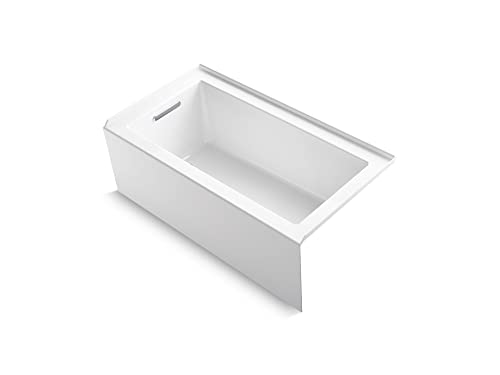
Kohler K-20202-LA Underscore 60″ Soaking Bathtub
Our badge: Best Overall
The Kohler K-20202-LA Underscore 60″ Soaking Bathtub earns the top spot here for a reason specific to doors: its 19-inch step-over height delivers a full-depth soak in a lower-profile shell, and a lower tub profile means a standard-height door panel covers the opening with better proportions and less top-heavy glass. Add the integral apron, the integral flange that keeps wall water behind the tile line, and molded lumbar support inside, and you have the pool’s most complete door partner.
Strengths
- 19-inch step-over height pairs elegantly with standard door panel heights.
- Integral flange helps prevent water seeping behind the wall — critical with door splash patterns.
- 68-gallon capacity and slotted overflow allow deep soaking behind closed glass.
Trade-offs
- At 128 pounds it is the heaviest alcove pick here; plan a two-person set.
- Left-drain configuration in this model; confirm your plumbing side.
- Premium positioning means the door budget must be planned alongside, not after.
| Color | White |
| Dimensions | 60 x 32 x 19 inches |
| Weight | 128 pounds |
Think about how a sliding door changes the water map of an alcove. A curtain contains spray softly and forgivingly; glass is rigid, so spray that strikes the panel runs down in sheets and exits wherever the panel overlap, the bottom guide, and the ledge pitch allow. The Underscore’s flange-and-apron construction is built for exactly this regime: water that gets past the glass line meets a flange designed to route it back to the tub rather than into the wall. That is unglamorous engineering, and it is the difference between a door installation that ages gracefully and one that swells the subfloor by year three.
The soaking experience behind the glass is equally considered. The slotted overflow permits a deeper fill than a standard overflow plate, so the bather sits lower relative to the door’s bottom rail — less splash against the glass, less water driven at the seals. Molded lumbar support keeps the soak comfortable at that depth. For households converting a tub-shower combo that serves both quick showers and long soaks, this is the configuration that serves both honestly. The door guidance in Best Sealant For Tubs applies directly to this install: the flange handles the wall line, but the door’s bottom guide and wall jambs still live or die by their sealant beads.
Choose this base when the bathroom is a long-term home and the door is a finishing investment. Its weight and positioning argue for a planned project — tub set, tile, then door measured from the finished opening — rather than a weekend improvisation.
Best for: Long-term bathrooms wanting a deep soak and the most door-friendly alcove base / Not suited for: Right-drain alcoves or solo DIY installs without a second pair of hands
Choose it if you are renovating once and renovating properly. Skip it if your drain is right-handed — the next pick covers that side in a standard footprint.

KINGSTON BRASS 60-Inch Alcove Acrylic Bathtub
Our badge: Best for Standard Alcoves
The KINGSTON BRASS 60-Inch Alcove Acrylic Bathtub is the archetype the frameless door industry designs around: 60 inches long, three-wall alcove, tile flange, integral apron, right-hand drain. If a door kit’s listing says “fits standard tub openings,” this is the tub it is picturing. That compatibility breadth is a genuine feature — it means more door styles, more hardware finishes, and more replacement parts available to you over the door’s life.
Strengths
- Standard 60-inch three-wall footprint matches the widest range of door kits.
- 58.2-gallon capacity with 14-inch depth to overflow — a real family soak.
- Acrylic with fiberglass and resin reinforcement keeps the ledge stable under a track.
Trade-offs
- Drain kit is not included; budget it alongside the door.
- Right-hand drain only in this configuration.
- Acrylic ledge requires the door’s bottom guide to be sealed, never screwed, through the surface.
| Color | Glossy White |
| Size | 60 inch (L) x 30-11/16 inch (W) x 22-1/16 inch (H) |
| Dimensions | 60 x 30.69 x 22.06 inches |
| Weight | 95 pounds |
Installation sequencing is where this tub-and-door combination shines. Set the tub level — genuinely level, checked with a long level along the ledge, because a sliding door amplifies any slope: panels drift toward the low end, overlaps open at the high end, and the bottom guide ponds water. Tile down to the flange, let the wall finish cure, then measure the finished opening at top, middle, and bottom before ordering glass. Tempered panels cannot be cut, so the finished measurement is the only one that counts. On a standard tub like this one, out-of-plumb walls are the usual surprise, and better door kits allow for it with adjustable jambs; the tub itself will not be the problem.
Daily life with the pairing is straightforward. The acrylic surface shrugs off the mild cleaners that glass-safe routines use, the apron front gives the door’s lower line a clean visual base, and the 58.2-gallon interior serves the family-bathroom double duty of kids’ baths and adult showers. When the door eventually needs roller service, the standard footprint means generic parts fit — a small, real ownership advantage that compounds over a decade. Buyers comparing alcove bases across this series will find this tub’s sibling analysis in Best Tubs For Seniors relevant too, since step-over and support questions overlap with door questions for multi-generation households.
Best for: Standard alcove renovations wanting maximum door-kit choice / Not suited for: Left-drain bathrooms or buyers who need the drain kit in the box
Choose it if your alcove is the standard 60-inch right-drain layout. Skip it if you want the drain included and the flange pre-fixed — the next pick was designed around exactly that.

Fine Fixtures Acrylic Alcove Soaking Bathtub
Our badge: Best for Easy Installation
The Fine Fixtures Acrylic Alcove Soaking Bathtub is the project-simplifier of this list: drain included, tile flange pre-fixed, no mortar or plaster bed required, adjustable legs for leveling. Every one of those details shortens the path to the day the door can be measured and hung, and the pre-fixed flange in particular removes the sloppiest step in alcove work — the wall-sealing line that door splash will test daily.
Strengths
- Drain included and pre-fixed tile flange shorten the parts list and the labor.
- Adjustable legs make true ledge leveling — the door-critical step — achievable.
- Sloped lumbar support and a toiletries ledge serve the shower-tub double duty well.
Trade-offs
- This configuration is left-hand; right-hand projects need the mirrored variant.
- Standard soaking depth rather than a deep-soak interior.
- Alcove-only format, as any door base must be.
| Color | White |
| Size | 60″ x 30″ – Left Hand |
| Dimensions | 30 x 60 x 21.5 inches |
| Weight | 65 pounds |
Leveling deserves its own paragraph in a door guide, because it is the single variable that decides whether a frameless slider feels expensive or feels broken. A panel hanging from a top rail, or riding a bottom guide, follows gravity faithfully: a ledge out of level by a quarter inch across 60 inches produces a door that rolls open by itself, or must be pushed uphill and latches nowhere. Adjustable legs turn leveling from a shimming art into a wrench task, and they let the installer correct the ledge after the tub is in the alcove rather than before. If you buy one feature for a door project, buy that.
The bathing side is honest mid-range: a sloped back that supports a soak, a ledge wide enough for the bottles a shower-tub accumulates, and an acrylic surface described as resistant to salts and oils. Note the ledge-sharing negotiation a door introduces: the bottom guide occupies the ledge’s center line, so bottle space shrinks to the back corners. Households with many products should plan a wall niche in the same project — it is far easier before the door goes on. The cleaning pairing matters as well; the routine in Best Bathtub Cleaner For Plastic Tubs covers the mild, non-abrasive approach that both acrylic and coated glass require.
Best for: Left-hand alcove projects where installation simplicity drives the plan / Not suited for: Right-hand alcoves or deep-soak seekers
Choose it if you want the shortest, cleanest path from old tub to hung door. Skip it if your drain hand is wrong — never re-plumb a bathroom to suit a tub’s handedness when a mirrored option exists.

BOOTZ INDUSTRIES Steel Bathtub with Right-Hand Drain
Our badge: Best Budget
The BOOTZ INDUSTRIES Steel Bathtub with Right-Hand Drain brings a material argument to the door question: rigidity. A steel ledge does not flex. Under a door’s bottom guide, where two glass panels concentrate their weight and their rolling loads on a narrow line, an enamel-over-steel ledge stays put in a way that thin acrylic ledges on lesser tubs do not. For a budget renovation adding glass to a standard alcove, that stiffness is the steel tub’s quiet superpower.
Strengths
- Rigid steel ledge provides a stable, non-flexing base for a door track or guide.
- Standard 60-inch alcove footprint accepts mainstream door kits.
- At 50 pounds it is the easiest tub here to move, set, and level.
Trade-offs
- Enamel can chip if struck; chips near the door line need prompt touch-up.
- Steel sheds heat faster than acrylic, shortening comfortable soaks.
- Right-hand drain only in this configuration.
| Color | White |
| Dimensions | 61 x 31 x 18 inches |
| Weight | 50 pounds |
Two steel-specific cautions belong in any honest door pairing. First, drilling: some door kits anchor their bottom guide with screws, and drilling enamel-over-steel invites chipped enamel and future rust at every hole. Prefer kits whose guides bond with the manufacturer’s approved adhesive system, or have the drilling done by someone who knows enamel — slow speed, sharp bit, no hammer mode. Second, chips: a dropped showerhead or a tool slip during door installation can chip the ledge, and a chip under a door track traps moisture invisibly. Touch up any chip before the door goes on, using the approach in Best Rust Stain Remover For Tubs, and inspect the ledge line at every deep clean thereafter.
With those cautions honored, the ownership story is strong. Steel tubs serve for decades, the door above them is a standard size with standard parts, and the combined project stays at the accessible end of the renovation range — which leaves budget for the door itself, where thicker glass and better rollers are worth paying for. In rental and resale contexts, a steel tub with a clean frameless door reads as a deliberate, durable bathroom, and both components can be serviced by any competent handyperson with generic parts.
Best for: Budget renovations wanting a rigid door base and standard sizing / Not suited for: Households prioritizing long hot soaks over project economy
Choose it if the project budget is firm and the alcove is standard. Skip it if enamel care sounds like a burden — acrylic forgives more.
Frameless Bypass Door with Soft-Close Rollers
Our badge: Best Door Type for Families
This pick is prose-only: no door kit exists in the verified pool, so we describe the type rather than a listing. The bypass configuration — two glass panels sliding past each other on a top rail, each accessible from either side — is the frameless format that suits tubs best, because a tub door must open wide enough for bathing children, cleaning the far wall, and stepping over the ledge safely. Soft-close rollers, which ease the panel the last few inches into place, are the family-critical detail: they end the glass-on-metal clang that chips edges and wakes households.
Strengths
- Two-panel bypass gives the widest practical access to a tub interior.
- Soft-close action protects glass edges and small fingers alike.
- No swing arc — works in small bathrooms where a pivot door cannot open.
Trade-offs
- The overlapping panels create a doubled track line that collects soap residue.
- Only half the opening is ever fully open at once.
- Soft-close mechanisms add parts that eventually need service.
| Type | Prose-only — door type, no pool product |
| Configuration | Two sliding tempered panels, top rail, bottom guide |
| Best pairing | Standard 60-inch alcove tubs above |
Judge this type by three specifications when you shop it. Glass gauge first: thicker tempered panels roll more quietly, flex less in the hand, and carry their hardware with less stress at the clamp points. Hardware second: rollers should be large-diameter, sealed-bearing, and rated well above the panel weight — undersized rollers are the number-one source of the grinding, jumping glide that makes owners hate their doors. Coating third: factory-applied water-repellent coatings genuinely reduce spotting and cleaning effort for their first years, after which a squeegee habit matters more than any coating. None of these are brand claims; they are the physical variables that separate a good bypass door from a bad one at any badge.
Water management with bypass doors is about the overlap. Position the inner panel on the showerhead side so spray striking the seam runs down inside the tub line, keep the bottom guide’s weep paths clear, and accept that a small amount of ledge water is the physics of frameless design — the ledge pitch should send it back to the tub, which is why the bases above were chosen for their flanges and level sets. Families will also appreciate that both panels lift off their guides on most designs, turning the annual deep clean from a contortion into a routine.
Best for: Family tub-showers needing wide access and gentle hardware / Not suited for: Buyers wanting a fully opening doorway or minimal track cleaning
Choose this type if the tub serves children and adults daily. Skip it if you dream of the single-panel rail look — that is the next pick, with its own honest costs.
Single-Panel Sliding Door with Exposed Roller Rail
Our badge: Best for the Spa Look
Also prose-only, this is the door type in the photographs: one large tempered panel hanging from exposed rollers on a polished rail, sliding across a fixed panel or an open section, all hardware visible and deliberate. On a tub, it delivers the strongest version of the frameless promise — maximum glass, minimum metal — and it makes a standard alcove look like a boutique hotel bath. It is also the least forgiving type on this list, and its review is where the guide’s honesty matters most.
Strengths
- The cleanest sightlines of any tub door type; the bathroom feels larger.
- Exposed hardware is accessible hardware — rollers can be inspected and serviced.
- One moving panel means one glide path to keep clean and aligned.
Trade-offs
- The fixed/open section limits access to part of the tub at a time.
- Exposed rollers and rail collect water spots and demand visible upkeep.
- Heavier single panels concentrate load; wall anchoring must hit structure.
| Type | Prose-only — door type, no pool product |
| Configuration | Single sliding tempered panel, exposed rail and rollers |
| Best pairing | Level, standard alcoves with solid wall structure |
The structural point deserves emphasis. A top-hung single panel puts its entire weight into the rail, and the rail puts it into the wall. In a tub alcove, that wall must offer real backing — studs or blocking at the rail line — because tile over soft substrate will not hold a heavy glass panel’s dynamic load through years of sliding. This is a renovation-stage decision: if the walls are open for a tub replacement like the bases above, add blocking then, and this door type becomes straightforward. Retrofitting it onto finished tile of unknown construction is the risky version, and a reputable installer will say so.
Aesthetically, the type rewards tidy households. Every water spot on the rail is on display; the big panel shows streaks a bypass’s busier lines would hide. The maintenance rhythm in Best Cleaner For Bath Tubs — squeegee after showers, mild cleaner weekly, no abrasives ever — is not optional garnish for this door; it is the price of the look. Households happy to pay it get the most beautiful tub door made. Households who know they will not squeegee should buy the bypass and enjoy its forgiveness instead.
Best for: Design-led renovations with solid wall backing and tidy habits / Not suited for: Retrofits onto unknown wall construction or low-maintenance households
Choose this type if the walls are open or verified solid and the look is the point. Skip it if access width matters daily — bathing kids through a half opening palls quickly.
Comparison Table
| Pick | Role | Dimensions / Format | Door-relevant trait | Check price on Amazon |
|---|---|---|---|---|
| Kohler Underscore | Linked tub base | 60 x 32 x 19 inches | Low step-over, integral flange | Check price on Amazon |
| KINGSTON BRASS Alcove | Linked tub base | 60 x 30.69 x 22.06 inches | Standard footprint, tile flange | Check price on Amazon |
| Fine Fixtures Alcove | Linked tub base | 30 x 60 x 21.5 inches | Adjustable legs for true level | Check price on Amazon |
| BOOTZ Steel | Linked tub base | 61 x 31 x 18 inches | Rigid steel ledge | Check price on Amazon |
| Bypass soft-close door | Prose-only door type | Two-panel sliding | Widest access, family-safe close | Check price on Amazon |
| Single-panel rail door | Prose-only door type | One-panel sliding, exposed rail | Cleanest look, needs wall backing | Check price on Amazon |
How to Choose the Best Frameless Sliding Shower Doors for Tubs
Measure the finished opening — three times, in three places
Tempered glass is cut before tempering and cannot be trimmed afterward, so the finished opening — tile complete, tub set, walls plumb-checked — is the only measurement that exists. Measure width at top, middle, and ledge, and note the smallest; measure both wall jambs for plumb. Quality kits tolerate modest out-of-plumb with adjustable jambs; grossly crooked openings need the wall corrected, not a door forced to fit.
Match the door to the ledge you actually have
The ledge must be flat, level, and wide enough for the bottom guide with sealant room on both sides. Curved, sloped, or narrow ledges — common on older cast-iron and sculpted acrylic tubs — are the leading cause of frameless disappointment. If your ledge fails this audit, the tubs reviewed above are the fix, and they should be installed before any glass is ordered.
Choose glass gauge and coating deliberately
Thicker tempered glass costs more and behaves better: quieter glide, less flex, a more substantial feel at the handle. Factory water-repellent coatings reduce spotting while they last; treat them as a head start on a squeegee habit, not a substitute for it. Avoid aftermarket coating promises that require abrasive prep — abrasives and acrylic tubs are enemies, as the guidance in Best Bathtub Cleaner For Plastic Tubs explains.
Interrogate the hardware, not the styling
Rollers, rails, and guides decide daily satisfaction. Look for large sealed-bearing rollers, a rail anchored into structure, a bottom guide that keeps panels aligned without trapping water, and hardware finishes that match your faucets closely enough to look intentional. Ask what the replacement roller part is called — if it has no name and no availability, that is your answer about year six.
Plan the water path before you drill anything
Decide which panel sits inside, where the overlap falls relative to the showerhead, and how ledge water returns to the tub. Sealant — covered fully in Best Sealant For Tubs — goes on the outside lines of jambs and guides, never as a dam across the interior drainage path. Most “leaky frameless door” stories are water-path mistakes, not product failures.
How Do You Install a Frameless Sliding Door on a Tub?
Sequence is the whole craft. First, the tub is set dead level and the walls are finished and cured. Second, the opening is measured and the door ordered to those numbers. Third, on installation day, the ledge and jambs are cleaned with a residue-free wipe, the rail line is located into structure, and holes in tile are drilled with a diamond bit, water-cooled, no hammer mode. Fourth, jambs and rail are mounted, panels hung, rollers adjusted until both panels glide with one finger and sit parallel. Fifth, the bottom guide is positioned and sealed, bumpers and seals fitted, and the whole assembly left unshowered for the sealant’s full cure time.
Two moments deserve a homeowner’s supervision even in a professional install: the level check on the ledge before anything is mounted, and the water test before the installer leaves — a full shower sprayed at the seams from inside, with a dry observer outside watching the ledge line and floor. Both take minutes; both prevent the callback cycle.
Problem: The panel rolls open or closed by itself — The ledge or rail is out of level. Re-level via the roller adjustment first; if the range is insufficient, the rail must be reset level — gravity always wins eventually.
Problem: Water escapes at the panel overlap — The inner panel is on the wrong side relative to the showerhead, or the overlap is too small at one end because the panels are not parallel. Swap panel order and align the glides.
Problem: The glide has gone gritty — Soap residue and grit in the guide or on the rollers. Lift the panels off, clean the track line with a mild solution and a soft brush, rinse, dry, and rehang — the routine in Best Cleaner For Bath Tubs covers safe products.
Problem: A white haze is building on the glass — Mineral spotting from hard water left to dry. Squeegee after showers; treat existing haze with a glass-safe, non-abrasive descaler and patience, never scouring pads.
Tub Ledges, Aprons, and Flanges: The Anatomy a Door Depends On
Three parts of a tub decide its door compatibility, and they are worth knowing by name. The ledge is the flat top surface the door’s guide sits on — width and flatness here are destiny. The apron is the finished front face of an alcove tub; a straight, vertical apron gives the door’s lower line a clean datum and keeps the glass plane consistent from rail to ledge. The flange is the raised lip at the wall edges that routes wall water back into the tub; with a door driving more water at the walls than a curtain ever did, the flange is the alcove’s insurance policy. Every linked base in this guide has all three in door-friendly form, which is precisely why the freestanding majority of the pool — beautiful soakers with none of these features — could not be recommended here with a straight face.
There is a renovation-order corollary: if you are choosing a tub and a door together, choose the tub first and the door second, and let the tub’s dimensions choose the door’s size class. Reversing the order — falling for a door, then hunting for a tub to fit it — inverts the market: standard tubs are plentiful, while glass is made to order and priced accordingly.
Frameless Versus Framed Versus Curtain: An Honest Three-Way
The framed door is the frameless door’s pragmatic sibling: metal channels around every edge, thinner glass, better inherent water sealing, lower cost, and a busier look. In a rental or a kids’ bathroom where doors are slammed and budgets are real, framed remains defensible. The curtain, meanwhile, is not a joke option: it opens fully, washes in a machine, costs almost nothing, and never needs roller service — its costs are the cling, the billow, and the dated look. Frameless sliding glass wins on appearance, on the solid feel of the bathroom, and on containing a shower’s spray in a way that feels permanent rather than improvised. It loses on price, on installation fussiness, and on the squeegee habit it quietly demands. Choose it with eyes open and it is the best of the three for an owner-occupied bathroom; choose it as a styling afterthought and it will educate you.
Households planning the wider bathroom refresh alongside the door will find the outdoor-to-indoor planning mindset in Best Place For Hot Tubs oddly transferable — placement, structure, and water management first, finishes last — and the single live reference in this series, Best Solar Bird Bath Water Pumps, is a reminder that water features of every scale reward the same discipline: measure first, buy once.
Common Buying Mistakes
Ordering the door before the walls are finished
Glass ordered to a rough opening arrives wrong for the finished one, and tempered panels cannot be cut down. The consequence is a remade panel at your expense and weeks of delay. Measure finished, then order.
Assuming any tub ledge will do
Curved and sloped ledges defeat bottom guides and leak at the ends. Audit the ledge first; if it fails, replace the tub or choose a different door style — do not ask sealant to perform structural miracles.
Buying the thinnest glass to save money
Thin panels flex, rattle, and stress their clamps. The saving is small against the project total and the disappointment is daily. Gauge is the last place to economize on a frameless door.
Sealing the inside drainage path shut
Sealant across the interior guide line dams water inside the track, where it mildews and eventually overflows outward. Seal the exterior lines; leave the interior path open to drain back to the tub.
Ignoring roller and parts availability
A door with orphan hardware is a disposable door. If rollers and guides cannot be reordered by name, the first worn roller ends the product’s life. Ask before you buy.
Final Recommendation
Build the project on the Kohler K-20202-LA Underscore 60″ Soaking Bathtub if you are renovating: its low step-over, integral flange, and deep soak make it the base a frameless door deserves. Pair it with the bypass soft-close door type for family life, or the single-panel rail type if the walls offer real backing and the spa look is the goal. For a standard right-drain alcove at a gentler project scale, the KINGSTON BRASS alcove tub is the runner-up — Check on Amazon and verify the drain kit is added to your order. The best frameless sliding shower doors for tubs are, in the end, a system: level tub, true walls, honest glass. Buy the system, not just the door.
Glass Care Across the Years: Coatings, Water Spots, and Hardware Service
A frameless door is a decade-long object, and its care divides into the daily, the seasonal, and the rare. Daily is the squeegee: thirty seconds after the last shower, the cheapest act in this entire guide and the one that decides whether the glass looks new at year five. Hard water is the variable that sets the stakes — mineral-heavy households who skip the squeegee are not cleaning glass later, they are restoring it, with descaling sessions that coated glass tolerates and uncoated glass resents. Seasonally, the hardware wants inspection: rollers checked for smooth, silent travel, guides cleared of the soap-and-grit paste that accumulates at the ledge line, seals and bumpers examined for the hardening that precedes cracking. A drop of the maker-approved lubricant where the manual allows it, and never where it does not — some roller systems are sealed and dry by design, and oil in the wrong bearing is a contaminant, not a kindness.
The rare events are roller replacement and seal renewal, and they are the moment the buying advice in this guide collects its debt: doors whose rollers reorder by name are serviced in an afternoon, while orphan hardware converts a worn roller into a door replacement. Keep the door’s documentation with the house records — model, glass specification, hardware part numbers — because the person servicing it in year seven, whether that is you or a glazier, will bless the folder. Frameless glass asks little, but it asks it forever, and the households that answer in small, regular installments are the ones whose doors still glide like the showroom’s on the tenth anniversary of the renovation.
A Note on Cost Planning for the Whole Project
Without printing prices this guide cannot verify, the project’s budget shape can still be taught: the door itself is rarely the majority of the money. The tub base, if it is being replaced, the wall finish, the plumbing’s small corrections, the installation labor, and the sealing and hardware consumables together commonly outweigh the glass. Plan the budget in that shape — base and walls first, door second, labor and consumables honestly counted — and the project that emerges is the one whose door was chosen for its glass and rollers rather than for what was left. Owners who invert the shape, spending on the door and starving the base, own beautiful glass on a compromised foundation, which is the renovation equivalent of a concert piano in a leaking hall.
Frequently Asked Questions
Can a frameless sliding door be installed on any bathtub?
No. It needs a straight, flat, level ledge wide enough for the bottom guide, and two walls to close the alcove. Freestanding and curved-ledge tubs cannot accept one. The alcove bases reviewed above are the compatible kind.
Do frameless tub doors leak?
They manage water rather than sealing it absolutely. Correct panel overlap, a level ledge pitched back to the tub, and properly placed seals keep spray inside under normal showering. A small amount of ledge moisture is normal for the type.
What glass thickness should I choose for a tub door?
Choose the thicker tempered gauges offered for the type. Thicker panels glide more quietly, flex less, and feel substantially more solid. It is the most noticeable quality difference in daily use.
Can I install a frameless door myself?
A careful two-person DIY install is feasible on a level, standard alcove with the right bits and patience. Heavy glass, tile drilling, and structural anchoring punish errors; many owners sensibly hire the hanging and do the measuring and prep themselves.
How do I keep frameless glass clear?
Squeegee after showers, clean weekly with a mild glass-safe product, and never use abrasive pads or powders — they destroy coatings and can damage the acrylic tub below. The full safe routine is in the cleaner guides linked above.
Sliding or pivot door for a tub?
Sliding, for most tubs: a pivot needs swing clearance the bathroom rarely has and an opening arc that drips onto the floor. Sliders trade full-width access for a compact, drip-contained operation that suits tub alcoves.


