Disclosure: As an Amazon Associate, dailyhomedecorating.com earns from qualifying purchases. Links to Amazon on this page are affiliate links; they cost you nothing extra. Prices and availability change often, so check the current Amazon listing before you buy.
The best yarn for knitting blankets must do what knitting asks: slide smoothly for thousands of stitches, hold a fabric that drapes rather than boards, keep stitch patterns honest after blocking, and survive blanket-scale washing without pilling into tiredness. This guide recommends yarn types as prose-only picks — our verified pool holds finished blankets, not yarn, and no yarn listings or specifications will be invented — with one linked hand-knit cotton blanket as a finished reference for what great blanket knitting becomes. The picks favor knitting’s strengths over crochet’s: smooth worsted wool blends for textured heirlooms, premium acrylic for family blankets that wash weekly, cotton for summer drape, superwash wool for the best of both worlds, chunky yarn for fast modern throws, and soft blends for baby blankets. Crocheters should use Best Yarn For Blankets Crochet instead — the crafts rank yarns differently — and everyone should ground fiber choices in Best Yarn For Blankets.
Knitting changes yarn behavior in the maker’s favor: knit fabric drapes more fluidly than crochet in the same yarn, uses less yardage for the same area, and shows off elasticity, halo, and subtle color in ways hooks cannot. It also punishes different flaws — splitty yarns slow every row, inelastic yarns tire hands differently, and a blanket’s sheer duration on the needles means your yarn choice is a months-long relationship, not a weekend fling. Choose like it matters, because at blanket scale it does.
Where to Buy
Yarn picks are prose-only with no affiliate links; check Amazon and yarn retailers for current listings and dye lots. The linked finished reference is the Bearaby Cotton Hand-Knit Weighted Blankets for Adults – Chunky Knit Blanket – Sustainable — Check on Amazon. Finished blankets for non-knitters live in Best Blankets For Sleeping, with room textiles in Best Throw Pillows Under $100.
In this guide
Quick Picks
| Pick | Badge | Why it earns its place |
|---|---|---|
| Wool-Blend Worsted Knitting Yarn (prose-only) | Best Overall | Elastic, drapey, stitch-true — knitting’s home fiber at blanket scale. |
| Premium Acrylic Knitting Yarn (prose-only) | Best Budget | Washable family blankets with modern softness and color range. |
| Superwash Wool Knitting Yarn (prose-only) | Best Premium | Heirloom wool character with survivable laundry. |
| Cotton and Cotton-Blend Knitting Yarn (prose-only) | Best for Summer | Cool drape and definition for warm-weather and baby blankets. |
| Chunky Knitting Yarn (prose-only) | Best for Fast Finishes | Modern throws in weeks, with texture from scale itself. |
| Bearaby Cotton Hand-Knit Weighted Blankets for Adults – Chunky Knit Blanket – Sustainable | Best Finished Reference | Hand-knit cotton at full blanket scale — the craft’s proof. |
Key Takeaways
- Wool and wool blends are knitting’s natural first choice: elastic stitches, forgiving tension, beautiful blocking.
- Premium acrylic wins family blankets on washing alone; superwash wool wins heirlooms on character plus care.
- Knit blankets drape more than crochet in the same yarn — size needles for the drape you want, not the band’s default.
- Buy the full project in one dye lot plus a spare skein; blanket timelines outlive store stock.
- Swatch big, wash it, block it, live with it: a knitted blanket is a hundred-hour decision.
How These Picks Were Chosen
Under the brief’s prose-only rule for pool gaps, picks are fiber constructions judged on knitting-specific criteria: stitch glide and split resistance, elasticity and memory, drape at knit gauges, blocking response, pilling under blanket abrasion, and wash survival. No brands, specs, prices, or ratings were invented. The Bearaby blanket is linked transparently as a finished hand-knit reference — unusually direct evidence for this keyword, since it is literally a hand-knit blanket. Yarns that excel for crochet but frustrate knitters (and vice versa) are ranked by knitting merit alone here. Chunky methods are expanded in Best Chunky Yarn For Blankets.
The 6 Best Best Yarn for Knitting Blankets — Reviewed
Wool-Blend Worsted Knitting Yarn (Prose-Only)
Our badge: Best Overall
Wool blended with acrylic or nylon, in worsted weight, is the knitted blanket’s sweet spot: wool contributes elasticity, warmth, and stitch memory; the synthetic partner contributes strength, wash tolerance, and price sanity. Cables pop, lace blocks open, garter squishes — every classic blanket stitch behaves as the pattern books promise.
Strengths
- Forgiving, pleasurable knitting across months of rows.
- Blocks into even, professional fabric with real drape.
- Warm, breathable finished blankets for year-round beds.
Trade-offs
- Care depends on the blend — read bands, wash swatches.
- Mid-tier cost at blanket yardage; budget before casting on.
- Wool content rules it out for wool-sensitive recipients.
Choose this class for the blanket you picture when someone says knitted blanket: a textured throw in a honest fiber, finished within a season, kept for a decade. Keep tension relaxed — wool blends reward ease with drape — and block generously at the end. Choose wool-blend worsted as your default knitting blanket yarn. Skip it for carefree toddler laundry or wool sensitivities.
Best for: textured throws and heirloom-leaning blankets / Not suited for: wool-sensitive or rough-laundry households
Choose wool-blend worsted for classic knitted blankets. No Amazon link is provided for this prose-only pick by design.
Premium Acrylic Knitting Yarn (Prose-Only)
Our badge: Best Budget
Premium acrylic is the family knitted blanket’s engine: soft modern fibers, enormous color stories for stripes and intarsia, machine washing without a care meeting, and prices that let a queen blanket exist outside heirloom budgets. Knitters who turn their noses up at acrylic usually learned on bargain skeins; premium tiers knit smoothly and wear respectably for years.
Strengths
- Carefree washing for kids’, pets’, dorm, and donation blankets.
- Consistent, affordable yardage for large colorwork plans.
- No felting, no moths, no blocking drama — finish and gift.
Trade-offs
- Less breathable and less elastic than wool; textured stitches sit flatter.
- Can pill over heavy years, premium tiers more slowly.
- Steam blocking must be cautious — heat can relax acrylic permanently if mishandled.
For donation and shelter blankets — whose requirements echo Best Blankets For Homeless: warm, washable, durable — premium acrylic is not a compromise but the correct professional choice. Choose it whenever the blanket’s life will be busier than its birth. Skip it when the project’s soul is natural-fiber character.
Best for: family, donation, and colorwork blankets / Not suited for: natural-fiber heirloom briefs
Choose premium acrylic for washable knitted workhorses. No Amazon link is provided for this prose-only pick by design.
Superwash Wool Knitting Yarn (Prose-Only)
Our badge: Best Premium
Superwash wool is treated to resist felting, delivering pure wool’s elasticity, warmth, and stitch glory with gentle machine washing as a realistic care plan. For knitters, it is the premium blanket yarn without an asterisk: cables for a wedding throw, lace for a christening blanket, garter for a cabin — all washable by the recipient you actually know.
Strengths
- Full wool knitting pleasure and blocking response.
- Gentle machine care makes heirloom gifting responsible.
- Superb drape and stitch definition across every classic pattern.
Trade-offs
- Highest yarn cost in this guide at blanket yardage.
- Superwash can grow when wet — swatch and block measurements are mandatory.
- Still wool: sensitivities and careful recipients apply.
Swatch superwash larger than feels necessary and wash it exactly as the blanket will be washed; its relaxed final gauge is the truth your pattern math needs. Gift with a care card even for washable wool — confidence keeps heirlooms in use. Choose superwash for blankets with occasions attached. Skip it for anonymous or rough-duty destinations.
Best for: wedding, baby-heirloom, and signature throws / Not suited for: budget or unknown-care gifts
Choose superwash wool for premium washable heirlooms. No Amazon link is provided for this prose-only pick by design.
Cotton and Cotton-Blend Knitting Yarn (Prose-Only)
Our badge: Best for Summer
Knitted cotton drapes like fabric from a loom: fluid, cool, and defined. Cotton and cotton-acrylic or cotton-bamboo blends make summer throws, baby blankets, and modern minimalist blankets whose beauty is line and drape rather than loft. Blends lighten cotton’s weight and forgive its inelasticity for longer projects.
Strengths
- Cool, breathable finished blankets for warm homes and seasons.
- Crisp stitch definition, especially in stockinette-based textures.
- Gentle on skin; a favorite for baby and sensitive recipients.
Trade-offs
- Inelastic: tension shows, hands tire — ergonomic needles and pacing help.
- Heavy at large sizes; weigh swatches and favor throws over bedspreads.
- Stockinette edges curl without planned borders.
The linked Bearaby reference demonstrates knitted cotton’s sculptural endpoint; home knitters usually choose finer cotton weights for drape over chunk. Border every cotton blanket deliberately — garter or seed stitch edges are both beautiful and structural. Choose cotton for summer and drape. Skip it for cozy winter loft.
Best for: summer throws, baby blankets, modern drape / Not suited for: winter warmth or hand fatigue
Choose cotton blends for cool, fluid knitted blankets. No Amazon link is provided for this prose-only pick by design.
Chunky Knitting Yarn (Prose-Only)
Our badge: Best for Fast Finishes
Chunky yarn on large needles produces the modern knitted throw: bold garter ridges, dramatic seed stitch, and blankets that finish while the season that inspired them is still current. In knitting, chunky rewards simplicity even more than in crochet, because knit drape plus large scale already supplies the design.
Strengths
- Fastest knitted blankets; gifts on real deadlines.
- Simple stitches look architectural at large gauge.
- Forgiving visibility for newer knitters learning tension.
Trade-offs
- Finished weight and laundry bulk demand planning.
- Short skein yardage hides true project cost — calculate yards.
- Detail stitches vanish; do not waste cables at jumbo scale.
Use circular needles for blanket width and weight distribution, keep a relaxed gauge to protect hands and drape, and weigh the growing blanket occasionally against your laundry plan. Full chunky strategy is in the dedicated chunky guide. Choose chunky for speed and statement. Skip it for heirloom detail.
Best for: fast modern throws and confident beginners / Not suited for: intricate stitch showcases
Choose chunky yarn for bold, quick knitted throws. No Amazon link is provided for this prose-only pick by design.
Bearaby Cotton Hand-Knit Weighted Blankets for Adults – Chunky Knit Blanket – Sustainable
Our badge: Best Finished Reference
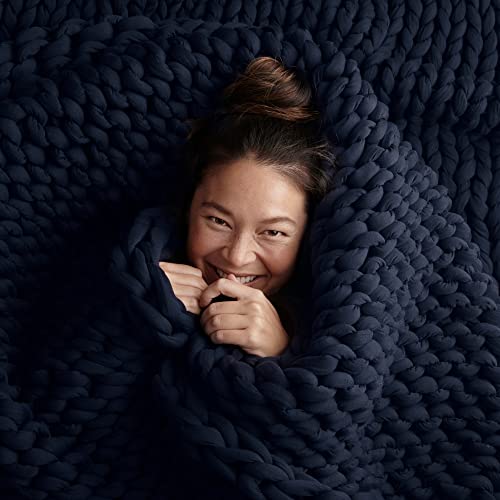
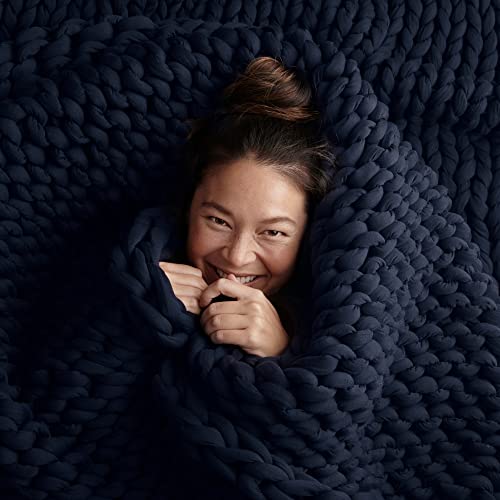
The Bearaby Cotton Hand-Knit Weighted Blankets for Adults – Chunky Knit Blanket – Sustainable is the most relevant linked reference in this entire yarn series: a blanket that is itself hand-knit, from organic cotton loops, at full throw scale (15 pounds, 40 by 72 inches, Midnight Blue). It proves what hand knitting in chunky cotton produces — open, breathable, sculptural fabric whose weight is the yarn itself — and it sets a quality bar for drape and finishing that home knitters can study stitch by stitch.
Strengths
- Literal hand-knit construction to examine for gauge and finishing.
- Organic cotton with no fillers — pure yarn behavior at scale.
- Machine washable, demonstrating cotton knits’ practical care.
Trade-offs
- A finished weighted blanket, not a yarn purchase.
- Weighted purpose and open loops differ from typical home blanket goals.
- Premium object pricing versus DIY yarn economics.
| Color | Midnight Blue |
| Size | 15 lbs (40”x72”) |
| Weight | 15 pounds |
Knitters should read the Bearaby as a masterclass in letting yarn be the design: no pattern stitch, no fill, no lining — just fiber, loop size, and consistency producing a blanket people love. Replicate its calm at home with chunky cotton and garter or stockinette, at whatever weight your household wants. Choose to study it before your next cast-on. Buy yarn by the classes above.
Best for: reference for hand-knit cotton scale and finish / Not suited for: shoppers expecting yarn
View the Bearaby as knitting’s finished benchmark. Check on Amazon
Comparison Table
| Pick | Elasticity | Drape | Care | Check price on Amazon |
|---|---|---|---|---|
| Wool-Blend Worsted | High | Fluid, warm | Blend-dependent | Check price on Amazon |
| Premium Acrylic | Moderate | Soft, stable | Machine easy | Check price on Amazon |
| Superwash Wool | Highest | Elegant | Gentle machine | Check price on Amazon |
| Cotton / Blend | Low | Fluid, cool | Machine gentle | Check price on Amazon |
| Chunky | Varies | Bold, heavy | Plan capacity | Check price on Amazon |
| Bearaby Reference | Cotton knit | Heavy, open | Machine washable | Check price on Amazon |
How to Choose the Best Yarn for Knitting Blankets
Let drape lead
Knit blankets live or die by drape. Swatch on the recommended needles, then one size up and down, wash and block all three, and drape them over a chair overnight. The swatch that folds like a blanket — not a placemat, not a noodle — chooses your needle size. Record it; blankets punish mid-project gauge drift visibly.
Match elasticity to pattern
Cables, lace, and textured stitches want elastic yarns (wool families) that recover and block open. Colorwork wants smooth, grippy-enough yarns that manage floats cleanly. Plain garter and stockinette forgive almost anything, including cotton and acrylic — spend pattern complexity only where yarn supports it.
Buy time as well as yarn
A worsted blanket is a season of evenings; a chunky blanket is a month. Choose weight by the deadline and your honest knitting pace, not by aspiration. Finished blankets warm people; perfect unfinished ones warm project bags. When in doubt, go one weight heavier than your ambition suggests.
Engineer the edges from the first row
Plan borders (garter, seed, applied I-cord) and slip-stitch selvedges at cast-on, not at the crisis of a curling stockinette edge in month two. Cotton and stockinette blankets especially are border designs with a blanket attached. Your future self, binding off, will be grateful.
Matching the Pattern to the Yarn You Actually Bought
Most blanket grief comes from a pattern and a yarn that were each excellent and jointly wrong. A lace pattern in a fuzzy, haloed yarn loses its holes and its point; a crisp cable in a slubby, thick-and-thin yarn reads as lumps; a colorwork design in two low-contrast yarns becomes an expensive rumor. Before casting on, knit the pattern’s signature motif — one cable repeat, one lace repeat, one colorwork chart pass — in the actual yarn, wash it, and look at it from across the room in daylight. That single motif tells you more than any review, because it tests stitch visibility, fabric drape, and color behavior simultaneously, at the cost of an evening. If the motif disappoints, change the pattern, not your standards: simple stitches in the same yarn will almost always succeed where the ambitious pairing failed, and a blanket’s warmth and use never depended on its complexity.
Gauge honesty belongs in the same conversation. A blanket tolerates approximate sizing better than a sweater does, which tempts knitters to skip swatching entirely — and then discover that approximate, multiplied across a bed-size cast-on, becomes a blanket a foot narrower than planned in a yarn already fully purchased. Swatch, block, measure, and adjust needle size or stitch count while adjustment is still free. Pay special attention to row gauge in patterns with stripes, blocks, or charts sized by rows, and to how your chosen fiber grows: cotton and some plant blends relax lengthwise after washing, wool springs back, and acrylic holds the shape it was blocked into. The finished blanket should be planned in its washed dimensions, not its off-the-needles dimensions, because the washed state is the state it will live in for decades.
Gifting a Hand-Knitted Blanket Well
A hand-knitted blanket is among the most labor-intensive gifts a person can give, and a little presentation protects the labor. Wash and block the finished blanket before gifting, so the recipient receives it at its true size and softness and never has to guess whether a first wash is safe. Include the care instructions in plain language on a card — fiber, washing method, drying method — written for a non-knitter, because ball bands speak a dialect recipients do not read. Name any quirks honestly: wool that should not meet a hot dryer, cotton that will soften further, colors to wash separately the first few times. Choose the moment with the same care as the yarn; a blanket given with its story — why this color, why this pattern, how long it took in honest, unboastful terms — is kept differently from a blanket handed over casually. And release it fully once given: the recipient may use it on the floor, under the dog, and in the car, and that intensive use is the compliment, not the abuse, of a blanket made to be lived on.
How to Block a Knitted Blanket Evenly
Wash gently by fiber, roll in towels to remove water, and lay the blanket on a flat surface, measuring width and length against your pattern targets as you smooth it square. Pin wool and cotton families to measurements; lay acrylic flat and shape by hand (steam only with caution and distance). Let it dry completely before moving — blocking is where lace opens, cables settle, and a handmade blanket acquires its finished geometry. Measure and photograph the blocked dimensions for your project records.
Problem: Stockinette edges curl relentlessly. — Physics, not failure. Add planned borders in the next project; for this one, a crocheted or knitted-on border after the fact can still rescue the edges.
Problem: The blanket grew hugely when washed. — Superwash and cotton relax. Your washed swatch predicted this; for the current blanket, re-block to target dimensions and dry flat every wash.
Problem: Rows change tension visibly. — Knitting when tired changes gauge. Mark progress by session for a week to see your pattern, and knit gift-critical sections in your best hours.
Problem: You are running short of yarn. — Weigh remaining yarn against a completed section’s consumption now, not later. A planned contrast border beats a desperate dye-lot hunt.
Knitted Blanket Patterns That Never Fail
Garter stitch in a beautiful yarn is the eternal blanket: squishy, reversible, flat, and meditative. Corner-to-corner construction manages size without casting on hundreds of stitches. Log-cabin and mitered-square architectures turn scraps and stripes into design while keeping the work portable in sections. Sampler strips teach new stitches inside a finishable frame. Notice what unites them: simple structures, forgiving gauges, and interest carried by color and fiber — the same priorities this guide’s yarn ranking rewards. Choose the pattern your yarn flatters, not the pattern your feed celebrates.
Needles, Notions, and Ergonomics for Blanket-Scale Knitting
Long circular needles carry blanket width and distribute weight into your lap instead of your wrists — the single biggest comfort upgrade for blanket knitters. Interchangeable tips let gauge swatching and mid-project adjustments happen without new purchases. Stitch markers every repeat, a row counter you actually use, and good light prevent the counting errors that blankets amplify. Finally, schedule hand care like an athlete: breaks, stretches, and alternate crafts on rest days. A blanket should be a pleasure sustained, not an injury acquired.
Yardage Math: How Much Yarn a Knitted Blanket Really Takes
Blanket disappointment is usually arithmetic, not talent: the knitter bought yarn by skein count or by hope instead of by yardage, and ran short three-quarters through. Work in total yardage from the start. Decide the finished size first — a lap throw, a generous couch throw, and a bed blanket are different yardage universes — then find a pattern or a reliable yardage estimate for that size at your chosen yarn weight and stitch pattern, and add a safety margin for swatching, mistakes, and the fringe or border you will inevitably want. Cables, textured stitches, and colorwork all consume more yarn than flat stockinette at the same dimensions, sometimes dramatically more, because the fabric pulls in and thickens. A swatch is not a ritual; it is your yardage instrument. Knit it in pattern, wash and block it the way you will finish the blanket, measure your gauge in the blocked state, and recalculate before you commit the full purchase.
Buy the whole project quantity in one order whenever you can, and check dye lots across every ball. Yarn dyed in different lots can differ subtly in the skein and glaringly across a finished blanket, where the shift appears as a horizontal tide line no blocking can fix. If you must add yarn later, alternate old and new balls every few rows across a transition zone to blur any difference, and place that zone where the eye rests least — near a border or a fold. Keep every ball band until the blanket is finished and washed; the band carries the fiber content, care instructions, lot, and yardage you will need for repairs, reorders, and honest answers when someone asks what the blanket is made of. Photograph one band with your phone as insurance against the universal law that paper bands vanish exactly when needed.
Weight class drives both yardage and knitting experience. Bulky and super-bulky yarns build blankets in weeks and forgive uneven tension, but each skein holds few yards, the finished blanket is heavy, and stitch definition turns soft and sculptural rather than crisp. Worsted and aran weights are the blanket workhorses: enough body for cables and texture, reasonable yardage per skein, and a finished weight most laps and beds welcome. Lighter weights create heirloom drape at the cost of months of knitting — a commitment to make deliberately, with a pattern you love, not by accident at the yarn shelf. Match the weight to the recipient as well: a heavy blanket delights an adult on a couch and overwhelms a child, a stroller, or a hospital bed. The right yarn is the one whose yardage, weight, and care all fit the blanket’s actual life, not just its first photograph.
Fiber Care Over a Blanket’s Lifetime: Acrylic, Wool, Cotton, and Blends in Real Homes
A knitted blanket is washed more than almost any other hand-knit, so fiber choice is a laundry decision disguised as a shopping decision. Acrylic and acrylic blends earn their blanket popularity honestly: they tolerate machine washing and drying, resist moths in storage, hold color through years of sunlight on a couch back, and come in yardage-generous skeins that suit large projects. Their trade-offs are hand feel that varies widely by quality — spin and finish matter more than the fiber name — and less breathability than natural fibers on warm laps. Wool brings elasticity that keeps blanket edges and stitches springy for years, warmth without stuffiness, and a forgiving response to blocking; it asks in return for gentler washing, moth-aware storage, and respect for felting, which is simply wool fibers locking permanently under heat, moisture, and agitation. Superwash-treated wools narrow that care gap and suit many blanket homes, provided you still follow the label rather than testing it.
Cotton and cotton blends knit into blankets with beautiful stitch definition, cool hand feel, and real weight — a cotton blanket drapes like a hug and suits warm climates and summer throws, but it has little elasticity, so stitches and arms tire faster, edges stretch under the blanket’s own weight over time, and pure cotton can fade and soften dramatically across washes. Plant-fiber blends that add acrylic or wool recover some spring and lighten the fabric, which is why so many successful summer blankets are blends rather than purists. For baby blankets, weigh softness after washing above softness in the skein: many yarns bloom, soften, or occasionally roughen in their first wash, and the only trustworthy test is a washed swatch rubbed against sensitive skin. For blankets destined for hospitals, shelters, or frequent hot washing, choose the fiber whose label explicitly tolerates that regime and say so when you gift it, with a care note tucked in — the kindest blanket is the one its owner can wash without fear.
Storage and repair complete the lifetime picture. Store clean blankets folded loosely with air circulation, never sealed damp, and refold along different lines a few times a year so creases do not set into permanent tracks. Keep a small repair reserve — half a ball of the project yarn, stored with its band — because a snag repaired in the original yarn disappears, while a snag repaired in a near-match announces itself forever. When a blanket returns to you with wear, treat thin spots early with duplicate stitch reinforcement rather than waiting for holes. These habits sound like fussiness until you price the alternative: reknitting a blanket you already loved once, in yarn that may no longer be sold.
Common Buying Mistakes
Buying yarn for the swatch you wish you knitted
Unwashed, unblocked swatches lie about drape and size. The washed swatch is the only honest salesperson in the yarn store.
Choosing splitty yarn for a year-long project
Minor annoyance per row becomes misery per blanket. Test splitting with your actual needles before the full purchase.
Ignoring finished weight
Cotton and chunky bed blankets can exceed comfortable lifting and washing weights. Weigh the swatch, do the multiplication, and resize the ambition if needed.
Casting on without a border plan
Edges are structure. A blanket begun without one often ends with one improvised badly. Decide at row zero.
Knitting the Blanket Without Hurting Your Hands, Back, or Enthusiasm
A blanket is the longest project most knitters ever hold, and its risks are ergonomic as much as technical. As the fabric grows, its weight should rest on your lap, a pillow, or the table — never hang from the needles, where it drags on every stitch and loads your wrists with the blanket’s full mass. Long circular needles used back-and-forth keep the weight centered in front of you and are the standard blanket setup for good reason. Sit with your feet supported and your work near elbow height, and build micro-breaks into the rhythm: stand, open and close your hands, roll your shoulders, and look at something far away every half hour or so. These pauses cost minutes across a project and save the aching that makes knitters abandon blankets in closets. If your hands tire quickly, consider lighter yarn weights, smoother needle surfaces that let stitches glide without pushing, and stitch patterns that do not demand constant cable-needle maneuvers on every row.
Enthusiasm needs ergonomics too. Blankets stall at the one-third mark, when novelty fades and the end is invisible, so plan the middle before you start: choose a pattern with visible progress markers — stripes, blocks, a repeating motif you can count — or impose your own by weighing the remaining yarn and marking calendar milestones. Knit the border decisions early, while you still have options: a garter or seed-stitch edge planned from the first row lies flatter and looks more intentional than a rescue border invented at the last row. Keep the project in one bag with its pattern, band, and repair reserve, so every session starts knitting instead of searching. And when a mistake appears rows below, judge it by the blanket’s real standard — will anyone but you ever find it in a folded, lived-on blanket? Fix what affects structure, warmth, or size; bless and release the rest. Finished blankets warm people; perfect blankets exist only in photographs.
Budgeting a Blanket Project Without Starving It
Blanket yarn is bought in project quantities, so its cost arrives all at once and tempts two opposite errors: overspending on prestige fiber for a blanket that will be washed weekly by a busy household, and underspending on a scratchy, thin yarn for a blanket meant to be an heirloom. Price the project per finished blanket, not per ball, and include the honest extras — an additional ball for swatching and repair reserve, the long circular needle if you do not own one, and the border or fringe quantity. Then match fiber spending to service: hard-washing household blankets justify quality acrylics and blends, whose cost per year of service is tiny; heirloom and gift blankets justify wool and premium blends, whose longevity and hand feel repay the outlay across decades. Watch for the false economy of sale yarn in insufficient quantity — a bargain that leaves you two balls short of a discontinued dye lot is the most expensive yarn you will ever buy. A blanket budget built this way, before the first ball is purchased, protects both the wallet and the project, and it turns the final recommendation below into a decision you can execute in a single confident order.
Final Recommendation
Knit your next blanket in wool-blend worsted for classic results, premium acrylic for family duty, or superwash wool for the heirloom — and keep the Bearaby Cotton Hand-Knit Weighted Blanket as your hand-knit standard: Check on Amazon. Swatch washed, buy by yardage and dye lot, and let drape make the final call.
Color, Texture, and Pattern: Making Design Choices You Will Still Love at Row 400
Blanket yarn cannot be judged in a single skein, because a blanket multiplies everything: a charming speckle becomes visual noise at bed scale, a subtle tonal becomes a rich field, and a high-contrast stripe that thrilled you in the shop becomes the dominant fact of a living room. Hold multiple balls together when you judge color, and view them across the room in the light where the blanket will live — yarn-shop lighting flatters almost everything. Variegated and self-striping yarns reward simple stitches, where the color does the work, and fight complex cables, where stitch and color compete until both lose. Solid and heathered yarns do the opposite: they showcase texture, cables, and lace with clarity, and they forgive the small tension variations of a long project better than flat, saturated solids, which display every uneven row like a headline. If you love both color and texture, separate their jobs — a textured solid main field with a variegated border, or striped blocks of solids — rather than asking one yarn to perform both at once.
Recipient-proofing is the unglamorous half of design. Dark and heathered colors hide the evidence of real life — pet hair, snack crumbs, the faint graying of a hundred washes — while white and pastel blankets photograph beautifully and demand a household that treats them gently. For blankets headed to children, dorms, hospitals, or beloved dogs, choose mid-tone, heathered, or patterned yarns and say nothing apologetic about it; practical color is a design virtue. Consider also how the blanket will be photographed and gifted: a simple care card, the fiber named honestly, and one sentence about why you chose that yarn for that person turns a textile into a keepsake. Knitters underestimate how long their blankets live in other people’s homes. Choose colors the recipient’s rooms can absorb, textures their hands will enjoy nightly, and fibers their laundry can sustain, and the blanket will still be in use when trend colors from the year you bought the yarn are unrecognizable.
Reading a Yarn Label Like a Blanket Knitter
Every fact you need is on the band, in a specific order of importance for blankets. Yardage per ball comes first, because blanket math runs on yardage, not ball count. Fiber content comes second, because it predicts washing, warmth, elasticity, and storage for the blanket’s whole life. Recommended gauge and needle size come third — useful as a starting point, but your blocked swatch overrules them, because your hands, not the label’s, are knitting this blanket. Weight per ball matters for estimating the finished blanket’s heft when multiplied across the project, a number worth calculating before you cast on a bed-size blanket in a dense yarn. Care symbols deserve a literal reading: machine washable on the band means the maker’s tested regime, and deviating — hotter water, harsher drying — voids the promise in practice. Finally, note the dye lot and keep the band, as the yardage section urged. A knitter who reads bands this way buys blankets that succeed; a knitter who buys by color and softness alone is gambling with months of work, and the house — in the form of shrinkage, tide lines, and short yardage — usually wins.
When a Blanket Project Goes Wrong: A Calm Troubleshooting Order
Work through blanket problems in order of reversibility, cheapest fix first. Uneven edges and wavy sides usually trace to inconsistent edge stitches or accidental increases and decreases; count stitches at regular intervals on the next project, add a defined edge treatment, and know that blocking corrects mild waviness while honest reknitting corrects the severe kind — decide by laying the blocked swatch and the work-in-progress side by side, not by hope. A blanket coming out denser and smaller than planned is a gauge problem discovered late; if the fabric itself is pleasant, consider finishing it at its true size as a lap blanket rather than frogging months of work, and let the bed-size ambition move to the next project with a corrected swatch. Running short on yarn with a discontinued color is the classic emergency: finish with a deliberate border or stripe section in a coordinating solid, worked symmetrically at both ends if any yarn remains to split, so the rescue reads as design. Color pooling — variegated yarn stacking into unintended blotches or stripes — responds to changing stitch count slightly, alternating balls every few rows, or moving the yarn to a simpler, more broken stitch pattern. Felting accidents in wool do not reverse; a felted section can sometimes be balanced by gently felting the whole blanket evenly under controlled conditions, but prevention — label literacy and wash discipline — is the only reliable strategy, which is why this guide returns to the band so insistently. Every experienced blanket knitter owns one rescued blanket and tells its story with pride; rescue, done deliberately, is a skill, not a shame.
Prevention deserves the last word in this section, because most rescues trace to three habits that cost almost nothing: swatching and blocking before the purchase is final, counting stitches and measuring dimensions at scheduled intervals instead of at the anxious end, and storing the project with its band, pattern notes, and repair reserve together so that a pause of months does not become a restart from confusion. Blanket projects are long enough that life will interrupt them; a project that can survive interruption — labeled, measured, and documented — is a project that gets finished. Treat those habits as part of the craft rather than as administration around it, and the troubleshooting above becomes a section you read with sympathy for other knitters instead of urgency for yourself. Keep one further habit alongside them: a brief project note, even a single index card in the project bag, recording the yarn, the lot, the needle size, the gauge you actually achieved, and any modifications you made as you went. Memory flatters every knitter into believing these facts are unforgettable, and every knitter who has resumed a blanket after a season away knows otherwise. The card takes two minutes to write and can save the entire project.
Frequently Asked Questions
What yarn weight is best for knitting a blanket?
Worsted weight for the classic balance of drape, speed, and stitch clarity. Chunky for fast modern throws; DK and sport for fine, slow, lightweight blankets. Match weight to deadline and desired drape.
Is wool or acrylic better for a knitted blanket?
Wool for elasticity, stitch beauty, and heirloom character; acrylic for washing, budget, and color range. Blends and superwash wool deliberately occupy the middle — most knitters’ blanket stashes contain all three for different recipients.
How much yarn does a knitted throw need?
It depends on weight, size, and stitch texture — textured and chunky projects consume far more. Always calculate from a pattern or a weighed, blocked swatch, add a margin, and buy one dye lot with a spare skein.
Why does my knitted blanket curl at the edges?
Stockinette curls by structure. Planned non-curling borders (garter, seed stitch) prevent it; after-the-fact borders can still tame it. Cotton blankets need borders for the same reason.
Can beginners knit a blanket?
Absolutely — garter stitch in worsted or chunky yarn on circular needles is a classic first large project. Choose smooth, light-colored yarn, plan a throw size, and let consistency be the whole curriculum.
What needles should I use for a blanket?
A long circular needle in the size your washed swatch approves. Circulars hold the width, spread the weight, and knit flat blankets back and forth without seam bulk.


