Disclosure: As an Amazon Associate, dailyhomedecorating.com earns from qualifying purchases. Links to Amazon on this page are affiliate links; they cost you nothing extra. Prices and availability change often, so check the current Amazon listing before you buy.
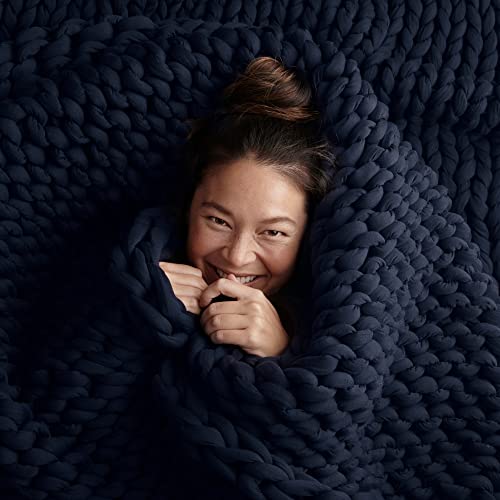
The best chunky yarn for blankets turns a blanket from a season-long commitment into a finished, giftable, nap-ready reality — often in a single weekend. Chunky, bulky, and jumbo yarns build fabric so fast that simple stitches look like design choices and beginners finish while motivation is still high. This guide compares chunky yarn types as prose-only picks, because our verified pool contains finished blankets rather than yarn and we will not invent yarn listings or specs. One linked finished blanket — a chunky hand-knit cotton weighted blanket — anchors the guide as a real-world reference for scale and drape. The picks span classic bulky acrylic, tube-style jumbo yarn for arm knitting, chenille chunky for plush, wool-blend chunky for warmth, cotton chunky for breathable weight, and blanket yarn sold specifically in large put-ups for throws. If you are still choosing fiber families, start with Best Yarn For Blankets; if you crochet, pair this with Best Yarn For Blankets Crochet.
Chunky yarn rewards honesty about three things: finished weight, washing logistics, and total yardage cost. A jumbo blanket can weigh more than a toddler and exceed a home washer’s comfortable capacity; a bulky blanket in short skeins can quietly cost more than a premium worsted project. None of that should scare you off — chunky blankets are beloved for good reason — but the makers who plan those three factors finish thrilled, while the rest finish with a gorgeous blanket they cannot launder. This guide plans them with you.
Where to Buy
Yarn picks are prose-only with no affiliate links; check Amazon and craft retailers for current chunky yarn listings, colors, and put-ups. The linked finished reference is the Bearaby Cotton Hand-Knit Weighted Blankets for Adults – Chunky Knit Blanket – Sustainable — Check on Amazon. For finished blankets without the making, see Best Blankets For Winter, and for room coordination, Best Throw Pillows Under $100.
In this guide
Quick Picks
| Pick | Badge | Why it earns its place |
|---|---|---|
| Bulky Acrylic Blanket Yarn (prose-only) | Best Overall | The balanced chunky: fast, washable, affordable, and warm. |
| Tube Jumbo Yarn for Arm Knitting (prose-only) | Best for Arm Knitting | Giant loops, no tools, blankets in an evening. |
| Chunky Chenille Blanket Yarn (prose-only) | Best for Plush Throws | Cloud-soft speed with hook or needles. |
| Wool-Blend Chunky Yarn (prose-only) | Best Premium | Real winter warmth and elasticity at chunky speed. |
| Chunky Cotton Yarn (prose-only) | Best for Breathable Weight | Heavy, cool, sculptural blankets for warm climates. |
| Bearaby Cotton Hand-Knit Weighted Blankets for Adults – Chunky Knit Blanket – Sustainable | Best Finished Reference | Verified chunky hand-knit cotton blanket to calibrate expectations. |
Key Takeaways
- Bulky (rather than jumbo) is the sweet spot for most makers: fast, warm, washable, and manageable in home laundry.
- Budget by total yardage and finished weight, never by skein count — chunky skeins hold surprisingly few yards.
- Simple stitches win in chunky yarn; texture comes from the yarn itself.
- Confirm your washing plan before casting on a bed-size chunky blanket.
- Arm knitting with tube yarn is the fastest blanket method that exists — and the least portable mid-project.
How These Picks Were Chosen
Picks are yarn constructions described qualitatively under the brief’s prose-only rule for pool gaps: no invented brands, specs, prices, or ratings. We judged chunky types on working speed, stitch clarity at large gauges, finished weight realism, washability, shedding behavior, and cost-per-finished-blanket logic. Loosely spun roving-style yarns that pill and separate under blanket use were excluded from recommendation despite their popularity in photos. The Bearaby blanket is linked only as a finished reference. Method guidance distinguishes knitting, crochet, and arm knitting because chunky yarn behaves differently in each; knitters wanting depth should also read Best Yarn For Knitting Blankets.
The 6 Best Best Chunky Yarn for Blankets — Reviewed
Bulky Acrylic Blanket Yarn (Prose-Only)
Our badge: Best Overall
Classic bulky acrylic — weight category five in common yarn standards, worked on large needles or hooks — is the chunky most makers should buy first. It builds a throw in a week of evenings, washes in a home machine, holds simple stitch patterns crisply, and comes in every color a blanket could want. Unlike jumbo yarns, it still behaves like yarn: portable, repairable, and forgiving of frogging.
Strengths
- Fast without extremes — real blankets in days, manageable weight and laundry.
- Washable, durable, and color-rich for family and gift blankets.
- Works for knit, crochet, and loom methods with abundant patterns.
Trade-offs
- Less dramatic than jumbo arm-knit texture; scale reads cozy, not sculptural.
- Still consumes yardage quickly — buy the project at once in one dye lot.
- Acrylic warmth can be too much for hot climates at bed size.
Choose a simple, satisfying stitch — garter, moss, basketweave, or half-double crochet — and let the pace carry you. Bulky acrylic is also the best chunky for donation and dorm blankets, where washability outranks drama. Weigh a finished swatch to predict blanket weight, and keep one spare skein for future repairs. Choose bulky acrylic for the chunky blanket you will actually finish and wash happily. Skip it only if you specifically want arm-knit scale.
Bulky acrylic also teaches chunky fundamentals at the lowest stakes. Because it frogs cleanly — unlike chenille or tube yarn — you can unravel a wobbly first attempt and rework it the same evening, which makes it the right classroom for learning how gauge behaves at large scale: how a half-size change in hook or needle visibly changes drape, how a border adds inches you must budget, how quickly a throw’s weight accumulates. Makers planning to graduate to wool chunky or jumbo tube work should serve this apprenticeship first. One more virtue deserves mention: bulky acrylic blankets travel well. They compress into a suitcase corner, forgive being sat on in transit, and wash in any machine at the destination — the handmade blanket most likely to actually accompany its owner through dorms, rentals, and first apartments.
Best for: most makers wanting fast, washable blankets / Not suited for: arm-knitting purists seeking giant loops
Choose bulky acrylic for balanced chunky success. No Amazon link is provided for this prose-only pick by design.
Tube Jumbo Yarn for Arm Knitting (Prose-Only)
Our badge: Best for Arm Knitting
Tube yarn — a knitted or woven casing stuffed with filling, sold in jumbo weights — exists for arm knitting and giant hand crochet. No needles, no hooks: your arms are the tools, loops are inches wide, and a throw genuinely can be finished in an evening. The finished fabric is sculptural and modern, with open spaces between giant stitches that read as texture rather than insulation.
Strengths
- Fastest blanket method available; unmatched gift-emergency potential.
- No tools to buy and a gentle learning curve for complete beginners.
- Statement texture that transforms plain rooms and photographs beautifully.
Trade-offs
- Open weave is less warm than it looks; not a winter insulation strategy.
- Very heavy and bulky finished blankets; washing often needs a large-capacity machine or careful hand washing.
- Mid-project, the work lives on your arms — no pausing to answer the door gracefully.
Plan an uninterrupted session, a large clear table, and consistent loop tension measured against your forearm. Keep stitches deliberately even rather than tight; tube yarn punishes tight work with a stiff, small blanket. Choose tube yarn for drama and speed on throws. Skip it for bed blankets, warmth-critical projects, or small homes without storage for a bulky finished piece.
Session planning is tube yarn’s hidden skill. Because the work lives on your arms, an arm-knit blanket is a commitment of one uninterrupted block: clear the table, silence the phone, keep water and scissors within reach, and warn the household. Makers who treat it as an event — music on, afternoon set aside — finish with even tension and good memories; makers who squeeze it between errands finish with uneven loops and a blanket half-worn to answer the door. Loop size deserves a physical reference: many makers mark a spot on the forearm or compare loops to the width of a phone, checking every row. And buy the yarn as one continuous plan: tube yarns are sold in short lengths, joins mid-blanket are visible events, so place them at edges deliberately rather than discovering them mid-row.
Best for: arm-knit throws, beginners, statement decor / Not suited for: warm bed blankets or easy laundry
Choose tube yarn for an evening blanket with wow factor. No Amazon link is provided for this prose-only pick by design.
Chunky Chenille Blanket Yarn (Prose-Only)
Our badge: Best for Plush Throws
Chunky chenille pairs jumbo softness with tool-based control: work it with a large hook or needles in the plainest stitches and receive a plush, dense, genuinely warm throw at remarkable speed. It is the chunky most often chosen for baby blankets, dorm gifts, and the couch blanket everyone negotiates for.
Strengths
- Dense plush warmth — unlike open jumbo weaves, chenille insulates.
- Forgiving pile hides tension learning curves completely.
- Fast with either craft; simple stitches only, minimal pattern stress.
Trade-offs
- Stitches are nearly invisible; counting requires markers and touch.
- Some chenilles shed or loosen at ends — buy quality and secure finishes generously.
- Finished throws are warm and weighty; too much for summer gifting in hot climates.
Use light colors while learning chenille, mark every tenth stitch, and wash the finished blanket gently before gifting so any loose pile declares itself on your laundry, not the recipient’s. Choose chunky chenille when the recipient values soft above all. Skip it for stitch artistry or warm climates.
Chenille at chunky scale has one more behavior to plan around: it relaxes. A freshly finished chenille blanket can grow slightly in length over its first weeks of use as the pile settles and the core yarn relaxes, so make the blanket a touch shorter than your target and let gravity finish the sizing. Work the ends with particular generosity — chenille tails can work loose more readily than plied yarn, so weave long, change direction twice, and consider a tiny securing stitch on a blanket destined for a washing machine’s regular company. For baby blankets, choose chenille whose pile passes a firm tug test on the skein, wash the finished blanket before it ever meets the baby, and remember that all blankets for infants belong in awake, supervised contexts — for holding, stroller rides with an attentive adult, and tummy time — never as unattended sleep bedding.
Best for: plush gifts, baby and dorm blankets / Not suited for: pattern showcases
Choose chunky chenille for the softest fast throw. No Amazon link is provided for this prose-only pick by design.
Wool-Blend Chunky Yarn (Prose-Only)
Our badge: Best Premium
Chunky wool blends deliver what acrylic chunky imitates: elastic, warm, breathable fabric with living texture, at a pace that makes a winter heirloom feasible in weeks. Superwash blends keep laundry survivable; pure-wool chunky suits cabin and display throws for careful homes.
Strengths
- True winter warmth with breathability synthetics cannot match.
- Elastic stitches look professional even from newer hands.
- Blocks into beautifully even, generous blankets.
Trade-offs
- Highest cost per blanket in this guide; yardage math is essential.
- Care discipline required; gift with instructions or choose superwash.
- Heavy finished blankets — confirm the recipient wants substantial weight.
Reserve wool chunky for named occasions and cold places. A cabin throw, a wedding blanket, a reading chair in a drafty house — these repay the investment weekly. Choose wool-blend chunky for legacy warmth at modern speed. Skip it for carefree family laundry.
Wool chunky repays one specific planning step: block generously. A chunky wool blanket off the needles can look slightly uneven and smaller than its destiny; a proper wet block evens every stitch, opens the fabric’s drape, and can add meaningful inches — which means you should knit slightly shy of target dimensions and let water do the final sizing. Because the yarn is costly, protect the project in progress: store it in a closed bag away from pets (a single claw snag in chunky wool is a visible event), keep the spare skein untouched for future repairs, and record the dye lot somewhere permanent. Ten years from now, when a corner needs mending, that record and spare skein are the difference between an invisible repair and a visible patch on an heirloom.
Best for: winter heirlooms and cold-climate gifts / Not suited for: budget or machine-wash-and-forget use
Choose wool-blend chunky for premium fast warmth. No Amazon link is provided for this prose-only pick by design.
Chunky Cotton Yarn (Prose-Only)
Our badge: Best for Breathable Weight
Chunky cotton makes blankets with presence and airflow: heavy in the hand, cool against skin, sculptural in simple stitches. It is the chunky for warm climates, for people who love weighted-feeling covers without synthetic warmth, and for modern minimalist throws where loop and line are the whole design.
Strengths
- Breathable weight — substantial without insulating heat.
- Crisp loop definition in large-scale stitches.
- Durable, washable fabric that softens over time.
Trade-offs
- Heaviest finished blankets here; weigh swatches and plan laundry capacity.
- Inelastic — arms and hands tire; schedule shorter sessions.
- Less cozy-warm for winter; position it as a warm-climate or summer weight.
The linked Bearaby reference below is this fiber’s proof at full scale. For your own project, favor throws over bed sizes to keep weight humane, and choose tightly constructed cotton yarns that resist splitting under large hooks. Choose chunky cotton for sculptural, breathable blankets. Skip it for winter warmth or hand comfort concerns.
Hand management decides whether chunky cotton is a pleasure or an ordeal. The fiber’s inelasticity means your hands supply all the give, and the yarn’s weight hangs from your work as it grows. Work in shorter sessions than your enthusiasm suggests, support the growing blanket on a table or pillow rather than letting it pull from your wrists, and alternate with a lighter project on heavy-making weeks. Tool choice helps too: a smooth, large hook with a comfortable handle, or needles with a little flex, reduce the grip force cotton demands. Makers with arthritis or repetitive-strain histories should test a generous swatch across two days before committing — cotton will tell you honestly whether the partnership works, at swatch scale rather than blanket scale.
Best for: warm climates, modern throws, weight lovers / Not suited for: winter insulation or hand fatigue
Choose chunky cotton for cool, substantial throws. No Amazon link is provided for this prose-only pick by design.
Bearaby Cotton Hand-Knit Weighted Blankets for Adults – Chunky Knit Blanket – Sustainable
Our badge: Best Finished Reference
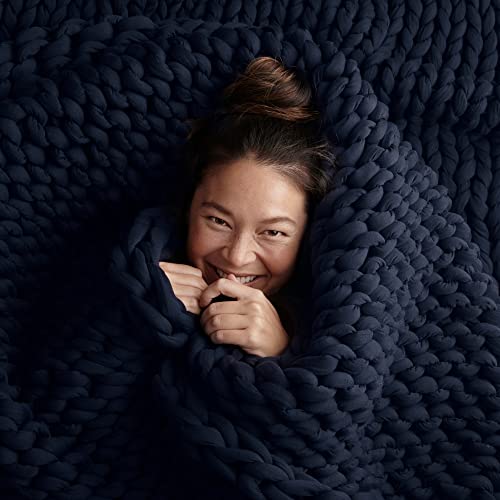
The Bearaby Cotton Hand-Knit Weighted Blankets for Adults – Chunky Knit Blanket – Sustainable is the guide’s linked reality check: a complete blanket hand-knit from chunky cotton loops, 15 pounds at 40 by 72 inches, whose weight, openness, and drape demonstrate exactly what chunky cotton construction produces. If you are deciding between tube jumbo and cotton chunky, this finished object is the cotton argument made visible.
Strengths
- Real chunky cotton scale, openness, and drape to study before buying yarn.
- Organic cotton, no fillers — pure fiber-and-loop construction.
- Machine washable, proving chunky cotton care is feasible at throw scale.
Trade-offs
- Finished weighted blanket, not a yarn supply.
- Personal size and weighted purpose differ from decorative throws.
- Open loops snag — a handling lesson for all chunky open weaves.
| Color | Midnight Blue |
| Size | 15 lbs (40”x72”) |
| Weight | 15 pounds |
Use the Bearaby to set expectations: chunky cotton blankets are heavy, breathable, and beautiful, and they occupy real storage and laundry capacity. If that profile delights you, buy chunky cotton yarn with confidence. If it alarms you, step down to bulky acrylic and keep the drama modest. Either way, the reference has done its job before you spend on yardage.
Best for: calibrating chunky cotton expectations / Not suited for: shoppers expecting yarn
Study one more detail in the reference: proportion. At 40 by 72 inches, the Bearaby is deliberately personal — long enough to cover a body, narrow enough to keep a heavy cotton construction manageable in the wash and on the arm. Chunky projects succeed when their dimensions respect their material, and they fail when a maker scales a throw pattern up to bed size without re-running the weight math. Let the reference calibrate your ambitions: in chunky cotton, a generous throw is already a substantial object.
View the Bearaby as the chunky cotton benchmark. Check on Amazon
Comparison Table
| Pick | Speed | Warmth | Wash ease | Check price on Amazon |
|---|---|---|---|---|
| Bulky Acrylic | Fast | Warm | Easy machine | Check price on Amazon |
| Tube Jumbo | Fastest | Light (open weave) | Large capacity needed | Check price on Amazon |
| Chunky Chenille | Fast | Very warm, plush | Gentle machine | Check price on Amazon |
| Wool-Blend Chunky | Fast | Warmest, breathable | Gentle / superwash | Check price on Amazon |
| Chunky Cotton | Moderate-fast | Cool weight | Machine, heavy load | Check price on Amazon |
| Bearaby Reference | Finished | Cool weight | Machine washable | Check price on Amazon |
How to Choose the Best Chunky Yarn for Blankets
Pick your chunk: bulky, super bulky, or jumbo
Bulky yarn behaves like yarn — tools, patterns, portability. Super bulky accelerates everything and suits chenille and wool throws. Jumbo and tube yarns leave tools behind for arm work and sculpture. Most households should own bulky results; jumbo is a deliberate statement with storage and laundry consequences. Choose with your washing machine in the room, metaphorically.
Do the yardage and weight math first
Find total yards for your size and stitch, weigh a swatch, and extrapolate finished weight. If the blanket will exceed what you can lift wet or your machine can handle, shrink the project to a throw or step down a yarn weight. Math before purchase prevents the saddest project outcome: a finished blanket nobody can maintain.
Keep stitches simple and consistent
Chunky yarn is the texture. Garter, stockinette with garter borders, moss, single and half-double crochet, and simple basketweave all shine. Complex lace disappears, cables eat yardage and courage, and inconsistent loop size — especially in arm knitting — shows immediately. Consistency beats complexity at this scale.
Plan the finish before you start
Chunky ends are bulky: weave them long, in multiple directions, and consider a sewn reinforcement for chenille and tube constructions. Borders in chunky yarn add significant yardage and weight; decide whether your design needs one before the final skein is spoken for.
Measure gauge at chunky scale — in loops, not inches
At jumbo scale, a single stitch can be two inches wide, so a four-inch gauge swatch may contain two stitches and tell you almost nothing. Measure across at least ten loops and a full session’s rows, and weigh the sample piece: at this scale, weight per square foot is the most honest predictor of the finished blanket’s heft, warmth, and laundry burden. Recheck after washing the sample, since tube and chenille constructions relax noticeably. A maker who knows loops-per-foot and ounces-per-foot can size any chunky blanket on the back of an envelope — and will never again be surprised by a twelve-pound throw.
Budget per finished blanket, not per skein
Chunky skeins are priced to look modest and yarded to disappear. Before buying, calculate the full project’s yards, multiply by the per-yard cost of your chosen yarn, and compare that total honestly across fibers — chunky wool’s blanket total can be several times bulky acrylic’s, which is fine for an heirloom and foolish for a dorm gift. Include the border, the spare skein, and shipping for online orders in the same arithmetic. Makers who budget this way buy chunky yarn with pleasure; makers who buy skein by skein experience the project’s cost as a series of small ambushes.
Mixing chunky with standard yarns
Hybrid designs — a standard-weight center field with a chunky border, or chunky stripes through a worsted blanket — can balance drama against weight and cost, but the two gauges must be reconciled deliberately: work a transition swatch, adjust stitch counts so edges align, and confirm both yarns share a care method. Done well, a chunky frame makes an ordinary blanket look designed and keeps the total weight humane. Done casually, the border ripples or strangles the field. Treat hybrids as advanced-beginner projects with real payoff, and swatch the junction, not just the fabrics.
Color at chunky scale: fewer colors, bigger commitment
Every color in a chunky blanket occupies enormous visual territory, so restraint reads as sophistication: one main color, at most one or two supporting shades, and stripes wide enough to look deliberate. Variegated chunky yarns change character quickly across a wide fabric — swatch wide or avoid them for large fields. Remember also that chunky blankets are hard to re-dye, overdye, or disguise later; the color you choose is the room’s color for years. When torn between a trend shade and a neutral, buy the neutral for the bed-size piece and let a small, replaceable throw carry the trend.
How to Arm Knit a Chunky Blanket Evenly
Work on a large flat surface, cast loops onto your arm at a measured, repeatable size — many makers compare each loop to a consistent forearm position — and resist tightening as you gain speed. Keep the working yarn untangled in a basket beside you, complete the blanket in one session when possible, and bind off loosely so the final edge matches the fabric’s natural openness. Finish by laying the blanket flat and coaxing loops into even rows with your hands before its first use.
Problem: Loops keep getting smaller as you work. — Tension creeps with speed. Pause each row, reset loop size against your reference, and continue deliberately.
Problem: The finished blanket is smaller than planned. — Chunky gauge deceives. Measure a full session’s work early — after several rows, measure width and calculate length honestly.
Problem: Ends keep escaping. — Weave longer tails in more directions, and for tube and chenille, add a few discreet stitches with matching thread.
Problem: The blanket is too heavy to wash at home. — Wash gently in a large-capacity machine if the fiber allows, or hand wash in a tub and roll in towels to remove water; never lift a fully soaked chunky blanket by one corner.
Problem: Rows alternate tight and loose, giving a wavy surface. — Your loop size follows your speed and mood. Work to a rhythm — many makers count or use music with a steady tempo — and re-measure every few rows, adjusting the next row deliberately rather than hoping the fabric averages out. Chunky scale forgives nothing and shows everything, which is why its even results look so impressive.
After binding off, give an arm-knit blanket a finishing pass before anyone uses it: lay it flat, walk your hands along every row, and gently equalize loops that drifted small or large. This five-minute grooming is the chunky equivalent of blocking and transforms a homemade-looking piece into the sculptural throw people photograph. Repeat the pass after each wash, while the blanket is still slightly damp and persuadable.
Chunky Blankets as Decor: Scale, Color, and Storage
A chunky throw is furniture-scale decor: one bold color, confidently draped, transforms a plain sofa more than any cushion arrangement. Choose colors that survive trends — naturals, deep greens and blues, warm greys — unless the blanket’s job is a child’s room or a seasonal statement. Store chunky blankets folded on shelves or in open baskets rather than compressed in vacuum bags, which crush loop structure and chenille pile. Rotate them off the couch for airing, and keep them away from pet claws and rough upholstery that snag open loops. Treated as textiles rather than sculptures, chunky blankets stay beautiful for years.
Storage has a seasonal rhythm worth planning: chunky blankets earn their shelf in winter and become a storage problem in July. Before making a second or third, decide where the off-duty ones will live — a breathable under-bed box, the top shelf of a linen closet, a basket that becomes part of the room. Vacuum compression is the enemy here: it flattens chenille pile and sets creases in tube loops that take weeks to relax. If storage space is genuinely tight, let that fact choose your yarn — bulky acrylic folds flattest, chenille next, and jumbo tube work barely folds at all. The most beautiful chunky blanket is the one that survives its summers.
Pet households deserve a specific decor note. Open jumbo loops invite kneading claws and catch on collars and tags; a chunky blanket on a pet-shared sofa should be a closed construction — bulky acrylic or chenille — in a color that forgives hair, with an owner who accepts that the blanket is now partly the pet’s. If the blanket is precious (wool heirloom), its home is a chair pets do not claim, full stop. Choosing placement by household reality keeps both the blanket and the peace intact, and a washable bulky throw on the pet’s favorite spot often protects every other textile in the room by being the most attractive option available.
Chunky Yarn for Gifts: Timing and Recipient Fit
Chunky blankets are the maker’s gift superpower — a weekend of work, a lifetime of use — but only when matched to the recipient. Dorm and first-apartment gifts want bulky acrylic: washable, light enough to ship, forgiving of laundry roulette. New babies want chunky chenille in supervised, photo-and-nap contexts, with safe-sleep guidance respected — blankets are for holding and tummy time, not unattended infant sleep. Elders may struggle with very heavy jumbo blankets; choose bulky warmth over jumbo weight. Always include a care card. A gift that arrives with instructions gets kept; a mystery textile gets closet-stored.
Timing is the gift-maker’s other discipline. A chunky throw’s honest timeline includes the swatch, the making, a wash, and drying time for a heavy textile — which can take a full day laid flat. Count backward from the occasion with a buffer week; chunky projects feel fast until the finishing, washing, and gifting logistics are added honestly. If the deadline is truly tight, shrink the ambition rather than the quality: a smaller lap throw in beautiful yarn, finished and washed, out-gifts a bed-size blanket promised for next month. And photograph your finished gifts before wrapping them — makers rarely keep records, and a photo archive of yarn, size, and recipient becomes your best planning tool for the next occasion.
One last gift consideration: hand delivery beats shipping for chunky blankets whenever geography allows. A jumbo throw can cost a startling amount to post, compresses badly in transit, and arrives needing a grooming pass — while a hand-delivered blanket arrives with its story told in person and its care card explained. If shipping is unavoidable, fold the blanket loosely in a generous box, include the care card on top, and tell the recipient to shake it out and groom the loops flat for an hour before judging its arrival state. First impressions of chunky blankets are made in the first ten minutes after unboxing; plan for them.
Common Buying Mistakes
Counting skeins instead of yards
Chunky skeins are short. Two projects with the same skein count can differ by hundreds of yards. Yards and finished weight are the only honest budget units.
Choosing roving-style yarn for a working blanket
Unspun or barely spun jumbo yarn photographs like a cloud and ages like one — pilling, separating, and thinning under use. For blankets that will be used, choose constructed yarns: plied, tubed, or chenille.
Ignoring laundry until the blanket is dirty
Decide the wash method at purchase. If neither your machine, your tub, nor your budget supports cleaning the finished size and fiber, change the project now.
Making the first project bed-sized
Learn chunky behavior on a throw. Bed-size chunky blankets multiply every cost — yarn, weight, time, laundry — before you know whether you love the craft.
Buying jumbo yarn for a baby blanket without thinking it through
Giant open loops, heavy finished weight, and hard-to-clean bulk make jumbo arm-knit blankets poor baby gifts despite their nursery-photo charm. Babies need light, washable, close-textured blankets for supervised awake time — chunky chenille at a modest scale, or standard yarns entirely. Save the jumbo statement for the parents’ couch, where it will be adored safely.
Final Recommendation
Buy bulky acrylic for your first chunky blanket, tube yarn when you want arm-knit drama, and chenille when plush warmth leads. Keep the Bearaby Cotton Hand-Knit Weighted Blanket in view as the finished chunky-cotton standard — Check on Amazon — and do the yardage and laundry math before the yarn purchase, not after the final row.
If you are torn between two yarns after all the math, let the blanket’s busiest day decide. Picture its hardest use — a dorm laundry cycle, a toddler’s fort, a decade of cabin winters, a summer of porch evenings — and buy the yarn that survives that day gracefully, not the one that photographs best on delivery day. Chunky blankets live large lives in every sense; choosing for the life rather than the listing is the whole craft of buying them well.
Frequently Asked Questions
What size yarn is considered chunky?
In common standards, bulky is category 5, super bulky is 6, and jumbo is 7. Retail naming varies, so judge by the band’s gauge and your swatch rather than the word chunky alone.
How long does a chunky blanket take?
A throw in bulky yarn takes most makers a week of evenings; an arm-knit jumbo throw can be finished in one long session. Crochet falls between, depending on stitch density. Your first project always takes longer — plan gifts with a buffer.
Are chunky blankets warm?
Dense chunky fabrics (chenille, wool, bulky acrylic) are very warm. Open jumbo weaves are mostly decorative — beautiful, weighty, and breezy. Choose construction by whether warmth or texture is the goal.
How do I wash a chunky blanket?
Follow the yarn band first. Most acrylic and chenille chunky blankets wash gently in a sufficiently large machine and dry low; wool needs gentle or superwash handling; very heavy blankets may need tub washing and careful water removal before moving.
Can beginners arm knit?
Yes — arm knitting is one of the most beginner-friendly blanket methods, requiring no tools and teaching tension by feel. Start with a small throw, work in one session, and measure loops consistently.
Why is my chunky blanket shedding?
Loose constructions shed early fibers, especially chenille and roving styles. A gentle wash before use removes much of it; persistent heavy shedding signals a yarn unsuited to blanket duty — note the brand and construction for future purchases.
What is the difference between bulky and jumbo yarn in practice?
Tools and texture. Bulky yarn is worked with large needles or hooks, makes a closed, genuinely warm fabric, and behaves like ordinary yarn in washing and repair. Jumbo yarn is worked with arms or giant hooks, makes an open, sculptural fabric, and dominates storage and laundry planning. Choose bulky for blankets that must work for a living; choose jumbo for blankets that make a room.
Can I crochet with chunky yarn, or is it only for knitting?
Crochet thrives at chunky weights — half-double and double crochet in bulky or chenille yarn build dense, warm blankets quickly, and crochet’s structure gives chunky cotton the firmness it needs. Use a large, smooth hook, expect generous yardage consumption, and keep stitches simple so the yarn’s scale stays the design. Many makers find chunky crochet faster than chunky knitting; both are well supported by patterns.
Do chunky blankets work in warm climates?
The right ones do. Chunky cotton and open-weave tube throws give the visual and tactile presence of a blanket without meaningful insulation, which is exactly what warm-climate decorators and warm sleepers want on a sofa. Dense chenille and wool chunky, by contrast, are winter instruments in any latitude. Match construction to climate and chunky stops being a season and becomes a texture you can use all year.
What is the best chunky blanket size for a sofa?
Aim for a throw that covers two seated people imperfectly or one person luxuriously — in practice, a generous lap-to-thigh coverage with enough length to tuck around feet. Too small and it reads as a cushion accessory; too large and it pools on the floor, collects dust, and becomes a tripping, dragging nuisance. Drape-test with a bedsheet folded to candidate dimensions before you buy yarn: five minutes with a sheet saves a season of almost-right sizing.
Is chunky yarn a good choice for a first-ever blanket?
It is the most encouraging choice, with one caveat about which chunky. Bulky acrylic on tools teaches real, transferable skills at a forgiving pace and produces a blanket that survives beginner laundry. Arm-knit tube yarn produces the fastest triumph but teaches arm knitting only. Either is a legitimate first project; choose by whether you want a skill or a throw first. What beginners should avoid is starting with expensive wool chunky or fragile roving — save premium fibers for the second blanket, when your tension has settled and your yardage estimates have been tested once.
How do I keep a chunky blanket looking new between washes?
Groom it like the textile it is: shake it outside weekly to release dust from the loops, groom arm-knit rows flat with your hands after use, brush chenille pile gently in one direction, and air wool chunky on a dry day instead of washing it on schedule. Spot-clean spills immediately by blotting — never rubbing — with a damp cloth, since ground-in stains are what force most full washes. A blanket groomed weekly often needs washing half as often, and every avoided wash is lifespan returned, especially for chenille and wool.
Why do chunky blankets cost more in yarn than they look like they should?
Because the eye reads loops and the wallet pays for yards and fiber weight. A chunky stitch is mostly yarn — thick yarn, used at a rate that surprises makers trained on worsted projects — and premium fibers at chunky gauges multiply quickly. The honest comparison is cost per finished blanket against a purchased equivalent of similar quality, where handmade chunky usually wins on character and loses on nothing except your time, which most makers count as the pleasure rather than the price. Budget with the yardage math in this guide and the total will feel planned rather than shocking.
What tools do I actually need for chunky blanket projects?
Fewer than the craft aisle suggests. For bulky yarn: one pair of large needles or one large hook in the size your swatch approves, a tapestry needle with an eye big enough for the yarn, sharp scissors, and stitch markers. For arm knitting: your arms, a large table, and a basket for the working yarn. Everything else — row counters, fancy cases, specialty gadgets — is optional comfort. Spend the tool budget on the yarn itself and on one genuinely comfortable hook or needle set, because at chunky scale your hands work against real resistance and tool comfort shows in the fabric’s evenness.
Can I repair a chunky blanket if a loop breaks or a seam opens?
Yes, and chunky scale makes repairs forgiving. Keep the spare skein: a broken loop in plied yarn can be re-formed and woven through its neighbors invisibly; tube yarn ends can be overlapped and stitched inside the casing; chenille damage is hidden by reweaving a short length through the pile. Work repairs after washing, when the fabric is at its true dimensions, and groom the area with your fingers so the texture settles. The blankets that cannot be repaired are the roving-style ones, whose fibers have nothing to hold a mend — one more reason working blankets deserve constructed yarns.
How big should my first chunky blanket be?
Lap-to-throw size — roughly the dimensions that cover one seated adult generously — is the sweet spot. It teaches every chunky skill, finishes while motivation is high, washes in a home machine, and gets used daily. Graduate to bed sizes only after you know you love the fiber, the weight, and the laundry, in that order.


