Disclosure: As an Amazon Associate, dailyhomedecorating.com earns from qualifying purchases. Links to Amazon on this page are affiliate links; they cost you nothing extra. Prices and availability change often, so check the current Amazon listing before you buy.
The best chairs for podcasting have two audiences: the body sitting in the chair for three hours, and the microphone listening to it the whole time. The second audience is the ruthless one. It hears the leatherette squeak when you shift, the creak of a loose joint at every laugh, the caster rumble when you lean for your notes — and it prints all of it into the recording forever. The best chairs for podcasting satisfy both audiences: silent in operation, supportive across marathon sessions, cool under lights, and — for the growing number of shows on video — composed on camera, with armrests that clear the desk and the microphone arm instead of colliding with them mid-sentence.
This guide reviews six chairs chosen on the podcaster’s real specification: quiet mechanics, fabric or mesh at the contact points where vinyl would talk, support that survives the long interview, and silhouettes that read as professional rather than playful on screen. The long-session ergonomics overlap heavily with Best Chairs For Computer Programmers, and the movement-friendly analysis in Best Chairs For Adhd matters to hosts who think on their feet while seated.
Where to Buy
Every pick below is sold on Amazon, where you can check the current price, color options, and availability before you buy.
- Steelcase Series 1 Ergonomic Office Chair — Check on Amazon
- HON Ignition 2.0 Ergonomic Office Chair — Check on Amazon
- SIHOO M18 Ergonomic Office Chair — Check on Amazon
- Secretlab Titan Evo Gaming Chair — Check on Amazon
- Homall Gaming Chair — Check on Amazon
- Ticova Ergonomic Office Chair — Check on Amazon
In this guide
Quick Picks
| Pick | Badge | Why it earns its place |
|---|---|---|
| Steelcase Series 1 Ergonomic Office Chair | Best Overall | Self-adjusting, quiet, graphite-professional, and compact — the chair the microphone forgets and the camera approves. |
| HON Ignition 2.0 Ergonomic Office Chair | Best Professional | Mesh-backed, warranty-backed, and built to contract standards of quiet durability for a daily show. |
| SIHOO M18 Ergonomic Office Chair | Best Budget | Breathable mesh, adjustable lumbar and headrest, and a 330 lb rating — a quiet, cool seat at a starter price. |
| Secretlab Titan Evo Gaming Chair | Best for Long Sessions | Cold-cure foam, 4D arms, and a magnetic head pillow — the marathon interview chair that also stars on video. |
| Homall Gaming Chair | Best for Video | A tall, camera-ready silhouette with recline and footrest for reaction-friendly shows — with a leatherette caveat for audio purists. |
| Ticova Ergonomic Office Chair | Best Value Adjustable | Two-axis lumbar, 3D arms, and a curved headrest — guest-proof adjustability at a value price. |
Key Takeaways
- Silence is the first specification: tight joints, fabric or mesh contact points, and a base that does not rumble — test every chair on the microphone, not just in the chair.
- Mesh and fabric beat leatherette on air: vinyl talks when you shift; textiles mostly do not.
- Session length rules the comfort brief — interviews run long, and the chair’s foam or suspension must outlast the conversation.
- Armrests must clear your desk and your mic arm through the whole show’s gestures; collisions are audible and visible.
- On video, the chair is set design: choose the silhouette your show’s brand would cast.
How These Picks Were Chosen
The audit added an acoustic filter to the usual ergonomic one. Chairs were favored for textile contact surfaces (mesh, fabric) over leatherette where the pool allowed, for reputable mechanisms and tested frames — loose joints are squeaks in waiting — and for bases and casters suited to staying put during a take. Support was scored for the interview’s length, and armrests for their adjustability, because a podcaster’s arms gesture, type, and reach for water across a small, fixed geography that includes a microphone.
One leatherette chair is included with its caveat stated in its review, because its video presence and session comfort are genuinely excellent and many shows record video-first; audio-only purists should weight the mesh and fabric picks. The final six divide by budget and brand: two contract-grade professionals, two value mesh chairs, and two gaming chairs for the streaming-native shows.
Specifications come from the verified pool, with package-style dimensions omitted where they occur and flagged in the sources file. No chair can promise silence absolutely — the how-to section includes the microphone test that verifies yours.
The 6 Best Best Chairs for Podcasting — Reviewed

Steelcase Series 1 Ergonomic Office Chair
Our badge: Best Overall
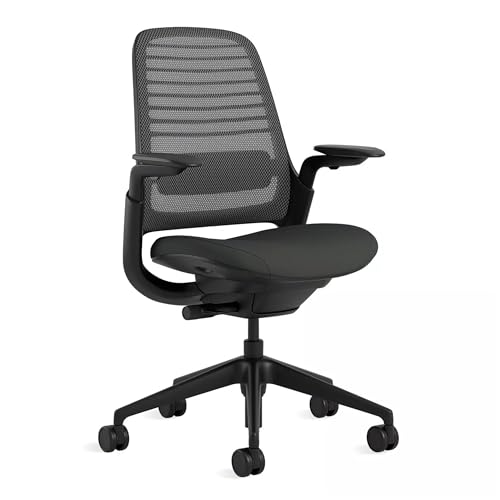
The Steelcase Series 1 Ergonomic Office Chair leads on the podcaster’s combined brief: its weight-activated controls adjust support automatically — no lever clicks mid-take, no forgotten settings before a guest — its adaptive bolstering and flexible edges keep long interviews pressure-free, its graphite finish reads professional on any camera, and its compact frame fits the small rooms most podcasts are actually recorded in. Steelcase’s build standards are the quiet argument: tight tolerances are silent tolerances. This configuration ships with carpet casters, which are also the quiet kind on hard floors’ behalf — soft contact, no rumble.
Strengths
- Self-adjusting support: nothing to click, creak, or forget before a take.
- Contract-grade build — the mechanisms stay tight, and tight is quiet.
- Compact, camera-professional silhouette for small studios.
Trade-offs
- No footrest or deep recline for the loosest show formats.
- Carpet casters on this configuration; plan floor protection accordingly.
- Understated looks for hosts who want the chair to be a character.
| Color | Graphite |
| Size | Carpet (Pack of 1) |
| Dimensions | 23.75 x 27 x 41.25 inches |
| Weight | 29 pounds |
The Series 1’s podcast virtue is disappearance. The host’s attention belongs to the guest; the guest’s attention belongs to the conversation; and the chair serves both by never entering either — no adjustments to perform on air, no noises to edit out in post, no visual noise behind the host’s shoulder. For interview shows, news formats, and professional services podcasts, that invisibility is the product. Its two-minute, tool-free assembly also suits the studio that rearranges between recording and everything else.
Choose the Steelcase if your show is a conversation and your chair should be infrastructure. Skip it if your show is a spectacle and the chair is part of the cast — the gaming chairs below audition for that role.
Best for: Interview and professional shows in real rooms / Not suited for: Spectacle streaming formats

HON Ignition 2.0 Ergonomic Office Chair
Our badge: Best Professional
The HON Ignition 2.0 Ergonomic Office Chair is the daily show’s workhorse: a breathable mid-back mesh — silent against clothing and cool under lights — lumbar support that encourages alignment, arms adjustable in height and width to clear your desk and mic setup, a standard tilt that permits the host’s lean-in without drama, and a 300 lb rating under the HON Full Warranty. Contract furniture is built for a decade of daily use by strangers; a podcast’s daily use by its host is a lighter sentence, and the chair’s quiet durability shows it.
Strengths
- Mesh back: the quietest, coolest contact surface in this guide.
- Two-way adjustable arms fit the mic-and-desk geography precisely.
- Full warranty and contract build for a show that records daily.
Trade-offs
- The pool lists no weight for this model.
- Mid-back height; no headrest for reclined listening segments.
- Utilitarian styling for brand-forward video shows.
| Color | Black |
| Size | Oversized |
| Dimensions | 28.5 x 27 x 44.5 inches |
The Ignition’s podcast case is reliability at scale: the solo host recording five days a week, the small studio whose chair serves host and guests in rotation — its quick adjustments re-fit it between bodies in seconds, silently — and the professional show whose video frame should say “office,” not “arena.” Mesh also solves the lights problem that leatherette hosts know: an hour under video lighting in a vinyl chair is an hour of rising temperature and rising fidget, both audible.
Choose the HON if your show records often and your brand is professional. Skip it if your format reclines — the Secretlab’s session below is built for that.
Best for: Daily shows and shared studio chairs / Not suited for: Recline-heavy formats

SIHOO M18 Ergonomic Office Chair
Our badge: Best Budget
The SIHOO M18 Ergonomic Office Chair gives the starting podcaster the essentials without the noise: a breathable mesh back that stays silent and cool, adjustable lumbar support, an adjustable headrest for the listening-back segments, 2D armrests, a wide cushion, tilt lock, and a frame tested to 330 lb — for sitters roughly 5’6″ to 6’2″ — at the guide’s friendliest price. For a show whose budget belongs to the microphone first, this is the chair that lets the audio chain be the priority while the sitting stays honest.
Strengths
- Full mesh back: quiet, cool, and kind to long sessions.
- Adjustable lumbar and headrest at a starter price.
- 330 lb tested rating suits hosts and most guests.
Trade-offs
- 2D armrests adjust less for elaborate mic geometries.
- Sized for average-to-tall sitters.
- Plainer on camera than the premium picks.
| Color | Charcoal |
| Size | Pack of 1 |
| Dimensions | 27.5 x 21 x 11 inches |
| Weight | 31.526103466 pounds |
The M18’s tilt lock deserves a host’s attention: lock the chair for the take and the whole class of mid-sentence creaks and drifts disappears, then unlock for the edit session’s lean. Its charcoal restraint also behaves on camera — no glare, no logos shouting over the host’s shoulder — which matters more with every show that adds video. As a first studio chair it is, quite simply, the correct allocation of a small budget.
Choose the SIHOO if the microphone ate the budget, as it should. Skip it if your mic arm geometry needs 3D arms — the Ticova below is the value answer.
Best for: Starting and budget studios, audio-first shows / Not suited for: Elaborate desk geometries

Secretlab Titan Evo Gaming Chair
Our badge: Best for Long Sessions
The Secretlab Titan Evo Gaming Chair serves the long-form show: cold-cure foam that holds its support through a three-hour interview, integrated lumbar support, a memory-foam magnetic head pillow for the listening lean, 4D armrests that position around any mic-and-desk geometry, and a high reclining back in black leatherette that reads as a deliberate brand choice on video. This Regular size suits users up to 285 lb; size by the maker’s guidance. Its podcast caveat is in its material: leatherette can squeak against clothing when a host shifts — manageable with a fabric layer or a throw over the seat, and irrelevant to video-first shows, but audio purists should hear it stated plainly.
Strengths
- Cold-cure foam: session three feels like session one.
- 4D arms solve the mic-arm collision problem completely.
- A camera presence that brands a streaming-native show.
Trade-offs
- Leatherette can talk on audio when the host shifts — the guide’s stated caveat.
- Size selection matters; measure before ordering.
- At 76 pounds it anchors its studio permanently.
| Color | Black |
| Size | Regular |
| Dimensions | 19.291338563 x 22.047244072 x 53.937007819 inches |
| Weight | 76.05948039 pounds |
For the marathon formats — the deep-dive interview, the actual-play recording, the streaming show that runs an evening — the Titan Evo’s endurance is the argument: foam that does not pack down keeps the host’s posture, and therefore voice, consistent from the cold open to the outro. Its head pillow makes the guest’s long answer a rest instead of a hold. Shows that record video get the second dividend: a chair that looks like a decision. The head-and-neck support details are argued fully in Best Chairs For Neck Support.
Choose the Secretlab if your sessions are marathons and your show is on video. Skip it for audio-only purism in a quiet room — mesh will serve your microphone better.
Best for: Long-form and streaming shows / Not suited for: Audio-only quiet-room purists

Homall Gaming Chair
Our badge: Best for Video
The Homall Gaming Chair is the video show’s character chair: a tall white silhouette that pops against a studio backdrop, a recline to 135 degrees for reaction and emphasis, a slide-out footrest for the relaxed segments, a flexible headrest, a massage lumbar pillow, high-density foam under PU leather, and a BIFMA-certified base rated to 300 lb. Its audio caveat is the leatherette’s, stated as plainly as the Secretlab’s: it can squeak on shift, so audio-first shows should test it on their own microphone before committing — video-first shows may never care.
Strengths
- A tall, bright, camera-native silhouette at a friendly price.
- Recline and footrest give video shows their full expressive range.
- Massage lumbar pillow for the long recording day.
Trade-offs
- PU leather: the squeak caveat applies, and it warms under lights.
- The gaming look is a brand decision, not a neutral.
- Armrests adjust less than the 3D and 4D sets in this guide.
| Color | White |
| Size | 19.7 inches x 18.5 inches x 50.4 inches |
| Dimensions | 18.5 x 20.9 x 50.4 inches |
| Weight | 39.7 pounds |
The Homall’s honest niche is the personality show: comedy, gaming, reaction, and creator formats where the host’s chair is part of the set and the set is part of the brand. Its price lets a two-host show buy the pair and keep the frame symmetrical — a production-design trick far above its cost. Run the microphone test in the how-to section during the return window; if your room and wardrobe keep it quiet, it is the most fun per dollar in this guide.
Choose the Homall if your show is video-first and personality-led. Skip it for audio-only recording in a treated room — your microphone will file the complaint.
Best for: Video podcasts and creator shows / Not suited for: Audio-only purists

Ticova Ergonomic Office Chair
Our badge: Best Value Adjustable
The Ticova Ergonomic Office Chair is the guest-proof studio chair: lumbar adjustable in height and depth, a headrest adjustable in height and angle, 3D armrests that move out of a guest’s way or into a host’s preference, a 130-degree rocking tilt, a spine-shaped mesh back, and a 3.4-inch W-shaped waterfall seat — BIFMA-tested, at a value price. A studio that hosts guests of every size needs a chair that re-fits in a minute, silently, and the Ticova’s adjustments are the quick kind.
Strengths
- Full adjustment chain at a value price — re-fits any guest in a minute.
- Mesh back keeps the chair quiet and the sitter cool.
- 3D arms clear mic arms and desks of every geometry.
Trade-offs
- The pool’s dimension figures appear to be package measurements.
- Foam seat warms more than full mesh across very long sessions.
- Rocking tilt rather than a true lounge recline.
| Color | Black |
| Size | 70D x 26W x 54H cm |
| Weight | 17.5 Kilograms |
Two-chair studios take note: a pair of Ticovas — one host, one guest — gives an interview show matched visuals and per-guest fit at a total cost below one premium chair, and the mesh keeps both sides of the conversation quiet. Its headrest, unusually good for the price, serves the guest’s listening posture, which is the posture guests spend most of the show in. For a growing show, it is the scalable choice.
Choose the Ticova if your studio hosts guests or needs two matched chairs. Skip it if a single statement chair is the brand — the Secretlab states louder.
Best for: Interview studios and guest chairs / Not suited for: Statement-set design
Comparison Table
| Pick | Color | Dimensions | Weight | Check price on Amazon |
|---|---|---|---|---|
| Steelcase Series 1 Ergonomic Office Chair | Graphite | 23.75 x 27 x 41.25 inches | 29 pounds | Check price on Amazon |
| HON Ignition 2.0 Ergonomic Office Chair | Black | 28.5 x 27 x 44.5 inches | — | Check price on Amazon |
| SIHOO M18 Ergonomic Office Chair | Charcoal | 27.5 x 21 x 11 inches | 31.526103466 pounds | Check price on Amazon |
| Secretlab Titan Evo Gaming Chair | Black | 19.291338563 x 22.047244072 x 53.937007819 inches | 76.05948039 pounds | Check price on Amazon |
| Homall Gaming Chair | White | 18.5 x 20.9 x 50.4 inches | 39.7 pounds | Check price on Amazon |
| Ticova Ergonomic Office Chair | Black | — | 17.5 Kilograms | Check price on Amazon |
How to Choose the Best Chairs for Podcasting
Run the microphone test before anything else
Set the chair up in your recording space, place the microphone exactly as you record, and tape five minutes of your full physical repertoire: lean in, lean back, laugh, reach for water, swivel to the notes, shift your weight the way you do at minute ninety. Play it back on headphones at editing volume. Every squeak, creak, and rumble you hear is a sound your audience will hear in every episode — decide, with that evidence, whether the chair passes. Do it inside the return window. This test outranks every review, including this one.
Choose textile at the contact points
The sounds chairs make on recordings come overwhelmingly from surfaces: vinyl and leatherette against clothing, at the seat and back, during shifts. Mesh and fabric are dramatically quieter at exactly those points, which is why four of this guide’s six picks wear them. If your heart or your brand demands a leatherette chair, mitigate: a fabric throw or seat cover at the contact points, and the microphone test to verify the mitigation worked.
Fit the arms to the mic geography
Map your recording position: desk edge, mic arm’s arc, keyboard, water, notes. Your chair’s armrests must support your forearms without entering the mic arm’s space or striking the desk when you swivel — collisions are audible thumps and visible jolts. Adjustable arms (the HON’s two-way, the Ticova’s 3D, the Secretlab’s 4D) solve the geometry precisely; fixed arms solve it only by luck. Some hosts remove one armrest entirely on the mic side — a legitimate studio modification if your chair allows it cleanly.
Buy for the session your show actually runs
A thirty-minute news show and a three-hour interview punish chairs differently. Short formats forgive almost anything quiet; long formats demand foam or support that does not fade — cold-cure foam, quality mesh tension, tested frames — because a host’s posture at hour three is their voice at hour three. Guest shows add the re-fit requirement. Inventory your format honestly and let its longest day specify the chair.
Cast the chair for the camera
On video, the chair’s back is in your frame for the entire show — it is, functionally, your co-host’s silhouette. Professional shows cast restraint (Steelcase, HON); creator shows cast personality (Secretlab, Homall); interview shows cast symmetry (a matched Ticova pair). Decide what your frame should say before the chair says it for you, and check the color against your backdrop and lighting — white chairs bloom under bright lights, black chairs disappear into dark sets, and graphite behaves almost everywhere.
How Do You Set Up a Quiet Recording Seat?
Start with the floor: a rug or mat under the chair kills caster rumble and foot noise at the source and defines the recording position so the chair returns to the same spot — and the same mic distance — every session. Set the chair’s height so your feet rest flat and still; dangling feet swing, and swinging feet are audible. Lock the tilt if your chair allows it during takes, or set its tension so your natural lean does not become a slow creak. Tighten every bolt on the chair the day it arrives and again at a month — squeaks are loose joints announcing themselves early, while they are still free to fix.
Position the chair so its swivel arc clears the desk and the mic stand at every point, and rehearse your three commonest reaches — water, notes, controls — inside that arc. The goal is a seat in which your whole performance is available and none of it makes a sound the microphone did not invite. The workstation logic around the chair is shared with Best Task Chairs For Home Office, whose setup sequence this arrangement assumes.
Problem: A squeak appears only during recordings — It was always there; the room’s quiet reveals it. Tighten the base and mechanism bolts, check the tilt tension, and test fabric contact points with a throw. If it persists at a joint, a drop of the lubricant the maker approves — never a guess — is the last step before the return window closes.
Problem: Casters rumble on your hard floor — The rug is the fix, sized to the chair’s full roll. Alternatively, this guide’s carpet-caster configuration rolls softer by design. Chairs that stay in one marked position barely roll at all — position discipline is also a sound treatment.
Problem: Your armrest keeps hitting the mic arm — Lower it, move it inward, or remove the mic-side rest if the chair allows. Re-map the geometry with the mic live and the recorder running; the collision you cannot hear in the room is obvious on the tape.
Problem: You fidget more as the session warms up — Heat and support fade are the usual causes: mesh or fabric for the first, real foam or a footrest for the second, and a chair whose recline lets you change state without standing. Restless hosts should also read the movement-friendly guide linked at the top.
Problem: The chair looks wrong on camera — Check the frame at recording height: the chair’s back should frame your shoulders, not tower or vanish. Adjust your camera before your chair — most “wrong chair” frames are camera placement — then judge the silhouette honestly.
The Guest Chair Is a Production Decision
Interview shows live or die on guests’ comfort, and guests sit in your chair, in your room, in front of your microphone — three unfamiliar things at once. A guest chair that re-fits in a minute (the Ticova’s quick adjustments, the Steelcase’s automatic ones), stays silent under a nervous shifter, and looks calm on camera removes one whole layer of guest anxiety before the first question. Brief the guest on the practicalities — the water’s location, the headphone volume, the chair’s recline if it has one — and let them settle for a full minute before recording. The conversation that follows will repay the minute at the rate of the whole episode.
Audio-First Versus Video-First: The Honest Split
This guide’s one real fork deserves its own paragraph. Audio-first shows should buy silence in its purest form — mesh, fabric, contract build — and let the camera, if any, take what it gets. Video-first shows may rationally trade a whisper of material noise for a silhouette that brands the frame, mitigating with throws and the microphone test. Neither is the “serious” choice; they are different media wearing one name. Know which show you make. The hosts who regret their chairs are almost always the ones who bought for the other medium — the audio purist in the squeaking statement chair, the streamer invisible in a chair chosen only for its silence.
Recording at Home: The Shared-House Studio
Most podcasts are recorded in homes that have other lives — the spare room that is also the office, the corner of the bedroom, the dining table after dinner — and the chair in those rooms serves two households: the show’s and the family’s. That dual service argues for the versatile end of this guide: chairs that look like furniture rather than equipment when the show is off, that re-fit quickly between the host’s recording posture and a partner’s working one, and that stay quiet in a room whose acoustics were never treated. The home studio’s other half — the desk, the screen, the work that shares the chair’s hours — is arranged in Best Work From Home Chairs For Back Pain, and its lesson transfers: a home workstation succeeds when every one of its jobs was considered, not just the loudest. The recording corner that respects the home gets kept; the one that colonizes it gets dismantled by the household, usually mid-season, always at the worst time.
Keeping the Quiet: A Maintenance Ritual
Silence is not a property a chair has once; it is a condition maintained. Build the five-minute ritual into the studio’s calendar — monthly is enough for most chairs, weekly for daily shows. Tighten every bolt you can reach, in the maker’s order; work the tilt and recline through their ranges and listen for the first whisper of a creak, which is a loose joint asking for attention while attention is still cheap. Check the casters for the grit and hair that make them rumble, vacuum the mesh and fabric where dust changes their voice against clothing, and confirm the armrests are still at their mapped heights — arms drift, and the mic arm collision returns by millimeters. Log the ritual in the same place you log your episodes. The hosts whose chairs stay silent for years are not the ones who bought the quietest chair; they are the ones who kept it quiet, the same way their show notes, their backups, and their release schedule are kept — by a small routine, done on time, without drama.
The Long Haul: Your Chair Across a Hundred Episodes
A podcast chair should be evaluated the way a show itself is: not by its launch, but by its hundredth episode. By then, the chair has survived a hundred setups, a hundred guests’ worth of shifting, a hundred hours of the host’s own weight in the same few postures — and its true qualities have declared themselves. The foam either still supports or has become a hammock with a brand name. The joints either still close silently or announce every laugh. The fabric either still reads as a set or as a surrender. This is why this guide weights build standards, tested frames, and warranties as heavily as first-sit comfort: the contract-grade chairs (Steelcase, HON) and the endurance foams (Secretlab’s cold-cure) are hundred-episode purchases, while a chair bought for its first impression is a ten-episode purchase wearing a season’s price tag.
The hundredth-episode test also reframes the posture question that runs under every recording: a host’s voice is a physical instrument, and its quality at episode one hundred is partly a chair story — breath supported by a spine that was never fighting its seat, a neck that spent a hundred sessions rested rather than held. The posture system beneath the podcast chair is the same one this program builds for desk workers in Best Chairs For Back Posture, and hosts who record daily should read the two guides as one: the microphone hears your posture before your audience sees your face, in the steadiness of the voice that a supported body produces without effort. Buy the chair for the hundredth episode, maintain it with the ritual this guide prescribes, and the show’s second season will sound like it — settled, supported, and entirely focused on the conversation, which is where a podcast’s quality was always going to live.
Chairs for the Co-Hosted and Panel Formats
Everything in this guide so far assumes one host in one chair, but a large share of podcasts are conversations among regulars — two co-hosts, a panel of four — and the multi-chair studio has its own rules. Match the chairs, first of all: a panel framed in four different silhouettes reads as a waiting room, while matched or deliberately paired chairs read as a set, and the audience’s eye settles accordingly. Match their heights, too, because a panel whose heads form a skyline distracts the camera and, in audio, usually means four different distances from four microphones. The value-adjustable strategy — the Ticova pair scaled to four — exists for exactly this: identical chairs, individually fitted, at a total that leaves the budget for the microphones a panel actually needs.
Panel chairs have one more duty solo chairs escape: they must be quiet under strangers. Co-hosts are known quantities, but the rotating fourth chair hosts guests who fidget, shift, and lean in ways no one can rehearse — which returns the whole panel to this guide’s first principle, verified per chair with the microphone test, textile at the contacts, joints tightened on the maintenance ritual. A panel show is only as silent as its least-known sitter’s chair. Buy the set as a set, test the set as a set, and the conversation — all of it, from every chair — will sound like it was recorded in a studio rather than a furniture store. That, for a panel show, is the entire ballgame, and it is won at the chair purchase or not at all.
The Budget Episode: Allocating a Small Studio’s Money
Because so many podcasters start with more ambition than budget, this guide closes its analysis with an allocation, stated plainly. The microphone and its chain come first — they are the show’s sound, and no chair can edit around them. The chair comes second, ahead of lighting, ahead of the camera, ahead of the backdrop, because the host sits in it for every minute of every episode and the audience hears its failures forever, while a backdrop can be a curtain for a year without anyone cancelling a subscription. Within the chair budget, this guide’s order of purchase is silence, then support, then looks: a quiet mesh chair that fits (the SIHOO’s whole argument) outranks a gorgeous leatherette that talks, at any price, for an audio-first show. Video-first shows may invert the last two — support, then looks, with silence defended by mitigation and the microphone test — but no show, at any budget, inverts the first: the microphone is the show, and the chair is its most important supporting actor.
The encouraging news buried in that allocation is how far a small budget now goes. The value tier in this guide — mesh, adjustability, tested frames, quiet textiles — would have been a professional studio’s specification a decade ago. A starting podcaster who buys the microphone properly and the SIHOO or Ticova honestly has not compromised the show at all; they have merely deferred the statement chair to the season when the show’s income buys it, which is exactly how the hosts of the hundredth-episode club mostly did it. Start quiet, start supported, and let the chair you upgrade to later be a celebration rather than a rescue.
One more scenario completes the picture, because a growing share of podcasters record somewhere that is not a studio at all: the closet, the spare room, the corner of a bedroom shared with a life. Small-space recording sharpens every criterion in this guide at once. The chair must be quiet, because the room’s softness cannot absorb its noise the way a treated studio does. It must be compact or foldable in spirit, because the recording corner is borrowed from another room’s purpose and must sometimes be returned. And it must be comfortable past the point of politeness, because small rooms heat up, sessions stretch, and the host who is enduring their chair is audible enduring it. The mesh value picks answer this scenario best — cool, quiet, modest in footprint, honest in support — which is why this guide keeps returning to them for real-world shows: the typical podcast is not recorded in a studio that looks like the photographs. It is recorded in a corner, by a person in a chair, and the corner shows succeed or fail on exactly the virtues the value tier happens to specialize in.
Keep one sentence from this guide taped inside the studio door, whichever room the studio currently is: the audience cannot see your chair, but they can always hear it. Every decision in these pages — the textiles, the joints, the microphone test, the maintenance ritual — is that sentence unfolded into a buying method. Follow it, and the only thing your listeners will ever know about your chair is that they never had to think about it at all.
Record the first episode in the new chair and listen back with the chair in mind. If you cannot hear it anywhere in the hour, you bought correctly — and you will not think about it again until episode one hundred proves the point.
Silence, support, and a hundred episodes of both: that is the brief, and it is entirely achievable at every budget in this guide.
Common Buying Mistakes
Testing the chair in a noisy showroom
Showrooms forgive every sound a chair makes; treated rooms forgive none. The microphone test at home, inside the return window, is the only audition that counts.
Buying leatherette for an audio-first show
It will talk. Sometimes softly, sometimes at the worst moment of the best interview. Textile contact points are the audio-first rule, and this guide’s exceptions are labeled with their caveats in plain sight.
Ignoring the armrest-versus-microphone geometry
The collision is inevitable if the geometry is wrong, and it will happen mid-sentence, on the record. Map the arc before the first session, not after the first ruined take.
Forgetting the guest
A host-only chair in an interview studio is half a purchase. Quick re-fit and silence under strangers are guest-chair specifications; buy them deliberately.
Choosing the chair before the microphone
In every budget, the audio chain outranks the seat. The SIHOO and Ticova exist in this guide precisely so a small budget can honor that order and still sit well.
Final Recommendation
For most podcasters, the Steelcase Series 1 Ergonomic Office Chair is the answer: silent by construction, self-adjusting between host and guest, and professionally invisible on camera. For long-form and streaming shows, the Secretlab’s endurance carries the day — compare it on its Check on Amazon listing and order your correct size. On a budget, the SIHOO’s mesh is the quiet buy; for guests, the Ticova pair. Run the microphone test on whatever you choose, tighten the bolts, lock the tilt — and let the only voice in the recording be yours.
Frequently Asked Questions
What is the quietest type of chair for recording?
A well-built chair with mesh or fabric at the seat and back, tight mechanisms, and a base that stays planted — the Steelcase, HON, and SIHOO pattern in this guide. Quiet is a build-quality property as much as a material one, which is why the microphone test, not the category, is the final judge.
Are gaming chairs bad for podcasting?
For video-first shows, they are often ideal — supportive for marathons and native to the camera. For audio-first shows, their leatherette can squeak against clothing when the host shifts. The category is not the problem; the material in a quiet room is. Test on your microphone, mitigate with fabric at contact points, or choose the fabric and mesh chairs.
Do I need a headrest for podcasting?
For listening-back segments and long interviews, a good adjustable headrest — the Ticova’s, the Secretlab’s pillow — rests the neck while guests talk, which is much of an interview show. For upright, short-format hosting it matters less. Judge by your format’s longest listening stretch.
How do I stop my chair from appearing in the audio when I move?
Tighten its bolts, lock or tension its tilt, put a rug under it, choose textile contact surfaces, and discipline your recording position so reaches happen inside a rehearsed arc. If a sound survives all that, it is the chair’s character — and the return window is the time to decide whether your show can live with it.
What chair should I buy for a two-person interview show?
A matched, quick-adjusting pair — the Ticova is this guide’s value answer — so both sides of the frame look intentional and each guest re-fits in a minute. Alternatively, a self-adjusting chair like the Steelcase for the guest seat removes the fitting entirely.
Does the chair’s color matter for video podcasts?
Yes, quietly: white can bloom under bright lights, black can vanish into dark backdrops, and graphite and charcoal behave in most frames. Match the chair to your set’s exposure and backdrop, and check it in your actual recording frame before the first episode, not after the fifth.


