Where to buy
Check the latest price, availability and delivery on Amazon. Orders are placed on Amazon. We may earn a commission from qualifying purchases.
- Best overall for modern homes: H.VERSAILTEX Linen Look 100% Blackout Curtains with White Backing, 52″W x 84″L, 2 Panels — Check on Amazon
- NICETOWN Beige Linen Blackout Curtains with Fused White Backing, 52″W x 84″L, 2 Panels — Check on Amazon
- NICETOWN Triple Weave Blackout Curtains, Sage Green, 52″W x 84″L, 2 Panels — Check on Amazon
- NICETOWN Full Blackout Curtains, 52″W x 84″L, 2 Panels — Check on Amazon
See 2 more Amazon options
- Deconovo 100% Blackout Curtains with Black Liner, 52″W x 84″L, 2 Panels — Check on Amazon
- NICETOWN Star Blackout Curtains for Kids’ Rooms, 52″W x 84″L, 2 Panels — Check on Amazon
Read the full guide ↓
Disclosure: As an Amazon Associate, dailyhomedecorating.com earns from qualifying purchases. Links to Amazon on this page are affiliate links; they cost you nothing extra. Listing details such as price and availability change often, so check the current Amazon listing before you buy.
A modern interior is unforgiving to curtains. In a room built on flat planes, honest materials and a short list of colors, a window treatment is never just a window treatment — it is the largest piece of fabric in the space, and it will either behave like part of the architecture or read as an apology hung in front of the glass. The shiny, slightly plastic-looking polyester that fills the budget blackout category fails that test instantly, which is why most people assume blackout curtains for a modern home start at design-store prices. They do not. Under $40 a pair — for two panels of 52 x 84 inches, the configuration used throughout this guide — there are textured linen-look faces, matte neutrals and clean grommet headers that disappear into a minimal room by day and close it down completely at night. The catch, and this guide will not hide it, is that the single best-looking curtain in this price band is not the single most absolute light barrier in it. Design and darkness are both available under $40; they just peak in different products, and the reviews below are organized so you can choose which peak matters in which room.
So the ranking here is a modern home’s ranking, not a sleeper’s. The H.VERSAILTEX linen-look pair leads because its face is the one a visitor would never identify as a blackout curtain, and its white backing still does genuine blackout work behind it. The NICETOWN beige linen pair delivers the same trick in a warmer neutral at a lower position in the budget. The sage triple weave is here because modern rooms run on restrained color, and a soft botanical tone in the lightest, softest-draping fabric in the guide is a legitimate design tool — as long as it is sold honestly as a darkener, not a blackout. And because a modern home still contains bedrooms and media walls, the two most absolute barriers in the category — NICETOWN’s lined full blackout and Deconovo’s sewn-in black liner — are here as the hidden workhorses, the curtains you specify where nobody is admiring the fabric. Below: a quick picks table, detailed notes on all six, a comparison table, a checklist written for modern rooms, an honest section on headers and hardware, the truth about ceiling-to-floor drapes on an 84-inch standard size, the mistakes that date a modern room, and a short FAQ.
Quick Picks
Short on time, or comparing several options at once? Each row below names the role the curtain plays in a modern home and the product that fills it, with a link to the listing. All six are pairs of two 52 x 84 inch panels — check price on Amazon for the current price of the configuration you choose.
| Role in a modern home | Pick | Why it stands out | Link |
|---|---|---|---|
| Best overall for modern homes | H.VERSAILTEX Linen Look 100% Blackout Curtains, White Backing, 52″W x 84″L, 2 Panels | A slubbed, matte linen-look face over a white blackout backing — the curtain that does not look like one | Check on Amazon |
| Best warm neutral | NICETOWN Beige Linen Blackout Curtains, Fused White Backing, 52″W x 84″L, 2 Panels | A warm beige linen-look face fused to a white backing that does the darkening — check price on Amazon | Check on Amazon |
| Best soft color accent | NICETOWN Triple Weave Blackout Curtains, Sage Green, 52″W x 84″L, 2 Panels | The lightest, softest drape in the guide, in the restrained green modern rooms actually use | Check on Amazon |
| Best hidden workhorse | NICETOWN Full Blackout Curtains, 52″W x 84″L, 2 Panels | A lined, true-blackout construction for the bedrooms behind the architecture — check price on Amazon | Check on Amazon |
| Best total darkness | Deconovo 100% Blackout Curtains with Black Liner, 52″W x 84″L, 2 Panels | A black liner sewn in behind the face — the most literal light barrier in this guide | Check on Amazon |
| Best modern nursery | NICETOWN Star Blackout Curtains, 52″W x 84″L, 2 Panels | Die-cut stars that appear as pinpoints of light — one graphic gesture, nothing more | Check on Amazon |
How These Picks Were Chosen
Two filters ran in sequence, and the order matters. The first was the budget, applied to one fixed configuration so comparisons stay consistent: a pair of two panels, each 52 inches wide by 84 inches long, with every pick positioned at or under $40 in exactly that configuration — check price on Amazon to confirm the current price for the size and colorway you select. Curtain pricing varies per size, per colorway and per panel count, so a listing that looks cheaper is routinely a single panel or a shorter drop wearing the pair’s photograph; anything that could not hold the standard configuration within the budget was excluded, however good it looked. The second filter was the modern one, and it was applied to the face of the fabric, because in a modern room the face is what you live with. We favored matte over shiny, texture over flat print, and the short neutral palette — warm whites, beiges, greys, one restrained sage — over the saturated jewel tones that dominate this category’s sales charts and date a minimal room on contact.
We did not hang these curtains ourselves. We read the maker listings and specification pages and compared the three constructions that exist at this budget — lined panels, fused or flocked white backings, and unlined triple weaves. That construction comparison produced the honest tension at the center of this guide, and we would rather state it here than let a buyer discover it: a blackout result is produced by a layer, and layers differ. A sewn-in black liner is the most absolute barrier of the three. A white backing bonded or flocked onto a decorative face blocks light just as completely when it is intact, and it is what allows the two best-looking picks in this guide to exist — but the bond is the vulnerable part of the product, sensitive to heat in a way a sewn liner is not. An unlined triple weave has no layer at all; its maker rates it at 85 to 99 percent, and in a pale or mid-tone colorway against strong glass it will glow. None of this disqualifies any pick below. It assigns each one to the room where its compromise is invisible: the beautiful backings to the rooms that are looked at, the absolute liners to the rooms that are slept in, and the triple weave to the rooms that only need to dim. Readers outfitting the sleeping rooms first should start from Best Blackout Curtains For Bedrooms Under $40, where this same budget is ranked by darkness alone.
The 6 Best Blackout Curtains for Modern Homes Under $40
H.VERSAILTEX Linen Look 100% Blackout Curtains with White Backing, 52″W x 84″L, 2 Panels
Who it suits: Anyone whose living room or primary bedroom runs on the modern formula — pale walls, natural textures, nothing shiny — and who needs that room genuinely dark at night.
This is the pick the whole guide is built around, because it solves the modern blackout problem in the right order: face first, mechanism second, both present. The face is a linen-look polyester with a slubbed, woven texture and a matte finish, the visual language of natural-fiber drapes from a much higher tier, and behind it sits a pure white blackout backing — the listing describes a white flocking-style backing — that does the light work the face cannot. The pairing matters twice over in a modern home. Inside, the curtain reads as a textile, not a product: no sheen, no printed pattern, nothing to argue with a restrained room. Outside, the street sees a uniform white panel rather than a patchwork of interior colors, which keeps the building’s elevation as clean as the room’s — a detail that matters to architects, landlords and homeowners’ associations alike. The pair, two 52 x 84 inch panels with eight anti-rust grommets per panel fitting rods up to 1.5 inches, sits near the top of this budget, with the emphasis spent on the face fabric — check price on Amazon for the current price.
Now the trade, stated as plainly as this guide states every trade: the most beautiful curtain here is not the most absolute barrier here. The white flocking backing blocks light completely while it is intact, but a bonded backing is a coating, and coatings are the layer of a curtain that heat and rough washing degrade first — cold, gentle washing and no hot dryer are not fussy care instructions for this pick, they are the maintenance schedule for the blackout itself. The textured face also arrives showing its package creases more honestly than a flat fabric does, and it should be judged after a cool steam, not out of the bag. And one warning about the brand’s own catalog, because it decides real purchases: H.VERSAILTEX sells several lines whose names differ by a word, and not all of them are this lined construction — some are unlined room-darkening panels with a far weaker result. The white backing is the tell. If the listing you land on does not describe one, close the tab; you are looking at a different curtain wearing this one’s name.
- Linen-look slubbed face, matte finish — the least “blackout curtain” looking pick in the guide.
- Pure white backing: full darkness inside, a uniform white face to the street.
- Eight anti-rust metal grommets per panel, for rods up to 1.5 inches.
Honest limitation: Top-of-budget pricing for a bonded backing that heat can crack or separate over time, and a textured face that needs a steam before it looks like the photographs.
Choose it if the curtain hangs in a room that is looked at all day and the face fabric is part of the design. Skip it if the room is a dedicated sleep or theater space where nobody sees the fabric — the black liner further down is the more absolute tool.

NICETOWN Beige Linen Blackout Curtains with Fused White Backing, 52″W x 84″L, 2 Panels
Who it suits: Warm-minimal rooms — pale oak, limewash tones, beige-on-beige palettes — and anyone who has been told, correctly about lesser curtains, that a light color cannot black out a room.
The lesson this product teaches is the one modern decorators most need from this category: a pale curtain fails as a blackout only when the face fabric is the barrier. NICETOWN’s linen blackout line takes the face out of the light path entirely. The warm beige linen-look front is fused to a white blackout backing — the listing calls it a safe fused white backing — and the backing blocks the light while the face is free to be exactly the color a warm modern palette asks for. It sits at the lower end of the backed constructions in this guide — check price on Amazon for the current price — which makes it a natural specification when a whole open-plan wall of glass needs treating: its lower position in the budget makes a real difference across four or five windows. Grommet top, two panels at 52 x 84 inches, from NICETOWN’s full size grid — which carries the standard warning for this brand: confirm the 52 x 84, two-panel configuration on the listing, because NICETOWN sells every dimension a window can have and the grid is where configuration mistakes happen.
What does the step up to the pick above buy, and what do you give up here? Finish, mostly. The beige face is convincing at conversational distance — which, in fairness, is where curtains are actually seen — and simpler up close, where the texture resolves into print-adjacent regularity rather than true slub. The drape is a touch stiffer, the color range narrower. What you do not give up is the mechanism: fused white backing, full blackout claim, grommet header. The care rule is the fused construction’s own and it is not optional: the bond between face and backing is the product, heat is its enemy, and a fused panel cooked in a hot wash or dryer can bubble or separate in a way a sewn liner never will. Wash cold and gentle and this is the value pick of the backed group; wash it like a bedsheet and it is the one pick here that can be ruined in a single load. For compact modern rooms where the window wall is the whole interior, Best Blackout Curtains For Small Rooms Under $40 ranks this same pair against the other space-conscious options at the budget.
- Fused white backing behind a warm beige face — genuine blackout in the palette modern rooms use.
- Linen-look texture in the most accessible backed pair in this guide — check price on Amazon.
- Grommet top, two 52 x 84 inch panels, from NICETOWN’s full size grid.
Honest limitation: The fused bond is heat-sensitive — a hot wash or dryer can bubble or separate the backing — and the face texture is simpler up close than the premium linen above.
Choose it if you are treating several windows in a warm neutral scheme and want the backed construction at the lowest price. Skip it if your household washes everything hot — take a sewn liner instead, either of the last two picks below.
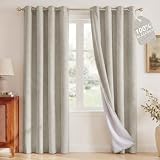
NICETOWN Triple Weave Blackout Curtains, Sage Green, 52″W x 84″L, 2 Panels
Who it suits: Modern living rooms and open-plan spaces that need glare control and one restrained note of color — not darkness — and that open and close their curtains every day.
Modern interiors are often described as colorless, which is wrong; they are color-disciplined, and the discipline usually allows exactly one soft, desaturated tone against the neutrals. Sage is that tone in current interiors — a greyed green that sits comfortably beside oak, concrete and warm white — and this NICETOWN pair is the cheapest honest way to put it on a window. The construction is the classic unlined triple weave: a single dense polyester fabric with black yarn woven between two colored layers, no liner, no backing. At a fifth of an inch thick in its package specs it is by far the lightest curtain in this guide, and that lightness is a genuine design property, not just a spec: it drapes in soft, narrow folds instead of the lined picks’ formal fall, it slides on its grommets with almost no effort, and it washes in a normal load and hangs dry without ceremony. For a living space that is curtained against afternoon glare on a screen and opened again every morning, that easy daily behavior is worth more than a darkness rating the room never uses. The pair is two 52 x 84 inch panels, grommet top — check price on Amazon for the current price.
The honesty paragraph, because this pick needs it more than any other: NICETOWN rates this construction at 85 to 99 percent light blocking, and that range is physics, not modesty. With no opaque layer, density and dye do all the work, so the result is set by the colorway and the window — a mid-tone sage against a bright west-facing afternoon will glow, softly and visibly, where a lined curtain would not. In a modern living room that is often acceptable, even pleasant; the room dims, the screen clears, the fabric keeps a little of the day in it. In a bedroom it is the wrong specification at any price, because the last few percent of light are precisely the percent that wakes a sleeper at dawn. Buy this pair as what it is — the best-draping darkener in the guide, in the one color a minimal room can absorb — and it earns its place. Buy it believing the word blackout on the listing, and you will be back in this guide buying a lined pair within the month. Renters in modern blocks, who often need exactly this balance of looks, weight and no-drama installation, will find it ranked against the other renter-friendly options in Best Blackout Curtains For Apartments Under $40.
- Unlined triple weave: the softest drape and lightest hand in the guide.
- Sage green — a restrained, greyed color that works inside a neutral palette.
- At the lower end of this budget for the pair, and the easiest wash of the six — check price on Amazon.
Honest limitation: Maker-rated 85–99% and it behaves like it: a darkener that glows against strong light, not a blackout. Wrong for any room someone sleeps in.
Choose it if the room needs dimming, softness and color discipline rather than darkness. Skip it if the room is a bedroom — the lined NICETOWN two picks down sits a step higher in the budget and closes completely.

NICETOWN Full Blackout Curtains, 52″W x 84″L, 2 Panels
Who it suits: The bedrooms and media walls of a modern home — the rooms where the curtain’s job is performance, and where a plain, flat, unpatterned face is all the design the brief requires.
Every modern house has two kinds of window: the ones in the photographs and the ones behind them. This is the curtain for the second kind. NICETOWN’s Full Blackout line is the cheapest way into the construction that actually delivers the word — a decorative face backed by a dedicated blackout layer rather than a single hopeful weave — and in its packaging specs the pair measures a half-inch thick where the triple weave above measures a fifth of an inch. That difference is the liner, and the liner is the product. Because the backing does the blocking, the darkness holds across the line’s color range in a way no unlined curtain’s can, so the plain, flat, neutral colorways a modern bedroom wants are also the ones that perform. The pair — check price on Amazon for the current price — is sold and shipped by NICETOWN, hanging from eight metal grommets per panel with the standard 1.6-inch inner diameter that fits rods up to about 1.5 inches.
Specified honestly, its modern credentials are real but narrow. The face is flat polyester without the linen picks’ texture, and in a design-led living room that flatness is exactly what the first two picks exist to fix. In a bedroom it is barely a compromise at all: the curtain is closed at night and open behind a stack of folds by day, and a plain face in a restful color is arguably the correct modern answer for a sleep space anyway. The weight, though, is a specification, not a footnote — a lined pair is noticeably heavier than a triple weave, it drapes with a stiffer, more formal fall, and it wants a rod anchored into studs or proper wall anchors rather than a tension rod’s optimism. Wash it cold and gentle; the backing is the part that suffers in a hot dryer. Treat this pick as infrastructure — the layer of the house that makes the bedrooms dark on command — and it is the benchmark the rest of the guide is measured against, comfortably within budget.
- Lined full-blackout construction — a dedicated blackout layer, not a hopeful weave.
- Darkness holds across colors because the backing, not the dye, blocks the light.
- Eight metal grommets per panel, 1.6-inch inner diameter for standard rods.
Honest limitation: A flat, untextured face that design-led rooms will find plain, and real weight — fit a sturdy, well-anchored rod and expect a formal drape.
Choose it if the room must go dark at noon and the fabric is not part of the interior scheme. Skip it if the window is the room’s main visual surface — that is what the linen-look picks at the top of this guide are for.
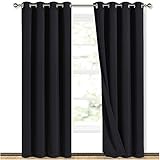
Deconovo 100% Blackout Curtains with Black Liner, 52″W x 84″L, 2 Panels
Who it suits: The one room in the modern home where darkness outranks everything — a media room, a projector wall, a primary bedroom facing east — and the buyer who trusts a black layer more than a percentage claim.
If the linen-look pick at the top of this guide is the design peak, this is the performance peak, and the distance between the two is the most useful thing this guide can teach. Deconovo, NICETOWN’s closest rival in this category, builds its 100% Blackout line the direct way: the face fabric carries the color and finish, and a black liner sewn in behind it does the blackout work. Black is the one backing color that absorbs rather than reflects, which is why this construction is the traditional answer wherever light must not merely be reduced but ended. The pair — two panels, each 52 x 84 inches, grommet-top — sits near the top of the budget, with the emphasis spent entirely on the barrier — check price on Amazon for the current price, which can vary by colorway. Deconovo sells the same line in a wide spread of colors and lengths, so confirm the 52 x 84, two-panel configuration on the listing before ordering; this brand’s size grid is exactly where configuration mistakes happen.
Two honest notes travel with a black liner into a modern home. The first is thermal: a black backing facing the glass absorbs heat on a summer afternoon, which is part of why these curtains insulate as well as they do, but the liner lives a harder life than a white one, and the maker’s gentle-care instructions deserve following rather than testing. The second is about where this curtain belongs in a design scheme — which is behind the scheme, not in it. The face fabrics in this line are plain, the black liner shows black from the street where the white-backed picks show a uniform white, and some associations and landlords have opinions about that. None of this makes it the wrong curtain; it makes it a specialist. Specify it where the modern home stops performing for visitors and starts performing for the people who live in it — the room with the projector, the bedroom of the person who sleeps past sunrise — and it is as close to a sealed darkroom as this budget gets.
- Sewn-in black liner — the most direct, most absolute light barrier of any construction here.
- Grommet top with the standard fit for rods up to about 1.5 inches.
- Strong thermal behavior: the dark backing absorbs at the glass, winter and summer.
Honest limitation: The black liner absorbs heat, wants gentle care, and shows black from the street — and the face fabric alone blocks little, so check the liner’s coverage to the edges when the pair arrives.
Choose it if one room needs maximum darkness and you prefer a black liner’s physics to a white backing’s. Skip it if the window is a design surface or bakes in afternoon sun — take the white-backed linen at the top of the guide.

NICETOWN Star Blackout Curtains for Kids’ Rooms, 52″W x 84″L, 2 Panels
Who it suits: A modern nursery or child’s room, where the design rule is one deliberate gesture — and where nap-time darkness matters more than adult darkness.
Children’s products are where modern interiors usually surrender: the palette goes primary, the motifs multiply, and the room stops speaking the house’s language. This NICETOWN pair is the exception that proves a nursery can stay in the scheme. The base is a triple-weave blackout curtain — the same honest 85-to-99-percent construction as the sage pick above — in a deep Stormy Sea colorway, with star shapes die-cut out of the fabric. Close it against daylight and the room dims while the stars appear as small, scattered points of light across the panel: a single graphic idea, executed once, in a color dark enough to belong in a restrained house. It is the rare children’s product whose headline feature is a controlled failure of its main job, and for its actual job the failure is the point — a toddler who naps in a room dusted with soft starlight is getting darkness where it matters and wonder where it does not. The pair, two 52 x 84 inch panels with a grommet top, sits in the middle of this budget — check price on Amazon for the current price — a step above the plain triple weave, which reflects the die-cutting.
The limitations are structural and should be read before, not after, the purchase. Every star is a hole: this curtain cannot produce total darkness, it is wrong for a light-sensitive sleeper of any age, and the cut edges are the panel’s delicate points, so it wants gentle washing and no enthusiastic tugging from the small hands it is bought for. The effect also runs on the light behind the glass — faint on a north-facing window in winter, the full show on a bright south-facing one. And a modern-design note in its favor that is easy to miss: because the motif is cut rather than printed, there is no ink, no character licensing and no color beyond the fabric itself, which is precisely why it survives in a minimal room when printed children’s curtains do not. Buy it as a darkening curtain with a constellation built in and it is the most-loved pick in this guide among the people it is actually for. Buy it as a blackout curtain that happens to have stars and the relationship is exactly backwards.
- Die-cut stars glow as pinpoints over a darkened room — one graphic gesture, no print, no ink.
- Triple-weave blackout base in a deep Stormy Sea colorway that darkens well.
- Full 52 x 84 inch pair with grommet top — check price on Amazon.
Honest limitation: The stars are holes. This curtain darkens; it cannot black out totally, and the cut edges want gentle handling and gentle washing.
Choose it if the room belongs to a child and nap-time dim with a little magic beats total darkness. Skip it if the room belongs to a day sleeper of any age — the lined NICETOWN above costs about the same and closes completely.

Comparison Table
| Product | Construction | Best use in a modern home | Link |
|---|---|---|---|
| H.VERSAILTEX Linen Look Blackout, White Backing, 52″W x 84″L, 2 Panels | White flocking-style backing, grommet | The design-led living room or primary bedroom | Check on Amazon |
| NICETOWN Beige Linen Blackout, Fused White Backing, 52″W x 84″L, 2 Panels | Fused white backing, grommet | Warm neutrals across several windows — check price on Amazon | Check on Amazon |
| NICETOWN Triple Weave Blackout, Sage Green, 52″W x 84″L, 2 Panels | Unlined triple weave, grommet | Soft color and glare control in living spaces | Check on Amazon |
| NICETOWN Full Blackout, 52″W x 84″L, 2 Panels | Lined blackout, grommet | Bedrooms and media walls behind the architecture | Check on Amazon |
| Deconovo 100% Blackout with Black Liner, 52″W x 84″L, 2 Panels | Sewn black liner, grommet | The most literal light barrier; projector rooms | Check on Amazon |
| NICETOWN Star Blackout Curtains, 52″W x 84″L, 2 Panels | Triple weave with die-cut stars, grommet | A modern nursery with one graphic gesture | Check on Amazon |
How to Choose Blackout Curtains for a Modern Home Under $40
- Assign each window a job before you look at fabric. Modern homes mix both kinds of room: surfaces that are looked at and rooms that are slept in. The backed linen looks belong on the first kind; the lined workhorses belong on the second. One construction everywhere is how a house ends up either pretty and bright at dawn or dark and dull all day.
- Fix the configuration, then check the current price. This guide uses a pair of two 52 x 84 inch panels as its standard configuration — check price on Amazon for the exact option you are ordering. A listing that looks cheaper is often a single panel, a shorter drop or a narrower width. Confirm panel count, width and length on the exact option you are ordering.
- Shop the face in matte and texture. Sheen is what dates a budget curtain. A slubbed linen-look or a flat matte face in a neutral color disappears into a modern room; a shiny satin finish announces its price from across it.
- Do the fullness math. Two 52-inch panels give 104 inches of flat fabric. Curtains need 1.5 to 2 times the window’s width to gather into the even folds a modern room wants and to block edge light, so one pair honestly covers a window up to about 52–69 inches wide. Wider glass needs a second pair, not wishful stretching — flat, starved panels are the least modern look there is.
- Match the color to the construction. In an unlined triple weave, color is performance: dark colors approach the maker’s 99% claim, pale colors sit near 85% and glow. In a lined or white-backed curtain, color is free — the layer does the work, so the beige and warm whites of a modern palette are safe.
- Check the grommet against your rod. Every pick here is grommet-top with a roughly 1.6-inch inner diameter, fitting rods up to about 1.5 inches. Measure the rod — including whether the grommets can pass its finials and brackets — before ordering.
- Plan for the light that leaks around, not through. Even a perfect panel leaks at the top, sides and center gap. A rod mounted close to the wall or ceiling, with returns at the ends, and panels that overlap in the middle, matter as much as the fabric — and in a modern interior the tight, architectural mount also looks better.
- Respect the backing in the wash. Liners, fused backings and flocked coatings share one enemy: heat. Cold, gentle washing and low or line drying keep them intact; a hot dryer is how a blackout curtain loses the layer that made it work.
- Weigh the pair before you hang it. Lined curtains are heavy. Anchor the rod into studs or proper anchors, and be suspicious of tension rods and adhesive mounts under a lined pair.
Headers and Hardware: Where the Modern Look Is Actually Decided
Ask a room why its curtains look modern and the honest answer is rarely the fabric — it is the header and the rod. Every pick in this guide is grommet-top, and for a modern interior that is the right default for a specific reason: metal grommets space the fabric into deep, even, repeating folds, the soft S-curve that reads as intentional architecture rather than gathered cloth. A rod pocket, by contrast, bunches the fabric into tight, irregular gathers that belong to traditional rooms, and it holds the curtain close and stationary — fine for a panel that never moves, wrong for the daily open-close rhythm of a modern living space. Back tabs and pinch pleats can look tailored, but at this price the grommet is the header that is actually available on verified blackout constructions, and its mechanical regularity is what the modern eye is responding to.
The rod is the other half of the decision, and it should be specified like hardware, not bought like an afterthought. Grommets in this guide have a roughly 1.6-inch inner diameter and fit rods up to about 1.5 inches, finished in the metals the curtains themselves use — the H.VERSAILTEX pick’s anti-rust grommets, the NICETOWN lines’ standard metal eyelets — so a matte black or brushed rod of the right diameter completes a single, quiet line across the window. Two mounting choices do more for a modern room than any fabric upgrade. The first is height: mounting the rod well above the frame, as close to the ceiling as the brackets allow, draws the panel as one tall plane and is the standard trick for making standard windows read as modern glass. The second is the return: a rod that bends back to the wall at both ends, or brackets that hold the fabric close, closes the side gap that a straight rod leaves open — which is simultaneously the modern look and the blackout fix, since that gap is where light leaks in. If you are coming to this guide from the general budget search, Best Blackout Curtains Under $40 ranks these same six purely on construction, without the design filter applied here.
Ceiling to Floor: Dressing Tall Modern Glass on an 84-Inch Standard
The signature modern window is tall — glass that runs toward the ceiling and asks for a drape that runs from ceiling to floor in one unbroken plane. It is right to want that line, and this guide owes you the arithmetic of what it costs at this budget. Every pick here is presented in an 84-inch drop, the standard configuration, because that is the configuration positioned within the under-$40 budget in this guide. On a standard eight-foot wall with a typical window, an 84-inch panel on a rod mounted high lands at or near the floor, and the ceiling-to-floor effect is genuinely achievable — the high mount does the work. On the taller glass of a newer build, the same panel stops short, and a curtain that ends mid-wall is worse than a shorter curtain that ends deliberately at the sill: the broken line is the one thing a modern room cannot absorb.
The honest options, in order. First, mount as high as the wall allows and let the 84-inch panel fall where it falls; if it kisses the floor or breaks just above it, you have the look within the budget configuration. Second, if the glass is genuinely tall, step up in length within the same product lines — these brands sell longer drops in their size grids — and accept that the longer configuration may sit outside this budget, because curtain pricing varies per size and a configuration positioned under $40 in one size cannot be assumed to hold in another. Third, for glass that is tall and wide, reconsider the panel count before the panel length: two pairs hung as one wide, full wall of fabric reads more modern than one stretched pair, and the fullness math in the checklist above is what decides it. What not to do is buy the 84-inch pair within this budget and plan to forgive the gap. In a traditional room a short curtain is a sizing error; in a modern room it is a design statement you did not intend to make. And if the whole project is really about testing how far the smallest budget stretches before stepping up, Best Blackout Curtains For Modern Homes Under $15 shows what the modern palette looks like at the floor of the market — mostly smaller sizes and honest compromises.
Common Buying Mistakes
- Believing the word “blackout” on the box. Construction decides darkness; the word is marketing, and the same brand sells lined and unlined curtains under near-identical names.
- Choosing the prettiest face for the bedroom that needs the darkest room. The linen-look picks are for rooms that are looked at; the sleep rooms get the liners.
- Buying a pale triple-weave curtain for a day sleeper’s room, and discovering that 85% of a noon sun is still a bright room.
- Ordering a single panel, a 63-inch drop or a 42-inch width because the price looked lower — then covering half a window at a bargain.
- Stretching one pair flat across wide modern glass instead of buying the second pair the fullness math requires.
- Hanging an 84-inch panel on tall glass and forgiving the gap — in a modern room the broken line reads as a mistake, not a compromise.
- Ignoring the gaps: a perfect panel on a rod held four inches off the wall leaks more light than a lesser panel mounted tight with returns.
- Washing a lined or fused-backing curtain hot, or tumble-drying it hard, and cracking the backing that made it a blackout curtain.
- Hanging a heavy lined pair on a tension rod or adhesive hooks, and meeting it on the floor at 3 a.m.
- Judging a textured face in its first hour out of the package, before a steam and a day of hanging have done their work.
Final Recommendation
- The design-led room: H.VERSAILTEX Linen Look 100% Blackout Curtains with White Backing.
- Warm neutrals, several windows, most accessible backed option: NICETOWN Beige Linen Blackout Curtains with Fused White Backing.
- Glare control and one soft color: NICETOWN Triple Weave Blackout Curtains in Sage Green.
- Bedrooms and media walls: NICETOWN Full Blackout Curtains.
- The most absolute darkness in the house: Deconovo 100% Blackout Curtains with Black Liner.
- A modern nursery: NICETOWN Star Blackout Curtains.
Our top two for a modern home are a pair of opposites, and choosing between them is the whole guide in one decision. The H.VERSAILTEX linen look is the curtain for the rooms your house shows the world: a matte, slubbed, natural-looking face over a white backing that keeps both the room dark and the street view clean. The Deconovo black liner is the curtain for the room the house keeps for itself: the most literal light barrier under $40, plain-faced and uncompromising, specified where performance is the entire brief. Between those poles, the NICETOWN beige linen repeats the H.VERSAILTEX trick in a warmer tone at a lower position in the budget per pair — the right call across a wall of windows — the sage triple weave is the honest darkener for living spaces that need dimming and drape rather than darkness, the NICETOWN full blackout is the quiet infrastructure behind every bedroom door, and the star curtain keeps a nursery inside the house’s design language while giving its occupant the better nap. Measure the window, decide which kind of room it is, confirm the size, panel count and color on the listing, and check price on Amazon — the current price can vary by colorway — before you order.
Frequently Asked Questions
Can blackout curtains actually look modern?
Yes, if you shop the face and the header rather than the category label. The modern look comes from a matte, textured face in a neutral color — the linen-look constructions at the top of this guide — hung from metal grommets that fold the fabric into even waves, on a rod mounted high and close. What reads as dated is sheen, saturation and gathered headers, and all three are choices, not requirements of blackout construction.
Why isn’t the best-looking curtain the best blackout?
Because the two qualities peak in different constructions. The best-looking picks here get their faces from a white backing bonded or flocked onto a decorative fabric — complete darkness while the backing is intact, but a coating that heat and rough washing can degrade. The most absolute barrier is a black liner sewn in as its own layer: less elegant, harder to kill. Modern homes need both kinds, in different rooms, which is why this guide ranks them side by side instead of pretending one product wins both contests.
What size should I buy for large modern windows?
Start from the pair this guide uses as its standard — two panels of 52 x 84 inches — and do the fullness math: at one and a half to two times fullness, one pair serves a window up to roughly 52–69 inches wide. Wider glass takes a second pair hung as one wall of fabric. Taller glass takes a longer drop from the same product lines, which may sit outside the budget for the 84-inch configuration used here. Measure from where the rod will sit, not from the glass.
Grommet or rod pocket: which looks more modern?
Grommet, and it is not close. Metal grommets space fabric into deep, even folds that read as architecture, and they glide for the daily open-close cycle. A rod pocket gathers fabric into tight, irregular bunches associated with traditional rooms, and it suits curtains that stay closed. Every pick in this guide is grommet-top with a roughly 1.6-inch inner diameter, fitting rods up to about 1.5 inches.
Can a light-colored curtain really black out a room?
Yes — when a layer does the work. A pale face fused or flocked to a white blackout backing, like the two linen-look picks here, blocks light with the backing and keeps the color free. A pale unlined triple weave cannot: with only density and dye in the light path, a light colorway sits near the bottom of its maker’s 85–99% range and glows against strong sun. The question is never the color; it is whether there is a layer behind it.
How do I stop light leaking around the edges?
Mounting, not fabric. Even a perfect panel leaks at the top, sides and center if the rod holds it inches off the wall. Mount the rod high and close, use a wrap-around rod or returns that bring the fabric back to the wall at both ends, let the panels overlap a few inches in the middle, and size for fullness so the edges are not stretched thin. Those four moves turn a blackout fabric into a blackout room — and they are the same moves that make the installation look architectural.