Where to buy
Check the latest price, availability and delivery on Amazon. Orders are placed on Amazon. We may earn a commission from qualifying purchases.
- Best for most small rooms: NICETOWN Beige Linen Blackout Curtains with Fused White Backing, 52″W x 84″L, 2 Panels — Check on Amazon
- H.VERSAILTEX Linen Look 100% Blackout Curtains with White Backing, 52″W x 84″L, 2 Panels — Check on Amazon
- NICETOWN Triple Weave Blackout Curtains, Sage Green, 52″W x 84″L, 2 Panels — Check on Amazon
- NICETOWN Full Blackout Curtains, 52″W x 84″L, 2 Panels — Check on Amazon
See 2 more Amazon options
- Deconovo 100% Blackout Curtains with Black Liner, 52″W x 84″L, 2 Panels — Check on Amazon
- NICETOWN Star Blackout Curtains for Kids’ Rooms, 52″W x 84″L, 2 Panels — Check on Amazon
Read the full guide ↓
Disclosure: As an Amazon Associate, dailyhomedecorating.com earns from qualifying purchases. Links to Amazon on this page are affiliate links; they cost you nothing extra. Listing details such as price and availability change often, so check the current Amazon listing before you buy.
A small room gives a curtain two jobs and almost no margin for error. The room probably has one window, and that window is doing double duty: it is the daylight source and it is the room’s only real sense of depth, the place your eye travels to when the walls start to feel close. The wrong blackout curtain fails both jobs at once. Too long, and it puddles onto the radiator, the desk or the bed that has nowhere else in the room to go. Too dark, and the window turns into a black rectangle that pulls the wall toward you every hour the curtain is closed. Too heavy, and the whole end of the room sags under fabric. The right curtain does something cleverer: it blacks the room out completely when you ask it to, and the rest of the time it makes the room feel taller, lighter and calmer than it actually is.
This guide re-ranks the six blackout curtains under $40 that our research verified — every one of them compared as a pair of two 52 x 84 inch panels, the comparison standard explained below — specifically for small rooms. The re-ranking is not cosmetic, because in a small room construction decides more than darkness. A lined or fused-backing curtain can wear a pale beige or linen face and still block everything, which means the window wall stays light and the room keeps its depth. An unlined triple weave forces a trade instead: dark colors darken the room in both senses of the word, and pale colors glow. Two skills matter as much as any fabric here, and this guide covers both — choosing the drop, because most small windows want a 63-inch length rather than the default 84, and mounting the rod high, close to the ceiling, so the eye reads the wall as taller than it is. If your small room needs real darkness without a dark wall, start with the NICETOWN beige linen pair. If it only needs dimming and softness, start with the triple weave. Readers who want the whole budget tier ranked for rooms of every size should see Best Blackout Curtains Under $40, where these same six picks are ordered without the small-room lens.
Quick Picks
Short on time, or comparing several options at once? Each row below names the small-room situation and the product that suits it, with a link to the listing. All six are pairs of two 52 x 84 inch panels — check price on Amazon for the current price on the exact size and colorway you order.
| Buyer type | Pick | Why it stands out | Link |
|---|---|---|---|
| Best for most small rooms | NICETOWN Beige Linen Blackout Curtains, Fused White Backing, 52″W x 84″L, 2 Panels | A pale beige face that genuinely blacks out, so the window wall stays light — check price on Amazon | Check on Amazon |
| Best dressed small room | H.VERSAILTEX Linen Look 100% Blackout Curtains, White Backing, 52″W x 84″L, 2 Panels | A textured linen-style face hiding a white blackout backing, for the room everyone sees | Check on Amazon |
| Best light and soft | NICETOWN Triple Weave Blackout Curtains, Sage Green, 52″W x 84″L, 2 Panels | The lightest, softest-draping pair here — a darkener, honestly labeled — check price on Amazon | Check on Amazon |
| Best total darkness | NICETOWN Full Blackout Curtains, 52″W x 84″L, 2 Panels | A lined, true-blackout construction from the category’s biggest brand — check price on Amazon | Check on Amazon |
| Best maximum barrier | Deconovo 100% Blackout Curtains with Black Liner, 52″W x 84″L, 2 Panels | A sewn-in black liner — the most literal light barrier in this guide | Check on Amazon |
| Best for a small kids’ room | NICETOWN Star Blackout Curtains, 52″W x 84″L, 2 Panels | Die-cut stars that twinkle as pinpoints of light over a darkened room | Check on Amazon |
How These Picks Were Chosen
The first filter was the budget itself, applied to one fixed configuration so the comparison means something. Curtain prices are meaningless without a size and a panel count attached, so every pick below was compared as a pair of two panels, each 52 inches wide by 84 inches long — the standard bedroom configuration — on Amazon.com in the United States, and every one was selected to fit this guide’s under $40 budget in that configuration. We kept that 84-inch standard even for a small-rooms guide, deliberately: it keeps this guide consistent against every other guide in the series. The same curtain lines are sold in shorter drops, including the 63-inch length most small windows actually want, and prices vary per size and per colorway — so check price on Amazon on the exact size you are ordering. A shorter drop in the same line is a different size option on the same listing family, not a different or lesser curtain.
We did not hang these curtains ourselves. We read the maker listings and specification pages, compared constructions — lined, fused-backing and triple-weave — checked header styles and grommet dimensions, and we favored products where the construction is one you can point at: a separate liner instead of a denser weave, a white backing that lets a pale face color work, a textured face fabric instead of flat shiny polyester. Headline light-blocking percentages in this category are maker figures rather than independent test results, and the same brand often quotes different percentages on different listings, so we weighted construction — what is actually layered between the room and the glass — at least as heavily as the number printed on the box. Where a maker’s own listings disagree with each other, we say so in the review.
On top of that shared research, this guide applies a small-room lens, and the lens changes the order. Three things get weighted here that a general guide can afford to treat as secondary: visual weight, meaning face color, drape stiffness and fabric bulk, because a curtain is the largest textile in a small room and the room feels all of it; length flexibility, because a small window punished with the wrong drop looks wrong every day; and behavior on a narrow window, where one standard pair produces far more fullness than the same pair on a wide one. The structural divide still runs underneath everything: lined and fused-backing curtains block light with a dedicated layer, so their face color is free, while unlined triple-weave curtains block light with density and dye, so their color is part of their performance. In a big room that divide is about darkness. In a small room it is also about whether the room still feels like a room. Most small rooms are bedrooms, and readers outfitting one purely for sleep should also see Best Blackout Curtains For Bedrooms Under $40, where the same budget is ranked on darkness alone.
The 6 Best Blackout Curtains for Small Rooms Under $40
NICETOWN Beige Linen Blackout Curtains with Fused White Backing, 52″W x 84″L, 2 Panels
Who it suits: Owners of small bedrooms and small living rooms who need genuine darkness but cannot afford to spend their one window on a dark rectangle of fabric.
This is the construction lesson of the whole category, aimed at exactly the problem a small room has. A pale curtain fails as a blackout when the face fabric is the only barrier, because light passes straight through light dye. NICETOWN’s linen blackout line removes the face fabric from the equation: the beige linen-look face is fused to a white blackout backing — the listing calls it a safe fused white backing — and the backing blocks the light while the face just has to look good. In a small room that division of labor is worth more than it is anywhere else, because the window wall gets to stay the lightest wall in the room even with the curtains closed. Check price on Amazon for the current price. It is a lined construction in a grommet top with two panels at 52 x 84 inches each. It comes from the same NICETOWN size grid as the benchmark pick further down this guide, which matters here: the line is sold in shorter drops as well, so a small window can take the 63-inch length in the same construction — confirm the size and the two-panel pack on the listing, because this brand sells every dimension a window can have — check the current price on Amazon for the exact size you choose.
What do you give up against the premium linen pick below, and what do you keep? You keep the mechanism entire: fused white backing, full blackout claim, grommet header. What you give up is finish. The face texture is convincing at conversational distance and simpler up close, the drape is a little stiffer, and the color range is narrower. One care note is specific to fused constructions and worth obeying in a small home where the laundry is one hot machine load for everything: the bond between face and backing is the product, so heat is its enemy — cold gentle washing, no hot dryer, no iron on the back — because a fused panel that has been cooked can bubble or separate in a way a sewn liner never will. There is also a quieter small-room benefit to this pair. It is a complete window treatment in a single purchase: no second sheer layer behind it, no extra panel to soften the color, nothing else eating wall. In a room where every layer shows, one pale pair that does both jobs — décor and darkness — is the efficient answer.
- Fused white backing behind a pale beige face — real blackout that keeps a small room feeling light.
- Linen-look texture in a lined pair — check price on Amazon.
- Grommet top, two 52 x 84 inch panels, from a size grid that also offers shorter drops for small windows.
Honest limitation: The fused bond is heat-sensitive: a hot wash or dryer can bubble or separate the backing, and the face texture is simpler up close than the premium linen below.
Choose it if your small room needs real darkness and a light-colored wall at the same time. Skip it if your household washes everything hot and dries it hotter — take a sewn liner instead, the NICETOWN Full Blackout further down.
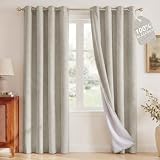
H.VERSAILTEX Linen Look 100% Blackout Curtains with White Backing, 52″W x 84″L, 2 Panels
Who it suits: Small rooms that are on show all day — a compact living room, a studio apartment, a small primary bedroom — where the curtain is the largest piece of décor in the room and has to earn that role.
Most blackout curtains announce themselves: flat, slightly shiny polyester that reads as a blackout curtain from across the room. In a small room there is no across-the-room distance to hide in, which is why this H.VERSAILTEX line ranks so high here. The face is a linen-look textured polyester, matte and slubbed like a woven natural fabric, and behind it sits a pure white blackout backing that does the light work — the listing describes a white flocking-style backing, which is also why the street side of the window shows a clean white rather than a patchwork of room colors, a detail landlords and homeowners’ associations both appreciate. The pair — two 52 x 84 inch panels, each with eight anti-rust grommets fitting rods up to 1.5 inches — check price on Amazon for the current price. It sits toward the top of this budget tier and earns its place there with the face fabric rather than the blackout layer, which matches the other lined picks in this guide.
The honest trade is care and crispness. A textured face shows creases from the package more than a flat one does, and it wants a cool steam rather than a fold-and-forget first week; judge it after steaming, not out of the bag — advice that matters doubly in a small room, where you are never more than a few feet from the fabric. The white backing, like every fused or flocked backing in this guide, is the vulnerable layer: wash cold and gentle, keep it out of a hot dryer, and do not iron the back. And a note on the brand’s own catalog, because it decides purchases: H.VERSAILTEX sells several curtain lines whose names differ by a word — some are this lined 100% construction, others are unlined room-darkening panels with a very different result. The white backing is the tell. If the listing you land on does not describe one, you are looking at a different, lesser curtain wearing a similar name.
- Linen-look textured face — the least “blackout curtain” looking pick in the guide.
- Pure white blackout backing: full darkness inside, a uniform white face to the street.
- Eight anti-rust grommets per panel, for rods up to 1.5 inches.
Honest limitation: It sits toward the top of this budget tier, a textured face that shows package creases until steamed, and a brand catalog full of similar names — confirm the white backing in the listing before ordering.
Choose it if the curtain will be seen all day at close range and looks matter as much as darkness. Skip it if the room is a spare or a rental and the premium face buys you nothing — the NICETOWN beige linen above does the same trick with a simpler finish.

NICETOWN Triple Weave Blackout Curtains, Sage Green, 52″W x 84″L, 2 Panels
Who it suits: Small rooms that need dimming rather than darkness — a compact living room fighting glare on a television, a guest corner, a studio that is three rooms in one — and anyone who wants the lightest, softest, least bulky pair on the window.
This is the classic Amazon blackout curtain, the one that built the category: a single panel of dense triple-weave polyester, black yarn woven between two colored layers, with no liner and no backing. NICETOWN’s own rating for the construction is 85 to 99 percent light blocking, and that range is the whole review in miniature — in a dark colorway against weak light it behaves like a blackout, and in a pale colorway against a west-facing afternoon it glows, visibly, because density and dye are doing work that only a layer can finish. The sage green pair linked here is the small-room compromise inside that trade: a mid-tone sits far closer to the darkening top of the range than a cream or white would, yet it does not pull the window wall toward you the way a charcoal or black pair does. Check price on Amazon for the current price. It comes as two panels at 52 x 84 inches, grommet top, and at a fifth of an inch thick in its packaging specs it is the lightest curtain in this guide — the softest drape, the slimmest stack when drawn open, and the easiest wash, going into a normal machine load without ceremony. In a small multi-use room, where one window’s curtains collect cooking smells and dust from the whole living space, that easy care is a practical feature and not a footnote.
None of that makes it a lesser product; it makes it a different one, and this guide’s honesty rule is that it be sold as what it is. For a small living room fighting glare, a guest nook that hosts three weekends a year, or a renter dimming a room they will leave in spring, a triple weave is the rational purchase and the lined picks above are money spent on darkness nobody in the room requires. For a night-shift nurse sleeping through July in a small bedroom, it is the wrong tool at any price, because the last five percent of light is exactly the five percent that matters at noon — and in a small room the bed is usually close enough to the window to receive that light undiluted. Color is a functional choice here, not just a decorative one: the darker the colorway, the closer to the top of that 85–99 range you land, which is why this pick is linked in sage rather than in one of the paler shades the same line offers.
- Unlined triple weave: the lightest weight, softest drape and slimmest stack-back in the guide.
- Sage mid-tone balances the trade — dark enough to dim seriously, light enough not to close the room in.
- An accessible pair from a major brand — check price on Amazon — with the easiest care in the guide.
Honest limitation: It is a room darkener at the pale end and a near-blackout only in dark colors in dim rooms. It will not give a day sleeper a dark noon, and no honest listing of it claims otherwise in the fine print.
Choose it if you need dimming, softness and easy washing in a small living or guest room. Skip it if you need to sleep in daylight — the lined beige linen at the top of this guide closes completely.

NICETOWN Full Blackout Curtains, 52″W x 84″L, 2 Panels
Who it suits: The small room that must go completely dark — a shift worker’s small bedroom, a nursery, a media nook — where darkness outranks every spaciousness trick in this guide.
Start with the benchmark. NICETOWN is the largest curtain brand on Amazon by a wide margin, and its Full Blackout line is a straightforward way into the construction that actually delivers on the word: a decorative face fabric backed by a dedicated blackout layer, rather than a single weave hoping density will do. That layered build is why this pair measures a half-inch thick in its packaging specs where the unlined triple-weave above measures a fifth of an inch — the extra material is the liner, and the liner is the product. Check price on Amazon for the current price. The pair is sold and shipped by NICETOWN itself, and it hangs from eight metal grommets per panel with the standard 1.6-inch inner diameter that fits rods up to about 1.5 inches. Because the blackout work is done by the backing rather than the dye, this line holds its darkness across its color range far better than a triple weave does — the black colorway linked here is the surest version, but the construction does not collapse when you choose a mid-tone the way an unlined curtain’s does, and in a small room that freedom is worth using: a mid-tone of this same line keeps nearly all of the performance with noticeably less visual weight. Check the current price on Amazon on the exact color you order, as prices vary by colorway.
The small-room costs are real, and the review would be dishonest without counting them. A lined pair is noticeably heavier than a triple-weave pair, and in a small room the rod often spans most of the wall it hangs on, so anchoring stops being a detail and becomes the whole installation: this pair wants a rod anchored into studs or proper wall anchors, not a tension rod’s optimism. The fabric also drapes with a stiffer, more formal fall that some people read as quality and some read as boardroom, and a dark colorway closed across the only window turns that wall into a dark slab that advances toward the bed — in a hundred square feet, you feel the difference between a wall that recedes and a wall that approaches. It is machine washable cold on the maker’s instructions for the line, but lined curtains reward gentle handling, because the backing is the part that suffers if you cook it in a hot dryer. None of this demotes the pick; it defines it. When the requirement is a dark room at noon, this is still the benchmark every other pick in the guide is measured against, and it does so while staying inside this budget tier.
- Lined full-blackout construction — a dedicated blackout layer, not a hopeful weave.
- Eight metal grommets per panel, 1.6-inch inner diameter for standard rods.
- Darkness holds up across colors because the backing, not the dye, blocks the light.
Honest limitation: It is heavy and comparatively stiff. Fit a sturdy, well-anchored rod, expect a formal drape rather than a soft one, and know that a dark colorway will visually shrink a small room while it is closed.
Choose it if total darkness is the requirement and the room is a small bedroom, nursery or theater nook. Skip it if you want the softest, lightest drape and only need dimming — that is the triple-weave pick above.
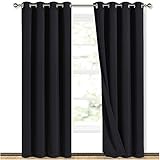
Deconovo 100% Blackout Curtains with Black Liner, 52″W x 84″L, 2 Panels
Who it suits: Buyers who want the most literal light barrier in the guide for a small room used as a cave on purpose — a media corner, an east-facing small bedroom — and who accept visual weight as the price of it.
Deconovo is NICETOWN’s closest rival in this category, and its 100% Blackout line takes the most direct approach of any pick here: the face fabric carries the color and the finish, and a black liner sewn in behind it does the blackout work. Black is the one backing color that absorbs rather than reflects, which is why this construction is the traditional answer for media rooms and for bedrooms facing east into a sunrise. The pair — two panels, each 52 x 84 inches, grommet-top — check price on Amazon for the current price in the United States. It sits near the top of this budget tier but inside it, and prices vary depending on colorway. Deconovo sells the same line in a wide spread of colors and lengths, so confirm the 52 x 84, two-panel configuration on the listing before you buy; the brand’s size grid is exactly where configuration mistakes happen, and a small window makes the shorter lengths in that grid worth a deliberate look rather than a default.
Two honest notes come with a black liner, and a small room sharpens both of them. The first is thermal: a black backing facing the glass absorbs heat on a summer afternoon, which is part of why these curtains insulate as well as they do, but it also means the liner lives a harder life than a white one, and the maker’s care instructions — gentle handling, no hot drying — deserve following rather than testing. In a small room there is less air between the curtain and the sleeper, so a heat-soaked liner on a July evening is not an abstract point. The second is aesthetic: hold a pale colorway of this line up to a bright window before the liner is in place and the face fabric alone would glow; the darkness you are buying lives entirely in that black layer, so inspect the stitching and the coverage of the liner when the pair arrives, because a liner that stops short of the hem or the edges leaks light in bright lines. This is also, plainly, the most visually committed pick in the guide: the backing shows black from the street, and a dark colorway of this line is the heaviest-looking window treatment here. Fitted on a rod that returns to the wall at both ends, it is as close to a sealed darkroom as this budget tier gets — buy it when the darkroom is the point.
- Sewn-in black liner — the most direct light barrier of any construction here.
- Grommet top with the standard fit for rods up to about 1.5 inches.
- Strong thermal behavior: the dark backing absorbs at the glass, winter and summer.
Honest limitation: The black liner absorbs heat and wants gentle care, the face fabric alone blocks little — the darkness is entirely the liner’s doing — and in a small room this is the option that closes the space in the most.
Choose it if you want maximum darkness and prefer a black liner’s physics to a white backing’s. Skip it if your window bakes in afternoon sun, or the room already feels close — take a white-backing pick above instead.

NICETOWN Star Blackout Curtains for Kids’ Rooms, 52″W x 84″L, 2 Panels
Who it suits: Parents furnishing a nursery or a child’s bedroom — usually the smallest room in the house — who want nap-time darkness with one deliberate, magical exception.
The last pick is the specialist, and small rooms are its natural habitat. This NICETOWN pair is a triple-weave blackout curtain — the same honest 85-to-99-percent construction as the value pick above — with star shapes die-cut out of the fabric, so that when the curtain is closed against daylight, the room goes dark and the stars appear as small points of light across the panel. It is the rare product whose headline feature is a controlled failure of its main job, and for its actual job that failure is the point: a toddler who naps in a room scattered with soft starlight is getting darkness where it matters and wonder where it does not. In a small child’s room the effect is concentrated rather than diluted — one window, one panel pair, and the whole room gets the constellation, with no projector to buy and no nightlight to leave on. The pair is two 52 x 84 inch panels in the Stormy Sea colorway with a grommet top — check price on Amazon for the current price in the United States. It sits above the plain triple weave in this tier, which reflects the die-cutting.
The limitations write themselves, and the review should state them rather than let a disappointed buyer discover them. Every star is a hole: this curtain cannot produce total darkness, it is wrong for a day sleeper of any age who needs the real thing, and the cut edges are the panel’s delicate points, so it wants the same gentle washing as its plainer sibling and no enthusiastic tugging from the small hands it is bought for. The effect also depends on light behind the curtain — on a north-facing window in winter the stars are faint, and on a bright south-facing window they are the show in the product photos. Buy it as what it is, a darkening curtain with a constellation built in, and it is the most-loved pick in this guide among the people it is actually for. Buy it as a blackout curtain that happens to have stars, and you have the relationship exactly backwards.
- Die-cut stars glow as pinpoints over a darkened room — a feature, deliberately.
- Triple-weave blackout base in a deep Stormy Sea colorway that darkens well.
- Full 52 x 84 inch pair with grommet top — check price on Amazon.
Honest limitation: The stars are holes. This curtain darkens; it cannot black out totally, and the cut edges want gentle handling and gentle washing.
Choose it if it is for a child’s room and nap-time dim with a little magic beats total darkness. Skip it if the room belongs to a day sleeper of any age — the lined NICETOWN further up this guide sits in a similar position in this tier and closes completely.

Comparison Table
| Product | Construction | Best use | Link |
|---|---|---|---|
| NICETOWN Beige Linen Blackout, Fused White Backing, 52″W x 84″L, 2 Panels | Fused white backing, grommet | Pale color with genuine blackout — check price on Amazon; keeps a small room feeling light | Check on Amazon |
| H.VERSAILTEX Linen Look Blackout, White Backing, 52″W x 84″L, 2 Panels | Fused white backing, grommet | A dressed linen face for the small room that is seen all day | Check on Amazon |
| NICETOWN Triple Weave Blackout, Sage Green, 52″W x 84″L, 2 Panels | Unlined triple weave, grommet | Light, soft dimming that adds no bulk to a small window | Check on Amazon |
| NICETOWN Full Blackout, 52″W x 84″L, 2 Panels | Lined blackout, grommet | Total darkness for a small bedroom or nursery | Check on Amazon |
| Deconovo 100% Blackout with Black Liner, 52″W x 84″L, 2 Panels | Sewn black liner, grommet | The most literal light barrier; a small media room used as a cave | Check on Amazon |
| NICETOWN Star Blackout Curtains, 52″W x 84″L, 2 Panels | Triple weave with die-cut stars, grommet | Nap-time darkness with starlight in a small kids’ room | Check on Amazon |
How to Choose Blackout Curtains for a Small Room Under $40
- Choose the drop before the color. Measure from where the rod will sit to the sill and to the floor. Most small windows are shorter than the standard the 84-inch default assumes, and a 63-inch drop that ends at the sill usually serves a small room better than fabric puddling past it. Every pick in this guide is compared in the 52 x 84 pair configuration as the standard; the same lines are sold in shorter drops, so check price on Amazon on the exact size you order.
- Mount high to borrow height. A rod placed four to six inches above the frame, or just below the ceiling, with fabric running from there, makes the eye read the whole wall as taller.
- Do the fullness math for a narrow window. Two 52-inch panels give 104 inches of flat fabric. On a small window of 36 to 48 inches, that is two to nearly three times fullness: deep folds, excellent edge sealing, and real visual bulk. One pair is plenty for a small window; a second pair is how a small window disappears under fabric entirely.
- Let construction free the color. In a lined or fused-backing curtain, the backing does the work, so beige, linen and white are safe choices that keep the room feeling open. In an unlined triple weave, color is performance — dark colors approach the maker’s 99% claim, pale colors sit near 85% and glow.
- Weigh visual bulk, not just fabric weight. Stiff lined drapes and dark colors advance the wall toward you; soft, light drapes recede. In a small room, pick the construction whose closed-curtain look you can live with all winter, not just its darkness rating.
- Check the grommet, not just the header name. Every pick here is grommet-top with a roughly 1.6-inch inner diameter, fitting rods up to about 1.5 inches. Measure your rod before ordering; a grommet that cannot pass the rod’s finial or bracket is a return waiting to happen.
- Plan for the light that leaks around, not through. In a small room the bed or desk is usually close to the window, so edge light lands where you are. A rod mounted close to the wall or ceiling, with returns at the ends, and panels that overlap in the middle, matter as much as the fabric.
- Anchor for the pair’s real weight. Lined curtains are heavy, and small-room rods often span most of the wall. Anchor into studs or proper anchors, and be suspicious of tension rods and adhesive mounts under a lined pair. Renters working around no-drill rules will find the renter-specific trade-offs ranked in Best Blackout Curtains For Apartments Under $40.
- Respect the backing in the wash. Liners, fused backings and flocked coatings all share one enemy: heat. Cold, gentle washing and low or line drying keep them intact; a hot dryer is how a good curtain becomes an expensive lesson.
The 63-Inch Question: Length, Mounting Height and the Small Window
The default 84-inch drop assumes a standard window on a standard eight-foot wall, and small rooms break both assumptions at once. Their windows are often shorter and narrower, and — the part the size charts never mention — their walls are fully employed. In a small room, furniture goes against the walls because there is nowhere else for it to go, which means the wall under the window is usually occupied: a radiator, a desk, the head of the bed. An 84-inch panel hung over that window does not float elegantly to the floor; it lands in the furniture, bunching behind the desk, resting on the radiator where heat and fabric are poor company, or pooling on a floor the room cannot spare. The 63-inch drop exists for exactly this geometry. It ends at or just below the sill, the lower wall stays visible, the room keeps its proportions, and the fabric stays off everything it should not touch. It is the correct size, and the 84-inch default is the misfit.
Mounting the rod just below the ceiling and running an unbroken column of fabric from there stretches the wall visually: the eye measures the room by its longest lines, and a curtain that starts at the ceiling makes the ceiling feel higher. There are two coherent ways to combine the levers. The tall strategy mounts high and lets the drop run long, ideally to the floor, for a small room whose under-window floor is clear. The airy strategy mounts high and uses the 63-inch sill drop, keeping the vertical line long above the window while leaving the wall below it bare and the furniture unmolested. Both beat the incoherent default — a rod hugging the top of the frame with 84-inch panels puddling at the bottom — which borrows no height and wastes the length. One caution belongs with both strategies: measure from the rod’s planned position, not from the window frame.
Dark Fabric, Small Room: The Trade — and How a Backing Cheats It
Dark colors absorb light and visually advance: a surface in charcoal or black reads as closer than the same surface in cream, because your eye judges distance partly by brightness. In a large room that effect is a decorating tool. In a small room it is a tax, because the window is the room’s depth cue — the bright rectangle your eye travels to — and covering it with a wall of near-black fabric, five feet wide and seven tall, brings the far point of the room to meet you. This is why the instinct to buy black curtains because the box says “blackout” backfires in small spaces: the room gets its darkness at noon and pays for it with a sense of enclosure at every other hour. Stepping up a tier does not repeal the trade, either. While researching this guide we checked the Sun Zero Nordic Theater Grade pair, a well-regarded heavy blackout curtain in this same 52 x 84 configuration, and it sits above this guide’s budget tier, and is a dark, heavy curtain besides.
The cheat available under $40 is construction. A lined or fused-backing curtain decouples the face color from the darkness: the opaque layer does the blocking, so the face can be beige linen or textured off-white and the window wall stays the lightest wall in the room even with the curtains fully closed. That is why the two pale lined pairs top this ranking, and why the same logic leads the rankings in Best Blackout Curtains For Modern Homes Under $40, where the visual result matters as much as the darkness. The unlined triple weave cannot cheat — its color is its mechanism — so its honest small-room play is the middle: a mid-tone like sage, dark enough to dim seriously, light enough not to advance the wall. And if the room’s job genuinely is darkness — a day sleeper, a projector — then take the trade knowingly with the lined benchmark or the black liner, mount high to win back height, and keep the rest of the room’s textiles light.
Common Buying Mistakes
- Ordering the default 84-inch drop for a short window, and living with panels puddled on the radiator, the desk or the floor.
- Choosing black because the box says “blackout” — turning a small room’s only window into a dark slab that advances the wall.
- Buying two pairs for a narrow window, and burying it under three times the fullness it can carry.
- Mounting the rod at frame height and forfeiting the one free upgrade a small room has: the taller-looking wall.
- Buying a pale triple-weave curtain for a day sleeper’s small bedroom, and discovering that 85% of a noon sun is still a bright room — especially with the bed two feet from the glass.
- Believing the word “blackout” on the box. Construction decides darkness; the word is marketing, and the same brand sells lined and unlined curtains under near-identical names.
- Hanging a heavy lined pair on a tension rod or adhesive hooks, and meeting it on the floor at 3 a.m.
- Choosing grommets without measuring the rod: a 1.6-inch grommet cannot pass every finial, bracket or thick decorative rod.
- Washing a lined or fused-backing curtain hot, or tumble-drying it hard, and cracking the backing that made it a blackout curtain.
- Judging a curtain’s color and creases in its first hour out of the package, before a steam and a day of hanging have done their work — in a small room you live at close range, so judge it at close range, after steaming.
Final Recommendation
- Most small rooms: NICETOWN Beige Linen Blackout Curtains with Fused White Backing.
- A small room that is seen all day: H.VERSAILTEX Linen Look 100% Blackout Curtains with White Backing.
- Dimming, softness and the least bulk: NICETOWN Triple Weave Blackout Curtains.
- Total darkness in a small bedroom or nursery: NICETOWN Full Blackout Curtains.
- The most literal light barrier: Deconovo 100% Blackout Curtains with Black Liner.
- A small child’s room that naps better with starlight: NICETOWN Star Blackout Curtains.
Our top two for small rooms are the NICETOWN beige linen — a lined construction wearing the pale face a small room needs, because its fused white backing makes a light color honest — and the NICETOWN Full Blackout, for the small room whose requirement is non-negotiable darkness and which can carry the weight, in both senses, of the benchmark lined pair. Between those poles, pick by the room’s real job: the H.VERSAILTEX where the curtain is the décor, the triple weave where dimming is genuinely enough and softness wins, the Deconovo where you want a black liner’s physics and accept the most closed-in look of the six, and the star curtain where the room’s occupant is four years old and the holes are the feature. Whatever you choose, do the two small-room things this guide keeps returning to: measure from the rod’s planned position and pick the drop the window actually wants — 63 inches for most small windows — and mount the rod high, so the curtain gives the room height instead of taking away its light. And if even this budget is more than the room needs, Best Blackout Curtains For Small Rooms Under $15 covers what the smallest budget honestly buys at this size of room. Check price on Amazon on the exact size and colorway, as prices vary with both, and order the construction that matches the darkness you actually need.
Frequently Asked Questions
What length blackout curtains work best in a small room?
For most small windows, a 63-inch drop. Small windows are usually shorter than the standard the 84-inch default assumes, and the wall beneath them usually holds furniture — a radiator, a desk, the bed — that a long panel would land in. A 63-inch panel ends at or just below the sill and keeps the lower wall visible, which helps the room read as bigger. Choose the 84-inch drop only when you are deliberately running the curtain to the floor as a height trick and the floor under the window is clear.
Will blackout curtains make my small room look smaller?
Dark, heavy ones can. A near-black pair closed across the only window turns the room’s brightest surface into its darkest, and dark surfaces read as closer than pale ones. The fix is construction, not compromise: a lined or fused-backing curtain blocks light with an opaque layer, so its face can be beige, linen or white and still black the room out fully. An unlined triple weave cannot separate the two — its color is part of its performance — so in a small room choose its mid-tones rather than its darkest or palest shades.
How high should I hang blackout curtains in a small room?
As high as the room allows: four to six inches above the window frame, or just below the ceiling. What matters is that the drop ends cleanly from that height, at the sill or at the floor.
Is one pair of blackout curtains enough for a small window?
Yes — usually it is more than enough. The pair this guide compares carries 104 inches of fabric, and curtains need one and a half to two times the window’s width to gather properly and seal the edges. On a small window of 36 to 48 inches, one pair delivers two to nearly three times fullness: deep folds and well-sealed edges. Do not stretch the pair flat to make it look wider, and do not buy a second pair — on a small window the extra fabric is bulk, not darkness.
Which blackout curtain is best for a small bedroom that needs real darkness?
A lined one with a pale face — in this guide, the NICETOWN beige linen pair. The fused white backing blocks the light completely, and the light beige face keeps the small room from feeling closed in while the curtains are drawn, which in a bedroom is most of the night and much of the morning. If the room faces east or the sleeper works nights and wants the most literal barrier available, the Deconovo’s sewn-in black liner is the step up — accept its heat absorption and its darker street-side look as the trade-off.
Grommet or rod pocket: which should I choose for a small room?
Every pick in this guide is grommet-top, and for curtains you open and close daily that is the right default: grommets glide, fold the fabric into even waves, and fit any standard rod up to about 1.5 inches. Rod pockets sit closer to the wall, which leaks slightly less light at the top, and suit curtains that mostly stay closed. If easy daily sliding matters, grommets; if the curtain is a near-permanent cover, a pocket is fine.