Where to buy
Check the latest price, availability and delivery on Amazon. Orders are placed on Amazon. We may earn a commission from qualifying purchases.
- Best overall for bedrooms: NICETOWN Full Blackout Curtains, 52″W x 84″L, 2 Panels — Check on Amazon
- Deconovo 100% Blackout Curtains with Black Liner, 52″W x 84″L, 2 Panels — Check on Amazon
- H.VERSAILTEX Linen Look 100% Blackout Curtains with White Backing, 52″W x 84″L, 2 Panels — Check on Amazon
- NICETOWN Beige Linen Blackout Curtains with Fused White Backing, 52″W x 84″L, 2 Panels — Check on Amazon
See 2 more Amazon options
- NICETOWN Triple Weave Blackout Curtains, Sage Green, 52″W x 84″L, 2 Panels — Check on Amazon
- NICETOWN Star Blackout Curtains for Kids’ Rooms, 52″W x 84″L, 2 Panels — Check on Amazon
Read the full guide ↓
Disclosure: As an Amazon Associate, dailyhomedecorating.com earns from qualifying purchases. Links to Amazon on this page are affiliate links; they cost you nothing extra. Listing details such as price and availability change often, so check the current Amazon listing before you buy.
A bedroom is the one room where a blackout curtain is not a decoration with a side benefit — it is sleep equipment. The difference between a room that is dim and a room that is dark sounds like a nuance until you are the person lying in it at noon: a nurse coming off a night shift, a toddler whose nap decides the whole household’s evening, a light sleeper whose east-facing window turns sunrise into an alarm clock nobody set. Human sleep is light-sensitive in a way living-room viewing is not. A television tolerates glare; a circadian system does not, and even modest light leaking into a sleeping room can pull sleep shallower without ever fully waking you, which is why the standard for this guide is stricter than for any other room in the house: in a bedroom, the last few percent of light are not a rounding error, they are the product.
That standard changes how the same $40 should be spent, and this guide spends it differently from the general roundup. “Blackout” is an unregulated word, and under $40 it covers three very different constructions: lined panels with a dedicated opaque layer that blocks 100% of light through the fabric, fused-backing panels where that layer is bonded to a decorative face, and unlined triple-weave panels whose own makers rate them at 85 to 99 percent — excellent dimmers that glow, faintly or frankly, against a bright day. In a living room the triple weave is often the smart buy. In a bedroom it is a compromise you should make knowingly, for a guest room or a heavy sleeper, not by accident because the box said blackout. Every pick below is considered as a pair of two 52 x 84 inch panels, the standard bedroom configuration, because a curtain comparison means nothing until the size and panel count are pinned down. Four of the six are lined or fused constructions that genuinely close. The other two are here with their limits stated in plain language, because bedrooms include nurseries and guest rooms too.
For most bedrooms we would start with the NICETOWN Full Blackout pair: it is a lined construction positioned toward the more accessible end of this tier from the brand that dominates this category — check price on Amazon, and a liner — not a dense weave — is what total darkness is made of. If your bedroom faces east or your sleep happens in daylight, the Deconovo’s sewn-in black liner is the most literal barrier in the guide. If the primary bedroom has to look like a bedroom and not a media room, two linen-faced picks hide their backings completely. And because fabric is only half of a dark bedroom, this guide spends real time on the other half: the light that leaks around a perfect panel, and the mounting — high, wide and close to the wall — that stops it. Below you will find a quick picks table, detailed notes on all six curtains written for sleep first, a comparison table, a buying checklist, a section on sealing the edges, the mistakes bedroom buyers make at this price, and answers to the questions that come up again and again.
Quick Picks
Short on time, or comparing several options at once? Each row below names the sleeper or bedroom the pick suits, with a link to the listing. All six are pairs of two 52 x 84 inch panels — check the current price on Amazon for the exact configuration.
| Buyer type | Pick | Why it stands out | Link |
|---|---|---|---|
| Best overall for bedrooms | NICETOWN Full Blackout Curtains, 52″W x 84″L, 2 Panels | A lined, true-blackout construction — total darkness; check price on Amazon | Check on Amazon |
| Best for day sleepers | Deconovo 100% Blackout Curtains with Black Liner, 52″W x 84″L, 2 Panels | A sewn-in black liner that absorbs light at the glass — built for sleeping through daylight | Check on Amazon |
| Best for a primary bedroom | H.VERSAILTEX Linen Look 100% Blackout Curtains, White Backing, 52″W x 84″L, 2 Panels | A textured linen face over a white blackout backing — darkness that does not look like it | Check on Amazon |
| Best pale color for sleep | NICETOWN Beige Linen Blackout Curtains, Fused White Backing, 52″W x 84″L, 2 Panels | A warm beige face that still blacks out fully, because the backing does the work | Check on Amazon |
| Best for guest bedrooms | NICETOWN Triple Weave Blackout Curtains, Sage Green, 52″W x 84″L, 2 Panels | An unlined 85–99% darkener — honest dimming for occasional sleepers; check price on Amazon | Check on Amazon |
| Best for kids’ bedrooms | NICETOWN Star Blackout Curtains, 52″W x 84″L, 2 Panels | Die-cut stars glow as pinpoints over a darkened room — nap darkness with one exception | Check on Amazon |
How These Picks Were Chosen
The first filter was the budget, applied to one fixed configuration so the comparison means something. Every pick below was considered as a pair of two panels, each 52 inches wide by 84 inches long — the standard bedroom pairing — on Amazon.com in the United States, within this guide’s under $40 budget framing. Listings change with size, colorway and panel count, and listings that look like a bargain are routinely a single panel or a 63-inch drop; anything not verified as a full 52 x 84 pair in this tier was left out. Check the current price on Amazon before you buy.
The second filter was the bedroom standard, and it is stricter than the one we would apply to a living room. We ranked constructions by what they do to a sleeping room at the worst hour, not the average one: lined and fused-backing panels first, because a dedicated opaque layer blocks 100% of light through the fabric in any face color; unlined triple weave last and labeled as what its own maker says it is — an 85 to 99 percent darkener whose result depends on the colorway and the brightness outside. We did not hang these curtains ourselves. We read the maker listings and specification pages, compared constructions and header styles, cross-checked constructions, and weighted what is physically layered between the sleeper and the glass over the percentage printed on the box, because in this category the headline numbers are maker figures and the same brand quotes different numbers on different listings.
One more thing decided the ranking, and it is specific to bedrooms: the fabric is only the middle of the window. Light also enters over the top of the rod, around the sides and through the center gap, and a bedroom buyer who spends the whole budget on fabric and nothing on mounting ends up with a blackout curtain in a room that still glows at the edges. So the reviews below judge each pick partly on how it behaves in a real bedroom installation — its weight on the rod, its stiffness against the wall, how it meets its partner panel in the middle — and the fitting sections that follow the reviews are written for sleep, not for show. If you are comparing this guide with the general tier roundup, Best Blackout Curtains Under $40 ranks the same six constructions across every room; here they are ranked for one room only.
The 6 Best Blackout Curtains for Bedrooms Under $40
NICETOWN Full Blackout Curtains, 52″W x 84″L, 2 Panels
Who it suits: Anyone whose bedroom has to go properly dark — light sleepers, parents of early risers, and every bedroom that faces a streetlight or an eastern sunrise.
This is the benchmark bedroom pick because it is built the way darkness is actually built: a decorative face fabric with a dedicated blackout layer behind it, instead of a single weave hoping density will do. NICETOWN is the largest curtain brand on Amazon, and its Full Blackout line is a lined construction positioned toward the more accessible end of this tier — check price on Amazon — sold and shipped by NICETOWN itself. In its packaging specs the pair measures a half-inch thick where an unlined triple weave measures a fifth of an inch, and that extra material is not padding; it is the liner, and the liner is the reason this curtain closes a room rather than dimming it. It hangs from eight metal grommets per panel with the standard 1.6-inch inner diameter, fitting rods up to about 1.5 inches.
For sleep, the property that matters most is the one shoppers rarely think about: because the backing blocks the light, the face color does not decide the darkness. An unlined curtain in a pale colorway is a lampshade; this one in a mid-tone performs like this one in black, so a bedroom can be both light in palette and dark at 6 a.m. The weight that comes with a lined build matters in a bedroom specifically, because bedroom rods are often the afterthought kind — a slim rod on two small brackets, sometimes a tension rod inside the frame. A lined pair wants anchors into studs or proper wall plugs, and it drapes with a stiffer, more formal fall that stays where it is hung, which in a bedroom is a virtue: panels that hold their position hold their overlap in the middle, and the center gap stays closed through the night instead of drifting open with the heating cycle. It is machine washable cold on the maker’s instructions, but treat the backing gently — cold, gentle, no hot dryer — because the layer that makes it a blackout curtain is the layer heat damages. Hung on a rod mounted high and wide, this pair gives a bedroom total fabric darkness while leaving room in the $40 budget for the mounting hardware that finishes the job.
- Lined full-blackout construction — a dedicated opaque layer, not a hopeful weave.
- Darkness is independent of face color, because the backing does the work.
- Eight metal grommets per panel, 1.6-inch inner diameter for standard rods.
Honest limitation: It is heavy and comparatively stiff. It needs a well-anchored rod rather than a tension rod, and the backing wants cold, gentle washing for its whole life.
Choose it if your bedroom must be dark at any hour and you want the surest lined construction in this tier — check price on Amazon. Skip it if the room is a guest bedroom used a few weekends a year — the triple-weave pick below dims it honestly and sits lower in the tier.
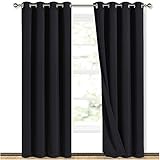
Deconovo 100% Blackout Curtains with Black Liner, 52″W x 84″L, 2 Panels
Who it suits: Night-shift workers, day sleepers, and anyone whose bedroom window faces sunrise, a streetlight or a neighbor’s security floodlight.
If the NICETOWN above is the benchmark, this Deconovo is the specialist, and its specialty is the hardest sleeping condition there is: full daylight on the other side of the glass. The construction explains why. Where a white backing reflects light back toward the window, this line sews a black liner in behind the face fabric, and black absorbs — the liner is the most literal light barrier in this guide, the one that behaves most like a wall. Deconovo is NICETOWN’s closest rival in the category, and the pair — two grommet-top panels, each 52 x 84 inches — sits near the top of this budget tier, depending on colorway — check price on Amazon — and is worth considering for the sleeper it serves. The brand sells the line in a wide spread of colors and lengths, so confirm the 52 x 84, two-panel configuration on the listing before you order; its size grid is exactly where configuration mistakes happen.
Two honest notes belong in a bedroom review of a black liner. The first is heat: a black layer facing the glass absorbs a summer afternoon, which makes these curtains strong insulators in winter and a warm window treatment in July — for a day sleeper that trade is usually worth it, since the same absorption is what kills the light, but a west-facing bedroom that already bakes should know the liner adds to it. The second is inspection. The face fabric alone blocks very little; the darkness lives entirely in the liner, so when the pair arrives, hold it up and check that the liner runs fully to the hem and both edges. A liner that stops short leaks light in bright lines — and in a bedroom, a bright line at eye level across a pillow is worse than a general glow, because it lands in one place all night. Fitted on a rod that returns to the wall, with the liner verified to the edges, this is the closest thing to a sealed darkroom in this tier, and the pick we would hand a nurse, a baker or a new parent whose sleep happens while the sun is up.
- Sewn-in black liner — absorbs light at the glass rather than reflecting it.
- The strongest construction here for daylight sleeping and east-facing rooms.
- Grommet top with the standard fit for rods up to about 1.5 inches.
Honest limitation: The black liner absorbs heat on sunlit glass and wants gentle care, and the face fabric contributes almost nothing — the liner’s coverage to the edges is the whole product, so check it on arrival.
Choose it if you sleep in daylight or your window faces sunrise or a streetlight. Skip it if your bedroom already overheats in afternoon sun and a heat-absorbing layer worries you — the NICETOWN full blackout above runs a white-backed construction instead.

H.VERSAILTEX Linen Look 100% Blackout Curtains with White Backing, 52″W x 84″L, 2 Panels
Who it suits: Primary-bedroom decorators who want the room to look soft, textured and grown-up at 2 p.m. — and cave-dark at 2 a.m.
The primary bedroom is the hardest room in the house to buy a blackout curtain for, because it is the one bedroom that is also on show: it is where the curtain is looked at all day, by the people who sleep behind it. Most blackout curtains announce themselves with flat, slightly shiny polyester. This H.VERSAILTEX line is the pick that does not. Its face is a linen-look textured polyester, matte and slubbed like woven natural fabric, and behind it sits a pure white blackout backing — described in the listing as a white flocking-style backing — that does all the light work. The pair, two 52 x 84 inch panels with eight anti-rust grommets each fitting rods up to 1.5 inches, sits at the top of this budget tier — check price on Amazon — with the emphasis on the face rather than the mechanism, and it matches the lined picks above for darkness.
The white backing earns a specific mention for bedrooms in houses where the window’s street side matters: from outside, the window shows a clean, uniform white rather than a patchwork of room colors, which landlords and homeowners’ associations both tend to require and which pale, coordinated bedrooms tend to want. The honest costs are care and first impressions. A textured face shows package creases more than a flat one, and it wants a cool steam and a day of hanging before you judge it — out of the bag is not the product. The flocked backing is the vulnerable layer, as every fused or flocked backing is: wash cold and gentle, keep it out of a hot dryer, never iron the back. And one warning that decides real purchases: H.VERSAILTEX sells several lines whose names differ by a word, and some of them are unlined room-darkening panels with a completely different result in a bedroom. The white backing is the tell — if the listing you land on does not describe one, you are looking at a lesser curtain wearing a similar name. In a smaller primary bedroom, where the window fills more of the wall and the face matters even more, Best Blackout Curtains For Small Rooms Under $40 weighs this same pick against the compact-room alternatives.
- Linen-look textured face — the least “blackout curtain” looking pick in the guide.
- Pure white blackout backing: full darkness inside, a uniform white face to the street.
- Eight anti-rust grommets per panel, for rods up to 1.5 inches.
Honest limitation: Positioned at the top of this budget tier, a textured face that shows creases until steamed, and a catalog of near-identical names — confirm the white backing in the listing before ordering.
Choose it if the bedroom is a primary bedroom that is seen all day and looks matter as much as darkness. Skip it if the room is a spare or a rental — the NICETOWN linen below performs the same trick at a lower position in the tier.

NICETOWN Beige Linen Blackout Curtains with Fused White Backing, 52″W x 84″L, 2 Panels
Who it suits: Sleepers in pale, warm, neutral bedrooms who have been told — correctly, about lesser curtains — that a light color cannot black out a room.
In a bedroom, that warning usually wins, and people end up sleeping behind dark, heavy-looking curtains they never wanted because they believed darkness required them. This NICETOWN line is the counterexample, and the mechanism is worth understanding because it frees the whole room’s palette. A pale curtain fails as a blackout when the face fabric is the only barrier, since light passes through light dye. Here the beige linen-look face is fused to a white blackout backing — the listing calls it a safe fused white backing — so the backing blocks the light and the face is released from duty: it only has to look good. The result is a warm beige pair with a casual woven texture that blacks out like a dark lined curtain, and it sits toward the more accessible end of this tier among the lined constructions in this guide — check price on Amazon — and it is the one that lets a bright, calm bedroom stay bright and calm in daylight hours and go fully dark at night.
Why does it sit lower in the tier than the H.VERSAILTEX above, and what do you give up? Finish, mostly: the texture convinces at conversational distance and simplifies up close, the drape is a little stiffer, and the color range is narrower. What you keep is the mechanism — fused white backing, full blackout claim, grommet header, the same NICETOWN size grid, which means the same advice: confirm the 52 x 84 two-panel configuration on the listing, because this brand sells every dimension a window can have. The care note is the one fused constructions always carry, and in a bedroom it is worth stating plainly: the bond between face and backing is the product, and heat is its enemy. Cold gentle washing, no hot dryer, no iron on the back. A fused panel cooked in a hot wash can bubble or separate in a way a sewn liner never will, so this is the pick for households that already wash gently — and the wrong pick for households that wash everything hot, who should take a sewn liner above. Renters furnishing a bedroom in a unit they cannot modify should also see how this construction ranks when drilling is off the table in Best Blackout Curtains For Apartments Under $40.
- Fused white backing behind a pale beige face — real blackout in a light color.
- Linen-look texture, positioned toward the accessible end of the tier among the lined pairs in this guide — check price on Amazon.
- Grommet top, two 52 x 84 inch panels, from NICETOWN’s full size grid.
Honest limitation: The fused bond is heat-sensitive: a hot wash or dryer can bubble or separate the backing, and the face texture is simpler up close than the premium linen above.
Choose it if your bedroom is decorated in pale neutrals and you refuse to choose between the palette and the darkness. Skip it if your household washes hot and dries hotter — take a sewn liner instead, either of the first two picks.
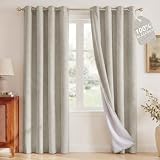
NICETOWN Triple Weave Blackout Curtains, Sage Green, 52″W x 84″L, 2 Panels
Who it suits: Guest bedrooms, heavy sleepers, and bedrooms where the goal is a darker, calmer room rather than a sealed one.
Every guide needs one pick that tells the truth about itself, and this is it. This NICETOWN pair is a single fabric of dense triple-weave polyester — black yarn woven between two colored layers — with no liner and no backing. Its maker rates the construction at 85 to 99 percent light blocking, and that range, honestly read, is the review: in a dark colorway on a shaded window it behaves almost like a blackout, and in a pale colorway against a bright morning it glows, because density and dye are doing work that only an opaque layer can finish. The sage green pair linked here — check price on Amazon — is two panels at 52 x 84 inches, grommet top, and at a fifth of an inch thick in its specs it is the lightest, softest-draping, easiest-washing curtain in this guide — it goes in a normal machine load, hangs dry, and asks nothing of its rod.
Placed in the right bedroom, those are real virtues. A guest bedroom hosts sleepers for a few nights at a time, usually at night, and what it needs is a room that feels dark, private and finished — which a triple weave delivers at the lower end of this tier from a major brand. A heavy sleeper in a north-facing room may never meet the conditions under which it glows. But this guide’s bedroom standard requires the limit to be stated where it bites: for a light sleeper, a day sleeper or a child who wakes with the sun, the missing percentage is exactly the percentage that matters, and no mounting trick fixes light coming through the fabric itself. Color is a functional decision with this construction — the darker the colorway, the nearer the top of that 85–99 range — which is why the pick is linked in a mid-tone sage rather than a cream. If your bedroom budget is tighter than your darkness requirement, note that the lined picks above sit higher in the tier; and if the room only ever needs dimming, this is the rational purchase.
- Unlined triple weave: the softest drape and easiest care in the guide.
- Maker-rated 85–99% light blocking — darkness depends on color, darker is darker.
- Positioned at the lower end of this tier for the pair, from a major brand — check price on Amazon.
Honest limitation: It is a room darkener. In a pale colorway or a bright room it glows, and it will not give a light sleeper or a day sleeper a dark noon at any mounting quality.
Choose it if the bedroom is a guest room, or the sleeper is a heavy one, and dimming plus softness beats total darkness. Skip it if anyone sleeping in the room is woken by light — the lined NICETOWN at the top of this guide sits a step higher in the tier and closes completely.

NICETOWN Star Blackout Curtains for Kids’ Rooms, 52″W x 84″L, 2 Panels
Who it suits: Parents of toddlers and young children, furnishing a nursery or a kid’s bedroom where nap darkness matters and a little wonder matters too.
The last pick belongs to the youngest sleepers, and it is the most honest product in the guide about what it is. This NICETOWN pair is a triple-weave blackout curtain — the same 85-to-99-percent construction as the value pick above, in a deep Stormy Sea colorway that sits at the dark, effective end of that range — with star shapes die-cut through the fabric. Close it against daylight and the room goes dark while the stars appear as small points of light across the panel. It is a controlled, deliberate failure of total blackout, and for its actual job that failure is the design: a child who naps in a room scattered with soft starlight is getting darkness where it counts — across the bed, at eye level, in the middle of the day — and a ceiling’s worth of magic that makes the darkened room somewhere a small person wants to be. The pair, two 52 x 84 inch panels with a grommet top, sits in the middle of this tier — check price on Amazon — above the plain triple weave, reflecting the die-cutting.
The limitations are structural, and a bedroom review should state them rather than let a tired parent discover them at nap time. Every star is a hole, so this curtain cannot produce total darkness: it is wrong for a baby whose sleep is fragile in bright rooms if the stars land over the crib, and it is wrong for any day sleeper who needs the real thing. Position matters — hang it so the star field falls away from the pillow, and pair it with the mounting advice in the fitting section below, because edge leaks plus star holes add up. The cut edges are also the panel’s delicate points, so it wants gentle washing and no enthusiastic tugging from the small hands it was bought for. The effect depends on light behind the curtain: on a bright window the stars are the show in the product photos, and on a dim north-facing window they are faint. Buy it as a darkening curtain with a constellation built in, for a child who will love it, and it earns its place. For a nursery where the budget has to be smaller still, Best Blackout Curtains For Bedrooms Under $15 covers what the lowest tier can and cannot do for a sleeping child.
- Die-cut stars glow as pinpoints over a darkened room — a feature, deliberately.
- Triple-weave blackout base in a deep Stormy Sea colorway that darkens well.
- Full 52 x 84 inch pair with grommet top — check price on Amazon.
Honest limitation: The stars are holes. This curtain darkens a child’s room beautifully and cannot black it out totally, and the cut edges want gentle handling and gentle washing.
Choose it if it is for a child’s bedroom and nap-time dim with a little magic beats a sealed room. Skip it if the room belongs to a day sleeper of any age — the lined NICETOWN at the top of this guide sits in a similar position in the tier and closes completely.

Comparison Table
| Product | Construction | Best use | Link |
|---|---|---|---|
| NICETOWN Full Blackout, 52″W x 84″L, 2 Panels | Lined blackout, grommet | Total fabric darkness for most bedrooms | Check on Amazon |
| Deconovo 100% Blackout with Black Liner, 52″W x 84″L, 2 Panels | Sewn black liner, grommet | Day sleepers and east-facing bedrooms | Check on Amazon |
| H.VERSAILTEX Linen Look Blackout, White Backing, 52″W x 84″L, 2 Panels | Fused white backing, grommet | A primary bedroom that is seen all day | Check on Amazon |
| NICETOWN Beige Linen Blackout, Fused White Backing, 52″W x 84″L, 2 Panels | Fused white backing, grommet | Pale bedrooms that still need full blackout | Check on Amazon |
| NICETOWN Triple Weave Blackout, Sage Green, 52″W x 84″L, 2 Panels | Unlined triple weave, grommet | Guest bedrooms and heavy sleepers | Check on Amazon |
| NICETOWN Star Blackout Curtains, 52″W x 84″L, 2 Panels | Triple weave with die-cut stars, grommet | Kids’ bedrooms and nurseries at nap time | Check on Amazon |
How to Choose Blackout Curtains for a Bedroom
- Start with the sleeper, not the window. A night-shift worker, a light sleeper or a baby needs a lined or fused-backing construction — the only builds that block 100% through the fabric. A heavy sleeper or a guest room can honestly take a triple weave instead.
- Fix the configuration, then compare. Every pick in this guide is considered as a pair of two 52 x 84 inch panels. A listing that looks like a bargain is often one panel, a shorter drop or a narrower width. Confirm panel count, width and length on the exact option you are ordering, and check the current price on Amazon.
- Do the fullness math. Two 52-inch panels give 104 inches of flat fabric. Curtains need 1.5 to 2 times the window’s width to gather properly and to seal the sides, so one pair honestly covers a window up to about 52–69 inches wide. A wider bedroom window needs a second pair, not a stretched one.
- Match color freedom to construction. In a lined or fused-backing curtain, color is free — the backing does the work, so beige and white sleep as dark as black. In an unlined triple weave, color is performance: dark colorways approach the maker’s 99% figure, pale ones sit near 85%.
- Budget for the mounting, not just the fabric. A rod mounted high, wide and close to the wall — or one that wraps back to the wall at the ends — recovers more darkness in a bedroom than any fabric upgrade. Set aside part of the $40 budget for exactly that.
- Check the grommet against your rod. Every pick here is grommet-top with a roughly 1.6-inch inner diameter, fitting rods up to about 1.5 inches. Measure the rod and its finials before ordering.
- Weigh the pair before you hang it. Lined curtains are heavy, and bedroom rods are often the weakest in the house. Anchor into studs or proper wall plugs, and do not trust a tension rod under a lined pair.
- Respect the backing in the wash. Liners, fused backings and flocked coatings share one enemy: heat. Cold, gentle washing and low or line drying keep them intact for years; one hot dryer cycle can end a blackout curtain’s career.
- Plan the center meeting. Two panels that merely touch will drift apart overnight. Overlap them by a few inches, or add the magnetic weights or clips sold for exactly this, so the seal is still closed at 4 a.m.
The Light That Leaks Around: Sealing a Bedroom Window
Here is the fact that decides whether a blackout bedroom works, and it is not about fabric: a perfect panel on an ordinary rod still leaks. Light enters a sleeping room through four gaps that no curtain construction can close by itself — over the top of the rod, down both sides where the panel stands off the wall, and through the center where the two panels meet. A standard bracket holds a curtain three or more inches out from the glass, and daylight treats that gap like an open door: it pours over the top, strikes the ceiling, and reflects down into the room as a general glow that can be brighter, at pillow level, than the light an unlined curtain lets through its weave. This is why some buyers hang a genuinely lined pair, stand back at noon, and conclude blackout curtains do not work. The fabric worked. The installation leaked.
The fixes are cheap, and in a bedroom they are worth more than a tier upgrade. Mount the rod as high as the wall allows — a few inches above the frame, near the ceiling if the room permits — so the panel’s top edge rises above the glass and the over-the-top leak has no line of sight into the room. Mount it wide, extending several inches past the frame on both sides, so the panel’s edges cover wall rather than ending at the glass line. Bring the curtain close to the wall: a wrap-around rod that curves back and returns to the wall at both ends seals the sides almost completely, and it is the single most effective hardware change a bedroom can make. Overlap the panels in the middle by a few inches rather than letting them kiss. And if one gap survives all of that — usually the top, on a rod that cannot move — a strip of dark fabric or a simple valance over the rod closes it. Do these things and the lined picks in this guide produce a room that is dark in fact, not just in fabric. Skip them and the best curtain under $40 will underperform a mediocre one that was mounted tight. Sleep is the one use case where the edges are not a detail.
Lined 100% or Triple-Weave 85–99%: The Bedroom Difference
Because the word “blackout” is unregulated, bedroom shoppers have to buy by construction, and under $40 there are three. The lined curtain — a face fabric with a separate blackout layer behind it, represented here by the NICETOWN Full Blackout and the Deconovo’s sewn black liner — is the only construction that blocks 100% of light through the fabric, in any face color, at any hour. The fused backing — a blackout layer bonded to the back of a decorative face, as in the H.VERSAILTEX linen and the NICETOWN beige linen — works on the same physics, lets the face be pale or textured, and carries one weakness: the bond, which heat and rough washing can crack or separate over time. The unlined triple weave — three layers of yarn woven as one fabric around a black core thread, as in the sage value pick and the star curtain — has no opaque layer at all. It darkens by density and dye, its maker rates it at 85 to 99 percent, and both ends of that range are real: the top end in a dark colorway on a dull day, the bottom end in a pale colorway against a bright one.
In most rooms that range is a footnote. In a bedroom it is the whole decision, because of when the missing percent arrives. Fifteen percent of a grey Tuesday is a dim room. Fifteen percent of a June sunrise, delivered at 5:40 a.m. directly onto a bed, is a wake-up call — and the sleeper never gets to choose which morning tests the curtain. That asymmetry is why this guide ranks two honest darkeners fifth and sixth rather than pretending the range is a rounding error, and why the step up in the tier matters so little here: the lined construction that closes completely sits above the triple weave that almost does. For a guest room, almost is a fair trade for a softer drape and easier washing. For the room where you, a partner, a shift worker or a small child actually sleep, that step up buys the only percent that was ever the point. Bedrooms decorated in a contemporary style, where a lined panel’s formal drape can fight the room, will find the same constructions weighed for looks as well as darkness in Best Blackout Curtains For Modern Homes Under $40.
Will a 52 x 84 Pair Fit Your Bedroom Window?
The configuration this guide uses — two panels, each 52 inches wide by 84 inches long — is the standard bedroom pairing, and it fits the standard bedroom window well. Width is decided by fullness: gathered at one and a half to two times the window’s width, the pair’s 104 inches of fabric serves a window roughly 52 to 69 inches wide. Bedroom windows are usually narrower than living-room glass, which is why one pair per window is the norm here — but measure, because a wide picture window in a primary bedroom needs a second pair, and a pair stretched flat to cover it leaks at both sides while looking starved. Length is decided by the rod, not the window: an 84-inch panel on a rod mounted four to six inches above the frame — where the sealing advice in this guide wants it — lands near the floor on a standard eight-foot wall, clears a baseboard heater, and stays out of the dust zone that a puddling panel collects in a room where air quality matters to sleep.
Two bedroom-specific fitting checks finish the job. The first is the bed’s position: if the bed sits under or beside the window, check where the panel’s bottom edge and its side gaps fall relative to the pillow, because a leak that lands on a wall is ambience and a leak that lands on a face is a defect. The second is what else the window wall holds — a radiator under the glass argues for a shorter drop or a panel hemmed clear of it, since a lined curtain draped over a heat source works against the room in winter and ages the backing early. Five minutes with a tape measure, taken from where the rod will actually sit, settles the width, the drop and the mounting in one pass.
Common Buying Mistakes
- Believing the word “blackout” on the box. Construction decides darkness; the word is marketing, and the same brand sells lined and unlined curtains under near-identical names.
- Buying a pale triple-weave curtain for a light sleeper’s bedroom, and discovering that 85% of a June sunrise is still a bright room at 5:40 a.m.
- Spending the whole budget on fabric and nothing on mounting, then blaming the curtain for light that was always coming around it, not through it.
- Ordering a single panel, a 63-inch drop or a 42-inch width because the price looked lower — then covering half the bedroom window at a bargain.
- Stretching one pair flat across a wide primary-bedroom window instead of buying the second pair the fullness math requires.
- Hanging a heavy lined pair on a tension rod or adhesive hooks, and meeting it on the floor at 3 a.m.
- Washing a lined or fused-backing curtain hot, or tumble-drying it hard, and cracking the backing that made it a blackout curtain.
- Letting the two panels merely touch in the middle, so the seal drifts open overnight with every heating cycle.
- Judging a curtain’s darkness at the shop-hour moment of hanging it, rather than at dawn — the hour a bedroom curtain is actually for.
- Forgetting the street side: some landlords and associations require a white or neutral backing facing out, which is a construction choice, not an afterthought.
Final Recommendation
- Most bedrooms that must go dark: NICETOWN Full Blackout Curtains, 52″W x 84″L, 2 Panels.
- Day sleepers and sunrise-facing rooms: Deconovo 100% Blackout Curtains with Black Liner.
- A primary bedroom on show all day: H.VERSAILTEX Linen Look 100% Blackout Curtains with White Backing.
- Pale palette, genuine blackout, accessible lined option: NICETOWN Beige Linen Blackout Curtains with Fused White Backing.
- Guest bedrooms and heavy sleepers: NICETOWN Triple Weave Blackout Curtains.
- A child’s bedroom at nap time: NICETOWN Star Blackout Curtains.
Our top two for bedrooms are the NICETOWN Full Blackout for anyone whose requirement is a dark room at any hour — it is a lined construction positioned toward the accessible end of the tier from the brand that owns this category — check price on Amazon — and the liner is the whole game — and the Deconovo for the sleepers the sun works hardest against, because its black liner absorbs at the glass in a way no white backing quite matches. Between those poles, choose by the room’s double life: the H.VERSAILTEX where the bedroom is seen all day and the face has to earn its place, the beige NICETOWN linen where the palette is pale and the washing is gentle, the triple weave where the room hosts guests or a heavy sleeper and dimming is genuinely enough, and the star curtain where the sleeper is small and the holes are the feature. Whichever you choose, spend the last of the budget and ten minutes of the install on the mounting — high, wide, close to the wall, overlapped in the middle — because in a bedroom the seal is half the product. Measure the window, confirm the size, panel count and color on the listing, check the live price, and order the construction that matches the sleep you actually need.
Frequently Asked Questions
What is the difference between 100% blackout and 85–99% blackout for a bedroom?
It is the difference between a layer and a weave. A lined or fused-backing curtain carries a dedicated opaque layer, so no light passes through the fabric at all, in any color. An unlined triple-weave curtain darkens by density and dye, and its own maker rates it at 85 to 99 percent — the result depends on the colorway and the brightness outside. In a living room the gap is a nuance; in a bedroom it is the gap between sleeping through a June sunrise and being woken by it, which is why this guide ranks the lined constructions first for anyone who sleeps in the room.
I work night shifts. Which of these should I buy?
The Deconovo with the sewn-in black liner is the specialist pick: black absorbs light at the glass rather than reflecting it, which makes it the strongest construction here for full daylight. The NICETOWN Full Blackout runs it close and sits lower in the tier — check price on Amazon. Whichever you choose, the mounting decides the result — rod high and wide, returning to the wall if you can, panels overlapped in the middle — because at noon the leaks around a curtain admit more light than a lined fabric admits through it.
My bedroom still glows at the edges with blackout curtains. What is wrong?
Almost certainly the installation, not the fabric. Standard brackets hold the panel three or more inches off the wall, and light pours over the top and around the sides through that gap, then reflects off the ceiling into the room. Mount the rod higher and wider, use a wrap-around rod that returns to the wall at both ends, overlap the panels in the center, and cover any surviving top gap with a valance or a strip of dark fabric. A lined panel mounted tight will out-darken any fabric upgrade mounted loose.
Can a light-colored curtain really black out a bedroom?
Yes — if the construction is lined or fused-backing. The pale-curtain problem belongs to unlined fabrics, where the face dye is the only barrier and light passes through light colors. In the NICETOWN beige linen and the H.VERSAILTEX picks here, a white blackout backing does the blocking and the pale face is free to be pale. In an unlined triple weave, by contrast, color is performance: choose the darkest colorway you can live with.
What size should I buy for a standard bedroom window?
Start with the pair this guide uses: two panels, each 52 inches wide by 84 inches long. Gathered at the recommended one and a half to two times fullness, that covers a window up to roughly 52–69 inches wide. Measure from where the rod will sit, not from the glass — mounting high for a better seal raises the starting point, and the rod’s height decides whether the 84-inch drop lands at the floor, the sill, or somewhere awkward between.
How do I wash blackout curtains without ruining them?
Cold and gentle, every time — and that instruction is doing real work. The blackout layer is the vulnerable part of every lined, fused or flocked curtain: hot water and a hot dryer can crack, bubble or separate it, after which the curtain darkens a room and no longer blacks it out. Unlined triple-weave curtains are the forgiving exception and wash like ordinary fabric. Never iron a backing, and when in doubt, line-dry.