Affiliate disclosure: Daily Home Decorating may earn a commission when you buy through links in this guide, at no extra cost to you. As an Amazon Associate, we earn from qualifying purchases. Prices, stock, seller terms, and upholstery options change; verify the exact model and total delivered cost before purchase.
The best deal for a faux leather sofa is not necessarily the lowest listed price. A sofa can look polished online and still be a poor value if the dimensions are wrong, the seat support does not suit daily use, the upholstery details are vague, or delivery and returns add unexpected costs. A stronger deal balances price with useful specifications, a frame and cushion setup you can understand, clear care guidance, and a retailer policy you can live with.
“Faux leather” covers several synthetic finishes, including polyurethane (PU), PVC or vinyl, leather-look fabrics, and products described as vegan leather. These terms are not always used consistently in product titles. Read the material description instead of assuming every faux leather sofa has the same feel or construction. This guide explains how to compare sofas by materials, build, price, warranty, and delivery. Amazon product cards are API-matched catalogue examples, not products we physically tested; check the live listing for details and current price.
For more sofa buying advice, compare our affordable sofa guide, sofa brand overview, and sofa cover guide.
Quick answer: how to spot a worthwhile faux leather sofa deal
- Confirm the material: look for a description of PU, PVC/vinyl, bonded leather, leather match, or a named synthetic surface. “Vegan leather” alone is not a full material specification.
- Compare the seating: check seat height, seat depth, interior width, cushion fill, suspension, and stated frame materials.
- Check the true price: add delivery, assembly, taxes, protection plans, and any required accessories.
- Read care and warranty terms: cleaning methods can vary, and improper cleaning may affect coverage.
- Measure the route: compare the product and package dimensions with doors, stairs, hallways, and the room footprint.
Do not judge quality from a single product photograph or a large discount badge. A markdown from an inflated reference price does not prove the current offer is the lowest price or that the sofa is well made. Compare the current total and specifications with similar models.
What “faux leather” can mean
PU and polyurethane upholstery
PU leather usually refers to a polyurethane surface applied to a fabric backing. The exact feel and wear behavior depend on the product’s layers and finish. A listing may call it PU leather, polyurethane leather, synthetic leather, or vegan leather. Ask the seller for the upholstery specification if the description is unclear. A smooth PU finish may be easy to wipe, but that does not make it immune to peeling, abrasion, or heat damage.
PVC or vinyl upholstery
PVC-based upholstery is also commonly called vinyl or faux leather. It may feel different from PU, and its flexibility, texture, and care instructions vary by finish. Product titles sometimes say only “faux leather” without identifying the coating. If material identity matters to you, check the product specification or contact customer service. Do not assume vinyl and PU are interchangeable just because both look like leather.
Bonded leather and leather match
Bonded leather and leather-match furniture are not synonyms for pure synthetic upholstery. A leather-match sofa may use leather on some contact panels and a synthetic material on other surfaces. Bonded leather uses processed leather fibers with a surface coating; its composition and durability depend on the product. Ask which panels use which material and how the seller describes the exact model. The front, arms, sides, and back can use different upholstery.
These distinctions affect appearance, maintenance, and how a sofa ages. If the listing does not make the construction clear, treat that uncertainty as part of the purchasing decision. Do not rely on marketing language such as “premium leather look” as proof of a specific hide or coating.
How to judge build quality from a product listing
Look for a frame description, not just the word “sturdy.” Product listings may identify solid wood, engineered wood, plywood, metal, or a combination. Each material can be used in different parts of a frame, so the specific construction is more useful than a single broad label. Ask which rails and supports carry the seat, whether the sofa has center legs, and how the frame is assembled if the information is missing.
Check the seat suspension and cushion fill. Common support systems include sinuous springs, webbing, and other spring platforms. A listing may describe foam cushions, fiber wrap, pocket coils, or layered fills. These details help you compare products but do not prove lifespan. Cushion feel is personal, so try the sofa in a showroom when possible. If shopping online, compare dimensions and read several reviews that discuss the exact same model.
Inspect visible seams, upholstery tension, cushion alignment, and feet. Look at close-up photographs, not only staged room images. If a sofa has tufting, check whether the buttons or channels appear evenly spaced. For a modular or sectional product, confirm how modules connect and whether connectors are included. Ask whether the back is finished if the sofa will float in the room.
Check assembly requirements. A sofa shipped in multiple boxes may be easier to move, but the assembly method affects stability and fit. Confirm whether tools are included, whether legs need to be attached, and whether the item is delivered assembled. For a large sofa, professional assembly can add to the total cost.
Look for the small practical details that are easy to miss in a sale photo: whether the seat cushions are attached or loose, whether the back is finished, if center support legs are included, and how the sofa connects if it is modular. Check the number of packages and who is responsible for mounting legs or joining sections. These details affect both the real delivered value and the amount of setup work you will do.
If specifications are sparse, contact the retailer with a short list of questions before you pay. Ask for the exact upholstery composition, inside seat dimensions, weight capacity if published, frame materials, cushion construction, cleaning instructions, and warranty document. A seller may not have every detail, but the response helps you judge how transparent the listing is. Save the answer with your purchase records.
Seat comfort and room fit
Measure seat height and depth. A low seat can look contemporary but may be harder for some people to stand up from. A deep seat can feel relaxing for a taller sitter but leave a shorter person without back support. The product’s total depth is not the same as usable seat depth. If the sofa has thick back cushions, ask for the seat measurement after those cushions are in place.
Compare usable width, not only outside width. Thick arms reduce the space between them. If three people are expected to sit together, check the number and width of seat cushions. A product title that says “three seater” is not a universal measure of adult seating comfort. Try it with the people who will use it if you can.
Measure the room and delivery path. Use painter’s tape to mark the sofa’s outside dimensions. Include side tables, walking space, and the open space needed if the model reclines or has a chaise. Measure doors, stair turns, hallways, and elevators. Ask for the package dimensions and whether the backs or legs can be removed.
How to compare price and value
Start with the current price for the exact size, color, and upholstery option. Sofa listings can show a range or a starting price; the selected version may cost more. A change in fabric, configuration, or delivery area can alter the total. Save the product page and record the date you checked it so you can compare the offer with another retailer.
Add freight or room-of-choice delivery, assembly, haul-away, tax, and optional protection. A low product price can become a poor deal if delivery is expensive or a return pickup costs a lot. Ask whether the sofa ships to your ZIP code and whether the quoted delivery includes stairs or apartment access. Confirm who removes packaging and what happens if the sofa cannot fit.
Compare discount claims carefully. A sale percentage is calculated from a reference price that may not reflect the price you would otherwise pay. Check the current price at other retailers, look for the same model number, and compare the exact configuration. Be cautious when a listing has an unusually large discount but no clear materials, dimensions, or return policy.
Consider the cost over your expected use. A sofa used occasionally in a spare room has different requirements than a main family-room seat. A lower price may be reasonable if the sofa is temporary and you understand its limitations. For daily use, comfort, repair access, and upholstery care may be worth paying more for.
Compare like for like. A 78-inch sofa with cup holders and storage pockets is not automatically a better deal than an 84-inch sofa with fewer extras. Decide which features you will use, then compare seat width, frame, cushion support, and total cost. Optional features can make a sofa more convenient, but they can also add seams, hinges, or materials that are not central to comfortable seating.
Look at the retailer’s current return period and whether it applies to clearance or sale furniture. Some promotions are final sale or limit exchanges. If delivery is free only above a spending threshold, do not add an unneeded accessory just to reach it without comparing the actual cost. A meaningful deal is the lowest reasonable total for the specific sofa you want, with terms you understand.
Amazon faux leather sofa examples
The product examples below were returned by Amazon Creators API searches for faux leather, PU leather, and vegan leather sofas. The product name and image were matched to Amazon catalogue records; image URLs returned HTTP 200 during research. We have not physically tested the items, and the API results did not provide a reliable current price for each configuration. Use the live page to verify the upholstery, dimensions, seller, delivery, and price.

Hulala Home faux leather sofa example
Use this listing to compare a three-seat mid-century-style profile and synthetic upholstery. Confirm the exact size and material details.
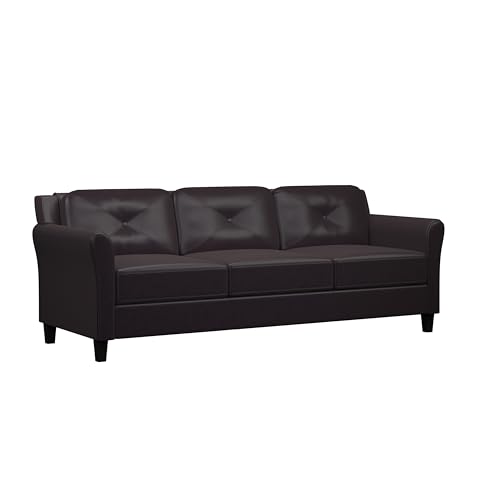
Studio Living Harrington vegan leather sofa
Compare this named sofa option by its published dimensions, cushion construction, and seller terms. Confirm that the selected cover is the same as the catalogue item.

Modway Auren vegan leather sofa
A contemporary faux leather example to inspect for dimensions, assembly, cushion fill, and current material information.
These are comparison starting points rather than a ranked “best deal” list. A lower-priced marketplace item can differ from a retailer’s showroom model in seller, warranty, or delivery. Check the Amazon page for the exact finish and return period before purchasing.
Check care instructions before buying
Faux leather is often described as easy to wipe, but the approved cleaner depends on the product finish. Ashley’s furniture care guidance identifies different upholstery materials and cautions that improper cleaning can affect warranty coverage. Use the cleaning method specified for the exact sofa. Avoid applying a generic leather conditioner or harsh household cleaner to a synthetic finish unless the manufacturer approves it.
Ask how to handle spills, food residue, and ordinary dust. Blot rather than rub where the manufacturer recommends. Keep the sofa away from strong direct sunlight and excessive heat, which can affect upholstery over time. Avoid placing sharp objects on the seating surface and be mindful of buckles, pet claws, and rough fabrics that can abrade a coating.
Find out whether seat cushions are reversible and whether the covers can be removed. A fixed cushion may be harder to clean around; a removable cover may still require professional cleaning. Save the cleaning code and product manual with your receipt. If a stain appears, follow the sofa maker’s instructions rather than experimenting on a visible panel.
Return policy, warranty, and seller quality
Read the return policy before purchase, especially for a large sofa. Confirm the return window, restocking fee, pickup cost, packaging requirements, and whether a made-to-order color is final sale. Ask whether the seller provides room-of-choice delivery and what happens if the item arrives damaged or does not fit.
Review warranty coverage by component. A frame warranty may not cover upholstery, cushions, labor, or shipping for the same period. Ask how to submit a claim and whether a local service technician is available. For marketplace listings, confirm who the seller is and whether the manufacturer warranty applies to that seller’s product.
Read reviews for repeated, specific themes rather than relying on the average rating. Comments about peeling, cushion compression, missing hardware, delivery damage, or customer service can identify questions to ask. Make sure reviews refer to the same model and upholstery. Retailers sometimes combine reviews across colors, sizes, and product variants.
Keep packaging until you have assembled the sofa and checked every part. Photograph the box and upholstery if there is damage on arrival. Test the seat, inspect the seams and legs, and make sure the dimensions match the order. Report a problem within the retailer’s stated time window. If a sofa arrives with a missing leg or the wrong color, an early report is easier to resolve than a problem discovered after packaging is discarded.
Compare whether the warranty is provided by the manufacturer, the retailer, or a third-party plan. A protection plan may have a separate deductible or claim process. Read the exclusions for upholstery wear, cleaning damage, and accidental spills before adding the cost to your order.
When faux leather is a good choice—and when to compare fabric
Faux leather can work well if you want a smooth surface, a leather-like appearance, and straightforward everyday wipe-down according to its care instructions. It can also offer a lower initial price than some leather options. It may not suit you if you prefer the feel of woven upholstery, expect the surface to develop a natural leather patina, or need a material that tolerates a particular pet or household use.
Compare fabrics if the room gets hot or if you want a breathable textured surface. Compare genuine leather if natural variation and long-term care are priorities. Neither category is automatically better for every home. Look at the surface up close, sit on the model, and check how warm or cool it feels. A sample swatch can help you compare color and texture with your room.
Think about the whole life of the sofa. Can you replace a cushion? Is the upholstery available in other colors? Can the frame be repaired? Will the sofa fit if you move? A lower initial price is less appealing if the item is difficult to service or cannot adapt to a new room.
Faux leather can create a strong visual line, especially in black, tan, or dark brown, and it can be a practical choice for a home office or a room where people eat. It may feel cooler or less breathable than woven fabric, and a glossy finish can show fingerprints or scratches. If you are choosing a sofa for a sunny room, think about direct light and heat; ask the maker how the surface should be protected and whether the warranty excludes fading.
Consider how the finish relates to the rest of the room. A large black sofa can make a small space feel visually heavy, while tan upholstery can resemble a warmer leather tone. Use a sample or inspect the sofa in person under different lighting. Compare the surface texture, stitching, and color against your rug and wood tones rather than assuming a product image is exact.
Faux leather can be easier to wipe after an everyday spill when the maker allows a damp cloth, but it is not automatically stain-proof. Avoid abrasive sponges, concentrated solvents, and unapproved conditioners. If a finish begins to crack or peel, improvised glue or paint may change the look and could affect a warranty. Ask the retailer how repairs are handled and whether parts or replacement panels are available.
If the best deal depends on a temporary promotion, take a screenshot of the selected SKU and price and note the date. Promotions can change before checkout, and products may sell out in a particular color. Keep a backup choice in a similar size and budget range so you can compare features instead of rushing to buy the first marked-down item.
Final recommendation
If two models are close in price, prefer the one with clearer material information, useful dimensions, and a written care and warranty policy. A detailed product page does not guarantee a better sofa, but it makes the purchase easier to evaluate. If a retailer cannot answer basic questions about the upholstery or returns, include that uncertainty in your comparison rather than relying on a sale banner.
For the best deal on a faux leather sofa, choose the exact style and size that fit your room, then compare material details, seat construction, care, warranty, seller, and delivered price. Do not let a large discount label substitute for product information. Ask for missing specifications before purchase and keep the answer in writing.
Use Amazon examples as a price and style comparison, not a quality guarantee. If the listing does not identify the material or dimensions clearly, keep looking. A sofa should be comfortable and sized correctly before you decide that it is a bargain.
Take time to compare two or three options using the same checklist. Note price, delivery, seat depth, material, frame, cleaning, and returns in one place. This makes it easier to spot an actual value instead of being distracted by a large markdown or an extra feature you do not need.
A small amount of research now can prevent a costly sofa return later.
For more ideas, see our affordable sofa guide, brand comparison, and replacement cushion guide.