Affiliate disclosure: Daily Home Decorating may earn a commission if you buy through links in this guide, at no extra cost to you. As an Amazon Associate, we earn from qualifying purchases.
Choosing the best sofa brand to purchase is less about finding one name that wins for every home and more about matching a brand’s product range, service model, warranty, and price to the sofa you actually need. A company may sell excellent compact sofas and still be a poor fit if you need a deep sectional, a sleeper, a washable slipcover, or delivery to a difficult apartment. Even within one brand, models can use different frames, cushions, fabrics, and manufacturing partners.
This buyer guide compares how to evaluate familiar sofa brands, what to inspect in their policies, and how to narrow the field by style and budget. It is not based on hands-on testing of every manufacturer or model. We use official brand information where available and Amazon Creators API listing examples for product images. Check the live details, selected configuration, seller, stock, and service terms before buying, since ranges and policies can change.
For individual style decisions, browse our Home & DIY guides, compare seating accents with our living room rug guide, or review our accent color ideas for gray sofas. If you need guest seating, see our guide to compact sofas with pull-out beds.
Quick guide: which sofa brand should you start with?
- Want a broad assortment across price levels and configurations? Compare larger full-service retailers and read the exact model details. A broad catalog can make it easier to find a style, but product specifications and warranty terms can vary across lines.
- Need a recliner or motion sofa? Visit a brand with a substantial motion lineup and test the mechanism in person if possible. Check the motor and mechanism warranty separately from the fabric and cushions.
- Prefer modular or slipcovered furniture? Look for brands that publish component measurements, replacement cover options, and a clear path to add or replace modules later.
- Want easier budget planning? Compare entry-level sofa models by total delivered cost, not just sticker price. Include delivery, assembly, return freight, taxes, and any optional coverage.
- Need long-term support? Read the warranty by component and ask how repairs are handled in your area. A long frame warranty does not automatically cover upholstery, cushions, labor, or shipping for the same length of time.
For a quick shortlist, choose three models that fit your room and budget, then compare their dimensions, seat construction, upholstery care, warranty, delivery, and return policy. This product-level comparison is more meaningful than a brand popularity ranking.
Why “best sofa brand” is not a single answer
Sofas are not standardized products. One brand can sell a compact apartment sofa, a power reclining model, a sleeper, a modular sectional, and a custom-upholstered frame. Those products can differ in construction, warranty coverage, service availability, and price. The company name may provide some useful context about catalog and support, but it cannot tell you whether a particular seat is firm enough, whether the fabric will suit your pets, or whether the model will fit up the stairs.
Retailers also sell collections made by different manufacturers. A product may carry a store label, a licensed designer name, or a brand family name while having its own specifications and warranty. Do not assume that a product inherits every feature or warranty from another product sold by the same retailer. Check the exact SKU, manufacturer, frame, cushion fill, fabric, and warranty attached to that item.
Online sofa lists often crown a single “best overall” after testing a small set of models. That can be helpful when the testing methods and sample size are clear. If you are shopping from a general brand list, however, rankings without hands-on testing or a transparent method can create false confidence. We focus instead on the questions that help you determine whether a brand and model match your room, budget, delivery needs, and use.
Brand and retailer types worth comparing
Large full-range furniture retailers
Large retailers can offer many styles, price points, and configurations under one roof. Ashley is one example of a broad furniture catalog that includes stationary sofas, sectionals, sleeper sofas, and motion seating. Its official warranty page separates coverage by component; for example, it lists different terms for upholstered frames, seating systems, sleeper mechanisms, sleeper mattresses, cushions, and upholstery. That detail is a useful reminder that a “warranty length” is rarely one simple number for an entire sofa.
When shopping a broad retailer, compare the exact model rather than relying on the store’s overall reputation. Ask which company manufactured the sofa if that information is not clear, whether replacement cushions or covers are available, and how service works in your ZIP code. If the retailer offers local showrooms, try the seat, inspect the fabric, and ask how delivery and repairs are handled.
Brands focused on motion seating
Brands with recliners and power seating may suit households that prioritize adjustable headrests, footrests, or reclining positions. La-Z-Boy is well known for motion furniture, but the brand’s warranty should still be read by component. Its published parts and warranty information includes separate items such as sleep sofa mechanisms and other mechanisms; check the warranty card for the exact model and purchase date. A mechanism warranty is not the same as a promise that labor, transport, fabric, and cushions receive identical coverage.
Try a motion sofa in a showroom where possible. Test the controls, footrest, headrest, and the way the seat supports your back and legs. Check whether the furniture needs space behind it to recline or uses a wall-hugging design. Confirm power requirements, outlet placement, cable routing, and how the unit is serviced if a motor or control stops working.
Modular and configurable brands
Modular sofas can be useful when a room changes over time or when a large sofa has to pass through narrow access points in smaller sections. Before choosing one, determine whether the pieces can be rearranged without purchasing extra connectors, whether the modules stay together during everyday use, and whether the brand sells matching pieces later. Check the assembled footprint for every arrangement you might use.
Ask whether the modules use the same cover and cushion options, whether a single damaged section can be replaced, and whether the color or fabric is expected to remain available. “Modular” does not automatically mean future-proof; a collection may change and a discontinued component can be difficult to match.
Slipcovered and family-friendly collections
Some brands make removable covers a central part of their sofa offering. A washable cover can be useful in busy homes, but verify which parts come off, whether the care label permits machine washing, and whether replacement covers are sold separately. A removable cover may still require professional cleaning or have restrictions on water temperature and drying.
Check cushion construction and replacement options as well. Reversible cushions can help distribute wear if the model is designed for flipping, while attached cushions may be simpler to keep aligned. Ask the seller whether seat cushions can be ordered later and whether a cover purchase includes all pieces or only selected components.
Design-led and custom upholstery brands
Design-led retailers and custom upholstery studios can provide a wider selection of silhouettes, fabrics, sizes, or finish details. Their higher price may reflect customization, materials, design, local production, or service, but a premium price alone does not prove that a sofa is the best fit or that every component is more durable. Request a fabric swatch, ask about lead time, and obtain the exact frame, suspension, cushion, and cleaning specifications in writing.
Custom orders need additional attention before checkout. Confirm the final width and depth, selected arm and leg finish, fabric code, cushion fill, and any change or cancellation deadline. Ask whether custom goods can be returned, what happens if the color looks different from the swatch, and who handles transit damage. A made-to-order sofa can be the right choice, but its terms may be less flexible than a stock item.
Value-focused and online-first brands
Online-first sellers may have appealing prices and simplified delivery, but the experience depends on the model and the terms. Confirm how the sofa ships: compressed in a box, in separate modules, or through a furniture delivery team. Find out whether assembly is required and what support is available if a part is missing or damaged.
Review recent product-specific feedback, especially comments about dimensions, cushion firmness, assembly, fabric accuracy, and customer service after delivery. Look for repeated patterns across multiple buyers instead of relying on a single glowing or negative review. Confirm whether a return requires repacking and paying freight, since a large box or assembled couch may be difficult to send back.
Retailer, manufacturer, and collection name can differ
The name at the top of a product page may identify the retailer, collection, licensed style, or manufacturer. Those roles are not always the same. Before comparing one company’s sofa with another, look at the exact product label and warranty issuer. If the retailer says a third party made the product, ask where its warranty is published and who will arrange service. A retailer might handle the sale while a manufacturer handles parts, or a retailer may coordinate a claim itself.
Brand changes and licensing arrangements can also mean that two sofas carrying a related name have different frames, upholstery options, and support. Do not assume that a collection’s reputation transfers to every product on a large marketplace. Identify the model number, retailer, seller, and manufacturer, and save the product page as it appeared when you ordered. This is especially useful if you later need replacement cushions, fabric care guidance, or warranty support.
Domestic manufacturing and sourcing claims
If buying a sofa made in a particular country matters to you, verify the claim on the exact product page. A brand may manufacture some models domestically and source others from abroad. A company headquarters, design studio, or warehouse location does not establish where a specific sofa was made. Look for an explicit country-of-origin statement attached to the item, and ask the seller if it is missing.
Domestic production can affect lead time, customization, and parts availability, but it does not by itself guarantee comfort or a longer useful life. Compare construction, fabric, cushions, service, and price in the same way you would for any sofa. If the label says “assembled” or “designed” in a country, distinguish that from a claim that the full product was manufactured there.
How to compare the sofa itself across brands
Dimensions and room fit
Measure overall width, depth, and height, then compare seat width, seat depth, and seat height. The outside depth includes the back and arms, so it does not tell you how much room there is to sit. A deep sofa can be excellent for lounging and awkward for someone who prefers an upright perch. A narrower model may preserve circulation in a small room but leave less room for several adults.
Measure the delivery route from the front door to the room, including stairs, turns, elevator doors, and tight hallways. Ask for package dimensions and whether the legs or backs detach. Retailers may offer a doorway fit guide, but confirm that it describes the exact model and access conditions. A sofa that fits the wall can still be impossible to deliver through a narrow landing.
Frame and seat support
Compare disclosed frame materials, suspension type, and support system details. Product copy may mention wood, engineered wood, sinuous springs, webbing, or platform support; ask for clarification if a detail is missing or unclear. A brand-level promise does not replace the model specification. The intended use matters: a formal occasional sofa, a main family-room couch, and a sleeper may need different support and maintenance.
Cushion fill and firmness
Foam, fiber wrap, down blend, and other fills can create different feels, and construction can vary within a brand. Ask whether the cushions are reversible, removable, replaceable, or attached. Some seats soften with use, and retailers may describe this as normal settling. If firmness is important, sit on the exact model in person or check the seller’s exchange policy before ordering.
Upholstery and care
Look beyond the color name. Check the fiber content, care code, cleaning method, and whether a treatment is included. Velvet, chenille, leather, performance polyester, and linen-like fabrics age and clean differently. A retailer’s “easy clean” label should be supported by specific care instructions and, if applicable, a written performance claim. Request a swatch when possible and check it in the lighting where the sofa will sit.
Warranty by part
Read the warranty as a table of parts, not as a headline. Frames, springs, mechanisms, cushions, upholstery, electrical components, and labor can have different periods, limits, and exclusions. IKEA’s U.S. warranty information describes ten-year limited coverage for frames and cushions of many sofas, sleeper sofas, armchairs, and ottomans, while exact products and conditions should be checked in the current warranty. Ashley’s warranty page similarly gives component-specific terms. La-Z-Boy asks customers to review the warranty card for product-specific coverage.
Ask how to make a claim, whether the company or retailer arranges service, who pays labor or shipping, and what proof of purchase is needed. A long coverage period can be useful, but its value depends on what is covered and how practical it is to get service. Warranty terms are not a substitute for inspection, care, or a return policy.
Amazon product examples for brand-level comparison
The examples below are live Amazon listing results returned through Amazon Creators API for brand-related searches. They illustrate that brands sell different sofa types and specifications; they are not a hands-on ranking of the brands. Product images and listing details can change. Confirm the current seller, exact model, fabric, dimensions, availability, and warranty before purchasing.

Signature Design by Ashley SimpleJoy 83-inch sofa
The API listing describes a three-seat black corduroy sofa with a platform foundation and no-assembly wording. Verify the current fabric, width, door access, cushion details, and return terms for the exact listing.
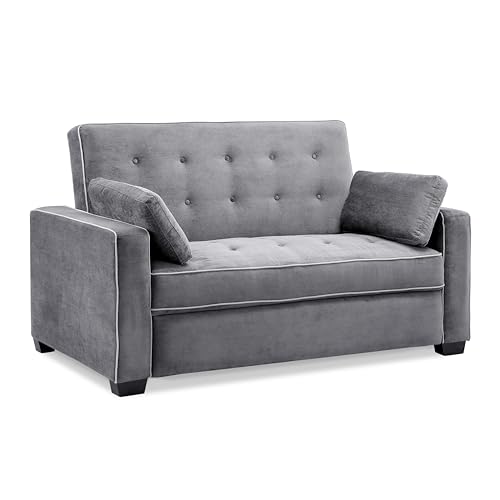
Serta Ainsley convertible sleeper sofa
The API result describes a 72.6-inch convertible sleeper and calls the bed queen size. Confirm the exact opening dimensions, mattress construction, color selection, and included components on the live product page before relying on that description.
These examples are not a substitute for researching the brand’s official product and service information. Amazon listings can include variations, multiple sellers, and changing availability. If a listing title and specification table disagree, contact the seller or manufacturer and save the answer before purchasing.
Questions to ask a sofa brand or retailer
- Who manufactures this exact model, and what is its item number?
- What are the overall, seat, and package dimensions for the selected configuration?
- What are the frame, suspension, seat cushion, and back cushion materials?
- Can seat cushions or covers be replaced, and are parts sold separately?
- What cleaning code applies to the selected fabric, and what cleaners are allowed?
- What warranty terms apply separately to the frame, springs, mechanism, foam, fabric, and labor?
- What delivery service is included, and are stairs, assembly, packaging removal, or haul-away extra?
- What is the return period, and who pays return shipping for a large sofa?
- How should damage be documented at delivery, and how soon must it be reported?
- Can I try this exact model or order a fabric swatch before committing?
Common mistakes when comparing sofa brands
- Choosing by reputation alone: the particular model, fabric, and service terms matter more than a broad brand label.
- Using warranty duration as a durability score: warranties differ by component and may exclude labor, wear, or upholstery.
- Comparing only list prices: add delivery, setup, taxes, financing cost, and possible return freight.
- Assuming every model is built the same way: one brand can sell multiple product lines and use different construction details.
- Ignoring the showroom experience: if a nearby store has the exact model, testing its seat and mechanism can answer questions a photo cannot.
- Overlooking local service: ask who handles repairs and whether support is available where you live.
- Assuming online reviews describe the exact configuration: reviews may combine different colors, sizes, or versions. Check the variant and date.
- Forgetting your delivery route: a sofa needs to fit through the full route, not merely in the living room.
How to make a shortlist in three steps
Step one: define the job. Decide whether the sofa is for everyday family seating, entertaining, a guest bed, a compact apartment, a home theater, or a formal room. Write down non-negotiable dimensions, seat feel, upholstery needs, and maximum total budget. This will eliminate brands whose catalogs do not match your use.
Step two: compare three exact models. Choose products from different brand or retailer types and make a simple grid with model number, dimensions, frame and cushion details, fabric care, warranty, delivery, and return policy. Request swatches or visit a showroom for the finalists. If the brands do not publish a detail, mark it as unknown and ask before you assume.
Step three: evaluate the total ownership experience. Consider assembly, delivery windows, support, replacement parts, and how the sofa can be cleaned and maintained. Think through what happens if a cushion loses shape, a cover is damaged, or a mechanism stops working. The brand that makes these answers clear may be a better fit than one with a more impressive marketing claim.
Frequently asked questions
What is the best sofa brand to purchase?
There is no single best brand for every home. Compare the exact model’s dimensions, cushion and frame details, upholstery, warranty, delivery, and return terms. A strong fit for a reclining family-room sofa may not be the best choice for a washable slipcover or a compact apartment.
Are expensive sofa brands always better?
No. A higher price may reflect customization, materials, design, domestic production, showroom service, or brand positioning. It does not automatically establish comfort or durability. Compare documented specifications, try the seat when possible, and understand the service and warranty terms.
Which sofa brands have the longest warranties?
Warranty coverage varies by product and component. IKEA’s U.S. warranty information describes ten-year limited coverage for frames and cushions of many seating products, while other brands may provide different terms for frames, springs, mechanisms, upholstery, and labor. Check the current warranty for the exact model rather than relying on a single company-wide number.
Should I buy a sofa online or in a store?
Buying in a store lets you test the seat and inspect upholstery, but the floor model may differ from the configuration you order. Online shopping can offer broader options and convenient comparisons, but makes it more important to verify dimensions, swatches, delivery access, and return costs. Choose the channel that gives you enough information and service confidence.
How many sofa brands should I compare?
Start with three to five exact models, not a long list of names. A small shortlist makes it easier to compare dimensions, construction, care, warranty, and total cost. Expand it only if none of the initial choices fits your needs.
Does a lifetime frame warranty mean the whole sofa is covered for life?
No. A frame warranty typically applies to a defined part and has terms, exclusions, and claim requirements. Cushions, upholstery, mechanisms, labor, and shipping may have shorter or separate coverage. Read the complete warranty and ask how service is provided.
Choose the model and service, then the brand
The best sofa brands to purchase are the ones whose specific models fit your room, support your daily use, and come with terms you can understand. Start with dimensions and comfort, compare fabric care and construction, then read the warranty component by component. Check delivery and return arrangements before paying. A recognized brand can be a helpful starting point, but the exact product listing and the service behind it should determine your final choice.
See our living room rug guide, our compact sleeper sofa comparison, browse Home & DIY, and read our affiliate disclosure.
Certain content on this site comes from Amazon and may change. Amazon product images and listing details are supplied through Amazon Creators API. Confirm the exact option, seller, dimensions, materials, and current terms before purchase.