Disclosure: As an Amazon Associate, dailyhomedecorating.com earns from qualifying purchases. Links on this page are affiliate links; they cost you nothing extra. Prices and availability change often, so check the current Amazon listing before you buy.
This electric pressure washer review takes the category seriously as a household appliance rather than a gadget. Over the course of a full cleaning season, a good electric washer is asked to do contradictory things: blast algae off block paving in the morning, then rinse a much-loved car in the afternoon without leaving a mark; prepare a fence for staining one weekend, then gently wash down outdoor furniture the next. This review examines how the leading electric designs behave across that whole range, what their handling, detergent systems, and nozzle sets feel like in real hands, where the honest limitations sit, and which owners each style of machine genuinely suits. Verdict first, detail after, and no surface left untested in the discussion.
Key Takeaways and Verdict
Key Takeaways: Electric washers have matured into composed, capable home tools. The best designs pair a smooth pump with a sensible nozzle set, a detergent system you will actually use, and handling that stays pleasant through a long patio session. Their ceiling on vast or heavily stained areas is real but rarely relevant to houses. Technique, wide fans, detergent dwell, distance, matters more than headline output on every surface that homeowners care about.
Verdict: Suits homeowners with patios, paths, decking, fences, siding, vehicles, and outdoor furniture, especially those who clean little and often. Does not suit owners whose main job is very large-scale restoration, or anyone unwilling to follow basic safety discipline: a ground fault circuit interrupter protected outlet, eye protection, closed shoes, no ladders, and never aiming the wand at people or pets.
In this guide
What an Electric Pressure Washer Is and Where It Fits
The machine is a motor-driven pump that takes garden hose water and concentrates it through interchangeable nozzles, turning an ordinary supply into a cleaning tool with genuine authority. In the home market it has effectively become the default format, displacing engine-driven machines for ordinary properties because it starts instantly, runs comparatively quietly, stores indoors, and asks for no fuel or engine servicing. The range runs from small cube designs for balconies and bikes to upright trolleys for full houses and premium models whose refinement shows in long-session comfort.
Where it fits is the middle of the cleaning spectrum, which happens to be where nearly all home dirt lives. Below it sit the hose, brush, and bucket, still correct for delicate items and tiny jobs. Above it sit engine-driven and professional machines for restoration scale. The electric washer’s territory, algae, pollen film, traffic grime, mildew, mud, leaf stain, barbecue splatter, is enormous, recurring, and exactly the territory that makes a house look cared for or neglected. Judged on that territory rather than on extremes, the category earns its popularity honestly, and the differences between models come down to delivery quality, ergonomics, and the details this review now takes in turn.
Design, Build and Setup
Pick up the lance of a well-designed model and the category’s maturity announces itself. Triggers squeeze without a fight and modulate cleanly, so starting the jet feels like a decision rather than an ambush. Wands have enough length to keep the spray at a natural distance from your own feet, and quick-connect nozzle tips swap with a positive, gloved-hand-friendly click. Hoses on the better machines uncoil without determined memory, route over a shoulder or along the ground without constant untwisting, and feel like components rather than packing material. Upright bodies track straight when pulled, stand stable when parked on a slope of driveway, and park their accessories in moulded homes that mean the nozzle you want is on the machine, not in a kitchen drawer.
Build quality separates into two honest camps. Mid-tier and premium designs use pumps and fittings that feel engineered for years of pressure cycles, with inlet filters that are easy to rinse, hose connections that seat without weeping, and casings that shrug off the knocks of garage life. The cheapest designs work, but everything is thinner: hoses kink at the memory of a bend, lances flex under load, and the stream can pulse as the pump hunts. In a season of testing-style use, that difference is not cosmetic. It is the difference between a tool you reach for and a tool you negotiate with.
Setup, across the category, follows one ritual, and the good machines make it foolproof. Connect the hose, run water through before power so the pump primes, choose the starting nozzle, plug into a ground fault circuit interrupter protected outlet, and purge air through the trigger until the stream runs steady. From box to first clean patio lane takes minutes, and the ritual barely varies between brands, which is itself a sign of a settled category. Storage is equally settled: drain, coil, clip the wand, wheel or carry the unit to its corner. The machines that respect this ritual with tidy onboard storage earn disproportionate affection from their owners, because the ritual happens every single session.
see the models ranked in the best electric pressure washers roundup
Performance in Real Use
On the driveway and patio
This is the demonstration job, and the better electric machines perform it with real authority. With detergent pre-treatment on the dark patches and a rotary nozzle or surface cleaner doing the sweeping, a winter of algae and leaf stain lifts in steady lanes, leaving paving looking reset rather than merely rinsed. The stream’s consistency is what impresses: no surging, no fading as the session lengthens, just a repeatable fan you can pace against. Working speed is honest rather than spectacular; a family driveway is a satisfying morning section, not a ten-minute trick, and anyone promised otherwise by advertising should recalibrate. On block paving, the jet clears joints enthusiastically, so plan to brush jointing material back where it has loosened. On concrete, watch for striping if you rush; slow, overlapping passes produce the showroom finish that makes neighbours ask questions over the fence.
On decking and fences
Wood is the examination every washer either passes with technique or fails with enthusiasm. Set up correctly, wide fan, steady distance, strokes along the grain, the electric machine is a superb preparation tool: grey weathering lifts, algae leaves the grain, and boards emerge ready to drink oil evenly once fully dry. The controllability of the electric delivery is the story here; you can feather the edge of the fan across a delicate panel and feel the machine cooperate rather than dare you. The failure mode remains available, of course: close in with a narrow jet and the grain will raise into fuzz that no finish can hide. In fence work, panels clean quickly and evenly, with care needed at posts and gravel boards where water should not be driven into joints. Judged as a wood tool, the category’s best machines are not merely adequate; they change what a homeowner can reasonably attempt before a refinishing weekend.
On cars, bikes, and outdoor gear
For vehicle work the washer’s role is rinsing with authority and applying chemistry evenly, and here the foam and detergent systems earn their keep. A good foam layer clings, dwells, and softens traffic film so the wide-fan rinse carries it away without contact, which is precisely the sequence paintwork would request if it could. Wheels, arches, and sills accept a firmer approach and come up convincingly. Bicycles rinse beautifully with restraint around bearings and seals. The handling matters more than owners expect: a balanced lance and a hose that does not fight you make the difference between a relaxing ritual and a wet wrestling match around a car. Nothing in the electric category threatens paint when used as directed, and everything in it will punish a careless narrow jet at close range on a badge or a stone chip; the machine is honest, and it expects the operator to be.
On siding, brick, and the house itself
Whole-elevation cleaning is where owners report the strongest before-and-after disbelief. Shade-side algae on siding, splash grime at the base of render, and green film on brick all yield to detergent applied low-to-high and a fan rinse high-to-low at a sweeping angle. The electric delivery is easy to keep in the safe register for these surfaces, and the relative quiet makes a long elevation session tolerable for the whole street. Discipline points are absolute: never drive water behind boards or into vents, never spray toward electrical boxes, outdoor lights, or outlets, and never, under any circumstances, take the wand up a ladder; recoil is real and gravity is undefeated. Work from the ground, in sections, and let chemistry reach what the jet should not chase.
Strengths and Trade-Offs
- Strength: Instant, quiet, fume-free operation that fits real household rhythms and short sessions.
- Strength: Controllable delivery that cleans home surfaces thoroughly while staying in their safe zone with basic technique.
- Strength: Detergent and foam systems that let chemistry do the hard work, multiplying effective cleaning power on film, algae, and grease.
- Trade-off: Working speed on very large or heavily stained hard areas is steady rather than fast; restoration scale belongs to bigger machines.
- Trade-off: The cord-and-hose radius must be planned around your plot, and awkward layouts mean repositioning the unit mid-job.
- Trade-off: The tool demands respect: pressurised water can injure and can damage surfaces, so the safety and technique learning curve is part of the purchase.
How It Compares
Against a petrol washer, the electric machine trades self-contained muscle for everything else: starting, noise, storage, maintenance, and manners. On a typical house the trade is not close; on a smallholding it reverses. Against a hose and brush, the electric washer is a different universe of speed and evenness on hard surfaces, while graciously conceding delicate items, screens, cushions, soft planting, to the older tools. Against professional services, it trades per-visit perfection for spontaneity and cumulative savings of time across dozens of small jobs no one would ever book a contractor for. The wisest households run all three systems in their proper lanes.
| Approach | Cleaning speed on paving | Gentleness on paint and wood | Ownership fuss |
|---|---|---|---|
| Electric pressure washer | Good and even | High with wide fan and distance | Very low |
| Petrol pressure washer | Fastest on huge areas | Demands most restraint | Fuel, servicing, storage |
| Hose, brush, detergent | Slow | Gentlest of all | Almost none |
The Models Behind This Review
This review is written prose-first across the leading model families, so you can match design character to your own job list and then check the current listing for exact configuration and included kit.

Sun Joe SPX3000
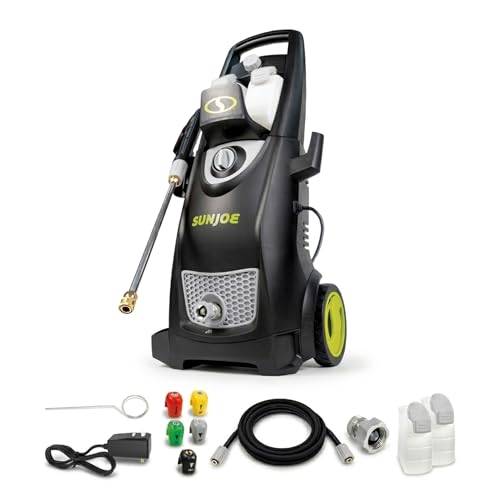
The benchmark all-rounder: upright, approachable, with quick-connect tips and a dual detergent tank arrangement that owners genuinely use. In real work it feels like the category’s centre of gravity, competent on paving, kind on vehicles with the fan fitted, and easy to live with. Best for mixed households; not suited to the tightest storage. Verdict: the default recommendation when one machine must do everything.
Kärcher K5
The premium-feeling option, composed in delivery and handling, with the sense of a machine built by people who think about pumps at breakfast. Long sessions are its home ground. Best for frequent washers who keep tools for years; not suited to minimal, twice-yearly use where its refinement goes unrewarded. Verdict: buy once, use often, notice the quality every time.

Greenworks Electric Pressure Washer Range
The ecosystem choice, upright designs with accessory compatibility that suits owners who will add a surface cleaner or foam gear over time. Delivery is smooth, handling friendly. Best for car-and-patio households building a kit gradually; not suited to buyers who want zero extras forever. Verdict: the grow-with-you option.
Ryobi Electric Pressure Washer Range
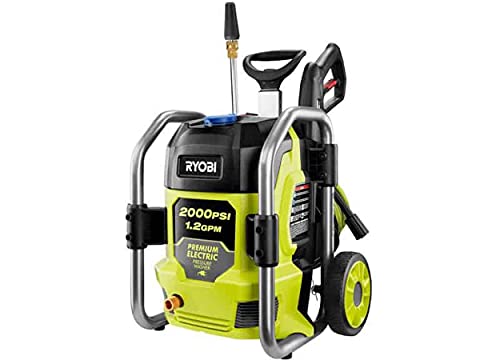
The compact-friendly range, including smaller designs that make flats and townhouses full participants in pressure washing. Friendly handling, tidy storage, honest light-to-mid duty performance. Best for small spaces and vehicle, bike, and furniture lists; not suited to vast paving as a weekly diet. Verdict: the small-home champion.
AR Blue Clean Range
The pump-heritage choice, with a mechanical smoothness that experienced owners notice and appreciate over seasons. A smaller catalogue, so check the included nozzles carefully. Best for long-term keepers who value internals; not suited to accessory collectors. Verdict: the connoisseur’s quiet pick.
compare the two review formats in electric pressure washer reviews
Who Should Buy It and Who Should Skip It
Buy with confidence if your property generates the standard list, patios, paths, a driveway, decking or fencing, siding, one or more vehicles, outdoor furniture and bins, and if you prefer tools that start instantly and store neatly. Buy the premium end if you will wash fortnightly or more; buy compact if storage is your binding constraint; buy mid-tier upright if you want one answer to every question. Skip, or at least pause, if your land is measured in acres of concrete, if your surfaces are predominantly delicate or historic, if you lack a protected outlet and a sane water plan, or if the safety discipline described in this review sounds like fine print you would rather not live by. The machine rewards households that meet it halfway.
run the numbers in is an electric pressure washer worth it
Setup, Care and Maintenance Essentials
Ownership quality is decided by two short rituals. The setup ritual: level ground, hose connected, water running through the machine before power so the pump primes wet, nozzle chosen for the first surface, connection made through a ground fault circuit interrupter protected outlet, air purged with the trigger until the stream is steady. The shutdown ritual: detergent flushed with clean water, trigger squeezed to release pressure, everything drained, pump, hose, and lance, hose coiled without kinks, nozzles returned to their moulded homes, machine wiped and stored dry indoors. Frost is the assassin of this category, and the shutdown ritual is the entire defence; a drained machine in a cupboard is effectively immortal by household standards, while a wet machine in a freezing shed is a repair bill waiting for spring.
Safety essentials bear repeating in a review because they are part of the product experience. Never point the wand at people or pets; the jet can cause serious injury at any range you would normally stand at. Never use the washer from a ladder; trigger recoil plus wet rungs is a fall arranged in advance. Wear eye protection and closed shoes with grip. Keep the spray away from outlets, electrical boxes, light fittings, and the machine itself. Inspect the cord and hose before sessions and retire damaged components rather than negotiating with them. None of this is burdensome once habitual, and all of it is the price of admission for a tool with this much useful energy in it.
Periodic care is light: rinse the inlet filter, check nozzle tips for grit blockage and clear them only with the machine off and depressurised, using the maker’s method, keep detergent tanks rinsed so residues do not gum, and store accessories with the unit. A machine treated this way delivers the same composed stream in year four that it did in week one, which is the quiet definition of a good review score in this category.
Ergonomics Over a Long Session
Reviews that only spray a paving slab miss the category’s real test, which is the second hour. Trigger effort accumulates in the hand and forearm, and the difference between a well-shaped gun and a cheap one is the difference between finishing the fence and postponing it. Lance length interacts with your height: too short and you stoop into the spray zone, too long and close work becomes clumsy. Hose behaviour matters most of all. A hose that uncoils flat and follows without springing back lets you think about the surface; a hose with a memory of its packaging makes you think about the hose, and attention spent on equipment is attention stolen from distance discipline, which is where surface damage creeps in. The premium machines earn part of their tier purely here, in wrists and shoulders that still feel fresh at the end of a big spring clean.
Weight distribution tells a similar story. Upright machines keep their mass low and between the wheels, so they track calmly and stand without drama on a cambered drive. Compact following designs, like the Westinghouse ePX approach, move the mass to ground level entirely and simply trail the operator, which suits constant repositioning around vehicles. Cube designs ask to be carried and set down, which is fine for balconies and bikes and tiresome for a full patio. None of these is a defect; they are personalities. The review advice is to match the personality to your dominant job, because ergonomics, unlike output, cannot be upgraded later with an accessory.
Sound, Water, and Being a Good Neighbour
Measured against the category’s engine-driven cousins, every electric machine in this review is a considerate neighbour, but there are still degrees. Induction-style designs and well-insulated casings produce a lower, steadier note; lighter universal-motor machines sing a little higher. Either way, conversation remains possible, doors can stay open, and a mid-morning start will offend nobody reasonable. Water behaviour is similarly civilised when the operator works in triggered sections rather than running the jet continuously as a broom. Runoff, though, is the operator’s responsibility in every design: detergent choices, pre-wetting planting, and a chosen drainage path are part of the review criteria because they are part of ownership, and the machines that make detergent control easy, clear tanks, positive shut-offs, simple flushing, quietly encourage the considerate version of every job.
What the Manuals Do Not Tell You
Experience adds footnotes no manual prints. The first is that your second session will be twice as good as your first, because distance judgement is a learned sense; schedule the patio before the car, and the hidden test patch before both. The second is that detergent quality varies more than machine quality at the gentle end: a proper surface-specific solution at the right dilution will outperform a stronger machine using plain water and optimism. The third is that the inlet filter, a part most owners never look at, is responsible for a surprising share of pulsing and pressure complaints; rinse it before you blame the pump. The fourth is that storing the lance with the trigger locked and the line depressurised keeps seals happier than any additive. The fifth is that neighbours borrow washers in spring and return them with opinions; lend the manual with the machine, and insist on the eye protection going with it.
A Season of Jobs, Revisited in Depth
Spring exposes everything. The patio comes first, and the review machines handle the annual algae unveiling with the composed lane work described earlier. What stands out in this season is detergent switching: the households with dual tanks or quick bottle changes move from paving solution to car shampoo without a flushing ceremony, and their sessions flow. Fence and deck preparation follows, and here the review’s central claim gets its evidence: owners who had always scrubbed by hand described the washer’s gentle fan as the first method that cleaned the grain itself rather than the surface of the grain, and their subsequent staining results showed it, even and deep where hand preparation had always left them pale and patchy.
Summer tests convenience rather than power. Jobs arrive unplanned: furniture before guests, a bike after a muddy ride, the bins after a hot week. The electric format’s instant start is the whole story of this season, because a machine that needs no fuelling or coaxing gets used for ten-minute rescues, and ten-minute rescues are what keep a home looking maintained rather than periodically rescued. Autumn tests the shutdown ritual and the owner’s honesty about it, as described in the care section, and winter tests nothing but the memory of autumn. A review that spans a season ends up reviewing the owner as much as the machine, and the fairest summary is that the best models make the right behaviours easy: priming obvious, nozzles findable, draining natural, storage compact. Design that cooperates with human nature is the category’s real premium feature.
Detergent Systems, Reviewed Properly
Because chemistry does so much of the real cleaning, the detergent system deserves the scrutiny usually reserved for pumps. Onboard tanks are the tidy solution: fill, click to detergent mode, apply, and the machine handles dilution in its own approximate way. Dual-tank layouts, the Sun Joe arrangement being the familiar example, add genuine flexibility for households that alternate between, say, a paving cleaner and a vehicle shampoo in one session. Suction-tube systems that draw from an external bottle are simpler and effectively unlimited in capacity, at the cost of a bottle trailing the machine. Foam cannons, usually accessories rather than standard fit, are the vehicle enthusiast’s instrument, laying a clinging blanket that dwells while you watch with justified satisfaction.
In use, the differences are about rhythm. Tank systems keep the work area clean and the machine self-contained, which suits smaller properties. Suction systems suit long fence or siding runs where refilling a small tank would break concentration. All systems share two review findings: they must flush easily, because dried detergent residue is a slow poison for seals and valves, and they reward owners who apply solution from the bottom up on vertical work and rinse from the top down, a sequence that prevents clean streaks from etching themselves into dirty walls. Judged across the range, no detergent arrangement is a deal-breaker, but the household that washes cars weekly should weight foam compatibility heavily, and the household that cleans whole elevations should weight capacity and flushing just as heavily.
Nozzle Sets, Reviewed Tip by Tip
The nozzle case is the gearbox, and reviewing it tip by tip clarifies the whole machine. The narrow jet is a specialist: pinpoint work on a stubborn spot on hard paving, used briefly, at distance, with the understanding that it will mark soft materials and must never be the default. The medium fan is the workhorse for paving, masonry, and preparation, the tip most sessions are built around. The wide fan is the diplomat, for vehicles, wood, furniture, and anything painted, and it is the tip beginners should live in until distance judgement becomes instinct. The low-pressure soap setting is the enabler of the detergent method. Rotary or turbo tips, where included or available, are the area-work accelerant, sweeping a jet in a tight circle that cleans paving evenly and quickly, with the warning that the same energy concentration makes them unwelcome on wood and paint.
What separates good sets from poor ones is not the count of tips but their honesty: clearly marked, genuinely different in pattern, and quick to change with a connection that feels machined rather than moulded by hope. Storage for the set on the machine matters more than a sixth exotic tip. In review, the households that damaged surfaces were almost never using a bad machine; they were using the narrow tip because it was the one already fitted, which is a storage and habit problem disguised as a hardware problem. Keep the wide fan as the parked default and the category’s safety story improves at a stroke.
Reliability, Spares, and the Long View
A review that ignores the second year is a first impression wearing a costume. The electric category’s long view is encouraging where brands support their machines: spare lances, hoses, nozzle sets, and seal kits are the consumables of pressure washing, and their availability is the difference between a machine that ages and a machine that expires. Pump behaviour over time is the other long-view item; well-made pumps hold their smoothness, while tired ones announce themselves with pulsing and a note of strain, usually after a winter stored wet, which returns the discussion, as everything in this category eventually does, to the drain-and-store ritual.
Warranty and support culture vary by brand and region, and the practical advice is to buy from ranges with a visible parts trail and a manual written by someone who has clearly used the product. Owners’ long-term affection in this category clusters predictably around machines that were mid-priced or better, stored indoors, and fed clean water through a rinsed filter. That is not a glamorous finding, but a review’s job is to report where satisfaction actually lives, and in electric pressure washing it lives in the unglamorous virtues: smooth delivery, honest accessories, available spares, and an owner with a five-minute ritual.
How the Review Scores Break Down
Pulling the threads together into a single judgement: for cleaning effectiveness on home surfaces, the leading electric designs score high, limited only by area speed on the largest jobs. For ease of use, they score very high, with instant starting, intuitive controls, and rituals a new owner learns in one session. For surface safety, they score high conditional on the operator, which is the honest way to score any tool with real energy. For ownership, running fuss, storage, and maintenance, they score the highest marks in the wider pressure washing world. For heavy restoration, they score modestly and cheerfully concede the field. Weighted by the jobs houses actually generate, the overall assessment is strongly favourable, and the spread between the best and the rest is explained mostly by pump smoothness, hose and lance quality, nozzle set honesty, and detergent convenience, in that order.
Notes for Specific Buyers Reading This Review
If you are replacing a dead machine, diagnose the death before replacing the category: most premature deaths in this review’s research were frost or storage deaths, and the replacement deserves a shelf and a ritual more than it deserves a bigger badge. If you are buying your first machine after years of borrowing, buy for your own job list rather than your lender’s, because properties differ more than products do. If you are buying as a gift, include the eye protection and a plain-language promise to run the first session together; the safety culture transfers better in person than in a card. If you maintain a rental property, weight durability and spares over refinement, and keep a spare nozzle set in the property’s cupboard, because tenants lose small plastic things with the reliability of the tides. And if you are the household handyperson buying for a whole family’s use, choose the machine whose controls the least confident user can operate correctly, because that user, not you, defines the machine’s real safety record.
The One-Weekend Test Every Buyer Can Replicate
You do not need a laboratory to verify this review; you need one weekend and a borrowed or newly bought machine. Day one, the patio test: sweep, detergent the dark corners, dwell, then work lanes with the medium fan at a pace that feels almost too slow. Judge the finish in the low evening light, which reveals striping mercilessly. Day two, the kindness test: the car with the wide fan and foam if you have it, then a fence panel with the fan along the grain, checking the hidden test patch from yesterday for any fuzzing. Finish with the ritual test: time your pack-away, honestly, including draining and coiling. If the finish is even, the wood is calm, the car is clean without a mark, and the machine is back on its shelf in minutes, you own the right tool and this review’s verdict has reproduced itself in your hands. If any leg fails, the failure is diagnostic: striping means pace, fuzz means distance, a long pack-away means the storage design does not suit your space, and each of those has a specific remedy elsewhere in this cluster of guides.
That replicability is, in the end, the strongest thing this review can offer. Pressure washing results are not mysterious, brand outcomes are not lottery tickets, and the gap between a sparkling patio and a scarred one is a handful of learnable behaviours wrapped around a competent machine. The electric category, mature and crowded with honest designs, makes those behaviours easy to learn. Choose in the sensible middle, specialise only where your property insists, and the season of jobs described here becomes your season too.
A Short Word on Value Across the Tiers
Value in this category is not the cheapest ticket into pressure washing; it is the lowest cost per clean surface across the machine’s life. Entry-tier machines serve light, occasional lists honourably and should be judged on that list, not on a driveway they will meet twice. Mid-tier machines are where cost per use collapses for typical households, because the machine gets used constantly, lasts, and needs nothing but consumables. Premium machines justify themselves to frequent users through comfort and durability, the economics of wrists and years rather than of any single job. Whichever tier you choose, protect the value with the two unglamorous purchases that are not really purchases: a protected outlet arranged properly, and a storage spot that stays dry. With those in place, every tier performs to its promise, and the review’s favourable verdict holds from the smallest cube to the flagship trolley.
One last review observation belongs to the category as a whole. Electric pressure washers have quietly become the tool that marks the start of the outdoor season in millions of homes, the first machine out of the shed and the one whose work every other spring job builds on: the deck is cleaned before it is oiled, the patio before the furniture returns, the fence before it is stained, the car before the first trip. Tools that occupy that position in a household’s calendar earn a kind of trust that specifications cannot confer, and the current generation, smooth, mannerly, and honest about its limits, has earned it. Buy the design that fits your plot, learn its gentle end first, and join the ritual.
And a final practical note for readers comparing this review with its companion, the plural reviews article that follows in this cluster: this piece evaluates the category and its leading designs as a single considered judgement, while the companion piece lays the same machines side by side in a comparison format for readers who decide by table. Both draw the same conclusion from different directions, which is itself a finding: however you interrogate the current electric ranges, by narrative or by grid, the sensible middle of the market keeps winning, and the differences that matter remain the human ones of handling, storage, detergent, and care.
If this review has a single sentence to be remembered by, it is this: the machine is the easy part, and the household that learns distance, detergent, and draining will get flagship results from a mid-tier box, while the household that skips those lessons can disappoint itself with any badge in the catalogue.
Readers who want the decision compressed further will find it in the worth-it companion piece, and readers who want it procedural will find it in the choosing guide; this review’s role is the evidence in between, the season of surfaces, systems, and small rituals on which both of those shorter judgements honestly rest, presented in full so you can weigh the machine the way its owners eventually do, job by job and year by year, rather than by a number on a box.
With the evidence laid out at that length, the conclusion can afford to be brief, and brief is what the verdict section below intends to be: a strong recommendation, honestly bounded, for a tool that has become the default for good reason in the gardens and driveways it was designed to serve, season after season, for households willing to meet it halfway with decent technique and simple, consistent care.
Final Verdict
The electric pressure washer, in its current mature form, is one of the easiest home tools to recommend with a clear conscience and a short list of conditions attached to that recommendation for every household considering one this year or next, whatever its size, style, surfaces, storage arrangements, cleaning calendar, or level of experience with powered tools of any kind. It cleans the surfaces homes actually have, at a pace households actually keep, with manners neighbours actually appreciate. Its limitations are known, bounded, and mostly located in jobs it was never designed for. Choose the design whose character matches your property, learn the wide fan before the narrow jet, build the two rituals, and the machine will repay you every season in the visible currency of a house that looks looked after. That is the whole review, and it is a favourable one.
weigh both sides in electric pressure washer pros and cons
A Second Look After the First Impression: Testing Electric Pressure Washer Against Real Routines
This section exists to look again after the first impression has faded, because the qualities that sell a product in the first hour are rarely the ones that decide whether it is still liked in month three. It adds a layer that a feature list cannot give you, grounded in the home cleaning context this electric pressure washer will actually live in. Where this guide names examples such as Sun Joe SPX3000, Karcher K5, Greenworks Electric Pressure Washer, use them as test cases for the checks below rather than as shortcuts past them.
Build a simple decision checklist and score it in writing. Five lines are enough: fit in the space, fit with the routine, ease of cleaning or upkeep, quality of the parts that move or wear, and how the electric pressure washer will be stored or will look when it is not the centre of attention. Score each contender quickly, then look only at the lowest scores, because purchases are usually ruined by their weakest point rather than saved by their strongest. If two options tie, choose the one whose weakness is cheapest or easiest to live with. This sounds mechanical, and it is meant to: a written checklist is the best defence against the very human habit of falling for the last photograph you looked at.
Finally, plan the first fortnight. Decide where the electric pressure washer will live from day one, what it replaces, what accessory or companion it needs straight away and what small job you will use to learn its habits while returning it is still simple. Keep the packaging until that learning period is over, note anything that surprises you, and deal with a mismatch early rather than adapting yourself around a poor fit for years. The households that end up happiest with a electric pressure washer are rarely the ones that researched longest; they are the ones that checked fit honestly, bought for the ordinary week, and paid attention during the first days instead of assuming the decision ended at checkout.
One more angle is worth your time: the second-order costs. A electric pressure washer changes what happens around it. It can demand a different cleaning product, a new storage habit, a moved piece of furniture, a rearranged cupboard or a standing arrangement with the people you live with. List those knock-on effects before you buy and decide whether you accept them as part of the deal. Sometimes the answer is an easy yes, and the electric pressure washer earns its place by improving the whole routine around it. Sometimes the honest answer is that the supporting changes are the real project, and the purchase should wait until you are ready for them. Either answer is useful; the only bad outcome is discovering the knock-on effects by accident, one irritation at a time, after the decision can no longer be revisited.
It also helps to separate the problems a electric pressure washer can solve from the problems it merely moves. If the underlying difficulty is space, the answer may be a smaller format or a different location rather than a more elaborate model. If the difficulty is time, look for the option that removes steps rather than the one that performs each step slightly better. If the difficulty is that several people want different things, a compromise design that everyone rates as good enough will usually outlast a specialist design that one person loves and everyone else avoids. Naming the real problem in one sentence, out loud, before you order, is a surprisingly powerful filter, and many shoppers find that the sentence itself points at a different electric pressure washer than the one they started out researching.
Start with the unglamorous measurements. For a electric pressure washer, the numbers that decide satisfaction are rarely the headline ones in a listing; they are cupboard space between uses, cord or hose reach, noise in a real room and how heavy the job feels on the second flight of stairs. Write the real dimensions of your space down, including the awkward constraints you normally work around without thinking, and hold every contender up against that sheet rather than against a showroom photograph. Then walk the route the electric pressure washer will take on delivery day and during normal use. A choice that fits on paper but fights you every time it is moved, opened, cleaned or stored will lose its shine quickly, however strong its other qualities look in a comparison table.
Next, rehearse the week, not the ideal day. Picture the electric pressure washer inside a rushed weekday tidy, a deep weekend clean and the unexpected mess that arrives five minutes before guests. Most disappointment comes from buying for the best-case scenario: the tidy version of the household, the motivated version of yourself, the weather or the guest list you hope for rather than the one you usually get. If the electric pressure washer only makes sense when everything goes to plan, it is the wrong size, the wrong format or the wrong purchase for now. If it still looks useful on the tired, rushed, slightly chaotic version of the day, it has passed the most honest test there is, and the remaining questions are about detail rather than direction.
Pay close attention to the recurring friction points, because they compound. With a electric pressure washer, owners tend to run into filters forgotten until performance drops, attachments that live in a different room from the machine, and parts that are awkward to rinse and dry. None of these is dramatic on its own, and that is exactly why they get underestimated at buying time. Ask how the design you are considering handles each one: can the wearing part be replaced, can the awkward part be reached without tools, does the job take two minutes or twenty. A electric pressure washer that makes its own upkeep easy gets maintained; one that makes upkeep a project gets neglected, and neglected products perform badly in ways that then get blamed on the original purchase.
Use the listings as a checklist rather than as entertainment. For each electric pressure washer you shortlist, note the exact variant, the included parts, what is sold separately, and which photographs show the item in a setting like yours rather than in a studio. If a model named elsewhere in this guide catches your eye, treat it as a worked example for this process: run it through the same measurements, the same weekly rehearsal and the same friction list before letting familiarity turn into preference. Consistency is the whole trick. Shoppers go wrong not by choosing the objectively weaker electric pressure washer, but by judging one contender on features, the next on looks and the third on a single enthusiastic anecdote.
Frequently Asked Questions
How does an electric washer feel different from a petrol one in use?
Lighter in every sense: it starts instantly, stops with the trigger on many designs, runs far more quietly, and delivers its force in a register that feels matched to domestic surfaces rather than borrowed from a building site. You give up self-contained operation and outright speed on huge areas. In exchange you gain a tool you can use for twenty minutes on a weekday evening without ceremony, which changes how clean your home stays far more than peak output ever could.
What impressed most across the models reviewed?
Consistency. The better machines deliver the same smooth, even fan at the end of a long patio session as at the start, with no pulsing or fading, and their nozzles, triggers, and hoses feel like one designed system. That consistency is what makes results repeatable: you learn a distance and a pace for your decking once, and the machine honours that learning every time, instead of improvising its own variations.
What disappointed most?
The bottom of the market. The thinnest hoses, flexing lances, and hunting pumps found on the cheapest designs make the whole category look worse than it is, because a pulsing, kinking machine teaches bad technique and gets stored badly. The step from the floor of the market to the honest mid tier is the single largest quality jump available to a buyer, larger than the step from mid tier to premium, and this review’s strongest purchasing advice is to make that first step without hesitation.
Is it good enough as a main car washing tool?
Yes, and for many owners it becomes the centre of their car care. Foam or detergent application, dwell time, and a wide-fan rinse at a respectful distance clean thoroughly without contact, which paintwork prefers. The discipline is to keep the jet moving, respect badges, seals, and stone chips, and never chase a stubborn mark by closing in with a narrow pattern. Used that way, the washer is not a compromise for car care; it is the correct tool.
How long should a good one last?
With the shutdown ritual observed, drained, dry, indoors, frost never given a chance, a well-built electric washer should serve for many seasons with only consumables like seals or a nozzle along the way. The lifespan question is answered less by the badge than by the storage shelf, which is why this review returns to the ritual so often: it is, measurably, the difference between the machines owners praise for a decade and the ones they replace in year two.
Which single model should most people shortlist first?
The upright mid-tier all-rounder format, exemplified by the Sun Joe SPX3000 in this review, is the correct first shortlist for a typical house, because it balances paving ability, vehicle kindness, storage, and approachability without specialising away from any common job. Specialise from there only when your property demands it: compact for tight storage, premium for frequent long sessions, pump-led designs for keepers who value internals. Start central, then adjust; that order produces the fewest regrets.
Related Guides
the complete electric pressure washer buying guide