Disclosure: As an Amazon Associate, dailyhomedecorating.com earns from qualifying purchases. Links on this page are affiliate links; they cost you nothing extra. Prices and availability change often, so check the current Amazon listing before you buy.
This outdoor storage shed buying guide is written for the moment before you spend anything: when the garage is full, the garden tools are living in a damp corner, and a shed sounds like the obvious answer — but the range of sizes, materials and designs makes the obvious answer surprisingly easy to get wrong. A shed is a small building, not a big box, and buying one well means deciding a handful of things in the right order: what will live in it, which material suits your climate and patience, where it will stand, what it will stand on, and whether your local rules allow it there. This guide walks through those decisions in order, introduces the main types, shortlists the well-known models by qualitative tier, and finishes with setup essentials and the mistakes that fill the negative reviews of every brand in the category.
Key Takeaways
- Size from your inventory and your largest single item — the door opening matters as much as the floor area.
- Choose the material family first: resin for low-maintenance finish, metal for capacity at an accessible tier, wood for looks and a maintenance covenant.
- The base is part of the purchase: a level base or foundation decides door fit and water pooling, and it must be planned and budgeted with the shed, not after it.
- Anchoring is not optional, and neither is checking the rules — many areas regulate sheds through permits or homeowners association covenants.
- Plan the interior when you buy: shelves, hooks and lidded bins are what turn enclosed space into usable storage.
Best for: households with genuine overflow — garden tools, mowers, bikes, seasonal decorations — and a plot that can take a small building. Not suited for: storage that must stay house-dry and temperature-stable, or plots where rules or space rule a shed out; in those cases a deck box plus indoor reorganisation is the honest answer, as the outdoor storage box buying guide explains.
One principle runs under every section that follows: in this category you are not really choosing a product, you are choosing an installation. The same kit becomes the best-reviewed shed on the street or the worst, depending on the base beneath it, the anchors through it, the site around it and the organisation inside it. Keep that principle in view and the rest of this guide — types, tiers, criteria, scenarios — reads as variations on a single theme: buy the building and its foundations as one decision, and you will only have to make it once.
It is worth saying, too, what this guide will not do: it will not pretend that one model is right for every garden, and it will not hide the conditions behind its recommendations. Every badge in the shortlist carries its condition with it — a builder’s patience, a base, a site’s shelter — because a recommendation without its condition is an advertisement. Read the conditions as carefully as the badges, match them against your own household without flattery, and the shortlist will do its job, which is to narrow a bewildering category to the two or three buildings that deserve your final attention.
In this guide
What an Outdoor Storage Shed Does and the Main Types
At its simplest, a shed is a weather-shedding, lockable room for the outdoors: it keeps rain off the things that live outside, organises them behind one door, and returns your garage and spare rooms to their actual purposes. It does not climate-control, it does not seal like a house, and it does not secure like a safe — and a buying guide does you a favour by saying so at the start, because every disappointment in this category is a version of expecting one of those three things. Judged on what it actually does, a good shed is transformative; judged on what it never promised, every shed fails.
Resin and Plastic Sheds
Resin sheds are moulded panel buildings from makers such as Keter, Suncast, Rubbermaid and Lifetime. Their panels resist rust entirely, shrug off knocks, and arrive in finishes that range from utilitarian to convincingly wood-grained. Many include an integral floor, skylight panels and proper ventilation as part of the design. They assemble with screws and clips into a structure that becomes rigid once the roof is on, and they ask for the least maintenance of any type: a wash now and then, and that is nearly all. Their trade-off is tier — resin generally costs more than metal for the same footprint — and a halfway-build flexibility that is normal, not a defect.
Metal Sheds
Metal sheds, from makers such as Arrow and YITAHOME, are coated steel panels over a frame. They offer the most enclosed volume at accessible tiers and a plain, working appearance that suits utility corners of a garden. The build is the price of admission: many panels, many fasteners, edges that demand gloves and a methodical temperament. Floors are often not included, so the base doubles as the floor and must be planned accordingly. Metal interiors can condense in damp climates if vents are ignored, which is a management issue rather than a flaw. For buyers whose priority is capacity and who have a patient builder in the household, metal is the value route.
Wood Sheds
Wood is the traditional material and the aesthetic winner: a timber shed can be painted to match a fence, accepts hooks and shelves anywhere, and feels like a garden building rather than an appliance. It is also the only type with a standing maintenance covenant — coatings to renew, a base line to watch for rot, and a closer eye after wet winters. Buy wood because you love how it looks and do not mind caring for it; do not buy it expecting resin’s indifference. In a buying guide it earns its place as a genuine third option, not a nostalgia act, but it is the wrong answer for a household that wants to forget the shed exists between uses.
Compact and Vertical Sheds
At the small end sit compact and vertical storage cabinets: tall, narrow units for long-handled tools, bins and a folded chair or two, designed for side yards, balconies’ bigger cousins and the strip beside a garage. They solve a real problem — tool storage where a walk-in shed cannot go — and they pair well with a deck box for cushions and small items. Their limit is absolute: nothing bulky, nothing wheeled, no working inside. Buy one as a deliberate answer to a small problem, not as a cheaper version of a big one, because the household that actually needed the walk-in will fill a cabinet in a weekend and be shopping again.
Top Picks at a Glance
The shortlist below is prose-first: models are named and badged by role and qualitative tier, with mini-reviews later in this guide and no links or prices printed here. Check any current listing for the details that change.
| Model | Badge | Tier | Character |
|---|---|---|---|
| Keter Factor Storage Shed | Best Overall | Premium resin | Garden-building looks, wide doors, low upkeep |
| Suncast Tremont Storage Shed | Best Built Feel | Premium resin | Reinforced character, sturdy floor on many versions |
| Lifetime Outdoor Storage Shed | Best for Organisation | Mid-to-premium resin | Steel-reinforced, shelving-friendly interiors |
| Rubbermaid Roughneck Storage Shed | Best Workhorse | Mid resin | Tough, simple, no ceremony |
| Arrow Steel Storage Shed | Best Capacity Value | Entry-to-mid metal | Lots of space, patient build required |
| YITAHOME Metal Storage Shed | Best First Shed | Entry metal | Straightforward, wall-side friendly sloped designs |
If you want the owner-experience evidence behind these badges, outdoor storage shed reviews reads the category’s feedback for patterns; if you want the argument for and against owning one at all, outdoor storage shed pros and cons lays it out.
How Much Capacity Do You Actually Need?
Capacity is the first criterion and the one most often fumbled, because buyers shop by photograph instead of by inventory. Do the unglamorous exercise: list everything the shed must hold, group it into wheeled equipment, long-handled tools, bins and boxes, and seasonal items, and then identify the single largest object — usually a mower — and let it set two hard requirements, a parking space and a door opening it passes through without tilting or swearing. Then add the honest multiplier every experienced owner will give you: sheds fill beyond their first inventory, because the house keeps exporting overflow once a destination exists. If your list exactly fills the shed on paper, the shed is too small.
Think in zones rather than volume. Wheeled equipment needs floor by the door; tools need a wall; bins need shelving; and you need a clear centre to stand in, because a shed you cannot enter is a shed you cannot organise, retrieve from or keep dry inside. Two sheds with identical footprints can differ enormously in usable capacity depending on door position, wall length and headroom where you stand. This is why the worked answer to capacity is a sketch, not a number: draw the footprint, place the mower, draw the shelves, hang the tools on paper, and only then compare models against the drawing.
Which Material Suits Your Climate and Your Patience?
Material decides maintenance, assembly character and ageing, so it is the second decision and it should be made before models are compared. In wet climates, resin’s rust immunity and metal’s need for vent discipline are the deciding facts, along with a base that keeps the floor edge clear of pooling water. In windy and storm-prone areas, every material needs anchoring, but lighter buildings need it most, and a lower profile in a sheltered position is worth more than any panel claim. In hot, sunny regions, ventilation and the gentle, even fading of quality resin are the themes, together with care about heat-sensitive contents. In snowy regions, roof pitch moves to the top of the list.
Patience is the other half of the question. Metal rewards a methodical builder and punishes a rushed one; resin is the most forgiving build; wood asks not for patience on one weekend but for small amounts of care forever. Households should answer honestly: the best material is the one whose build day and upkeep rhythm your household will actually perform, not the one with the most impressive description. The step-by-step version of this decision lives in how to choose an outdoor storage shed.
How Wide Must the Door Be, and What Kind?
Doors are the most-used part of a shed and the least glamorous line in any listing, so this guide gives them their own criterion. Double hinged doors are the easiest to live with: they open the full front, swallow bulky loads and let two people work at once. A single door suits compact sheds and light contents. Sliding doors save swing space in tight side yards but their tracks collect grit and want sweeping. Judge any door by three tests: your largest item passes through it; it latches positively and accepts a padlock, because a locked shed deters casual access and keeps children away from sharp tools — while never pretending to be a safe; and it can be adjusted, because a frame that settles a fraction will ask for adjustment and good hardware allows it gracefully.
Headroom and light ride along with the door decision. You will stand just inside that door more than anywhere else in the shed, so standing room there, plus daylight from a skylight panel or window, decides whether the interior is a workspace or a cave. Reviewers praise sheds they can see inside without a torch with a consistency that should move light from the nice-to-have list to the criteria list for any shed you will use daily.
What Will It Stand On? The Base and Anchoring Criteria
Every buying decision above is wasted if this one is skipped. A level base or foundation — concrete, paving slabs, a sound timber deck or a properly compacted gravel pad, slightly larger than the footprint — decides whether the doors hang true, meet and latch, and whether rainwater runs away from the shed or pools against its walls and floor edge. Ground that settles twists the frame, and the doors report the twist first. Bare grass and soil are not bases. When comparing models, fold the base into the comparison honestly: a shed with an integral floor still needs the level foundation beneath it, and a metal shed without a floor needs the base to be the floor, finished accordingly.
Anchoring belongs in the buying criteria, not the small print, because an unanchored lightweight shed can shift or blow over in strong wind. Prefer designs with clear anchor points and instructions for fixing to the base or ground, and plan the hardware at purchase time. Before any of it, check the rules: many areas regulate sheds — permits or homeowners association covenants may govern size, height, placement near boundaries and appearance — and the cheapest moment to learn that is before you have chosen a model that breaks them. State it plainly to yourself at the start of the project: sheds are commonly regulated, checking is part of buying, and a model that cannot legally stand where you want it is not a bargain at any tier.
Siting completes the foundation picture. Choose ground that drains, avoid the hollow where water collects after rain, keep clear of overhanging branches that drop debris onto the roof, and leave working room around the shed for assembly and for the door swing. A shed hard against a fence on two sides may fit on paper and be miserable to build and worse to maintain. The site, the base and the anchor are one decision wearing three hats, and this guide treats them that way deliberately.
How Should You Prioritise by Use Case?
The serious gardener should prioritise wall length for tools, a door that takes a wheelbarrow, ventilation for a working building, and a hazardous-items zone — high, ventilated and latched — for the fuel and chemicals gardening accumulates, stored per their labels and away from children. Resin or wood both serve; organisation features matter more than raw volume. The family overflow buyer should prioritise door width, a permanently clear centre, and shelving for bins of seasonal things; the shed is a logistics hub and should be specced like one. The mower and equipment owner should let the largest machine dictate door and floor, full stop, and treat every other criterion as secondary. The small-plot buyer should prioritise footprint discipline and looks, consider compact or vertical designs honestly, and pair with a deck box rather than letting a building eat the garden — the live guide to storage baskets for the indoor overflow covers the inside half of that strategy.
The Picks in Detail

Keter Factor Storage Shed — Best Overall
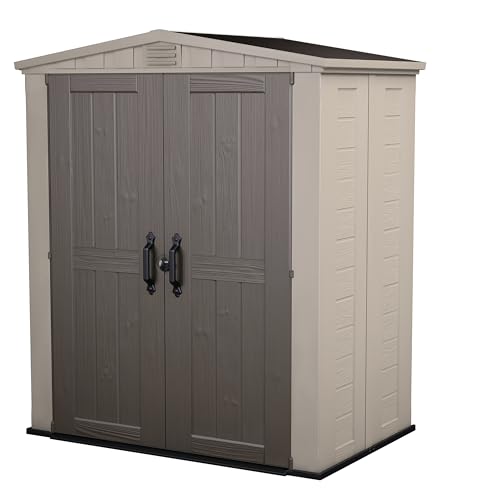
Best for: households wanting a shed that looks like a garden building and behaves like a low-maintenance one. Not suited for: maximum volume at the lowest tier. The Factor family’s wood-effect panels, pitched roof and wide double doors make it the default recommendation for visible positions, and its ownership rhythm — wash, check, forget — is the category’s easiest. Give it a level base and its anchors, and it returns years of uneventful service, which is the highest praise storage can earn.

Suncast Tremont Storage Shed — Best Built Feel
Best for: buyers who equate value with solidity and plan to install once, properly. Not suited for: anyone expecting a quick, casual build. The Tremont line’s reinforced character and integrated flooring on many versions produce the most substantial-feeling resin buildings in this guide. Assembly is a project; the result justifies it. If your household keeps things for a long time and maintains them lightly, this is your tier.

Lifetime Outdoor Storage Shed — Best for Organisation
Best for: families and gardeners who will shelve, hook and zone the interior. Not suited for: minimalists who want four walls and a roof and nothing else. Lifetime’s steel-reinforced resin designs treat the interior as part of the product, and their manuals are a genuine buying criterion for first-time builders. In a guide that keeps insisting organisation is half the product, this family’s approach is the most aligned with the evidence.

Rubbermaid Roughneck Storage Shed — Best Workhorse
Best for: tool-heavy storage where toughness is the brief. Not suited for: buyers shopping for garden charm. The Roughneck name promises durability without decoration and the sheds keep that promise. Buy it as equipment, site it as equipment, and it will out-work prettier buildings. Its mid-tier positioning makes it the honest middle of this guide: neither the cheapest space nor the finest finish, but a tool store that simply does not complain.
Arrow Steel Storage Shed — Best Capacity Value
Best for: buyers who need maximum enclosed space and have a patient builder and a level slab. Not suited for: rushed assemblies or floor-included expectations. Arrow’s long-running metal range is the capacity answer at its tier, with the known conditions: gloves, method, time, and a base that doubles as the floor. Met, those conditions buy a lot of building. Unmet, they buy the category’s most frustrated reviews — which is a buying-guide fact, not a contradiction.

YITAHOME Metal Storage Shed — Best First Shed
Best for: a first, accessible tool shed against a wall or fence. Not suited for: exposed sites without extra anchoring care. YITAHOME’s straightforward galvanised designs, often with sloped roofs that sit naturally against a boundary, are a sensible entry point when the inventory is tools and overflow rather than machinery. At this tier your installation is the product: level base, thorough anchoring, realistic expectations.
First Setup and Care Essentials
Setup order is fixed: rules checked, site chosen, base built and levelled, then the kit assembled in the manual’s order with a helper, doors adjusted while the frame can still be nudged square, and anchoring completed before the shed is loaded — an empty, unanchored shed is at its most wind-vulnerable, so anchoring is the last step of the build, not a job for next month. Store the manual and spare fasteners inside the finished shed. From there, care is a light rhythm: wash panels occasionally, keep vents and sliding tracks clear, clear the roof of leaf build-up, check door alignment and anchor fixings each spring and after severe storms, and keep the interior zoned — wheeled equipment by the door, tools on the wall, bins on shelves, fuel and chemicals per their labels in a ventilated, latched place away from children. If smaller items also need a home by the seating area, how to choose an outdoor storage box is the companion read, and the value question behind the whole purchase is examined in is an outdoor storage shed worth it.
Mistakes to Avoid
The category’s mistakes are so consistent that a buying guide can list them as a litany. Buying by photograph instead of inventory, and discovering the mower does not fit the door. Choosing the material for its description rather than for your climate and your household’s real maintenance appetite. Treating the base as an afterthought and earning the twisted frame and scraping doors that follow. Skipping the anchors and meeting the first storm unprepared. Ignoring permits and association rules until a neighbour or an inspector raises them. Storing things damp, loose and unboxed on the floor, then blaming the panels for the mustiness that organisation would have prevented. And filling the shed to the ceiling in the first month, leaving no circulation space, so that every retrieval becomes an excavation and the building slowly becomes a place the household avoids. Every one of these is avoidable at buying time, which is precisely when you are reading this.
Reading Listings Like a Buyer, Not a Browser
A final skill this guide can teach is how to read a shed listing critically. Translate every claim into a question. A claim about spaciousness becomes: what is the door opening, and does my largest item pass it? A claim about durability becomes: what are the panels reinforced with, what does the hardware feel like, and what does the manual assume about the base? A claim about weather resistance becomes: where are the vents, how does the roof shed water, and what does the maker say about anchoring? A claim about easy assembly becomes: how many people, how many parts, and is a floor included or assumed? Listings are written to sell the building in the photograph; buyers purchase the building in their garden, in their weather, on their base. The distance between those two buildings is closed by questions, and the questions above are the ones this category’s happiest owners demonstrably asked.
It is also worth deciding, before you look at a single model, what would make you walk away: a door your mower cannot pass, a design with no clear anchoring provision, a size your local rules prohibit, a build your household cannot staff. Walk-away criteria protect you from the most common buying failure of all, which is falling for a photograph and negotiating with reality afterwards. Reality always wins that negotiation; it is cheaper to hold it first.
Outdoor Storage Shed Buying Guide: The Decision Order in Brief
Everything in this guide reduces to an order of operations, and the order matters because each decision constrains the next. Inventory first, because contents decide size and door. Rules second, because a prohibited shed is not a shed. Site and base third, because they decide whether any shed will work at all on your plot. Material fourth, because it decides maintenance and build character. Model last, because by then the field has narrowed to a handful of honest candidates and the comparison is finally about details — hardware, light, ventilation, interior systems — rather than about hope. Buyers who reverse the order, starting with a model they liked in a photograph, spend the rest of the project negotiating with the decisions they skipped. Buyers who follow it describe the purchase as almost boring, which in this category is the sound of things going right.
Thinking in Tiers: What the Extra Money Actually Buys
This guide positions products by qualitative tier — entry, mid, premium — because static prices help nobody for long, and because the tiers have stable meanings even as numbers move. Entry tier buys enclosure: a working building, honestly made, whose hardware and finish are functional rather than delightful, and whose success depends most on forgiving conditions and careful installation. Mid tier buys ease: better hardware, clearer manuals, floors and vents designed in, panels that make the finished building feel like a structure. Premium tier buys character: the garden-building finish, the substantial door action, the interior thoughtfulness, the sense that the shed is part of the property rather than an appliance on it.
The buying mistake is to shop tiers by aspiration rather than by use. A premium shed storing a mower and three rakes is not wasted money exactly, but it is money spent on an audience of gardening tools; an entry shed asked to be the visible centrepiece of a designed garden, or to survive an exposed coastal plot unanchored, is money spent twice — once on the shed and once on its replacement or repair. Match the tier to the site’s harshness, the shed’s visibility and the household’s standards for how things should feel in the hand, and the tier system becomes a tool rather than a temptation. The models in this guide’s shortlist are deliberately spread across the tiers so that each kind of buyer has an honest candidate.
Support, Parts and the Long View
A shed is a long-lived object assembled from replaceable parts, and the support picture behind a model is a legitimate buying criterion that listings underplay. Ask, before you buy: can replacement panels, doors and hardware be obtained if a storm, a falling branch or a decade of use damages one? Is the manual clear enough that a future repairer — probably you, in year six, in the rain — can understand how the building comes apart? Are the fasteners standard enough to replace from a hardware store? Established makers with long-running ranges score well here almost by definition, because their parts ecosystems exist; that is a real, if unglamorous, component of the premium and mid tiers’ value.
Keep your own side of the support bargain: retain the manual, note the model name somewhere durable, keep the spare fasteners that kits include, and photograph the finished installation including its anchors and base. If the shed is ever damaged, that small archive converts a frustrating reconstruction puzzle into a straightforward repair conversation. It also disciplines the purchase itself — a buyer who plans to keep the paperwork is a buyer who has understood they are acquiring a building, with a building’s small ongoing responsibilities, and not a disposable container.
Three Worked Buying Scenarios
The suburban gardener with a full garage. Inventory: mower, long-handled tools, pots, compost, seasonal decorations, a ladder. The door must pass the mower; the walls must take hooks; the chemicals need a ventilated, latched zone. The decision order produces a mid-to-premium resin shed — Keter Factor or Lifetime territory — on a slab base, anchored, sited along the side fence where the rules allow, with shelving bought at the same time as the shed. The deck box by the patio, chosen from the best outdoor storage boxes for everyday items, takes cushions and games so the shed stays a tool building. Outcome the guide predicts: a garage that fits a car by the following weekend.
The rural equipment owner. Inventory: a ride-on mower, fuel, fencing tools, feed bins. Door and floor are dictated by the machine; capacity matters more than charm; the site is open and the wind is real. The order produces a large metal or premium resin building — Arrow’s capacity or Suncast’s solidity — on a substantial level base, anchored with extra seriousness, fuel stored per its label in the ventilated zone away from ignition and children. Organisation is shelving and a clear central lane. Outcome: equipment under cover, out of the weather, in one lockable place, with the anchoring treated as the life-safety item it is in open country.
The small-plot townhouse. Inventory: hand tools, a folding bike, bins, a few seasonal boxes — and a garden that is also the view. The rules check matters most here, because association covenants in such developments commonly govern outbuildings; the size honesty matters second, because the plot cannot absorb a mistake. The order may well produce a compact or vertical shed, or even talk the household out of a walk-in entirely in favour of a cabinet plus deck box — a legitimate buying-guide outcome. Spending the shed money on the smaller, correct answer is this guide working as intended, not failing.
Comparing a Shed With the Alternatives, Honestly
A buying guide owes you the comparisons against not buying a shed at all. A deck box is the closest alternative: far simpler, no base or rules drama in most cases, ideal for cushions, games and small tools — and incapable of holding a mower, a ladder or a season’s worth of anything. Most households that buy both use them as complements, and this cluster’s box guides, including outdoor storage box pros and cons, make that pairing explicit. A garage reorganisation — racking, a clear-out, a wall system — is the cheapest alternative and should honestly be tried first by households whose overflow is modest; a shed bought to avoid tidying the garage simply relocates the untidiness outdoors.
Rented storage is the alternative that looks easiest and ages worst for garden contents: the items are neither at home nor conveniently anywhere, and the household pays indefinitely for access to its own belongings. It suits a transitional season — a move, a renovation — and suits almost nothing permanently. A built extension or a professionally constructed timber building beats a kit shed on finish, insulation and lifespan, and loses on cost, complexity and usually on the very rules that govern sheds, only more so. The kit shed’s place in this landscape is precise: the most building you can get for the least construction, provided your needs are storage-shaped. If your needs are workshop-shaped — heating, power, hours spent inside — that is a different purchase wearing a similar silhouette, and this guide would rather tell you now than let a storage shed disappoint you as a studio.
A Buyer’s Walk-Around: Judging a Shed in Person
If you can stand in front of a display model, the corpus of owner experience compresses into a five-minute ritual. Work the door first: open and close it several times, feel whether the latch engages positively or needs persuasion, and imagine it with your hands full and your patience thin, because that is the state it will usually meet you in. Lean — gently — on a wall panel and then on a corner: panels flex, structures should not, and the difference between those two sensations is the difference between a kit and a building. Look up: is there a vent, is there light, does the roof have a pitch that will shed your weather? Look down: is the floor a designed part of the structure, and what exactly does the design assume is underneath it?
Then crouch and look at the base line and the anchor points, because you are really buying those. Ask the questions listings avoid: what does the maker require for anchoring, what does the manual assume about the foundation, and what happens to the door warranty of your patience if the ground moves a fraction? Finally, stand inside, close the door, and spend ten seconds in the actual volume with the actual light. Sheds are bought by people who will stand in that spot hundreds of times; ten honest seconds there are worth more than an hour of photographs. Households that performed some version of this ritual are, not coincidentally, the ones whose reviews read calmly years later.
Delivery Day and the First Month of Ownership
The buying process does not end at checkout; it ends about a month after installation, when the shed has been loaded, rained on and used daily. Delivery day has its own checklist: the cartons are large and heavy, so confirm the route from kerb to site is clear and help is available; inspect for transit damage while the delivery is fresh in everyone’s mind; and open the cartons promptly to check contents against the parts list, because a missing bracket discovered a week early is an errand, while the same bracket discovered on build morning is a crisis. Store panels flat, dry and out of the wind while they wait — a kit stored carelessly starts its life at a disadvantage.
The first month is when the installation tells the truth. After the first serious rain, walk the interior: is the floor dry at the wall edges, is water pooling anywhere against the base, do the doors still meet as they did on build day? After the first windy night, check the anchors and the latch. Small findings now — a corner that wants a shim, a track that wants sweeping, a vent blocked by an enthusiastic shelf — are five-minute corrections; the same findings ignored for a year become the category’s standard complaints. This is also the month to finish the interior properly while motivation lasts: zones marked, hooks up, bins labelled, the fuel and chemicals settled into their ventilated, latched place per their labels, and the manual filed inside the door. Households that treat the first month as commissioning, the way you would a boiler or a boat, are the households whose sheds simply disappear into the background of a well-run home — which is, in the end, the entire point of buying one.
Longevity, Repair and End of Life
A buying guide that only covers arrival is half a guide, so consider the far end of ownership before you commit. A well-installed shed from an established maker should serve for many years, and its lifespan is extended by exactly the habits this guide has repeated: a base that keeps it square and dry at the edges, anchors that keep it where it was put, coatings renewed on wood, scratches touched up on metal, and vents and tracks kept clear on everything. Most mid-life shed problems are component problems — a door, a hinge, a panel damaged by a branch — and component problems are solvable when parts are available, which is one more reason the established ranges earn their place in the shortlist above.
When a shed finally does reach the end, its materials part company: metal is readily recyclable, resin is a bulk plastic that local schemes handle variably, and wood can often be reused in the garden before it is waste. None of that should dominate a buying decision, but a household that buys once, buys well and maintains lightly has made the sustainable choice almost by accident — the greenest shed is the one that is not replaced. That long view is also the final argument for the unglamorous spending this guide keeps recommending: bases, anchors and shelving are not accessories to the purchase. They are the purchase, amortised over every year the building stands.
Measuring, Matching and Checking: The Outdoor Storage Shed Decision Worksheet
Most of the groundwork for choosing a outdoor storage shed is covered above, so this section turns to the stage where orders are actually placed: verifying fit, reading listings critically and checking the practical details that photographs tend to hide. Work through it with your measurements and your shortlist in front of you.
Start With Your Space and Your Routine
Compare how each option handles the in-between moments, such as being half full, partly open, moved aside or used in a hurry, because daily life happens mostly in those moments. Guests notice different things than owners do, so if the outdoor storage shed will be used by visitors, test it from a fresh user’s point of view, without the habits you have already built around it. Do not let a single impressive feature distract you from a basic mismatch in size, capacity or care needs, since basics decide satisfaction long after features stop being novel. Storage is part of ownership, so decide now where the outdoor storage shed, its accessories and its seasonal extras will go when they are not in use, and measure that space too.
If a outdoor storage shed comes in several sizes or configurations, choose by the measured demands of your space and household rather than by the middle option, which is a common default that suits nobody in particular. Equally, list what your old outdoor storage shed did well, because replacements sometimes quietly lose a virtue you relied on, such as a size, a shape or a simplicity the new model has redesigned away. Apply the same checks to each shortlisted example, whether that is the Arrow Steel Storage Shed; the Suncast Tremont Storage Shed; the Lifetime Outdoor Storage Shed, because consistent testing is what makes the differences between models visible. If you shop with someone else, agree the must-haves together before looking, so that the outdoor storage shed you choose is a shared decision rather than one person’s compromise discovered later.
When Small Problems Appear
Beware of choosing a outdoor storage shed for a rare occasion, such as a large gathering once a year, if that choice makes everyday use worse for the other fifty-one weeks. When something about the outdoor storage shed starts to annoy you, note whether the cause is the product itself, its position, or the way it is being used, since each cause has a different and usually cheaper fix. Write down the three tasks you will do most often with the outdoor storage shed and score each shortlisted option against those tasks alone, ignoring features you are unlikely to touch. Set the assembled outdoor storage shed up fully before deciding it is wrong for the space, since partly built or badly positioned pieces often look worse than they will once finished and levelled.
Read the listing for what it does not say as carefully as for what it does, because missing information about materials, assembly or care is itself a useful signal when you compare outdoor storage shed options. Build your shortlist in two passes: first remove every outdoor storage shed that fails a hard requirement such as size, capacity or placement, then compare what remains on quality and feel rather than on features alone. Finally, judge the outdoor storage shed against the life you actually lead this year, not the tidier or more ambitious life in the listing photographs, and the choice will usually make itself. Seasonal checks suit most Garden & Lawn items well, so tie a quick inspection of the outdoor storage shed to a job you already do, such as changing clocks or clearing gutters.
Consider the busiest version of the day, not the calmest one, and ask whether the outdoor storage shed still works when people are hurrying, carrying things or sharing the same space.
A Short Decision Checklist
- The main job the outdoor storage shed must do, written in one sentence
- Who will use the outdoor storage shed most, and any limits they have
- How the outdoor storage shed will be cleaned in an ordinary week
- Packaging kept until the outdoor storage shed has passed its first trial in place
- Assembly needs, tools required and whether help is needed
- The one feature you will not compromise on
- What your current arrangement does badly that the outdoor storage shed must fix
- Where the outdoor storage shed and its accessories will be stored when not in use
Taken together, these checks take only a little time, yet they answer the questions that decide whether the outdoor storage shed suits your home, your household and your routine, and they do so before money changes hands rather than after.
Frequently Asked Questions
What size shed do most households actually need?
The size that fits their real inventory with room to spare — which is usually one step larger than the size they first imagine. List everything the shed must hold, let the largest item set the door and parking requirements, plan zones for tools, bins and wheeled equipment, and keep a clear centre for access. If the paper plan fills the shed completely, go larger or plan a clear-out, because sheds accumulate contents over time. Capacity creep is the most predictable force in this category; buy for the inventory you will have, not only the one you have today.
Which material is best for a beginner?
Resin is the most forgiving first purchase: rust-free panels, a comparatively straightforward build, an included floor on many designs, and maintenance that amounts to washing and checking. Metal offers more space at accessible tiers but demands a patient, methodical build and a base that serves as the floor. Wood is a commitment to upkeep in exchange for looks. A beginner is best served by the material whose demands they will genuinely meet, and for most households that is resin — with the level base and anchoring that every material requires.
Do I need permission to put up a shed?
Very possibly, in one form or another. Many areas regulate sheds through permits or planning rules covering size, height and placement, and homeowners associations commonly add their own conditions. The rules vary too much for any guide to answer for your plot, which is exactly why checking is a buying step rather than an afterthought: confirm before you order, choose a model and position that comply, and keep the paperwork with the manual. Discovering a rule after installation is the most expensive way to learn it.
Is a floor included, and does it matter?
It depends on the model, and yes, it matters. An integral floor keeps contents off the ground, helps square the structure and gives a clean, finished interior; a shed without one relies on its base as the floor, which is perfectly workable when the base is a proper slab or deck and a problem when it is not. Either way, the floor never replaces the foundation: a level base beneath the shed is what keeps doors true and water moving away. Check what a specific model includes before comparing it with one that includes more.
How do I keep a shed from getting damp inside?
Layer the defences, because no single feature does it alone. Site the shed where water drains away rather than pooling, build the level base, keep the maker’s vents unobstructed so moist air can escape, raise stored items off the floor on shelves or pallets, put anything precious in lidded bins, and never store items while they are wet. A shed sheds weather rather than sealing it out, so condensation and driving rain set honest limits — but a sited, vented, organised shed keeps ordinary contents dry in the ordinary sense, which is what the product promises.
What should I check before storing fuel in a shed?
Check the label, and do what it says. Fuel and garden chemicals should stay in their original containers, in a ventilated part of the shed, latched or shelved where children cannot reach or open them, away from ignition sources, with containers inspected seasonally for leaks or damage and aged chemicals disposed of through local schemes. A lockable, vented shed is a sensible home for these items — outside the house, in one managed place — provided the storage is deliberate rather than an afterthought in a corner.