Disclosure: As an Amazon Associate, dailyhomedecorating.com earns from qualifying purchases. Links on this page are affiliate links; they cost you nothing extra. Prices and availability change often, so check the current Amazon listing before you buy.
Weighing outdoor storage shed pros and cons honestly is harder than it looks, because most lists in this category are either sales copy in disguise or complaint compilations, and the truth is more interesting than either: a shed is a genuinely useful small building whose advantages are large and durable, and whose disadvantages are real, specific and — this is the part the sales copy omits and the complaints obscure — mostly decided by installation choices you control. This article lays out the pros and cons in full, with the evidence and the caveats attached to each, then shows what the trade-offs mean for different households, how to buy in a way that softens the cons, and how setup and care keep the balance tipped the right way for years.
Quick Verdict and Key Takeaways
Quick verdict: for a household with real outdoor overflow, the pros win comfortably — provided the base, anchoring and rules are handled properly, because several of the worst cons are not properties of sheds but properties of skipped groundwork. Suits: gardeners, families with bikes and seasonal clutter, anyone whose garage has become a storage unit. Does not suit: anyone needing house-dry, temperature-stable storage, or a plot where rules or space forbid a building.
- The biggest pro is transformation: indoor space comes back, and outdoor things get one organised, lockable home.
- The biggest con is that a shed is a project — base, build, anchoring, rules — before it is a product.
- Weather protection means shedding, not sealing; security means deterrence, not a vault.
- Nearly every serious con has a known mitigation, and most mitigations are cheapest before installation.
How to use this article: read the pros and cons in full once, then return to the sections that match your situation — the profiles, the worked weighings and the safety balance will matter more to your decision than any single entry in the ledger. The lists are deliberately unsparing in both directions, because a shed is a long-lived object and a purchase this durable deserves a weighing that will still look honest in five years. Where a claim in either column depends on a condition, the condition is stated with it; that, more than the verdict itself, is what makes the verdict trustworthy.
One convention of this article is worth naming: nothing here is counted twice. Several entries could have been inflated into multiple pros or split into multiple cons — space, order and protection are cousins, as are the project, the base and the anchoring — and a sales page would have split them gladly to lengthen the winning column. They are kept as single, load-bearing entries because a ledger you can trust is worth more than a ledger that merely looks decisive, and because the real weighing, as the worked examples show, is done by households in situations, not by columns in the abstract.
In this guide
Outdoor Storage Shed Pros and Cons: The Pros
Pro: It Gives Indoor Space Back
The defining advantage of a shed is what happens inside the house. Garages fit cars again; hallways lose their leaning tools; spare rooms stop being warehouses for decorations and outdoor kit. This is not a marginal tidiness gain — for many households it is the difference between rooms that work and rooms that apologise. The pro compounds over time, too, because a household with a proper overflow destination stops accumulating indoor clutter in the first place: every new bulky thing has an address from the day it arrives. No other purchase in the garden category returns usable indoor rooms as a side effect, and it is why owners consistently describe the shed as infrastructure rather than as storage. If your home is short of space — and most homes are — this pro alone can justify the category, and it is the standard against which the cons below should be weighed.
Pro: One Organised, Lockable Home for Outdoor Things
Before a shed, outdoor equipment lives everywhere: tools in a corner, the mower under a cover, cushions in a spare bed, chemicals on a garage shelf at child height. A shed concentrates all of it behind one door, in zones you design — wheeled equipment by the entrance, tools on a wall, bins on shelves, hazards high and latched. The daily dividend is retrieval: knowing exactly where the pruning saw, the hose fitting and the furniture covers are, every time, without a search. Concentration also improves safety in a way scattered storage never can, because one lockable, ventilated place, organised deliberately, is easier to keep safe than five improvised ones. Gardeners in particular describe this pro in almost affectionate terms: the shed becomes the workshop’s store room, the garden’s backstage, the place where outdoor life is administered from.
Pro: Low Ongoing Maintenance for Resin and Metal
Once built, a resin or metal shed asks remarkably little of its owner: an occasional wash, leaves cleared from the roof, vents kept open, a spring check of doors and anchors. There is no painting cycle, no treatment schedule, no rota of care — a stark contrast with fences, decking and most other outdoor structures. This pro matters more with each passing year, because maintenance burdens compound exactly like benefits do, and a building that costs its owner an hour or two a year is a building that never becomes a resented chore. Wood sheds are the exception that proves the point: their owners trade this pro away knowingly in exchange for looks, and the honest ones say so. For the majority who choose resin or metal, the shed is close to the ideal durable purchase — bought once, used weekly, maintained almost never.
Pro: Real Weather Shelter for Things That Live Outdoors
A shed keeps ordinary rain off everything inside it, shades contents from sun, and takes the wind and frost that would otherwise age equipment stored under covers or in the open. Mowers start their seasons cleaner, tools rust slower, cushions and fabrics survive years longer than they do in a damp garage corner, and wooden handles stop splitting in the weather. This pro needs its honest boundary — shedding is not sealing, and the cons section will state it plainly — but within that boundary the protection is real and it is the difference between equipment that ages gracefully and equipment that is replaced. Anyone who has watched a good mower deteriorate under a tarp understands that a roof, four walls and a floor are not a luxury for outdoor machinery; they are its service life.
Pro: It Scales From Cabinet to Small Building
Few product categories span as wide a range as this one, and the span itself is a pro: compact vertical cabinets for a side yard, mid-size tool sheds, family-size buildings, equipment stores with room to work inside. Whatever the plot and the inventory, there is a size that fits, and the household can match the purchase to the problem rather than to a single standard product. The range also allows honest staging — a compact shed now, a deck box beside it later — and it allows the small-plot buyer to participate at all. Choice at this scale does create the burden of choosing well, which the cons will address, but a category that can serve a balcony-adjacent courtyard and a rural smallholding with the same basic idea is a category with a genuine structural advantage.
Pro: It Adds Order — and Appeal — to the Property
A well-sited shed, especially in the resin garden-building styles or in painted wood, reads as an intentional part of a property: the garden looks administered, the clutter disappears from view, and the whole plot feels more finished. Even the practical value is real — a household whose outdoor equipment is housed and organised presents better to any future buyer than one with a tarp farm behind the garage — but the everyday version of this pro is simpler: it is pleasant to look out at a tidy building instead of at your own overflow. Storage that improves the view while it works is doing double duty, and in a category where the alternative is visible chaos, that is not a trivial advantage.
The Cons
Con: It Is a Project Before It Is a Product
The shed in the photograph is the end of a process, and the process is the first honest con. The site must be chosen and cleared, a level base or foundation built — the step that decides whether doors fit and whether water pools or drains — the kit assembled with a helper over a substantial slice of a weekend, and the finished building anchored. None of this is optional decoration; skip the base and the frame twists, skip the anchors and the wind gets its vote. Households that enjoy projects will read this con as a description of a satisfying weekend. Households that wanted a purchase, not a project, should read it as the category’s entry fee, stated plainly so they can decide with open eyes — or choose the smaller answers, like a deck box, whose entry fee is correspondingly tiny.
Con: An Unanchored Shed Is a Wind Risk
This con deserves its own heading because it is the only one that can destroy the product outright. A lightweight shed presents large, flat panels to the weather, and an unanchored lightweight shed can shift or blow over in strong wind — most vulnerably when new and empty, before contents add weight. The mitigation is known, cheap and built into every reputable design: anchor the shed to its base or the ground exactly as the maker directs. But a con with a mitigation is still a con, because it means the product’s safety depends on a step the buyer must perform correctly, in an area — foundations and fixings — where many buyers have no experience. Treat this seriously at buying time: if your site is exposed and your household will not anchor properly, the honest purchase is a heavier building, a sheltered position, or no shed yet.
Con: Rules, Permits and Neighbours
Many areas regulate sheds — through permits or planning rules on size, height and placement, and through homeowners association covenants that can govern all of that plus appearance. This is a con of friction and occasionally of outright prohibition: the shed you want may need approval, may need to move a boundary’s width, or may not be allowed at all, and discovering any of that after installation is miserable. The mitigation is a check before ordering, which converts the con from a risk into a errand — but the errand is real, it is yours, and no seller will run it for you. State it plainly, as this cluster does in every article: sheds are commonly regulated, checking is part of the purchase, and a buyer who skips the check has accepted a risk that has nothing to do with the shed’s quality.
Con: Dry Means Shed-Dry, Not House-Dry
A shed sheds weather; it does not seal it out. Driving rain can find panel joints, standing water against a wall can creep at the floor edge, and condensation can form on cool roof panels and drip onto whatever sits beneath. For garden equipment, tools, bikes and most outdoor contents, shed-dry is entirely sufficient — that is the pro stated earlier. For paper, delicate textiles, electronics or anything that must stay pristine, shed-dry is not sufficient at any tier, and no brand upgrade changes the physics. The working mitigations are layered: good siting, a level base, vents kept clear, contents raised off the floor, and lidded bins for anything precious. But a buyer whose true requirement is house-dry storage should hear this con as a stop sign rather than a challenge, because the correct purchase for them is indoor space, not a better shed.
Con: Size Mistakes Are Expensive in Both Directions
Too small is the famous error: the shed fills within a season, capacity creep does the rest, and the household owns a building that solved last year’s problem. Too large is the quieter error: a building that eats the garden it was meant to serve, steals light, dominates the view and may trip the very rules discussed above. Both errors are expensive because sheds are not easily exchanged, resized or returned, and both are made at the same moment — the moment of choosing by photograph instead of by inventory. The mitigation is the discipline this cluster repeats: list the contents, let the largest item set the door, sketch the zones, and add headroom for the future. It is unglamorous homework, and it is the difference between the pro of scale and the con of scale, which are the same property viewed from opposite sides of a tape measure.
Con: Assembly Quality Is Partly Yours
Panel kits become rigid only when complete, which means the product’s final quality is co-authored by its builder. A rushed, forced or solo assembly can leave a shed out of square with doors that never sit right, through no fault of the design; a methodical two-person build of the same kit produces a building that feels factory-made. Metal kits sharpen this con — many panels, many fasteners, edges that demand gloves — while resin softens it. Buyers should count this honestly among the cons: your afternoon is part of the specification. The encouraging half is that the skill required is patience rather than expertise, and the manual, read in advance, supplies the rest. But a household that knows it will improvise should weight this con heavily and choose the most forgiving design it can, or budget for help.
Con: A Lock Is a Deterrent, Not a Vault
Sheds lock, and the lock matters — it deters casual, opportunistic access, keeps the curious out, and puts sharp tools and hazardous items behind a latch children cannot casually open. But panel construction is not a safe, and a determined thief is a problem for lighting, sightlines and insurance, not for a hasp. This con is really about expectation management: buyers who store high-value equipment believing the shed secures it are carrying a risk they have mispriced. Store the genuinely valuable with that understanding, keep the shed locked as a matter of routine, site it where it is overlooked rather than hidden, and let the lock do the job it is actually good at — which, for the overwhelming majority of households and years, is enough.
What the Trade-Offs Mean for You
For the serious gardener, the balance is not close. The pros — tools housed, chemicals in one ventilated and latched place, a potting-and-storage base for the whole hobby — engage every week, while the cons are mostly one-time: the build weekend, the base, the rules check. Gardeners should weight Pro Two and Pro Four heavily and treat the project con as the price of a permanent improvement to how they garden. For families, the deciding pros are space returned and daily order, and the deciding con is size: a family shed must be bought for the inventory of three years from now, bicycles included, or the too-small con will arrive on schedule. Families should also weight the lock con correctly — a latched shed genuinely improves household safety for tools and chemicals, which is a pro wearing a con’s clothing.
For small-plot households, the trade-offs tighten. The space-returned pro shrinks because there is less overflow; the too-large con grows because the building competes with the garden itself. Many such households land, correctly, on the compact end or on the shed-plus-deck-box pairing explored in outdoor storage box pros and cons. For equipment owners, the weather-shelter pro is the whole argument and the wind con is the whole caution: a mower store on an exposed site lives or dies by its base and anchors. And for anyone storing valuables or damp-sensitive items, the cons section is the article: read Con Four and Con Seven again, and buy accordingly. The full decision framework behind these profiles is in the outdoor storage shed buying guide, and owner experience is in outdoor storage shed reviews.
The Context Table: Shed Versus the Alternatives
| Option | Main advantage | Main limitation |
|---|---|---|
| Outdoor storage shed | A real, lockable building for bulky outdoor things; indoor space returned | A project to install; shed-dry, not house-dry; rules may apply |
| Deck box | Simple, quick, no base or building work | Small volume; nothing tall or wheeled; not a building |
| Garage reorganisation | Lowest cost; uses space you already own | Only works if the overflow is modest; the garage stays the storage |
| Rented storage unit | No installation at all; flexible for a season | Ongoing cost; your things live somewhere else |
The table makes the shed’s position plain: it is the only option that adds a building, and the only one that demands building work in return. Everything in this article is a footnote to that exchange.
Models That Soften the Cons
No model abolishes the cons, but design choices blunt specific ones. The picks below are prose-only, positioned by tier, chosen because their characters answer particular disadvantages named above.

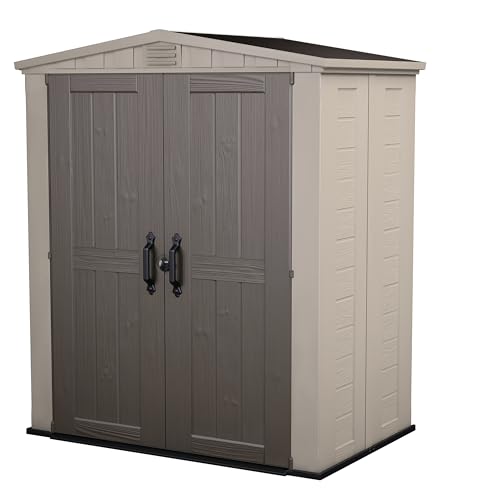
Keter Factor Storage Shed — Softens the Maintenance and Looks Cons
Best for: visible positions and low-upkeep households. Not suited for: maximum capacity at the lowest tier. The Factor family’s finished, wood-effect appearance answers the concern that a shed cheapens a garden, and resin construction keeps the maintenance pro fully intact. Its wide doors also soften the daily-access friction that makes some sheds annoying to live with.

Lifetime Outdoor Storage Shed — Softens the Organisation Con
Best for: households whose sheds tend toward chaos. Not suited for: buyers wanting the simplest possible kit. A shed filled badly is a shed whose pros evaporate, and Lifetime’s shelving-friendly, steel-reinforced resin designs are the category’s most direct answer: interiors designed to be organised, and manuals clear enough that the build con shrinks too.
Arrow Steel Storage Shed — Softens the Capacity-Per-Tier Con
Best for: buyers who need the most building their tier allows. Not suited for: anyone who will rush the assembly. Arrow’s metal range answers the cost-of-space problem head-on; its trade is the assembly con in its sharpest form. Choose it with a patient builder and a level slab and the exchange is fair; choose it casually and both cons arrive together.

Rubbermaid Roughneck Storage Shed — Softens the Durability Worry
Best for: working tool storage that will be knocked about. Not suited for: garden-ornament expectations. The Roughneck’s tough, simple character answers the anxiety that a resin shed is a delicate object. It is not the prettiest answer in this list and does not try to be; it is the one that treats daily use as the design brief.

Suncast Tremont Storage Shed — Softens the Flimsiness Worry
Best for: buyers whose chief con is the fear of a shed that feels temporary. Not suited for: households that may need to move the building later. The Tremont’s reinforced, substantial character is the premium-resin answer to the halfway-build wobble that unsettles first-time builders: the finished structure feels like a building because, in every way that matters to daily use, it is one.

YITAHOME Metal Storage Shed — Softens the First-Step Barrier
Best for: households whose con list is headed by the scale of the commitment itself. Not suited for: exposed sites without extra anchoring care. An entry-tier metal shed lowers the threshold of the whole decision — a real building for tools and overflow, against a wall, at the accessible end of the category — provided its owner pays the installation cons in full: level base, thorough anchoring, patient assembly.
How to Buy Smart
Buying smart, in a pros-and-cons frame, means purchasing mitigations along with the shed. Buy the base at the same time as the building, in money and in diary time, because the level foundation that decides door fit and water pooling is not an accessory. Buy the anchoring the design calls for, at the same moment, because the wind con is retired on installation day or not at all. Buy the interior — shelves, hooks, lidded bins — with the shed, because organisation bought late rarely happens. Check the rules before any of it, because the permit con is cheapest when it is still hypothetical. Choose the material for your climate and your household’s real patience, the size from a written inventory, and the tier for the site and the standards of your hands. And hold the expectation line this article has drawn: shed-dry, deterrent-locked, project-first. A buyer who does those things has, in effect, pre-answered the cons — which is what buying smart means in a category where the product and the installation are the same purchase. The step-by-step method is laid out in how to choose an outdoor storage shed, and the value verdict in is an outdoor storage shed worth it.
Setup and Care That Reduce the Cons
Setup is con-management in its purest form. Build the base flat and level, slightly larger than the footprint, on ground that drains. Assemble in the manual’s order with a helper, adjust the doors while the frame can still be squared, and anchor to the base or ground per the maker’s directions before loading anything in. Site with drainage and door swing in mind, and keep the rules confirmation in the project file. Each of those steps retires a named con from the list above; the build is the one moment when they are all cheap.
Care keeps them retired. Keep stored fuel and chemicals per their labels, in a ventilated part of the shed, latched or shelved away from children — which converts the hazard-storage question from a worry into a system. Wash resin and metal panels occasionally, renew wood coatings on schedule, keep vents and sliding tracks clear, clear roof debris, and check door alignment and anchor fixings each spring and after major storms. Store nothing wet, box anything precious, and keep the centre of the shed walkable so problems are seen early. None of this is onerous, and all of it is the standing difference between the pros column and the cons column in a particular household’s experience. For the smaller end of outdoor storage, the live roundups at garden hose reels for a tidier wall and raised garden beds for the working garden cover the companions most sheds end up serving.
The Pros and Cons Nobody Lists
Beyond the standard ledger sits a second, quieter one that owners mention in passing and listicles miss entirely. On the pro side: a shed disciplines buying. When storage has a defined, finite home, the household develops an instinct for what deserves the space, and the slow accumulation of duplicate tools and forgotten equipment — the kind that fills garages by stealth — meets a natural limit. A shed also protects the house itself in small ways: muddy, sharp, fuel-smelling things stop travelling through indoor rooms, paint and chemicals leave the under-stair cupboard, and the garage floor stops being a trip hazard of good intentions. And a shed is a surprisingly good neighbour: equipment housed is equipment invisible, and a plot with a tidy building on it raises the tone of a whole fence line.
On the unlisted con side: a shed can become a licence to keep things that should be discarded, because out of sight is a powerful anaesthetic for decision-making. Every household has items whose honest destination is donation, sale or the tip, and a shed lets those items retire comfortably instead of being decided about — the building fills, the capacity con arrives, and the real cause was never the shed’s size. A shed also concentrates risk in one small way worth naming: everything outdoors in one place means one storm, one leak or one break-in touches all of it at once, which is another argument for the anchoring, siting and insurance-mindedness this article has pressed. Finally, a shed quietly commits the household to its position: moving one is possible, especially in resin, but nobody describes it as fun, so the siting decision deserves the permanence it will probably have.
These unlisted entries share a theme: they are about the household, not the hardware. That is the deepest pattern in the whole pros-and-cons ledger, and it is why two neighbours can own the same shed and file opposite reports. The building is a constant; the base, the organisation, the expectations and the honesty about what deserves storing are the variables. A pros and cons article that pretended otherwise — that located every advantage and disadvantage inside the panels — would be tidier than this one and considerably less true.
How the Balance Shifts Over Time
The ledger is not static, and a fair weighing should say how it moves. In the first month, the cons dominate the felt experience: money spent, a weekend consumed, a garden disrupted, rules navigated. The pros at that stage are mostly promises. Through the first year the balance swings hard: the garage transformation lands, the first seasonal rotation runs through the shed instead of the house, the mower winters under a real roof, and the maintenance pro reveals itself by absence — nothing to paint, nothing to treat, nothing to do. Owners’ language changes in this period from project talk to infrastructure talk, which is the sound of the balance settling.
Over years, two slow cons test the settlement: capacity creep, as the house exports its overflow and the shed approaches the excavation threshold, and the small degradations of doors, tracks and fixings that ask for the spring check this article recommends. Both are manageable, and both punish neglect in the same currency — daily friction. The pros, meanwhile, mature rather than fade: a shed that has stood square and dry through several winters becomes part of how the household trusts its own systems. The long-run verdict the evidence supports is that the balance improves with time for maintained sheds and degrades for neglected ones, and the fork between those paths is chosen, cheaply, in the first season.
Safety: The Balanced View
Safety appears on both sides of this ledger and deserves a section that holds them together. On the pro side, a shed removes hazards from the house and concentrates them under management: sharp tools leave the hallway, the mower leaves the garage’s walkway, and fuel and chemicals leave indoor cupboards for a ventilated, lockable building where they can be stored per their labels, latched or shelved away from children, in one known place. A household that knows exactly where its hazardous items are, and keeps them there deliberately, is safer than a household whose hazards are distributed by accident. The lock that the cons section correctly calls a mere deterrent against thieves is, against a curious child, a genuinely effective barrier — the same hardware, two different threat models, and honesty requires crediting both.
On the con side, a shed introduces a structure that must be respected: it must be anchored against wind, built square so its doors behave, and kept organised so that heavy items are stored low and stable rather than stacked into an avalanche behind a door. A neglected shed — doors swinging unlatched, contents piled, chemicals forgotten in a hot corner — is worse than no shed, because it concentrates hazards and then abandons them. The balanced view is that a shed is a safety tool whose sign depends on its management, like a kitchen knife or a car. This cluster’s position, stated across all six articles, is that the management is neither difficult nor time-consuming; it is simply part of the purchase, and households unwilling to perform it should count that unwillingness honestly on the con side of their own ledger.
The Environmental Ledger
A complete weighing should include the environmental entries, which are genuinely mixed. On the con side, resin and metal sheds are manufactured, transported flat-packed buildings with a real production footprint, and a shed bought carelessly and replaced in a few years is an environmental own goal whatever it is made of. On the pro side, a durable shed protects equipment — mowers, tools, furniture — and protected equipment is replaced less often, which is where the larger footprint savings usually hide: the most sustainable object is the one that is not manufactured twice. A shed also enables the repair-and-keep culture — a place to store parts, maintain machines and mend things — over the discard culture, in a way that rarely gets credited.
The practical conclusion mirrors the rest of this article: the environmental balance is decided by longevity, and longevity is decided by the same unglamorous variables — base, anchoring, material matched to climate, maintenance performed. Buy once, buy at the tier your site demands, install it as a building, and a shed is a modest-footprint object that returns years of service and saves equipment along the way. Buy cheaply for a harsh site, skip the groundwork, and replace it after a storm, and every entry in this section flips sign. The environment, like the doors, reports the quality of the installation.
Worked Weighings: Three Households Decide
The two-car garage that held no cars. This household’s ledger was lopsided from the first line: the space-returned pro was worth more to them than every con combined, because two vehicles were living outdoors while their shelter housed boxes. They chose a mid-tier resin shed, spent their care on the slab and the anchors, checked their association rules before ordering — and found, as many do, that the rules were satisfied by the rear-fence position they wanted anyway. A year on, their reported cons are a door they adjusted once and a roof they clear of leaves. Their weighing is the category’s most common, and it is not close: when indoor space is genuinely scarce, the cons of a shed are mostly the cons of a weekend, and the pros are the cons of the previous decade, retired.
The exposed coastal plot. This household’s ledger balanced on a single con: wind. Their site took weather directly, and an unanchored lightweight shed there would not have been a purchase but a countdown. They weighed honestly — heavier building, lower profile, sheltered position behind the house, anchoring done to the maker’s directions and then checked after every storm of the first season — and concluded the pros survived the scrutiny, at a higher tier and with more groundwork than a sheltered garden would have demanded. Their case is the template for harsh sites: the cons do not disappear, they get priced, and the household decides whether the priced version still wins. For them it did. For a neighbour who could not face the groundwork, the same ledger honestly produced a deck box and a garage clear-out instead.
The townhouse with the tiny, perfect garden. This household wanted storage and loved their outdoor room in equal measure, and their weighing is the one this article most wants small-plot readers to copy. The space pro was modest — hand tools, a bike, seasonal boxes. The too-large con was enormous, because any walk-in building would have consumed the garden it served and quite possibly breached their association’s rules into the bargain. They chose a compact vertical shed against the side wall, a deck box for the rest, and spent the difference on the garden itself. Their verdict, in pros-and-cons terms, is that the category still served them — at the size where its pros outweighed its cons for their plot. A pros and cons article that only ever concludes buy the big one is a sales page; the honest ledger sometimes concludes smaller, and it is more trustworthy for it.
Bottom Line
The pros of an outdoor storage shed are structural and permanent: space returned, order imposed, equipment sheltered, upkeep minimal. The cons are real but front-loaded and largely governable: a project to install, rules to check, anchoring to do, and expectations to set at shed-dry and deterrent-locked. Households that govern the cons get the pros at full strength, which is why this category, judged whole, earns its place in so many gardens. Judge your own household against the profiles above, honestly, and the balance will tell you what to do.
If the balance tips toward buying, the neighbouring articles in this cluster will carry you the rest of the way: the buying guide for the decision order, the choosing guide for the step-by-step method, the reviews roundup for the owner evidence, and the worth-it analysis for the value argument in full. If the balance tips away — because the plot, the rules or the inventory say so — then this article has still done its job, because a pros and cons page that talks a household out of the wrong purchase has saved more than one that talks every household into the same one.
Keep the ledger, whichever way it falls: the entries that decided it for you this year are the first entries to revisit if the household, the plot or the rules change, because pros and cons are a snapshot of a situation, and situations — unlike sheds — rarely stand still.
The Everyday Balance Sheet for a Outdoor Storage Shed: Gains, Costs and Frictions
Advantages and disadvantages read differently once an item is in daily use, so this section weighs the outdoor storage shed the way a household experiences it over months rather than minutes. It focuses on the frictions, workarounds and quiet benefits that decide whether the balance stays positive.
Start With Your Space and Your Routine
Check the dimensions given in the listing against your own measurements rather than relying on the room name in a photograph, since staged photos routinely make Garden & Lawn pieces look smaller than they are. Write down the three tasks you will do most often with the outdoor storage shed and score each shortlisted option against those tasks alone, ignoring features you are unlikely to touch. Set the assembled outdoor storage shed up fully before deciding it is wrong for the space, since partly built or badly positioned pieces often look worse than they will once finished and levelled. A slight wobble, a stiff action or a small misalignment on day one rarely improves on its own, so address it during setup while adjustments are still easy to make.
If a disadvantage of the outdoor storage shed would appear daily and its advantage only occasionally, the honest balance tips against it for most households, however appealing the advantage looks in a listing. Equally, list what your old outdoor storage shed did well, because replacements sometimes quietly lose a virtue you relied on, such as a size, a shape or a simplicity the new model has redesigned away. Apply the same checks to each shortlisted example, whether that is the YITAHOME Metal Storage Shed; the Keter Factor Storage Shed; the Arrow Steel Storage Shed, because consistent testing is what makes the differences between models visible. If you are replacing an older outdoor storage shed, list what failed or frustrated you about it, and check each item on that list against the new listing before you order its successor.
When Small Problems Appear
Keep a short note of the questions each listing leaves unanswered, and treat a seller who answers them clearly as a better prospect than one who repeats general claims. Do not let a single impressive feature distract you from a basic mismatch in size, capacity or care needs, since basics decide satisfaction long after features stop being novel. Keep the fittings, spare parts and instructions that come with the outdoor storage shed together in one labelled place, because the part you need in a year is always the one that was put somewhere safe. Measure the space where the outdoor storage shed will live, including the clearance needed to use it, move around it and clean behind or beneath it, and keep those numbers beside you while you compare options.
Small problems are easiest to solve in order: check position first, then adjustment, then cleaning, and only then conclude that the outdoor storage shed itself is at fault. Separate the drawbacks you can fix, such as position or accessories, from the drawbacks built into the outdoor storage shed itself, because only the second kind should count heavily against it. Storage is part of ownership, so decide now where the outdoor storage shed, its accessories and its seasonal extras will go when they are not in use, and measure that space too. Households with children or pets put different demands on a outdoor storage shed than the listing photographs suggest, so judge edges, stability and cleanability against your real household, not a styled one.
Where the outdoor storage shed meets the floor, the wall or another surface, check what protects both sides, because scuffs and marks in those contact zones are the most common early complaint. If two options look nearly identical, compare the parts you will touch every day, since those contact points decide whether a outdoor storage shed feels solid or flimsy after the novelty wears off.
A Short Decision Checklist
- The material and finish, matched to light, moisture and wear in its spot
- The one feature you will not compromise on
- Packaging kept until the outdoor storage shed has passed its first trial in place
- Assembly needs, tools required and whether help is needed
- Where the outdoor storage shed and its accessories will be stored when not in use
- The measured space, including clearance to use and clean around the outdoor storage shed
- Who will use the outdoor storage shed most, and any limits they have
- What your current arrangement does badly that the outdoor storage shed must fix
Taken together, these checks take only a little time, yet they answer the questions that decide whether the outdoor storage shed suits your home, your household and your routine, and they do so before money changes hands rather than after.
Frequently Asked Questions
What is the single biggest disadvantage of a storage shed?
The installation burden, because it gates everything else. A shed requires a level base, a two-person assembly and proper anchoring before it can deliver any of its advantages, and each skipped step manufactures a later complaint — twisted doors from a poor base, damp from poor siting, storm damage from missing anchors. The encouraging news is that this con is one-time and entirely within the buyer’s control. Households willing to spend one careful weekend on groundwork retire the biggest disadvantage permanently; households unwilling should choose a smaller storage answer whose installation burden matches their appetite.
Are sheds worth it despite the cons?
For households with genuine outdoor overflow, yes — the value case is made in full in this cluster’s worth-it analysis. The pros engage weekly for years: space returned to the house, tools and equipment housed and findable, upkeep near zero for resin and metal. The cons concentrate at the beginning: one project, one rules check, one set of expectations to set correctly. A purchase whose costs are front-loaded and whose benefits recur is usually a good purchase, and a shed is the garden’s clearest example — provided the front-loaded costs are actually paid, in base, anchors and care, rather than deferred into complaints.
How bad is the damp problem, really?
Manageable, and widely misunderstood. A shed sheds weather rather than sealing it out, so driving rain, pooling water and condensation set real limits — but siting the shed where water drains away, building a level base, keeping vents clear, raising contents off the floor and boxing anything precious handles the ordinary case comfortably. The severe damp stories in this category trace overwhelmingly to poor siting and loose, wet storage rather than to failed panels. What a shed will never be is house-dry, and items that truly require that standard belong indoors regardless of the shed’s quality or tier.
Do the pros differ much between resin, metal and wood?
The core pros — space returned, order, shelter — are shared by all three materials. What differs is the supporting cast. Resin maximises the low-maintenance pro and the finished-look pro. Metal maximises capacity for the tier, at the cost of the sharpest assembly con. Wood maximises appearance and the pleasure of a building that accepts shelves and hooks anywhere, at the cost of a standing maintenance covenant. Choosing a material is therefore less about finding more pros than about deciding which cons your household minds least — which is exactly the kind of decision a pros and cons article exists to frame.
Can the cons be avoided by buying a premium shed?
Some soften; the structural ones do not. Premium tiers buy better hardware, clearer manuals, designed-in floors, vents and light, and a finish that answers the looks concern — all genuine improvements to daily experience. But a premium shed on an unlevel base still twists, an unanchored premium shed still answers to the wind, premium panels still shed rather than seal water, and the rules apply to premium sheds exactly as to entry ones. Money upgrades the building; only installation retires the big cons. Buy the best tier your use justifies, and spend the difference in standards on the groundwork first.
What is the most overlooked con?
The rules. Buyers research sizes, materials and models exhaustively and then discover — sometimes from a neighbour, sometimes from an inspector — that permits or homeowners association covenants governed the shed’s size, height or placement all along. Many areas regulate sheds, and the discovery is only painful because it comes late. A short check before ordering converts this con into a minor errand and occasionally into useful information that improves the siting decision itself. It is the cheapest con on the entire list to eliminate, and the one whose elimination buyers most often skip.