Disclosure: As an Amazon Associate, dailyhomedecorating.com earns from qualifying purchases. Links on this page are affiliate links; they cost you nothing extra. Prices and availability change often, so check the current Amazon listing before you buy.
This outdoor storage shed review takes a long, honest look at what a freestanding shed actually does for a household once the novelty of extra space wears off. A shed is one of those purchases that looks simple in a product photo and turns out to be a small building project in real life: it needs a level base, it needs anchoring, it lives outdoors in every season, and it has to swallow the awkward, dirty, bulky things that never quite fit in a garage. In this review we walk through design, materials, setup, day-to-day performance and long-term care, and we compare the main material families and a shortlist of well-known models, all described in prose so you can judge the fit before you check any current listing.
Key Takeaways
Best for: households whose garage, basement or spare room has run out of room for garden tools, seasonal decorations, outdoor cushions, sports kit and the general overflow of family life. A good shed gives those things a dry, lockable, organised home of their own and gives the rest of the house breathing room back.
Not suited for: anyone expecting a shed to behave like a bank vault, a climate-controlled room or a structure you can drop on uneven grass and forget. Sheds shed water rather than seal it out completely, they need a prepared base and proper anchoring, and in many areas they are regulated, so permits or homeowners association rules may apply before you install one.
The short verdict: the product category earns its place when you size it honestly, build the base properly, anchor it as the maker directs, and organise the inside instead of treating it as a dumping ground. Skip those steps and even a well-made shed disappoints.
In this guide
What an Outdoor Storage Shed Is and Where It Fits
An outdoor storage shed is a small freestanding structure, usually supplied as a kit of panels, doors and a roof, that stands in a garden, side yard or on a patio edge and stores the things that are too bulky, dirty or seasonal for indoor rooms. The category stretches from compact resin cabinets that hold a few long-handled tools up to walk-in buildings with room for a ride-on mower, workbench and shelving along both walls. Everything in between is a negotiation between footprint, headroom, door width and how much building work you are willing to do before the first box goes in.
Three material families dominate. Resin and plastic sheds, from makers such as Keter, Suncast, Rubbermaid and Lifetime, are moulded panels that click and screw together, resist rust, and shrug off the casual knocks of garden life. Metal sheds, from makers such as Arrow and YITAHOME, use coated steel panels on a frame; they tend to offer a lot of enclosed volume for the money and a more utilitarian look. Wood sheds are the traditional option, often built or supplied as timber kits; they look at home in a garden and can be painted to match a fence, but they ask for the most ongoing care. Each family has honest strengths, and the rest of this review keeps returning to the same question: which set of trade-offs matches your yard, your climate and your patience?
Where a shed fits in a household is worth thinking about before size. For gardeners it becomes the tool library and potting base. For families it absorbs bikes, scooters, pool kit and holiday decorations. For anyone with a garage that has slowly become a storage unit with a car squeezed in, a shed is the pressure valve that lets the garage go back to being a garage. What a shed is not is a place for anything that truly cannot get damp, hot or cold: paper archives, delicate electronics and heirloom textiles belong indoors, because a shed moderates the weather rather than defeating it.
If you are still deciding between a full shed and something smaller, our companion guides can help you compare scales: how to choose an outdoor storage box covers the deck-box end of the spectrum, and the outdoor storage shed buying guide walks through sizing and materials in decision order.
Outdoor Storage Shed Review: Design, Build and Setup
Design starts with the door. Most sheds use either hinged double doors, a single hinged door, or sliding doors on larger metal models. Double doors are the easiest to live with because they open the full front of the shed, letting you wheel in a mower or carry out a bulky box without threading it through a narrow gap. Sliding doors save swing space in a tight side yard but can collect grit in their tracks. Whatever the style, judge a design by whether you can get your single largest item through the opening with room to spare, because that one item decides whether the shed works at all.
Roof design matters more than it first appears. A pitched or gable roof sheds rain and snow better than a nearly flat one and adds headroom in the middle of the shed where you actually stand. Some resin models include skylight panels or small windows that make the interior usable without a torch, which sounds like a luxury until you are hunting for a specific tool on a grey afternoon. Ventilation is the quiet design feature that separates thoughtful sheds from damp boxes: louvred vents high on the walls let warm, moist air escape, slow condensation and make the interior far less musty for stored fabrics such as cushions.
Build quality shows in the panels and the frame rather than in any single headline feature. Resin panels with internal reinforcement feel solid and resist denting; thin, unsupported panels flex and drum in the wind. Metal sheds rely on the frame and on careful assembly to become rigid, and they reward patience during the build. Floors are a dividing line: some kits include an integral floor panel that keeps contents off the ground and helps square the structure, while others expect you to build on a slab or deck and provide your own floor. Neither approach is automatically better, but you need to know which you are buying before delivery day.
Setup is a two-person job for anything beyond the smallest cabinet, and it deserves a realistic slice of a weekend rather than a hopeful hour. Panels are large, light and awkward in a breeze, screws are numerous, and the structure only becomes stiff once the roof is on. Read the manual fully before opening the hardware bags, lay parts out in order, and keep fasteners in trays so nothing migrates into the grass. Most frustration in owner reports traces back not to the shed itself but to a rushed build on a base that was not ready.
That base is the single most important part of the whole project. A level base or foundation decides whether doors hang true, meet in the middle and latch without a fight, and it decides whether rainwater runs away from the shed or pools against its walls and floor edge. A shed set on sloping or soft ground slowly twists as the ground settles, and the first symptom is always the doors: gaps appear, latches misalign and one door starts to scrape. Concrete, paving slabs, a timber deck or a well-compacted gravel pad can all work when they are flat, level and slightly larger than the footprint. Grass and bare soil, on their own, cannot.
Anchoring is the second non-negotiable. An unanchored lightweight shed can shift or blow over in strong wind, and an empty resin or metal shed is at its most vulnerable in its first storm before your belongings add weight. Anchor the shed to its base or the ground exactly as the maker directs, using the anchor points and hardware the design provides for, and treat that step as part of the build rather than an optional extra. Before any of this, check permit and homeowners association rules for your area: many places regulate sheds by size, height, placement near boundaries and sometimes appearance, and it is far cheaper to learn the rules before installation than to move a finished building afterwards.
Performance in Real Use
Weather Resistance and the Honest Limits of Dry
A well-built shed on a level base keeps ordinary rain out and keeps stored things dry to the touch in most weather. The honest limit is that sheds are water-shedding structures, not sealed containers: driving rain forced sideways by wind, or standing water pooled against a wall, can find panel joints and door edges. Condensation is the other quiet source of moisture, forming on cool roof panels overnight and dripping onto whatever sits below. The practical answers are simple ones: site the shed where water does not collect, keep vents clear, raise anything precious off the floor on shelving or pallets, and use lidded plastic bins inside the shed for the items you care about most. Judged by that realistic standard, resin and metal sheds both perform well; judged by the standard of a house room, every shed fails, which is a failure of expectation rather than of the product.
Capacity and How Space Really Gets Used
Nominal capacity is a poor guide because sheds fill from the floor up and the corners die first. Long-handled tools lean and tangle, mowers claim a permanent parking space, and boxes stack until the thing you need is at the bottom. The sheds that feel generous are the ones with enough wall length for hooks and shelves, enough door width to move bulky items without a wrestling match, and enough headroom that you can stand inside and organise rather than crouch and throw. Planning the interior layout before you buy — mower here, shelves along this wall, hooks for tools there — turns a vague sense of size into a real test the shed either passes or fails. Households routinely underestimate how much they will store once a shed exists, because a shed creates its own demand: things that were scattered through the house migrate to it within a month.
Security and Everyday Access
Most sheds accept a padlock through a hasp or handle, and a locked shed deters casual, opportunistic access and keeps children away from sharp or heavy tools. It is not a safe, and it should never be sold to yourself as one: determined theft needs the layered answers of lighting, sightlines and insurance, not faith in a plastic door. Where sheds genuinely excel is organised access. When every garden item has a known place behind one door, the small frictions of outdoor life — finding the hose fitting, the pruning saw, the furniture covers — disappear, and that daily convenience, repeated hundreds of times a year, is where the product quietly earns its keep.
Storing Fuel and Chemicals Safely
Sheds commonly end up holding mower fuel, fertiliser, paint and garden chemicals, and those items set their own rules. Keep stored fuel and chemicals exactly as their labels direct, in a ventilated part of the shed rather than a sealed corner, in their original containers, and latched or shelved away from anywhere children can reach or open. Never treat the shed as a place to hide hazards from view and forget them: check containers seasonally for leaks or swelling, keep ignition sources and anything that sparks away from fuel storage, and dispose of old chemicals through your local scheme rather than letting them accumulate for years. A ventilated, organised shed makes this easy; a chaotic one makes it risky.
Strengths and Trade-Offs
Strengths
- Transforms cluttered garages and spare rooms by giving bulky outdoor things a dedicated home.
- Resin and metal models ask for very little maintenance once built — no painting, no treating, just washing and checks.
- Lockable doors keep tools tidy, deter casual access and put sharp equipment behind a latch children cannot casually open.
Trade-offs
- The purchase is only the start: base preparation, anchoring and assembly are real work that the headline product does not do for you.
- Weather protection is shedding, not sealing — driving rain, pooling water and condensation set honest limits.
- Size mistakes are expensive in both directions: too small fills instantly, too large eats garden and may trip local rules.
Models Worth a Closer Look
The models below are described in prose only, positioned by qualitative tier, so you can shortlist by material and character before checking any current listing. They are the same well-known names that recur throughout this cluster of guides, compared in more depth in outdoor storage shed reviews from owners.

Keter Factor Storage Shed — Premium Resin Pick
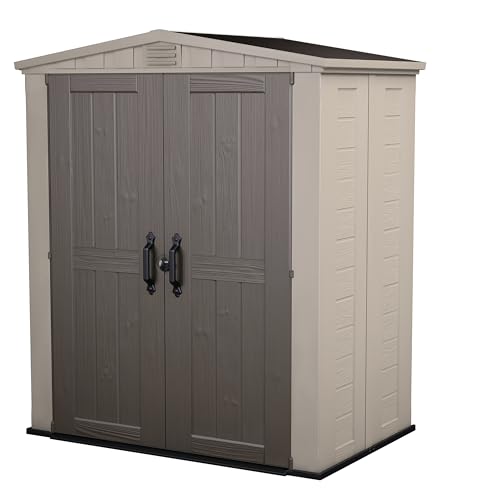
The Keter Factor family represents the polished end of resin design: wood-effect textured panels, a pitched roof with skylight-style light panels on many versions, and double doors that open wide. In use it feels more like a small garden building than a plastic box, which is exactly its appeal for visible positions near a patio. Best for: households wanting a tidy, low-maintenance shed that looks deliberate in the garden. Not suited for: buyers who want the lowest possible spend per unit of space, where plain metal usually wins.

Suncast Tremont Storage Shed — Premium Resin Alternative
The Suncast Tremont line is another premium resin option, known for reinforced wall panels, a sturdy floor on many versions and hardware that feels a step above basic kits. Assembly is methodical rather than quick, and the finished structure feels notably rigid. Best for: buyers who prioritise a solid, finished feel and plan to keep the shed for many seasons. Not suited for: anyone hoping to move the shed frequently, since a building of this character is happiest installed once, properly.

Rubbermaid Roughneck Storage Shed — Mid-Tier Workhorse
Rubbermaid’s Roughneck name has been attached to tough, no-nonsense storage for years, and the shed versions follow the same brief: durable resin panels, a practical layout and very little ceremony. It is the shed equivalent of a good work boot. Best for: tool-heavy households that value toughness and simplicity over garden-centre looks. Not suited for: buyers wanting windows, skylights and a furniture-like finish.

Lifetime Outdoor Storage Shed — Mid-to-Premium Family Pick
Lifetime sheds are steel-reinforced resin buildings with a reputation for thoughtful interiors — shelving and organisation features appear across the range — and for clear, well-illustrated manuals that make the build less daunting. Best for: families who will organise the interior properly and want the shed to help them do it. Not suited for: minimalists who want the simplest possible panel kit and nothing more.
Arrow Steel Storage Shed — Entry-to-Mid Metal Pick
Arrow is the classic name in metal sheds: galvanised steel panels on a frame, sliding or hinged doors depending on the model, and a lot of enclosed space for the tier. The build rewards patience and gloves, and the result is a functional, economical building. Best for: buyers maximising capacity on a budget who are comfortable with a careful, methodical assembly. Not suited for: anyone wanting a floor included by default or a soft-touch finish.

YITAHOME Metal Storage Shed — Entry-Tier Metal Alternative
YITAHOME’s metal sheds compete at the accessible end of the market with straightforward galvanised designs, often with sloped roofs that suit placing against a wall or fence. Best for: a first shed for tools and overflow where spend matters most. Not suited for: exposed, windy sites unless the base and anchoring are done with extra care, which is true of every lightweight shed but matters most at this tier.
How It Compares Across Materials
Resin versus metal is the comparison most buyers actually face. Resin sheds cost more for the same footprint but repay it in rust-free panels, quieter behaviour in rain, easier assembly and a friendlier look. Metal sheds give more space per pound or dollar spent, tolerate being tucked into utilitarian corners, and their weakness is assembly effort and a greater tendency to condensation if vents are ignored. Wood wins on appearance and on how naturally it accepts shelves, hooks and repairs, and loses on upkeep: it wants paint or treatment and a watchful eye for rot at the base. There is no universal winner; there is only the match between material and the person who will build it, site it and live with it. Our step-by-step companion, how to choose an outdoor storage shed, turns this comparison into a decision sequence.
Against the alternatives, a shed also compares well. A deck box is cheaper and simpler but holds a fraction of the volume and nothing tall; the two work best as a pair, box by the patio for cushions, shed for everything else, as explored in the outdoor storage box buying guide. Renting storage space off-site moves the problem rather than solving it and charges you monthly for the privilege of driving to your own belongings. A garage extension beats a shed on every quality measure except cost, effort and planning permission. For most households the shed sits in the sweet spot: a real building, at a fraction of construction cost, that can be installed in a weekend once the base is ready.
Who Should Buy One and Who Should Skip It
Buy a shed if your garage or indoor storage is genuinely full, if garden tools currently live in a damp corner or a hallway, if seasonal items migrate painfully between loft and living space twice a year, or if you are planning garden projects that need a permanent tool base. Buy one, too, if you can commit to the unglamorous foundations: a level base, anchoring, and a quick check of the permit and homeowners association rules that apply to your plot.
Skip it, for now, if the things you need to store must stay perfectly dry and temperature-stable, if your outdoor space is so tight that a shed would consume the garden it serves, or if local rules prohibit the size you actually need — in which case a combination of deck boxes and indoor reorganisation is the honest answer. Also skip the bargain-basement end of the market if your site is exposed: the savings evaporate the first time a storm tests an unanchored, lightly built shed.
Before buying, run this checklist: measure your largest item and confirm the door opening beats it; walk the intended site after rain and check for pooling; confirm the base you will build and its cost in time; check the rules; decide the interior layout on paper; and choose the material family before comparing models, because material decides maintenance for the life of the shed. For smaller overflow, the live guides at best outdoor storage boxes for a patio top-up and deck boxes for cushions cover the compact end honestly.
Setup, Care and Maintenance Essentials
Setup follows a fixed order that should never be improvised: prepare and level the base; confirm the shed will sit square on it; build the floor and walls per the manual; fit the roof; hang and adjust the doors while the structure can still be nudged square; then anchor the shed to the base or ground as the maker directs. Test the doors after anchoring, not just before, because tightening anchors can pull a frame slightly and the latch will tell you if it has.
Care is refreshingly light for resin and metal. Wash panels down once or twice a year, clear leaves and standing debris from the roof and the base edge, keep vents unobstructed, and check door alignment and anchor fixings each spring and after any major storm. Lubricate hinges and lock hasps occasionally, keep sliding door tracks swept clean, and trim back vegetation that traps damp against the walls. Wood sheds add repainting or treatment on the maker’s schedule and a check for soft spots at the base. None of this is burdensome; all of it is the difference between a shed that feels new at year five and one that feels tired at year two.
Inside, maintenance means organisation: heavy items low and near the walls, fuel and chemicals stored per their labels in a ventilated spot away from children’s reach, fabrics in lidded bins, and a floor kept clear enough that you can see a leak or a pest problem early. A shed you can walk into is a shed you will keep; a shed you can only throw things into becomes a very expensive cupboard of regrets. The weighing-up behind that habit is covered in outdoor storage shed pros and cons and is an outdoor storage shed worth it.
A Season-by-Season Performance Diary
Spring is when a shed earns its reputation. This is the season of maximum traffic: the mower comes out of hibernation, hand tools rotate constantly, seed trays and pots move in and out, and the doors open many times a day. A shed with wide double doors and a sensible layout feels effortless now; a shed with a narrow door and a mower parked across it feels like an obstacle course. Spring is also when winter’s lessons become visible — a door that scraped in February because the ground shifted, a damp patch in the corner where meltwater pooled, fixings that loosened over freeze and thaw. The households that stay happy with a shed treat early spring as inspection season: check the anchors, confirm the base still reads level, oil the hinges, and fix small misalignments while they are still small.
Summer tests heat and organisation. A closed shed in full sun becomes warm inside, which most garden contents tolerate easily but which argues for keeping the vents clear and for thinking twice before storing anything heat-sensitive, from candles to certain chemicals, whose labels will tell you their limits. Summer is also cushion and entertaining season, when the shed becomes the backstage of outdoor life: furniture covers, games, pool kit and barbecue tools cycle through it weekly. This is where the pairing of shed and deck box proves itself — everyday items near the seating in the box, everything else in the shed — and where a lockable door quietly matters on evenings when the garden is full of guests and children.
Autumn is the great intake. Furniture is cleaned and put away, the mower does its last cuts, tools are wiped down, and seasonal decorations rotate. Sheds fail in autumn not from weather but from volume: everything arrives at once, and a shed without shelves becomes a pile with a roof. The owners who cope best stage the intake — clean and dry everything before it goes in, because storing damp cushions or a wet mower builds the musty, mouldy interior people blame on the shed itself. Autumn is also the last comfortable window to re-level a settling corner, clear the roof of leaf build-up and confirm the anchors before winter storms arrive to test them.
Winter is the audit. Wind is the headline risk, and it is the season that punishes every shortcut: the unanchored lightweight shed that shifted in a gale, the door left unlatched that worked itself open and banged for a night, the base edge where standing water froze against the wall. Snow load argues for pitched roofs in colder regions and for clearing exceptional accumulations rather than assuming. Inside, winter is when condensation management matters most, because warm daytime air and cold nights are the recipe for moisture on roof panels; vents left clear and contents kept off the floor in bins carry most households through without drama. A shed that comes through winter square, dry and unshifted has proven its installation, which is why experienced owners judge a shed after its first winter, not its first weekend.
Inside the Shed: Organisation Systems That Work
The difference between a shed that serves you and a shed that swallows things is almost entirely interior organisation, and it costs more thought than money. Start with zones, decided before the first item goes in: a parking zone for wheeled equipment near the door, a wall zone for long-handled tools on hooks or in a corner rack, a shelving zone for bins and smaller items, and a hazard zone — high, latched and ventilated — for fuel and chemicals, stored per their labels and away from children’s reach. Zones survive because they match how items are used; a layout drawn from your actual routines beats a generic diagram every time.
Vertical space is the shed’s free capacity. Walls that hold hooks, rails and shelves double the useful storage of the same footprint and keep the floor clear, which in turn keeps air moving and lets you spot a leak or a spill immediately. Resin sheds often provide for their own shelving systems or accept free-standing shelf units happily; metal sheds usually take free-standing units best. Either way, measure the interior after the build, not from the brochure, because wall ribs and roof braces steal small amounts of space that matter to shelf fit.
Bins deserve their own word because they are the real weatherproofing. A lidded plastic bin inside a shed is dry in a way the shed alone never promises to be, and a household that bins its cushions, fabrics, decorations and paperwork-adjacent items gets house-level protection at shed-level cost. Label the bins on the end that faces the door, keep a simple inventory note on the inside of the door if your household is large, and resist the anonymous black bag, which is where stored things go to be forgotten and rediscovered ruined.
Finally, keep a working margin. A shed filled to one hundred percent of its volume is a shed you cannot use, because every retrieval becomes an excavation. Aim to keep the central floor and the doorway permanently clear, treat roughly a fifth of the space as circulation rather than storage, and let that discipline decide when the honest answer to a new purchase is a clear-out rather than a bigger building. This is the point the value discussion in this cluster keeps returning to: the shed pays when it stays usable.
Common Owner Complaints, Diagnosed Honestly
Read enough owner feedback across the category and the same complaints recur — and most of them trace back to installation or expectation rather than to defects. The first is doors that will not close properly after a few months. The cause, almost every time, is a base that was never level or ground that settled, twisting the frame until the doors misalign; the cure is re-levelling the base and re-squaring the structure, and the prevention was the afternoon spent on the foundation at the start. The second complaint is damp: contents found musty or spotted. The diagnosis is usually condensation plus storage habits — items put away wet, vents blocked by shelving, precious things left unboxed on the floor — rather than rain pouring through panels.
The third recurring complaint is that the shed feels flimsy during assembly. Panel kits genuinely do feel insubstantial halfway through the build, because rigidity arrives only when walls, roof and floor are all connected; judging a kit at the halfway stage is like judging a tent with half its poles missing. The fourth is size regret, expressed in both directions within the same product’s feedback, which tells you it is a planning failure rather than a product failure: households that inventoried first rarely join in. The fifth, and the only one that regularly is a product issue, is hardware quality on the cheapest kits — hinges, hasps and fasteners that feel thin. That is the honest dividing line between tiers, and it is why the mid-tier workhorses in this review earn their place: not glamour, but hardware that still feels sound after years of daily use.
Delivery, Kit Contents and Build Day Realities
A shed arrives as one or more large, heavy flat-pack cartons, and the first practical question is whether they can travel from the kerb to the building site: through a side gate, down a path, perhaps up steps. Measure that route before ordering, arrange help for the carrying, and plan a dry, flat place to stage the panels, because a kit stored leaning against a fence in the rain for a month starts its life at a disadvantage. Check the cartons on arrival for transit damage and open them promptly to confirm the contents against the parts list; discovering a missing bracket on build morning, with two helpers standing by, is a small domestic tragedy that a ten-minute check the week before prevents entirely.
Know what the kit does not include, because the extras are where budgets quietly grow: the base itself, anchoring hardware in some cases, a padlock, shelving, and occasionally the floor. None of these are hidden costs in any dishonest sense — listings and manuals describe them — but a buyer comparing two sheds on headline appeal alone can miss that one includes a floor and anchor points while the other expects a slab and a separate hardware purchase. Build day itself rewards an early start, a charged drill driver with a spare battery, gloves for metal panels, and the discipline to stop rather than force a part that will not sit: a panel that resists is almost always a panel in the wrong position or a structure slightly out of square, and force converts a solvable puzzle into a bent part.
Disposal and the long view close the practical picture. Panel kits generate a surprising volume of packaging; plan its removal. Keep the manual, a note of the model and a small bag of spare fasteners in the shed itself, because the person who needs them in year four is you. And photograph the finished installation — base, anchors, door fit — for your own records: if a storm ever does test the shed, those photos are the difference between a clear insurance conversation and a vague one.
How This Review Judged the Category
Because this wave of guides is written prose-first, with product verification still pending, this review judges the category by the criteria that decide real ownership rather than by laboratory claims. First, installation honesty: how much work the product quietly assumes — base, anchoring, help, time — and whether that work is clearly signposted before purchase. Second, structural common sense: whether panels, frame, roof and doors form a system that becomes rigid when assembled, and whether the design gives water an obvious path off and away. Third, daily usability: door opening against the largest common loads, headroom where you stand, light and ventilation inside, and hardware that invites daily use rather than discouraging it.
Fourth, maintenance burden over years rather than weeks: whether the material asks for nothing but washing, or for coatings and vigilance. Fifth, safety and rules: anchoring provision, lockable access, sensible storage of fuel and chemicals per their labels, and the permit and association questions every buyer should settle first. Sixth, value in the qualitative sense used throughout this cluster — entry, mid and premium tiers judged on what the extra money visibly buys in hardware, finish and thoughtfulness, never on a number printed here. A shed that scores well on those six measures is a shed a household keeps happily; the brand on the door matters less than the pattern of answers, which is exactly why the companion pieces in this cluster — the buying guide and the step-by-step choosing guide — are organised around criteria first and models second.
Final Verdict
An outdoor storage shed is one of the highest-leverage purchases a crowded household can make, provided it is treated as a small building rather than a big box. Choose the material for your climate and patience, size it from your largest item and your honest inventory, build the base level, anchor it against the wind, respect the local rules, and organise the interior from day one. Do those things and the shed repays you every week for years. Do none of them and no brand name will save the experience.
Related reading for the practical side of the yard: garden hoses that need a home covers one of the very things most sheds are bought to hold.
One last perspective for households still hesitating: a shed is unusual among home purchases in that its value compounds quietly. The garage stays usable, the garden tools stop rusting in a corner, the seasonal rotation stops being a twice-yearly upheaval, and the house itself feels calmer because the overflow has a proper address. None of that shows up in a product photograph, and all of it shows up in the second year of ownership, which is the year this category should be judged by. Buy for year two — the base, the anchors, the door width, the interior plan — and year one will take care of itself.
That is also the standard this review would apply to any individual model a reader is weighing right now: not how it photographs, not how it is described, but how it will behave in its second year on your ground, in your weather, under your household’s habits. A shed that passes that test on paper — level base planned, anchors provided for, doors sized to your largest load, interior zoned before it is filled — is a shed worth ordering. One that fails it will fail it expensively and in person, which is the only outcome this entire cluster of guides exists to prevent.
Under the Surface: The Outdoor Storage Shed Details That Decide Long-Term Satisfaction
Listings present a outdoor storage shed at its best, so this section slows the assessment down and looks at the evidence an individual model offers: its construction, its finish, its listing detail and the checks you can run before and just after it arrives. The aim is a verdict based on inspection rather than impression.
Start With Your Space and Your Routine
Keep the care routine simple enough to repeat: a outdoor storage shed that needs ten minutes of attention weekly will usually get it, while one that needs an hour monthly often gets none. Look for the detail photographs in the listing, not just the wide shots, and zoom in on edges, joints, fasteners, controls and finishes, which is where build quality usually shows itself first. If you shop with someone else, agree the must-haves together before looking, so that the outdoor storage shed you choose is a shared decision rather than one person’s compromise discovered later. Check the dimensions given in the listing against your own measurements rather than relying on the room name in a photograph, since staged photos routinely make Garden & Lawn pieces look smaller than they are.
A closer look at any single outdoor storage shed should start with the unglamorous evidence: the underside, the back, the inside and the fittings, because review photographs concentrate on the angles that flatter it most. Beware of choosing a outdoor storage shed for a rare occasion, such as a large gathering once a year, if that choice makes everyday use worse for the other fifty-one weeks. Apply the same checks to each shortlisted example, whether that is the Arrow Steel Storage Shed; the YITAHOME Metal Storage Shed; the Rubbermaid Roughneck Storage Shed, because consistent testing is what makes the differences between models visible. A return is easiest when you have kept the packaging until you are sure, so give the outdoor storage shed a fair trial period in its real position before you break down boxes and dispose of padding.
When Small Problems Appear
Take a break between shortlisting and ordering if you can, and return to the listings with fresh eyes, because fatigue makes almost any outdoor storage shed look acceptable late in a long search. Plan where the packaging and any old item being replaced will go on delivery day, a small step that prevents a rushed, careless first setup of the new outdoor storage shed. Think about who else will use the outdoor storage shed, how often, and in what way, because a choice that suits one person perfectly can frustrate everyone else in the household. Where the outdoor storage shed meets the floor, the wall or another surface, check what protects both sides, because scuffs and marks in those contact zones are the most common early complaint.
Measure the space where the outdoor storage shed will live, including the clearance needed to use it, move around it and clean behind or beneath it, and keep those numbers beside you while you compare options. When you examine a outdoor storage shed in detail, work from the largest element to the smallest, checking overall proportions first, then construction, then finish, and only then the small features sellers emphasise. Equally, list what your old outdoor storage shed did well, because replacements sometimes quietly lose a virtue you relied on, such as a size, a shape or a simplicity the new model has redesigned away. Take a photograph of the space before you order and mark the intended position of the outdoor storage shed on it, then revisit that photo whenever a listing tempts you toward a larger or different style.
Read the listing for what it does not say as carefully as for what it does, because missing information about materials, assembly or care is itself a useful signal when you compare outdoor storage shed options. If the outdoor storage shed will be seen every day, its proportions matter as much as its function, so hold the listing dimensions up against a familiar piece nearby to judge the visual weight honestly. Where the outdoor storage shed has moving parts, work them through their full range during your first checks, listening and feeling for roughness that a photograph cannot show.
A Short Decision Checklist
- The material and finish, matched to light, moisture and wear in its spot
- The one feature you will not compromise on
- Assembly needs, tools required and whether help is needed
- Packaging kept until the outdoor storage shed has passed its first trial in place
- Delivery path, from the door to the final position
- How the outdoor storage shed will be cleaned in an ordinary week
- What your current arrangement does badly that the outdoor storage shed must fix
- Where the outdoor storage shed and its accessories will be stored when not in use
Taken together, these checks take only a little time, yet they answer the questions that decide whether the outdoor storage shed suits your home, your household and your routine, and they do so before money changes hands rather than after.
Frequently Asked Questions
Do I need a permit for an outdoor storage shed?
Often, rules apply even when a formal permit does not. Many areas regulate sheds by size, height and distance from boundaries, and homeowners associations frequently add their own conditions about placement and appearance. The only safe answer is to check your local rules and any association covenants before you order or install, because moving a finished shed to satisfy a rule is miserable work. State the plain version to yourself: yes, sheds are commonly regulated, and checking first is part of the project, not red tape to dodge.
What is the best base for a storage shed?
The best base is the one that is flat, level, stable and slightly larger than the shed: concrete, paving slabs, a sound deck or a properly compacted gravel pad all qualify. A level base decides whether doors hang true and latch cleanly, and whether water runs away or pools against the walls. Bare grass and soil fail on every count because they settle unevenly, and the shed twists with them. Spend your effort here before anywhere else; it is the cheapest quality you will ever buy for this product.
Will a shed keep everything completely dry?
It will keep things dry in the ordinary sense — normal rain stays out of a well-built, well-sited shed — but no shed is a sealed vault. Driving rain and standing water can find joints, and condensation can form inside on cool nights. Keep vents clear, site the shed away from pooling water, raise stored items off the floor, and put anything precious in lidded bins inside the shed. That layered approach, rather than faith in the panels alone, is what actually protects your belongings.
How important is anchoring, really?
It is essential, not optional. A lightweight shed, especially an empty one, presents a large flat surface to the wind and can shift, lift or blow over in strong gusts if it is not fixed down. Anchor the shed to its base or the ground exactly as the maker directs, using the anchor points provided, and re-check the fixings after severe weather. The ten minutes anchoring takes is the cheapest storm insurance in the whole project, and skipping it is the most common cause of catastrophic shed failures.
Can I store petrol and garden chemicals in a shed?
Yes, with discipline. Keep fuel and chemicals in their original containers, follow the storage directions on their labels, place them in a ventilated part of the shed, and keep them latched or shelved where children cannot reach or open them. Check containers seasonally for leaks, keep ignition sources away from fuel, and clear out aged chemicals through local disposal schemes. A shed concentrates your hazardous items in one lockable place, which is a safety benefit only if the organising is done properly.
How long does assembly usually take?
Plan on a substantial part of a weekend for a walk-in shed, with two people, once the base is ready — and the base itself may take its own session beforehand. Small cabinets are quicker; large metal kits are slower because of the sheer number of panels and fasteners. The variables are preparation and temperament: parts laid out in order, the manual read in advance and hardware kept in trays will save more time than any shortcut taken mid-build. Rushing a shed build is how panels get forced and doors end up misaligned.