Disclosure: As an Amazon Associate, dailyhomedecorating.com earns from qualifying purchases. Links on this page are affiliate links; they cost you nothing extra. Prices and availability change often, so check the current Amazon listing before you buy.
Reading outdoor storage shed reviews one at a time can leave you more confused than you started, because one household calls the same shed brilliant and the next calls it flimsy — and both are usually telling the truth about different installations. This roundup steps back and reads the category the way an editor should: looking for the patterns that repeat across many owners, many brands and many seasons, separating the praise that holds up from the complaints that turn out to be self-inflicted, and finishing with prose mini-reviews of the best-known models so you can match a shed to your yard, your climate and your tolerance for DIY.
Key Takeaways
The pattern in one sentence: owners who prepare a level base, anchor the shed properly and size it from a real inventory report years of quiet satisfaction, while nearly every bitter review in the category begins with a skipped base, a rushed build or a shed bought one size too small.
Best for: households drowning in garage overflow, garden tools and seasonal clutter who want a lockable, weather-shedding building of their own. Not suited for: anyone who needs guaranteed dry, temperature-stable storage, or who cannot — because of space, rules or inclination — do the groundwork a shed demands. If you want the single-product deep dive instead, start with our full outdoor storage shed review; this piece is about the crowd’s experience across the whole category.
One more takeaway before the detail: reviewers almost never regret the unglamorous spending — the base materials, the anchor kit, the shelving, the second pair of hands on build day. The regrets in this category attach to glamour decisions made carelessly and groundwork decisions skipped entirely. Read the sections that follow with that lens and the whole corpus, with all its contradictions, resolves into a remarkably clear picture of what to do and what to avoid.
And a word about the limits of reviews themselves, since this article is built from them: a review corpus can tell you how a category behaves, where it fails and what its owners wish they had known, but it cannot tell you which shed belongs on your plot, because no reviewer has stood in your garden after your rain. Use the patterns here to form your questions — about base, anchors, doors, rules and organisation — and then answer those questions on your own ground. The corpus narrows the field; the site decides it.
In this guide
Outdoor Storage Shed Reviews: What Owners Praise Most
The most consistent praise in shed reviews is not about any panel or roof; it is about reclaimed space. Owners describe garages that fit cars again, hallways cleared of tools, and seasonal decorations that stop migrating through the house twice a year. That transformation is the product’s real deliverable, and it explains why satisfaction tends to rise in the second year: the shed stops being a purchase and becomes infrastructure. Reviewers who organise the interior from day one — shelves along a wall, hooks for long-handled tools, lidded bins for fabrics — praise the same shed far more warmly than reviewers who filled the floor and called it done, which tells you the interior plan is part of the product whether the maker sells it or not.
The second praise theme is low maintenance, and it belongs mostly to resin. Owners of resin sheds from Keter, Suncast, Rubbermaid and Lifetime repeatedly describe a ownership rhythm of washing the panels down occasionally, clearing leaves off the roof and otherwise forgetting the building exists. Metal shed owners praise capacity for the tier and a utilitarian toughness, accepting a more involved build as the price. Wood owners praise looks and the ease of adding hooks and shelves to timber walls. Notice the pattern: each material’s owners praise exactly what that material is for, which is the strongest evidence in the whole category that choosing the material family first, before models, is the right order of decisions.
Third comes the door. Reviews glow about wide double doors that swallow a mower or a stack of storage boxes without a sideways shuffle, and grumble with remarkable consistency about narrow single doors and sliding tracks that collect grit. Light inside matters more than listings suggest: sheds with skylight panels or windows collect praise for being usable without a torch, while windowless sheds collect a steady trickle of annoyance that has nothing to do with storage capacity. Ventilation earns quieter praise — the absence of mustiness is only noticed when a reviewer compares a vented shed with a previous unvented one — but it is praise all the same, and it is why experienced buyers look for louvred vents high on the walls.
What Owners Complain About — and What It Really Means
The loudest complaint in shed reviews is doors that stop meeting properly: gaps at the top, a latch that needs lifting to engage, one leaf scraping the floor. Read closely and the story is nearly always the same — the shed stands on grass, soil or a base that was eyeballed rather than levelled, the ground settles unevenly, and the frame twists a few millimetres that the doors amplify into a visible failure. A level base or foundation is what decides door fit, and it also decides whether rainwater runs away from the walls or pools against them, which is why the second complaint — damp — so often shares an address with the first. Sheds sited where water pools get wet floors at the wall edge no matter how good the panels are.
Damp deserves an honest paragraph of its own. Owners who expected a shed to be a sealed, house-dry room report betrayal; owners who understood that a shed sheds weather rather than defeating it report satisfaction with the same buildings. Driving rain can find joints, standing water can creep under walls, and condensation forms on cool roof panels and drips. The reviewers who solved damp did it with siting, vents left clear, contents raised off the floor and lidded bins for anything precious — a layered approach, not a different brand. When you read a damp complaint, ask what the shed was standing on and what was stored loose on its floor before you blame the maker.
Assembly complaints form the third theme, and they split by material. Resin kits attract comments about panels that feel flexible until the roof locks everything together — a normal stage of the build that reads as flimsiness if you judge it halfway. Metal kits attract the sharper complaints: many panels, many fasteners, sharp edges that demand gloves, and instructions that reward a slow, methodical temperament. Across both, the reviewers who laid parts out in order, read the manual first and kept two people on the job report a merely long day; reviewers who improvised report a miserable one. The shed is rarely the variable. The preparation is.
The fourth theme is wind, and it is the one complaint category where sympathy runs out. An unanchored lightweight shed can shift or blow over in strong wind — this is stated plainly by makers and repeated in the saddest reviews in the category, usually involving an empty new shed and its first storm. Anchoring to the base or ground per the maker’s directions is part of the product, and reviews written by owners who skipped it are reviews of a decision, not of a shed. Closely related are the rule complaints: owners who discovered after installation that permits or homeowners association rules regulated their shed’s size or placement. Many areas regulate sheds, and the time to learn that is before the base is poured, a point this cluster repeats deliberately in the outdoor storage shed buying guide.
The Models, Reviewed in Prose
The six models below are the names that dominate owner discussion in this category. Each mini-review is prose-only, positioned by qualitative tier, and summarises the character owners describe rather than any specification sheet. For the decision framework behind them, see how to choose an outdoor storage shed.

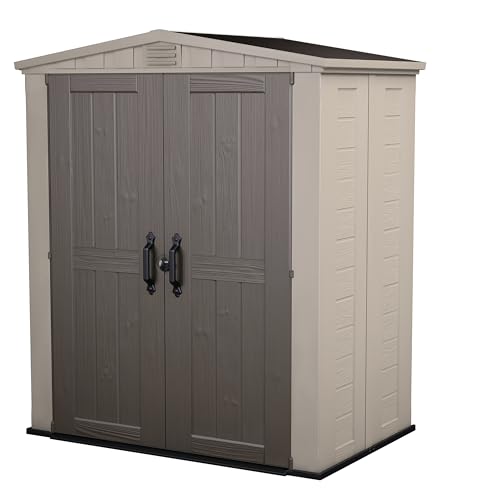
Keter Factor Storage Shed — Premium Resin
Best for: visible garden positions where the shed must look intentional. Not suited for: buyers maximising volume per unit of spend. Owner discussion of the Factor family centres on finish: the wood-effect panels and pitched roof make it read as a small garden building, and the wide double doors collect the category’s favourite praise. Build reports describe a systematic kit that becomes satisfyingly rigid once complete. The recurring caveat is the familiar one — it wants its level base, and owners who gave it one report the doors still meeting sweetly years later, while the minority who did not wrote the category’s standard door complaint under a premium badge.

Suncast Tremont Storage Shed — Premium Resin
Best for: buyers who want the most solid-feeling resin build they can get. Not suited for: anyone planning to relocate the shed later. Tremont reviews emphasise substance: reinforced-feeling walls, a floor that is part of the structure on many versions, and hardware that owners describe as a cut above basic kits. Assembly is reported as a proper project rather than an afternoon, and the finished building earns the word sturdy more often than most. As with every shed in this roundup, the satisfied owners are the anchored, level-based ones; the design gives you the anchor points and expects you to use them.

Lifetime Outdoor Storage Shed — Mid-to-Premium Family Favourite
Best for: organised families who will use shelving and interior systems. Not suited for: buyers wanting the absolute simplest panel kit. Lifetime’s steel-reinforced resin sheds draw praise for two things reviewers mention together: clear manuals that make a big build feel manageable, and interiors designed for organisation rather than mere enclosure. Owners who garden seriously tend to settle on this family, because the shed supports hooks, shelves and zones instead of fighting them. Complaints, when they come, are about build time — there is a lot of shed here — rather than about the result.

Rubbermaid Roughneck Storage Shed — Mid-Tier Workhorse
Best for: tool storage where toughness beats charm. Not suited for: buyers wanting windows and a furniture-like finish. Roughneck owner feedback is the most blue-collar in the category: the sheds are described as tough, simple and unbothered by knocks, with little ceremony about appearance. Reviewers who bought it as a working tool store are content; the rare disappointed reviews come from buyers who expected garden-building looks from a product that never promised them. It is the clearest illustration in this roundup that matching expectations to tier matters as much as the tier itself.
Arrow Steel Storage Shed — Entry-to-Mid Metal
Best for: maximum enclosed space on a careful budget. Not suited for: impatient builders or anyone expecting an included floor by default. Arrow reviews are the category’s most polarised, and the split is almost perfectly explained by temperament: methodical builders with gloves, patience and a level slab describe an economical, capacious building that serves for years, while rushed builders describe a forest of panels and fasteners. The product has not changed between those reviews; the afternoons have. If your household contains a patient builder, Arrow’s value is real. If it does not, the resin workhorses will make you happier.

YITAHOME Metal Storage Shed — Entry-Tier Metal
Best for: a first shed for tools and overflow against a wall or fence. Not suited for: exposed sites without extra care on base and anchoring. YITAHOME’s sheds attract first-time buyers, and their reviews repeat the entry-tier lesson: the building is honest for its tier, and outcomes hinge on installation. Owners who sited the sloped roof against a wall, built a level base and anchored thoroughly report a serviceable tool store; owners who treated it as a pop-up tent wrote the predictable storm and door reviews. At this tier more than any other, your installation is the product.
Strengths and Trade-Offs Across the Category
Strengths
- The transformation is real: garages, spare rooms and hallways genuinely get their space back.
- Resin and metal models settle into a wash-and-check maintenance rhythm that owners describe as nearly effortless.
- Lockable doors, sensible siting and organised interiors turn scattered outdoor clutter into one managed place.
Trade-offs
- Every shed is a project before it is a product: base, build, anchoring and a check of local rules come first.
- Weather protection means shedding, not sealing — driving rain, pooling water and condensation set the honest limits.
- Assembly quality is partly yours; the same kit earns opposite reviews from different builders.
The balanced version of this debate, organised as arguments rather than owner stories, lives in outdoor storage shed pros and cons, and the money-and-space verdict is in is an outdoor storage shed worth it.
How to Read Shed Reviews Without Being Misled
Since this roundup exists because individual reviews mislead, here is the reading method it used, offered so you can apply it to any listing you check next. First, filter for installation: a review that mentions the base, the anchoring or the build process is worth five that do not, because it tells you the conditions behind the verdict. Second, translate complaints into causes — door gaps mean movement, mustiness means moisture management, flimsiness mid-build means a kit judged before it became a structure. Third, weight reviews by time: a shed praised after winters and storms has been tested by the only laboratory that matters, while a review written on delivery day is a review of packaging and hope.
Fourth, watch for expectation mismatches dressed as product faults: the buyer who wanted a dry room, a security vault or a garden ornament from a working storage building will be disappointed by every brand equally, and their review tells you about the gap, not the shed. Fifth, notice what is never complained about. Across the category, owners almost never regret buying the larger of two sizes they debated, almost never regret the afternoon spent levelling the base, and almost never regret choosing the material that matched their maintenance appetite. The regrets cluster on the opposite choices. A review corpus is a map of other people’s tuition payments; read it that way and you get the education free.
Sixth, be suspicious of perfection in either direction. A shed with nothing but glowing short reviews has probably not met a winter yet, and a shed with nothing but fury has probably met a lot of unlevel grass. The truth of this category lives in the long, specific, mildly grumpy-but-satisfied middle: doors that needed one adjustment, a corner that wanted re-levelling, a roof that wants its leaves cleared — and a building that, season after season, simply does its job. That is the profile of every model in the mini-reviews above at its best, and it is achievable with any of them if the installation is right.
Setting Up for the Reviews You Want to Write
The practical section of this roundup is short because the category’s lessons are short; they are just non-negotiable. Prepare a level base or foundation — concrete, slabs, a sound deck or a compacted gravel pad — slightly larger than the footprint, on ground that does not pool water. Check permit and homeowners association rules before you install, because many areas regulate sheds and it is far better to know first. Build with a helper, in the manual’s order, without forcing parts. Anchor the shed to the base or ground exactly as the maker directs, because an unanchored lightweight shed can shift or blow over in strong wind. Then organise the interior into zones, with fuel and chemicals stored per their labels in a ventilated spot, latched or shelved away from children, and anything precious in lidded bins off the floor.
Care after that is light: wash resin or metal panels occasionally, keep vents clear, sweep sliding tracks, check door alignment and anchor fixings each spring and after major storms, and trim vegetation away from the walls. Households storing smaller items alongside the shed often pair it with a deck box by the seating area — the live guide to deck boxes for cushions and the roundup of garden hose reels cover those companions, and if your overflow is smaller than you feared, how to choose an outdoor storage box may talk you down a size honestly.
Reviews by Use Case: Who Ends Up Happiest
Gardeners are the category’s most satisfied tribe, and their reviews explain why: a shed matches gardening’s shape perfectly. Tools are long, dirty and numerous; pots and compost are bulky; everything is used outdoors and stored happily at outdoor temperatures. Gardener reviews praise wall hooks, potting space near the door and the simple pleasure of ending a session by putting everything in one place. Their complaints are the refined kind — a shelf that should be deeper, a door that could be wider for a wheelbarrow — which is to say complaints from inside a basically solved problem. If your overflow is mostly garden, the reviews say you are the buyer this product was invented for.
Families with bikes, scooters, sports kit and seasonal decorations write the second-happiest reviews, with one condition: the door. Family loads are wide, awkward and carried by people in a hurry, so family satisfaction tracks door width and a clear central floor more than any other variable. Reviews from households that kept a permanent parking lane for bikes glow; reviews from households that stacked the shed like a warehouse cubby do not, because a family shed is accessed daily by several people and punishes excavation. The lesson families teach the category is that circulation space is storage space — the empty square metre in the middle is what makes the full ones around it usable.
Mower and equipment owners write the most technical reviews, and theirs hinge on thresholds and floors. A mower that must be lifted over a lip or threaded through a narrow door generates a complaint every single use, which compounds into the harshest verdicts in the corpus; a mower that rolls straight in off a level base generates contentment just as reliably. Equipment owners also write the most informed anchoring and base reviews, because heavy machines expose a twisting frame quickly. If a ride-on or a heavy mower is in your inventory, their collective advice is unambiguous: door opening and floor first, everything else second.
Small-yard owners are the most divided group, and their division is instructive. Those who chose compact sheds or paired a modest shed with a deck box describe a tidy equilibrium; those who bought the largest shed the plot could physically hold describe a garden dominated by a building, with light stolen from beds and a lingering sense that the cure ate the patient. Small-yard reviews are where the size-honesty lesson bites hardest, and they are worth reading in full before any purchase where the shed will be visible from the house — which, in a small yard, is always.
Long-Term Ownership: What Reviews Say After the First Winters
Reviews written after several seasons form the most valuable slice of the corpus, because a shed’s enemies — wind, water, ultraviolet light, ground movement — all work slowly. The patterns there are encouraging for the category as a whole. Resin panels are reported to fade gently and evenly rather than fail; owners describe colour mellowing, not cracking or brittleness, as the typical ageing path when the shed is sited and anchored properly. Metal sheds age at their fasteners and edges first, and owners who touched up scratches early report structures that stay sound, while neglected chips in damp corners are where rust stories begin. Wood ages fastest and most visibly without its maintenance, and its long-term reviews split cleanly between owners who enjoy the upkeep ritual and owners who discovered they did not.
Doors and hardware dominate the long-term complaints, which is logical: they are the only moving parts. Hinges want occasional lubrication, sliding tracks want sweeping, latches want the frame to stay square — which returns, as everything in this category returns, to the base. Long-term reviewers who re-levelled a settling corner in year one report doors that still close sweetly in year five; those who forced a misaligned latch for years report worn hardware and a shed that feels old before its time. Anchors, too, feature in the long view: owners in storm-prone areas describe checking fixings each spring as a two-minute ritual, and their sheds are conspicuously absent from the storm-damage stories.
The other long-term theme is capacity creep. Sheds reviewed at year three are fuller than the same sheds reviewed at delivery, because storage creates its own demand — the house exports its overflow steadily once a destination exists. Owners who bought with headroom describe this as the shed absorbing life gracefully; owners who bought exactly to their inventory describe a second storage problem wearing the first one’s roof. This is the empirical basis for the category’s most repeated advice, and this cluster endorses it: if your honest inventory nearly fills the shed on paper, the shed is too small, because paper does not include next year.
The Tier Question: What Reviews Say Extra Money Buys
Because this cluster never prints prices, tiers here are qualitative — entry, mid and premium — and the review corpus is unusually clear about what moving up a tier actually purchases. It does not primarily purchase space; entry-tier metal often encloses the most volume of all. What it purchases is hardware and finish: hinges, hasps and handles that feel machined rather than stamped, panels with reinforcement that makes the finished building feel like a structure, floors that are part of the design, skylights and vents that are designed-in rather than absent, and manuals that respect the builder. Owners feel those things every single day, in the action of the door and the sound the walls make in rain, which is why premium-tier reviews use words like building and mid-tier reviews use words like shed.
Entry-tier reviews are not negative — they are conditional. Their satisfied owners share a profile: sheltered site, level base, thorough anchoring, modest contents, expectations set to working storage. Their dissatisfied owners share the opposite profile, and often a storm. The honest summary the corpus supports is that entry-tier sheds are installation-sensitive products: excellent value in forgiving conditions, false economy in harsh ones. Mid-tier is where reviews become boring in the best way — fewer dramas in either direction — and premium is where reviews start describing the shed as part of the garden rather than an appliance in it. None of that requires a single price to understand, and all of it is more useful than one.
Climate by Climate: What Regional Reviews Reveal
Reviews sort themselves by climate more honestly than any marketing does. In wet regions, the corpus is a seminar on water management: siting away from pooling, bases that lift the floor edge clear of splashback, vents kept open, bins for anything precious. Wet-region owners who did those things praise their sheds warmly; those who did not wrote the damp reviews discussed earlier, and notably, they wrote them about every material in turn — resin, metal and wood all feature — which is the strongest proof in the category that water problems are site problems wearing a product’s name.
In windy regions, reviews become a literature of anchoring. Owners describe ground anchors, slab fixings and frame ties with the specificity of people who have watched weather test them, and the satisfied pattern is consistent: the shed was anchored per the maker’s directions, to a base with real mass or to the ground with proper hardware, before its first storm rather than after its first scare. Windy-region reviews also favour lower profiles, sheltered placements behind fences or walls, and doors that latch positively — and they are where the warning bears repeating in its plainest form: an unanchored lightweight shed can shift or blow over in strong wind, and no tier and no brand exempts a building from physics.
In hot, sunny regions the themes are heat and light. Interiors warm considerably, vents earn their keep, and owners learn to keep heat-sensitive items — certain chemicals among them, whose labels state their limits — in the shaded, ventilated part of the shed or out of it altogether. Ultraviolet exposure is the slow variable: quality resin panels are formulated for outdoor life and age by gentle fading, while the cheapest panels in the harshest sun draw the corpus’s few brittleness complaints after years. In snowy regions, roof pitch dominates: owners of steeply pitched roofs write short, contented winter reviews, while shallow roofs collect longer ones about load, clearing and the wisdom of not letting exceptional accumulation sit. Across all four climates the meta-lesson is identical — the shed is a system of product plus site plus installation, and reviews only make sense when all three are named.
Resin, Metal and Wood: The Corpus Verdict in Full
Resin’s reviewed identity is the friendly default. Owners praise the absence of rust, the moulded finish that looks finished from day one, doors that feel substantial, and assembly that, while not instant, does not fight back. The complaints are price-for-space and a halfway-build flexibility that unsettles first-time builders until the roof completes the structure. Long-term, resin’s reviews are the calmest in the category: wash it, check it, forget it. For households whose shed will sit in view and whose maintenance appetite is low, the corpus points here first, and the premium names — Keter’s Factor family, Suncast’s Tremont, Lifetime’s reinforced range — are where that calm is most consistently reported.
Metal’s reviewed identity is the value engine with a temperament clause. Owners praise capacity, a no-nonsense working character, and longevity when edges and fasteners are cared for; they complain, sometimes vividly, about assembly day — the panel count, the sharp edges, the fasteners that demand method. Metal also collects a specific moisture note: unvented metal interiors in damp climates can condense noticeably, which owners solve with vents and bins rather than with regret. Arrow’s long-established range and YITAHOME’s entry models bookend this family in the mini-reviews above, and the distance between their reviews is mostly the distance between their builders’ afternoons.
Wood’s reviewed identity is the romantic one, and the most honestly double-edged. Owners praise beauty, solidity, the ease of screwing a hook anywhere, and the way a timber shed becomes part of a garden’s design rather than an object placed in it. They also report, without exception when they are being candid, the maintenance covenant: coatings renewed, bases watched for rot, a building that is alive to the seasons in a way panels are not. Wood reviews from owners who enjoy that covenant are the most affectionate in the entire category; wood reviews from owners who wanted resin’s neglect-tolerance are among the saddest. The material is not better or worse — it is a relationship, and the corpus advises choosing it only if you want the relationship.
Read together, the three families’ reviews converge on the same closing advice this roundup opened with: pick the family whose daily character you will enjoy, because you will interact with the door, the walls and the upkeep thousands of times, while the purchase happens once. Then let the unglamorous foundations — level base, anchoring, rules checked, interior planned — carry the experience. That is what the happiest reviewers in every family, at every tier, in every climate, actually did.
What Reviewers Wish They Had Known Before Ordering
Threaded through the corpus is a wistful genre: the sentence that begins with the wish to have known. The wishes are so consistent that they amount to a checklist, and this roundup closes its evidence with them. The first wish is about delivery: that the cartons are large and heavy, that the route from kerb to garden matters, and that checking contents against the parts list on arrival — not on build morning — is the difference between a smooth weekend and a stalled one. The second wish is about the base: that it should have been built first, levelled properly and given time to settle or cure, instead of being improvised under a half-opened kit while helpers waited.
The third wish is about rules: that someone had said, plainly and early, that many areas regulate sheds — by size, height, placement and sometimes appearance — through permits or homeowners association covenants, and that a short check before ordering replaces a miserable negotiation after installation. The fourth wish is about contents: that fuel and chemicals would need a planned home inside the shed, stored per their labels, ventilated and latched away from children, rather than wherever they happened to land on day one. The fifth wish is about the interior: that shelves, hooks and bins had been bought with the shed, not discovered as necessities over the following year, because a shed organised from the start stays organised, and a shed filled in chaos tends to stay that way too.
The sixth wish is the size wish, and it cuts in the less obvious direction as often as the expected one. Yes, many reviewers wish they had bought larger — capacity creep again — but a vocal minority in small gardens wish they had bought smaller and kept their outdoor room intact, pairing a modest shed with a deck box for the everyday overflow. The wish underneath both is the same: to have measured the actual inventory and the actual plot, rather than shopping by photograph. The seventh and final wish is about help: that assembly is a two-person job in fact and not just in the manual’s polite suggestion, and that the second pair of hands should be booked like any other part of the project. None of these wishes requires hindsight to grant. They are all, now, in this article — which is rather the point of reading reviews before you write your own.
Second-Hand Sheds: What the Review Corpus Adds
A quiet corner of the corpus concerns sheds that were inherited with a house or bought used, and it is worth including because it tests the category’s durability claims from the other direction. Inherited sheds are reviewed, in effect, by people who did not choose them, and their verdicts are strikingly fair: a well-founded shed from any of the major families is typically described as still doing its job years after installation, with complaints reserved for the same familiar items — door alignment, a tired latch, a corner where the base has moved. That is meaningful evidence, because these reviewers owe the product nothing and their sheds have met winters the original buyers may never have reported on.
Used purchases teach a sharper lesson about disassembly. Resin sheds travel best: panels unclip and unbolt into a movable stack, and reviewers who moved one describe reassembly on a new, level base as very achievable. Metal sheds travel worst, because thin panels bend in handling and fasteners that have weathered do not always let go politely; several used-metal reviews read as cautionary tales about a bargain that arrived as a puzzle with bent pieces. Wood sits between: sound if the base timbers are sound, a false economy if rot has started where nobody looked. The shared advice is to inspect any used shed at its foundations first and its roof last, which inverts most buyers’ instincts and is exactly why it is worth printing.
The second-hand corpus also settles a question new buyers ask constantly: does a shed hold its usefulness, or is it a purchase a household grows out of? The inherited-shed reviews suggest usefulness persists because the need persists — gardens generate tools, households generate overflow, and seasons generate rotation regardless of who owns the house. What changes hands successfully is not the panels but the installation: base, anchoring and siting, done properly once, keep paying owners who never met the person who did the work. If there is a single sentence the whole of this roundup exists to support, it is that one.
Final Verdict
Read as a whole, outdoor storage shed reviews tell a reassuringly consistent story: the category works, and it works for the households that treat a shed as a small building project rather than a big purchase. Choose the material family for your climate and patience, size from your real inventory and your largest item, build the base level, anchor against the wind, respect the local rules, and organise the inside. The brand debates that fill review sections matter far less than those six decisions, and every model above can be the right answer when the decisions underneath it are right.
For readers who want to keep going, the neighbouring pieces each take one part of this story deeper: the single-product examination in our main review, the balanced argument in the pros and cons piece, the value judgement in the worth-it analysis, and the worked profiles in the choosing guide. And if the reviews have persuaded you that your overflow is real but modest, there is no shame in the smaller answer — a well-chosen deck box, covered in the live roundups of outdoor storage boxes for smaller overflow and raised garden beds for the working garden, solves a smaller problem completely, which is better than solving a big one badly.
That, in the end, is the reviews’ collective gift: not a winner, but a way of seeing — installation first, expectations honest, material matched to climate and temperament — that turns a bewildering category into a short list of buildings any of which could serve you well.
Under the Surface: The Outdoor Storage Shed Details That Decide Long-Term Satisfaction
Listings present a outdoor storage shed at its best, so this section slows the assessment down and looks at the evidence an individual model offers: its construction, its finish, its listing detail and the checks you can run before and just after it arrives. The aim is a verdict based on inspection rather than impression.
Start With Your Space and Your Routine
If you are replacing an older outdoor storage shed, list what failed or frustrated you about it, and check each item on that list against the new listing before you order its successor. Where the outdoor storage shed has moving parts, work them through their full range during your first checks, listening and feeling for roughness that a photograph cannot show. The best outdoor storage shed for a rented home may differ from the best for an owned one, because fixings, marks and alterations carry different consequences in each case. Seasonal checks suit most Garden & Lawn items well, so tie a quick inspection of the outdoor storage shed to a job you already do, such as changing clocks or clearing gutters.
Consistency is the detail to hunt for in a outdoor storage shed: consistent gaps, even finish, matching parts and smooth actions usually indicate care in manufacture that shows up later as reliability. Decide in advance which single feature you would refuse to compromise on, and let that one priority settle ties between otherwise similar outdoor storage shed choices. Apply the same checks to each shortlisted example, whether that is the Rubbermaid Roughneck Storage Shed; the Arrow Steel Storage Shed; the Lifetime Outdoor Storage Shed, because consistent testing is what makes the differences between models visible. Keep the care routine simple enough to repeat: a outdoor storage shed that needs ten minutes of attention weekly will usually get it, while one that needs an hour monthly often gets none.
When Small Problems Appear
Ask how the outdoor storage shed will be cleaned on an ordinary week, with the products and time you actually have, not with a special routine you are unlikely to keep up. If the outdoor storage shed will be seen every day, its proportions matter as much as its function, so hold the listing dimensions up against a familiar piece nearby to judge the visual weight honestly. Where the outdoor storage shed has a surface you will set things on, lean on, or load, consider the heaviest realistic load in your household rather than the lightest display load in the photos. Set the assembled outdoor storage shed up fully before deciding it is wrong for the space, since partly built or badly positioned pieces often look worse than they will once finished and levelled.
Look for the detail photographs in the listing, not just the wide shots, and zoom in on edges, joints, fasteners, controls and finishes, which is where build quality usually shows itself first. Details that look minor in isolation, such as how a outdoor storage shed is finished at the back or underneath, matter because they reveal whether shortcuts were taken where the camera rarely goes. If a part of the outdoor storage shed can be replaced, refreshed or re-covered separately, that option can extend its useful life well beyond the point where a sealed design would be thrown out. Write down the three tasks you will do most often with the outdoor storage shed and score each shortlisted option against those tasks alone, ignoring features you are unlikely to touch.
When you compare delivery options for a outdoor storage shed, factor in where the item will be left and who will move it to its final spot, since the last few metres are where damage and strained backs happen. When something about the outdoor storage shed starts to annoy you, note whether the cause is the product itself, its position, or the way it is being used, since each cause has a different and usually cheaper fix. Guests notice different things than owners do, so if the outdoor storage shed will be used by visitors, test it from a fresh user’s point of view, without the habits you have already built around it.
A Short Decision Checklist
- Packaging kept until the outdoor storage shed has passed its first trial in place
- What your current arrangement does well that the outdoor storage shed must not lose
- The main job the outdoor storage shed must do, written in one sentence
- How the outdoor storage shed will be cleaned in an ordinary week
- The one feature you will not compromise on
- Where the outdoor storage shed and its accessories will be stored when not in use
- Assembly needs, tools required and whether help is needed
- The measured space, including clearance to use and clean around the outdoor storage shed
Taken together, these checks take only a little time, yet they answer the questions that decide whether the outdoor storage shed suits your home, your household and your routine, and they do so before money changes hands rather than after.
Frequently Asked Questions
Why do reviews of the same shed disagree so much?
Because reviewers are often reviewing different installations rather than different products. A shed on a level, anchored base with an organised interior is a genuinely different ownership experience from the identical kit twisted on settling grass and filled from the floor up. When reviews conflict, look for the ones that describe their base, anchoring and build process; those details explain the verdict, and they tell you which experience you are likely to reproduce with your own installation choices.
Are resin or metal sheds reviewed better?
Each collects praise for what it is for. Resin sheds are praised for finish, rust-free panels, easier assembly and a building-like feel, at a premium tier. Metal sheds are praised for capacity relative to spend and utilitarian toughness, with more assembly complaints along the way. Neither family wins the corpus; the winners are individual households whose material matched their site, climate and patience. Choose the family first, then compare models inside it, and the reviews will suddenly read much more consistently.
What is the most common avoidable complaint?
Door misalignment caused by an unlevel or settling base, with damp from poor siting a close second. Both are installation issues with known prevention: a flat, level foundation slightly larger than the footprint, on ground that drains away from the shed, decides whether doors hang true and whether water pools against the walls. A remarkable share of the category’s negative reviews would have been positive ones if a single afternoon had been spent on the base before the kit was opened.
Do sheds really blow over in wind?
Unanchored ones can, yes — a lightweight shed presents large flat panels to the wind, and an empty shed has little weight to resist it, so it can shift or blow over in strong gusts. That is why makers provide anchor points and instructions, and why anchoring to the base or ground per those directions is part of the build rather than an optional extra. Owners who anchor rarely write storm reviews; the cautionary tales in the category come overwhelmingly from installations that skipped the step.
Can I trust a shed to store fuel and chemicals?
Yes, if you store them the way their labels direct: in original containers, in a ventilated part of the shed, latched or shelved where children cannot reach or open them, with containers checked seasonally for leaks and ignition sources kept away from fuel. A lockable shed is actually a good home for such items because it concentrates them in one managed, ventilated place outside the house. What you cannot do is toss them in a corner and forget them; the shed rewards the organised and exposes the careless.
How much should negative reviews about assembly worry me?
Less than they first appear. Panel kits feel insubstantial until the structure is complete, metal kits involve many fasteners and sharp edges, and both punish improvisation. Reviewers who read the manual in advance, laid parts out in order, wore gloves for metal and worked with a helper consistently report a long but manageable build. Treat assembly complaints as a forecast of the afternoon, not of the shed: budget the time, prepare properly, and the building at the end of it is the thing you will actually live with.