Disclosure: As an Amazon Associate, dailyhomedecorating.com earns from qualifying purchases. Links on this page are affiliate links; they cost you nothing extra. Prices and availability change often, so check the current Amazon listing before you buy.
Every outdoor storage box pros and cons list on the internet reads the same because most are written from a specification sheet. This one is written from the deck: from seasons of cushions going in damp, lids being opened with full hands, storms arriving sideways, and children being told, again, that the box is not a boat. The advantages are real and the disadvantages are real, and both deserve more than a bullet each.
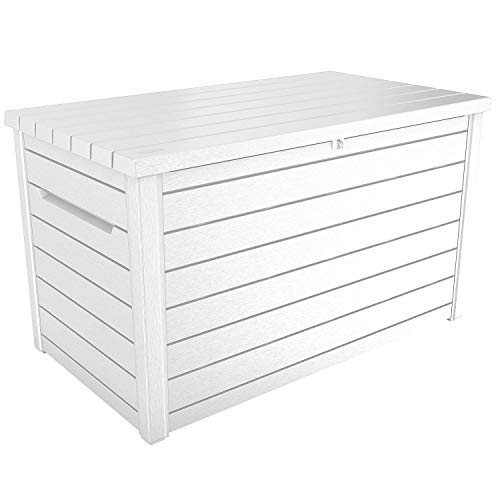
Outdoor Storage Box Pros and Cons — The Complete Picture
In this guide
Key Takeaways
- The biggest pro is readiness: a deck that is always minutes from use.
- The biggest con is the water expectation gap; bags and placement close it.
- Lid quality separates tiers more than panel thickness does.
- A lock deters casual access; it never makes the box a safe.
- With honest expectations, the balance lands clearly positive for most homes.
The Short Version Before the Detail
If you want the verdict early: for a household with outdoor seating and nowhere good to put its cushions, the pros decisively outweigh the cons, provided the box is sized honestly, placed well, and understood as water-resistant rather than waterproof, and as storage rather than as a toy or a safe. The cons concentrate in exactly those misunderstandings, which is why this article spends as long on the limits as on the benefits.
The households that regret the purchase are rarely the ones that bought a bad box. They are the ones that bought a box for a job it cannot do: securing valuables, defeating storm water unaided, entertaining a toddler, or swallowing a cushion set it was never measured against. Read the cons below as a checklist of expectations to set correctly, and most of them dissolve before you spend anything.
The Pros, in Detail
It Ends the Daily Carry
The core advantage is behavioural: storage located where items are used is storage that gets used. Cushions stop travelling through the house, towels stop living on rails, and the ten small trips a day that made the deck feel like work simply disappear from the routine.
It Protects What You Already Own
Cushions and fabrics kept dry, shaded and uncompressed between uses fade less, mildew less and hold their shape longer. The box slows the replacement cycle of the most expensive soft goods outdoors, a financial pro that compounds quietly season after season.
It Makes the Space Feel Finished
A clear deck reads as an invitation and a cluttered one reads as a chore. The box removes the visual noise of outdoor life into a single furniture-like object, and guests experience the garden as a place rather than as storage with chairs in it.
It Doubles as Seating or a Surface
Bench-rated designs add overflow seating and a place for a tray exactly where a small deck needs both. Dual purpose is a genuine pro on tight footprints, provided the sitting-only rule is respected and nobody stands on the lid.
It Is Simple, Cheap to Run and Repairable
No power, no consumables, no servicing: a wash once a season and a check of the hinges is the entire running cost. Panels and lids on many designs can be replaced, so a single accident need not end the box’s life.
The Cons, Honestly Stated
It Is Not Waterproof
The headline con. Driving rain and standing water defeat the rain-shedding design, and buyers who expected a sealed vault find damp cushions and feel misled. Bags inside the box and sane placement fix it, but the fix should not have been a surprise.
It Is Not Secure
A padlock hasp deters the casual and the curious; it stops nobody determined. Owners who store serious tools in a deck box on an open drive are relying on hardware that was never designed for the job, and the disappointment is structural, not brand-specific.
It Demands a Safety Rule With Children
The box must be introduced to children as furniture with a rule, never as a plaything, because a child inside a closed box faces entrapment and suffocation risk. Most households manage this easily, but it is a real, permanent responsibility that comes with the purchase.
It Occupies Real Space
A large box is a large object. On a small deck it competes with the furniture it serves, and a badly placed box can make a tight space feel tighter even as it tidies it. Footprint discipline is not optional at the compact end.
Lids and Hinges Are Wear Points
The moving parts age first: struts tire, hinges gather grit, lids warp if abused or baked. None of this is fatal, but the box is not the fit-and-forget object the simplest listings imply, and a season of neglect shows up at the lid.
Child Safety: Read This Before Anything Else
A deck box is never a hiding place and never a toy, and this needs saying plainly because every summer brings the same preventable accidents. Children must not climb inside a storage box: a child inside a closed box faces entrapment and suffocation risk, and a heavy lid can trap small fingers or worse. Teach the rule early, repeat it often, and treat the box in conversation the way you treat the road or the pool: not forbidden fruit, just not a plaything.
Choose and use the box to make the safe behaviour the easy behaviour. Prefer lids that cannot latch a child in, keep the lid closed when the box is not being loaded, and never store pool chemicals, sharp tools, or anything hazardous in a box that children can open. If your household includes toddlers, a box in a spot you can see from the house, opened only by adults, is the sensible arrangement until the rule is fully understood.
Supervision beats hardware here. A stay-open lid reduces slam injuries but does not make the interior safe, and no hinge design changes the fundamental point: the inside of the box is for cushions and equipment, never for children, not for a game, not for a dare, not for a photograph. Households that state this once, clearly, and enforce it kindly tend to have no trouble with it at all.
How Water-Resistant Is Water-Resistant, Honestly?
The phrase on the box is water-resistant, and it deserves an honest translation. A well-designed lid sheds normal rain: showers run off the overlapping lip, the contents stay dry, and the system works as advertised through ordinary weather. Driving rain is a different test. Wind pushes water sideways and upward into seams that shrug off vertical rain, and a storm that soaks the deck from every direction will find the way into many boxes that kept contents dry all spring.
Standing water is the other honest limit. A box sitting in a puddle on a low patio, or under a dripping gutter, lives in conditions its designers did not promise to defeat; water can wick through base seams and panel joints given time and pressure. Raising the box slightly on a level hard surface, moving it out of the drip line, and checking after major storms are the practical answers, none of which require a different box.
For real protection of the things that matter most, store cushions in bags inside the box. A large breathable or waterproof storage bag around the cushion set turns the box from the only line of defence into the outer of two, and that combination survives weather that defeats either layer alone. Judge any box you buy by this standard: excellent against normal rain, assisted by bags and placement against the worst rain, and never honestly described as a submarine.
Lockable Lids: What a Lock Does and Does Not Do
Many deck boxes accept a padlock through a hasp on the lid, and the feature is worth having for the right reasons. A lock deters casual access: it keeps curious children out of the contents, stops a neighbour’s toddler opening the box at a barbecue, keeps the lid down in storms, and signals to an opportunist that easier targets exist elsewhere on the street. For tools and pool supplies in an open front garden, that deterrence is real value.
Be equally clear about the limit: a lockable lid is not a safe. Resin panels can be forced, hasps are light hardware, and a determined thief with time and privacy will not be stopped by a deck box. Valuable power tools, documents, and anything you could not shrug off losing belong indoors or in genuinely secure storage. The lock manages everyday access and temptation; it does not create a vault, and buying a box believing otherwise sets up a painful lesson.
Practical notes: choose a weather-resistant padlock, because a cheap one will seize outdoors and leave you cutting your own lock off; keep the spare key indoors rather than in the box’s own vicinity; and if children are the concern, remember the lock works only when it is actually on, so a lid routine at the end of the day matters more than the hardware itself.
The Main Models Worth Knowing
Because this wave of the guide is written prose-first, the models below are described without purchase links while listing verification is completed. Treat each as a starting point for your own comparison, positioned by tier in words rather than by price, and check the current listing for the exact configuration before you buy.
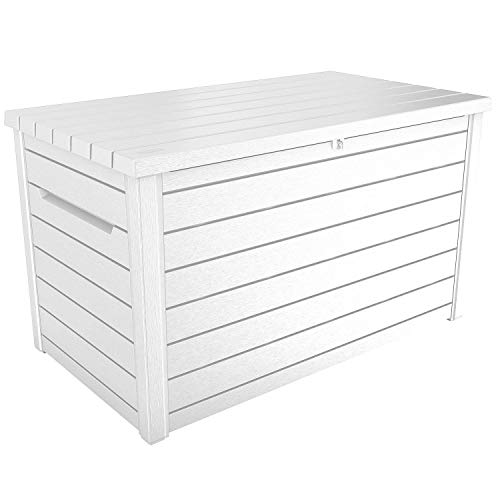
Keter deck box
The Keter deck box is the household-name resin option, widely sold in sizes from compact balcony boxes to large cushion stores, with woven-look and wood-look finishes that suit styled decks. In daily use its strengths show up in the ordinary moments: the lid behaviour when your hands are full of cushions, the interior shape when a full set needs to go away quickly before rain, and the way the finish sits alongside furniture rather than against it. Its trade-offs are the usual ones for its tier, and the sections throughout this article on materials, lids and placement apply to it exactly as written.
Best for: households whose priorities match the Keter approach of balancing weather resistance, capacity and presentation. Not suited for: anyone expecting a lockable resin or light metal box to act as a security safe, or anyone whose cushion set is at the very largest end and has not first measured the interior against it. As a prose-only pick in this edition, it is positioned qualitatively in the mid-to-premium conversation for its class rather than by any fixed figure.

Suncast deck box
The Suncast deck box is a long-running American resin maker whose boxes lean practical: straightforward panels, stay-open lids on many designs, and a reputation for honest, unfussy construction. In daily use its strengths show up in the ordinary moments: the lid behaviour when your hands are full of cushions, the interior shape when a full set needs to go away quickly before rain, and the way the finish sits alongside furniture rather than against it. Its trade-offs are the usual ones for its tier, and the sections throughout this article on materials, lids and placement apply to it exactly as written.
Best for: households whose priorities match the Suncast approach of balancing weather resistance, capacity and presentation. Not suited for: anyone expecting a lockable resin or light metal box to act as a security safe, or anyone whose cushion set is at the very largest end and has not first measured the interior against it. As a prose-only pick in this edition, it is positioned qualitatively in the mid-to-premium conversation for its class rather than by any fixed figure.

Rubbermaid deck box
The Rubbermaid deck box is the utility-first choice from a brand built on household storage, typically double-walled resin with a sturdy, workmanlike feel and little interest in decoration. In daily use its strengths show up in the ordinary moments: the lid behaviour when your hands are full of cushions, the interior shape when a full set needs to go away quickly before rain, and the way the finish sits alongside furniture rather than against it. Its trade-offs are the usual ones for its tier, and the sections throughout this article on materials, lids and placement apply to it exactly as written.
Best for: households whose priorities match the Rubbermaid approach of balancing weather resistance, capacity and presentation. Not suited for: anyone expecting a lockable resin or light metal box to act as a security safe, or anyone whose cushion set is at the very largest end and has not first measured the interior against it. As a prose-only pick in this edition, it is positioned qualitatively in the mid-to-premium conversation for its class rather than by any fixed figure.

Lifetime storage box
The Lifetime storage box is the heavy-duty end of the mainstream, from a maker known for sheds and tables, with rigid panels and lids that feel noticeably more structural than most. In daily use its strengths show up in the ordinary moments: the lid behaviour when your hands are full of cushions, the interior shape when a full set needs to go away quickly before rain, and the way the finish sits alongside furniture rather than against it. Its trade-offs are the usual ones for its tier, and the sections throughout this article on materials, lids and placement apply to it exactly as written.
Best for: households whose priorities match the Lifetime approach of balancing weather resistance, capacity and presentation. Not suited for: anyone expecting a lockable resin or light metal box to act as a security safe, or anyone whose cushion set is at the very largest end and has not first measured the interior against it. As a prose-only pick in this edition, it is positioned qualitatively in the mid-to-premium conversation for its class rather than by any fixed figure.
YITAHOME deck box
The YITAHOME deck box is a value-tier regular in online listings, offering large capacities and bench-style designs at the accessible end of the market, with assembly that rewards patience. In daily use its strengths show up in the ordinary moments: the lid behaviour when your hands are full of cushions, the interior shape when a full set needs to go away quickly before rain, and the way the finish sits alongside furniture rather than against it. Its trade-offs are the usual ones for its tier, and the sections throughout this article on materials, lids and placement apply to it exactly as written.
Best for: households whose priorities match the YITAHOME approach of balancing weather resistance, capacity and presentation. Not suited for: anyone expecting a lockable resin or light metal box to act as a security safe, or anyone whose cushion set is at the very largest end and has not first measured the interior against it. As a prose-only pick in this edition, it is positioned qualitatively in the mid-to-premium conversation for its class rather than by any fixed figure.
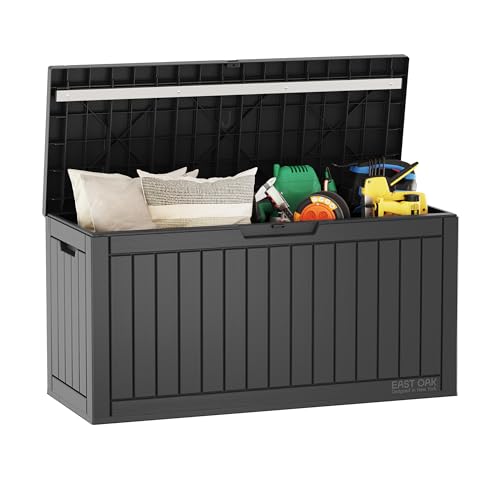
EAST OAK deck box
The EAST OAK deck box is a newer online brand that has built a following on clean styling, galvanised or resin builds depending on the line, and lids that present well on modern patios. In daily use its strengths show up in the ordinary moments: the lid behaviour when your hands are full of cushions, the interior shape when a full set needs to go away quickly before rain, and the way the finish sits alongside furniture rather than against it. Its trade-offs are the usual ones for its tier, and the sections throughout this article on materials, lids and placement apply to it exactly as written.
Best for: households whose priorities match the EAST OAK approach of balancing weather resistance, capacity and presentation. Not suited for: anyone expecting a lockable resin or light metal box to act as a security safe, or anyone whose cushion set is at the very largest end and has not first measured the interior against it. As a prose-only pick in this edition, it is positioned qualitatively in the mid-to-premium conversation for its class rather than by any fixed figure.
Pool Storage Without the Chaos
Pools generate a special category of clutter: inflatables that never fully deflate, towels that are always damp, a skimmer net with a long pole, and chemicals that must be stored responsibly. A deck box handles the soft goods beautifully. Inflatables last longer stored loosely folded out of the sun, and towels aired then boxed stay fresher than towels draped over rails for days.
Keep pool chemicals out of any box children can open, and ideally out of the general deck box entirely: they belong in a dedicated, ventilated, child-inaccessible store, because mixing family storage with chemical storage is how accidents get their opportunity. The same applies to sharp tools and anything heavy that could fall on small fingers rummaging at the bottom of the box.
The long-handled equipment still needs its own answer, usually hooks on a fence or a tall narrow store, because a standard deck box swallows poles awkwardly. Accepting that the box is for the soft and bulky, while rails and hooks handle the long and thin, gives you a pool deck that can be cleared in minutes before guests arrive, which is the real luxury on offer.
Garden Tool Storage That Stays Usable
Hand tools, twine, gloves, kneelers and seed packets suit a deck box well; long tools do not, and forcing them in diagonally creates the jumbled pit everyone dreads opening. The fix is layering: heavy and rarely used items at the bottom, everyday tools in a caddy or bucket that lifts out as one piece, and gloves and small consumables in a pouch hung or placed at the top where hands land first.
Damp is the enemy of tools. Soil left on trowels holds moisture against the metal, so a quick brush-off before storage and a dry box interior keep edges bright far longer. A small tray or mat in the base catches the grit that inevitably migrates, and lifting it out for a shake is easier than vacuuming a textured resin floor.
If the box lives at the far end of the garden, weight your choice toward weather resistance and a lid that seals well, because it will face the worst of every storm unsupervised. If it lives by the back door as a mudroom overflow, convenience features matter more: a lid that stays open, a smooth interior that wipes clean of boot-room mud, and room for the watering can to stand upright.
Small Decks and Balconies: Thinking Compact
On a small deck, the box competes directly with the furniture it serves, so footprint discipline matters more than raw volume. A slim box along a railing or a compact cube in a corner can hold a surprising amount if the contents are chosen honestly: the cushions for the two chairs you actually own, not the six you host twice a year. Vertical thinking helps too, since a taller compact box uses airspace that a long low one cannot.
Measure the door and gate the box or its panels must pass through before ordering; assembled dimensions are quoted everywhere, but the delivery path is your own problem to solve. Flat-packed resin panels are forgiving here, which is one reason the style dominates apartment-friendly listings. Check building or HOA rules as well, because some balconies restrict storage furniture, and a box that must be returned helps nobody.
Dual purpose is the small-space superpower. A compact box that serves as a side table between two chairs, holding the cushions for those chairs inside it, is the tidiest trick in this entire category. Add a tray on top for drinks and the piece stops reading as storage at all, which on a small deck is exactly the point.
Style: Making Storage Look Like Furniture
A storage box is a large object, and on a styled deck it will be seen more than it is opened. Finishes that echo your furniture, woven-look textures that nod to wicker, and colours drawn from the house trim or the decking all help the box disappear into the scheme rather than announce itself as equipment. The current generation of resin designs is far better at this than the shiny utility boxes of a decade ago.
Placement and dressing finish the job. A box aligned with the railing line, centred under a window, or paired symmetrically with a planter looks placed rather than parked. A cushion pad in your scheme’s fabric turns it into a bench visually even if nobody sits on it, and a lantern or a pot on a corner of the lid, moved aside when you open it, softens the silhouette further.
None of this requires the premium tier. It requires choosing the colour and texture deliberately instead of accepting whatever was cheapest that week, and giving the box a considered position instead of the leftover corner. The difference between a deck that looks stored-on and a deck that looks styled is usually exactly these two decisions.
Delivery, Returns and Warranty Realities
These are bulky items, and the logistics deserve a thought before the purchase rather than after. Panels arrive in a large flat carton that needs a dry place to wait if assembly day is rainy. Check panels on arrival for transit cracks, especially at corners and clip points, and photograph anything suspect before assembly, because a pre-assembly photograph is the strongest evidence there is in a damage conversation.
Read the warranty for what it actually covers: typically manufacturing defects and sometimes fading or rust, rarely misuse, storm damage or a lid cracked by standing. Keep the receipt and the model identification together, and note that a box used within its intended purpose, on a level surface, with a lid that has not been forced, is a box whose warranty story stays simple.
Returns of assembled bulky goods are painful enough that measuring twice is the real returns policy. Confirm the interior dimensions against your largest item, confirm the footprint against your marked-out tape outline on the deck, and confirm the lid swing against your wall or railing. Ten minutes with a tape measure and some painter’s tape is the cheapest insurance in this category.
Comparing Sizes Without the Numbers Game
Capacity figures are the least honest numbers in this category, not because makers lie but because a shell’s volume says nothing about sloping walls, lid mechanisms that intrude when closed, or the shape of your actual cushions. The reliable method is analogue: build your inventory pile on the deck, measure its length, width and settled height with a tape, and compare those three figures with the interior dimensions of any box you are considering, leaving a hand’s width of slack on each side.
Shape beats volume every time. A long low box swallows cushions and frustrates tool storage; a squarer box stacks games, pots and gear but may refuse a full-width cushion. If your inventory is mixed, the answer is often a long box for the soft goods plus the discipline of a lift-out caddy for the small hard goods, rather than a single compromise shape that serves both badly.
When two sizes both fit, buy the larger if the footprint allows it. Seasonal rotation guarantees that whatever slack exists in July will be spoken for by November, and the price of slightly too big is a little air, while the price of slightly too small is a box lid that will not close in the first week of ownership.
Zoning: Two Smaller Boxes Versus One Large One
One large box is the default, but two smaller boxes placed where their contents are used can beat it. A compact box at the pool end for towels and inflatables, and the main box by the seating for cushions, removes the cross-deck carrying that a single central box still demands. Zoning works because storage succeeds on proximity, and proximity is easier to buy in two small footprints than in one large one.
The costs are real: two lids to keep aligned, two assemblies, and a deck that can start to look like a storage yard if the boxes do not match. Keep finishes and colours in the same family and align both boxes on the same visual line, and the pair reads as furniture planning rather than accumulation.
Zoning also helps families. A low, light box designated for children’s outdoor toys, with nothing hazardous in it and a lid they can manage under supervision, separates the play inventory from the adult one. The main box, holding tools and household gear, can then carry the stricter rules without negotiation at every opening.
When a Shed, a Bench or Nothing Is the Better Answer
Honesty about alternatives improves every purchase. If your inventory is dominated by long tools, machinery, bicycles or anything valuable, a shed is the right answer and a deck box is a detour. If your only problem is two cushions, a simple bench with a storage seat, or even a weatherproof bag in a covered corner, may serve you without a new large object on the deck.
If your outdoor space is fully covered, the calculus shifts again: weather protection matters less, and open shelving or a simple chest kept for looks may do the job at the tier you prefer. The deck box earns its place specifically in exposed spaces with bulky soft inventory, and forcing it into other roles produces the disappointed reviews this category collects.
The test is to name the three items the box will hold most. If you cannot, you are shopping for tidiness in the abstract, and no product delivers that. If you can name them instantly, measure them, and the box that fits them will feel less like a purchase and more like the end of an argument.
Renters, Balconies and HOA Rules
Renters should weight assembly and disassembly more heavily than owners: a box that panels apart cleanly will move house with you, while one that must be half-destroyed to dismantle will be left behind. Keep the carton if you can, because flat panels travel best in the packaging shaped for them, and photograph the assembly order as you build so the rebuild is painless.
Balcony rules vary by building: some restrict storage furniture, some restrict anything visible above the railing, and some landlords have opinions about weight on older structures. A quick message before ordering is cheaper than a return. Weight when loaded is rarely a problem with soft goods, but a box full of wet soil-covered pots is a different object from a box full of cushions.
Shared and visible spaces reward discretion. A box in a front garden or shared courtyard should look like furniture, sit neatly, and ideally be lockable, not for security but to keep the shared space’s children and passers-by out of your things and your things out of trouble.
Questions to Ask Before You Order
Run this checklist against any candidate. Does my largest single item fit the interior shape, not just the volume? Does the footprint, taped out on the deck, leave the lid a full swing and me a walking path? Is the surface level and hard, or am I budgeting pavers too? Does the lid stay open unaided, and can it take a padlock if I want one? What is the panel replacement story if a lid cracks in year three?
Add the household questions. Who will actually put things away, and is the box where their habits already go? What is the rule for children, stated before the box arrives rather than after the first game of hide and seek suggests itself? What will live in it in winter, and does that change the size I need?
If a listing cannot answer the product questions and you cannot answer the household ones, the correct move is to wait a day. Deck boxes are not scarce, sales recur, and a measured purchase in this category is very nearly a permanent one, which makes the day’s patience the best value in the whole transaction.
The First Month: Calibrating the System
Expect the first month to be calibration, not failure. You will learn that the hose nozzle lives better in the caddy than the corner, that one cushion only fits happily in one orientation, and that the box wants to sit a hand’s width further from the wall than you placed it. Adjust without self-reproach: the households with immaculate systems are the ones that moved things twice in month one.
Build the closing routine early. Box closed, lid latched or locked, cushions in dry, nothing leaning against the outside. Two minutes at dusk is what separates a system from a pile with a lid, and it is also the moment the safety rules get reinforced for children without a lecture, simply by watching the adults treat the box as furniture with a purpose.
By the end of the first month, do one honest audit: open the box and remove anything that has not been touched. That item does not belong in prime outdoor storage, and evicting it returns the slack that makes everything else easy to reach. The box you audit monthly stays the box you praised in week one.
Why Outdoor Clutter Builds Up So Fast
Every patio develops the same slow drift. Cushions come off the chairs and land on a bench, pool towels pile onto the loungers, the watering can migrates to the steps, and by midsummer the space that was meant for slow evenings is mostly a holding area for things with nowhere to live. An outdoor storage box works because it gives that drift a single destination close to where the items are actually used, which is the only kind of storage system anyone keeps using.
The alternative most households try first is carrying everything indoors, and it fails on friction alone. Cushions dragged through a kitchen twice a day get dirty, get forgotten, and eventually get left outside anyway, where dew and pollen do the damage the carrying was meant to prevent. A box on the deck removes the trip, and removing the trip is what turns good intentions into a habit that survives the whole season.
It also changes how the space feels. A clear deck reads as an invitation; a deck covered in leaning tools and stacked cushions reads as a chore. The box is therefore doing two jobs at once, one practical and one visual, and judging it only on capacity misses half of what you are paying for when you choose a size and a finish that suit the space.
What People Actually Store in a Deck Box
The honest inventory is more varied than the marketing suggests. Seat cushions and throw pillows lead the list, followed by pool towels, inflatables and the pump that serves them, then garden hand tools, gloves, a coiled hose nozzle set, outdoor games, citronella supplies, furniture covers, and the small debris of outdoor life that otherwise colonises every flat surface. Writing your own inventory down before shopping is the single most useful step in this whole category.
Bulky-but-light items dominate, which is why these boxes are sized by volume rather than by weight. A set of deep-seat cushions takes far more room than new buyers expect, especially if you refuse to compress them hard, and compressing them hard all season is unkind to the foam. Measure your cushion stack as it naturally sits, not squeezed, and treat that footprint as your minimum interior, because a box you have to wrestle closed will soon be a box left open.
Seasonal rotation matters too. The box that holds towels and pool toys in July holds furniture covers, planters and holiday lights in November, so a little spare capacity in summer becomes exactly the capacity you need in autumn. Buying precisely to today’s inventory, with no slack, is the most common sizing regret in this category and the easiest one to avoid.
Resin, Wood, Metal and Fabric: The Material Choice
Most deck boxes are moulded resin, and for good reason: resin shrugs off rain, does not rust, does not need oiling, and wipes clean with a hose and a cloth. Its weaknesses are aesthetic and structural rather than weather-related. In strong sun some resin fades or turns chalky over years, and thin-walled resin flexes under a heavy seated adult, so wall feel and lid rigidity are worth checking in person or through detailed owner accounts.
Wood boxes, usually cedar or acacia, win on looks and lose on upkeep. They ask for periodic oiling or sealing, they can harbour mildew in shaded damp corners, and their joinery loosens as the seasons cycle the timber through wet and dry. In return they age gracefully in traditional gardens and feel like furniture rather than equipment. Choose wood only if you genuinely enjoy the maintenance rhythm it requires.
Metal boxes are the security-leaning minority: tougher shells, heavier lids, and a more utilitarian look. Fabric-sided and collapsible storage bags sit at the other extreme, cheap and light but offering little weather protection of their own, so they work best as liners inside a hard box rather than as the box itself. The material decision is really a decision about how much care you want to give, and how furniture-like you need the result to be.
Lids, Hinges and Gas Struts
The lid is the part you will interact with most, and its engineering decides whether the box feels like a help or a nuisance. A good lid opens wide enough that you are not holding it with one hand while fishing with the other, stays where you leave it, and closes without a slam. Gas struts or spring hinges that hold the lid open are more than a luxury: they free both hands and they remove the guillotine worry when children are nearby, though they never remove the need for supervision.
Hinges live a hard life outdoors. Metal hinges can corrode in coastal air; living hinges moulded into the resin avoid rust but can fatigue. Whatever the design, grit is the enemy, so a lid that sheds water away from the hinge line and a quick brush-out each season keep the action smooth. A lid that warps even slightly stops sealing along its lip, and that is when rain starts finding its way in.
Check the lip design as carefully as the hinge. Overlapping lips and raised interior rims channel water outward before it can drip inside, while a simple flat-on-flat closure relies entirely on perfect alignment. On a deck that sees wind-driven rain, the channelled designs earn their keep. None of this is visible in a hero photograph, which is why detailed owner reports matter so much in this category.
Ventilation, Mildew and the Damp-Cushion Problem
A sealed box full of slightly damp cushions is a mildew incubator, and this is the failure mode nobody warns about at the point of sale. Cushions should go in dry, or as close to dry as a day of use allows; if they were caught in a shower, stand them to drain and air before boxing them. Boxes with subtle ventilation, or lids that do not hermetically seal, trade a little weather protection for a lot of freshness, and for cushion storage that trade is usually right.
If you open the box to a musty smell, act early: remove everything, wash the interior with mild soapy water, let it dry fully in the sun, and air the cushions before they go back. A small open container of baking soda inside helps between deep cleans. Storing cushions inside large breathable bags adds a second line of defence, keeping dust and any stray drips off the fabric while still letting moisture escape.
Location influences all of this. A box in full sun dries its contents’ ambient air and discourages mould, but bakes fabrics and ages resin faster. A box in permanent shade stays cooler and kinder to colours, yet dries slowly after rain and grows algae on its north face. Most households do best with partial sun and a few centimetres of clearance from walls so air can move around the shell.
Living With the Trade-Offs: How the Outdoor storage box Balance Plays Out Over a Season
A pros and cons list is a snapshot, but a outdoor storage box is a long-term housemate. Advantages that look decisive on paper can shrink once the seasons turn, and drawbacks that seem minor in a showroom can grow teeth in February or during a busy holiday week. The fairest way to weigh a outdoor storage box is to follow one full season of ordinary use and ask how each side of the ledger behaves when the weather, the light and the household routine all change. This section does exactly that, so the balance you act on reflects lived experience rather than first impressions.
When the Advantages Grow — and When They Fade
The strengths of a good outdoor storage box tend to compound quietly. A design that saves steps, stores more, or cleans easily gives that benefit back every single day, and over a season those small repayments add up to the real value of the purchase. By contrast, advantages based on novelty — an unusual finish, a fashionable shape, a feature you showed to guests twice — fade within weeks. When you re-read any pros list, sort each point into one of those two families: daily-compounding benefits deserve heavy weight, while novelty benefits deserve almost none, however attractive they looked at the point of ordering.
When the Drawbacks Bite Hardest
Weaknesses in a outdoor storage box rarely bite at random; they bite at predictable pressure points. Guests arriving, a seasonal deep clean, a heatwave, a power cut, a house move, or a child or pet entering a new stage will each stress a different limitation. Think through those moments for the outdoor storage box you are considering and ask whether the drawback is an occasional annoyance you can plan around or a recurring friction you will meet every week. An occasional annoyance is a fair price for a strong advantage elsewhere; a weekly friction almost never is, and it is the single most common reason owners replace a outdoor storage box long before it wears out.
Notice which parts are replaceable and which are not; a outdoor storage box whose wear parts can be swapped cheaply often outlasts a sealed design twice its price in spirit, if not in years. Consider the outdoor storage box from the perspective of the person who cleans around it, because designs that trap dust, block access or demand special products quietly tax every week of ownership. Think about noise, light and heat as neighbours of the outdoor storage box, not afterthoughts, since a choice that performs well but disturbs the room around it rarely stays popular for long.
Judged across a season, most outdoor storage box choices become clearer, not harder. The right model is rarely the one with the longest pros list; it is the one whose drawbacks land in the moments you can tolerate and whose strengths land in the moments you repeat every day. Hold any candidate up against your own calendar before you commit, and the pros and cons stop being abstract and start being a forecast you can trust.
Frequently Asked Questions
What is the single biggest pro?
Readiness. The deck is always a few minutes from guest-ready, cushions live where they are used, and the daily carrying between house and patio simply ends. Owners describe evenings, not specifications, when they explain why they would buy again.
What is the single biggest con?
The water gap between expectation and reality. Water-resistant sheds normal rain, but driving storms and standing water can get in, and buyers who expected waterproof storage feel cheated until they add bags inside the box and fix the placement.
Are deck boxes safe around children?
Only with a clear household rule: the box is never a hiding place or a toy, children must not climb inside because of entrapment and suffocation risk, lids should not be able to latch a child in, and chemicals and tools stay out of any box children can open.
Does the lock actually help?
As a deterrent, yes: it manages casual access, children and opportunists, and keeps the lid down in wind. As security, no: it is not a safe, resin can be forced, and valuables belong indoors. Both halves of that sentence matter.
Do the cons shrink with a better box?
Some do: lid quality, wall rigidity and finish all improve with tier. The structural cons do not: no tier makes a deck box a safe, a toy, or a submarine, and honest expectations remain part of the purchase at every level.
Who should skip a deck box entirely?
Households whose real problem is secure tool storage, whose outdoor inventory is two folding chairs, or whose only available spot is so small the box would displace the seating it serves. For everyone else the balance lands clearly positive.
Related Guides
Keep reading with the companion pieces in this series and the closest live guides on the site: outdoor storage box review outdoor storage box reviews outdoor storage box buying guide is an outdoor storage box worth it how to choose an outdoor storage box best garden hoses best rain barrels for gardening best RV outdoor rugs best deck box for cushions