Disclosure: As an Amazon Associate, dailyhomedecorating.com earns from qualifying purchases. Links on this page are affiliate links; they cost you nothing extra. Prices and availability change often, so check the current Amazon listing before you buy.
A reusable silicone bags buying guide has to solve a specific problem: the market now offers thick premium slabs, design-led stand-up vessels, giant value multi-packs and featherweight lunch zips, all calling themselves the same product. This buying guide cuts through that by starting where purchases should start — with the jobs in your kitchen — and only then mapping designs to them. You will learn the main types, the criteria that actually separate them (seal design, wall build, size coverage, filling ergonomics), how to prioritise by household profile, and which specific sets to shortlist for each role. No prices are printed here, by design: positioning is given in words, and you check the current listing when you are ready to choose.
The one-sentence version: buy seal confidence and size coverage for your real week, in that order, and let brand come third. A set whose seals you trust with soup and whose sizes match your habits will be used for years; a prestigious set in the wrong sizes will be admired in a drawer while the disposable roll does the work. Everything below expands that sentence into a method.
Key Takeaways
- Types divide by build: heavy pinch-press, stand-up vessel-style, value multi-pack, and lightweight lunch zip.
- Seal design and size coverage matter more than brand; verify closures by habit, whatever you buy.
- Prioritise by profile: batch cookers need larges, lunch families need mediums and smalls, minimalists need compact coverage.
- Plan the wash-and-dry routine before buying — a drying spot is part of the purchase.
- Keep the allocation honest: disposables for raw proteins if you prefer, beeswax for wrapping, vacuum for the longest freezes.
- All recommendations here are prose-only; check price on Amazon for current set configurations.
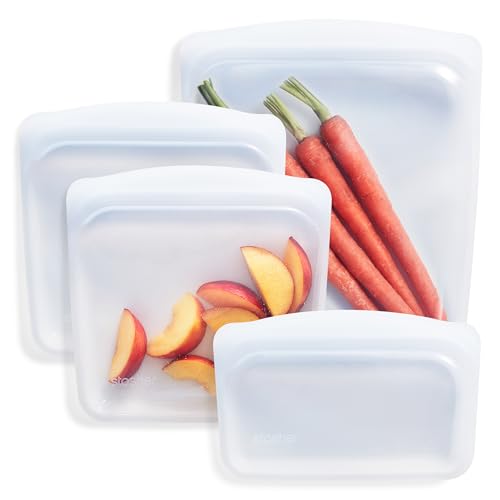
What Reusable Silicone Bags Do and the Main Types
The Heavy Pinch-Press Bag
The original and still the benchmark format: a thick silicone pouch closed by pressing twin tracks together along the opening. The build brief is durability and seal certainty. These bags flex around awkward shapes, survive freezer traffic, handle marinades and liquids with confidence, and feel — in the hand and in the drawer — like permanent equipment. Their trade-offs are weight and presence: they are the bulkiest option per bag, and a full set is a deliberate purchase. Choose this type as your freezer-and-fridge backbone.
The Stand-Up Vessel Bag
A design-led evolution that adds a stable base, so the bag stands open on the counter and sits upright in fridge and freezer. Filling becomes a one-person, two-handed job; portioning soup stops being a juggling act; the fridge gains soft containers that squeeze into gaps rigid tubs waste. The silicone is typically substantial and the finish considered — these are the bags that can live on an open shelf without apologising. Choose this type if filling frustration or fridge chaos is your current pain.
The Value Multi-Pack
Many bags, many sizes, utilitarian finish, honest construction. The multi-pack’s superpower is coverage: enough bags that every job in the week finds one waiting, which is the true mechanism by which households quit disposables. Seals vary by set — press or slider-assisted — and the silicone is generally a step lighter than the premium tier, entirely adequate for fridge, lunch and weekly freezer cycles. Choose this type to convert a household in one move, or to build the fleet around a few premium heroes.
The Lightweight Lunch Zip
The thin, flat, double-zip reusable: built to disappear into lunchboxes, handbags and carry-ons. Not a liquid or long-freezer specialist, and not pretending to be — its job is the high-turnover dry and semi-dry traffic of sandwiches, snacks and travel organisation, at a weight and flatness the heavy bags cannot match. Choose this type as the mobile wing of a silicone-centred system.
In this guide
Top Picks at a Glance
| Pick | Badge | Tier in words | Best job |
|---|---|---|---|
| Stasher Silicone Bags | Best Overall Backbone | Premium | Freezer, liquids, long service |
| W&P Porter Silicone Bags | Best for Filling and Fridge Order | Premium | Soups, portioning, visible storage |
| Lerine Silicone Bags | Best for Meal Prep | Mid | Marinades, batches, freezer cycles |
| IDEATECH Silicone Bags | Best Coverage per Set | Entry | Whole-drawer conversion |
| Xomoo Silicone Bags | Best Starter Set | Mid | Small kitchens, first switch |
| (re)zip Reusable Bags | Best for Lunch and Travel | Entry | Snacks, sandwiches, on the move |
Each pick below is presented prose-only, with its role and limits stated plainly. Match roles to your household profile in the next sections, then check the current listing for the set that fits.

Stasher Silicone Bags
Positioning: premium tier — the benchmark pinch-press design. Stasher is the name most people picture first, and the reputation rests on the seal: a pinch-press closure that runs the full width of the opening and gives clear tactile feedback as it closes, section by section, under your fingers. The silicone body is thick and supple rather than rigid, so the bag flexes around odd shapes — a halved onion, a wedge of cheese, a tangle of herbs — instead of forcing food into a fixed geometry. Sizes run from small snack formats up to generous half-gallon styles suited to marinades and freezer batches, and the colours are genuinely useful rather than decorative, because a consistent colour-per-size habit makes a crowded freezer drawer readable at a glance. In daily use the bags wash up well, dry best propped open, and hold their seal integrity over long service. Best for: households building a core set they expect to keep for years. Not suited for: anyone who wants the absolute lightest bag for travel, where thinner reusable designs travel flatter.
W&P Porter Silicone Bags
Positioning: premium tier — the design-led, stand-up option. Porter bags are what happens when a design studio treats a storage bag as tableware: calm colours, a matte finish that looks at home on an open shelf, and a stand-up base that lets the bag sit open on the counter while you fill it — a small thing that changes the whole experience of portioning soup or decanting grains. The silicone is substantial, the seal closes with a confident press, and the overall feel is closer to a soft container than to a bag, which is precisely the appeal for people who disliked the floppiness of earlier reusables. They photograph beautifully, but the substance underneath is real: thick walls for freezer duty, a shape that stacks and stands rather than slumping, and a surface that releases food cleanly. Best for: design-conscious kitchens, countertop-visible storage and soup portioning. Not suited for: bulk buying on the tightest budget, where multi-packs stretch further.

Lerine Silicone Bags
Positioning: mid tier — the family freezer-workhorse option. Lerine sets pitch themselves squarely at the freezer-and-prep household: sturdy silicone, leak-resistant seals tested by the brand for liquids, and sizes that take marinades, portioned proteins and batch-cooked grains without drama. The bags feel workmanlike in the best sense — thick enough to trust in a deep freeze, flexible enough to squeeze air out before sealing, and plain enough that nobody minds them living in the hardest-working drawer in the kitchen. They handle the weekly cycle of marinate, freeze, thaw and wash with the least fuss of the value tier, provided you follow the golden rules: dry fully before storing, keep the seal tracks clean, and check the closure along its full length before a bag of soup goes horizontal. Best for: meal preppers and freezer organisers. Not suited for: heavy liquid storage in the largest sizes, where the premium brands’ seals earn their keep.
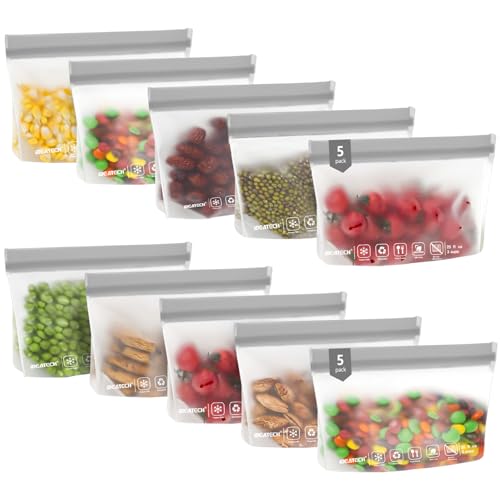
IDEATECH Silicone Bags
Positioning: entry tier — the value multi-pack option. IDEATECH built its following on the unglamorous virtue of the multi-pack: enough bags, in enough sizes, that a household can actually retire the disposable roll instead of rationing three precious reusables. The bags use a slider-assisted or press seal depending on the set, the silicone is freezer-appropriate and flexible, and the assortment logic — small for snacks, medium for produce and leftovers, large for freezer batches — matches how kitchens actually consume bags across a week. Expect a slightly more utilitarian finish than the design-led brands, and expect to spend a minute learning each size’s sealing feel, but the cost-per-bag maths of a big set is what converts sceptics: when a reusable is always within reach, the disposable habit quietly dies. Best for: families converting a whole drawer at once. Not suited for: minimalists who want two perfect bags rather than a working fleet.

Xomoo Silicone Bags
Positioning: mid tier — the compact everyday set option. Xomoo sets occupy the sensible middle: compact assortments, honest silicone construction, and a price position that makes them an easy first experiment for households not yet sure the reusable habit will stick. The bags cover the everyday bases — snacks, produce halves, lunch items, small leftovers — and the seals close securely for fridge and short freezer duty. They are a particularly good answer to the most common failure of reusable systems, which is not quality but coverage: too few bags, so the disposables creep back. A Xomoo set in the drawer plus a couple of premium large bags for freezer work is a legitimate, complete system for a small household. Best for: first-time switchers and small kitchens. Not suited for: heavy liquid storage in the largest sizes, where the premium brands’ seals earn their keep.
(re)zip Reusable Bags
Positioning: entry tier — the lightweight lunch-and-travel option. The (re)zip line takes the opposite design bet from the heavy silicone slabs: go light, go flat, and make the reusable bag disappear into a lunchbox, handbag or carry-on the way a disposable once did. The double-zip closure is familiar on first use — no new technique to learn — and the bags lie almost completely flat when empty, which matters more than it sounds when drawer space is the real constraint. They suit the dry and semi-dry rhythm of daily life: sandwiches, chopped fruit, crackers, nuts, chargers and toiletries on the road. Treat them as the high-turnover tier of a silicone-centred system rather than its freezer backbone, wash them gently, dry them thoroughly over a bottle or rack so the zip tracks air out, and they repay the small footprint with constant use. Best for: lunches, snacks and travel kits. Not suited for: long freezer storage of liquids or heavy marinades.
How Much Capacity Do You Actually Need?
Capacity questions go wrong when they are asked in the abstract. Ask instead: what are the five bulkiest things I bag in a month? A whole marinating chicken, a double batch of soup, a kilo of chopped vegetables for the freezer — those define your large-bag requirement, and for most households two to four genuine larges suffice, because larges turn over slowly. Mediums are the opposite: they turn over daily and in parallel — lunch, leftovers and produce all at once — so medium count, not large size, is where sets usually under-buy. Smalls are the cheapest coverage in the system and the most quietly useful: halves, ends, snacks and small hardware of kitchen life. A balanced first set weights mediums heaviest, and this guide’s profiles below show the proportions per household.
Size strategy decides whether a set gets used. Too few sizes and every job is a compromise; too many and the drawer becomes a jumble nobody can search. The working pattern most households settle on is a spine of medium bags — the leftover, produce and lunch size that turns over daily — supported by small snack bags for halves, nuts and little things, and a few large bags for freezer batches, marinades and family quantities. Stand-up designs earn extra drawer credit because they fill without a third hand and sit in the fridge like soft containers. Buy coverage of your actual week, not an imaginary one: list the last twenty things you put in a disposable bag, size the set to that list, and the silicone will be in constant rotation instead of occasional service.
Which Seal Design Suits Your Hands?
Every silicone bag lives or dies by its seal, and the designs divide into two families. Pinch-press seals close under your fingers, track by track, and give immediate tactile confirmation — you can feel an unclosed section and fix it before it matters. Slider and bar closures trade that feedback for speed and a mechanical confidence some users prefer, especially with large bags and full hands. Whichever family you choose, build the verification habit: after closing, run your fingers along the full length once more, and for liquids, hold the bag briefly over the sink and give it a gentle squeeze. A two-second check is the entire difference between a leak-proof reputation and a spilled fridge shelf, and it is a habit worth more than any single brand’s marketing.
Add two household factors to that technical picture. Children and lunch-packing speed favour the closure a small hand can verify — test by having the actual packer close and check a bag of water over the sink. Arthritis or reduced grip strength favours slider-assisted and stand-up designs that ask for less pinch force. There is no universally best seal; there is the seal your household will actually close properly at 7 a.m., and that is the one to buy.
How Much Does Build Quality Show in Daily Life?
Build shows in three places. First, the corners: well-finished bags have smooth, strong corners that rinse clean and resist splitting; corners are where cheap bags fail and where food hides, so inspect them in product photos and in hand. Second, the seal’s hundredth use: quality tracks engage evenly along their length long after novelty fades. Third, the material’s memory: good silicone returns to shape after freezer stacking instead of keeping a crease. None of this requires a laboratory to assess — it requires reading listings for construction detail, favouring makers who describe their seals and sizes plainly, and treating suspiciously vague listings as the risk they are.
How to Prioritise by Use Case
The batch cooker and freezer filler: larges first, thick walls, seals you would trust with a litre of stew; mediums second; smalls optional. Anchor brands: the workhorse and premium tiers. The lunch-packing family: mediums and smalls in depth, a lightweight contingent for bags and boxes, two larges for the weekly soup; coverage beats thickness. The produce-heavy fresh cook: mediums with stand-up manners for fridge order, smalls for halves, and a wrap solution alongside for cheese and bread — silicone plus beeswax is this profile’s natural system. The small-space minimalist: one compact set covering all three size roles, stand-up designs preferred for their tub-like double duty, expansion only on proven gaps. Worked through the decision in the other direction — from criteria to shortlist — in how to choose reusable silicone bags.
First Setup and Care Essentials
Washing is where silicone bags succeed or quietly fail, and the routine is simple once it is a habit. Wash promptly after use in hot soapy water, paying deliberate attention to the seal track and the corners, where food films hide. A bottle brush or the corner of a sponge run along the closure groove clears the residue that a quick rinse misses. Many bags are described as dishwasher friendly, and a top-rack wash with the bag held open over the prongs can work well, but hand washing gives you the inspection moment that matters: you see the seal, you feel for stickiness, and you catch damage early. Rinse thoroughly, because silicone can hold soap scent if it is left soapy, and a faint detergent note in tomorrow’s berries is a self-inflicted wound.
Drying deserves its own paragraph because it is the step households skip. A silicone bag stored damp, sealed shut in a drawer, is a small dark greenhouse, and the seal crevice is exactly where moisture lingers longest. Dry bags fully before storing: prop them open over a bottle, a drying rack peg or a rolled towel, let the interior air out completely, and only then close and file them. If a bag ever develops a musty note in the crease, wash it again, dry it in moving air and a little daylight, and store it open until the smell is gone. This one discipline — washed well, dried completely, stored dry — is the difference between a set that serves for years and a set that gets mysteriously retired to the back of a drawer.
On day one, wash the set, assign the drawer, install the drying spot, and run the water test on each size: fill, seal, squeeze gently over the sink. Ten minutes of setup converts a purchase into a system, and the households that do it are the ones still delighted in month six.
Mistakes to Avoid
Buying a single prestige bag and expecting conversion — coverage converts, tokens do not. Buying only larges because they photograph well, then lacking mediums for the daily work. Ignoring the drying question until the first musty crease. Sealing liquids without the fingertip check and blaming the bag. Expecting silicone to replace wraps and vacuum sealing too, then judging it for failing jobs it never claimed. And the quietest mistake: keeping the disposable roll at the front of the drawer ‘just in case’, which guarantees the old habit wins every tired evening. Move it to the back. Let the new system be the easy reach.
Reusable Silicone Bags Buying Guide: The Bottom Line
Reusable silicone bags are a solved product category: every type in this guide works, and the only real risk is mismatch — wrong sizes, wrong seal for your hands, no drying plan. Audit the week, pick the type per role from the table, verify seals by habit, dry bags like you mean it, and your set will serve for years. For the value question behind the purchase, see whether reusable silicone bags are worth it.
Reading a Listing Like an Engineer
Listings for silicone bags range from admirably plain to pure fog, and a buyer who knows what to look for can sort them in minutes. Look first for the set’s anatomy stated outright: how many bags, in which sizes, with which seal type. A maker who will not say is telling you something. Look next at the closure described as a mechanism rather than an adjective — tracks you press, a bar that slides — and at photographs that show the seal open, the corners finished, and a bag standing or filled, not only flat packshots. Look for care guidance printed by the maker: washing method, drying advice, temperature guidance for freezer and reheating. Makers who teach care are makers who expect their bags to be kept, and that expectation correlates with construction more reliably than any slogan on the page.
Then apply the three sceptic’s questions. Does the set’s size mix match a real week — mediums in depth, smalls present, larges honest — or is the headline count padded with sizes nobody assigns jobs to? Does the seal suit the hands in your house, per the ergonomic section above? And does the brand describe demotion-worthy honesty anywhere — limits, care duties, what the bags are not for? A listing that admits limits is the rarest and best sign in this category. Fog, padding and perfection claims are the three tells of a set to skip, whatever its tier.
Seasonal and Household-Stage Buying Advice
Moving house and first kitchens: buy the roster before the gadgets. A complete silicone set is foundational infrastructure — it will be used on the first night and every night after — and a compact, role-complete set beats a premium partial one while the kitchen finds its shape. New baby and weaning years: smalls and mediums multiply in value — portions, snacks, teethers-and-toys organisation in the changing bag — and the wash-and-dry routine folds into a household already washing everything; choose seals a sleep-deprived hand can verify. The batch-cooking convert: buy larges and freezer leadership first, because your conversion lives or dies on batch day, and let the fridge roster follow. The downsizer: stand-up mediums do double duty as bags and soft tubs, letting a small kitchen retire both a roll of disposables and a stack of rigid containers — measure the drawer, buy to the inch, and enjoy the rare purchase that gives space back.
The Two-Basket Method: Building the Roster in Stages
Households unsure about full conversion should use the two-basket method this guide recommends above any single purchase. Basket one, bought now: one complete role, chosen by your dominant job — freezer larges for the batch cooker, lunch mediums and smalls for the packing family, stand-ups for the fridge-chaos sufferer. Run it for one month with the full routine: water test, role assignment, wash and dry properly, disposables exiled to their allocated jobs only. Basket two, bought on evidence: the gaps the month actually revealed, which are never quite the gaps browsing predicted. This method costs a little patience and buys certainty — every bag in the final roster has a proven job, and the drawer contains no tourists. It is also the honest answer to give anyone who asks whether silicone is ‘worth it’: do not debate it, stage it, and let a month of your own kitchen vote.
Warranty, Returns and the Confidence Question
Without inventing any maker’s terms, the buyer’s principle is simple: favour sellers whose returns and support posture treats the bag as durable equipment. A set sold as a years-long tool should come with the confidence signals of one — clear care documentation, responsive support, replacement posture for a seal that fails early. Read the listing’s own words on these points before buying, keep your order details, and run the water test on every size within the return window, because a closure flaw announces itself in the first fill far more honestly than in the first photograph. Buyers who test early and buy from makers who publish real guidance almost never need the return they checked for — which is, of course, the point of checking.
Worked Buying Plans for Four Budgets of Attention
Money is not the only budget a purchase spends; attention is scarcer. So this guide closes its advice with four plans stated as rosters, for four levels of willingness to think about storage bags ever again. Plan Zero — ‘Never think again’: one complete value multi-pack plus one premium large pair. Coverage everywhere, heroes where it matters, a single seal family to learn, done. This is the plan for households that want the problem solved, not curated. Plan Curator: stand-up mediums for the fridge, premium larges for the freezer, lightweight smalls for travel — three deliberate choices, each best-in-role, for households that enjoy owning exactly the right thing. Plan Staged: the two-basket method from earlier in this guide, basket one this month, basket two on evidence — for the sceptical, the budget-conscious and the small-kitchened, and the plan with the lowest regret rate in this guide’s judgement. Plan Household-Total: a full roster bought in one move — fleet, heroes, stand-ups, travel wing, drying rack in the same order — for the household converting completely and immediately, usually after a move or a kitchen refit. Each plan is complete as stated; none requires the others’ purchases; and all four share the same day-one ritual of wash, water-test, assign and exile the roll.
Questions This Guide Gets Asked
Should I match one brand throughout for consistency?
Consistency of seal family matters; consistency of badge does not. A mixed roster with one closure type to learn beats a single-brand set whose sizes fight your kitchen. Buy the badge where the badge is genuinely best in role, and let the drawer be a coalition. The exception is colour coding: if you plan to run a strict colour-per-size system, a single brand’s palette makes it effortless, and that operational benefit can legitimately tip a close decision.
Is it better to buy one big set or assemble piece by piece?
Big sets win on coverage and simplicity; assembly wins on precision. First-time converters with a typical kitchen should take the set — the audit shows most kitchens are more typical than they believe — and assemble only the second wave, once real gaps are known. Kitchens with a genuinely unusual profile — heavy freezing, heavy travel, very small storage — should assemble from the start, using this guide’s role table as the parts list.
What about gift purchases?
Silicone bags are a better gift than their humility suggests, with one rule: gift a complete role, not a token. A stand-up pair with a note about soup portioning delights; a single random bag confuses. Pair the gift with the two habits in writing — verify the seal, dry it fully — and you have given a system rather than an object, which is the difference between a gift that gets used and one that gets stored.
The Guide’s Final Shortlist Logic
Everything in this buying guide compresses to a decision tree short enough to run in the shop. Is your dominant job freezer and liquids? Start at the premium backbone. Is it filling frustration and fridge chaos? Start at the stand-ups. Is it a whole household converting at once? Start at the coverage fleet. Is it a first experiment in a small kitchen? Start at the compact starter. Is lunch and travel the real traffic? Start at the lightweight wing — inside a silicone-centred system. Then apply the seal-by-hands rule, the mediums-first sizing rule and the drying-spot rule, and check the current listing for the configuration you have chosen. A buyer who runs that tree cannot buy badly in this category; they can only buy early or late in their own staging, and the two-basket method exists to forgive even that.
Comparing Set Configurations Without Being Fooled
Set configurations are where buying guides earn their keep, because the same headline — a count of bags — can describe wildly different rosters. Learn to read a configuration in three passes. Pass one: the role census. Ignore the total and count by size: how many true larges, how many working mediums, how many smalls. A set whose census matches your audit’s proportions is a candidate; a set padded with a size your kitchen does not use is a smaller set wearing a bigger number, and should be priced in your head accordingly. Pass two: the seal census. Are all bags the same closure family — good for learning — or mixed, and if mixed, is the mix by role (sliders on the larges your hands struggle with, press on the rest) or random? Purposeful mixes are features; random mixes are inventory. Pass three: the system census. Does the configuration include, or does the maker at least specify, the supporting cast — the drying method they intend, the labelling approach, the storage footprint? Makers who think in systems sell rosters that behave like systems. Three passes, five minutes, and configuration fog — the last refuge of the weak set — is gone.
A worked comparison makes the method concrete. Set A advertises the larger count, but its census is smalls-heavy: a dozen tiny bags, a spine of four mediums, two larges. Set B advertises fewer bags: eight mediums, six smalls, four larges, one seal family, and a stated drying method. For the audit-typical household — mediums in parallel, smalls in a steady stream, larges on batch day — Set B is the larger working roster despite the smaller headline, and it is not close. Buyers who run the census buy Set B and never learn what they avoided. Buyers who read headlines buy Set A and spend a season wondering why the system feels thin. The census is this guide’s single most transferable skill: it works on every set, every brand and every future configuration the market invents, because it reads rosters the way kitchens use them — by role, not by count.
A Note on Buying for Two Homes and Other Multiplications
Households that split life between two kitchens — a main home and a cabin, a flat and a family house, a term-time address and a home address — should resist the travelling roster and buy two static ones, even if the second is compact. The reasoning is the audit principle in its purest form: a set that lives in a drawer gets used, a set that lives in a suitcase gets forgotten at the other address on exactly the weekend it was needed. Weight the second roster by that kitchen’s actual jobs, which are rarely a miniature of the first’s — holiday kitchens marinate, grill and graze more than they batch — and let each roster be a portrait of its own kitchen. The same logic governs the office drawer, the caravan and the boat: small, static, role-complete rosters beat one grand portable system every time, because storage, like everything else in domestic life, happens where the drawer is.
After the Purchase: The First-Month Optimisation Loop
A buying guide that ends at the checkout has done half its job, because the difference between a good set and a great roster is a month of small optimisations that this section exists to prescribe. Week one is observation only: run the roster, log the near-misses on the fridge door — the job that found no bag, the bag that fought its job — and resist all purchasing, because week-one data is novelty wearing a lab coat. Week two is arrangement: move the smalls to the fruit bowl’s drawer, the lunch contingent to the packing zone, the larges to batch day’s reach; more rosters are fixed by relocation than by addition. Week three is the demotion-and-gap review: any bag unused three weeks running is reassigned a role in writing or demoted to travel and dry duty, and any gap that has repeated three times graduates to the shopping list — the rule of three, applied in both directions, keeps the drawer honest. Week four is the seal audit: every closure water-tested once, quickly, so the roster enters its second month at certified strength, and the one tired seal — if there is one — is caught by you rather than by a litre of soup. Run that loop and the set you bought becomes the roster your kitchen would have designed for itself, which is the destination every section of this guide has been driving towards: not the perfect purchase, but the perfected one.
One last piece of buying wisdom, offered because this guide has watched it save more households than any product recommendation: buy the drying solution in the same order as the bags. A small rack, a set of bottle props, a peg rail — the object is trivial and the effect is not, because it converts the category’s one real duty from a daily improvisation into a piece of kitchen furniture that simply exists. Guides bury this advice in care sections; this one promotes it to the buying decision itself, where it belongs. The bags are the purchase. The rack is the system. Buy both, and the rest of this guide becomes a description of your kitchen within a month.
Buying for the Way You Actually Shop for Food
One variable this guide has not yet isolated deserves its moment, because it quietly determines size coverage more than any other: how your household shops for food. The weekly big-shop household processes a mountain on one day — produce to portion, proteins to divide, a fridge to load like a warehouse — and needs its roster at full strength simultaneously: the parallel peak is the shopping day itself, and larges plus mediums in depth are the specification. The daily top-up household bags in a stream rather than a flood — tonight’s ingredients, tomorrow’s leftovers, a constant gentle turnover — and needs fewer bags in total but faster access: a compact roster in the most reachable drawer, weighted to mediums and smalls, with the wash cycle turning daily. The market-and-garden household bags produce above all — gluts of beans, herbs by the bunch, tomatoes in their brief abundance — and should weight produce-sized mediums and the stand-up designs that make fridge triage calm, plus larges for the preserving weekends when the garden outruns the table. Match the roster to the shopping rhythm and the sizes stop being a guess: the shop tells you, in advance, exactly which bags your kitchen is about to need, and a buying guide’s last job is simply to teach you to hear it.
The Guide’s Promise and Its Limits
A buying guide should end by stating what it cannot do. This one cannot feel a seal close under your fingers, cannot see your drawer’s true dimensions, and cannot know whether your household’s washing willingness is a fact or a hope. What it can do — what it has done — is order the decision correctly: jobs before brands, seals and sizes before tiers, infrastructure before enthusiasm, evidence before expansion. Run the order, and the residual uncertainty is the honest kind, the kind a month of use resolves. Skip the order, and no guide, however long, can insure the purchase. The bags themselves are ready whenever you are; they have been ready, in their various designs, for years. It is the choosing that makes them worth it — and the choosing, now, is yours.
One sentence of parting discipline for the buyer who has read this far: photograph your drawer the day the set is arranged, and again at three months. The first picture is the purchase; the second is the verdict — and in this guide’s experience, the second picture, with its filed freezer slabs above and its calm stacks below, is the one households send to friends. Buy so that the second photograph pleases you, and every rule in this guide will have been obeyed without your needing to remember any of them.
Before You Order: A Practical Fit and Listing Check for the Reusable Silicone Bags
Most of the groundwork for choosing a reusable silicone bags is covered above, so this section turns to the stage where orders are actually placed: verifying fit, reading listings critically and checking the practical details that photographs tend to hide. Work through it with your measurements and your shortlist in front of you.
Start With Your Space and Your Routine
If you shop with someone else, agree the must-haves together before looking, so that the reusable silicone bags you choose is a shared decision rather than one person’s compromise discovered later. Beware of choosing a reusable silicone bags for a rare occasion, such as a large gathering once a year, if that choice makes everyday use worse for the other fifty-one weeks. Finally, judge the reusable silicone bags against the life you actually lead this year, not the tidier or more ambitious life in the listing photographs, and the choice will usually make itself. Decide in advance which single feature you would refuse to compromise on, and let that one priority settle ties between otherwise similar reusable silicone bags choices.
In a buying guide the order of decisions matters, so settle size and placement for the reusable silicone bags first, materials and build second, and style last, when the practical questions can no longer be changed by a prettier photograph. Colour and finish samples in listings are taken under controlled light, so expect the reusable silicone bags to look different at home and favour options that sit comfortably with the tones already in the room. Apply the same checks to each shortlisted example, whether that is the IDEATECH Silicone Bags; the Lerine Silicone Bags; the Stasher Silicone Bags, because consistent testing is what makes the differences between models visible. Storage is part of ownership, so decide now where the reusable silicone bags, its accessories and its seasonal extras will go when they are not in use, and measure that space too.
When Small Problems Appear
A reusable silicone bags that fits on paper can still fail in daily use if a doorway, a corner, a cupboard door or a walkway cuts into the space it needs, so trace the full path from delivery to final position. The best reusable silicone bags for a rented home may differ from the best for an owned one, because fixings, marks and alterations carry different consequences in each case. Guests notice different things than owners do, so if the reusable silicone bags will be used by visitors, test it from a fresh user’s point of view, without the habits you have already built around it. Set the assembled reusable silicone bags up fully before deciding it is wrong for the space, since partly built or badly positioned pieces often look worse than they will once finished and levelled.
Think about the season in which the reusable silicone bags will work hardest, and judge it against that season rather than the mild week in which you happen to be shopping. A useful buying habit is to read the questions other shoppers have asked about the reusable silicone bags, because those questions often expose the exact ambiguities the main description glosses over. Keep a short note of the questions each listing leaves unanswered, and treat a seller who answers them clearly as a better prospect than one who repeats general claims. Consider the busiest version of the day, not the calmest one, and ask whether the reusable silicone bags still works when people are hurrying, carrying things or sharing the same space.
Think about the end of the reusable silicone bags’s life with you as well, including whether it could move to another room, be passed on, or be stored without damage when your needs change. When something about the reusable silicone bags starts to annoy you, note whether the cause is the product itself, its position, or the way it is being used, since each cause has a different and usually cheaper fix. Ask how the reusable silicone bags will be cleaned on an ordinary week, with the products and time you actually have, not with a special routine you are unlikely to keep up. Where the reusable silicone bags has a surface you will set things on, lean on, or load, consider the heaviest realistic load in your household rather than the lightest display load in the photos.
A Short Decision Checklist
- The main job the reusable silicone bags must do, written in one sentence
- The measured space, including clearance to use and clean around the reusable silicone bags
- Who will use the reusable silicone bags most, and any limits they have
- What your current arrangement does badly that the reusable silicone bags must fix
- Delivery path, from the door to the final position
- Where the reusable silicone bags and its accessories will be stored when not in use
- What your current arrangement does well that the reusable silicone bags must not lose
- The one feature you will not compromise on
Taken together, these checks take only a little time, yet they answer the questions that decide whether the reusable silicone bags suits your home, your household and your routine, and they do so before money changes hands rather than after.
Frequently Asked Questions
What size set should a first-time buyer start with?
Start with coverage of your real week: a spine of mediums for leftovers, produce and lunches, a few smalls for halves and snacks, and two to four larges for freezer batches and marinades. Most households under-buy mediums and over-buy larges. After a month, add only where a gap has repeated — that discipline builds a set with no dead members.
Pinch-press or slider seal — which is better?
Both seal securely when verified. Pinch-press gives tactile feedback along the whole closure and suits people who like certainty they can feel; slider and bar closures are faster and can suit reduced grip strength or very full hands. Choose by who will close the bags on a busy morning, and build the fingertip check habit either way — that habit matters more than the mechanism.
Can one set replace disposable bags completely?
For most households, nearly — with two honest exceptions. Many keep disposables for raw meat and fish to avoid washing after them, and vacuum sealing still wins for storage measured in months. Everything else — fridge, produce, lunches, marinades, weekly freezer cycles, liquids — a complete silicone roster absorbs comfortably. Aim for backbone-plus-exceptions rather than purity.
How do I keep silicone bags from smelling?
Wash promptly in hot soapy water, scrub the seal groove, rinse clean, and dry the bag fully open before storing it dry. Mustiness is almost always trapped moisture in the seal crease of a bag stored damp. A bag that already smells should be rewashed and aired open until clear. Build the drying spot — rack, bottles or pegs — into the kitchen and the problem rarely starts.
Are stand-up silicone bags worth choosing over flat ones?
If filling frustration or fridge chaos is your pain, yes: a bag that stands open while you portion soup, and stands in the fridge like a soft tub, changes daily ergonomics out of proportion to its simplicity. Flat designs store flatter and flex better around odd shapes. Many rosters mix both — stand-ups for liquids and fridge order, flats for freezer stacking and travel.
What should I check on a listing before buying?
Look for plain detail: the sizes and count in the set, the seal type, whether the maker describes freezer and reheating guidance, and clear construction photos showing corners and closure. Favour makers who specify rather than slogan. Decide your tier in words — entry for coverage, premium for backbone — then check price on Amazon for the current configuration of the set you chose.
Related Guides
Round out the decision with the cluster’s value verdict and full trade-off analysis.
our full reusable silicone bags review our comparative reusable silicone bags reviews how to choose reusable silicone bags step by step whether reusable silicone bags are worth it reusable silicone bags pros and cons in full For wider kitchen organisation, see also the best storage baskets the best under-bed storage the best closet organizer shelves the best mini fridges the best vacuum storage bags.


