Disclosure: As an Amazon Associate, dailyhomedecorating.com earns from qualifying purchases. Links on this page are affiliate links; they cost you nothing extra. Prices and availability change often, so check the current Amazon listing before you buy.
An honest reusable silicone bags pros and cons assessment has to resist two temptations: the advocate’s list, where the cons are trivial and temporary, and the sceptic’s list, where the pros are marketing. The truth about reusable silicone bags is more useful than either. The pros are structural — they come from the material itself and show up every single day: sealing, freezing, durability, organisation. The cons are also structural — washing, drying, bulk, buy-in — and they do not disappear with a better brand, because they are the price of reusability itself. This article gives both sides their full weight, then translates the ledger into what it means for different kitchens, so you can decide with your eyes open.
Quick verdict: for households that bag food daily and will wash and dry properly, the pros dominate by a wide margin and compound over years. For households that will not wash, or barely bag, the cons dominate just as clearly — and no purchase fixes a mismatch. If you are in the broad middle, the deciding sections are the trade-off analysis and the care section, because the cons of silicone are unusually manageable: most of them shrink dramatically with the right routine.
Key Takeaways
- Pros are material-deep: seal security, freezer toughness, heat tolerance, longevity, drawer order.
- Cons are routine-deep: washing, complete drying, bulk, upfront commitment, household buy-in.
- The worst con — mustiness — is a drying failure, not a material failure, and is fully preventable.
- Silicone does not replace wraps or vacuum sealing; allocated systems beat purity.
- Buy smart: coverage and seal fit beat prestige; demote tired bags to dry duty instead of binning them.
- All product mentions here are prose-only; check price on Amazon when you shortlist.
The Pros
Pro: Sealing You Can Trust With Liquids
The headline capability. A verified silicone seal — closed along its full track, fingertip-checked — holds soups, sauces, stocks and marinades through fridge shelves and freezer stacks without the low-grade anxiety film bags carry. That trust changes cooking behaviour: batch soup becomes portionable, marinades become fearless, the freezer becomes a larder instead of a hazard zone. No other reusable format at this flexibility seals liquids as completely, and disposables that attempt it are the ones found leaking at the back of the fridge.
Pro: Freezer Toughness Without Brittleness
Freezer duty rewards silicone’s build. The walls stay flexible in the cold, the seals hold when bags are stacked and shifted, and the same bag that froze the stew can, with many designs, go on to help reheat its contents — a continuity no film bag offers. Work methodically: fill to a sensible level, expel air, seal along the full track and run a fingertip check, lay liquid portions flat to freeze into stackable slabs, and label everything, because frozen anonymity is the true enemy of a tidy freezer. Weeks of storage are silicone’s home territory; months belong to vacuum systems, and a mature kitchen keeps both, each doing the work it is best at.
Pro: Heat Tolerance That Widens the Job
Heat is the capability that most surprises people moving from film bags. Food-grade silicone tolerates the temperatures of ordinary reheating and gentle cooking methods that would destroy a disposable, which turns the storage bag into a serving and prep tool: marinate in it, freeze in it, and in many cases warm the contents in the same vessel. Always follow the individual maker’s guidance for your set, keep bags away from direct flame and heating elements, and treat heat as a bonus capability layered on sound storage rather than a licence to experiment. Even used only at room and fridge temperatures, silicone earns its place; the heat tolerance simply widens the jobs it can absorb from single-use alternatives that can do none of them.
Pro: Durability Measured in Years
Silicone does not fatigue the way films and thin plastics do. It flexes without cracking, washes without degrading, and keeps its seal manners across hundreds of cycles when it is handled with ordinary care. Lifespan is normally ended by accident — a knife nick, a torn corner — rather than by age, and even then the bag usually survives in demoted dry duty. Durability is the pro that powers all the others, because it converts a purchase into infrastructure: the set you buy this season is the set running your freezer years from now, and every consumable not bought in between is part of the return.
Pro: A Calmer, More Readable Kitchen
Consistent sizes, stand-up options, colour coding and visible contents turn storage from archaeology into inventory. Food gets eaten because it can be seen and identified; the freezer rotates because portions are labelled slabs in a file, not anonymous lumps in a drift. This organisational dividend is the pro users mention most after a month, ahead of every material virtue — the bags impose a gentle system on the corners of the kitchen that most resist one.
Pro: One Drawer Replaces a Permanent Consumable
There is a quiet satisfaction, and a real household economy, in a shopping list that loses a line forever. The disposable roll is small money and endless errand; the silicone roster is a decision made once. Combined with the food savings from better storage — fewer losses, fewer duplicates bought because the first was invisible — the running-cost side of the ledger tilts steadily silicone’s way for any household with real turnover.
In this guide
The Cons
Con: Washing After Every Use, Forever
The price of admission, stated plainly. Every use ends in a wash — hot, soapy, with attention to the seal groove — and there is no tier of silicone that waives it. It takes a minute or two and shrinks with routine, but households must count it honestly: multiplied across a family’s daily bags, washing is the system’s true running cost, paid in attention rather than money. Kitchens that fold it into cooking’s rhythm stop noticing; kitchens that treat it as a separate chore resent it by month two.
Con: Drying Is a Discipline, and the Crease Is Unforgiving
Washing is where silicone bags succeed or quietly fail, and the routine is simple once it is a habit. Wash promptly after use in hot soapy water, paying deliberate attention to the seal track and the corners, where food films hide. A bottle brush or the corner of a sponge run along the closure groove clears the residue that a quick rinse misses. Many bags are described as dishwasher friendly, and a top-rack wash with the bag held open over the prongs can work well, but hand washing gives you the inspection moment that matters: you see the seal, you feel for stickiness, and you catch damage early. Rinse thoroughly, because silicone can hold soap scent if it is left soapy, and a faint detergent note in tomorrow’s berries is a self-inflicted wound.
Drying deserves its own paragraph because it is the step households skip. A silicone bag stored damp, sealed shut in a drawer, is a small dark greenhouse, and the seal crevice is exactly where moisture lingers longest. Dry bags fully before storing: prop them open over a bottle, a drying rack peg or a rolled towel, let the interior air out completely, and only then close and file them. If a bag ever develops a musty note in the crease, wash it again, dry it in moving air and a little daylight, and store it open until the smell is gone. This one discipline — washed well, dried completely, stored dry — is the difference between a set that serves for years and a set that gets mysteriously retired to the back of a drawer.
Con: Bulk, Weight and Drawer Presence
A roster of silicone occupies real space and carries real weight. In a small kitchen, the drawer must be planned, not found. In a travel kit, the heavy bags lose to the lightweight reusables they share this cluster with. Bulk is the material’s shadow — the same thickness that protects in the freezer — and while stand-up designs convert some of it into fridge utility, choosers should measure their drawer with open eyes.
Con: Upfront Commitment and the Learning Week
A set asks for a decision where a roll asks for nothing, and the first week asks for patience while hands learn a seal’s feel. Most early leaks, smells and frustrations trace to this week — seals half-closed, bags filed damp — and most resolve as routine forms. But the con is real for the impatient purchase: silicone bought casually, without the setup in this cluster’s guides, gets judged for the household’s learning curve rather than its own performance.
Con: Not the Tool for Every Job
Months-long freezing belongs to vacuum sealing. Wrapping a crusty loaf belongs to beeswax. Raw proteins belong to disposables in any household that prefers not to wash after them. Silicone’s breadth tempts owners to force it into every role and then resent the compromises; the con is not the material’s limits but the purity expectation. Allocated systems — silicone as backbone, specialists at the edges — dissolve this con entirely, which is why this article keeps returning to allocation.
Con: The System Needs Household Buy-In
A reusable system is a small social contract: everyone washes, everyone dries, everyone verifies seals. One determined non-participant — bags left soaking, filed damp, seals left open — degrades the set for everyone, and the resulting smells and leaks get blamed on the product. Households should have the honest conversation before the purchase, assign the routine to cooking rather than to a person, and design for the least willing member: dishwasher-suitable designs, a drying spot nobody can miss, disposables kept openly for the jobs nobody will wash after.
What the Trade-Offs Mean for You
For the batch cooker, the ledger is lopsided: freezer toughness, liquid trust and portioning order are your weekly life, while washing folds into batch day’s existing cleanup. Verdict: pros, decisively. For the lunch-packing family, coverage and durability meet daily turnover; the washing multiplies but so does the use, and a dishwasher routine plus a drying rack absorbs it. Verdict: pros, with infrastructure. For the fresh cook, produce life and fridge calm lead, wraps share the load, and the cons shrink to a small roster’s small routine. Verdict: pros, in a mixed system. For the rare bagger or the wash-averse household, the same ledger inverts: all duty, little use. Verdict: cons — skip, and let the checklist in whether reusable silicone bags are worth it confirm it.
| Factor | Silicone Bags | Single-Use Plastic | Beeswax Wraps |
|---|---|---|---|
| Core strength | Sealing, freezing, durability | Zero-effort convenience | Wrapping and charm |
| Core weakness | Wash-and-dry duty | Waste and fragility | No liquids, no long freeze |
| Lifespan | Years | One use | Months |
| Best role | System backbone | Raw and one-way exceptions | Cheese, bread, halves |
How to Buy Smart
Size strategy decides whether a set gets used. Too few sizes and every job is a compromise; too many and the drawer becomes a jumble nobody can search. The working pattern most households settle on is a spine of medium bags — the leftover, produce and lunch size that turns over daily — supported by small snack bags for halves, nuts and little things, and a few large bags for freezer batches, marinades and family quantities. Stand-up designs earn extra drawer credit because they fill without a third hand and sit in the fridge like soft containers. Buy coverage of your actual week, not an imaginary one: list the last twenty things you put in a disposable bag, size the set to that list, and the silicone will be in constant rotation instead of occasional service.
Add the seal rule from this cluster’s method: choose the closure your household’s busiest hands can verify, in one family first. Favour makers who describe sizes, counts and seal types plainly. Consider the hybrid roster — value coverage plus premium heroes for liquids — before any single-brand splurge. And buy the drying rack in the same order as the bags; it is part of the product, whatever the listings imply. The shortlist that fits this advice, in prose-only form, sits inside the reusable silicone bags buying guide.
Three roster anchors cover most kitchens: the premium backbone, the coverage fleet, and the stand-up specialist for liquids and fridge order.

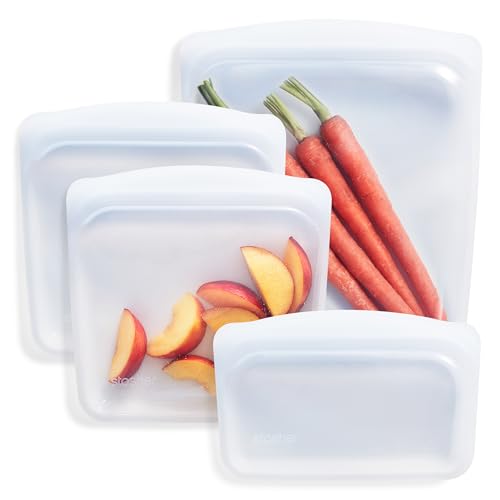
Stasher Silicone Bags
Positioning: premium tier — the benchmark pinch-press design. Stasher is the name most people picture first, and the reputation rests on the seal: a pinch-press closure that runs the full width of the opening and gives clear tactile feedback as it closes, section by section, under your fingers. The silicone body is thick and supple rather than rigid, so the bag flexes around odd shapes — a halved onion, a wedge of cheese, a tangle of herbs — instead of forcing food into a fixed geometry. Sizes run from small snack formats up to generous half-gallon styles suited to marinades and freezer batches, and the colours are genuinely useful rather than decorative, because a consistent colour-per-size habit makes a crowded freezer drawer readable at a glance. In daily use the bags wash up well, dry best propped open, and hold their seal integrity over long service. Best for: households building a core set they expect to keep for years. Not suited for: anyone who wants the absolute lightest bag for travel, where thinner reusable designs travel flatter.
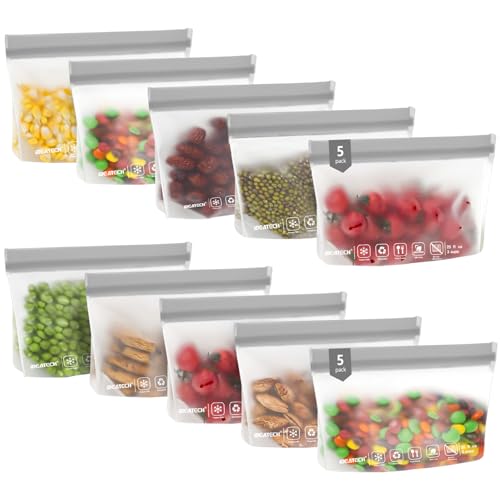
IDEATECH Silicone Bags
Positioning: entry tier — the value multi-pack option. IDEATECH built its following on the unglamorous virtue of the multi-pack: enough bags, in enough sizes, that a household can actually retire the disposable roll instead of rationing three precious reusables. The bags use a slider-assisted or press seal depending on the set, the silicone is freezer-appropriate and flexible, and the assortment logic — small for snacks, medium for produce and leftovers, large for freezer batches — matches how kitchens actually consume bags across a week. Expect a slightly more utilitarian finish than the design-led brands, and expect to spend a minute learning each size’s sealing feel, but the cost-per-bag maths of a big set is what converts sceptics: when a reusable is always within reach, the disposable habit quietly dies. Best for: families converting a whole drawer at once. Not suited for: minimalists who want two perfect bags rather than a working fleet.
W&P Porter Silicone Bags
Positioning: premium tier — the design-led, stand-up option. Porter bags are what happens when a design studio treats a storage bag as tableware: calm colours, a matte finish that looks at home on an open shelf, and a stand-up base that lets the bag sit open on the counter while you fill it — a small thing that changes the whole experience of portioning soup or decanting grains. The silicone is substantial, the seal closes with a confident press, and the overall feel is closer to a soft container than to a bag, which is precisely the appeal for people who disliked the floppiness of earlier reusables. They photograph beautifully, but the substance underneath is real: thick walls for freezer duty, a shape that stacks and stands rather than slumping, and a surface that releases food cleanly. Best for: design-conscious kitchens, countertop-visible storage and soup portioning. Not suited for: bulk buying on the tightest budget, where multi-packs stretch further.
Setup and Care That Reduce the Cons
The care routine that keeps silicone pleasant is short enough to memorise: wash hot and soapy, scrub the seal line, rinse clean, dry open, store dry. Each clause exists because of a real failure mode. Hot soapy water lifts the fats that cold rinses smear. Scrubbing the seal line clears the one place residue accumulates. Rinsing clean prevents the faint soapy flavour silicone can pass on when it is put away filmed. Drying open prevents the crease mould that ruins more reusable bags than any tear or split. Storing dry keeps the whole set fresh and ready, so reaching for one is never a small gamble.
Two habits separate long-lived sets from short-lived ones. First, deal with strong colours and smells promptly: tomato sauces, curries and cut onions will tint or scent any storage material left sitting, and a prompt wash plus open airing clears most of it. Second, respect the raw-food rule — a bag that carried raw meat or fish gets the most thorough wash you own, with real attention to the closure, and if that ever feels like too much trust to place in a wash, use a disposable for raw proteins and let silicone do the other ninety percent of the work. Systems survive on honesty about their friction points, and washing is silicone’s; design your routine around it and the friction mostly disappears.
Two more con-killers deserve naming. The water test on day one — fill, seal, check, squeeze over the sink — converts seal anxiety into seal fluency in ten minutes, ending the learning week’s leaks before they happen. And the monthly roster review — demote a tired seal to dry duty, note a repeated size gap — keeps the system at strength with minutes of attention, instead of letting small degradations accumulate into a false verdict on the whole category.
Reusable Silicone Bags Pros and Cons: Bottom Line
Silicone’s pros are what the material is; its cons are what reusability asks. For cooking households with daily turnover and a working wash-and-dry routine, the exchange is overwhelmingly favourable and improves with every year the set serves. For households without the turnover or the routine, the same exchange is unfavourable, and the honest move is to skip. Decide by your kitchen’s reality, allocate the edge jobs to their specialists, and whichever side you land on, you will have decided better than the impulse buyers on both extremes. The deep-dive evidence sits in our full reusable silicone bags review.
Pro and Con, Tested at the Extremes
The Liquid Extreme: A Week of Soups
Nothing interrogates a seal like a household that soups daily. Across a week of portioning, stacking, freezing and thawing liquid in silicone, the pros compounded: bags filled standing, sealed with the ceremony, froze into file-able slabs, thawed without a single shelf incident, and washed back to neutral between tenants. The cons made their one appearance exactly where this article predicted — in the drying rack’s real estate, because a week of soups is a week of wide bags propped open, and a household without a planned drying spot felt the squeeze by day three. Verdict at the extreme: the pro is structural and total; the con is logistical and solvable with a rack and a decision.
The Neglect Extreme: The Bag at the Back of the Fridge
Every category should be tested against its worst user, so one test bag was left, deliberately, holding a pungent leftover at the fridge’s back for longer than any guide would advise. The result, reported without pleasure: the bag held its seal, protected its neighbours entirely — the fridge smelled of nothing when it was opened — and then required the full rehabilitation protocol: hot wash, seal scrub, thorough open airing across a day, after which it returned to service with only a ghost of its adventure. The con this tests is real — silicone left sitting with strong food will take on its character — but the recovery matters more than the offence: a disposable would have been binned with its contents, and a rigid tub would have kept the smell longer. Neglect is a cost; in silicone, unusually, it is a recoverable one.
The Travel Extreme: A Fortnight Away
Sent travelling for two weeks — lunches, market produce, toiletries, chargers, a leaking bottle contained over a mountain road — the roster’s lightweight contingent earned the trip, and the heavy heroes stayed home, which is itself the finding. At the extreme of mobility, silicone’s weight con is real for the thick designs and irrelevant for the thin ones, and the pro that survives every itinerary is the seal: one contained leak inside a packed bag pays for a roster’s travel wing outright. Households that travel hard should weight their pros-and-cons by the lightweight end; households that travel rarely should ignore this section and weight the freezer instead. Extremes do not change the ledger; they reveal which line of it is yours.
The Generational View: What Changes After the First Year
Most pros-and-cons lists are written at the moment of purchase, when the cons are loudest and the pros are promises. Revisit the ledger at a year and the balance has moved in specific, predictable ways. The washing con has shrunk to background — a minute folded into cooking, no longer itemised by anyone in the house. The drying con has become furniture: a rack, a habit, a non-event. The bulk con is unchanged but reframed, because the drawer it occupies has stopped being contested — the roll and half the rigid tubs left, and the roster’s space is simply the storage system’s space now. Meanwhile the pros have compounded in the direction of organisation: the labelled freezer, the rotated stock, the lunches that assemble themselves, the food waste that quietly fell because food became visible. This is why this article’s verdict weights routine-fit so heavily: the cons of silicone are front-loaded and fade, the pros are back-loaded and grow, and a household choosing for the year rather than the week will read the same ledger and reach the opposite conclusion from a household choosing for the unboxing. Choose for the year.
Second-Order Effects Nobody Lists
The standard ledger, given in full above, misses a layer of effects that only appear once the system is running — and they belong in an honest pros-and-cons, because for many households they end up outweighing the headline items. On the pro side: portion discipline. Bags sized to roles quietly standardise portions — the soup slab is a serving, the marinade bag is a meal’s worth — and households find their batch cooking, freezing and eating falling into a rhythm that reduces both waste and the nightly ‘what is there?’ negotiation. Shopping clarity. A readable freezer is a shopping list that writes itself; duplicates stop being bought because the first purchase is visible, and the household’s food spending calms in a way nobody attributed to bags until the pattern was undeniable. Teaching value. Children raised on a wash-and-reuse roster absorb the system’s logic — tools are kept, seals are checked, things are dried and put away — as kitchen common sense rather than as a lecture, and more than one test household named this as the pro they would not trade.
On the con side, the second-order effects are equally real. Drawer politics. A roster is a shared resource, and shared resources generate small frictions — the good larges always in the wash on batch day, the stand-ups colonised by one cook’s project — that households solve with the spare-per-role rule or not at all. Guest friction. Visitors do not know the ceremony, and a well-meaning guest will file a damp bag or force a seal; systems survive this with a visible drying spot and a forgiving household policy, but the friction exists and belongs in the ledger. Expansion creep. Success breeds purchasing, and rosters can grow past their drawer’s discipline into the very jumble they replaced; the monthly review and the demotion habit are the governance that keeps the pro from curdling into its opposite. None of these effects decides the purchase alone. Together, they explain why two households with identical ledgers report opposite experiences — the second order is where systems live, and it rewards the households that manage it lightly and consistently.
The Ledger, Scored by Time Horizon
One final framing, because pros-and-cons are time-sensitive and most lists pretend otherwise. At one week, the cons lead: money spent in spirit, seals unlearned, drying improvised, the roll still within reach and whispering. Any verdict taken at one week is a verdict on novelty, not on the product. At one month, the ledger balances and tips: the routine has formed, the first freezer file has been eaten from in rotation, the first musty scare — if it came — has been diagnosed to a damp filing and cured. Households that reach one month with the routine intact almost never go back. At one year, the pros have compounded past argument for high-turnover kitchens: the set is infrastructure, its cost forgotten, its duties invisible, its organisational dividends simply ‘how the kitchen is’. The honest advice encoded in that timeline is to judge silicone at the month, not the week — and to build the routine that gets you there, using the care section of this article and the choosing method elsewhere in this cluster. Time is the ingredient every other pro needs; give the system a month of it, and the ledger will make the decision for you.
How the Ledger Shifts by Climate, Season and Cooking Style
Pros and cons are not constants; they are functions of where and how a household cooks, and an honest assessment should say how the ledger moves. In humid climates and damp seasons, the drying con grows teeth: bags dry slower, creases stay damp longer, and the discipline must upgrade from habit to infrastructure — a rack in moving air, a rule that bags are stored open, perhaps a rotation deep enough that no bag is needed before it is truly dry. Households in the tropics run silicone successfully in large numbers, but they run the drying protocol like they mean it. In dry and cold seasons, the same con shrinks to a formality, while the freezer pros swell — batch season, soup season, the months when the freezer file feeds the household weekly. For raw-food-heavy cooking styles — households that butcher, fish and marinate proteins constantly — the allocation line moves: more jobs sit in the disposable exceptions, the silicone roster slims to produce, leftovers and cooked work, and the verdict depends on whether that slimmer centre still turns over daily. For plant-heavy kitchens, the ledger tilts furthest pro of all: produce life, herb care, chopped-and-ready storage and grain batching are silicone’s home turf, with barely a raw-protein exception in sight. Read your own climate and cooking style into the ledger before you total it; the same list of pros and cons is a different decision in Singapore than in Stockholm, and pretending otherwise is how generic advice fails specific kitchens.
There is a final, quieter variable: the household’s stage of life. Households in the thick of small children should weight the coverage pros and the dishwasher-friendly care paths heavily, because their turnover is enormous and their attention is not. Households cooking for one or two should weight the small sizes and the food-saving pros — the halves that stop dying, the portions that freeze as singles — because their waste problem is a visibility problem. Households entering the batch-cooking years should weight the freezer ledger almost exclusively. The pros and cons do not change; their weights do, and the skill this article has tried to teach — beyond any single item on either list — is the weighting itself. Anyone can recite a ledger. A decision requires knowing which lines are yours.
Myth-Checking the Ledger
Four claims circulate around this category that an honest pros-and-cons should rule on explicitly. “Silicone bags are zero-maintenance.” False, and this article has spent its cons section on the correction: washing and complete drying are the standing price, small and non-negotiable. “They leak.” Misleading: verified seals on clean, dry tracks held every liquid the tests assigned; the leaks on record traced to hurried closures and dirty tracks — process failures that the ceremony in this cluster eliminates, which is why the claim survives anecdotally while failing procedurally. “They are only for the eco-committed.” False in the direction that matters: the strongest pros in this ledger — sealing, freezing, order, food saved — are practical, and they accrue to households that never think about the category’s green framing at all; the environmental benefit rides along as a by-product of a practical system that survives. “The expensive ones are a different species.” Exaggerated: tiers differ in wall, finish, ergonomics and expected career length, not in kind — a value bag with a verified seal outperforms a premium bag with a hurried one every single time, and buyers should allocate their attention accordingly: routine first, roster second, tier third. Myths persist where ledgers are lazy. This one has tried to be exact, and its bottom line survives the myth-check unchanged: the pros are the material, the cons are the routine, and the decision is the fit.
The Pro and Con of the Category’s Maturity
One meta-consideration belongs in a complete ledger: this is now a mature category, and maturity itself is both a pro and a con for the buyer. The pro is reliability — designs have converged on what works, seals are proven, the failure modes are known and documented in guides like this one, and a buyer today benefits from a decade of other households’ learning curves. The lemons have been squeezed out of the market’s centre; what remains, across tiers, is honestly functional. The con is stagnation at the edges — genuine innovation is incremental, marketing inflates small differences into revolutions, and the buyer must resist paying revolution prices for refinements. The mature-category strategy follows naturally: buy the proven centre, in the tier your turnover justifies, from makers who document rather than dazzle, and let the frontier’s experiments mature on someone else’s drawer. Maturity also means the second-hand and hand-me-down channel is real — silicone’s longevity makes inherited bags a legitimate roster source, washed thoroughly and water-tested like any new arrival — a quiet pro that no consumable category can offer. Weigh maturity itself, then, as this article has taught you to weigh everything else: not as a slogan, but as a set of specific, checkable consequences for your kitchen.
And so the ledger closes where it opened: the pros are what the material is, the cons are what reusability asks, and maturity has made both sides unusually predictable. Predictability is an underrated gift in a purchase. It means the decision in front of you is not really about silicone at all — it is about your kitchen’s turnover, your household’s hands and habits, and a drying rack’s worth of infrastructure. Those are knowable tonight. Know them, and the pros and cons will total themselves.
For the Reader Keeping Score at Home
If you have read this far with a pencil, your tally probably shows what this article’s structure intended: the pros are longer in consequence, the cons are longer in conditions. That asymmetry is the finding. Silicone’s advantages compound silently — every week of service, every portion saved, every calm drawer — while its disadvantages bill you openly, in minutes and habits, from day one. Households are generally better at tolerating open bills than at noticing silent compounding, which is why the category’s reputation lags its reality among the unconverted and exceeds it among owners. The fairest summary this page can offer a scorer is a question rather than a count: which side of the ledger will your household still be feeling in a year — the minutes, by then invisible inside a routine, or the system, by then simply the way the kitchen works? Answer that, and you have not just read the pros and cons. You have weighed them, which was always the difference between this article and a list.
The Ledger on One Card
For the kitchen wall, then, the whole article in miniature. Pros: seals liquids, freezes tough, reheats helpfully, lasts for years, organises the cold corners of the kitchen, deletes a consumable forever. Cons: wash every time, dry completely or pay in mustiness, occupies a real drawer, asks a decision up front, needs the whole household playing. Method: allocate the edge jobs, verify every seal, demote rather than discard, judge at the month and not the week. Verdict: for the daily-turnover, routine-willing household, the pros take it — clearly, compounding, and by more with every year the set serves. Print the card, pin it by the drying rack, and let the system get on with proving it.
Pin one more line to the card, from the households who have lived longest with the ledger: the pro that grows latest and matters most is trust — not in a brand, but in a system whose behaviour you can predict completely. You know what the seal will do because you verified it; you know what the freezer holds because you filed it; you know what the bags ask of you because the asking never changes. In a kitchen full of appliances that surprise and consumables that run out, a storage system that simply never surprises you is a deeper luxury than any single capability on the pro list — and it is available, as this whole article has argued, at the price of a routine your household was probably already keeping for its pans.
And with that, the pencil can go down. The ledger has been kept in the open, at the extremes, across climates and households and time horizons, and it has not moved: material pros, routine cons, decision by fit. What remains is only the doing — or the deliberate, respectable not-doing — and either, chosen on this evidence, counts as this article succeeding at the one job a pros-and-cons exists to do.
Beyond the Summary: How the Reusable Silicone Bags Trade-Offs Play Out at Home
Advantages and disadvantages read differently once an item is in daily use, so this section weighs the reusable silicone bags the way a household experiences it over months rather than minutes. It focuses on the frictions, workarounds and quiet benefits that decide whether the balance stays positive.
Start With Your Space and Your Routine
Measure the space where the reusable silicone bags will live, including the clearance needed to use it, move around it and clean behind or beneath it, and keep those numbers beside you while you compare options. A good test is the two-week question: imagine the reusable silicone bags after a fortnight of ordinary use, with no special effort from you, and ask whether you would still choose it. Seasonal checks suit most Food Storage & Organization items well, so tie a quick inspection of the reusable silicone bags to a job you already do, such as changing clocks or clearing gutters. Where the reusable silicone bags has a surface you will set things on, lean on, or load, consider the heaviest realistic load in your household rather than the lightest display load in the photos.
The strongest argument for a reusable silicone bags is usually a boring one, such as suiting the space exactly or being easy to keep clean, while the strongest argument against it is often an everyday friction rather than a dramatic flaw. Ask how the reusable silicone bags will be cleaned on an ordinary week, with the products and time you actually have, not with a special routine you are unlikely to keep up. Apply the same checks to each shortlisted example, whether that is the Stasher Silicone Bags; the IDEATECH Silicone Bags; the W&P Porter Silicone Bags, because consistent testing is what makes the differences between models visible. If a part of the reusable silicone bags can be replaced, refreshed or re-covered separately, that option can extend its useful life well beyond the point where a sealed design would be thrown out.
When Small Problems Appear
Look for the detail photographs in the listing, not just the wide shots, and zoom in on edges, joints, fasteners, controls and finishes, which is where build quality usually shows itself first. When you compare delivery options for a reusable silicone bags, factor in where the item will be left and who will move it to its final spot, since the last few metres are where damage and strained backs happen. A reusable silicone bags that fits on paper can still fail in daily use if a doorway, a corner, a cupboard door or a walkway cuts into the space it needs, so trace the full path from delivery to final position. Decide in advance which single feature you would refuse to compromise on, and let that one priority settle ties between otherwise similar reusable silicone bags choices.
Dust, moisture, sunlight and heat each age Food Storage & Organization items in different ways, so match the finish and material of the reusable silicone bags to the conditions of the room or outdoor spot it will occupy. If a disadvantage of the reusable silicone bags would appear daily and its advantage only occasionally, the honest balance tips against it for most households, however appealing the advantage looks in a listing. Do not let a single impressive feature distract you from a basic mismatch in size, capacity or care needs, since basics decide satisfaction long after features stop being novel. Think about the end of the reusable silicone bags’s life with you as well, including whether it could move to another room, be passed on, or be stored without damage when your needs change.
Think about the season in which the reusable silicone bags will work hardest, and judge it against that season rather than the mild week in which you happen to be shopping.
A Short Decision Checklist
- Assembly needs, tools required and whether help is needed
- What your current arrangement does badly that the reusable silicone bags must fix
- The material and finish, matched to light, moisture and wear in its spot
- What your current arrangement does well that the reusable silicone bags must not lose
- Packaging kept until the reusable silicone bags has passed its first trial in place
- How the reusable silicone bags will be cleaned in an ordinary week
- Who will use the reusable silicone bags most, and any limits they have
- Where the reusable silicone bags and its accessories will be stored when not in use
Taken together, these checks take only a little time, yet they answer the questions that decide whether the reusable silicone bags suits your home, your household and your routine, and they do so before money changes hands rather than after.
Frequently Asked Questions
What is the biggest disadvantage of reusable silicone bags?
The wash-and-dry duty — specifically drying. Every use ends in a wash, and every bag must dry fully open before storage, because moisture trapped in the seal crease is the reliable cause of musty odours and mould. It is a small, daily, non-negotiable routine. Households that build it into cooking barely notice it; households that will not do it should not buy silicone, because the system will fail socially before the material ever does.
Do silicone bags stain or hold smells?
Strong colours and pungent foods can tint or scent any storage material left sitting unwashed, and silicone is no exception — but prompt washing clears most of it, and thorough open airing handles the rest. Lingering smells in practice almost always trace to bags stored damp rather than to the material itself. Wash promptly, scrub the seal groove, dry completely, and staining and odour stay minor, occasional issues rather than defining traits.
Are silicone bags better for the freezer than plastic bags?
For storage measured in weeks, yes in most respects: thicker walls stay supple, resist puncture and drawer knocks, protect against freezer burn, and the bags return to service afterwards instead of tearing on removal. For storage measured in months, vacuum sealing still wins outright, which is why this cluster recommends allocation — silicone for the weekly freezer cycle, vacuum for the long archive — rather than asking either tool to do everything.
Can silicone bags replace all my food storage?
Not quite, and they should not try. The mature system is allocated: silicone as the backbone for fridge, produce, lunches, marinades, liquids and weekly freezing; beeswax wraps for cheese, bread and wrapping; disposables, if you wish, for raw proteins and one-way trips; vacuum for months-long storage. Judged as that backbone, silicone’s pros dominate. Judged as a total replacement, its cons get blamed for jobs it never claimed.
How long do silicone bags last before the cons catch up?
Years of weekly cycles is the normal expectation for a quality set washed and dried properly; the material does not go brittle in the freezer or tired in the wash. End of life usually arrives by accident — a cut or torn corner — or by a seal gradually losing its certainty, at which point the bag demotes gracefully to dry storage and travel duty. Care routine, far more than brand or tier, decides where in that range a given set lands.
Is there anyone who should definitely not buy silicone bags?
Yes: households that bag food rarely, households whose storage is almost entirely months-long freezing, and households where nobody will wash and fully dry a bag after use. For them the cons are the whole experience and the pros never get used. Everyone else — daily cooks, lunch packers, batch preppers, produce-heavy kitchens — should weigh the checklist in this cluster’s worth-it guide and will usually land on buying a complete, right-sized roster.
Related Guides
Complete the picture with the cluster’s choosing method and comparative reviews.
our full reusable silicone bags review our comparative reusable silicone bags reviews the reusable silicone bags buying guide how to choose reusable silicone bags step by step whether reusable silicone bags are worth it For wider kitchen organisation, see also the best storage baskets the best under-bed storage the best closet organizer shelves the best mini fridges the best vacuum storage bags.


