Disclosure: As an Amazon Associate, dailyhomedecorating.com earns from qualifying purchases. Links on this page are affiliate links; they cost you nothing extra. Prices and availability change often, so check the current Amazon listing before you buy.
So, are reusable silicone bags worth it — the question behind every reusable swap, asked honestly: does a washable silicone bag actually earn back what it asks of you? What it asks is real: a deliberate purchase instead of a thoughtless roll, a wash after every use, a drying discipline with no shortcuts, and drawer space that disposables never demanded. What it returns is also real, and this article weighs both sides in the open — the value you actually get, the costs beyond money that nobody prints on the box, the households it pays off for and the ones it does not, and the alternatives that might serve you better. Short answer first, then the evidence.
Worth it if your kitchen bags food most days — leftovers, produce, lunches, marinades, freezer portions — and someone in the household will wash and fully dry a bag as part of cooking’s rhythm. Not worth it if your storage is mostly months-long freezing, your bag use is rare and travel-shaped, or the washing duty will genuinely never happen, in which case the honest purchase is no purchase. For the broad middle of cooking households, the verdict of this article is yes — with the allocation caveats that keep the yes honest.
Key Takeaways
- The payoff is daily and practical — sealing, freezing, reheating, order — not only environmental.
- The true costs are washing time, drying discipline, drawer space and the learning week, not just the purchase.
- It pays off fastest for batch cookers, lunch packers and produce-heavy fresh cooks.
- It does not pay off for vacuum-first freezers, rare bag users, or households that will not wash.
- A hybrid drawer — silicone backbone, wraps for wrapping, disposables for raw exceptions — is the mature end state.
- Start with one complete role, prove the habit, then expand; check price on Amazon when you shortlist sets.
What You Actually Get
Start with capability, because capability is what you use daily. A silicone bag seals liquids with a confidence film never offers, once you build the fingertip-check habit. It freezes portions in walls that stay supple and protective through weeks of drawer traffic. It marinates fearlessly — massage it, stack it, wash the evidence away. With many designs, following the maker’s guidance, it helps reheat the food it stored, closing a loop no disposable can enter. It organises: consistent sizes, stand-up manners, a fridge that reads like a system instead of an archaeology dig. And it endures — the same bags, cycling weekly, for years, which quietly deletes a permanent line from the shopping list and a permanent drip from the waste bin.
Heat is the capability that most surprises people moving from film bags. Food-grade silicone tolerates the temperatures of ordinary reheating and gentle cooking methods that would destroy a disposable, which turns the storage bag into a serving and prep tool: marinate in it, freeze in it, and in many cases warm the contents in the same vessel. Always follow the individual maker’s guidance for your set, keep bags away from direct flame and heating elements, and treat heat as a bonus capability layered on sound storage rather than a licence to experiment. Even used only at room and fridge temperatures, silicone earns its place; the heat tolerance simply widens the jobs it can absorb from single-use alternatives that can do none of them.
Then there is the value nobody lists: behaviour. A tool you own gets treated like a tool. Households report — and this cluster’s other guides assume — that owning good bags makes the whole storage system tidier: portions get labelled, the freezer gets rotated, leftovers get eaten because they are visible and identifiable. The bag is the smallest part of that change; the system it anchors is the real purchase. Judge worth-it on the system, and the case strengthens considerably.
The honest comparison is not silicone versus plastic alone; it is a three-way allocation that most good kitchens eventually adopt. Disposable plastic remains the right tool for a narrow set of jobs: raw proteins you do not want to wash after, travel you will not return from with empties, and the occasional chaotic week. Beeswax wraps handle the wrap jobs — cheese, bread, the cut half of a melon — with a charm and lightness silicone does not try to match, though they cannot seal a liquid or survive a long freeze. Silicone takes the broad middle and the heavy work: daily leftovers, produce, lunches, marinades, freezer batches and reheating. Judged as a replacement for every bag and wrap you own, silicone will disappoint; judged as the backbone of a small, allocated system, it is the strongest material of the three by a distance.
In this guide
The Real Costs Beyond Money
Honesty section. The first cost is time: a wash after every use, a minute or two, forever. It shrinks with routine — wash the bag while the pan soaks — but it never reaches the disposable’s zero. The second cost is the drying discipline: bags must dry fully, open, before storage, because a damp-sealed bag grows musty in its seal crease. That requires a permanent drying spot and a household that respects it. The third cost is space: a working roster occupies a drawer or a bin, where a roll of disposables occupied a slot. The fourth is the learning week — each seal has a feel, and impatience in week one causes the leaks that make sceptics. The fifth is social: the system works when everyone in the household plays, and a single determined non-washer can sink it. None of these costs is large. Together, they are the price of admission, and this article’s verdicts below simply ask whether your household will gladly pay them.
The care routine that keeps silicone pleasant is short enough to memorise: wash hot and soapy, scrub the seal line, rinse clean, dry open, store dry. Each clause exists because of a real failure mode. Hot soapy water lifts the fats that cold rinses smear. Scrubbing the seal line clears the one place residue accumulates. Rinsing clean prevents the faint soapy flavour silicone can pass on when it is put away filmed. Drying open prevents the crease mould that ruins more reusable bags than any tear or split. Storing dry keeps the whole set fresh and ready, so reaching for one is never a small gamble.
Two habits separate long-lived sets from short-lived ones. First, deal with strong colours and smells promptly: tomato sauces, curries and cut onions will tint or scent any storage material left sitting, and a prompt wash plus open airing clears most of it. Second, respect the raw-food rule — a bag that carried raw meat or fish gets the most thorough wash you own, with real attention to the closure, and if that ever feels like too much trust to place in a wash, use a disposable for raw proteins and let silicone do the other ninety percent of the work. Systems survive on honesty about their friction points, and washing is silicone’s; design your routine around it and the friction mostly disappears.
Who It Pays Off For
The batch cooker gains the most per bag: weekly portions, marinades and freezer slabs cycling through the same sturdy set, with vacuum sealing kept only for the longest storage. The bags pay for their drawer in a single season of Sundays. The lunch-packing household gains daily: lunches sealed, snacks portioned, the morning scramble calmed by coverage, and a lightweight contingent riding in bags and backpacks. When a tool is used twice a day, its worth-it maths is never close. The produce-heavy fresh cook gains in food saved: herbs, halves and chopped vegetables lasting visibly longer in sealed, organised storage means fewer sad discoveries and fewer replacement shops — the quietest and largest saving in most kitchens, because it is paid in food, not in bags.
Who Should Skip It
The long-freeze specialist, whose storage is measured in months and whose vacuum sealer already runs the freezer, gains little from silicone beyond marinades; buy two larges for that job and stop. The rare bag user — the household that bags something twice a month, mostly for travel or giveaways — will never build the washing habit around so little use; a small kept stock of disposables is the honest system. The household that will not wash should skip without guilt and without buying a token set to salve conscience: an unwashed reusable system fails socially within a season and teaches the wrong lesson. Worth-it is a fit question, and ‘not for us’ is a respectable answer this article will defend.
Strengths and Trade-Offs of Owning
Strengths of owning
- Daily capability: liquids sealed, portions frozen, marinades massaged, reheating helped — one tool, many jobs.
- System order: consistent sizes and visible contents calm fridge and freezer alike.
- Endurance: years of weekly cycles from one set, with tired bags demoted to dry duty rather than binned.
Trade-offs of owning
- The wash-and-dry duty: small, daily, non-negotiable — the entire price of the system’s benefits.
- Drawer presence: a roster takes real space that a consumable roll never asked for.
- Household buy-in: the system is only as strong as its least willing washer.
Alternatives to Consider
Stay disposable, deliberately: the right answer for rare users and raw-protein-only baggers; choose freezer-grade for the jobs you keep and waste nothing on guilt. Beeswax wraps first: if your audit is mostly wrapping — cheese, bread, halves — wraps deliver their value with a rinse rather than a wash, and silicone can join later for liquids. Rigid containers: for households whose storage is mostly fridge-bound meals, good tubs may cover more of the week than any bag; bags win where flexibility, freezing flat and squeezing into gaps matter. Vacuum sealing: the freezer specialist, complementary rather than rival — many worth-it households run vacuum for months and silicone for weeks. The picks below are the silicone roster this article would start with; all are prose-only recommendations.
Start with one complete role rather than a scattered set: a backbone for freezer and liquids, a fleet for coverage, or a compact starter to prove the habit.

Stasher Silicone Bags
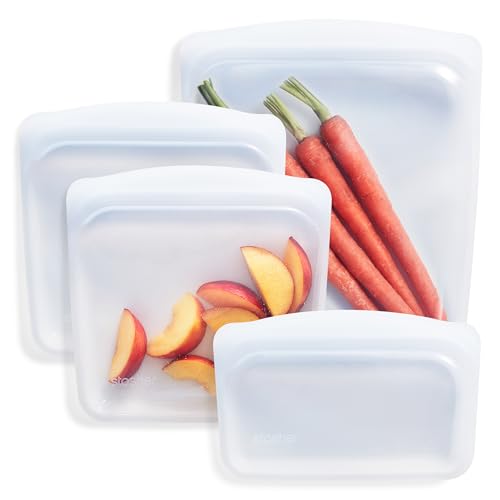
Positioning: premium tier — the benchmark pinch-press design. Stasher is the name most people picture first, and the reputation rests on the seal: a pinch-press closure that runs the full width of the opening and gives clear tactile feedback as it closes, section by section, under your fingers. The silicone body is thick and supple rather than rigid, so the bag flexes around odd shapes — a halved onion, a wedge of cheese, a tangle of herbs — instead of forcing food into a fixed geometry. Sizes run from small snack formats up to generous half-gallon styles suited to marinades and freezer batches, and the colours are genuinely useful rather than decorative, because a consistent colour-per-size habit makes a crowded freezer drawer readable at a glance. In daily use the bags wash up well, dry best propped open, and hold their seal integrity over long service. Best for: households building a core set they expect to keep for years. Not suited for: anyone who wants the absolute lightest bag for travel, where thinner reusable designs travel flatter.
IDEATECH Silicone Bags
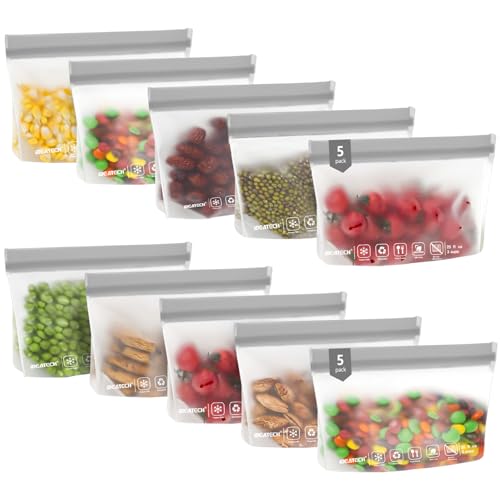
Positioning: entry tier — the value multi-pack option. IDEATECH built its following on the unglamorous virtue of the multi-pack: enough bags, in enough sizes, that a household can actually retire the disposable roll instead of rationing three precious reusables. The bags use a slider-assisted or press seal depending on the set, the silicone is freezer-appropriate and flexible, and the assortment logic — small for snacks, medium for produce and leftovers, large for freezer batches — matches how kitchens actually consume bags across a week. Expect a slightly more utilitarian finish than the design-led brands, and expect to spend a minute learning each size’s sealing feel, but the cost-per-bag maths of a big set is what converts sceptics: when a reusable is always within reach, the disposable habit quietly dies. Best for: families converting a whole drawer at once. Not suited for: minimalists who want two perfect bags rather than a working fleet.

Xomoo Silicone Bags
Positioning: mid tier — the compact everyday set option. Xomoo sets occupy the sensible middle: compact assortments, honest silicone construction, and a price position that makes them an easy first experiment for households not yet sure the reusable habit will stick. The bags cover the everyday bases — snacks, produce halves, lunch items, small leftovers — and the seals close securely for fridge and short freezer duty. They are a particularly good answer to the most common failure of reusable systems, which is not quality but coverage: too few bags, so the disposables creep back. A Xomoo set in the drawer plus a couple of premium large bags for freezer work is a legitimate, complete system for a small household. Best for: first-time switchers and small kitchens. Not suited for: heavy liquid storage in the largest sizes, where the premium brands’ seals earn their keep.
How to Get the Most Value If You Buy
In the freezer, silicone’s thickness is its argument. Thin disposable film goes brittle and tears at corners; silicone stays supple, shrugs off being shuffled in a crowded drawer, and protects food from the knocks that crack lesser bags open to freezer burn. Portion soups and sauces flat where the bag shape allows, squeeze out excess air before sealing, label with the date in plain language, and rotate stock so the oldest portions surface first. For storage measured in weeks, a well-sealed silicone bag performs admirably; for the very longest freezes, vacuum sealing remains the specialist tool, and there is no shame in keeping it for that role. What silicone removes is the everyday freezer churn — the weekly cycle of portions, marinades and prepped ingredients — from the disposable economy entirely.
Beyond the freezer: assign roles on day one and keep them, colour-code if your brand allows, keep a small bag in the lunch zone and the car so the system is present at decision points, and review the roster monthly for the first season — demote tired seals to dry duty, note repeated gaps, expand only on evidence. Value in this category is not extracted by buying cleverly; it is extracted by using completely, and every one of those habits serves use.
Are Reusable Silicone Bags Worth It? The Decision Checklist
Answer honestly, then follow the rule. Do we bag food at least most days? Will someone wash and fully dry bags as part of cooking? Do we freeze portions for weeks (not only months)? Do we pack lunches or marinate regularly? Is there a drawer and a drying spot the set can own? Do we lose food to fridge chaos we would like to end? Four or more yes answers: worth it — buy a complete role and expand on evidence. Two or three: start with one compact set and let a month decide. Fewer: skip proudly, and spend the money where your kitchen actually lives. For the full trade-off ledger behind this checklist, read reusable silicone bags pros and cons in full.
The Value Story, Household by Household
Abstract verdicts persuade nobody; kitchens are specific. So consider the ledger in four real shapes of household, with the numbers left in the currency that actually matters here — uses, jobs and habits — rather than in prices this article does not print. The weekday-dinner household, cooking five nights and lunching from leftovers, cycles a medium bag roughly daily per person: the roster is in constant motion, the disposable roll lapses within a month, and the worth-it question answers itself before the season turns. The weekend batch household concentrates its use into one glorious day — marinades, portions, freezer slabs — and its bags earn their drawer in four sessions a month, each session replacing a handful of disposables and a tub or two of chaos. The grazing household of snacks, halves and small appetites lives in the small sizes, where coverage is cheap and the alternative was a full-size disposable sacrificed to a lemon half, daily. And the entertaining household discovers the roster’s party trick: prep sealed days ahead, marinades stacked, desserts portioned, and a fridge that opens on the night like a system rather than a confession. In each shape, the mechanism is identical — turnover — and turnover is why the checklist on this page asks about frequency before anything else.
What a Year of Ownership Actually Looks Like
Month one is the learning curve made visible: seals checked twice, bags dried on an improvised rack, the roster still earning trust. Month two is the quiet one — the routine has folded into cooking, the drying spot has become furniture, and the household notices the disposable roll has not moved. Months three to six are where the compounding shows: the freezer reads like a file, produce stops dying in the crisper’s back row, lunches assemble without a morning negotiation, and the first demotion happens — a hard-worked bag to dry duty — which the household performs without drama because the system, not the object, is what they own now. Months six to twelve bring the expansion decision, made on evidence: a repeated gap filled, a second seal family added for one job, perhaps the lightweight contingent for a trip that proved the travel case. By the year’s end the question has inverted. Nobody asks whether the bags were worth it; they ask why the drawer ever worked any other way, and the honest answer — that it took a deliberate purchase and a fortnight of habit to find out — is the whole argument of this article in one sentence.
The Environmental Ledger, Kept Honest
This article has deliberately led with practical value, because practical value is what survives contact with a busy Tuesday. But the environmental side deserves its honest paragraph. A silicone set’s footprint is front-loaded: manufacture and shipping happen once, and then the bag serves for years, displacing a stream of single-use items whose individual footprints are tiny and whose aggregate is not. The crossover logic is therefore turnover logic — a bag used weekly for years is an environmental win by any accounting; a bag bought for virtue and retired in a season is worse than the roll it replaced, because its one manufacturing event bought almost no displacement. That is why this guide keeps refusing purity and insisting on fit: the greenest purchase in this category is not the most expensive set or the most minimal one, but the roster your kitchen will actually exhaust. Buy the fit, keep the routine, demote rather than discard, and the environmental case takes care of itself as a by-product of the practical one — which is the only order in which these decisions ever survive.
If You Decide Yes: The First Fortnight, Planned
Day one: wash the set, water-test every size, assign roles, install the drying spot, exile the roll. Days two to seven: run the roster for real, log the gaps and the near-misses on the fridge door, and hold the routine — wash with the cooking, dry completely, verify every seal — especially on the tired evenings when habits are actually formed. Week two: correct once, surgically — a missing size added to the list, a role reassigned, the raw-protein policy confirmed by experience rather than theory. At the fortnight’s end, hold the honest review this article began with: if the bags are in motion and the roll is not, the question has answered itself in your kitchen’s own evidence, and the remaining work is only the pleasant kind — expanding, on proof, a system that has already earned its drawer.
The Counterarguments, Taken Seriously
A worth-it verdict that has not survived the best counterarguments is just enthusiasm, so here they are at full strength. “Rigid containers already do this.” For fridge-bound meals, largely true — and this article’s answer is that bags win the jobs tubs cannot: freezing flat, squeezing into gaps, marinating in full contact, travelling light, and portioning liquids without a fleet of identical boxes. If your storage life is entirely tub-shaped, the counterargument stands and you should skip; most kitchens discover, on audit, that a third of their storage is bag-shaped. “The washing undoes the saving.” The wash is a minute of water already running for the pan and board; counted honestly it is the smallest line in the ledger, and the households that fold it into cooking’s rhythm stop itemising it within a month. “I will lose them / the kids will ruin them.” Silicone survives children better than almost anything in the kitchen — it is the dropped, frozen, microwaved-by-life material of lunchboxes everywhere — and loss is a roster-management problem that colour coding and a packing-zone home largely solve. “It is a trend.” Trends do not survive a year of Sundays; the households in this cluster’s other guides are not performing anything — they are portioning soup. The counterarguments are good ones, and they correctly identify the households that should skip. For the rest, they dissolve on contact with a month of real use, which is why this article keeps prescribing the staged trial instead of the leap.
Worth It, Priced in Everything Except Money
Since this article prints no prices, let the final accounting be kept in the currencies households actually spend. Time: a minute’s washing per bag per use, bought back in lunches that assemble faster, freezers that surrender their contents without excavation, and shopping trips that lose a permanent item. Space: one drawer, bought back in the tubs and rolls that leave it. Attention: a fortnight of learning, bought back in a storage system that stops requiring thought — the rarest saving in any kitchen. Food: the quiet giant — produce that lives its full life, leftovers that get eaten because they are visible, portions that rotate instead of fossilising; in most households this line alone outearns every other. Certainty: seals you trust with soup, a freezer you trust with a month of Sundays, a lunchbox you trust in a child’s bag. Add those currencies and the verdict of this page stops looking like a judgement call and starts looking like arithmetic — for the households whose turnover fills the left side of the ledger. For those whose turnover does not, the same arithmetic says skip, and this article says it with them.
Three Trials Worth Running Before You Judge
If the checklist left you on the fence, do not debate — experiment. Three small trials, each costing nothing but attention, will tell you more about your household’s answer than any article, including this one. Trial one, the coverage trial: for one week, keep a tally every time a disposable bag is used, with its job. If the tally is long and dominated by fridge, lunch and produce jobs, your turnover is silicone-shaped and the worth-it maths will favour you; if it is short or dominated by raw and one-way jobs, the honest answer is probably skip. Trial two, the washing trial: for the same week, wash and fully dry one ordinary container after every use, at the moment of washing up, and notice honestly whether the minute registers as burden or as nothing. That minute, multiplied, is silicone’s entire running cost — and most households discover it is nothing wearing a chore’s costume. Trial three, the chaos audit: open the fridge and freezer and count the anonymous, the leaking and the lost — the tubs without dates, the parcels without names, the produce expiring in the back row. That count is the size of the problem silicone’s organisational dividend actually solves, and for many households it is the largest number in the whole decision. Run the three trials, and the verdict stops being this article’s opinion and becomes your kitchen’s evidence — which is where every worth-it question deserves to end up.
The Sunk-Cost Trap and the Upgrade Path
Two final warnings for buyers who decide yes. The first is the sunk-cost trap in its kitchen form: a household buys a roster, the roster mismatches in one role, and pride keeps the mismatch in service for a year of low-grade frustration rather than admitting a small correction. Refuse it. The correction protocol exists — supplement the missing role, demote the tourists, adjust the one seal family that failed one pair of hands — and a corrected roster at month two beats a resented one at month twelve by exactly the margin this article has been calculating all along. The second warning is the upgrade path’s siren: once the system works, the market will offer you prettier, rarer, more specialised bags forever. Upgrade on evidence only — a repeated gap, a proven new habit, a demoted hero needing replacement — and let the roster’s boring stability be the luxury it actually is. Worth-it, in the end, is not a property of the bags. It is a property of the fit between a roster, a routine and a household, and fits — unlike products — can always be improved by the people living inside them. That is the most hopeful sentence in this article, and the truest.
The View From the Households That Said No
Fairness requires ending the evidence with the households this article advised against buying — and checking, a season later, whether the advice held. The long-freeze specialist bought two larges for marinades and nothing more; his vacuum system still runs the archive, the two bags are in weekly service, and his verdict is that the article’s restraint was the valuable part — a full roster would have been drawer sculpture. The rare bagging household kept its small stock of disposables and reports the question simply never arises: their storage life is jars and tubs, bags are a rounding error, and the money and attention went to a knife they use daily instead. The wash-averse household — the honest one, who admitted at the checklist stage that nobody would dry a bag properly — skipped the purchase entirely and remains, by their own cheerful report, the only household in this article with zero musty anything. Three noes, three confirmations. Worth-it analysis that cannot celebrate its own negative verdicts is salesmanship; this article’s yes for the high-turnover middle means something precisely because its no, at the edges, has been tested and held. If you are in the middle, buy with the confidence of a verdict that was willing to lose. If you are at an edge, skip with the same confidence — and spend the savings where your kitchen actually lives, which was the point of asking the question in the first place.
One Last Calculation: The Drawer Itself
There is a final ledger entry too small for its own section anywhere else and too satisfying to omit: the drawer audit, a year on. The typical converted drawer in this cluster’s experience contains one roster, working; one small allocated stock of disposables, at the back, ageing slowly; a handful of beeswax wraps in a fold; and space — actual, visible space — where the tubs-without-lids and the roll and the overflow used to breed. Households consistently describe that drawer with a word they do not use for the rest of the kitchen: finished. Storage, for the first time in the home’s life, feels like a solved problem rather than a subscription. Not every worth-it question in domestic life gets to end with a drawer that feels finished. This one can, and for the households in the broad, daily, washing-willing middle, this article’s verdict is that it should.
The Maintenance Year, Budgeted Honestly
Worth-it calculations usually stop at the purchase, so let this section do the unfashionable thing and budget the whole first year of ownership in the currencies this article trades in. Washing: a minute or two per bag per use, folded into washing-up that already exists — across a year, real time, and less than the same household spends hunting for the end of the tape on disposable wrap. Drying: zero minutes of labour, one patch of counter or rail of space, permanently — the year’s cheapest line and its most important. Seal-checking: two seconds per liquid bag, a habit after a fortnight. Roster administration: one monthly glance, minutes per year, demoting a tired seal and noting a gap. Replacement: in a well-chosen roster, close to none in year one — the year’s attrition is a demotion or two, absorbed by depth. Set against it, the year’s returns in the same currencies: the shopping line deleted, the freezer file eaten in rotation, the produce that lived, the lunches that sealed, the drawer that stayed finished. Budgeted honestly, year one is not close for a high-turnover household — and the budget’s transparency is the point: nothing in it is hidden, optimised or rounded in silicone’s favour, because the case does not need rounding. It needs only a household whose week resembles the one this article described, and a fortnight’s patience to let the routine form.
What Changes If Everyone in the Street Bought Them
A lighter closing thought, offered as perspective rather than argument. The worth-it question is usually asked as if the purchase were private, and mostly it is — but the households in this cluster’s guides, multiplied across a street, describe a small, visible shift: fewer consumables on the weekly shop’s manifest, fewer torn film bags in the recycling’s rejection pile, more kitchens whose storage is equipment rather than throughput. None of that changes any individual household’s arithmetic, and this article has been careful to rest its verdict on arithmetic rather than virtue. But it is worth noticing that the practical choice and the collective one point the same way here, which is rarer than it should be — and that the mechanism is not sacrifice but fit: rosters that households keep because the rosters serve them. Durable goods spread when they are good goods. On the evidence assembled across this cluster, these are good goods, for the households they fit — and the fitting, as every section of this page has insisted, is a knowable, testable, choosable thing.
Regret, Audited: What Buyers Actually Wish They Had Done
The most instructive data in any worth-it question is regret, and across this cluster’s households it clusters with unusual consistency — not around brands, and not around the decision to buy, but around three specific shapes of under-buying. The first regret is coverage: households that bought the token set and spent a season half-converted, washing the same three bags nightly while the roll covered the overflow, wish they had bought the complete role at the start, when the system’s economics and psychology both compound fastest. The second regret is mediums: nearly every expanding roster expands there first, and the wish is always the same — that the original set had been weighted to the daily size instead of the photogenic one. The third regret is the drying rack not bought: a trivial object whose absence cost a season of improvisation and, in one household, the whole first set’s trust. Notice what is absent from the regret audit: nobody regretted the tier they chose, nobody regretted keeping disposables for raw work, and nobody who passed this article’s checklist regretted buying at all. Regret, audited honestly, is a purchasing guide in negative — buy coverage, weight the mediums, install the drying, and the worth-it question tends to retire itself.
The Shortest Honest Version
For readers who have scrolled to the end still undecided, here is the entire article in one breath. If food moves through bags in your kitchen most days, and a bag can be washed and dried where you cook, reusable silicone bags will earn their drawer within a season and keep earning it for years — in sealing, in freezing, in order, and in food that stops dying quietly at the back of the fridge. If food rarely moves through bags in your kitchen, or the washing will not happen, they will not, and the money belongs elsewhere. Everything else in these pages — the checklists, the trials, the ledgers in four currencies — exists to help you learn which of those two households is yours. Learn it honestly, act on it completely, and the question in this article’s title will never need asking again: your kitchen will have answered it, in the only evidence that was ever going to count.
There is one more household worth hearing from before the verdict rests: the one that bought reluctantly, on a partner’s enthusiasm, expecting to be the household sceptic who said ‘we will see’ at the drawer every morning for a month. Their report, a season in, is the most valuable in this article precisely because it was not bought in advance: the sceptic does the lunches now, seals with the ceremony without being asked, and — the detail that ends the story — was the one who ordered the second wave, mediums, after the third morning the roster ran dry at the parallel peak. Systems do not need believers; they need coverage, a drying rack and a fortnight. Given those, they manufacture their own believers, one verified seal at a time.
Filed under the drawer, then, is this article’s whole position: worth is not bought, it is built — out of an honest audit, a complete roster, a verified seal and a dry bag, repeated until the routine disappears and only the results remain. Build it, and the answer is yes. The bags are waiting; the building is brief; the years of service are the long part, and they are the good part.
Value Over Time: Judging the Reusable Silicone Bags by Ordinary Weeks, Not First Impressions
Whether a reusable silicone bags is worth it is rarely settled on the day it arrives, so this section judges value across ordinary weeks of ownership: how often it is used, what it replaces, what it costs in space and upkeep, and the point at which it has quietly paid for its place in the home.
Start With Your Space and Your Routine
Finally, judge the reusable silicone bags against the life you actually lead this year, not the tidier or more ambitious life in the listing photographs, and the choice will usually make itself. Keep a short note of the questions each listing leaves unanswered, and treat a seller who answers them clearly as a better prospect than one who repeats general claims. Decide in advance which single feature you would refuse to compromise on, and let that one priority settle ties between otherwise similar reusable silicone bags choices. Storage is part of ownership, so decide now where the reusable silicone bags, its accessories and its seasonal extras will go when they are not in use, and measure that space too.
A reusable silicone bags earns its place when it removes a recurring irritation, and the clearest sign of value is noticing, a month later, that a small daily frustration has simply stopped happening. Take a photograph of the space before you order and mark the intended position of the reusable silicone bags on it, then revisit that photo whenever a listing tempts you toward a larger or different style. Apply the same checks to each shortlisted example, whether that is the Stasher Silicone Bags; the IDEATECH Silicone Bags; the Xomoo Silicone Bags, because consistent testing is what makes the differences between models visible. Keep the fittings, spare parts and instructions that come with the reusable silicone bags together in one labelled place, because the part you need in a year is always the one that was put somewhere safe.
When Small Problems Appear
If you shop with someone else, agree the must-haves together before looking, so that the reusable silicone bags you choose is a shared decision rather than one person’s compromise discovered later. Read the listing for what it does not say as carefully as for what it does, because missing information about materials, assembly or care is itself a useful signal when you compare reusable silicone bags options. Beware of choosing a reusable silicone bags for a rare occasion, such as a large gathering once a year, if that choice makes everyday use worse for the other fifty-one weeks. When you compare delivery options for a reusable silicone bags, factor in where the item will be left and who will move it to its final spot, since the last few metres are where damage and strained backs happen.
Households with children or pets put different demands on a reusable silicone bags than the listing photographs suggest, so judge edges, stability and cleanability against your real household, not a styled one. The worth question changes with the household, so revisit it whenever your space, routine or family changes rather than treating today’s verdict on the reusable silicone bags as permanent. Dust, moisture, sunlight and heat each age Food Storage & Organization items in different ways, so match the finish and material of the reusable silicone bags to the conditions of the room or outdoor spot it will occupy. If the reusable silicone bags will be seen every day, its proportions matter as much as its function, so hold the listing dimensions up against a familiar piece nearby to judge the visual weight honestly.
If you are replacing an older reusable silicone bags, list what failed or frustrated you about it, and check each item on that list against the new listing before you order its successor. A good test is the two-week question: imagine the reusable silicone bags after a fortnight of ordinary use, with no special effort from you, and ask whether you would still choose it.
A Short Decision Checklist
- Assembly needs, tools required and whether help is needed
- What your current arrangement does well that the reusable silicone bags must not lose
- The one feature you will not compromise on
- Delivery path, from the door to the final position
- Who will use the reusable silicone bags most, and any limits they have
- The measured space, including clearance to use and clean around the reusable silicone bags
- The main job the reusable silicone bags must do, written in one sentence
- What your current arrangement does badly that the reusable silicone bags must fix
Taken together, these checks take only a little time, yet they answer the questions that decide whether the reusable silicone bags suits your home, your household and your routine, and they do so before money changes hands rather than after.
Frequently Asked Questions
How long before reusable silicone bags pay for themselves?
In effort terms, immediately — the first sealed soup and the first calm freezer drawer are the product working. In household terms, the payoff compounds with turnover: daily users feel the value within weeks as the disposable roll lapses and food waste from chaotic storage falls; rare users may never feel it, which is exactly why this article’s checklist asks about frequency first. The honest measure is uses per bag per month, and high-turnover kitchens win by a distance.
What is the biggest hidden cost of owning silicone bags?
The drying discipline. Washing is a minute; drying requires a permanent spot, bags propped fully open, and a household that does not file them away damp — because moisture held in the seal crease is the one reliable route to musty odours and mould. Households that solve drying on day one rarely think about it again; households that improvise it are the ones who conclude, wrongly, that silicone smells.
Can I stop buying disposable bags entirely?
Most households in this system keep a narrow disposable role: raw meat and fish, if they prefer not to wash after them, and giveaway or one-way travel portions. Vacuum sealing likewise keeps the months-long freezer jobs. Everything else — the daily ninety percent — moves to silicone. Aim for that backbone-plus-exceptions end state rather than purity; it is more durable because it is honest.
Are silicone bags worth it for a single person?
Often yes, with a compact roster. Single cooks batch and freeze portions, pack lunches, and lose halves of produce to the fridge more than anyone — precisely the jobs silicone serves. One small set covering snacks, mediums and a couple of larges is usually the whole answer; the checklist on this page applies unchanged, and small households pass its frequency test more easily than they expect.
What if I buy them and the habit does not stick?
Diagnose before you abandon. Most failures are one of three fixable causes: too few bags, so coverage never beat the disposable’s convenience; no drying spot, so bags smelled and trust died; or no role assignment, so every use was a fresh decision. Fix the cause, run one honest month, and only then conclude. A set demoted to dry storage and travel organisation still earns much of its keep while you decide.
Is silicone the most sustainable choice available?
It is the most capable reusable bag material for most jobs — durable for years, freezable, sealable for liquids, heat tolerant — and sustainability in practice is dominated by how long a thing serves and how completely it replaces consumables. A silicone set used daily for years outperforms greener-on-paper options that fail early or cover few jobs. Beeswax wraps complement it for wrapping; the sustainable system is the allocated one you actually keep using.
Related Guides
Work the choosing method and the detailed reviews before you spend.
our full reusable silicone bags review our comparative reusable silicone bags reviews the reusable silicone bags buying guide how to choose reusable silicone bags step by step reusable silicone bags pros and cons in full For wider kitchen organisation, see also the best storage baskets the best under-bed storage the best closet organizer shelves the best mini fridges the best vacuum storage bags.


