Disclosure: As an Amazon Associate, dailyhomedecorating.com earns from qualifying purchases. Links on this page are affiliate links; they cost you nothing extra. Prices and availability change often, so check the current Amazon listing before you buy.
These sectional sofa reviews exist because a single review cannot answer the question households actually ask, which is not whether sectionals are good but which kind of sectional survives their specific home. A compact modular design that delights a renter will frustrate a family of six; a grand traditional sectional that anchors a farmhouse living room cannot physically enter a third-floor flat. So this piece reviews the leading sectional types side by side — modular, chaise-led, convertible sleeper, compact modern, tailored, and traditional — judging each on the same ground: delivery, orientation, everyday comfort, pets and children, cleaning, and how gracefully it ages. Named models stand in for their types, and every verdict is given with its household attached, because a sectional recommendation without a household attached is just advertising.
Key Takeaways
- There is no best sectional — there is a best match between a sectional type, a room, a delivery route, and a household routine.
- Modular designs win on adaptability; fixed chaise designs win on unified feel; sleeper designs win only when guests are genuinely frequent.
- The delivery route eliminates more candidates than any comfort test: measure doorways, hallways, and stair turns before comparing fabrics.
- Left-facing versus right-facing is determined standing in front of the sofa, and reversible designs remove the risk of choosing wrong.
- Washable covers and rotatable cushions predict long-term satisfaction better than any showroom impression.
Short verdict. Start with the HONBAY-style modular if your life changes, the Belffin-style chaise sectional if your room is settled, the LINSY HOME-style convertible if guests are constant, and the Mopio-style compact if the room is small — then adjust within that family. The detailed reasoning, and the cases where each recommendation reverses, fills the rest of this page.
In this guide
Sectional Sofa Reviews: How the Main Types Stack Up
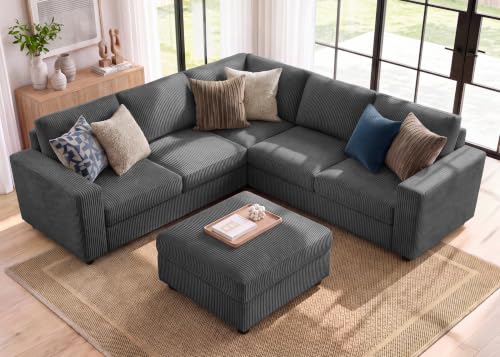
Before the individual reviews, it helps to see the field clearly. Sectionals divide by configuration first: modular systems built from separate seats; fixed L shapes with a chaise; fixed L shapes with a full return sofa; U shapes that wrap a group on three sides; and convertibles that fold out into a bed or hide storage. They divide again by orientation: fixed left-facing, fixed right-facing, or reversible. And they divide a third time by intent: everyday family seating, apartment-scaled seating, guest-ready sleeping, or design-led statement seating. Every model in these reviews is a point in that three-way grid, and most buying mistakes happen when a household shops one axis — usually looks — and ignores the other two.
Delivery cuts across all of it. The single most common sectional disaster is a sofa that cannot complete the journey from street to living room: a corner unit that will not rotate on a stair landing, a chaise piece too long for a hallway turn, a doorway narrower than the smallest dimension of a fixed section. Modular types largely dodge this because their largest piece is one seat. Fixed types demand honest measurement of every doorway, corridor, and turn, plus the diagonal thinking that experienced delivery crews use instinctively. Any household whose route includes a tight turn should weight the modular reviews below far more heavily than fabric or style preferences.
Comfort, the third axis, is more personal than listings admit. Seat depth decides whether shorter sitters can use the backrest; cushion resilience decides whether the sofa still supports upright sitting in year three; arm height decides whether reading and laptop work feel natural. Across these reviews, the recurring pattern is that households overvalue the first five minutes of softness and undervalue the exit — how easily each family member can stand up — and the worst seat, usually a junction or middle seat, rather than the glorious corner everyone tests first.

HONBAY Sectional Sofa — modular, reviewed
The HONBAY sectional is reviewed here as the modular benchmark: separate pieces that arrange into an L, re-form into other layouts, and separate again for moving. In daily use, its great strength is forgiveness. Rearrange for a party, split off a seat as a standalone chair for a reading corner, add a piece when the household grows, remove one when it shrinks. Owners in rentals and first homes rate this adaptability as the feature they would not trade, and it directly answers the category’s biggest risk — a fixed sofa bought for one room rarely fits the next. The trade-offs are real: seams between pieces are visible, the unified sculpted look of a fixed sectional is absent, and sections must be properly clipped or they drift on hard floors, opening the familiar corner gap.
Comfort is honest everyday comfort rather than luxury: a sit that suits mixed use — upright conversation, sideways lounging, a child asleep across two seats. In prose terms this is an entry-to-mid tier design, and judged within that tier it is the easiest recommendation in these reviews for anyone whose address or floor plan may change. Best for: renters, movers, growing households, indecisive layouts. Not suited for: formal rooms wanting a single tailored statement, or buyers who dislike visible modular seams. Households comparing it with a powered alternative should also read our reclining sofa reviews before deciding that adaptability beats mechanism.
Belffin Sectional Sofa — chaise-led with storage, reviewed
The Belffin sectional represents the layout most buyers picture: a main run of seating, a chaise for full-length lounging, and storage worked into the design so blankets and clutter disappear instead of colonising the arms. Reviewed as a daily family sofa, its strength is how naturally it organises an evening — upright seats for conversation, the chaise for the person reading or recovering from the day, storage swallowing the throws that otherwise live on the floor. The sit is unified in a way modular pieces rarely match, because the sections were designed as one composition.
The cautions are orientation and commitment. A chaise-led fixed design must be ordered on the correct side — left-facing or right-facing, judged standing in front of the sofa — and it will hold that opinion through every future rearrangement. Its pieces are also larger, so the delivery route needs the full measurement treatment, especially hallways and stair turns. In prose terms it sits in the mid tier, and within that tier it is the strongest all-round family recommendation in this set for a settled home. Best for: family rooms with a stable layout and a screen position already decided. Not suited for: households that rearrange seasonally or move often. Our step-by-step companion, how to choose a sectional sofa, shows how to confirm the chaise side from inside your own room before ordering.

LINSY HOME Sectional Sofa — convertible and storage-led, reviewed
The LINSY HOME sectional stands for the multifunction branch: seating that reconfigures, a chaise with storage beneath, and in this family of designs a sleeping solution for guests. Reviewed honestly, its value is density — in a home without a spare room, one piece of furniture does the work of a sofa, a guest bed, and a blanket cupboard. For small homes with regular overnight guests, that density is not a gimmick; it is the difference between hosting comfortably and apologising for an air bed on the floor.
The compromises follow the physics. Mechanisms add weight, which makes the delivery route even more decisive and rearrangement a two-person decision rather than an impulse. A convertible’s everyday sit is usually a touch firmer than a pure sofa’s, because the seat must also be a bed. And multifunction pieces reward households that actually use the functions: a sleeper opened twice a year has cost its owners firmness and weight every single day in exchange for two nights. In prose terms this family sits in the entry-to-mid tier. Best for: compact homes, frequent guests, storage-starved rooms. Not suited for: buyers whose top priority is the softest possible daily sit. Guest-focused readers should cross-check the best queen sleeper sofas for the dedicated sleeper field.
Mopio Sectional Sofa — compact modern, reviewed
The Mopio sectional is the compact modern entry in these reviews: lower profile, cleaner arms, proportions drawn for apartments and smaller living rooms rather than scaled-down reluctantly from a larger design. Its achievement is keeping the sectional experience — corner seat, chaise lounging, inward conversation — inside a footprint a modest room can carry with a walkway intact. Reviewed in a small-room context, it regularly beats a standard sofa plus chairs, because it seats more people against the walls and leaves the middle of the room open.
Its limits are the honest reverse of its virtues. Seat depth and sprawl are moderated; a tall household will feel the difference on long film nights, and a large extended family will simply run out of seats. The modern low profile also sits lower, which some older relatives find harder to rise from. In prose terms it sits in the mid tier. Best for: apartments, first homes, and smaller family rooms. Not suited for: large households or buyers wanting maximum sink-in depth. The wider small-space field is gathered in the best apartment sectional sofas, which pairs naturally with this review.
Rivet Sectional Sofa — tailored and upright, reviewed
The Rivet sectional represents the tailored school: defined lines, a firmer and more upright sit, and a silhouette that holds its own in rooms used for conversation and work as much as for sprawling. Reviewed across a working week, it is the sectional most likely to satisfy people who found softer designs unsupportive — backs stay comfortable through long reads and laptop sessions, and the whole piece keeps a composed look even in a household that never plumps a cushion. In prose terms it sits in the mid-to-premium tier.
The trade is surrender. This is not the sofa that swallows you on a Sunday afternoon, and dedicated loungers may find its discipline austere. Its tailored upholstery also shows a tidy household’s habits kindly and a chaotic one’s less so — structure displays wrinkles and displacement more honestly than slouchy designs do. Best for: upright sitters, design-led rooms, home workers. Not suited for: buyers whose definition of comfort is maximum softness. If your household is split between the two camps, the framework in the sectional sofa pros and cons will help settle it before money is spent.
Stone and Beam Sectional Sofa — generous traditional, reviewed
The Stone and Beam sectional closes the set as the generous traditional design: deep seats, full cushions, and proportions intended to anchor a large room for the long term. Reviewed in that setting, it delivers the most complete version of sectional comfort in this roundup — room to sit sideways, stretch out, pile children and a dog into the corner, and still have a seat left for a guest. In prose terms it sits in the premium tier, and its build intent is permanence rather than portability.
Everything about it demands a ready home. The pieces are the largest in these reviews, so doorways, hallways, and stair turns must be measured without optimism; the footprint dominates any room that is merely medium; and moving house with it is a project, not an errand. Best for: large family rooms and settled households buying once. Not suited for: apartments, renters, or narrow entry routes — for those homes, start from sofas for narrow doorways and work backwards to what can actually enter.
Head-to-Head: The Comparisons That Decide Purchases
Modular versus fixed is the first real fork. Modular wins whenever the future is uncertain — moves, rearrangements, growing or shrinking households — and loses a little on unified looks and seam-free comfort. Fixed wins when the room plan is settled for years and the household values a composed, single-gesture piece of furniture. Neither answer is a quality judgement; it is a prediction about your own life, and households are generally better at predicting their floor plans than their taste in fabrics.
Chaise versus full return is the second fork. A chaise gives one glorious lounging seat and keeps the footprint lighter; a full return gives proper upright seating around the corner and suits households that host groups sitting and talking rather than sprawling at a screen. U shapes extend that logic to its limit and should be reserved for wide rooms, because a U that fills the room leaves no graceful way to enter the seating at all. Sleeper versus storage is the third fork, and the rule is frequency: weekly guests justify a sleeper, weekly clutter justifies storage, and households with neither should buy the plainest, most comfortable sit their tier allows.
Fabric comparisons cut across every model. Tightly woven, washable-covered designs win for pets and children regardless of brand; delicate weaves and pale colours win only for careful adult households; leather-look finishes win on wipe-clean speed and lose on claw resistance and temperature. The complete fabric picture is in our sectional sofa buying guide, and the maintenance rhythm that keeps any of them alive is in the care section below.
Strengths and Trade-Offs Across the Field
Strengths
- Choice of commitment level: from fully modular to fully fixed, the category lets a household buy exactly as much permanence as its life can support.
- A seat for every posture: corner, chaise, and upright run in one piece cover conversation, work, reading, and full-length rest without extra furniture.
- Space efficiency at its best: a well-sized sectional seats more people on less wall than equivalent separate furniture.
Trade-offs
- Every type fails somewhere: modular shows seams, fixed resists change, sleepers sit firmer, compacts seat fewer, traditional designs overwhelm small rooms.
- Delivery is a filter, not a formality: the larger types are simply unavailable to homes whose routes cannot pass them, whatever their merits.
- The worst seat problem: junction and middle seats vary widely between designs and are rarely the seat anyone tests first.
Who Each Type Suits — and the Buying Checklist
Match the household, not the photograph. Renters and movers: modular, mid tier or below, washable covers. Settled families with a screen-centred room: fixed chaise-led, chaise side chosen from inside the room, performance fabric. Homes without a guest room: convertible sleeper, accepted with its firmer sit. Small rooms: compact modern, taped footprint, chaise along the wall. Upright, design-led households: tailored. Large settled rooms: traditional, after the most rigorous route measurement of all. The checklist that protects every one of these choices is the same: measure the full route from street to final position including turns; tape the footprint and live with it for a day; decide orientation standing in the room; choose fabric for the real household; confirm how sections connect and whether covers wash.
Two profiles deserve special warning. Households buying for a home they have not yet moved into should default to modular or reversible, because no floor plan survives first contact with real furniture unchanged. And households where one person lounges and everyone else sits upright should resist the deepest, softest designs: a sectional is shared territory, and its sit must be a compromise everyone can live with daily, not a victory for its keenest lounger. The value side of these decisions is examined in is a sectional sofa worth it.
Setup, Care and Maintenance Essentials
Assembly across the field follows one pattern: legs on, sections aligned, connectors fully engaged, and the sofa positioned before it is joined, never dragged after. Modular owners should photograph their preferred configuration before the first rearrangement — recreating a beloved layout from memory is harder than it sounds. Sleeper owners should open and close the mechanism once on delivery day, while help is present, and store the instructions with the bedding the mechanism exists for. Storage chaise owners should resist filling the compartment with anything heavy or rarely needed; it earns its keep holding the throws and spare cushions in daily rotation.
Care is a rhythm, not an event. Vacuum junctions and under cushions weekly, because every design in these reviews sheds crumbs into its corner. Rotate and flip cushions so the favourite seat does not age alone. Brush pet hair in the direction of the weave before it works in, blot spills immediately, and wash removable covers before they look desperate rather than after. Twice a year, check connectors and legs, clean behind the sofa — floating layouts especially — and air the cushions. Designs maintained this way hold their shape and their looks; neglected ones fail at the cushions first, whatever their tier. Fabric-specific guidance lives in the most comfortable sofa fabrics.
Final Verdict
Read as a field, these reviews point to one conclusion: sectional buying is matching, not ranking. The modular HONBAY style is the safest pair of hands for changing lives; the Belffin style is the settled family’s centre of gravity; the LINSY HOME style packs the most functions into the fewest rooms; the Mopio style proves small rooms are not excluded; the Rivet style serves upright, design-conscious sitters; and the Stone and Beam style rewards large, permanent homes. Choose by household, route, and room — in that order — and any of these types can be the right answer. For the single-product deep dive, return to our sectional sofa review.
How These Reviews Judged Comfort — and Why the Worst Seat Decides
Every sectional in this roundup was judged by the same uncomfortable standard: its worst seat, at the end of a long evening, for the household member least suited to it. That standard sounds harsh, but it mirrors ownership. The corner seat of almost any sectional is delightful; the differences that separate these types live in the junction seats, the end of the chaise where legs meet a seam, and the middle of the long run where two cushions meet and support dips almost imperceptibly. Households feel those differences nightly and showroom tests never reveal them, which is why these reviews keep returning to them.
Seat depth was judged against mixed-height households, because that is where sectionals quietly fail. A deep, loungy design is bliss for tall sitters and a slow exile for shorter ones, who end up perched on the edge or building a pillow fort to reach the backrest. Designs with movable back cushions scored best across mixed households, since each seat can be tuned. Seat height was judged by the exit test — can an older relative stand without using the arm as a crane — and low, soft designs lost marks there regardless of how luxurious they felt to sink into. Arm design was judged by real behaviour: reading, laptop work, a child’s head during a film, a cup balanced by an optimist. Wide flat arms earn their width; very low or sloping arms are decoration.
Finally, each type was judged on forgiveness — how it treats the mistakes households inevitably make. Modular forgives layout mistakes. Reversible chaises forgive orientation mistakes. Washable covers forgive pet and child mistakes. Storage forgives clutter mistakes. The designs that scored highest overall were rarely the most luxurious in any single moment; they were the ones that kept forgiving, week after week, the ordinary chaos of the homes they were reviewed for. That is also why no single winner is crowned here: forgiveness is household-specific, and the most forgiving design for a renter is a burden of seams and clips for a settled formal household.
Room by Room: Where Each Type Earned Its Verdict
In the small apartment living room, the compact Mopio style and the modular HONBAY style divided the honours. The compact design looked more composed and asked nothing of its owners; the modular design seated one more person and could shed a piece when the room felt crowded. The fixed chaise-led Belffin style, in this room, was simply too committed — its chaise claimed the walkway, and no fabric choice could argue with geometry. The lesson generalises: in small rooms, footprint discipline outranks every other virtue, and the correct first question is not which sectional is best but which sectional the room can carry with its paths intact.
In the family room — children, a dog, grandparents, a screen — the order reversed. The Belffin style’s unified sit and storage chaise organised the chaos best, the LINSY HOME style’s sleeper answered the grandparent problem outright, and the tailored Rivet style, for all its posture virtues, showed every cushion displacement a busy household creates. The generous Stone and Beam style would have led this room too, had the room been larger; scale, again, was the gatekeeper. Family rooms reward capacity, washability, and forgiveness in that order, and punish delicacy without exception.
In the open-plan space, the sectional’s second job — architecture — came to the fore. Floating a mid-sized sectional with its back to the dining zone defined the living area more gracefully than any rug alone, and the modular and chaise-led types both performed, provided a genuine walkway remained behind. The U-shaped logic was tested here and rejected for all but the widest spaces: a wrap-around arrangement that fills an open plan leaves guests orbiting outside the seating looking for a way in. And in the rental with a difficult stair turn, only the modular type completed the journey without drama — a verdict so absolute it deserves repeating: when the route is hostile, the comparison ends at the stairs, and every other review on this page becomes academic.
Fabric, Reviewed Across All Six Types
Because fabric choice repeats across every model in this roundup, it is reviewed once, comparatively, here. Tightly woven synthetic fabrics were the most forgiving all-rounders in testing-by-living: they released pet hair with a brush, blotted clean after the ordinary spill, and kept their colour in sunlit rooms. Their honest weakness is hand-feel — some read slightly flat or warm — which a natural-fibre throw at the main seats fixes cheaply. Microfibre-style weaves matched them for stain forgiveness and beat them for softness, while showing pressure marks more readily and gathering dust in dry homes.
Natural blends breathed best and felt richest, and asked the most in return: faster blotting, gentler cleaning, and tolerance for uneven fading where sunlight lands daily. Leather-look finishes wiped clean fastest of all and were the least forgiving of claws; households with cats should treat that pairing as a known, accepted wear pattern rather than a surprise. Velvet-look fabrics produced the strongest room transformation and the strongest opinions — their sit marks brush out, but owners must actually brush them. Across all six types, the fabric verdict never changed the ranking of the types themselves; it changed how gracefully the chosen type aged inside a real household, which is a different and equally important axis.
Colour interacted with fabric in one predictable way: mid-tones hid the evidence of ordinary life longest, whatever the weave. Very pale sectionals in family and pet homes became maintenance projects with seats attached. Very dark sectionals displayed every pale hair and crumb. The most successful colour strategy observed across these reviews was unglamorous — match the fabric tone loosely to the household’s dominant mess, whether that is a pale dog, dark-haired children, or a garden that tracks in light dust — and let pattern or texture, where available, break up what the eye would otherwise catch.
What a Year of Ownership Does to Each Type
Project these reviews forward a year and the gaps widen in instructive places. Modular designs look much as they did, with the caveat that unclipped sections on hard floors have wandered and need re-squaring — a five-minute ritual their owners either adopt or resent. Fixed chaise designs hold their composed look best of all, provided cushions were rotated; where they were not, the chaise end and corner show the household’s favouritism in their slump. Sleeper convertibles age at their mechanisms: a mechanism used monthly stays smooth, while one left folded for a year and then forced for a holiday guest is the one that complains.
Compact modern designs age gracefully in proportion — nothing about a small room changes to expose them — while generous traditional designs in rooms that were borderline at purchase tend to feel larger each year, as households accumulate the furniture of real life around them. Tailored designs keep their lines and their dignity, and their owners keep their posture, which across a year of evenings may be the most valuable outcome in this entire roundup. The meta-lesson of the year test is that sectionals rarely fail; they reveal. They reveal whether the route was measured, the orientation chosen in the room, the fabric matched to the household, and the size chosen for the life actually lived. Every review above is, in the end, a way of asking those four questions before the delivery truck arrives rather than after.
Delivery and Assembly, Type by Type
The delivery experience splits this field more cleanly than comfort does. Modular designs arrive as the most and smallest boxes; one person can receive them, carry pieces around a stair turn that would defeat any fixed corner unit, and assemble the sofa in the room where it will live. That last point matters more than it sounds — assembling in place means the finished sofa never has to pass a doorway at all. For upper-floor flats and older houses, this is not a convenience; it is the difference between owning a sectional and returning one.
Fixed chaise and traditional designs arrive as a few very large pieces and reward preparation: the route cleared, doors propped, the final position decided, and a second pair of hands ready. Their corner units are the recurring villain of delivery stories — a rigid, bulky shape that must rotate through spaces designed for people, not furniture. Convertible sleeper designs add sheer weight to the same problem, and their owners should plan the route for the heaviest single piece, not the average one. Across all types, the reviews’ advice is identical and unglamorous: measure the route’s narrowest point and its tightest turn, write both down, and compare them with the largest piece before ordering — and if a comparison fails, believe it, and change the design rather than the laws of geometry.
Assembly quality also predicts ownership quality. Connectors that engage positively, legs that seat firmly, and sections that align without force are the marks of a design that will stay composed; brackets that must be persuaded on day one will be re-persuaded monthly. Sleeper mechanisms should be cycled once with help present. Storage chaises should be opened and closed until the motion is familiar. These ten minutes on delivery day are the cheapest quality control in the entire purchase, and they are the moment when an orientation mistake — a chaise on the wrong side — can still be corrected with a phone call instead of a shrug that lasts a decade.
The Supporting Cast: What These Sectionals Needed Around Them
No sectional was reviewed in an empty room, because none lives in one. Lighting decided more evenings than fabric did: a floor lamp at the chaise end turned the good seat into the reading seat, and households planning a chaise should plan its lamp at the same time — a point explored in the best lamps for sectional sofas. Side tables mattered at the arms and were useless at the corner, where a small tray on the seat itself did the work. Rugs needed to be large enough for the front legs of every section, or the arrangement looked adrift; a rug that only fits the long run makes the chaise look like an afterthought.
Cushions and throws, meanwhile, quietly corrected the mismatches these reviews kept finding. A lumbar cushion converted a too-deep seat for a shorter sitter; a throw protected the corner seat — always the most used, always the first to wear — and laundered in minutes. Households that budgeted a little attention for these companions got measurably more from every type reviewed here, at every tier, than households that spent the same money stepping one tier up the sofa itself. It is the least glamorous conclusion in this roundup and one of the most reliable: the sectional is the platform, but the room around it decides the experience.
A Note on Prices, Tiers and Honest Expectations
These reviews deliberately judge value by tier rather than by any figure, because figures in this category move constantly and a recommendation built on a number rots quickly. What a tier buys is consistent, though. Entry-tier sectionals buy the shape and honest daily comfort, with lighter construction that asks for cushion care and modest expectations of decade-long service. Mid-tier sectionals — where most of this roundup’s strongest recommendations live — buy sturdier frames, more resilient cushions, washable covers on many designs, and the modular or reversible layouts that forgive a change of address. Premium-tier sectionals buy depth: deeper comfort, richer fabrics, quieter mechanisms, and a planted, permanent feel in rooms large enough to honour it.
What no tier buys deserves equal emphasis, because disappointed buyers most often expected it. Money does not buy immunity from geometry: the most expensive corner unit in this roundup fails a tight stair turn exactly as completely as the cheapest. Money does not fix orientation: a premium chaise on the wrong side is a daily, decade-long irritation wearing a beautiful fabric. And money does not substitute for the half hour of measuring and taping that separates satisfied sectional owners from return statistics. Spend in the right order — fit first, orientation second, fabric for the real household third, tier last — and even an entry-tier purchase will outperform a premium one bought in the reverse order. That ordering, repeated across six types and four kinds of room, is the closest thing these reviews have to a single universal finding.
How to Use These Reviews in Ten Minutes
Readers short on time can extract this roundup’s value in a deliberate sequence. First, eliminate by route: if your doorway, hallway, or stair turn is doubtful, only the modular review applies to you, and your decision is already half made. Second, eliminate by life: frequent guests promote the convertible review, a settled family room promotes the chaise-led review, a small room promotes the compact review, and upright working households promote the tailored one. Third, read the surviving review’s trade-offs rather than its strengths, because trade-offs are what ownership actually consists of. Fourth, take the surviving candidate into the step-by-step method and subject it to the tape, the footprint test, and the orientation decision from inside your room. Reviews narrow the field; measurements close the sale — and households that respect that division of labour are the ones whose sectional stories end well, whichever of these six types is waiting in their living room a month from now.
What Owners Argue About, Settled
Three arguments recur wherever sectional owners gather, and this roundup can settle each from its own evidence. The first is whether the corner seat is truly the best seat or merely the most fought over; the answer is that it is both, because its two leaning directions and its view of room and screen make it the only seat that serves conversation, reading, and film equally — which is precisely why households compete for it. The second argument is whether modular seams are a real cost or a reviewer’s invention; they are real but minor, felt in the first week, forgotten by the first rearrangement that a fixed design would have refused. The third is whether a chaise beats a full return; it beats it for lounging households and loses to it for talking households, and any reviewer who answers without asking which household you are is selling, not reviewing. These settlements share the roundup’s whole philosophy: in this category, context is not a caveat on the verdict — context is the verdict.
A Closing Note on Confidence
It is fitting to end a roundup of reviews by admitting what reviews cannot do. No comparison, however careful, can sit in your room, under your light, with your household’s bodies and habits — and the final few percent of any sectional decision will always belong to the tape test, the footprint day, and the household’s own knowledge of itself. What these reviews can do, and have tried to do, is narrower and more valuable: eliminate the wrong categories before they cost you anything, name the trade-offs in the order ownership will reveal them, and leave you with two or three right answers instead of thirty plausible ones. Take those survivors into your own room and your own measurements, and the decision that remains is small, calm, and almost impossible to regret — which is the most any honest set of reviews has ever been able to offer.
One sentence of method, offered as the roundup’s parting gift: eliminate by route, choose by household, verify by tape — and let the surviving design’s fabric be the only decision you make with your heart.
Bring that sentence to the listings with you, written above the measurements, and the field of hundreds will behave like the field of six it always secretly was.
After the Boxes Are Gone: Long-Term Ownership Notes From Sectional sofa Reviews
Most sectional sofa coverage stops at unboxing, yet almost everything that decides owner satisfaction happens afterwards. The first evening tells you about finish and first impressions; the third month tells you about durability, upkeep and whether the design still suits the way your household actually behaves. This section looks at the ownership phase in detail — the settling-in period, the first signs of wear worth watching for, and the small habits that separate owners who stay pleased from owners who start browsing replacements. If you are weighing HONBAY Sectional Sofa, Belffin Sectional Sofa or any similar design, treat the points below as the questions a good long-term review should answer.
The Settling-In Period: What Changes in the First Weeks
New materials and mechanisms relax. Fabrics soften, joints settle, finishes lose their showroom sharpness, and moving parts either bed in smoothly or start to complain. With a sectional sofa, use the first fortnight deliberately: operate everything daily, check fixings once after the first week, and keep a mental note of any sound, wobble or resistance that was not there on day one. Changes that stabilise after a small adjustment are normal settling; changes that keep progressing are early warnings, and they are far easier to raise with a seller while the purchase is recent.
Wear Worth Watching, and Wear Worth Ignoring
Not all wear is failure. Honest materials in the living room furniture category develop a patina — slight softening of edges, gentle colour shifts where hands and light fall — and most owners come to like it. The wear that matters is functional: looseness that returns after tightening, surfaces that mark from ordinary use rather than accidents, parts that need persuading, and finishes that fail at edges and corners first. Check those high-contact zones on any sectional sofa you already own, and look for honest close-up photographs of exactly those zones when you judge a replacement.
A simple ownership routine keeps a sectional sofa performing the way the early reviews promised:
- Once a month, spend two minutes checking fixings, feet, seals or moving parts — whichever your sectional sofa relies on — and correct small changes before they compound.
- Clean little and often with the mildest method that works, rather than rarely and aggressively, and always test any new cleaner on a hidden patch first.
- Rotate, rest or reposition the sectional sofa if one side takes all the light, heat or traffic, so wear spreads evenly instead of concentrating.
- Keep the manual, spare parts and any touch-up materials together in one labelled place; the day you need them is never the day you want to search.
- Photograph the sectional sofa once a year from the same spot; comparing pictures is the most reliable way to notice slow change you would otherwise miss.
Remember that guests experience your sectional sofa without instructions, so anything that needs explaining, warning or demonstrating is worth simplifying before it is worth defending. Plan for the sectional sofa to be moved at least twice in its life — for cleaning, redecorating or a change of room — and favour designs that forgive being shifted, tilted or carried. Look at the edges and undersides when you judge build quality, because those are the places makers save money first and the places owners discover last. Ask how the sectional sofa behaves on your worst floor, wall or surface rather than your best one, since homes are uneven and listings are photographed in perfect rooms. Keep the receipt, delivery note and a photograph of the label together, because warranty conversations go smoothly when dates and model details are at hand. If two people in the household disagree about the sectional sofa, let the person who will use or maintain it most have the deciding vote on practical questions. Beware of buying for the household you hope to become; the sectional sofa that serves the household you already are will be used this week, not someday. A tape measure, a spirit level and ten patient minutes prevent more sectional sofa regrets than any amount of comparison shopping after the fact. When a listing is vague about a dimension, material or included part that matters to you, treat the vagueness itself as information and look for a clearer seller. Photograph your room at the time of day you will use the sectional sofa most, and compare candidates against that light rather than against bright midday photographs. Small households should weight compactness and easy storage more heavily, while large households should weight durability and simple operation, because the failure modes differ.
Ownership rewards attention in small doses. A sectional sofa that is checked monthly and cleaned gently will usually outlast a neglected premium model, and it will certainly stay pleasanter to live with. Judge any review — including the detailed assessments earlier in this guide — by whether it helps you through this long middle phase of ownership, because that phase, not the unboxing, is where the money is really spent.
Frequently Asked Questions
Which type of sectional is best for a family with kids and a dog?
A fixed chaise-led or modular sectional in a tightly woven fabric with removable, washable covers is the most forgiving combination. The weave releases hair instead of trapping it, the covers turn accidents into laundry, and either configuration gives children the corner and chaise they will claim anyway. Avoid delicate weaves, very pale colours, and leather-look finishes where claws are concerned. Storage in the chaise is a genuine bonus in family rooms, because it swallows the blankets and games that otherwise migrate across every seat.
Are modular sectionals as comfortable as fixed ones?
For everyday sitting and lounging, yes — the difference most owners notice is visual, in the seams between pieces, rather than in comfort. Fixed sectionals can feel marginally more unified, especially in the corner, while modular designs repay you with rearrangement, easier delivery, easier moving, and the ability to replace or add a single piece. Households that expect to move or replan within a few years usually find modular comfort plus flexibility the better total package; settled households may prefer the fixed feel.
How do these reviews handle left-facing and right-facing?
Every fixed design in this roundup must be ordered in the correct orientation, judged the standard way: stand in front of the sofa, facing it — if the chaise extends to your left, it is left-facing; to your right, right-facing. Decide from inside your own room, with the screen position, door swings, and walkways in view, never from a listing photograph. If the decision feels uncertain, that uncertainty is itself information: choose a reversible chaise or a modular design and remove the risk entirely.
Is a sleeper sectional worth choosing over a regular one?
Only when guests are frequent enough to use it regularly. A sleeper mechanism adds weight that complicates delivery, and a seat that must also be a bed usually sits a little firmer every day. For a home hosting overnight guests most months, that trade is clearly worth it, and a convertible sectional is kinder than an air bed. For a home hosting twice a year, a comfortable plain sectional plus a decent occasional bed for guests is almost always the smarter allocation of the same money and space.
What should I measure before ordering any of these?
Measure the complete delivery route — every doorway at its narrowest point, hallway widths, and the turning space on stairs and landings — and compare it honestly with the largest piece of the design you want, remembering the corner unit is usually the bulkiest. Then tape the full footprint on the living-room floor and live with the outline for a day, checking walkways, door swings, and the path to the screen. If any measurement requires optimism, step down to a more modular or compact design rather than hoping the delivery crew can perform geometry that the tape measure has already ruled out.
Which sectional holds up best over the years?
The ones whose owners maintain them lightly and often: cushions rotated and plumped, connectors checked, covers washed, junctions vacuumed. Construction helps — resilient cushions and a frame that feels planted from day one age best — but care rhythm matters as much as tier. Modular designs have one extra longevity advantage: a single worn or damaged piece can be replaced without replacing the sofa. Across all types, fabric chosen for the real household, rather than an aspirational one, is the strongest single predictor of a sectional still looking good in year five.
Related Guides
Go deeper with our sectional sofa buying guide, weigh the format itself in the sectional sofa pros and cons, or browse the best plush sectional sofas and sectional sofa Black Friday deals for the wider market.