Disclosure: As an Amazon Associate, dailyhomedecorating.com earns from qualifying purchases. Links on this page are affiliate links; they cost you nothing extra. Prices and availability change often, so check the current Amazon listing before you buy.
Learning how to choose a sectional sofa is mostly learning the order in which to make decisions, because the wrong order is what produces the category’s famous failures: beautiful sofas that cannot enter the house, chaises fixed on the wrong side, fabrics ruined by the household’s own dog. The right order is unglamorous and completely reliable — route, room, configuration, orientation, comfort, fabric, and only then model and tier. This guide walks that order as a series of steps, each with the test that settles it, so that by the final step the sectional has almost chosen itself. Households that follow the steps in sequence rarely return furniture; households that start at the last step, falling for a model, spend the earlier steps as apologies.
Key Takeaways
- The deciding criteria, in order: delivery route, room footprint, configuration, chaise orientation, sit comfort, fabric.
- Measure doorways, hallways, and stair turns before anything else — a sectional that cannot enter the home is the number one return in the category.
- Tape the footprint and live with it for a day; the room will vote honestly.
- Left-facing means the chaise extends to your left as you stand facing the sofa; reversible and modular designs erase the risk of choosing wrong.
- Judge comfort by the worst seat and the exit test, not by the corner seat’s first five minutes.
The short answer. Choose by measurement first and taste last: a sectional that fits the route, the room, the household’s bodies, and the household’s mess — in that order — will be loved in almost any fabric, while the reverse order produces the returns statistics this category is known for.
In this guide
What You Need to Know Before Comparing
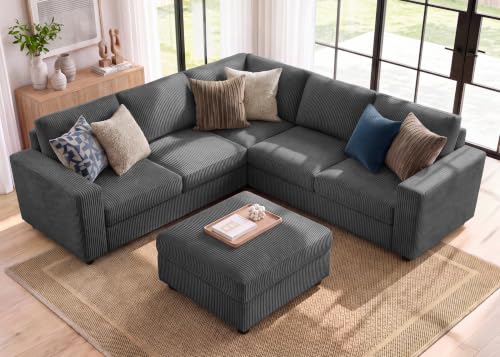
A sectional is not one piece of furniture but a system: sections that connect at a corner, in a configuration — fixed L, modular, sleeper, storage, reclining, U-shaped — that decides what the sofa can do and how permanently it does it. Two vocabulary items matter before any comparison begins. The first is orientation: stand in front of the sofa, facing it, and if the chaise extends to your left the sectional is left-facing, to your right, right-facing — the opposite of the picture most buyers form while imagining themselves seated. The second is the distinction between a chaise return, one extended lounging seat, and a full return, a second run of upright seating; listings blur them, rooms do not.
The second thing to know is that a sectional purchase is unusually irreversible. Its size defeats casual returns, its configuration resists rearrangement, and its fabric will meet your household’s real life within the week. That irreversibility is not a reason to fear the format — it is the reason the steps below front-load every test that can be done with a tape measure, painter’s tape, and honest observation, before money converts opinions into furniture. Readers who want the value framing behind the method will find it in is a sectional sofa worth it; readers who want the models will find them in the gear section, deliberately placed after the steps that disqualify most of them.
How to Choose a Sectional Sofa in Seven Steps
Step 1: Measure the delivery route, all of it
Begin where failures begin: the journey from street to living room. Measure every doorway at its narrowest point, hallway widths, and — the measurement almost everyone skips — the turning space on stairs and landings, where a long chaise piece or a rigid corner unit must rotate. Write the numbers down, because memory is optimistic and paper is not. Then identify the largest single piece of any sectional you are considering and test it against those numbers on paper, remembering that pieces can often tilt to borrow diagonal space and that the corner unit is usually the bulkiest shape in the delivery. If a fixed design fails the route, the step does not end in disappointment; it ends in a redirection toward modular designs, whose largest piece is a single seat and which pass routes that defeat every fixed sectional — the principle behind sofas for narrow doorways. Common mistake: measuring the room beautifully and the route not at all, then meeting the problem with the sofa already in the hallway.
Step 2: Tape the footprint and live with it
Mark the full outline of the configuration you want on the living-room floor with painter’s tape — the whole outline, chaise included, because the chaise is the part buyers most consistently underestimate. Then live an ordinary day inside the tape. Cross the room on its real paths, open every door, let children and pets take their usual shortcuts, sit in chairs placed where the sectional’s seats would be, and watch a screen from the corner position. By evening the room will have voted: either the outline feels like organisation, or it feels like an occupation. Trust the vote. A footprint that frays your patience as tape will not improve as upholstered furniture, and a footprint that feels natural empty will feel better filled, because the real thing also gives you somewhere wonderful to sit.
Step 3: Choose the configuration for your life
Now, and only now, choose what kind of sectional this will be — by life, not by looks. Households that move, rearrange, or expect change choose modular, and accept visible seams as the price of forgiveness. Settled households choose fixed and gain a unified, composed piece. Households that host overnight guests most months choose a sleeper and accept its firmer sit and heavier delivery; households that host rarely refuse the sleeper and buy daily comfort. Households drowning in blankets and games choose storage in the chaise. Households that lounge separately and personally choose reclining ends, having first confirmed the wall clearance reclining requires. The error this step prevents is buying functions for an imagined life: every mechanism is paid for daily, in weight or firmness, whether or not it is ever used.
Step 4: Settle the chaise side from inside the room
Stand in the room and decide, physically, where the chaise belongs: beside the lamp and the natural reading spot, on the screen’s natural side, clear of door swings, radiators, and the main walking path. Then translate that position into the industry’s language — facing the sofa’s future position as if you stood in front of it, chaise to your left is left-facing, to your right is right-facing — and write the answer down before opening a single listing. If two positions are genuinely plausible, or the household may move, do not guess harder; change the design instead, to a reversible chaise or a modular layout where the question dissolves. This step is short, free, and responsible for preventing the most quietly permanent regret in the category: a beautiful sofa whose best seat faces the wrong life for a decade.
Step 5: Judge the sit by the worst seat and the exit
Comfort testing, in a showroom or during a home trial, should be deliberately unfair. Ignore the corner seat at first — it is every sectional’s best behaviour — and sit in the junction and middle seats, where cushions meet and support is honest or is not. Sit upright for conversation, sideways for reading, and stretched out for a film, and then perform the exit test: stand up, and notice what it cost. A seat that an older relative must climb out of is a seat that relative will stop using, and a household’s comfort is set by its least-served member. Check depth against the household’s shortest sitter, who needs the backrest reachable without a pillow fort, and check arms against real behaviour — a book, a laptop, a resting head. Softer is not better; matched is better, and this step is where matching happens.
Step 6: Choose fabric for the real household
Describe your household’s messiest ordinary week, out loud, and choose fabric as its countermeasure. Pets point to tight weaves that release hair and resist snagging, and to removable washable covers above every other feature, because covers convert disasters into laundry. Children point the same way, with mid-tone colours that forgive the evidence of ordinary days. Eating at the sofa points to fabrics that tolerate prompt blotting, or leather-look finishes that wipe clean — unless claws are also in the household, in which case woven wins. Sunlight points away from delicate natural fibres at the window end. The complete fabric picture is in the most comfortable sofa fabrics; the step’s rule is simpler: fabric chosen for the household in the photograph will be defeated by the household in the home, every time.
Step 7: Choose the model and tier, last
Only now — route passed, footprint taped, configuration and orientation settled, sit and fabric criteria written down — should specific models enter the conversation, because now they can be judged in seconds against a list they either satisfy or do not. Choose the tier by use: heavy daily family life repays sturdier mid-tier construction; a lightly used room in a temporary home does not need it; a large settled home buying for a decade may justify the premium tier’s depth. Then verify the unglamorous details before ordering: how the sections connect, whether covers come off and how they wash, whether a single section or cushion can be replaced years from now, and what the largest piece measures against your Step 1 numbers one final time. The model that survives all seven steps is rarely the one a household would have picked from a photograph — and it is almost always the one they would pick again.
Gear for This Guide

HONBAY Sectional Sofa — the step-proof choice for changing households
This modular representative passes more steps for more households than any other design in the cluster: its pieces satisfy Step 1 in homes that defeat fixed designs, its rearrangement forgives Steps 3 and 4 entirely, and it sits in the entry-to-mid tier in prose terms. Choose it when your life, rather than your room, is the uncertain variable. Best for: renters, movers, growing households. Not suited for: formal rooms wanting one sculpted, permanent gesture.
Belffin Sectional Sofa — the settled family’s step-by-step winner
This chaise-led representative is what the steps produce when every answer is settled: route generous, room stable, orientation obvious, guests occasional, clutter constant. Its storage answers the household’s real mess, its unified sit rewards the family that will use it daily, and it sits in the mid tier in prose terms. Choose it when Step 3’s honest answer is that nothing about your life is about to change.
Mopio Sectional Sofa — the small-room answer the tape test approves
This compact representative is the design Step 2 keeps pointing small rooms toward: sectional comfort whose taped outline leaves walkways alive. It sits in the mid tier in prose terms, and its moderated depth is a feature the steps reveal, not a flaw — in a small room, proportion is comfort. The wider small-space field is gathered in the best apartment sectional sofas.

LINSY HOME Sectional Sofa — the guest-frequency answer
This convertible representative is the correct output of Step 3 for exactly one profile: the home whose guest nights, honestly counted, are frequent. Its sleeper and storage functions then earn their daily costs many times over. It sits in the entry-to-mid tier in prose terms. If your guest count is a hope rather than a number, the steps say to admire it and buy daily comfort instead — and our sectional sofa buying guide will help you spend the difference well.
Common Mistakes
The mistakes are the steps, skipped. Skipping Step 1 produces the sofa in the hallway, negotiating with a stair turn while the delivery crew checks the time. Skipping Step 2 produces the room that technically fits its sectional and functionally resents it, crossed daily by people turning sideways. Skipping Step 3 produces mechanisms bought for imaginary lives — sleepers for absent guests, recliners against walls with no clearance to recline. Skipping Step 4 produces the decade of the wrong-side chaise. Skipping Step 5 produces the household member who quietly stops sitting in the living room. Skipping Step 6 produces the pale sofa under throws, in a house with a dog, defended like a museum piece. Skipping Step 7’s verification produces the sectional whose covers, it turns out, do not come off. Every one of these stories is common, and every one is a step that cost an hour at most.
Pro Tips
Photograph your taped footprint and your room from the doorway before ordering; comparing those photographs with listing images corrects the scale illusions that showrooms and staged photographs create. Keep a one-line record of your Step 1 measurements in your phone — it will serve every future furniture decision, not just this one. If the household disagrees about softness, compromise toward support: throws and cushions can soften a supportive seat for an evening, but nothing can firm up a slumped one. And when two finalists remain, choose the one whose worst feature your household will notice least often — not the one whose best feature photographs best — because ownership is a long average of ordinary evenings, not a highlight reel.
Worked Examples
A renter in a second-floor flat runs the steps and watches them eliminate: Step 1 removes every fixed design at the stair turn; Step 2 approves a compact L with the chaise along the wall; Step 3, facing an expected move, selects modular; Step 6, facing a cat, selects a tight weave with washable covers. The HONBAY style in a mid-tone is what remains, and the purchase succeeds precisely because the model was chosen last. A settled family with weekly grandparents runs the same steps to the opposite answer: the route is generous, the room is large, Step 3’s guest count is a real number, and a sleeper design in the LINSY HOME style — with storage for its own bedding — is the rational winner, firmer sit and all.
A design-conscious couple who work from home run the steps and find their deciding criterion is Step 5: posture through a working day. The tailored Rivet style, upright and composed, beats deeper loungers they initially preferred, and a mid-tone fabric survives their dog where the pale fabric they loved would not. A large household in a large, permanent home finds every step permissive and Step 7 decisive: with nothing to eliminate them, the generous Stone and Beam style’s depth and capacity earn the premium tier honestly. Four households, one method, four different sofas — the method working exactly as intended, which is the strongest claim this guide can make for it. Readers who want the underlying evidence can cross-check the ledger in the sectional sofa pros and cons and the comparisons in sectional sofa reviews compared.
Rivet Sectional Sofa — the Step 5 winner for upright households
This tailored representative is what the method produces when the exit test and a working week of upright sitting outrank sprawl: firmer support, composed lines, and a sit that stays comfortable through long reads and laptop sessions. It sits in the mid-to-premium tier in prose terms. Choose it when Step 5’s honest result is that your household sits up more than it sinks in.
Stone and Beam Sectional Sofa — the Step 7 winner when nothing eliminates it
This generous traditional representative wins by surviving every step in a home with nothing to hide: a route that passes its large pieces, a room that carries its footprint with walkways to spare, a household settled enough to commit for years. It sits in the premium tier in prose terms. Choose it only when each earlier step was answered with measurements rather than optimism, because no design in this cluster punishes assumed answers more completely.
Measuring, Done Properly: The Technique Behind Step 1
Since the whole method stands on Step 1, its technique deserves more than a sentence. Measure doorways at their narrowest point, which is rarely the frame’s width — it is the door itself, opened as far as it will go, measured from its edge to the opposite frame, with door handles and hinges counted as the obstacles they are. Measure hallways at their narrowest too, remembering radiators, rails, and the corners where hallways turn, because a long chaise piece travels a hallway the way a ladder does, using length the tape must account for. On stairs, the critical space is the turn: stand on the landing and consider honestly whether a rigid corner unit can rotate there, with the ceiling height above the turn counted as part of the space, since tilting a piece upward is often what makes a turn possible at all.
Then measure the pieces with equal honesty. A sectional’s listed dimensions describe it assembled and upright; what travels through your doorway is each piece in whatever orientation the crew can manage, and the piece’s smallest dimension is the one that must pass your narrowest doorway — provided the piece can be rotated into that orientation in the space available, which is exactly what the landing test checks. Keep the two sets of numbers side by side on paper. Where every route number exceeds the corresponding piece number with room to spare, proceed in confidence. Where they merely touch, treat the design as failing unless its pieces separate further. Experienced delivery crews perform small miracles weekly, but they perform them within geometry, not against it, and a method that depends on a miracle is not a method.
After the Steps: Ordering, Delivery and the First Month
Choosing well ends only when the sofa is in place and proven, so the method extends past the order button. Before ordering, re-read your step notes as a checklist and confirm the listing matches them — configuration, orientation in the maker’s own left-facing or right-facing language, fabric, and the largest piece’s dimensions against Step 1. Photograph the listing’s key details; if the wrong orientation arrives, that record settles the conversation instantly. Prepare the route before delivery day, decide the final position while the floor is still empty, and plan to connect the sections where the sofa will live rather than dragging it assembled across the room.
In the first month, run a quiet acceptance test. Sit in every seat, including the junctions. Open and close the sleeper or storage until the motion is boring. Let pets and children follow their real routines and watch what the fabric reports. Rotate the cushions once, so the habit exists before the favourite seat needs it. Small corrections — a cushion swapped with its twin, a connector re-engaged, the lamp moved to the chaise’s true end — are nearly free in month one and strangely expensive in month six, when they have hardened into the household’s story about the sofa. The method’s final step, unwritten until now, is simply this: live with the sectional deliberately for a month, and it will serve you passively for a decade.
Reading a Listing Like an Inspector
Listings are written to be fallen for, and the steps give you the counter-skill: reading one as an inspector rather than a admirer. Start with the dimensions and identify the largest single piece, then find — or note the absence of — any statement about whether the pieces separate, whether the chaise is reversible, and how the sections connect. Move to the cushions: can they be flipped, rotated, and removed, and do the covers come off for washing? A listing that answers these questions plainly is describing a product its maker expects to be lived with; a listing that answers none of them, however lyrical its language about luxury, is asking you to buy the photograph and discover the furniture later.
Read the fabric description for care reality rather than adjectives: what the weave is, what cleaning it tolerates, and whether the colour shown is the colour that survives a sunny room. Read the mechanism descriptions, on sleepers and recliners, for weight and clearance implications rather than convenience claims. And read the whole listing once more against your step notes, line by line, treating every mismatch as disqualifying rather than as a detail to resolve later. Later, with a sectional in the hallway, details stop being details. The inspector’s reading takes ten minutes and is the cheapest step in this entire guide — cheaper even than the tape.
Configurations Compared, One Last Time
Because Step 3 carries so much weight, it is worth setting the configurations side by side in plain language before you commit. The fixed L is the composed choice: the most unified sit and look, bought with total commitment to one layout and one orientation. The modular system is the forgiving choice: rearrangement, growth, separation, and kind delivery, bought with seams and a less sculpted silhouette. The reversible chaise design is the hedge: a fixed sofa’s unity with the orientation question postponed until the sofa is in the room, and re-openable if the room changes. The sleeper is the hospitality choice, the storage design is the tidiness choice, and the reclining design is the personal-comfort choice — each genuine, each charging daily rent for its speciality.
The U shape, finally, is the commitment choice squared: magnificent for the wide room and the large, settled, gathering household, and the fastest route to an overwhelmed room everywhere else. Households tempted by it should apply Step 2 with double tape and double honesty. What the comparison shows, across every row, is that there is no configuration that is best in general — there are only configurations whose costs a particular household will never notice and whose benefits it will use weekly. Choosing a sectional is the act of finding that row, and the seven steps are simply a reliable way of reading the table with your own household’s name at the top of it. For the value judgement that precedes even Step 1, households still deciding whether the format itself suits them should start with our sectional sofa review and return here when the answer is yes.
Ask Your Household These Questions First
The steps measure rooms and furniture; this short interview measures the people, and it should happen before Step 3. Where did everyone actually sit last week, and for how long? Who sprawls, who sits upright, who works from the sofa, and who — be honest — finds low, deep seats difficult to leave? How many nights did a guest sleep in this home in the last year, counted from memory and calendar rather than estimated from generosity? What lives on the current sofa that should not — blankets, games, laundry, a pet with tenure — and which of those things is the new sectional expected to solve, and which will it merely inherit?
Two further questions protect the future. Is anything about this household’s size, address, or routines likely to change within the sectional’s expected life — a move, a child, a parent, a home office — and if so, does the configuration under consideration bend with that change or break against it? And what does the household do in the living room besides sit: exercise, play, host standing gatherings, dry laundry, work at a desk in the corner? A sectional claims the room’s centre permanently, and rooms with many second jobs need that claim weighed at full value. Households that answer the interview honestly find that Steps 3 to 6 nearly complete themselves, because the configuration, orientation, sit, and fabric are all just these answers wearing furniture’s clothing.
Where the Money Should Go, Step by Step
Without figures — this category’s prices move too constantly for printed numbers to stay honest — the steps still imply a clear spending order. Spend first on configuration correctness: a modular or reversible design that fits your life is worth more than any upgrade applied to a configuration that does not. Spend second on construction you will feel in year three — resilient cushions and a frame that sits planted and silent — because those are the qualities daily use tests longest. Spend third on fabric matched to the household, where the return is measured in cleaning hours and in whether the sofa still looks like itself after a year of the dog.
Spend last, and most cautiously, on features and scale. A sleeper mechanism, a reclining end, a larger footprint — each is a genuine good for the household that uses it and a daily tax for the household that merely owns it, and the steps exist to tell those households apart before the money moves. The premium tier, approached in this order, buys depth and permanence for homes ready to honour them; approached in reverse order, it buys the category’s most expensive regrets, upholstered beautifully. The order is the advice. Households that keep it will find that the sectional they can afford, chosen correctly, outperforms the sectional they could not, chosen by photograph, across every year of its life.
A Worked Measurement: One Hallway, Honestly Read
To make Step 1 concrete, walk a typical difficult route in words. A flat’s front door opens against a wall, limiting how far it swings; the hallway beyond runs straight, then turns at a right angle past a radiator, and the living-room door stands at the end, opening inward. A fixed sectional’s corner unit must travel this route as a rigid, bulky shape: through the front door at an angle the door’s swing barely permits, down the hall, and then — the moment the whole purchase hinges on — rotated through the turn, in a space shortened by the radiator, beneath a ceiling that limits how far the piece can be tipped. Read honestly, on paper, this route says no to the fixed design before any money moves, and it says it kindly, while the answer is still free.
The same route read for a modular design tells a different story: single seats travel it the way people do, turning where people turn, tipping where people tip, and assembling in the room they will live in. Nothing about the flat changed; the furniture’s demands did. This is why the method treats configuration as a route answer before it is a style answer, and why households with difficult homes should not experience Step 1 as a disappointment. The tape measure has not taken a sectional away from them. It has pointed them, precisely and in time, to the branch of the family that was designed for homes like theirs — and spared them the version of this story that ends with a sofa in a hallway and a crew shaking their heads.
When Two Finalists Remain: The Tie-Breakers
Households that run the steps faithfully often arrive, correctly, at two designs that both pass — and then stall, because the steps have done their eliminating and taste alone feels too thin a basis for so large a decision. Three tie-breakers, applied in order, resolve almost every such stall honestly. First, the worst-seat test: sit both designs’ junction seats, or reason about them from their construction, and favour the one whose least comfortable place is still a place a family member would choose. Second, the decade test: favour the design whose cushions can be flipped, whose covers can be replaced, and whose sections can be separated — the one that can be maintained, rearranged, and moved, because the next ten years will ask for all three. Third, the regret test: imagine each purchase having gone wrong in its most characteristic way — the fixed design’s orientation, the modular design’s seams, the sleeper’s firmness — and favour the failure your household could live with most cheerfully. A choice that survives all three tie-breakers is not merely defensible; it is, in the only sense ownership recognises, the right one.
The One-Page Version of the Whole Method
For households that will read one section of this guide, let it be this compression. Measure the route and write it down. Tape the footprint and live a day inside it. Choose the configuration your counted life — guests, moves, clutter, rearrangements — actually requires. Decide the chaise side standing in the room, or refuse the question with a reversible or modular design. Test the worst seat and the exit, not the corner. Choose fabric for the messiest ordinary week. Choose the model and tier last, verifying connectors, covers, and the largest piece against the first measurement you took. Seven sentences, one hour of total effort, and a purchase that a decade of evenings will keep approving — that is the entire method, and everything else in this guide is commentary on why each sentence earns its place.
Teaching the Method to the Next Buyer in the Household
A final, practical tip closes the guide: the steps are teachable, and households that teach them make better furniture decisions for years, because the order — route, room, configuration, orientation, comfort, fabric, model — applies with small changes to dining sets, wardrobes, and every other large, semi-permanent purchase a home absorbs. The tape measure habit alone, once installed in a household, quietly prevents more expensive mistakes than any single product recommendation could. So run the steps out loud, with the household present, rather than alone with a laptop at midnight; the conversation the steps force — about guests, moves, mess, and how evenings are actually spent — is itself a large part of the method’s value, and the sectional it produces will carry the memory of having been chosen properly, together, in the right order.
Keeping a Choosing Journal
One humble tool improves every step in this guide and costs nothing: a single page of notes, kept as you work. Record the route measurements, the taped footprint’s verdict after its day of trial, the guest count, the chaise decision and the reasoning behind it, the fabric’s name and care requirements, and the finalists with the reason each survivor survived. That page settles arguments during the choosing, settles disputes if the delivery goes wrong, guides the first month of care, and — years later, at the next move or the next purchase — becomes the household’s institutional memory of how its home actually works. Buyers who keep the page rarely repeat a furniture mistake, because they can read, in their own hand, exactly what their home taught them last time. It is the least technological recommendation in this guide and, across a household’s lifetime of large purchases, very possibly the most valuable one.
The Steps, Remembered as a Story
Households that struggle to hold seven steps in mind can hold one story instead, because the method is a story: a sofa’s journey and a household’s honesty, in that order. The sofa travels — so measure its road. The sofa lands — so tape its ground and live there a day. The sofa serves — so choose its configuration from the life it will actually serve, guests counted and moves admitted. The sofa faces — so stand in the room and give it its direction, or choose the design that carries no direction to get wrong. The sofa holds people — so test its worst seat and its exit, for the person who will struggle most. The sofa meets life — so dress it in the fabric your real household requires. And only then does the sofa get a name and a tier, chosen in the calm of decisions already made. Tell the story in order and the steps take care of themselves; tell it backwards, as the category’s cautionary tales all do, and the ending writes itself in a hallway, at a stair turn, with a crew checking the time.
Keep the story by the front door, where the tape measure lives. The next large purchase that enters this home — and there will be one — deserves the same beginning: not a photograph, not a hope, but a road measured, a ground taped, and a household that has said out loud what it actually needs. That is how homes fill, over years, with furniture that fits them in every sense, and it starts, as this guide has argued from its first paragraph, with the order in which decisions are made.
And keep the journal page with the household documents when the choosing is done, beside the order confirmation and the delivery photographs. Years from now it will read less like shopping notes and more like a small, accurate history of the home — what its doors allowed, what its rooms held, what its people needed — and the sectional in the living room, still gathering everyone into its corner, will be the longest chapter it started.
File it, too, where the next buyer in the family will find it — because the measure-first habit, once learned, tends to be inherited along with the furniture.
Measure Twice, Order Once: A Hands-On Fit Check Before You Choose a Sectional sofa
Choosing a sectional sofa goes wrong far more often at the measuring stage than at the comparing stage. Listings are easy to browse; rooms are unforgiving. This section turns the advice elsewhere in the guide into a single hands-on session with a tape measure, a phone camera and twenty unhurried minutes. Work through it before you order, and you will eliminate the most common causes of returns in the living room furniture category: the near-fit, the blocked door, the cable that does not reach, and the delivery that cannot get through the hallway.
Step One: Measure the Space, Then Measure the Journey
Measure the destination first — width, depth and height, at floor level and again higher up, because walls lean and skirting steals more room than people expect. Note sockets, vents, radiators, window swings and door arcs on the same sketch. Then measure the journey: every doorway, turn and stair the sectional sofa must pass through, boxed, on delivery day. A model that fits the room but not the route is a return waiting to happen. Photograph each measurement with the tape in frame; when you compare listings later, the photos end arguments that memory would lose.
Step Two: Mock It Up Before You Commit
Mark the footprint on the floor with painter’s tape, or build the volume from cardboard boxes, and live around the mock-up for a day. Open nearby doors and drawers against it, walk past it carrying something bulky, and sit or stand in your usual spot to check sightlines. For anything with a screen, flame, light or lid, check the viewing or working angle from where you will actually be, not from where the photograph was taken. This crude rehearsal catches proportion mistakes that no dimension table can, and it costs nothing but an evening.
Finish the fit check with these five confirmations before ordering your sectional sofa:
- The taped footprint leaves your main walking route clear even when doors, lids or drawers are fully open.
- Power, water, drainage or ventilation — whichever the design needs — is reachable without stretching cables or hoses across a walkway.
- The delivery route fits the boxed dimensions with room to spare at the tightest turn, not just at the doorways.
- Daylight and artificial light fall on the spot the way you expect, checked at the time of day you will use it most.
- Every regular user can reach, open, lift or operate the key parts from their natural standing or sitting position.
Keep the receipt, delivery note and a photograph of the label together, because warranty conversations go smoothly when dates and model details are at hand. If two people in the household disagree about the sectional sofa, let the person who will use or maintain it most have the deciding vote on practical questions. Beware of buying for the household you hope to become; the sectional sofa that serves the household you already are will be used this week, not someday. A tape measure, a spirit level and ten patient minutes prevent more sectional sofa regrets than any amount of comparison shopping after the fact. When a listing is vague about a dimension, material or included part that matters to you, treat the vagueness itself as information and look for a clearer seller. Photograph your room at the time of day you will use the sectional sofa most, and compare candidates against that light rather than against bright midday photographs. Small households should weight compactness and easy storage more heavily, while large households should weight durability and simple operation, because the failure modes differ. If the sectional sofa will serve children or older relatives, test the key actions with the weakest grip and the shortest reach in the house in mind. Leave a little capacity unused — in size, storage or power — because a sectional sofa run permanently at its limit ages faster and annoys sooner than one with headroom. Notice which parts are replaceable and which are not; a sectional sofa whose wear parts can be swapped cheaply often outlasts a sealed design twice its price in spirit, if not in years. Consider the sectional sofa from the perspective of the person who cleans around it, because designs that trap dust, block access or demand special products quietly tax every week of ownership.
A sectional sofa chosen this way rarely surprises its owner, and that is the real goal: not the thrill of a bargain, but the quiet absence of regret. Keep the sketch and photographs with the receipt. If you ever add a matching piece, extend the setup, or move home, those twenty minutes of measurements become the most useful document you own for this category.
Frequently Asked Questions
What is the very first thing to do when choosing a sectional?
Measure the delivery route — every doorway at its narrowest, hallway widths, and the turning space on stairs and landings — and write the numbers down. Compare them with the largest piece of any sectional you consider, usually the corner unit. This step comes first because it can disqualify whole categories instantly, and because a sectional that cannot enter the home is the category’s most common and most preventable return. If the route is tight, modular designs, whose largest piece is a single seat, become the starting point rather than a fallback.
How do I work out whether I need left-facing or right-facing?
Use the standard convention: stand in front of where the sofa will be, facing it — if the chaise extends to your left hand, you need left-facing; to your right, right-facing. Decide the position from inside the room first: the chaise belongs near the lamp and the natural lounging spot, clear of door swings and the main walkway, and on the natural side for the screen. If the answer is not obvious, or the room may change, choose a reversible chaise or a modular design instead of guessing, because a fixed orientation cannot be corrected after delivery.
How do I know if a sectional is too big for my room?
Tape its full footprint on the floor, chaise included, and live an ordinary day inside the outline. If people cross the room naturally, doors swing freely, and the main path stays comfortable, the size is right. If the taped day involves turning sideways, blocked doors, or growing irritation by evening, the sectional is too big for the room regardless of what the measurements alone suggest. Proportion matters too: low-profile designs with raised legs sit lighter in small rooms than deep, high-backed ones of the same footprint.
Which is more important, frame or fabric?
They protect against different failures. The frame and cushion construction decide how the sectional sits and looks in year three — whether it stays supportive and composed or slumps at the favourite seats. The fabric decides how it survives your household’s daily life — hair, spills, sunlight, and claws. For pet and child households, fabric and washable covers usually matter first, because they are tested weekly. For households buying a decade of daily sitting, construction matters most. In practice, choose construction you cannot fault, then the most forgiving fabric your real household requires.
Should I choose a sectional with a sleeper or storage?
Only when the function matches a counted need. A sleeper earns its extra weight and firmer sit when overnight guests are frequent — a regular feature of most months — and becomes a daily tax for a twice-a-year benefit when they are not. Storage in the chaise earns its keep in rooms where blankets, games, and spare cushions genuinely lack a home, and is merely a heavier chaise where cupboards already cope. Count the actual guest nights and the actual clutter before ordering; honest numbers make this the easiest step in the whole method.
What if my household cannot agree on a sectional?
Disagree by step, not by sofa. Most household arguments dissolve when the steps are run in order, because measurements, tape, and guest counts settle the factual questions — size, configuration, orientation — without anyone winning or losing. What usually remains is a softness disagreement, and that one is best settled toward support, since cushions and throws can soften a supportive seat for an evening while nothing can firm a slumped one. If the disagreement is really about whether to buy a sectional at all, work through how to choose a reclining sofa together as the comparison case before deciding.
Related Guides
Continue with our sectional sofa review for the deep dive, browse the best plush sectional sofas after your steps are done, or check sectional sofa Black Friday deals if timing a purchase matters.