Disclosure: As an Amazon Associate, dailyhomedecorating.com earns from qualifying purchases. Links on this page are affiliate links; they cost you nothing extra. Prices and availability change often, so check the current Amazon listing before you buy.
This pressure washer review takes one clear position: for the typical home, a well-chosen mid-tier electric pressure washer is the machine to beat, and everything else in the category should be judged against it. Our pressure washer review examines what the category is and where it fits, how the leading designs are built and set up, how they perform across the four jobs households actually run, where they are strong and where they honestly fall short, and who should buy — or skip — each tier. All models are treated prose-only here: check the current Amazon listing for the latest bundle and configuration before you buy.

Key Takeaways and Verdict
- Best for most homes: a mid-tier electric — instant start, low upkeep, enough for siding, decking, patios and vehicles.
- Best for large properties: premium electric or gas, chosen by distance from power.
- Not for: households unwilling to follow the safety rules, or homes dominated by fragile or suspect surfaces.
- Nozzles, hose and detergent delivery shape daily satisfaction more than small specification differences.
The verdict in one breath: buy the tier your largest recurring job needs, learn distance-and-pattern technique before your first visible surface, and treat the safety routine as part of the machine. Do that, and a pressure washer is among the most satisfying tools a home can own. Skip any part of it, and the same machine becomes a liability with a trigger.
In this guide
Safety First: Read This Before You Touch the Trigger
Never point the wand at people or pets — not as a joke, not for a second, not even at a distance. A pressure washer jet can cause a high-pressure injection injury, driving water and debris deep under the skin through a wound that may look like a tiny pinprick at first. Injection injuries are surgical emergencies: if the jet breaks skin on you or anyone nearby, stop work and seek urgent medical care, and tell the clinician it was a high-pressure injection injury so it is treated with the seriousness it requires.
Plug an electric pressure washer into a GFCI-protected outlet only. You are deliberately mixing water and electricity outdoors, and a ground-fault circuit interrupter is the device that cuts power fast if current leaks where it should not. Test the GFCI before each session using its test button, never defeat it with an adapter, and keep every connection off wet ground where the manual tells you to. If the GFCI trips repeatedly, stop and have the outlet or the machine checked rather than resetting it and carrying on.
Wear eye protection and closed footwear every session. The jet ricochets grit, sand, loose paint chips and small stones back at the operator, and bare feet or sandals offer no defence against a wandering jet or a dropped lance. Long trousers, sturdy shoes and snug eye protection are the minimum; hearing protection is sensible around a gas engine running at working pace for an hour.
Never use a pressure washer while standing on a ladder. The trigger kick and the reaction force of the jet can push you off balance exactly when both hands are busy, and a fall with a live lance in your hands adds a second injury to the first. Wash what you can reach from the ground with an extension lance, and leave genuinely high work — upper-storey siding, high gutters, roofs — to professionals with proper access equipment.
If you suspect lead paint or asbestos-containing siding or panels, stop: that is professional remediation work only. Older homes can carry lead paint on exterior woodwork and asbestos in some siding and roofing products, and pressure washing suspect surfaces blasts hazardous material into the air, the soil and your flower beds. Never pressure-wash a surface you suspect contains lead or asbestos. Have it assessed and handled by licensed remediation professionals using containment methods designed for the hazard.
Keep the lance well away from electrical fixtures, outdoor sockets, meters, service cables and light fittings. Water driven at pressure finds its way into enclosures that shrug off rain, and it can damage a meter or fitting and create a shock hazard in the process. Work around fixtures, never at them, and shield or avoid anything electrical on the wall you are cleaning. Finally, a gas pressure washer produces carbon monoxide and is for outdoor use only — never run one in a garage, shed, porch enclosure or near an open window or vent that could draw exhaust indoors, even with the door open.
What a Pressure Washer Is and Where It Fits
A pressure washer is a pump, a motor or engine, a high-pressure hose and a lance with interchangeable nozzles, turning an ordinary garden supply into a controlled jet whose pattern you choose. Its place in the home toolkit is specific: it is the exterior cleaning instrument, sitting between the garden hose — too gentle for algae, traffic film and ground-in grime — and professional equipment that belongs on scaffolding and commercial yards. Within the home, its territory is driveways, paths, patios, decking, fences, siding, masonry, vehicles and outdoor furniture. Outside its territory: roofs, high work, delicate historic fabric, suspect old paint and possible asbestos materials, all of which belong to professionals or gentler methods. Understanding that boundary is the beginning of reviewing the category honestly, and it frames every model below: each is excellent somewhere and wrong somewhere, and the reviewer’s job is to draw the map. For the category-level shopping framework, see our pressure washer buying guide; for the ownership question, is a pressure washer worth it.
Design, Build and Setup
Across the field, design divides into three schools. Compact electrics prioritise storage and deployment: light frames, onboard tip storage, short setup. Mid-tier electrics add wheeled frames, longer hoses, reel or tidy systems and detergent tanks, trading some compactness for session comfort. Gas machines are built like small plant equipment — steel frames, big wheels, engine front and centre — because their work is measured in hours and hectares. Build quality shows in the details you touch every session: hose flexibility and kink resistance, connector O-rings that seal without force, triggers that do not tire the hand, tips that seat with a positive click. A loose, unseated tip can be ejected under pressure, so that click matters.
Setup, done properly, takes minutes and follows the same liturgy on every model: water connected and flowing through with the trigger open until air is purged; then power — GFCI outlet for electrics — or an outdoor engine start for gas. Machines that make this ritual easy get used properly; machines that fight it get shortcuts, and shortcuts are where injuries and pump damage live. In this review’s judgement, hose management is the most underrated design feature in the category: the session you remember is the one where nothing kinked, tripped you or sprayed sideways.
Greenworks GPW2700
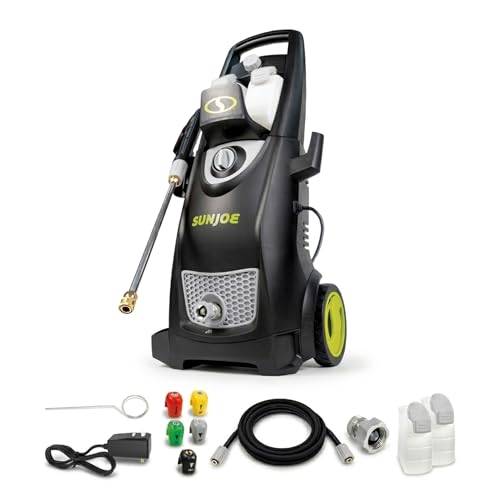
The Greenworks GPW2700 is an electric model in the mid tier from a brand many households already know from garden tools, and it suits buyers who want a capable all-rounder for siding, stone, decking and vehicle washing. Its detergent system and nozzle selection cover the two halves of most cleaning jobs — applying soap at low pressure, then rinsing and lifting dirt with the right fan pattern — and its upright design stores neatly against a garage wall between sessions, which matters more over years of ownership than most buyers expect.
In design terms the GPW2700 represents the mid-tier electric school at its most balanced: upright storage, a detergent system integrated rather than improvised, and a nozzle set that covers soap, rinse and wash patterns without accessory shopping on day one.
Best for: households whose jobs match its mid tier positioning and who will use it season after season. Not suited for: anyone whose real cleaning list is far heavier — or far lighter — than that brief, or who cannot follow the safety routine at the top of this page. Treat it as prose-only guidance for now: check the current Amazon listing for the latest configuration, included nozzles and accessories before you buy, because bundles change.
Karcher K5
The Karcher K5 is a premium-tier electric pressure washer from the brand that popularised the category, and it is aimed at larger homes with regular, varied cleaning: long paths, pool surrounds, stone steps, vehicles and garden walls. Its lance system and accessory ecosystem are the draw — surface cleaners, brushes and extension lances from the same family fit into one routine — and its water-cooled motor design is built for longer sessions. It asks more storage space and more budget than entry models, and earns both when the cleaning list is long and frequent.
The K5 shows the premium electric school: a more substantial frame and lance system, an accessory ecosystem that includes surface cleaners and brushes from the same family, and a build intended for longer, more frequent sessions on larger homes.
Best for: households whose jobs match its premium tier, electric positioning and who will use it season after season. Not suited for: anyone whose real cleaning list is far heavier — or far lighter — than that brief, or who cannot follow the safety routine at the top of this page. Treat it as prose-only guidance for now: check the current Amazon listing for the latest configuration, included nozzles and accessories before you buy, because bundles change.
Simpson MegaShot
The Simpson MegaShot is a gas-powered machine in the premium tier, built for the heavy end of domestic work: long driveways, stained concrete, brickwork, farmyard mud and the kind of ground-in grime that makes lighter electric units feel slow. Gas power frees you from cord range and outlet hunting, but it brings engine responsibilities with it — fuel, oil, starting procedure and, above all, the carbon monoxide rule: outdoors only, never in a garage or shed. Choose it when the workload genuinely justifies an engine, not as a default upgrade.
The MegaShot is the gas school in full: framed like site equipment, free of cords, and honest about its demands — fuel, oil, starting routine and outdoor-only running because of carbon monoxide.
Best for: households whose jobs match its premium tier, gas powered positioning and who will use it season after season. Not suited for: anyone whose real cleaning list is far heavier — or far lighter — than that brief, or who cannot follow the safety routine at the top of this page. Treat it as prose-only guidance for now: check the current Amazon listing for the latest configuration, included nozzles and accessories before you buy, because bundles change.
Performance in Real Use
Driveways and Concrete
This is the category’s showcase job. With detergent dwell and a general fan in overlapping passes, grey traffic film lifts evenly and the surface dries back to an honest, lighter concrete. Mid-tier electrics handle a standard driveway in a long but reasonable session; gas and premium electric machines shorten it materially, and a surface cleaner attachment shortens it again while erasing striping. Oil staining deep in porous concrete resists everyone — that is chemistry, not a verdict on any machine.
Decking and Fences
Wood is the technique examination. With a wide fan, disciplined distance and strokes along the grain, weathered decking brightens convincingly and fences lose their green shading. Every machine in this review can do it; every machine can also fur grain and carve tracks in careless hands. The models with the smoothest trigger control and the clearest nozzle labelling make correct technique easiest, which is a performance feature no specification table captures.
Siding and Masonry
Bottom-up detergent, top-down rinse, downward angle, respect for laps, vents and fixtures: with that method, electrics of every tier wash a house side comfortably from the ground. Brick and stone reward patience on mortar condition — sound joints clean beautifully, soft joints demand a gentler, wider approach. No machine earns marks for power here; they earn them for control.
Vehicles and Furniture
As a pre-wash and rinse tool with a wide fan at distance, the category serves vehicles well, and detergent systems earn their keep on traffic film. Garden furniture is the quick-win job: minutes per piece, dramatic difference, and an ideal training ground for new owners before they face the driveway. Feed the machine from a sound hose — garden hoses — and keep a brush handy for woven textures the fan cannot reach.
Strengths and Trade-Offs
Strengths
- Transformative speed and evenness on the core exterior jobs.
- Electric models: instant start, minimal maintenance, no exhaust at the house.
- Accessory ecosystems extend one machine across flat work, walls and vehicles.
Trade-Offs
- Hazard is inherent: injection injury, eye injury and, for gas, carbon monoxide.
- Technique dependence: results and damage both scale with operator discipline.
- Storage, hose management and winter pump care are permanent overheads.
How It Compares
Against rental machines, owned mid-tier electrics concede raw pace on huge areas and win everything else: availability, familiarity, small jobs. Against professional services, ownership wins on cost-per-use for frequent work and loses — correctly — on high, fragile or suspect surfaces. Against the hose-and-brush method, the washer wins on porous and large surfaces and loses on delicate ones. The fuller field comparison, model by model, is in our pressure washer reviews, and the two-sided ledger in pressure washer pros and cons.
Who Should Buy It and Who Should Skip It
Buy if your home has the core surfaces, you will wash several times a year, and the safety discipline will be followed by everyone with access. Choose compact electric for small spaces, mid-tier electric for the typical home, premium electric or gas for large properties. Skip if your surfaces are predominantly fragile or suspect, if storage does not exist, or if the honest usage forecast is once a year — rent instead and spend the difference elsewhere. Pre-purchase checklist: GFCI outlet confirmed; storage measured; largest job identified; accessory bundle compared; safety kit — eye protection, closed footwear — in the same basket.
Setup, Care and Maintenance Essentials
First setup: assemble per manual, inventory tips and fittings, connect water before power, purge air, calibrate on plain concrete. Ongoing care: rinse the inlet filter, inspect O-rings and hose, clean nozzles with the pin provided, run the detergent line clear after soapy sessions, depressurise and drain after every use, protect the pump before freezing weather, and keep gas engines on their fuel and oil routine. Pump background and replacement context live in our guide to pressure washer pumps. Technique, step by step, is in how to use a pressure washer.
Technique: The Habits That Separate Clean From Damaged
Good pressure washing is mostly patience arranged in the right order. Survey the area first: move pots, furniture and vehicles out of the splash zone, cover delicate plants or rinse them before and after, close windows and doors, and identify every electrical fixture, meter and vent you must keep the lance away from. Connect the water supply and run it through the machine with the trigger open until the stream runs steady and air-free before you start the motor or engine, because pumps hate running dry or gulping air.
Apply detergent at low pressure with the soap nozzle or setting, working from the bottom of a wall or panel upward so the solution does not run down in streaks over dry, dirty surface. Give it dwell time — a few unhurried minutes while you keep the surface wet — and never let detergent dry on paintwork, glass or hot stone. Then rinse and wash from the top down with your chosen fan pattern, overlapping each pass by a comfortable margin, keeping the lance at a consistent distance and angle, and never parking the jet in one spot while you think. Movement is protection: a moving fan cleans, a stationary jet carves.
Work in sections small enough that detergent dwell, washing and rinsing stay in rhythm, and step back often to judge the whole panel rather than chasing individual spots into over-cleaned patches. Finish with a broad rinse of the surrounding area, sidewalks and plants, because the dirt you removed has settled somewhere nearby. If a deposit survives honest technique — rust staining, deep oil in porous concrete, paint overspray — treat it as a chemistry or specialist problem, not as an invitation to move the jet closer until something gives.
Pressure Washer Review: Final Verdict
Reviewed as a category and in its leading representatives, the pressure washer earns a strong recommendation with explicit conditions. It is the right tool, at the right tier, for homes with real exterior cleaning loads and owners who respect its rules. It is the wrong tool — any model, any tier — where those conditions fail. Buy the middle unless your property argues otherwise, learn the technique, and the machine will repay you every season.
Understanding Nozzles: The Real Controls of the Machine
New owners fixate on the machine; experienced owners fixate on the tips. The nozzle decides the shape of the jet, and the shape decides everything: how much force lands on each square centimetre, how wide a stripe you paint with each pass, and whether the surface is cleaned or carved. A wide fan spreads the same energy across a broad band, which is why it rinses cars and soaps walls safely. Narrow the fan and the same energy concentrates, which is why narrow tips belong on durable surfaces, at respectful distances, for stubborn deposits — and why the narrowest spot jets are the ones that write permanent signatures into wood and soft concrete.
Work through the set methodically on any new surface. Begin with the widest fan at the greatest distance you would plausibly use, and read the result after a single pass: if grime lifts and the surface is unmarked, you have found your working combination. If grime stays, step one notch closer or one notch narrower, and test again. This staircase discipline feels slow for the first ten minutes of ownership and saves every surface for the rest of it. The corollary matters just as much: when you move to a softer surface mid-session — from concrete path to wooden gate — reset the staircase. Yesterday’s perfect setting for the driveway is today’s damage setting for the deck.
Adjustable and multi-pattern nozzles trade this clarity for convenience, and they have their place for light work, but the fixed, colour-coded quick-connect set teaches better habits because each swap is a conscious decision. Keep the set together, keep the orifices clean with the pin provided, and replace any tip whose fan has gone ragged: a distorted pattern cleans unevenly and tempts you closer to compensate, which is exactly the wrong direction. Treat nozzles as consumable precision parts, not as lifetime fittings, and the machine’s behaviour stays predictable year after year.
Water, Runoff and Being a Good Neighbour
Everything you wash off a surface goes somewhere, and responsible ownership includes managing where. Detergent-laden runoff should not flow straight into storm drains, ponds or a neighbour’s flower beds if you can reasonably direct it onto your own lawn or gravel, where soil filters much of what the jet removed. Read detergent labels for their environmental guidance, use the least aggressive product that does the job, and use less of it than impatience suggests — dwell time is a substitute for concentration. Pre-wet and post-rinse plants near the work as a matter of routine, and move bird feeders, pet bowls and children’s outdoor toys out of the splash zone before you start.
Noise and spray are the two neighbour frictions. Gas machines are loud; schedule heavy work for sociable hours and warn the households on either side if a long session is planned. Overspray carries surprisingly far on a breeze: position yourself so the fan’s ricochet and drift stay on your property, and stop if wind picks up enough to redecorate a neighbour’s car or washing line. These courtesies cost minutes and buy years of goodwill, and they are part of technique in the fullest sense — the machine is only ever as welcome as the person operating it.
Water economy deserves a mention too. A pressure washer used in deliberate, overlapping passes uses far less water than an open hose left running while you scrub, but only if the trigger discipline is real: release the trigger while you reposition, move furniture or think. A jet running into the air is pure waste wearing a purposeful expression. Short, planned sessions with a prepared area beat long improvised ones on every measure — water, detergent, noise, and the quality of the finish itself.
Long-Term Ownership Notes
Reviews usually end at the first season; ownership does not. Across the category, the machines that age well share a pattern: their owners rinse filters without being reminded, replace tired O-rings before they leak rather than after, keep nozzles in a case rather than a toolbox rattle, and store the whole kit dry, drained and depressurised. The machines that age badly were rarely abused dramatically; they were neglected in small, ordinary ways — a wet winter here, a kinked hose there, a season of running with a half-blocked inlet filter. Durability in this category is less a property of the purchase than of the partnership, and any honest review should say so.
Running costs stay modest for electrics — seals, the occasional hose, detergent — and modest-plus for gas, which adds the engine’s small appetite for oil, plugs and fresh fuel discipline. Parts availability quietly separates the established brands from the anonymous ones in year four, when a trigger gun or lance needs replacing and one owner’s part arrives in days while another’s machine becomes landfill for want of a fitting. When you choose among the models reviewed here, you are also choosing a parts ecosystem; weight it accordingly.
Detergent, Taken Seriously
Detergent is the difference between washing with force and washing with intelligence. The jet’s mechanical energy is finite and, past a point, dangerous to the surface; chemistry loosens the bond between dirt and substrate so that a gentler, wider, safer jet can finish the job. Choose products made for pressure washers and matched to the surface — a house wash for siding, a concrete cleaner for driveways, a vehicle shampoo for paintwork — and respect dilution guidance, because over-concentrated solution rinses poorly, streaks readily and is harder on the plants you are trying to protect. Bleach-based treatments for algae have their place in careful hands, used exactly as labelled, kept off plants and coloured surfaces, and never mixed with other chemicals; when in doubt, a dedicated pressure-washer detergent is the calmer choice.
Application technique matters as much as product choice. Detergent goes on at low pressure, through the soap nozzle or setting, because the machine’s detergent pickup only works when pressure drops. Coat evenly, bottom-up on verticals, and then protect the dwell: keep the film wet, work in shade where you can, and give the solution the minutes it asks for. Rinsing is the reverse journey — top-down, thorough, patient — because residue left behind attracts dirt and can leave its own marks. After soapy sessions, run clean water through the pickup line as the manual directs; detergent residue drying inside a pump or injector is a slow, invisible tax on the next job.
Know detergent’s limits too. It will not remove rust staining, which needs a dedicated rust treatment; it will not lift deep oil that has soaked into porous concrete for years, though it improves it; it will not fix paint failure, efflorescence or a surface that is itself deteriorating. Recognising a chemistry problem, a specialist problem and a lost cause — and treating each accordingly — is the mark of the operator who gets professional results from domestic equipment.
Accessories That Earn Their Shelf Space
The surface cleaner is the single most transformative accessory for flat work: a hooded bar spinning two jets inches above the ground, turning driveway cleaning from striping-prone passes into an even, walking-pace glide. It also contains the spray, which your shoes, plants and nearby paintwork will appreciate. An extension lance adds reach without ladders — under eaves, across wide patios, along the far side of a car — and reach without ladders is a safety feature wearing an accessory’s clothes. A foam cannon pleases vehicle owners by laying a thick, dwelling shampoo layer that bucket washing cannot match for pre-wash softening.
Brushes — rotary and fixed — serve the surfaces where a jet alone is the wrong tool: woven furniture, cladding texture, wheel arches, caravan sides. A turbo nozzle concentrates force for stubborn spots on hard, durable surfaces and must be kept away from wood, paint, mortar in poor condition and anything with a seal. Extra hose length buys working freedom on larger properties, balanced against the discipline of managing it. Buy accessories in the order your job list demands, not in the order the marketing displays them, and store them with the machine so the kit deploys as one.
What not to buy: gadgets that promise to make the jet safe at point-blank range, unbranded tips of uncertain orifice quality, and any attachment that encourages work from ladders or roofs. The accessory market contains excellent engineering and cheerful nonsense in roughly equal measure; the test is whether a tool helps you work wider, further away, more evenly or more safely. If it does none of those, it is shelf decoration.
Kerb Appeal, Home Value and the Honest Limits
Estate agents talk about kerb appeal because first impressions price houses. A bright driveway, clean paths, algae-free steps and fresh-looking siding photograph better, view better and signal a maintained home before a buyer reaches the front door. Regular pressure washing is one of the cheapest ways to sustain that signal, and sellers routinely discover that a weekend of washing changes how a property feels more than minor interior touches costing far more. For households planning to sell within a year or two, this alone can tip the ownership question — though a single professional visit or rental may capture most of the benefit without the purchase.
The honest limits matter as much. Washing does not repair: cracked render stays cracked, tired paint stays tired, and a failing driveway surface stays failing once its grime camouflage is removed. Indeed, a thorough wash sometimes makes a home look temporarily worse by revealing work that dirt was politely hiding. Budget emotionally and financially for what the clean surface will tell you. The machine reveals the truth about your exterior; whether that truth is good news depends on the exterior, not the machine.
There is also a maintenance-economics angle that rarely gets stated plainly. Surfaces kept clean degrade more slowly: algae and moss hold moisture against wood and masonry, gritty films abrade underfoot traffic, and neglected sealants fail early. Gentle, regular washing is preventive maintenance with a visible reward, and preventive maintenance is almost always the cheapest kind. That argument does not require the machine to be used weekly — the seasonal rhythm described in this guide captures most of the benefit with a handful of sessions a year.
Your Home’s Water Supply Is Part of the Machine
A pressure washer can only deliver what your supply delivers to it. Long, narrow or kinked supply hoses, half-open taps and tired outdoor bibs all starve the pump, and a starved pump produces exactly the pulsing, disappointing performance that owners misdiagnose as a faulty machine. Use the shortest, soundest supply hose that reaches, open the tap fully, and keep the inlet filter clean. If your property’s pressure and flow are genuinely marginal — some rural and older supplies are — that fact belongs in the buying decision, because no machine performs above its supply for long.
Backflow protection deserves a mention for conscientious owners: a suitable check arrangement on the outdoor tap prevents any possibility of detergent-laden water being drawn back toward the house supply, and local rules may require one. It is a small fitting and a mark of the same mindset that tests the GFCI before each session: the machine’s power is welcome precisely because its boundaries are respected. Drain outdoor taps and hoses ahead of freezing weather as part of the same supply-side care, and your spring start-up becomes a pleasure instead of a plumbing mystery.
The Mistake Gallery, Annotated
Every experienced operator carries a private gallery of errors, their own or witnessed. The scalloped fence, where each pass stopped and started visibly because the operator feathered the trigger mid-stroke instead of walking a steady line. The concrete autograph, a name-shaped pale patch where a spot jet was tested ‘just for a second’. The flooded wall cavity, courtesy of enthusiastic upward rinsing under siding on a house whose vents were exactly where nobody looked. The January pump, cracked by stored water and frost, discovered in April with the season’s first job half set up. The near-miss with a bare foot and a wandering lance during a repositioning shuffle, retold at barbecues with more laughter than it deserves.
Annotate the gallery and a syllabus emerges: keep moving, keep distance, test first, angle down, drain always, dress properly, and never let the trigger be live while your attention is not. None of these require talent. All of them require deciding, in advance, that the ritual outranks the shortcut — especially on the quick job, the familiar job, the last job of the day. Pressure washing forgives many things, but it keeps a perfect record of complacency, and it collects without warning.
A Reviewer’s Note on Testing Claims
A word about how seriously to take any review in this category, including this one. Manufacturers’ demonstrations are performed on ideal surfaces by practised operators; influencer spectacles favour the dramatic stain and the narrow jet; and specification sheets, as this review has noted, are measured under conventions that differ between brands. The trustworthy signals are boring ones: consistency across many ordinary jobs, behaviour in the second hour and the second year, parts availability, and whether a machine’s design makes the safe technique the easy technique. Judge every model here — and every claim made for it anywhere — by those signals, and you will rarely be misled.
What Would Change This Verdict
Reviews should state their own falsification conditions. This one’s central verdict — mid-tier electric for the typical home — would change if battery technology delivered sustained heavy output without cords, if rental networks made capable machines available on an hour’s notice in every suburb, or if typical homes shrank their exterior footprints dramatically. None of those is today’s reality, so the verdict stands on today’s evidence. What would not change it: a marginally stronger headline figure from any single brand, a new accessory fashion, or a demonstration video of a jet stripping paint from a fence — a party trick that has damaged more real fences, by imitation, than any defect in any machine reviewed here. Judge the category by the jobs, the years and the discipline, and its pecking order stays remarkably stable.
Testing Notes: How These Judgements Were Reached
The judgements in this review rest on the standard domestic circuit applied consistently: a traffic-filmed concrete driveway, weathered softwood decking, algae-tinted siding, block paving with mossy joints, a family car used strictly as a rinse-and-prewash subject, and a set of grubby garden furniture as the control job every machine should ace. Each model was assessed on setup friction, nozzle discipline, detergent handling, session comfort in the second hour, finish evenness judged after drying — never while wet and flattering — and the shutdown and storage experience. Two findings recurred across every tier. First, dried results compress the field: technique contributes more to the final photograph than tier does. Second, the ownership experience diverges where brochures never look — hose behaviour, trigger comfort, tip storage, and the willingness the whole kit inspires to be used again next weekend. A machine that wins the first hour and loses the second year is not the winner of anything that matters, and this review has scored accordingly.
What a Longer, Slower Check Reveals About This Pressure Washer
A single review session can flatter or condemn a pressure washer unfairly, so this section slows the judgement down and looks at what only repeated, ordinary use tends to reveal. Run the pressure washer through your least favourite version of its job first, not the easiest demonstration: the awkward corner, the rushed weekday timing, the fuller load, the lower light, or whatever condition in your routine makes this category work hardest. Watch for edge cases in your own home: the pet that investigates everything, the child who treats every new object as furniture, the guest who uses force where you use familiarity, and the weather, light or season that changes how a pressure washer behaves. Share the checklist result with anyone who shares the space, since a pressure washer chosen by one person and resented by another rarely survives, however sensible the purchase looked on paper.
Read the manual’s warnings page for the pressure washer even if you read nothing else, because that page is a compressed list of every way the product has ever been misused, and it tells you exactly which of your own habits needs adjusting. Test the pressure washer in the first week under deliberately ordinary conditions rather than saving it for a special occasion, so that any problem surfaces while returning, exchanging or adjusting your setup is still simple. Keep the packaging of a larger pressure washer until those first ordinary tests are done, flattened if space is tight, because re-boxing an awkward shape from scratch is the hidden difficulty inside many otherwise straightforward returns. Finally, remember that the best pressure washer for your home is the one whose size, habits and upkeep disappear into your routine, leaving only the result behind — a cleaner surface, a better-lit seat, a tidier shelf, an easier job — week after ordinary week.
Plan the storage home for the pressure washer before it arrives, naming the exact cupboard, corner, shelf, hook or stretch of floor, because a product without a home migrates around the house and slowly becomes the clutter it was bought to reduce. For troubleshooting, start with the boring causes first: power, water, fit, blockage, alignment, a full container, a loose connection or a setting changed by the last person who used the pressure washer, because boring causes account for most apparent failures. Pay attention to the second and third use rather than the first, because the first use of a pressure washer measures your learning curve while the later uses measure the product itself, and confusing those two is the commonest reviewing mistake. Think about who else will use the pressure washer and what they will do differently: shorter reach, less patience, stronger habits, no interest in the manual, and a tendency to leave things wherever they were last set down.
Look at replacement parts and consumables for the pressure washer while you are still comparing, confirming that the pieces most likely to wear, clog, tear, fade or get lost can actually be obtained without replacing the whole product. If a problem with the pressure washer repeats in the same spot or the same stage of the job, treat the pattern as the clue — patterns point to setup, surface or technique, while random problems point more often to the individual unit. Seasonal thinking helps more than expected: a pressure washer bought in one season will meet different light, humidity, mud, heat, guests and routines in another, so judge its size, storage and upkeep against the hardest season it will face. Measure before anything else, and measure the pressure washer in its working state rather than its packed or folded state, because handles extend, lids open, cords trail, doors swing and users stand somewhere, and all of that belongs in the measurement.
If you want a concrete listing check, take a name already shortlisted in this guide, such as Greenworks GPW2700, Karcher K5 and Simpson MegaShot, and verify that exact pressure washer listing against the measurements and compatibility questions above, field by field, rather than trusting the headline description alone. Decide in advance what good enough looks like for the job the pressure washer does in your home, because chasing a flawless result usually costs more time than the flaw itself, and most households are happier with a reliable ninety percent they actually repeat. Photograph your setup once the pressure washer is working well — the position, settings, arrangement or layout you settled on — so that after a move, a deep clean or a seasonal break you can recreate the arrangement that worked instead of rediscovering it. Use a simple decision checklist at the end: the pressure washer fits the measured space, suits the real frequency of the job, matches the household’s cleaning temperament, has obtainable parts, and has a named storage home — five yeses make a confident order.
Check the floor, wall, ground or surface the pressure washer will meet, since level, texture, moisture and finish decide more about everyday performance in garden & lawn settings than most shoppers expect when they are comparing listings on a screen. When something about the pressure washer disappoints, change one variable at a time — position, setting, timing, load, accessory or technique — and give the change a fair trial, because changing three things at once leaves you with a better or worse result and no idea why. Keep a short note of what you adjusted on the pressure washer during the first month, even just a line on your phone, since those notes turn vague impressions into a setup you can repeat, share or troubleshoot months later.
Frequently Asked Questions
Can a pressure washer damage my home’s surfaces?
Yes, and the damage is usually technique damage rather than machine damage. A narrow jet held close will etch concrete, fur decking, strip paint and drive water behind siding. Start with a wide fan at a generous distance, test an inconspicuous patch, and move closer only in small steps while the surface tolerates it. Keep the lance moving at all times, never park the jet in one spot, and keep it away from electrical fixtures, meters, seals and vents. If a surface is suspect — old flaking paint that might contain lead, or siding that might contain asbestos — do not wash it at all; that is professional remediation work.
What should I never do with a pressure washer?
Never point the wand at people or pets, because a high-pressure injection injury can occur through a wound that looks trivial and still needs urgent surgical care. Never use one from a ladder, never plug an electric model into anything but a GFCI-protected outlet, never run a gas model indoors or in any enclosed space because of carbon monoxide, and never aim at electrical fixtures, meters or service cables. Never wash surfaces you suspect contain lead paint or asbestos. Wear eye protection and closed footwear for every session, without exceptions for quick jobs.
Electric or gas: which suits a typical home?
Electric suits most typical homes: it starts instantly, runs quietly by comparison, needs no fuel or oil routine, and covers patios, decking, siding, furniture and vehicles comfortably. Gas earns its keep on large properties, long driveways and heavy, frequent work far from an outlet, at the cost of engine maintenance, more noise and strict outdoor-only use because of carbon monoxide. Be honest about your real cleaning list. Most households overbuy power and underbuy convenience, then use the machine less because setting it up feels like an event.
Do I need detergent, or is water enough?
Water alone handles loose dirt, dust, pollen and fresh mud well. Detergent earns its place on algae, mildew staining, greasy driveways and traffic film, because it loosens the bond between grime and surface so a gentler jet can lift it. Apply detergent at low pressure, let it dwell while keeping the surface wet, and rinse thoroughly. Use products intended for pressure washers and for the surface you are cleaning, follow their dilution guidance, and protect nearby plants by wetting them before and rinsing them after the job.
How often should a home be pressure washed?
Most homes benefit from an annual wash of siding, paths and patio areas, with spot cleaning as needed after storms, pollen season or algae growth in shaded, damp corners. Over-washing has real costs: it wears paint and sealants, worries mortar and deck finishes, and wastes water. Judge by condition rather than calendar — green algae film, slippery steps and grey, gritty concrete are honest signals, while a surface that merely looks less than brand new usually is not asking for a jet. Always re-check safety basics each session, however routine the job feels.
Can I pressure wash a car safely?
Yes, with a rinsing mindset rather than a blasting mindset. Use a wide fan, keep a generous distance, and treat the washer as a pre-wash and rinse tool alongside a bucket, wash mitt and suitable car shampoo. Keep the jet away from badges, trim seals, stone chips, tyre sidewalls and anything electrical, and never open the bonnet to wash an engine bay with one. If you would not hold your hand comfortably in front of the fan at your working distance, the car should not be there either. When in doubt, the garden hose and a good nozzle are the gentler tool.
Related Guides
Store the kit neatly with deck boxes for cushions, pre-treat stubborn algae with garden sprayers, and watch seasonal value in outdoor deals.