Disclosure: As an Amazon Associate, dailyhomedecorating.com earns from qualifying purchases. Links on this page are affiliate links; they cost you nothing extra. Prices and availability change often, so check the current Amazon listing before you buy.
Short answer first, because is a media console worth it deserves one: yes, for most households that own a television plus anything at all that plugs into it — and the worth has almost nothing to do with the television. A media console earns its place by ending the low-grade chaos every TV wall generates: the boxes stacked on the floor, the cables spilling sideways, the remotes migrating into sofa cushions, the games console balanced on a side table. It is worth it if your setup has outgrown a bare stand, if children or pets share the room, or if the TV wall is the first thing guests see. It is not worth it if your entire system is a wall-mounted screen and a soundbar, or if you are furnishing a room you will leave within the year.
Key Takeaways
- Worth it if: you own two or more devices, visible cable clutter bothers you, children or pets share the room, or the TV wall anchors your living room’s look.
- Not worth it if: your whole setup is a wall-mounted TV and a soundbar, you rent short-term, or a simple stand already hides everything you own.
- The real return is order and safety — anchored, ventilated, cable-managed storage — not the furniture itself.
- Tier matters less than fit: a right-sized entry-tier console beats a premium piece with the wrong storage mix.
- Safety is part of the value: a console that is anchored, with the TV secured, removes a real household hazard rather than decorating around it.
In this guide
Is A Media Console Worth It: What You Actually Get
What you actually get, first and most underrated, is a single home for a scattered system. A modern viewing setup is never just a television. It is a streaming box, a games console, perhaps a receiver and speakers, a soundbar, chargers, remotes, headsets, game cases and a power strip with ambitions. Without a console, those things colonize the floor, the coffee table and the top of any nearby surface, and the room reads as a technology spill with a sofa in it. A console gathers all of it into one deliberate footprint, at the right height, against the right wall, and the room becomes a living room again that happens to contain a superb screen.
You also get the television presented properly. Screen height is comfort: a console sets the display at seated eye level in a way that a random sideboard or a too-tall dresser rarely does, and it gives a wall-mounted screen the visual base that stops it floating oddly on a bare wall. There is a reason every styled living room you have ever admired has something substantial beneath the television — the eye wants the composition grounded. A console provides that grounding while doing storage work a decorative table cannot.
You get cable management as a system rather than a hope. Rear cutouts, internal routing and a defined home for the power strip turn the rat’s nest into a single managed bundle that can be opened, changed and cleaned. That has a safety dimension people miss: managed cables do not cross walkways, do not get yanked by vacuum cleaners or toddler hands, and do not pull a lightweight streaming box off a shelf by its own cord. Order behind the doors translates directly into fewer accidents and fewer mysterious unpluggings in front of them.
And you get the safety structure itself. A proper console is a wide, stable, anchorable platform: the furniture straps to the wall, the television is secured to the wall or the console as its maker directs, and the screen sits fully supported instead of balanced on a narrow table edge. Televisions and loaded furniture tipping onto children is a real hazard that safety agencies warn about every year, and the console — anchored, loaded low, with drawers that are never climbed — is the standard domestic answer to it. That alone justifies the category for any household with small children, before a single aesthetic argument is heard.
The Real Costs Beyond Money
Honesty requires the other ledger. A media console costs floor space — a wide, deep footprint on your most valuable wall — and in a small room that footprint competes with seating, play space and the simple feeling of air. It costs assembly time, because most consoles arrive flat-packed and the honest ones take an afternoon and a second pair of hands. It costs moving pain: consoles are awkward, wide and heavier than they look, and a solid-wood piece is a genuinely heavy lift that should always be shared between two people, never dragged or solo-heaved up stairs.
It costs maintenance, modest but real. The top surface is a dust stage under a static-prone screen and wants a weekly wipe. Sliding tracks and drawer runners want occasional attention. Ventilation is a standing obligation: the moment you close a door on a receiver or a games console, you have taken responsibility for its airflow, and a console that tempts you to seal hot electronics in a pretty box is a cost disguised as a feature. There is also a learning curve, small but nonzero — working out which device lives where, how the cables route, and how the anchor straps fit your wall type is an evening’s thinking the first time you do it.
Finally, it costs commitment. A console fixes your room’s layout around one wall and one screen size more firmly than a simple stand does. Rearranging the room, upgrading to a much larger television or moving the viewing area to another wall all become bigger projects. Households that rearrange furniture seasonally, or that are mid-renovation with the final layout undecided, should count that commitment honestly — it is the strongest of the non-money costs, and the one most often discovered too late.
Who It Pays Off For
The multi-device household. If your setup includes a receiver, a center speaker, one or two games consoles and a streaming box, the console is not furniture, it is infrastructure. Open bays cool the hot components, closed bays hide the rest, the soundbar gets its stage and the center speaker its home. The payoff is daily and compounding: every device reachable, ventilated and dust-managed, every cable known. For this household the question answers itself, and the only real decision is size — worked through step by step in how to choose a media console.
The family with young children. Here the payoff is safety and sanity in equal measure. An anchored console with the television secured removes the tip-over scenario that a lightweight stand invites; doors put the fascinating boxes and blinking lights behind a barrier small hands cannot easily defeat; drawers give remotes and batteries a home that is findable at bedtime. The rules still apply — children never climb drawers or shelves, one drawer open at a time, straps checked yearly — but the console is the platform that makes those rules easy to keep. Pair it with the family-proofing thinking in best sofas for homes with kids and the whole room gets calmer.
The design-led living room. For households where the living room is the home’s public face, the console pays off as composition. It grounds the screen, hides the machinery, provides a styled surface for a plant, a stack of books or a lamp, and sets the material tone — farmhouse warmth, mid-century line, solid-wood gravity — for everything around it. Guests see a room, not a setup. If you have ever rearranged a photograph of your living room to crop out the cable spill, this payoff is yours.
Who Should Skip It
The true minimalist setup. A wall-mounted television, a soundbar and a streaming stick hidden behind the screen is a complete, elegant system with nothing to store. Adding a console beneath it buys an empty cabinet and a dust surface. A low floating shelf or nothing at all serves better, and the money is better spent on the seating — the viewing comfort in best chairs for watching TV will repay you nightly.
The short-term renter. If your lease has a year to run and your next home is unknown, a wide console is a liability: it may not fit the next wall, the next doorway or the next life. A simple, light stand that moves in one trip and fits anywhere is the rational buy, and the console decision can be made properly in the settled home. The exception is the renter with children, for whom the anchoring and containment arguments may still carry the day — but buy at an entry tier and buy wide rather than tall.
The dedicated theater room with a rack. Serious home-cinema builders often house equipment in a dedicated rack, closet or ventilated cabinet designed for the purpose, with the screen wall kept clean. In that architecture a media console under the screen is redundant furniture. Your storage problem is already solved by better means; spend on acoustics and seating instead.
Strengths and Trade-Offs of Owning One
Strengths. One home for every device, cable and remote, ending the technology spill across the room. Correct screen height and a grounded, deliberate look for the most-watched wall in the house. A stable, anchorable platform that, properly strapped with the TV secured, directly addresses the tip-over hazard. Storage that multitasks — games, blankets, albums and board games alongside the electronics, as any look at best coffee tables for board games households will confirm the overflow is real.
Trade-offs. A wide footprint claimed permanently from your best wall, and a layout commitment that makes rearranging a project. Assembly and moving effort, including genuinely heavy two-person lifts at the solid-wood end. A standing ventilation duty: closed doors and hot electronics are a poor mix, and the console makes you the airflow manager. And a dust-collecting top surface that sits under the screen asking for a weekly cloth — small, but forever.
Alternatives to Consider
The plain TV stand is the honest alternative and gets a fair hearing in media console vs TV stand: cheaper in spirit, lighter, easier to move, and entirely sufficient when your device count is low and your clutter tolerance is high. The wall-mounted floating shelf suits the minimalist setup, keeping the floor clear and the look architectural, though it stores almost nothing and demands confident wall fixings. The repurposed sideboard or credenza — including pieces you may already own — can serve beautifully if its height keeps the screen at eye level, its interior can be vented or left open at the back, and it can be anchored; measure before you romanticize, because many lovely sideboards are too tall for comfortable viewing.
Whichever alternative tempts you, test it against the same four questions the console answers: Where does every device live? Where does the heat go? Where do the cables run? What stops the television tipping? An alternative that answers all four is a genuine alternative. One that answers two is a compromise you should choose knowingly, at a tier that matches its limits.
How to Get the Most Value If You Buy
Measure twice, in the full sense: screen width and stand footprint, wall run, doorway turns, gear dimensions with cable clearance, and seated eye height. Buy the storage mix for your real clutter, not your aspirational clutter — the Tuesday-evening test from the media console buying guide applies here word for word. Anchor the console and secure the television on day one, while the tools are out and the motivation is high; a strap fitted later is, in too many homes, a strap fitted never. Give the hottest component the most open home in the layout, route cables into one labeled bundle, and photograph the finished rear wiring for future troubleshooting.
Then use the console as the room’s organizing idea. Let its finish arbitrate the coffee table and shelving choices; keep its top surface mostly clear so the screen wall breathes; and revisit the setup once a year — straps taut, vents dusted, cables checked, drawers decluttered. A console maintained that way does not merely stay worth it; it quietly becomes the reason the whole room works. The detailed balance sheet, if you want it before deciding, is laid out in media console pros and cons.
The Decision Checklist
Answer honestly, yes or no. Do you own two or more devices that need a home by the television? Does visible cable clutter genuinely bother you? Do children or pets share the room? Is the TV wall a focal point guests see? Will you live with this room’s layout for at least a couple of years? Do you own living-room overflow — games, blankets, albums — that currently has no home? Can you anchor furniture to your walls, or arrange an approved alternative with your landlord?
Four or more yes answers: buy the console, and buy it properly — measured, anchored, ventilated. Two or three: buy at an entry-to-mid tier and let the piece prove itself, as the Salinas-style practical pick is designed to do. Fewer than two: keep your stand, mount the screen well, and spend the difference where your household will feel it. The checklist is not a sales device; it is the whole article compressed, and it will still be true when the finishes change.
The Lines That Frame the Decision
Abstract value arguments sharpen when they stand next to real furniture. The four lines below frame this article’s decision at four tiers and temperaments — storage-led, style-led, practical and premium — all presented in prose only while their listings await verification. None of them changes the checklist at the end of this article; all of them change what a yes answer looks like in your room.
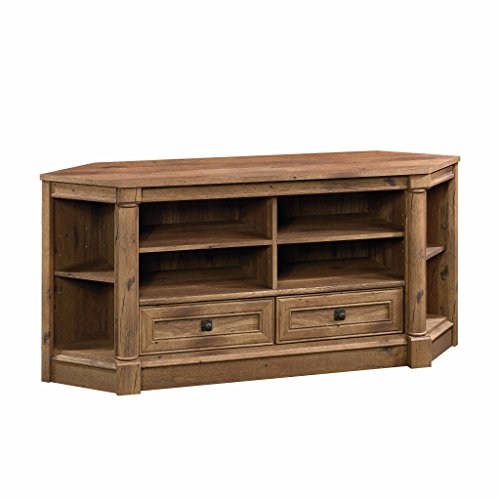
Sauder Harbor View Entertainment Credenza — mid-tier credenza pick
Sauder’s Harbor View line is the storage-maximizing expression of the worth-it argument: a long credenza that runs a television while swallowing the household overflow whole. If your value question is really a storage question, this line answers it in a single footprint.
Best for: Households that want the console to double as serious living-room storage in one long, furniture-first piece.
Not suited for: Small rooms where a long credenza would crowd the wall, and minimalists with nothing to hide.

Walker Edison Mid Century Modern TV Stand — mid-tier style pick
Walker Edison’s mid-century line makes the worth-it case on composition: tapered legs, clean fronts and proportions that turn the TV wall into a scene. Its storage is honest rather than vast, which suits the streaming-era gear list precisely.
Best for: Design-led rooms with short gear lists and long standards.
Not suited for: Households needing maximum enclosed volume.
Bush Furniture Salinas TV Stand — entry-to-mid practical pick
The Salinas line from Bush Furniture is the low-regret test of the category: practical, divided, blending rather than shouting. It teaches a household exactly which storage it uses — the best buying education available at any tier.
Best for: Value-focused households testing the category with divided storage and forgiving finishes.
Not suited for: Deep-bay cinema builds and statement seekers.
Simpli Home Warmington TV Media Stand — premium solid-wood pick
Simpli Home’s Warmington line anchors the premium end: solid timber whose cost per year of daily use shrinks toward nothing across a settled decade, and whose drawers and cabinets carry a full family load without complaint.
Best for: Settled households whose worth-it math runs across a decade.
Not suited for: Frequent movers and temporary spaces.
Running the Numbers Without Prices
Worth-it questions invite arithmetic, and this category’s arithmetic can be done honestly without quoting a single figure, because its currency is years and evenings rather than amounts. Take any console you are considering and divide your attention between two numbers you do know: how many years this room will keep its layout, and how many evenings a week the household actually watches. A piece used four evenings a week for six years delivers well over a thousand evenings of order, safety and presentation; even a premium tier, amortized across that count, becomes one of the cheapest comforts in the home. The same piece in a one-year tenancy delivers a fiftieth of the service for the same effort of assembly and moving — which is why the horizon, not the tier, dominates the worth-it equation.
Run the avoided-cost side of the ledger too, qualitatively but honestly. A console that replaces a stand plus a storage cabinet plus a basket system is not competing with a stand; it is competing with a small furniture department. A console whose anchored safety prevents one tip-over incident has repaid itself beyond any arithmetic this article is willing to print. A console whose cable system saves one weekend of fault-finding, whose drawers end one year of remote hunting, whose ventilation saves one receiver from a heat-shortened life — each is a real return that never appears in a listing’s feature bullets. Worth-it calculations that count only the purchase are answering a smaller question than the household is asking.
Finally, run the regret asymmetry. Households that buy a console slightly too capable — a bay too many, a tier too high — report mild, fading regret; the spare capacity fills, the quality is enjoyed nightly. Households that buy slightly too little — a bay short, a size too narrow — report sharp, recurring regret, because the overflow and the compromise are visible every single evening. When your checklist lands near the borderline, this asymmetry is the tiebreaker the numbers cannot give you: err toward the piece that can absorb your household’s growth, at the highest tier your horizon justifies.
What Owners Actually Say a Year Later
The most reliable worth-it evidence is the twelve-month verdict, and it follows patterns consistent enough to print. Owners praise, first and loudest, the disappearance of the cable spill and the device sprawl — the calm of the wall — usually in language about the room feeling finished. They praise the drawers more than they expected to, because the remote-and-battery economy turns out to be a daily tax whose abolition is felt daily. They praise, in family households, the closed doors and the anchored calm with a seriousness that surprises even themselves.
The twelve-month complaints follow patterns too, and they are almost never about the furniture’s quality. They are about measurement skipped at purchase: the bay a receiver nearly fits, the width a larger television now crowds, the fireplace insert where a center speaker needed to live. They are about ventilation discovered late — the door now permanently open on the games console’s bay, a small daily monument to a planning step skipped. And they are about the top surface’s dust, mentioned with a shrug by most and with genuine irritation by the fastidious. Read together, the praise and the complaints make the same point this article has made throughout: the console is worth it when it is chosen by measurement, and merely expensive when it is chosen by photograph.
The Renter’s Special Case, Argued Properly
Renters deserve a fuller hearing than a checklist dismissal, because their worth-it equation has extra terms. Against the console: leases end, layouts change, wide furniture is the hardest to move and the likeliest to be sold at a loss of effort, and anchoring — the safety step this series never waives — may need a landlord conversation. For the console: rented living rooms are often the most storage-starved rooms in housing, the TV wall is often the renter’s only real furnishing canvas, and children in rented homes need anchored safety exactly as much as children in owned ones. A hazard does not check tenure.
The renter’s resolution is usually a tier and format decision rather than a yes-no one. Entry-to-mid tier, so the commitment matches the horizon. A width that fits most plausible future walls — the middle of the size range rather than the heroic maximum. A design whose anchoring can be achieved with the least invasive fixings the landlord will approve, discussed openly rather than improvised silently. And a hard rule that the safety conversation happens before purchase, not at the wall with a drill in hand. Resolved that way, plenty of renters land on yes — and land there more thoughtfully than many owners do.
When the Answer Changes Over Time
Worth-it is a verdict with a date on it, and households should expect it to be revisited as life moves. The couple whose minimal setup made a console pointless acquires a games console, then a child, then a second console, and the checklist answers quietly change underneath them. The family whose credenza earned its wall nightly empties its nest, wall-mounts a screen in a quieter room and finds the great piece suddenly surplus. Neither household was wrong at either date; both were right twice. The practical moral is to buy for the household you can see two years out, not the one you can imagine ten years out, and to treat the console as the current answer to a recurring question — where does the system live — rather than a lifetime vow. Furniture that serves its season fully has been worth it, whatever the next season decides.
The Trial Period: Borrowing the Answer
Households that remain genuinely undecided after the checklist can borrow evidence before buying it. Live for one week with a simulation: gather every device, cable and accessory that a console would house, and stage them in a taped outline on the floor where the console would stand — the footprint made visible, the clutter made countable. Most households find the tape outline alone persuasive in one direction: either the staged pile is embarrassingly large, and the console’s case is made, or it is a soundbar and a stick, and the case collapses. Live with the tape on the floor for the full week, walking around it, vacuuming around it, letting children and pets vote with their behavior.
Extend the trial to the safety imagination, soberly. Look at your current arrangement — the screen on its present support, unanchored or otherwise — and walk the scenario this series keeps naming: a child pulling up on the furniture, a drawer used as a step, a pet launching from the top. If the current arrangement passes that imagination calmly, note it. If it does not, the worth-it question has acquired a term that no tier discussion can outvote, and the console — anchored, with the television secured — stops being a furnishing preference and becomes the household’s answer to a hazard it has now honestly pictured. Many a borderline checklist has been settled by that single act of imagination, and rightly.
Opportunity Cost: What the Same Effort Buys Elsewhere
A rigorous worth-it account must ask what else the same money-in-spirit and the same weekend of effort could buy the room, because value is always comparative. The strongest rival is seating: hours are spent in the sofa and chairs, minutes admiring the console, and a household choosing between a console and a long-deferred seating upgrade should usually choose the seating — with the console following when the room’s comfort is secured. The second rival is the television itself: a console bought to dignify a screen the household is about to replace anyway should wait, sized for the successor. The third rival is light: a dark room’s viewing improves more from controlled light and a bias glow than from any furniture, and cheaply.
Where the console beats its rivals is when the room’s actual pain is organizational and structural — clutter, cables, containment, safety — because no rival purchase touches those pains at all. A finer sofa does not house a receiver. A larger screen does not anchor itself. The worth-it question, properly run, is therefore not console-versus-everything but pain-versus-remedy: name the TV wall’s worst daily friction, and buy the thing that removes it. When the friction is the spill, the heat, the hunting and the hazard, the console is not merely worth it; it is the only item on the list that answers.
The Five-Year Reunion Test
Project the purchase forward to a single imagined evening five years from now, and interrogate it. The room has changed around the console in the ways rooms do — a different rug, a rearranged chair, perhaps a larger screen that the console’s width absorbed or did not. The system has churned: a console generation replaced, a streaming device swapped, each change absorbed by the cable system and the reserved empty bay, or fought against a piece bought exactly full. The children are five years taller, and the anchor straps — checked yearly, still taut — have never once been thought about, which is their triumph. The finish has either aged into the room’s patina or peeled into its grievance, according to the construction chosen on a long-ago afternoon.
That imagined evening is the worth-it question with its makeup off. Purchases that pass it share the traits this article has circled throughout: measured rather than photographed, constructed rather than decorated, anchored rather than placed, ventilated rather than sealed. Purchases that fail it fail in the same few ways, all visible at buying time to a household willing to look. Five years is not a metaphor in furniture; it is a short lease on a decade piece. Buy the console that you can picture, in that future evening, still quietly running the wall — and the present-tense question answers itself.
A Note on Trends, Because Worth Outlives Them
Finishes will rotate while this article is still being read: this decade’s farmhouse warmth will cool, something else will warm, and the listings will photograph it all beautifully. The worth-it calculus in these pages was deliberately built from things that do not rotate — devices multiply, cables tangle, electronics heat, children climb, rooms settle and unsettle, evenings accumulate. A console bought on the rotating layer alone is a trend with storage; a console bought on the permanent layer is infrastructure that happens to be wearing this year’s finish. Choose the finish you love, by all means — you will look at it for years — but let the permanent layer make the decision, and the trend layer merely dress it. That ordering is the whole secret of furniture that stays worth it after its photograph has dated.
Worth It, One Household at a Time
General verdicts dissolve, properly, into household ones, so let three more households stand for the pattern. The shift-work household, whose viewing happens at odd hours in a darkened room while others sleep: the console is worth it for its containment of light and clutter — doors that close on standby glows, drawers that silence the remote hunt at 3 a.m., a cable system that never needs a flashlight excavation while the house sleeps. The sport-obsessed household, whose screen is a weekend stadium: worth it for the staging — soundbar centered, seating-facing geometry right, the console’s top cleared for the ritual objects of match day, and the anchoring doubly valued in a room that celebrates standing up, suddenly, several times an afternoon.
The reading household, for whom the television is a minor appliance in a room of books: not worth it, and the honesty matters — a modest stand keeps the screen humble, the room’s budget and its wall belong to shelving, and the console’s focal claim would be a small daily falsehood about what the room is for. Three households, three verdicts, one method: the checklist does not change, because the checklist was never about the furniture. It was about the life around the screen, and it will keep giving different answers for as long as households keep being different — which is the surest sign the question was worth asking properly.
The Answer You Can Defend at the Door
Every purchase in this category eventually faces the same tribunal: a partner, a parent or a friend at the living-room door, asking what the new wide thing is and whether it was worth it. The households that answer easily are never the ones with the most expensive piece; they are the ones who can point — at the vanished cable spill, the drawer where the remotes live, the straps behind the frame, the bay where the console breathes, the board games behind the door — and narrate a system instead of describing a style. Worth-it, in the end, is a story a household tells about its own evenings, and the console earns its place in the story one unremarkable, friction-free night at a time. Buy the piece that gives you that narration, at the tier your horizon justifies, and the question this article opened with will never need asking again in your house.
The Evening Audit: A Practical Last Test
One final instrument, for the household still holding this article with its decision unmade: the evening audit, performed tonight, in your own room, with no tape measure and no listings. Sit where you sit. Look at the television wall the way a guest’s eyes would find it, and count — honestly, out loud if it helps — the objects that are there because they have nowhere else to be: the boxes on the floor, the device on the side table, the cables describing their slow drape, the remotes in their three current hiding places, the games in their exile. Then look at the screen’s height against your neck’s memory of last night’s film, and at the support beneath the screen, and ask the anchor question without flinching: is any of this strapped to anything?
The audit’s power is that it converts an abstract category question into a census of your own wall. Households whose count is high and whose anchor answer is no do not need another paragraph of persuasion; they need a console, a free afternoon and the installation ritual, in that order. Households whose count is two — a soundbar and a stick — and whose screen is mounted and secured have their answer with equal clarity, and it is no. Most households land between, and for them the audit’s count becomes the checklist’s missing weight: write the number down, and let it sit beside the five-year projection and the regret asymmetry, and decide in the morning. Decisions made from a census of your own room age better than decisions made from anyone’s article — including, the author freely admits, this one.
The Gift, the Inheritance and the Borrowed Room
Three situations test worth-it logic in ways checklists rarely reach. The gifted console — chosen by a well-meaning relative — arrives with its worth pre-decided by somebody else’s room, and the honest household response is measurement without sentimentality: if it fits the wall, the gear and the safety ritual, its worth is real regardless of its origin; if it does not, it is furniture for another room or another home, and no gratitude is owed to a mismatch. The inherited console, often solidly built from an era of heavier furniture, can be the best value in this entire article — free, durable, anchorable — provided its height keeps a modern screen at eye level and its bays can be opened at the back for modern heat. Sentiment is not a dimension; measure it like a listing.
The borrowed room — the furnished rental, the temporary stay with family, the house between houses — inverts the question entirely: not whether a console is worth buying, but whether the one already standing there is worth trusting. The answer is an inspection, not a purchase: Is it anchored, or can it be? Is the television fully supported and secured? Are the cables out of the walkways, the hot devices in the open, the drawers unclimbed-upon by the household’s smallest residents? A borrowed console that passes becomes, for the duration, exactly as worth it as a bought one. A borrowed console that fails deserves the same afternoon of straps and rearrangement as any other — because worth, in this category, was never really about ownership. It was always about the wall being safe, ordered and calm, by whatever furniture history provided.
One Sentence Each Way
If this entire article had to survive as two sentences, they would be these. For the console: it is worth it the moment your television stops being an appliance and becomes a system — of devices, cables, people and evenings — because a system deserves a home that is safe, ordered and calm. Against it: it is not worth it the moment the furniture would be answering questions your household has not asked, because an empty cabinet is the only truly expensive kind. Everything else in these pages is commentary on those two sentences, and the household that can say which sentence describes its wall has finished deciding, whatever it goes on to buy.
Decide it this week, while the audit of your own wall is still fresh in your eyes, because worth-it questions decay into someday questions, and someday is where good rooms go to wait. The console, the stand or the shelf — any of them, chosen now by measurement and installed with the safety ritual complete, beats the perfect answer postponed through another year of spill, heat and hunting.
The Earn-Its-Place Test: When a Media Console Repays the Space It Takes
Worth-it questions about a media console are really questions about frequency, so start by honestly counting how often the job it does actually arises in your household in a normal month, not in the motivated week when you decided to shop for one. Multiply that frequency by the friction it removes each time — minutes saved, mess avoided, a workaround retired, a room made usable for longer each day — and the value of a media console stops being a feeling and becomes a rough but usable number. When something about the media console disappoints, change one variable at a time — position, setting, timing, load, accessory or technique — and give the change a fair trial, because changing three things at once leaves you with a better or worse result and no idea why. Look at replacement parts and consumables for the media console while you are still comparing, confirming that the pieces most likely to wear, clog, tear, fade or get lost can actually be obtained without replacing the whole product.
Share the checklist result with anyone who shares the space, since a media console chosen by one person and resented by another rarely survives, however sensible the purchase looked on paper. Use a simple decision checklist at the end: the media console fits the measured space, suits the real frequency of the job, matches the household’s cleaning temperament, has obtainable parts, and has a named storage home — five yeses make a confident order. Consider the cleaning rhythm honestly: a media console that needs attention after every use suits a household that enjoys small rituals, and frustrates a household that wants to finish a job and walk away, so match the upkeep to the temperament, not the intention. Test the media console in the first week under deliberately ordinary conditions rather than saving it for a special occasion, so that any problem surfaces while returning, exchanging or adjusting your setup is still simple.
The deciding experiment is to live one ordinary week noticing every moment the media console would have been used, marking each one down, because a week of real tally marks settles the worth-it question better than another evening of comparison shopping. Seasonal thinking helps more than expected: a media console bought in one season will meet different light, humidity, mud, heat, guests and routines in another, so judge its size, storage and upkeep against the hardest season it will face. Think about who else will use the media console and what they will do differently: shorter reach, less patience, stronger habits, no interest in the manual, and a tendency to leave things wherever they were last set down. Plan the storage home for the media console before it arrives, naming the exact cupboard, corner, shelf, hook or stretch of floor, because a product without a home migrates around the house and slowly becomes the clutter it was bought to reduce.
Measure before anything else, and measure the media console in its working state rather than its packed or folded state, because handles extend, lids open, cords trail, doors swing and users stand somewhere, and all of that belongs in the measurement. Decide in advance what good enough looks like for the job the media console does in your home, because chasing a flawless result usually costs more time than the flaw itself, and most households are happier with a reliable ninety percent they actually repeat. If a problem with the media console repeats in the same spot or the same stage of the job, treat the pattern as the clue — patterns point to setup, surface or technique, while random problems point more often to the individual unit. Photograph your setup once the media console is working well — the position, settings, arrangement or layout you settled on — so that after a move, a deep clean or a seasonal break you can recreate the arrangement that worked instead of rediscovering it.
If you want a concrete listing check, take a name already shortlisted in this guide, such as Sauder Harbor View Entertainment Credenza, Walker Edison Mid Century Modern TV Stand and Bush Furniture Salinas TV Stand, and verify that exact media console listing against the measurements and compatibility questions above, field by field, rather than trusting the headline description alone. Check the floor, wall, ground or surface the media console will meet, since level, texture, moisture and finish decide more about everyday performance in living room furniture settings than most shoppers expect when they are comparing listings on a screen. Then subtract the standing costs honestly: the floor, shelf, cupboard or counter space a media console occupies every day, the cleaning and upkeep it asks for, and the small accessories or consumables its ownership quietly requires.
Frequently Asked Questions
Is a media console worth it for a small apartment?
Usually yes, if you choose a low, wide piece that works as hard as it looks. In a small apartment the console is often the only real storage on the TV wall, and a sliding-door or credenza design can hold the electronics, the games and the living-room overflow in one footprint instead of three scattered pieces. Measure the doorway and the wall run with extra care, keep the profile low so the room does not feel crowded, and anchor it as you would anywhere — small rooms put children and guests closer to the furniture, not further from the risk.
What is the difference between a media console and a TV stand?
Storage and intent. A TV stand’s job is to hold the television up; a media console’s job is to hold the television up and house the entire system around it — devices, cables, media and living-room overflow — inside a piece of furniture designed for the room. Consoles are typically wider, lower and more storage-rich, with cable routing and doors or drawers; stands are simpler, lighter and easier to move. Neither is automatically better. The full side-by-side, argued fairly for both, is in the media console vs TV stand comparison in this series.
Can a media console work with a wall-mounted TV?
Beautifully — it is arguably the console’s best role. The wall mount sets the screen at exact viewing height and removes it from climbing reach, while the console below becomes the storage engine and the visual base that grounds the composition. The top surface is freed for a soundbar, and the interior still swallows every box and cable. Anchor the console itself regardless; a wall-mounted screen does not make the furniture beneath it immune to being climbed, pulled or overloaded.
How long should a media console last to be worth it?
Think in years of evenings. A well-chosen console in a settled room should serve across at least one television upgrade — which is why buying slightly wider than your current screen is wise — and a solid-wood piece should serve across several, with refinishing rather than replacement as its midlife event. Flat-pack pieces at entry tiers earn their worth faster but age sooner at the joints and finishes. The honest test is cost per year of daily use, and by that measure even a premium console in a settled family room is one of the cheapest furnishings you own.
Are media consoles safe for homes with toddlers?
They are the safest mainstream way to furnish a TV wall — when they are installed with the safety steps completed. Anchor the console to the wall with the supplied straps or brackets, secure the television to the wall or console as directed, keep the screen fully supported with no overhang, and enforce the household rules: no climbing on drawers or shelves, one drawer open at a time, heavier items stored low. A console treated this way removes hazards; a console merely placed invites the exact tip-over scenario the anchoring exists to prevent.
What should I buy instead if a console is not worth it for me?
Match the alternative to your reason for skipping. Minimalist setup: a floating shelf or clean wall mount with in-wall or channeled cable routing. Short tenancy: a light, simple stand that moves easily and fits any wall. Serious cinema build: a ventilated equipment rack and a clean screen wall. In every case, still solve the four standing questions — device home, heat, cables and tip-over security — because skipping the console does not excuse skipping the safety.


