Disclosure: As an Amazon Associate, dailyhomedecorating.com earns from qualifying purchases. Links on this page are affiliate links; they cost you nothing extra. Prices and availability change often, so check the current Amazon listing before you buy.
So, is a makeup organizer worth it — worth the counter space, worth the money in any tier, worth the small discipline of putting things back? The short answer: worth it if your products currently live in bags, piles, or three different rooms and your mornings involve searching; not worth it if your routine is four products that already sit neatly by the sink. Between those poles, the value is real but specific, and this article prices it honestly in time, space, hygiene, and product waste rather than in enthusiasm. For the buying detail once you decide, keep the complete makeup organizer buying guide open alongside.
Key Takeaways
- Worth it if: you own more products than you can see at once, lose time searching, or keep buying duplicates.
- Not worth it if: your routine is a handful of products with an existing tidy home.
- The biggest returns are time, visibility, and hygiene — not the object itself.
- The real costs are counter space, a monthly wash, and the honesty to declutter first.
- An organizer cannot fix an over-large collection; it can only organise a right-sized one.
- Judge it after a month of real mornings, not on the day it arrives.
In this guide
Is A Makeup Organizer Worth It: What You Actually Get
Strip away the marketing and an organizer buys you four concrete things. First, visibility: every product you own, surveyable in seconds, which quietly ends duplicate purchases and forgotten favourites expiring at the back of a drawer. Second, sequence: a layout that matches your routine, so a rushed morning runs on muscle memory instead of searching. Third, protection: palettes no longer crushed under bottles, brushes no longer bent in a bag, powders no longer living in steam and dust. Fourth, a boundary: a defined home that makes tidying a ten-second act instead of a weekly project. None of these require an expensive object; all of them require the right format, which is why how to choose a makeup organizer, step by step matters more than any single product.
Visibility is a feature, not an accident. Clear materials, open tops, and shallow layers all serve the same goal: you should be able to inventory your collection with your eyes, in ordinary room light, in about five seconds. If you have to lift three products to see a fourth, the organizer is storing your makeup from you, not for you. This is why deep opaque bins fail at vanities despite working fine in linen cupboards, and why the clear drawer stack became the category’s default shape. When you set up a new organizer, do the five-second test from where you actually stand to do your makeup, in the light you actually use.
The real test of any organizer is a rushed weekday morning. A good setup lets you run the whole routine in order without putting anything down on a wet counter: cleanser and skincare first, then base, then eyes, then lips, then tools back in their slots. Arrange compartments in the order you actually work, not in the order that photographs well. Keep the daily dozen at the front or on top, weekly products behind or below, and duplicates out of the organizer entirely. When the layout matches the routine, tidying up takes seconds, because every product has exactly one obvious home and your hands learn the map within a week.
Dust is the countertop organizer’s slow enemy. Open trays and upright cups collect bathroom dust and powder fallout on every exposed surface, and products stored open wear a film of it within weeks. Drawers and lidded designs keep products cleaner between uses, which is one reason drawer stacks suit people who do a full routine only a few times a week: everything waits, clean, behind a clear front. Daily users who touch every product every morning can happily use open designs, because turnover itself keeps things fresh — but even then, the weekly wipe from the cleaning rhythm matters more than the format.
The Real Costs Beyond Money
The honest ledger has a cost column, and it is mostly not money. The first cost is space: every organizer takes a footprint from the most contested surface in the home, and a badly sized one is resented daily. The second cost is maintenance: a weekly wipe and a monthly wash, forever, because makeup residue builds up and harbours grime in any container that holds brushes and powders. The third cost is the declutter you must do first — an organizer bought to avoid sorting the collection will simply present the mess more neatly. The fourth is subtler: a beautiful organizer can license buying more makeup to fill it, which is the opposite of the point.
Whatever format you choose, put washing on the calendar. Makeup residue is not inert dust: foundation smears, powder fallout, and the film from creams build up inside compartments and harbour everyday grime, and brushes rest their heads right in it. Empty the organizer fully, wash removable trays and drawers in warm soapy water, wipe fixed sections with a damp cloth, and let everything dry completely before products go back — a damp drawer is a miserable home for powder products. A quick wipe weekly and a proper wash monthly is a realistic rhythm for most people. The wash is also the perfect moment to spot products that have separated, dried out, or quietly passed their best.
Countertop organizers live or die by footprint. The counter beside a bathroom sink is some of the most contested space in the home, shared with soap, toothbrushes, skincare, and the mirror itself. A countertop piece that is too wide will be resented daily, however clever its compartments. Measure the clear patch of counter you can genuinely give up, then choose a design that goes up rather than out: stacked drawers, tiered trays, and upright brush holders all store vertically. Open-top compartments suit the products you grab without looking — brushes, mascara, lip balm — while anything you use with wet hands belongs in a section that wipes clean in seconds.
The most common buying mistake in this category is purchasing storage for the collection you imagine rather than the one on your counter. Aspirational buying produces a beautiful, half-empty palace that crowds the sink, while the real routine still lives in a wash bag because the palace’s compartments are the wrong shapes. The second mistake is the opposite: buying exactly to today’s count, with no slack, so the first new palette has nowhere to go and the overflow restarts the chaos. Aim for an organizer that is comfortably full on day one — roughly four-fifths occupied — with one flexible space that can absorb the next few purchases.
Who It Pays Off For
It pays off most clearly for three profiles. The collector, whose palettes, lipsticks, and brushes have outgrown a wash bag, gains visibility and protection in one move; for this profile the organizer usually pays for itself the first time it prevents a duplicate purchase or a crushed palette. The rushed professional, whose routine is modest but whose mornings are timed to the minute, gains sequence — everything in reach, in order, every day. And the household sharing one bathroom gains peace: zoned storage ends the daily migration of products across a shared counter, a benefit the household notes in makeup organizer pros and cons, weighed plainly describe well.
Shared bathrooms add diplomacy to the design brief. When two or more people share one counter, an organizer per person — or clearly zoned sections in one larger unit — prevents the daily negotiation over whose products migrate where. Vertical designs help here too, because they give each person a level or a column rather than a contested patch of counter. In family bathrooms, keep daily adult products in closed drawers if small children are curious, and give children their own low, washable tray for their own things. The goal is a counter that resets itself: everything has a home, so the evening wipe-down takes a minute and nobody’s mascara ends up behind the taps.
Palettes and compacts store best flat or filed upright like books, never stacked loose in a deep bin. Flat in a shallow drawer, each palette shows its cover at a glance and slides out without disturbing the rest. Filed upright in a slotted rack or a wide compartment, they take less room and still stay identifiable. What palettes hate is weight: a heavy bottle stored on top of a palette presses on pans and hinges every time the drawer moves. Give palettes their own zone, keep liquids out of it, and the mirrors inside the lids will stay uncracked and the pans unshattered far longer.
Who Should Skip It
Skip it, happily, in three situations. If your whole routine is a few products that already live neatly in a drawer or a small tray, an organizer adds footprint and washing to a solved problem. If your collection is large mainly because it is unsorted — full of dried, duplicated, and expired products — the right purchase is a bin bag and an honest afternoon, after which you may discover you need only the smallest organizer or none. And if your bathroom is tiny and steamy with no bedroom vanity option, a lidded pouch in a dry cupboard may serve your powders better than any countertop piece. Skipping is a legitimate verdict; this series says so in its in-depth the in-depth makeup organizer review as well.
Bathrooms are convenient and hostile in equal measure. Steam from showers raises humidity daily, and powder products, in particular, prefer dry air; a powder stored in constant steam can harden on the surface and stop performing. If your bathroom is small and steamy and your routine is powder-heavy, a bedroom vanity or a lidded organizer that closes against the damp is the kinder home. If the bathroom is your only option, choose materials that shrug off moisture — acrylic, coated metal, and washable plastics rather than untreated wood or fabric — and favour designs you can lift out and dry fully after the monthly wash.
Start with an honest audit of what you actually own and use. Lay everything out and sort it into three groups: the daily routine you touch every morning, the weekly rotation for evenings and occasions, and the honest rarely-used pile. Only the first group earns counter space. The second group belongs in drawers or a cabinet organizer. The third group deserves a hard look — dried, duplicated, or long-expired products are not storage problems, they are clutter wearing a storage costume. People are routinely surprised to find their daily routine is a dozen products, which means a modest organizer, well chosen, beats a huge one bought to house products that should have left the house.
The Strengths and Trade-Offs of Owning One
- Strength: the whole collection becomes visible at a glance, ending duplicates and forgotten products.
- Strength: mornings get faster and calmer when the layout matches the routine sequence.
- Strength: products last better — brushes keep their shape, palettes stay uncrushed, powders stay drier.
- Trade-off: it claims permanent counter space, the scarcest resource in most bathrooms.
- Trade-off: it needs regular washing; an unwashed organizer is worse than a wash bag you replace.
- Trade-off: it can encourage buying to fill it, unless you hold the four-fifths-full rule.
Brushes deserve their own thinking. Stored upright in an open cup or slot, brushes keep their shape, dry properly after washing, and are easy to grab mid-routine. Stored loose in a drawer, bristles bend, heads pick up powder residue from neighbouring products, and you will rummage with damp hands every morning. If your organizer has an upright brush section, check that it is tall enough to support the handles without the heads splaying against a lid or shelf above. Face brushes and eye brushes ideally sit in separate slots, because the powder fallout from a big blush brush will happily migrate onto smaller, cleaner eye brushes sharing the same cup.
Alternatives to Consider
An organizer is not the only route to a calm vanity. A single shallow tray corrals a small routine for almost nothing and washes in seconds. Drawer inserts convert an existing vanity drawer into zoned storage without touching the counter at all. A structured wash bag or pouch suits minimal routines and travels well. And a small rotating tray borrowed from the kitchen solves the tall-bottle problem on a deep counter. Each alternative fails where a full organizer succeeds — capacity, visibility, protection — but for the right-sized problem each can be the smarter spend. The wider field is compared in makeup organizer reviews across the wider field.
Every makeup organizer belongs to one of three broad formats, and the format matters more than the brand name on the box. Countertop organizers sit beside the mirror and keep the daily routine within arm’s reach; they are the easiest to use and the easiest to overfill. Drawer organizers either stack as clear drawers on the counter or drop into an existing vanity drawer, trading instant visibility for a calmer surface. Rotating organizers spin a full circle of compartments into a small footprint, which suits tall bottles and crowded corners. Most happy setups combine two formats: a countertop piece for the daily dozen products, and drawers or a cabinet piece for everything used weekly rather than daily.
Reference Points: What the Main Formats Give You
If you do decide to buy, these are the formats whose value cases are strongest. Judge each against your own profile above rather than against each other’s marketing, and note the hygiene angle: every one of them is washable in sections, which is a condition of the value case, not a bonus.
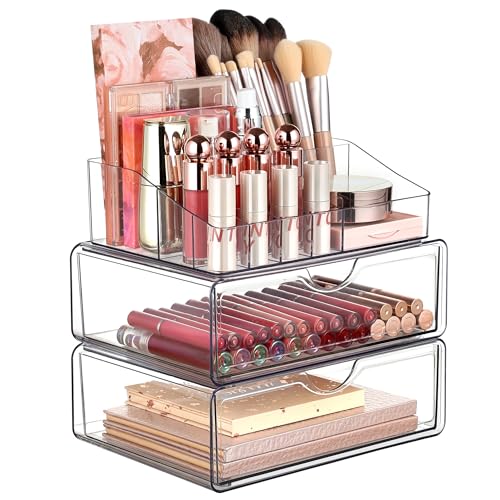
Sorbus Makeup Organizer
The Sorbus Makeup Organizer is a stacked clear-acrylic design with drawers below and open compartments on top. In tier terms it sits in the mid tier of this category: you are paying for the format and the finish rather than for a famous badge, and its value shows in daily use rather than in specifications. Used as directed in this guide — daily products in the most reachable zone, weekly products behind or below — it behaves like the reference example of its format. Best for a classic vanity setup that mixes drawers and open-top storage. Not suited for very small counters where its stacked footprint crowds the mirror. As with every pick in this guide, it is described in prose only while independent verification is pending, so compare its current listing details against the measurements and checks in this article before you buy.

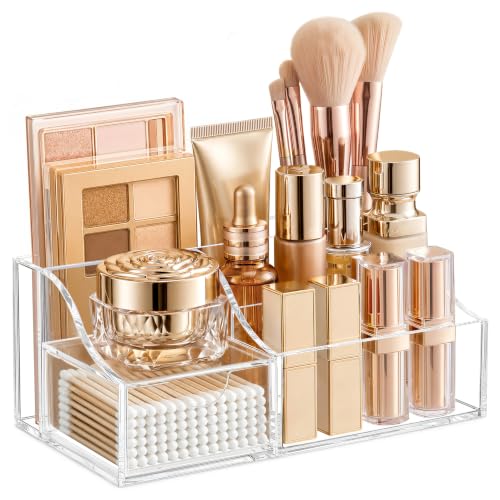
HBlife Makeup Organizer
The HBlife Makeup Organizer is a clear acrylic cosmetic storage box built around several pull-out drawers. In tier terms it sits in the entry tier of this category: you are paying for the format and the finish rather than for a famous badge, and its value shows in daily use rather than in specifications. Used as directed in this guide — daily products in the most reachable zone, weekly products behind or below — it behaves like the reference example of its format. Best for drawer-first routines built on compacts, lipsticks, and small tubes. Not suited for tall skincare bottles, which belong in an open-top design instead. As with every pick in this guide, it is described in prose only while independent verification is pending, so compare its current listing details against the measurements and checks in this article before you buy.

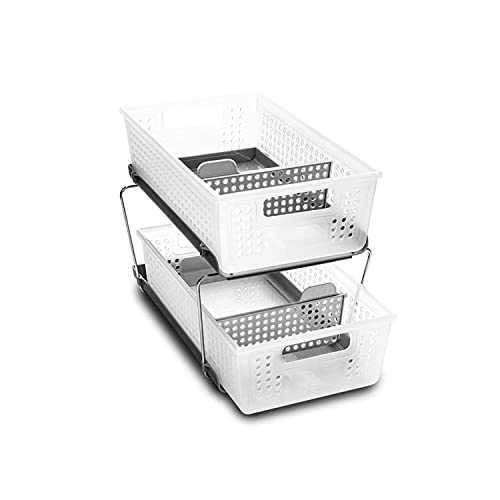
madesmart Two Tier Organizer
The madesmart Two Tier Organizer is a two-tier sliding-basket organizer that works on a vanity or inside a cabinet. In tier terms it sits in the mid tier of this category: you are paying for the format and the finish rather than for a famous badge, and its value shows in daily use rather than in specifications. Used as directed in this guide — daily products in the most reachable zone, weekly products behind or below — it behaves like the reference example of its format. Best for under-sink cabinets and deep shelves where things disappear at the back. Not suited for anyone who wants a display-style acrylic look on the counter. As with every pick in this guide, it is described in prose only while independent verification is pending, so compare its current listing details against the measurements and checks in this article before you buy.
How to Get the Most Value If You Buy
Value is extracted in the setup, not the purchase. Audit first and let a fifth of the space stay empty. Zone by routine order. Keep eye and lip products in their own slots so they are never casually shared, and use the monthly wash as an expiry audit with opening dates taped to bases. Pair the organizer with decent light and a mirror you can actually see into — the makeup mirror buying guide covers that half of the vanity — and do the two-minute weekly reset that stops drift before it starts.
Use the organizer as an expiry checkpoint. Cosmetics do not last forever: mascaras dry and clump, cream products separate, sunscreens lose their reliability, and powders eventually pick up a hard, shiny pan that will not transfer colour properly. Most products carry a small open-jar symbol showing how many months they are intended to last after opening. You do not need a spreadsheet — a small piece of tape with the month and year you opened a product, stuck to its base, turns every tidy-up into an instant audit. When you wash the organizer, scan for tape dates that have run well past the symbol’s guidance and let those products go without regret.
An organizer quietly improves hygiene in one more way: it makes sharing rules easy to keep. As a principle, eye and lip products should not be shared — mascara wands, eyeliners, lipsticks, and lip glosses go directly onto mucous membranes and lashes, and passing them between people passes whatever is on them too. When every product has its own slot, it is simple to keep a small guest set or a separate pouch for anything a partner, teenager, or visiting friend might borrow, and to keep your own eye and lip items unmistakably yours. The organizer does not enforce the rule, but a labelled home for everything makes the rule almost effortless to follow.
An organizer does not live alone; it lives next to a mirror, under your bathroom or bedroom lighting. Place it where you can see into every compartment without leaning or lifting products out — a drawer stack slightly to your dominant-hand side, a rotating tower where the light falls across it, a tray where it does not block the mirror’s lower edge. If you are setting up a new vanity corner, the mirror and the organizer should be chosen together: the right mirror makes a modest organizer feel generous, and the best organizer is wasted in a dark corner where you cannot see the difference between two similar shades.
The Decision Checklist
- Can you see every product you own in under ten seconds today? If not, an organizer earns its place.
- Have you bought a duplicate of something you already owned in the past year?
- Does your morning routine involve opening more than two bags, drawers, or cupboards?
- Is there a measured patch of counter or a spare drawer genuinely available?
- Will you honestly wash it monthly? If not, choose the simplest washable format.
- After decluttering, do you still own more than a small tray can hold?
- Rule of thumb: three or more yes answers — buy, using the checklist in the buying guide. Fewer — tidy what you have first.
Think in tiers rather than totals. Entry-tier organizers are simple moulded trays, basic drawer boxes, and single turntables: honest tools that solve the counter-chaos problem for very little commitment, and the right starting point if you are not yet sure which format suits you. Mid-tier designs add thicker acrylic, smoother drawers, adjustable shelves, and modular pieces that combine. Premium designs sell finish — heavier materials, softer-close drawers, furniture-grade looks that belong on a bedroom vanity. The useful rule is that function saturates early: beyond the mid tier you are mostly buying appearance and feel, which is a perfectly good reason to spend, as long as you know that is what you are buying.
More Practical Notes on Living With a Makeup Organizer
One underrated habit is the two-minute reset. Every evening, or every Sunday if evenings are fiction, spend two minutes returning strays to their slots, wiping the top surface, and pulling forward anything running low. Two minutes is short enough to survive tired days, and it prevents the slow drift that turns an organised vanity back into archaeology. The reset is also when you notice the small things: a brush that needs washing, a lipstick wandering toward the handbag it should live in, a product you have not touched in a month that can move to the weekly drawer and free prime space.
Labels sound fussy until a household shares a bathroom. A small label on a drawer front — face, eyes, lips, tools — ends the rummaging of partners and teenagers who would otherwise open everything. Labels also help a new organizer bed in: for the first fortnight you are learning the map, and labels carry you until your hands know it. Choose labels you can remove or rewrite, because the map will change as your routine does. Inside drawers, a strip of non-slip liner keeps small items from skating to the back every time the drawer opens, and it lifts out for washing.
Consider keeping a small ‘finishing’ zone within the organizer: cotton pads, cotton buds, a micellar water or remover, and tissues. Makeup removal and correction happen at the same mirror as application, and having the correction kit inside the system stops the drips and smears that otherwise migrate across the counter. Keep this zone washable and separate from powders, because remover is exactly the kind of liquid that finds its way into a powder pan if they share a tray. A lidded pot or a narrow upright section keeps pads clean and dry between uses.
If you wear glasses or contact lenses, let the organizer respect that routine too. A flat, safe parking spot for glasses — on top of a drawer stack, or in a wide shallow drawer — prevents the daily countertop hazard of glasses meeting a falling bottle. Lens cases and solution belong with skincare rather than makeup, in a zone that stays dry and clean. These small adjacencies sound trivial, but an organizer succeeds precisely by absorbing the small adjacencies of your real morning, not by imposing a showroom routine on top of it.
Seasonality is real at the vanity. Summer routines lean lighter and more water-resistant; winter routines bring richer creams and deeper lip colours forward. A modular organizer lets you swap the top tray or the front drawer with the season and park the off-season products in a labelled box in a cupboard. This is another argument against one-piece designs with fixed compartments: the collection breathes across the year, and storage that cannot breathe with it ends up either half-empty or overflowing, depending on the month.
When an organizer starts to feel wrong, diagnose before you replace. If mornings feel slow, the layout order is probably wrong — re-sort by routine sequence. If products get dusty, you need lids or drawers, not more space. If things vanish, you need shallower layers or clearer material. If the counter feels crowded, the footprint is wrong, and going taller will fix what a wider replacement would worsen. Most organizer dissatisfaction is one of these four faults, and three of them can be fixed by rearranging what you already own.
Photographs flatter organizers; measurements do not lie. Before ordering anything you have admired online, tape its footprint onto your counter with painter’s tape and live with the outline for a day. Brush your teeth, wash your face, do a full routine inside the taped world. You will learn more from that day than from any product page: whether the elbows collide, whether the mirror still opens, whether the tap still clears. It takes five minutes to tape and saves the most common return in this category, which is not breakage — it is a good organizer in the wrong-sized life.
Finally, remember what the organizer is for. It is not a display cabinet and it is not a test of discipline. It exists so that the products you enjoy are visible, clean, protected, and quick to use, and so the counter returns to calm the moment you are done. Judge every design, every rearrangement, and every purchase by that standard alone, and you will make good decisions in this category almost automatically — including the decision, some years, to buy nothing at all because the current setup already does its job.
As a gift, a makeup organizer is safer than makeup itself, because it makes no guesses about shades or skin. It suits teenagers building a first routine, anyone moving into a new home, and anyone whose bathroom counter has become a shared battlefield. The safest gift format is a clear drawer stack or a two-tier design — neutral, useful in a bathroom or bedroom, and easy to expand later. Pair it with the honest advice from this guide: measure the space first, keep only the daily routine on the counter, and wash it monthly. A gift that comes with a system is worth far more than a bigger box.
An organizer is also a small sustainability decision. The greenest option is the one you keep for a decade, so durability and adaptability beat novelty: thick material, replaceable or removable trays, and a format that can move from bathroom to bedroom to a teenager’s desk as life changes. A cracked organizer usually cracks at a corner or a drawer front, which is why gentle cleaning matters — most early failures are care failures, not design failures. And an organizer that keeps products visible genuinely reduces waste: you stop buying duplicates of products you already own but could not find, and you use things up before they expire instead of rediscovering them a year too late.
Shared bathrooms add diplomacy to the design brief. When two or more people share one counter, an organizer per person — or clearly zoned sections in one larger unit — prevents the daily negotiation over whose products migrate where. Vertical designs help here too, because they give each person a level or a column rather than a contested patch of counter. In family bathrooms, keep daily adult products in closed drawers if small children are curious, and give children their own low, washable tray for their own things. The goal is a counter that resets itself: everything has a home, so the evening wipe-down takes a minute and nobody’s mascara ends up behind the taps.
Visibility is a feature, not an accident. Clear materials, open tops, and shallow layers all serve the same goal: you should be able to inventory your collection with your eyes, in ordinary room light, in about five seconds. If you have to lift three products to see a fourth, the organizer is storing your makeup from you, not for you. This is why deep opaque bins fail at vanities despite working fine in linen cupboards, and why the clear drawer stack became the category’s default shape. When you set up a new organizer, do the five-second test from where you actually stand to do your makeup, in the light you actually use.
Travel exposes what your home organizer gets right. If your daily products live in one removable tray or one drawer of a stack, packing becomes lifting that section into a case rather than gathering strays from three rooms. Some people keep a permanent travel pouch stocked with decanted basics beside the organizer and simply top it up. What does not travel well is a routine scattered across five unrelated containers. Even if you never leave home, organising by removable sections pays off at cleaning time: lift a tray out, wash it at the sink, dry it, drop it back. Fixed, one-piece sculptural designs are the hardest to wash and the first to be abandoned.
One underrated habit is the two-minute reset. Every evening, or every Sunday if evenings are fiction, spend two minutes returning strays to their slots, wiping the top surface, and pulling forward anything running low. Two minutes is short enough to survive tired days, and it prevents the slow drift that turns an organised vanity back into archaeology. The reset is also when you notice the small things: a brush that needs washing, a lipstick wandering toward the handbag it should live in, a product you have not touched in a month that can move to the weekly drawer and free prime space.
Labels sound fussy until a household shares a bathroom. A small label on a drawer front — face, eyes, lips, tools — ends the rummaging of partners and teenagers who would otherwise open everything. Labels also help a new organizer bed in: for the first fortnight you are learning the map, and labels carry you until your hands know it. Choose labels you can remove or rewrite, because the map will change as your routine does. Inside drawers, a strip of non-slip liner keeps small items from skating to the back every time the drawer opens, and it lifts out for washing.
Consider keeping a small ‘finishing’ zone within the organizer: cotton pads, cotton buds, a micellar water or remover, and tissues. Makeup removal and correction happen at the same mirror as application, and having the correction kit inside the system stops the drips and smears that otherwise migrate across the counter. Keep this zone washable and separate from powders, because remover is exactly the kind of liquid that finds its way into a powder pan if they share a tray. A lidded pot or a narrow upright section keeps pads clean and dry between uses.
If you wear glasses or contact lenses, let the organizer respect that routine too. A flat, safe parking spot for glasses — on top of a drawer stack, or in a wide shallow drawer — prevents the daily countertop hazard of glasses meeting a falling bottle. Lens cases and solution belong with skincare rather than makeup, in a zone that stays dry and clean. These small adjacencies sound trivial, but an organizer succeeds precisely by absorbing the small adjacencies of your real morning, not by imposing a showroom routine on top of it.
Seasonality is real at the vanity. Summer routines lean lighter and more water-resistant; winter routines bring richer creams and deeper lip colours forward. A modular organizer lets you swap the top tray or the front drawer with the season and park the off-season products in a labelled box in a cupboard. This is another argument against one-piece designs with fixed compartments: the collection breathes across the year, and storage that cannot breathe with it ends up either half-empty or overflowing, depending on the month.
When an organizer starts to feel wrong, diagnose before you replace. If mornings feel slow, the layout order is probably wrong — re-sort by routine sequence. If products get dusty, you need lids or drawers, not more space. If things vanish, you need shallower layers or clearer material. If the counter feels crowded, the footprint is wrong, and going taller will fix what a wider replacement would worsen. Most organizer dissatisfaction is one of these four faults, and three of them can be fixed by rearranging what you already own.
Photographs flatter organizers; measurements do not lie. Before ordering anything you have admired online, tape its footprint onto your counter with painter’s tape and live with the outline for a day. Brush your teeth, wash your face, do a full routine inside the taped world. You will learn more from that day than from any product page: whether the elbows collide, whether the mirror still opens, whether the tap still clears. It takes five minutes to tape and saves the most common return in this category, which is not breakage — it is a good organizer in the wrong-sized life.
Finally, remember what the organizer is for. It is not a display cabinet and it is not a test of discipline. It exists so that the products you enjoy are visible, clean, protected, and quick to use, and so the counter returns to calm the moment you are done. Judge every design, every rearrangement, and every purchase by that standard alone, and you will make good decisions in this category almost automatically — including the decision, some years, to buy nothing at all because the current setup already does its job.
As a gift, a makeup organizer is safer than makeup itself, because it makes no guesses about shades or skin. It suits teenagers building a first routine, anyone moving into a new home, and anyone whose bathroom counter has become a shared battlefield. The safest gift format is a clear drawer stack or a two-tier design — neutral, useful in a bathroom or bedroom, and easy to expand later. Pair it with the honest advice from this guide: measure the space first, keep only the daily routine on the counter, and wash it monthly. A gift that comes with a system is worth far more than a bigger box.
An organizer is also a small sustainability decision. The greenest option is the one you keep for a decade, so durability and adaptability beat novelty: thick material, replaceable or removable trays, and a format that can move from bathroom to bedroom to a teenager’s desk as life changes. A cracked organizer usually cracks at a corner or a drawer front, which is why gentle cleaning matters — most early failures are care failures, not design failures. And an organizer that keeps products visible genuinely reduces waste: you stop buying duplicates of products you already own but could not find, and you use things up before they expire instead of rediscovering them a year too late.
Shared bathrooms add diplomacy to the design brief. When two or more people share one counter, an organizer per person — or clearly zoned sections in one larger unit — prevents the daily negotiation over whose products migrate where. Vertical designs help here too, because they give each person a level or a column rather than a contested patch of counter. In family bathrooms, keep daily adult products in closed drawers if small children are curious, and give children their own low, washable tray for their own things. The goal is a counter that resets itself: everything has a home, so the evening wipe-down takes a minute and nobody’s mascara ends up behind the taps.
The Earn-Its-Place Test: When a Makeup Organizer Repays the Space It Takes
Worth-it questions about a makeup organizer are really questions about frequency, so start by honestly counting how often the job it does actually arises in your household in a normal month, not in the motivated week when you decided to shop for one. Multiply that frequency by the friction it removes each time — minutes saved, mess avoided, a workaround retired, a room made usable for longer each day — and the value of a makeup organizer stops being a feeling and becomes a rough but usable number. Borrowed enthusiasm is the trap here: a makeup organizer can be excellent and still not be worth it for you, if your neighbours, your feed or your guests use theirs weekly while your own routine would reach for it a handful of times a year. For troubleshooting, start with the boring causes first: power, water, fit, blockage, alignment, a full container, a loose connection or a setting changed by the last person who used the makeup organizer, because boring causes account for most apparent failures.
Measure before anything else, and measure the makeup organizer in its working state rather than its packed or folded state, because handles extend, lids open, cords trail, doors swing and users stand somewhere, and all of that belongs in the measurement. Decide in advance what good enough looks like for the job the makeup organizer does in your home, because chasing a flawless result usually costs more time than the flaw itself, and most households are happier with a reliable ninety percent they actually repeat. Read the manual’s warnings page for the makeup organizer even if you read nothing else, because that page is a compressed list of every way the product has ever been misused, and it tells you exactly which of your own habits needs adjusting. Then subtract the standing costs honestly: the floor, shelf, cupboard or counter space a makeup organizer occupies every day, the cleaning and upkeep it asks for, and the small accessories or consumables its ownership quietly requires.
When something about the makeup organizer disappoints, change one variable at a time — position, setting, timing, load, accessory or technique — and give the change a fair trial, because changing three things at once leaves you with a better or worse result and no idea why. Keep a short note of what you adjusted on the makeup organizer during the first month, even just a line on your phone, since those notes turn vague impressions into a setup you can repeat, share or troubleshoot months later. Consider the cleaning rhythm honestly: a makeup organizer that needs attention after every use suits a household that enjoys small rituals, and frustrates a household that wants to finish a job and walk away, so match the upkeep to the temperament, not the intention. Finally, remember that the best makeup organizer for your home is the one whose size, habits and upkeep disappear into your routine, leaving only the result behind — a cleaner surface, a better-lit seat, a tidier shelf, an easier job — week after ordinary week.
Think about who else will use the makeup organizer and what they will do differently: shorter reach, less patience, stronger habits, no interest in the manual, and a tendency to leave things wherever they were last set down.
Frequently Asked Questions
Is a makeup organizer worth it for a small collection?
Usually not in its larger forms. If your routine is a handful of products, a small tray or a single compact drawer unit gives you the visibility benefit without the footprint or the washing burden of a full organizer. The value case grows with collection size and with morning time pressure; it is weakest exactly where the storage problem is already solved.
How does an organizer save money if it costs money?
Mainly by preventing waste rather than by being cheap. Visible storage stops duplicate purchases of products you already own, and better storage — palettes uncrushed, brushes unbent, powders kept dry — extends the usable life of what you have. For most owners the saving is modest but real, and it arrives through behaviour the organizer makes easy, not through the object itself.
What is the biggest hidden cost of owning one?
Maintenance. Makeup residue builds up inside any organizer and harbours everyday grime, so the object needs a weekly wipe and a monthly wash for as long as you own it. The second hidden cost is counter space: a badly measured organizer is a daily irritation. Neither cost is large, but both are permanent, and honest buyers should count them before purchasing.
Can an organizer fix a messy, oversized collection?
No — it can only organise a collection that has been honestly edited. Products that are dried out, duplicated, or long past their intended life are clutter, not a storage problem. Declutter first, then measure what remains. Many people find the edited collection needs a far smaller organizer than they expected, and some find a tray they already own is suddenly enough.
Which format gives the best value for most people?
A clear drawer stack is the safest value for most collections: it protects products from dust and steam, keeps everything visible, and adapts as routines change. Rotating designs give better value for tall bottles on deep counters, and two-tier cabinet organizers give the best value under sinks. The buying guide in this series matches formats to profiles in detail.
How long should a decent organizer last?
Years, if it is cared for gently. Most early failures are care failures: acrylic scrubbed with abrasive pads or sprayed with harsh solvents can scratch, cloud, or crack at the edges. Wash with warm water and mild soap, use soft cloths, dry fully, and a mid-tier organizer should outlast several complete changes of the routine it holds.
Related Guides and Next Steps
Keep building the same calm, washable system around the vanity with these companion guides from the same series and the wider site:
- how to choose a makeup organizer, step by step
- the complete makeup organizer buying guide
- makeup organizer pros and cons, weighed plainly
- the in-depth makeup organizer review
- makeup organizer reviews across the wider field
- the companion makeup mirror review
- the makeup mirror buying guide
- a wall mirror that suits a small vanity corner
- storage baskets for the overflow a vanity cannot hold
- nightstands with charging stations for a bedroom vanity setup
- square bathroom sinks when you are planning the counter itself