Disclosure: As an Amazon Associate, dailyhomedecorating.com earns from qualifying purchases. Links on this page are affiliate links; they cost you nothing extra. Prices and availability change often, so check the current Amazon listing before you buy.
This balanced look at makeup organizer pros and cons refuses the usual sales pattern of seven glowing advantages and one trivial drawback. A makeup organizer genuinely improves visibility, speed, and product care — and it genuinely costs counter space, demands regular washing, and can quietly encourage a bigger collection than you need. Both halves are true at once, and which half dominates depends on your space, your routine, and your honesty at the decluttering stage. Read both sides, then use the use-case section to locate yourself. For the purchase mechanics afterwards, see the complete makeup organizer buying guide.
Key Takeaways
- The core pro is visibility: everything you own, surveyable in seconds.
- The core con is footprint: permanent space on the most contested surface at home.
- Hygiene cuts both ways — a washed organizer is a hygiene upgrade; an unwashed one is worse than a bag.
- Organizers protect products but cannot rescue an unedited collection.
- Format decides which pros and cons you personally get: drawers, spinners, and trays differ sharply.
- Most cons shrink with the right setup and care; most pros vanish with the wrong one.
In this guide
Makeup Organizer Pros And Cons: The Pros
Pro: Everything Becomes Visible at a Glance
The deepest advantage is not tidiness but information. When every product has a visible home, you know what you own, what is running low, and what you have been neglecting. Duplicates stop, because nobody buys a third coral lipstick while looking at the two they own. Forgotten favourites come back into rotation before they expire. This single pro quietly pays for the organizer over time in avoided waste, and it is the advantage owners mention most after the novelty fades.
Visibility is a feature, not an accident. Clear materials, open tops, and shallow layers all serve the same goal: you should be able to inventory your collection with your eyes, in ordinary room light, in about five seconds. If you have to lift three products to see a fourth, the organizer is storing your makeup from you, not for you. This is why deep opaque bins fail at vanities despite working fine in linen cupboards, and why the clear drawer stack became the category’s default shape. When you set up a new organizer, do the five-second test from where you actually stand to do your makeup, in the light you actually use.
Pro: Mornings Get Faster and Calmer
A layout zoned by routine order turns a search into a sequence. Products sit where the hand expects them, in the order the routine uses them, and the whole process sheds its small frictions — the rummage, the putting-down on wet counters, the product that lived in another room. The saving is a few minutes a day, which compounds into hours across a year, and the calm is worth more than the minutes.
The real test of any organizer is a rushed weekday morning. A good setup lets you run the whole routine in order without putting anything down on a wet counter: cleanser and skincare first, then base, then eyes, then lips, then tools back in their slots. Arrange compartments in the order you actually work, not in the order that photographs well. Keep the daily dozen at the front or on top, weekly products behind or below, and duplicates out of the organizer entirely. When the layout matches the routine, tidying up takes seconds, because every product has exactly one obvious home and your hands learn the map within a week.
Pro: Products Are Protected and Last Better
Palettes stop being crushed under bottles. Brushes stop bending in bags and picking up residue from loose powders. Powders live drier, behind drawer fronts, away from steam and dust. Glass bottles stand in compartments instead of skating across stone counters. None of this is dramatic, and all of it extends the working life of products that are not cheap to replace.
Palettes and compacts store best flat or filed upright like books, never stacked loose in a deep bin. Flat in a shallow drawer, each palette shows its cover at a glance and slides out without disturbing the rest. Filed upright in a slotted rack or a wide compartment, they take less room and still stay identifiable. What palettes hate is weight: a heavy bottle stored on top of a palette presses on pans and hinges every time the drawer moves. Give palettes their own zone, keep liquids out of it, and the mirrors inside the lids will stay uncracked and the pans unshattered far longer.
Brushes deserve their own thinking. Stored upright in an open cup or slot, brushes keep their shape, dry properly after washing, and are easy to grab mid-routine. Stored loose in a drawer, bristles bend, heads pick up powder residue from neighbouring products, and you will rummage with damp hands every morning. If your organizer has an upright brush section, check that it is tall enough to support the handles without the heads splaying against a lid or shelf above. Face brushes and eye brushes ideally sit in separate slots, because the powder fallout from a big blush brush will happily migrate onto smaller, cleaner eye brushes sharing the same cup.
Pro: Hygiene Becomes Structural
A washable organizer with defined slots supports the habits that keep makeup fresher: regular washing of the storage itself, brushes stored upright and apart, eye and lip products kept in their own slots rather than shared around a household, and a natural monthly moment to check what has expired. The organizer does not create discipline, but it gives discipline a structure to live in — which, for most households, is the difference between a rule and a routine.
An organizer quietly improves hygiene in one more way: it makes sharing rules easy to keep. As a principle, eye and lip products should not be shared — mascara wands, eyeliners, lipsticks, and lip glosses go directly onto mucous membranes and lashes, and passing them between people passes whatever is on them too. When every product has its own slot, it is simple to keep a small guest set or a separate pouch for anything a partner, teenager, or visiting friend might borrow, and to keep your own eye and lip items unmistakably yours. The organizer does not enforce the rule, but a labelled home for everything makes the rule almost effortless to follow.
Use the organizer as an expiry checkpoint. Cosmetics do not last forever: mascaras dry and clump, cream products separate, sunscreens lose their reliability, and powders eventually pick up a hard, shiny pan that will not transfer colour properly. Most products carry a small open-jar symbol showing how many months they are intended to last after opening. You do not need a spreadsheet — a small piece of tape with the month and year you opened a product, stuck to its base, turns every tidy-up into an instant audit. When you wash the organizer, scan for tape dates that have run well past the symbol’s guidance and let those products go without regret.
Pro: The Counter Resets Itself
Because every item has exactly one home, tidying stops being a project. Products return to their slots almost automatically, the evening wipe-down takes a minute, and guests can be faced without a pre-visit scramble. In shared bathrooms this pro has a diplomatic dimension too: zoned storage ends most arguments about whose products migrated where.
Shared bathrooms add diplomacy to the design brief. When two or more people share one counter, an organizer per person — or clearly zoned sections in one larger unit — prevents the daily negotiation over whose products migrate where. Vertical designs help here too, because they give each person a level or a column rather than a contested patch of counter. In family bathrooms, keep daily adult products in closed drawers if small children are curious, and give children their own low, washable tray for their own things. The goal is a counter that resets itself: everything has a home, so the evening wipe-down takes a minute and nobody’s mascara ends up behind the taps.
The Cons, Honestly
Con: It Claims Permanent Counter Space
The first con is the mirror of the first pro: visibility is bought with footprint. Bathroom counters are small and shared with soap, toothbrushes, and skincare, and a badly sized organizer is a daily, physical irritation — elbows, taps, and mirror doors all collide with it. Going taller rather than wider softens this con, but no format abolishes it. Measure ruthlessly, and tape the footprint before you buy.
Countertop organizers live or die by footprint. The counter beside a bathroom sink is some of the most contested space in the home, shared with soap, toothbrushes, skincare, and the mirror itself. A countertop piece that is too wide will be resented daily, however clever its compartments. Measure the clear patch of counter you can genuinely give up, then choose a design that goes up rather than out: stacked drawers, tiered trays, and upright brush holders all store vertically. Open-top compartments suit the products you grab without looking — brushes, mascara, lip balm — while anything you use with wet hands belongs in a section that wipes clean in seconds.
Small spaces reward vertical thinking and punish sprawl. In a compact bathroom or a rented room with a sliver of counter, the winning designs are tall and narrow: stacked drawers, tiered trays, and rotating towers that use the air above the counter instead of the counter itself. Wall-mounted and over-door options move storage off the surface entirely, though they suit lighter items. The mistake to avoid is buying a wide, low tray because it looks neat in photographs; on a small counter it becomes a landing strip that eats the space where you actually put things down while getting ready.
Con: It Needs Regular Washing, Forever
Makeup residue is not decorative dust. Foundation smears, powder fallout, and cream films accumulate inside compartments and harbour everyday grime, and brush heads rest directly in it. An organizer therefore commits you to a weekly wipe and a monthly wash for its entire life. Owners who will not do this are genuinely better served by a cheap tray they can replace or a wash bag they can launder — an unwashed organizer is the worst storage in the bathroom.
Whatever format you choose, put washing on the calendar. Makeup residue is not inert dust: foundation smears, powder fallout, and the film from creams build up inside compartments and harbour everyday grime, and brushes rest their heads right in it. Empty the organizer fully, wash removable trays and drawers in warm soapy water, wipe fixed sections with a damp cloth, and let everything dry completely before products go back — a damp drawer is a miserable home for powder products. A quick wipe weekly and a proper wash monthly is a realistic rhythm for most people. The wash is also the perfect moment to spot products that have separated, dried out, or quietly passed their best.
Con: It Cannot Fix an Unedited Collection
Storage organises; it does not absolve. A collection swollen with dried, duplicated, and expired products will fill any organizer and still overflow, and the organizer’s neatness can disguise the problem for months. The declutter must come first, and for some households the honest conclusion of decluttering is that the remaining routine needs only a tray. An organizer bought to avoid that afternoon is money spent postponing it.
Start with an honest audit of what you actually own and use. Lay everything out and sort it into three groups: the daily routine you touch every morning, the weekly rotation for evenings and occasions, and the honest rarely-used pile. Only the first group earns counter space. The second group belongs in drawers or a cabinet organizer. The third group deserves a hard look — dried, duplicated, or long-expired products are not storage problems, they are clutter wearing a storage costume. People are routinely surprised to find their daily routine is a dozen products, which means a modest organizer, well chosen, beats a huge one bought to house products that should have left the house.
Con: Materials Have Real Weaknesses
Acrylic, the category’s favourite, scratches under abrasive cleaning and can craze or crack with harsh solvents or a hard fall onto tile. Bamboo sulks in standing water. Thin plastics flex and split at corners. Wire rails let small items slip through. Every material in this category has a failure mode, and the failure usually arrives through care that ignores it. This con is manageable — the care rules are simple — but it is not imaginary.
Clear acrylic is the default material in this category for good reasons: it is light, it shows exactly what is inside, it wipes clean, and it suits almost any bathroom or bedroom decor. It does ask for a little respect in return. Acrylic can scratch if you scrub it with abrasive pads, and it can craze or crack if it meets harsh solvents or a hard knock on a tile floor. Clean it the gentle way: warm water, a drop of mild soap, a soft cloth, and no ammonia-based sprays. Treated that way, a decent acrylic organizer stays clear for years. Treated roughly, it clouds at the edges and develops the fine cracks that make it look tired long before it actually fails.
Beyond acrylic, each material brings a personality. Bamboo and wood look warm on a bedroom vanity and feel sturdy, but they dislike standing water and need drying after a wash. Metal frames and wire racks are tough, airy, and easy to rinse, though small items can slip through wide rails. Soft fabric and felt-lined trays are gentle on glass bottles and quiet on stone counters, but they stain and are the hardest to wash properly. Plastic organizers vary the most: the best are thick, smooth, and easy to clean, while the thinnest flex and crack at the corners. Match the material to the room first — steamy bathroom, dry bedroom, shared family space — and to how honestly you will maintain it.
Con: The Wrong Format Actively Fights You
A deep bin hides products as effectively as a drawer reveals them. A spinner topples lipsticks. An open tray in a steamy bathroom films powders with damp dust. Format mismatch converts every pro into its opposite: visibility becomes excavation, protection becomes crushing, tidiness becomes a prettier mess. This is the con with the highest stakes, because it is locked in at purchase — which is why the step order in how to choose a makeup organizer, step by step puts format before everything.
Every makeup organizer belongs to one of three broad formats, and the format matters more than the brand name on the box. Countertop organizers sit beside the mirror and keep the daily routine within arm’s reach; they are the easiest to use and the easiest to overfill. Drawer organizers either stack as clear drawers on the counter or drop into an existing vanity drawer, trading instant visibility for a calmer surface. Rotating organizers spin a full circle of compartments into a small footprint, which suits tall bottles and crowded corners. Most happy setups combine two formats: a countertop piece for the daily dozen products, and drawers or a cabinet piece for everything used weekly rather than daily.
Bathrooms are convenient and hostile in equal measure. Steam from showers raises humidity daily, and powder products, in particular, prefer dry air; a powder stored in constant steam can harden on the surface and stop performing. If your bathroom is small and steamy and your routine is powder-heavy, a bedroom vanity or a lidded organizer that closes against the damp is the kinder home. If the bathroom is your only option, choose materials that shrug off moisture — acrylic, coated metal, and washable plastics rather than untreated wood or fabric — and favour designs you can lift out and dry fully after the monthly wash.
Con: It Can Encourage Buying More Makeup
Empty compartments exert a quiet pull. A half-empty organizer makes a modest collection feel inadequate and invites purchases to complete the picture — the exact opposite of the visibility dividend. The defence is the four-fifths rule: buy an organizer that is comfortably full on day one, treat the remaining fifth as slack for genuine replacements, and let a full organizer be the collection’s boundary rather than its advertisement.
The most common buying mistake in this category is purchasing storage for the collection you imagine rather than the one on your counter. Aspirational buying produces a beautiful, half-empty palace that crowds the sink, while the real routine still lives in a wash bag because the palace’s compartments are the wrong shapes. The second mistake is the opposite: buying exactly to today’s count, with no slack, so the first new palette has nowhere to go and the overflow restarts the chaos. Aim for an organizer that is comfortably full on day one — roughly four-fifths occupied — with one flexible space that can absorb the next few purchases.
What the Trade-Offs Mean for You
For the collector, the pros dominate: visibility and protection transform a large collection from a liability into a library, and the washing cost is trivial against the value stored. For the minimalist, the cons dominate: a tray delivers the one pro that matters — a corralled routine — without footprint or maintenance. For the shared household, the deciding factor is zoning; a per-person setup turns the space con into the peace pro. For the small, steamy bathroom, the material and format cons are decisive, and the right answer may be a lidded drawer unit in the bedroom. Locate your profile honestly and the balance usually tips clearly one way — the same conclusion reached from the value angle in is a makeup organizer worth it — the honest value case.
Dust is the countertop organizer’s slow enemy. Open trays and upright cups collect bathroom dust and powder fallout on every exposed surface, and products stored open wear a film of it within weeks. Drawers and lidded designs keep products cleaner between uses, which is one reason drawer stacks suit people who do a full routine only a few times a week: everything waits, clean, behind a clear front. Daily users who touch every product every morning can happily use open designs, because turnover itself keeps things fresh — but even then, the weekly wipe from the cleaning rhythm matters more than the format.
How the Alternatives Compare
Set against its rivals, the full organizer is the high-capacity, high-maintenance option. A single tray offers a fifth of the capacity with almost none of the washing burden and total visibility in one layer — better for small routines, hopeless for large ones. Drawer inserts match the organizer’s protection while surrendering no counter at all, but they demand a suitable drawer and fixed dimensions. A structured pouch wins on travel and loses on visibility and protection. None of these is a failed organizer; each is the right answer at a different collection size, which the field-wide comparison in makeup organizer reviews across the wider field maps in full.
How to Buy Smart if the Pros Win
Audit first. Measure the footprint, the tallest bottle, and the widest palette. Choose the format by room and collection, the material by your real cleaning temperament, and the size by the four-fifths rule. Prefer adjustable dividers and removable trays, because routines change and washing is forever. Shortlist from the reference designs below — each is a format exemplar presented in prose while verification is pending — and finish the vanity with the makeup mirror buying guide so the light does the storage justice.
Sorbus Makeup Organizer
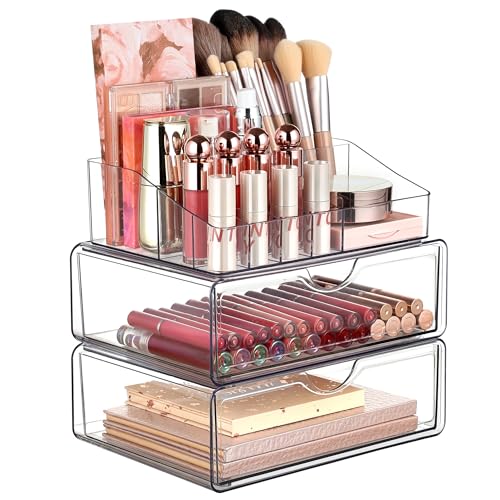
The Sorbus Makeup Organizer is a stacked clear-acrylic design with drawers below and open compartments on top. In tier terms it sits in the mid tier of this category: you are paying for the format and the finish rather than for a famous badge, and its value shows in daily use rather than in specifications. Used as directed in this guide — daily products in the most reachable zone, weekly products behind or below — it behaves like the reference example of its format. Best for a classic vanity setup that mixes drawers and open-top storage. Not suited for very small counters where its stacked footprint crowds the mirror. As with every pick in this guide, it is described in prose only while independent verification is pending, so compare its current listing details against the measurements and checks in this article before you buy.

madesmart Two Tier Organizer
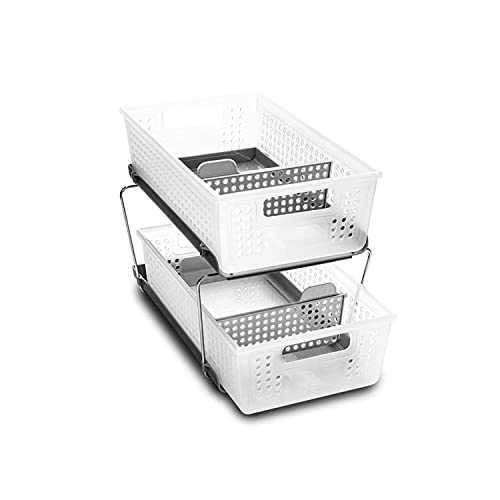
The madesmart Two Tier Organizer is a two-tier sliding-basket organizer that works on a vanity or inside a cabinet. In tier terms it sits in the mid tier of this category: you are paying for the format and the finish rather than for a famous badge, and its value shows in daily use rather than in specifications. Used as directed in this guide — daily products in the most reachable zone, weekly products behind or below — it behaves like the reference example of its format. Best for under-sink cabinets and deep shelves where things disappear at the back. Not suited for anyone who wants a display-style acrylic look on the counter. As with every pick in this guide, it is described in prose only while independent verification is pending, so compare its current listing details against the measurements and checks in this article before you buy.
iDesign Cosmetic Organizer
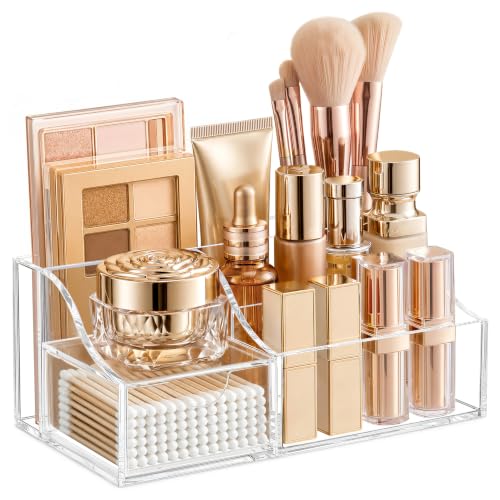
The iDesign Cosmetic Organizer is clear vanity trays and drawer pieces designed to be combined and rearranged. In tier terms it sits in the mid tier of this category: you are paying for the format and the finish rather than for a famous badge, and its value shows in daily use rather than in specifications. Used as directed in this guide — daily products in the most reachable zone, weekly products behind or below — it behaves like the reference example of its format. Best for growing collections, because pieces can be added and re-stacked over time. Not suited for anyone who wants one single finished unit with nothing to configure. As with every pick in this guide, it is described in prose only while independent verification is pending, so compare its current listing details against the measurements and checks in this article before you buy.
Setup and Care That Reduce the Cons
Nearly every con shrinks under good setup. Footprint shrinks when you go vertical and zone by routine. The washing burden shrinks when trays lift out and interiors are smooth. The material cons shrink under gentle care: warm water, mild soap, soft cloths, full drying, no solvents on acrylic. The buying-more con shrinks under the four-fifths rule. Even the steam con shrinks with lids, drawers, or a bedroom relocation. What setup cannot fix is a wrong format or an unedited collection — those two decisions happen before the organizer arrives, and they are the whole game.
Adjustable dividers are the difference between an organizer that fits your collection and one your collection must fit. Fixed compartments assume everyone’s products are the same shapes; they never are. Look for drawer inserts you can slide, trays you can remove, and shelves you can raise or lower. A modular approach also future-proofs the purchase: when your routine changes — and routines change with seasons, jobs, and whims — the storage can be rearranged instead of replaced. The most flexible setups in this category are deliberately plain: a clear drawer stack plus a couple of loose trays will out-adapt any sculptural design with compartments moulded for products you do not own.
Bottom Line
The pros are about information, sequence, and care; the cons are about space, maintenance, and honesty. If your collection is edited, your space is measured, and your format is right, the pros win decisively and keep winning every morning. If any of those three conditions fails, the cons will find you. That conditional verdict is the most useful sentence in this article, and it is the same verdict the hands-on the in-depth makeup organizer review reaches from the testing side.
More Practical Notes on Living With a Makeup Organizer
Shared bathrooms add diplomacy to the design brief. When two or more people share one counter, an organizer per person — or clearly zoned sections in one larger unit — prevents the daily negotiation over whose products migrate where. Vertical designs help here too, because they give each person a level or a column rather than a contested patch of counter. In family bathrooms, keep daily adult products in closed drawers if small children are curious, and give children their own low, washable tray for their own things. The goal is a counter that resets itself: everything has a home, so the evening wipe-down takes a minute and nobody’s mascara ends up behind the taps.
Visibility is a feature, not an accident. Clear materials, open tops, and shallow layers all serve the same goal: you should be able to inventory your collection with your eyes, in ordinary room light, in about five seconds. If you have to lift three products to see a fourth, the organizer is storing your makeup from you, not for you. This is why deep opaque bins fail at vanities despite working fine in linen cupboards, and why the clear drawer stack became the category’s default shape. When you set up a new organizer, do the five-second test from where you actually stand to do your makeup, in the light you actually use.
Travel exposes what your home organizer gets right. If your daily products live in one removable tray or one drawer of a stack, packing becomes lifting that section into a case rather than gathering strays from three rooms. Some people keep a permanent travel pouch stocked with decanted basics beside the organizer and simply top it up. What does not travel well is a routine scattered across five unrelated containers. Even if you never leave home, organising by removable sections pays off at cleaning time: lift a tray out, wash it at the sink, dry it, drop it back. Fixed, one-piece sculptural designs are the hardest to wash and the first to be abandoned.
One underrated habit is the two-minute reset. Every evening, or every Sunday if evenings are fiction, spend two minutes returning strays to their slots, wiping the top surface, and pulling forward anything running low. Two minutes is short enough to survive tired days, and it prevents the slow drift that turns an organised vanity back into archaeology. The reset is also when you notice the small things: a brush that needs washing, a lipstick wandering toward the handbag it should live in, a product you have not touched in a month that can move to the weekly drawer and free prime space.
Labels sound fussy until a household shares a bathroom. A small label on a drawer front — face, eyes, lips, tools — ends the rummaging of partners and teenagers who would otherwise open everything. Labels also help a new organizer bed in: for the first fortnight you are learning the map, and labels carry you until your hands know it. Choose labels you can remove or rewrite, because the map will change as your routine does. Inside drawers, a strip of non-slip liner keeps small items from skating to the back every time the drawer opens, and it lifts out for washing.
Consider keeping a small ‘finishing’ zone within the organizer: cotton pads, cotton buds, a micellar water or remover, and tissues. Makeup removal and correction happen at the same mirror as application, and having the correction kit inside the system stops the drips and smears that otherwise migrate across the counter. Keep this zone washable and separate from powders, because remover is exactly the kind of liquid that finds its way into a powder pan if they share a tray. A lidded pot or a narrow upright section keeps pads clean and dry between uses.
If you wear glasses or contact lenses, let the organizer respect that routine too. A flat, safe parking spot for glasses — on top of a drawer stack, or in a wide shallow drawer — prevents the daily countertop hazard of glasses meeting a falling bottle. Lens cases and solution belong with skincare rather than makeup, in a zone that stays dry and clean. These small adjacencies sound trivial, but an organizer succeeds precisely by absorbing the small adjacencies of your real morning, not by imposing a showroom routine on top of it.
Seasonality is real at the vanity. Summer routines lean lighter and more water-resistant; winter routines bring richer creams and deeper lip colours forward. A modular organizer lets you swap the top tray or the front drawer with the season and park the off-season products in a labelled box in a cupboard. This is another argument against one-piece designs with fixed compartments: the collection breathes across the year, and storage that cannot breathe with it ends up either half-empty or overflowing, depending on the month.
When an organizer starts to feel wrong, diagnose before you replace. If mornings feel slow, the layout order is probably wrong — re-sort by routine sequence. If products get dusty, you need lids or drawers, not more space. If things vanish, you need shallower layers or clearer material. If the counter feels crowded, the footprint is wrong, and going taller will fix what a wider replacement would worsen. Most organizer dissatisfaction is one of these four faults, and three of them can be fixed by rearranging what you already own.
Photographs flatter organizers; measurements do not lie. Before ordering anything you have admired online, tape its footprint onto your counter with painter’s tape and live with the outline for a day. Brush your teeth, wash your face, do a full routine inside the taped world. You will learn more from that day than from any product page: whether the elbows collide, whether the mirror still opens, whether the tap still clears. It takes five minutes to tape and saves the most common return in this category, which is not breakage — it is a good organizer in the wrong-sized life.
Finally, remember what the organizer is for. It is not a display cabinet and it is not a test of discipline. It exists so that the products you enjoy are visible, clean, protected, and quick to use, and so the counter returns to calm the moment you are done. Judge every design, every rearrangement, and every purchase by that standard alone, and you will make good decisions in this category almost automatically — including the decision, some years, to buy nothing at all because the current setup already does its job.
As a gift, a makeup organizer is safer than makeup itself, because it makes no guesses about shades or skin. It suits teenagers building a first routine, anyone moving into a new home, and anyone whose bathroom counter has become a shared battlefield. The safest gift format is a clear drawer stack or a two-tier design — neutral, useful in a bathroom or bedroom, and easy to expand later. Pair it with the honest advice from this guide: measure the space first, keep only the daily routine on the counter, and wash it monthly. A gift that comes with a system is worth far more than a bigger box.
An organizer is also a small sustainability decision. The greenest option is the one you keep for a decade, so durability and adaptability beat novelty: thick material, replaceable or removable trays, and a format that can move from bathroom to bedroom to a teenager’s desk as life changes. A cracked organizer usually cracks at a corner or a drawer front, which is why gentle cleaning matters — most early failures are care failures, not design failures. And an organizer that keeps products visible genuinely reduces waste: you stop buying duplicates of products you already own but could not find, and you use things up before they expire instead of rediscovering them a year too late.
Shared bathrooms add diplomacy to the design brief. When two or more people share one counter, an organizer per person — or clearly zoned sections in one larger unit — prevents the daily negotiation over whose products migrate where. Vertical designs help here too, because they give each person a level or a column rather than a contested patch of counter. In family bathrooms, keep daily adult products in closed drawers if small children are curious, and give children their own low, washable tray for their own things. The goal is a counter that resets itself: everything has a home, so the evening wipe-down takes a minute and nobody’s mascara ends up behind the taps.
Visibility is a feature, not an accident. Clear materials, open tops, and shallow layers all serve the same goal: you should be able to inventory your collection with your eyes, in ordinary room light, in about five seconds. If you have to lift three products to see a fourth, the organizer is storing your makeup from you, not for you. This is why deep opaque bins fail at vanities despite working fine in linen cupboards, and why the clear drawer stack became the category’s default shape. When you set up a new organizer, do the five-second test from where you actually stand to do your makeup, in the light you actually use.
Travel exposes what your home organizer gets right. If your daily products live in one removable tray or one drawer of a stack, packing becomes lifting that section into a case rather than gathering strays from three rooms. Some people keep a permanent travel pouch stocked with decanted basics beside the organizer and simply top it up. What does not travel well is a routine scattered across five unrelated containers. Even if you never leave home, organising by removable sections pays off at cleaning time: lift a tray out, wash it at the sink, dry it, drop it back. Fixed, one-piece sculptural designs are the hardest to wash and the first to be abandoned.
One underrated habit is the two-minute reset. Every evening, or every Sunday if evenings are fiction, spend two minutes returning strays to their slots, wiping the top surface, and pulling forward anything running low. Two minutes is short enough to survive tired days, and it prevents the slow drift that turns an organised vanity back into archaeology. The reset is also when you notice the small things: a brush that needs washing, a lipstick wandering toward the handbag it should live in, a product you have not touched in a month that can move to the weekly drawer and free prime space.
Labels sound fussy until a household shares a bathroom. A small label on a drawer front — face, eyes, lips, tools — ends the rummaging of partners and teenagers who would otherwise open everything. Labels also help a new organizer bed in: for the first fortnight you are learning the map, and labels carry you until your hands know it. Choose labels you can remove or rewrite, because the map will change as your routine does. Inside drawers, a strip of non-slip liner keeps small items from skating to the back every time the drawer opens, and it lifts out for washing.
Living With the Trade-Offs: A Week-by-Week Reality Check for a Makeup Organizer
A pros-and-cons list is a snapshot, but living with a makeup organizer is a film, and this section follows the trade-offs across the first weeks when novelty fades and routine takes over. In week one, most owners notice the headline advantage of a makeup organizer constantly, because every use is a comparison with whatever came before it, while the headline drawback feels minor simply because it is still new. By week three the pattern usually reverses: the advantage becomes invisible background, part of how the room or routine simply works now, while any recurring friction with the makeup organizer — a awkward reach, a fiddly clean, a storage squeeze — is the thing you feel on every single use. Check the floor, wall, ground or surface the makeup organizer will meet, since level, texture, moisture and finish decide more about everyday performance in beauty & personal care settings than most shoppers expect when they are comparing listings on a screen.
When something about the makeup organizer disappoints, change one variable at a time — position, setting, timing, load, accessory or technique — and give the change a fair trial, because changing three things at once leaves you with a better or worse result and no idea why. If you want a concrete listing check, take a name already shortlisted in this guide, such as Sorbus Makeup Organizer, madesmart Two Tier Organizer and iDesign Cosmetic Organizer, and verify that exact makeup organizer listing against the measurements and compatibility questions above, field by field, rather than trusting the headline description alone. That reversal is the real test for a makeup organizer: ask whether the drawback you are weighing is a one-time cost, paid at setup or purchase, or a per-use cost that you will pay hundreds of times a year without ever getting used to it. If a problem with the makeup organizer repeats in the same spot or the same stage of the job, treat the pattern as the clue — patterns point to setup, surface or technique, while random problems point more often to the individual unit.
Share the checklist result with anyone who shares the space, since a makeup organizer chosen by one person and resented by another rarely survives, however sensible the purchase looked on paper. Plan the storage home for the makeup organizer before it arrives, naming the exact cupboard, corner, shelf, hook or stretch of floor, because a product without a home migrates around the house and slowly becomes the clutter it was bought to reduce. If you already own a makeup organizer, run the same week-by-week check backwards and note which drawback you have genuinely stopped noticing and which one still earns a small sigh, because that sigh is the most honest review you will ever read.
Frequently Asked Questions
What is the biggest advantage of a makeup organizer?
Visibility. When every product you own can be surveyed in seconds, duplicate purchases stop, neglected products return to use before they expire, and the morning routine runs in a fixed order instead of a search. Protection for palettes and brushes and a counter that resets itself are close runners-up, but visibility is the advantage that quietly pays for the purchase over time.
What is the biggest disadvantage?
The permanent footprint on a small, shared counter — closely followed by the maintenance commitment. An organizer needs a weekly wipe and a monthly wash for its whole life, because makeup residue builds up and harbours grime. Buyers unwilling to wash it should choose a simple tray instead; an unwashed organizer is worse storage than the bag it replaced.
Do makeup organizers actually improve hygiene?
They can, structurally. Defined slots keep your eye and lip products separate from anything guests might borrow, brushes stand upright with heads apart, and a washable unit that empties fully makes regular cleaning easy. The organizer supplies the structure; the habits still have to happen. Without the washing rhythm, the hygiene argument collapses into its opposite.
Are acrylic organizers a good idea given they can crack?
For most people, yes — with eyes open. Acrylic cracks or crazes mainly under harsh solvents, abrasive scrubbing, or hard knocks, all of which gentle care avoids: warm water, mild soap, soft cloths. In return you get the clearest visibility in the category and easy washing. Households that know they clean roughly may prefer coated metal or thicker moulded designs instead.
Can an organizer make a small bathroom feel more crowded?
A badly chosen one can. Wide, low designs eat the working counter, and open trays invite sprawl. The fixes are vertical formats — stacked drawers, tiers, rotating towers — honest measuring, and the tape-the-footprint test before buying. In the smallest, steamiest bathrooms, the best organizer may live in the bedroom instead, with only the day’s products travelling to the sink.
Is a tray ever better than a full organizer?
Often. For a routine of a few products, a single washable tray delivers visibility and a corralled counter with almost no footprint cost and seconds of cleaning. Full organizers earn their extra space and maintenance only when the collection outgrows one visible layer — which is a conclusion many people reach only after an honest declutter shrinks the collection to tray size.
Related Guides and Next Steps
Keep building the same calm, washable system around the vanity with these companion guides from the same series and the wider site:
- how to choose a makeup organizer, step by step
- is a makeup organizer worth it — the honest value case
- the complete makeup organizer buying guide
- the in-depth makeup organizer review
- makeup organizer reviews across the wider field
- the companion makeup mirror review
- the makeup mirror buying guide
- a wall mirror that suits a small vanity corner
- storage baskets for the overflow a vanity cannot hold
- nightstands with charging stations for a bedroom vanity setup
- square bathroom sinks when you are planning the counter itself