Disclosure: As an Amazon Associate, dailyhomedecorating.com earns from qualifying purchases. Links on this page are affiliate links; they cost you nothing extra. Prices and availability change often, so check the current Amazon listing before you buy.
This makeup organizer buying guide covers the whole category the way a good salesperson never will: by format first, by the questions that actually decide fit second, and by specific designs only once you know what you are shopping for. A makeup organizer is a small purchase with an outsized daily effect, because it sits inside your morning routine for years. Read the types, work through the criteria questions, match yourself to a buyer profile, and the shortlist at the end will narrow itself. If you are still deciding whether to buy at all, start with is a makeup organizer worth it — the honest value case.
Key Takeaways
- Buy the format first — countertop, drawer, rotating, or cabinet — and the brand second.
- Shallow layers and clear materials beat deep bins for anything you use daily.
- Measure the footprint, the tallest bottle, and the widest palette before shortlisting.
- Washability is a core feature: removable trays and smooth interiors or nothing.
- Mid-tier designs deliver most of the function; premium tiers mostly sell finish.
- Plan the layout by routine order, and leave a fifth of the space empty.
In this guide
Makeup Organizer Buying Guide: What a Makeup Organizer Does and the Main Types
At its simplest, a makeup organizer converts a scattered collection into a visible, sequenced, protected system. It earns its counter space by making every product findable in seconds, keeping fragile items safe from each other, and giving the daily routine a fixed geography your hands can learn. The types below are the genuine choices in the category; most products on the market are variations or combinations of these five.
Countertop Trays and Open Organizers
The simplest type: a tray or open compartment piece that corrals the daily routine on the counter. Trays wash in seconds, suit small collections, and keep everything in a single visible layer. Their limits are dust, steam exposure, and capacity — once the routine outgrows one layer, a tray becomes a pile with edges. Best for minimal routines and dry, spacious bathrooms.
Clear Drawer Stacks
The category’s default for good reason. Stacked clear drawers protect products from dust and steam while keeping them visible, sort naturally by category, and grow by adding a unit rather than replacing one. Shallow drawers are the useful ones; one deep drawer in a stack is a bonus for bulkier items, not the main event. Best for medium and large collections and powder-heavy routines.
Rotating Organizers
A spinning tower trades footprint for height and brings the back of a deep counter to the front. Adjustable shelves make rotating designs the best home for mixed tall bottles and skincare. They need turning clearance, dislike top-heavy loading, and are poor at tiny loose items. Best for bottle-heavy routines and corner counters.
Drawer Inserts and In-Drawer Trays
If you have a vanity drawer, inserts may be the smartest purchase in the category: the counter stays completely clear, products live in a single visible layer, and the drawer itself provides the lid. Measure the interior carefully and choose inserts you can lift out for washing. Best for bedroom vanities and anyone who prizes a bare counter.
Cabinet and Two-Tier Organizers
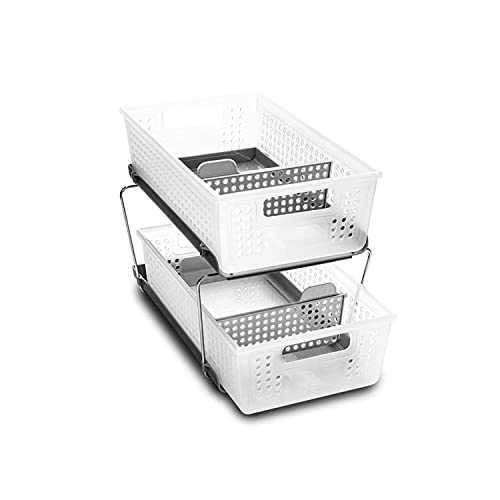
Sliding two-tier baskets and cabinet racks rescue the deep, dark spaces under sinks and inside cupboards, where products otherwise vanish behind plumbing. They suit weekly and backup products as much as daily ones. Best as the second half of a system: a modest counter piece for the daily routine, cabinet storage for everything else.
Every makeup organizer belongs to one of three broad formats, and the format matters more than the brand name on the box. Countertop organizers sit beside the mirror and keep the daily routine within arm’s reach; they are the easiest to use and the easiest to overfill. Drawer organizers either stack as clear drawers on the counter or drop into an existing vanity drawer, trading instant visibility for a calmer surface. Rotating organizers spin a full circle of compartments into a small footprint, which suits tall bottles and crowded corners. Most happy setups combine two formats: a countertop piece for the daily dozen products, and drawers or a cabinet piece for everything used weekly rather than daily.
Top Picks at a Glance
Five reference designs cover the types above. Badges here describe roles, not rankings, and every pick is presented in prose while verification is pending — compare the current listing against the criteria in this guide, especially measurements, before buying. The step-by-step method behind this shortlist is in how to choose a makeup organizer, step by step.
Sorbus Makeup Organizer — Best Overall Format
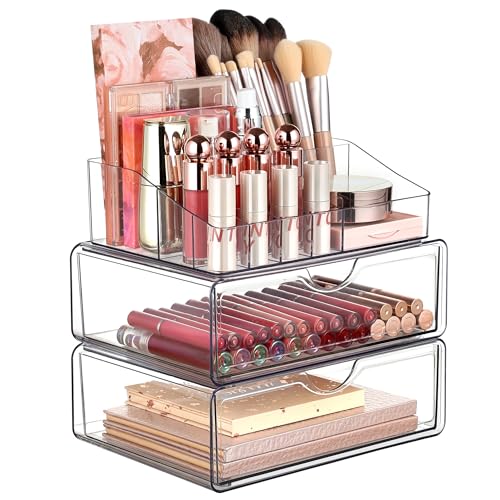
The Sorbus Makeup Organizer is a stacked clear-acrylic design with drawers below and open compartments on top. It sits in the mid tier, where the money goes on format and finish rather than badge. Best for a classic vanity setup that mixes drawers and open-top storage. Not suited for very small counters where its stacked footprint crowds the mirror. In the mini-reviews below it is judged against the same criteria as everything else in this guide, because a pick that cannot survive its own buying guide does not belong in one.

Vtopmart Makeup Organizer — Best for Upright Daily Essentials
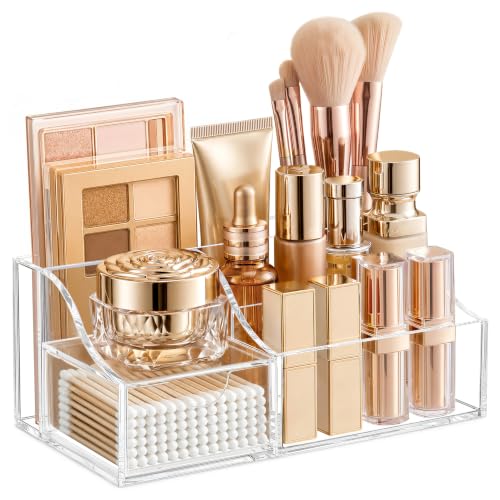
The Vtopmart Makeup Organizer is a countertop organizer that pairs drawers with upright slots for brushes and tall bottles. It sits in the entry tier, where the money goes on format and finish rather than badge. Best for everyday essentials that need to stand upright and stay visible. Not suited for large palette collections that need wide, flat storage. In the mini-reviews below it is judged against the same criteria as everything else in this guide, because a pick that cannot survive its own buying guide does not belong in one.

HBlife Makeup Organizer — Best Drawer-First Value
The HBlife Makeup Organizer is a clear acrylic cosmetic storage box built around several pull-out drawers. It sits in the entry tier, where the money goes on format and finish rather than badge. Best for drawer-first routines built on compacts, lipsticks, and small tubes. Not suited for tall skincare bottles, which belong in an open-top design instead. In the mini-reviews below it is judged against the same criteria as everything else in this guide, because a pick that cannot survive its own buying guide does not belong in one.

madesmart Two Tier Organizer — Best for Cabinets and Under-Sink Space
The madesmart Two Tier Organizer is a two-tier sliding-basket organizer that works on a vanity or inside a cabinet. It sits in the mid tier, where the money goes on format and finish rather than badge. Best for under-sink cabinets and deep shelves where things disappear at the back. Not suited for anyone who wants a display-style acrylic look on the counter. In the mini-reviews below it is judged against the same criteria as everything else in this guide, because a pick that cannot survive its own buying guide does not belong in one.
iDesign Cosmetic Organizer — Best Modular Starter
The iDesign Cosmetic Organizer is clear vanity trays and drawer pieces designed to be combined and rearranged. It sits in the mid tier, where the money goes on format and finish rather than badge. Best for growing collections, because pieces can be added and re-stacked over time. Not suited for anyone who wants one single finished unit with nothing to configure. In the mini-reviews below it is judged against the same criteria as everything else in this guide, because a pick that cannot survive its own buying guide does not belong in one.
How Much Capacity Do You Actually Need?
Capacity is where most buyers overspend. Audit the collection first: daily products on the counter, weekly products in drawers or a cabinet, occasion products in a labelled box elsewhere. Count the daily group and buy for that count plus about a fifth of slack. Beware capacity described by enthusiasm rather than by compartments you can name a job for. An organizer that is four-fifths full on day one is correctly sized; one that is half empty will either crowd the counter pointlessly or quietly invite you to buy makeup to fill it.
Start with an honest audit of what you actually own and use. Lay everything out and sort it into three groups: the daily routine you touch every morning, the weekly rotation for evenings and occasions, and the honest rarely-used pile. Only the first group earns counter space. The second group belongs in drawers or a cabinet organizer. The third group deserves a hard look — dried, duplicated, or long-expired products are not storage problems, they are clutter wearing a storage costume. People are routinely surprised to find their daily routine is a dozen products, which means a modest organizer, well chosen, beats a huge one bought to house products that should have left the house.
Measure before you fall in love with any design. Three numbers decide whether an organizer fits your life: the width and depth of the counter or drawer it will occupy, the height of your tallest daily bottle, and the width of your widest palette. Palettes are the usual deal-breaker — a drawer that swallows lipsticks beautifully may refuse a standard palette by a few millimetres. If the organizer is going inside a vanity drawer, measure the drawer’s interior, not its front panel, and leave a little clearance so the organizer lifts out for washing. If it is going under a sink, measure around the plumbing, because pipes steal more space than drawings suggest.
Which Format Fits Your Counter and Your Routine?
Let the room decide the shortlist. A clear patch of counter beside the mirror suits countertop and rotating designs; a spare drawer suits inserts; a deep corner suits a spinner; a steamy small bathroom with no counter to spare suits a lidded unit in the bedroom instead. Then let the collection refine it: palettes pull you toward shallow drawers, tall bottles toward tiers and spinners, brushes toward upright sections, and mixed skincare-plus-makeup routines toward designs with genuinely separate zones.
Countertop organizers live or die by footprint. The counter beside a bathroom sink is some of the most contested space in the home, shared with soap, toothbrushes, skincare, and the mirror itself. A countertop piece that is too wide will be resented daily, however clever its compartments. Measure the clear patch of counter you can genuinely give up, then choose a design that goes up rather than out: stacked drawers, tiered trays, and upright brush holders all store vertically. Open-top compartments suit the products you grab without looking — brushes, mascara, lip balm — while anything you use with wet hands belongs in a section that wipes clean in seconds.
Rotating organizers earn their keep in one specific situation: a deep or corner counter where products at the back would otherwise be forgotten. A turntable brings the back row to the front with a flick, and adjustable shelves on many spinning designs let tall bottles and short jars share the same tower. The trade-offs are real, though. A spinner needs clearance on every side, it can wobble if it is overloaded on one side, and small items like single lipsticks can topple when the tray turns quickly. If your routine is built on a handful of tall bottles, skincare, and brushes, rotating storage is genuinely convenient. If it is built on palettes and compacts, flat drawers serve you better.
Decide early whether skincare shares the organizer or lives separately. Skincare bottles are taller, heavier, and used with wet hands; makeup is smaller, drier, and more numerous. Together in one unit, the tall bottles dominate the top, the small makeup vanishes into drawers, and the whole thing can work beautifully — if the design has genuinely separate zones. Apart, each category gets storage shaped to it: a tiered or rotating piece for bottles, a drawer stack for makeup. The failed middle ground is a single open tray holding both, where bottles topple onto palettes and everything wears a film of moisturiser. Choose one strategy deliberately rather than drifting into the tray.
How Much Does Material and Care Matter?
More than the product pages admit. The organizer will be washed monthly for years, handled with wet hands daily, and exposed to steam, powder fallout, and the occasional falling bottle. Acrylic rewards gentle care; bamboo dislikes standing water; metal rinses fast; fabric linings stain and resist washing. Removable trays and smooth interiors are worth more than decorative texture, because residue builds in every crevice and harbours grime exactly where brushes rest.
Clear acrylic is the default material in this category for good reasons: it is light, it shows exactly what is inside, it wipes clean, and it suits almost any bathroom or bedroom decor. It does ask for a little respect in return. Acrylic can scratch if you scrub it with abrasive pads, and it can craze or crack if it meets harsh solvents or a hard knock on a tile floor. Clean it the gentle way: warm water, a drop of mild soap, a soft cloth, and no ammonia-based sprays. Treated that way, a decent acrylic organizer stays clear for years. Treated roughly, it clouds at the edges and develops the fine cracks that make it look tired long before it actually fails.
Beyond acrylic, each material brings a personality. Bamboo and wood look warm on a bedroom vanity and feel sturdy, but they dislike standing water and need drying after a wash. Metal frames and wire racks are tough, airy, and easy to rinse, though small items can slip through wide rails. Soft fabric and felt-lined trays are gentle on glass bottles and quiet on stone counters, but they stain and are the hardest to wash properly. Plastic organizers vary the most: the best are thick, smooth, and easy to clean, while the thinnest flex and crack at the corners. Match the material to the room first — steamy bathroom, dry bedroom, shared family space — and to how honestly you will maintain it.
Whatever format you choose, put washing on the calendar. Makeup residue is not inert dust: foundation smears, powder fallout, and the film from creams build up inside compartments and harbour everyday grime, and brushes rest their heads right in it. Empty the organizer fully, wash removable trays and drawers in warm soapy water, wipe fixed sections with a damp cloth, and let everything dry completely before products go back — a damp drawer is a miserable home for powder products. A quick wipe weekly and a proper wash monthly is a realistic rhythm for most people. The wash is also the perfect moment to spot products that have separated, dried out, or quietly passed their best.
What Makes Storage Hygienic Rather Than Just Tidy?
Tidy is visible; hygienic is structural. Look for drawers or lids where dust and steam are heavy, separate slots that keep your eye and lip products unmistakably yours rather than casually shared, brush storage that holds heads upright and apart, and a layout you can empty fully for the monthly wash. Add the opening-date habit — a small tape label on bases — and the organizer becomes an quiet expiry system as well as a storage system.
An organizer quietly improves hygiene in one more way: it makes sharing rules easy to keep. As a principle, eye and lip products should not be shared — mascara wands, eyeliners, lipsticks, and lip glosses go directly onto mucous membranes and lashes, and passing them between people passes whatever is on them too. When every product has its own slot, it is simple to keep a small guest set or a separate pouch for anything a partner, teenager, or visiting friend might borrow, and to keep your own eye and lip items unmistakably yours. The organizer does not enforce the rule, but a labelled home for everything makes the rule almost effortless to follow.
Use the organizer as an expiry checkpoint. Cosmetics do not last forever: mascaras dry and clump, cream products separate, sunscreens lose their reliability, and powders eventually pick up a hard, shiny pan that will not transfer colour properly. Most products carry a small open-jar symbol showing how many months they are intended to last after opening. You do not need a spreadsheet — a small piece of tape with the month and year you opened a product, stuck to its base, turns every tidy-up into an instant audit. When you wash the organizer, scan for tape dates that have run well past the symbol’s guidance and let those products go without regret.
Brushes deserve their own thinking. Stored upright in an open cup or slot, brushes keep their shape, dry properly after washing, and are easy to grab mid-routine. Stored loose in a drawer, bristles bend, heads pick up powder residue from neighbouring products, and you will rummage with damp hands every morning. If your organizer has an upright brush section, check that it is tall enough to support the handles without the heads splaying against a lid or shelf above. Face brushes and eye brushes ideally sit in separate slots, because the powder fallout from a big blush brush will happily migrate onto smaller, cleaner eye brushes sharing the same cup.
How to Prioritise by Use Case
The rushed minimalist should prioritise sequence and small footprint: a compact drawer stack or tray, daily products only, everything in routine order. The collector should prioritise shallow drawer capacity and palette safety, with skincare exiled to a separate tiered piece. The shared-bathroom household should prioritise zoning and lids — a level or column per person, washable materials, closed storage where children are curious. The renter in a small space should prioritise height over width and designs that can move rooms later, because the next home will have a different counter. Each profile is a different product, which is why this guide refuses to crown one winner — and why the balanced verdict in makeup organizer pros and cons, weighed plainly is worth reading before checkout.
Small spaces reward vertical thinking and punish sprawl. In a compact bathroom or a rented room with a sliver of counter, the winning designs are tall and narrow: stacked drawers, tiered trays, and rotating towers that use the air above the counter instead of the counter itself. Wall-mounted and over-door options move storage off the surface entirely, though they suit lighter items. The mistake to avoid is buying a wide, low tray because it looks neat in photographs; on a small counter it becomes a landing strip that eats the space where you actually put things down while getting ready.
Shared bathrooms add diplomacy to the design brief. When two or more people share one counter, an organizer per person — or clearly zoned sections in one larger unit — prevents the daily negotiation over whose products migrate where. Vertical designs help here too, because they give each person a level or a column rather than a contested patch of counter. In family bathrooms, keep daily adult products in closed drawers if small children are curious, and give children their own low, washable tray for their own things. The goal is a counter that resets itself: everything has a home, so the evening wipe-down takes a minute and nobody’s mascara ends up behind the taps.
The Picks in Detail
Returning to the shortlist with the criteria now in hand: the stacked acrylic design suits the broadest range of routines and rooms, and is the default recommendation when the audit is ambiguous. The upright countertop design serves brush-and-bottle routines best. The drawer-first box is the value route into clear drawers. The two-tier sliding design is the only pick here that truly solves cabinet depth. The modular clear pieces are the choice for collections still changing shape. Judge each by your measured footprint and your widest palette, not by the photographs, and pair the final choice with a mirror that lights the whole setup — see the companion makeup mirror review.
Adjustable dividers are the difference between an organizer that fits your collection and one your collection must fit. Fixed compartments assume everyone’s products are the same shapes; they never are. Look for drawer inserts you can slide, trays you can remove, and shelves you can raise or lower. A modular approach also future-proofs the purchase: when your routine changes — and routines change with seasons, jobs, and whims — the storage can be rearranged instead of replaced. The most flexible setups in this category are deliberately plain: a clear drawer stack plus a couple of loose trays will out-adapt any sculptural design with compartments moulded for products you do not own.
Dust is the countertop organizer’s slow enemy. Open trays and upright cups collect bathroom dust and powder fallout on every exposed surface, and products stored open wear a film of it within weeks. Drawers and lidded designs keep products cleaner between uses, which is one reason drawer stacks suit people who do a full routine only a few times a week: everything waits, clean, behind a clear front. Daily users who touch every product every morning can happily use open designs, because turnover itself keeps things fresh — but even then, the weekly wipe from the cleaning rhythm matters more than the format.
First Setup and Care Essentials
Set up in routine order on day one: skincare and base first in reach, eyes and lips central, brushes upright at the dominant-hand side, finishing supplies — pads, buds, remover — in their own washable zone. Wash removable trays before first use, and start the rhythm immediately: a weekly wipe, a monthly full wash, everything dried completely before products return. Put the organizer where the light from a wall mirror that suits a small vanity corner actually reaches into the compartments, and store overflow in storage baskets for the overflow a vanity cannot hold rather than letting it creep back across the counter.
The real test of any organizer is a rushed weekday morning. A good setup lets you run the whole routine in order without putting anything down on a wet counter: cleanser and skincare first, then base, then eyes, then lips, then tools back in their slots. Arrange compartments in the order you actually work, not in the order that photographs well. Keep the daily dozen at the front or on top, weekly products behind or below, and duplicates out of the organizer entirely. When the layout matches the routine, tidying up takes seconds, because every product has exactly one obvious home and your hands learn the map within a week.
An organizer does not live alone; it lives next to a mirror, under your bathroom or bedroom lighting. Place it where you can see into every compartment without leaning or lifting products out — a drawer stack slightly to your dominant-hand side, a rotating tower where the light falls across it, a tray where it does not block the mirror’s lower edge. If you are setting up a new vanity corner, the mirror and the organizer should be chosen together: the right mirror makes a modest organizer feel generous, and the best organizer is wasted in a dark corner where you cannot see the difference between two similar shades.
Mistakes to Avoid
Do not buy before auditing. Do not measure the drawer front instead of the interior. Do not choose open storage for powders in a steamy bathroom. Do not buy exactly to today’s count. Do not let a beautiful fixed-compartment design dictate a collection it was never shaped for. And do not skip the tape-the-footprint test: five minutes with painter’s tape on the counter prevents the most common disappointment in the category, which is a good organizer in the wrong-sized life.
The most common buying mistake in this category is purchasing storage for the collection you imagine rather than the one on your counter. Aspirational buying produces a beautiful, half-empty palace that crowds the sink, while the real routine still lives in a wash bag because the palace’s compartments are the wrong shapes. The second mistake is the opposite: buying exactly to today’s count, with no slack, so the first new palette has nowhere to go and the overflow restarts the chaos. Aim for an organizer that is comfortably full on day one — roughly four-fifths occupied — with one flexible space that can absorb the next few purchases.
Bathrooms are convenient and hostile in equal measure. Steam from showers raises humidity daily, and powder products, in particular, prefer dry air; a powder stored in constant steam can harden on the surface and stop performing. If your bathroom is small and steamy and your routine is powder-heavy, a bedroom vanity or a lidded organizer that closes against the damp is the kinder home. If the bathroom is your only option, choose materials that shrug off moisture — acrylic, coated metal, and washable plastics rather than untreated wood or fabric — and favour designs you can lift out and dry fully after the monthly wash.
More Practical Notes on Living With a Makeup Organizer
If you wear glasses or contact lenses, let the organizer respect that routine too. A flat, safe parking spot for glasses — on top of a drawer stack, or in a wide shallow drawer — prevents the daily countertop hazard of glasses meeting a falling bottle. Lens cases and solution belong with skincare rather than makeup, in a zone that stays dry and clean. These small adjacencies sound trivial, but an organizer succeeds precisely by absorbing the small adjacencies of your real morning, not by imposing a showroom routine on top of it.
Seasonality is real at the vanity. Summer routines lean lighter and more water-resistant; winter routines bring richer creams and deeper lip colours forward. A modular organizer lets you swap the top tray or the front drawer with the season and park the off-season products in a labelled box in a cupboard. This is another argument against one-piece designs with fixed compartments: the collection breathes across the year, and storage that cannot breathe with it ends up either half-empty or overflowing, depending on the month.
When an organizer starts to feel wrong, diagnose before you replace. If mornings feel slow, the layout order is probably wrong — re-sort by routine sequence. If products get dusty, you need lids or drawers, not more space. If things vanish, you need shallower layers or clearer material. If the counter feels crowded, the footprint is wrong, and going taller will fix what a wider replacement would worsen. Most organizer dissatisfaction is one of these four faults, and three of them can be fixed by rearranging what you already own.
Photographs flatter organizers; measurements do not lie. Before ordering anything you have admired online, tape its footprint onto your counter with painter’s tape and live with the outline for a day. Brush your teeth, wash your face, do a full routine inside the taped world. You will learn more from that day than from any product page: whether the elbows collide, whether the mirror still opens, whether the tap still clears. It takes five minutes to tape and saves the most common return in this category, which is not breakage — it is a good organizer in the wrong-sized life.
Finally, remember what the organizer is for. It is not a display cabinet and it is not a test of discipline. It exists so that the products you enjoy are visible, clean, protected, and quick to use, and so the counter returns to calm the moment you are done. Judge every design, every rearrangement, and every purchase by that standard alone, and you will make good decisions in this category almost automatically — including the decision, some years, to buy nothing at all because the current setup already does its job.
As a gift, a makeup organizer is safer than makeup itself, because it makes no guesses about shades or skin. It suits teenagers building a first routine, anyone moving into a new home, and anyone whose bathroom counter has become a shared battlefield. The safest gift format is a clear drawer stack or a two-tier design — neutral, useful in a bathroom or bedroom, and easy to expand later. Pair it with the honest advice from this guide: measure the space first, keep only the daily routine on the counter, and wash it monthly. A gift that comes with a system is worth far more than a bigger box.
An organizer is also a small sustainability decision. The greenest option is the one you keep for a decade, so durability and adaptability beat novelty: thick material, replaceable or removable trays, and a format that can move from bathroom to bedroom to a teenager’s desk as life changes. A cracked organizer usually cracks at a corner or a drawer front, which is why gentle cleaning matters — most early failures are care failures, not design failures. And an organizer that keeps products visible genuinely reduces waste: you stop buying duplicates of products you already own but could not find, and you use things up before they expire instead of rediscovering them a year too late.
Shared bathrooms add diplomacy to the design brief. When two or more people share one counter, an organizer per person — or clearly zoned sections in one larger unit — prevents the daily negotiation over whose products migrate where. Vertical designs help here too, because they give each person a level or a column rather than a contested patch of counter. In family bathrooms, keep daily adult products in closed drawers if small children are curious, and give children their own low, washable tray for their own things. The goal is a counter that resets itself: everything has a home, so the evening wipe-down takes a minute and nobody’s mascara ends up behind the taps.
Visibility is a feature, not an accident. Clear materials, open tops, and shallow layers all serve the same goal: you should be able to inventory your collection with your eyes, in ordinary room light, in about five seconds. If you have to lift three products to see a fourth, the organizer is storing your makeup from you, not for you. This is why deep opaque bins fail at vanities despite working fine in linen cupboards, and why the clear drawer stack became the category’s default shape. When you set up a new organizer, do the five-second test from where you actually stand to do your makeup, in the light you actually use.
Travel exposes what your home organizer gets right. If your daily products live in one removable tray or one drawer of a stack, packing becomes lifting that section into a case rather than gathering strays from three rooms. Some people keep a permanent travel pouch stocked with decanted basics beside the organizer and simply top it up. What does not travel well is a routine scattered across five unrelated containers. Even if you never leave home, organising by removable sections pays off at cleaning time: lift a tray out, wash it at the sink, dry it, drop it back. Fixed, one-piece sculptural designs are the hardest to wash and the first to be abandoned.
One underrated habit is the two-minute reset. Every evening, or every Sunday if evenings are fiction, spend two minutes returning strays to their slots, wiping the top surface, and pulling forward anything running low. Two minutes is short enough to survive tired days, and it prevents the slow drift that turns an organised vanity back into archaeology. The reset is also when you notice the small things: a brush that needs washing, a lipstick wandering toward the handbag it should live in, a product you have not touched in a month that can move to the weekly drawer and free prime space.
Labels sound fussy until a household shares a bathroom. A small label on a drawer front — face, eyes, lips, tools — ends the rummaging of partners and teenagers who would otherwise open everything. Labels also help a new organizer bed in: for the first fortnight you are learning the map, and labels carry you until your hands know it. Choose labels you can remove or rewrite, because the map will change as your routine does. Inside drawers, a strip of non-slip liner keeps small items from skating to the back every time the drawer opens, and it lifts out for washing.
Consider keeping a small ‘finishing’ zone within the organizer: cotton pads, cotton buds, a micellar water or remover, and tissues. Makeup removal and correction happen at the same mirror as application, and having the correction kit inside the system stops the drips and smears that otherwise migrate across the counter. Keep this zone washable and separate from powders, because remover is exactly the kind of liquid that finds its way into a powder pan if they share a tray. A lidded pot or a narrow upright section keeps pads clean and dry between uses.
If you wear glasses or contact lenses, let the organizer respect that routine too. A flat, safe parking spot for glasses — on top of a drawer stack, or in a wide shallow drawer — prevents the daily countertop hazard of glasses meeting a falling bottle. Lens cases and solution belong with skincare rather than makeup, in a zone that stays dry and clean. These small adjacencies sound trivial, but an organizer succeeds precisely by absorbing the small adjacencies of your real morning, not by imposing a showroom routine on top of it.
Seasonality is real at the vanity. Summer routines lean lighter and more water-resistant; winter routines bring richer creams and deeper lip colours forward. A modular organizer lets you swap the top tray or the front drawer with the season and park the off-season products in a labelled box in a cupboard. This is another argument against one-piece designs with fixed compartments: the collection breathes across the year, and storage that cannot breathe with it ends up either half-empty or overflowing, depending on the month.
When an organizer starts to feel wrong, diagnose before you replace. If mornings feel slow, the layout order is probably wrong — re-sort by routine sequence. If products get dusty, you need lids or drawers, not more space. If things vanish, you need shallower layers or clearer material. If the counter feels crowded, the footprint is wrong, and going taller will fix what a wider replacement would worsen. Most organizer dissatisfaction is one of these four faults, and three of them can be fixed by rearranging what you already own.
Photographs flatter organizers; measurements do not lie. Before ordering anything you have admired online, tape its footprint onto your counter with painter’s tape and live with the outline for a day. Brush your teeth, wash your face, do a full routine inside the taped world. You will learn more from that day than from any product page: whether the elbows collide, whether the mirror still opens, whether the tap still clears. It takes five minutes to tape and saves the most common return in this category, which is not breakage — it is a good organizer in the wrong-sized life.
A Pre-Purchase Measurement and Compatibility Audit for Your Makeup Organizer
Use this audit in the final ten minutes before you order a makeup organizer, because that is when most buying-guide advice stops being abstract and starts being a tape measure, a doorway and a return label you would rather not need. Write down three numbers for the makeup organizer you are considering: the footprint where it will sit or be stored, the largest dimension it reaches in normal use, and the clearance it needs so doors, drawers, lids, handles or moving parts can work without catching. Look at replacement parts and consumables for the makeup organizer while you are still comparing, confirming that the pieces most likely to wear, clog, tear, fade or get lost can actually be obtained without replacing the whole product. Read the manual’s warnings page for the makeup organizer even if you read nothing else, because that page is a compressed list of every way the product has ever been misused, and it tells you exactly which of your own habits needs adjusting.
Plan the storage home for the makeup organizer before it arrives, naming the exact cupboard, corner, shelf, hook or stretch of floor, because a product without a home migrates around the house and slowly becomes the clutter it was bought to reduce. Compatibility is the second audit, and for a makeup organizer it means checking what it must work alongside: the surfaces, fittings, power or water access, storage and other pieces already in your beauty & personal care setup that the new purchase has to cooperate with every day. Use a simple decision checklist at the end: the makeup organizer fits the measured space, suits the real frequency of the job, matches the household’s cleaning temperament, has obtainable parts, and has a named storage home — five yeses make a confident order. When something about the makeup organizer disappoints, change one variable at a time — position, setting, timing, load, accessory or technique — and give the change a fair trial, because changing three things at once leaves you with a better or worse result and no idea why.
Measure before anything else, and measure the makeup organizer in its working state rather than its packed or folded state, because handles extend, lids open, cords trail, doors swing and users stand somewhere, and all of that belongs in the measurement. For troubleshooting, start with the boring causes first: power, water, fit, blockage, alignment, a full container, a loose connection or a setting changed by the last person who used the makeup organizer, because boring causes account for most apparent failures. Then measure the route, not just the destination, since a makeup organizer that fits its final spot perfectly can still fail at a narrow hallway, a tight turn, a low doorway or a cupboard mouth that is smaller than the space behind it. Finally, remember that the best makeup organizer for your home is the one whose size, habits and upkeep disappear into your routine, leaving only the result behind — a cleaner surface, a better-lit seat, a tidier shelf, an easier job — week after ordinary week.
Frequently Asked Questions
What type of makeup organizer is best for beginners?
A small clear drawer stack is the most forgiving starting point: it keeps everything visible, protects products from dust and steam, and can grow by adding a second unit later. Beginners with tiny routines can start even simpler, with a single washable tray, and upgrade only when the tray genuinely overflows rather than when a bigger design catches their eye.
How do I know what size to buy?
Audit first, then measure three things: the available footprint, your tallest daily bottle, and your widest palette. Buy for the daily collection plus about a fifth of slack. Measure drawer interiors rather than fronts, and check under-sink spaces around the plumbing. If a design’s footprint is borderline, tape its outline on the counter and live with it for a day before ordering.
Are acrylic organizers durable?
Yes, with gentle care. Acrylic’s enemies are abrasive scrubbing pads, harsh solvent sprays, and hard knocks on tile, which can scratch, cloud, or crack it. Washed in warm water with mild soap and a soft cloth, and dried fully, a decent acrylic organizer stays clear for years. Treat it like the plastic it is rather than the glass it resembles and it will not disappoint you.
Should skincare and makeup share one organizer?
Only in a design with genuinely separate zones. Bottles are tall, heavy, and handled with wet hands; palettes and powders are flat, fragile, and dry. In one open tray they damage each other. In a tiered or divided unit — or in two dedicated pieces — they coexist happily. Large collections almost always do better with separate storage shaped to each category.
What features are worth paying more for?
Adjustable or removable components, thicker material, smooth drawers, and shelves that reposition — the features that let storage adapt as your routine changes. Beyond the mid tier, extra spending mostly buys finish and appearance: heavier materials, softer movement, furniture-grade looks. That can be worth it on a bedroom vanity you see all day, as long as you know the function saturated earlier.
How do I keep an organizer hygienic?
Choose washable designs, wipe weekly, and wash fully about once a month, drying everything completely before products return. Keep brushes upright with heads apart, store your own eye and lip products in their own slots so they are not shared, and label opening dates on bases so the monthly wash doubles as an expiry check for products past their intended life.
Related Guides and Next Steps
Keep building the same calm, washable system around the vanity with these companion guides from the same series and the wider site:
- how to choose a makeup organizer, step by step
- is a makeup organizer worth it — the honest value case
- makeup organizer pros and cons, weighed plainly
- the in-depth makeup organizer review
- makeup organizer reviews across the wider field
- the companion makeup mirror review
- the makeup mirror buying guide
- a wall mirror that suits a small vanity corner
- storage baskets for the overflow a vanity cannot hold
- nightstands with charging stations for a bedroom vanity setup
- square bathroom sinks when you are planning the counter itself