Disclosure: As an Amazon Associate, dailyhomedecorating.com earns from qualifying purchases. Links on this page are affiliate links; they cost you nothing extra. Prices and availability change often, so check the current Amazon listing before you buy.
A makeup mirror buying guide should do one job: turn a wall of similar-looking glass into a short, confident shortlist. This makeup mirror buying guide does it by type first, then by the questions that actually separate good mirrors from pretty ones — light, magnification, power, placement and build — and closes with the picks in prose while live listing verification is pending, so you can see exactly which format serves which routine before you spend anything.
Key Takeaways
- Choose the format from your space first: tabletop, wall-mounted, tri-fold or travel.
- Light quality — even, frontal, neutral — is the feature that most changes results.
- Magnification should be moderate, paired with a true-size view, and matched to your eyes.
- Rechargeable is the flexible default; corded suits a permanent vanity; hardwiring is an electrician’s job.
- Buy build quality in the moving parts: hinges, arms and bases decide how long the mirror delights.
In this guide
Makeup Mirror Buying Guide: What a Makeup Mirror Does and the Main Types
A makeup mirror exists to move the reflection to the work: closer than a bathroom mirror allows, better lit than most bathrooms manage, and angled to the person rather than the wall. That single job splinters into types because homes and routines differ, and each type below is a different answer to the question of where the reflection should live.
Tabletop and Double-Sided Mirrors
Within the tabletop family, the split that matters is single-sided versus double-sided. A single-sided mirror is usually larger, steadier and cheaper for its size, and it is the honest choice if you know you will never use magnification. A double-sided mirror flips between the true-size and magnified views and covers nearly every routine in one object, which is why it dominates dressing tables. Tri-folds are really a third answer to a different question — not how close, but from what angle — and they shine for hair, for profile checks and for anyone who has ever tried to see the back of their own head with a hand mirror in a bathroom doorway. Wall-mounted swing-arm mirrors answer a space question. Naming the question your routine is actually asking is most of choosing well.
Wall-Mounted and Swing-Arm Mirrors
The wall-mounted family trades flexibility for space. Fixed flat mirrors behave like better-placed bathroom mirrors; swing-arm designs are the interesting ones, floating the glass out over the counter to your face and folding back when the sink needs the room. They are the small bathroom’s best trick and the category’s only real installation project — studs or properly rated anchors, a checked swing arc, and an absolute rule against heavy glass over beds or pillow areas. Lighted wall models add wiring questions: plug-in versions are simple, hardwired versions belong to a licensed electrician on a protected circuit. Buyers with the wall for it gain a permanent, clutter-free station; renters and the drill-averse should admire this family from a distance and take the tabletop instead.
Tri-Fold Mirrors
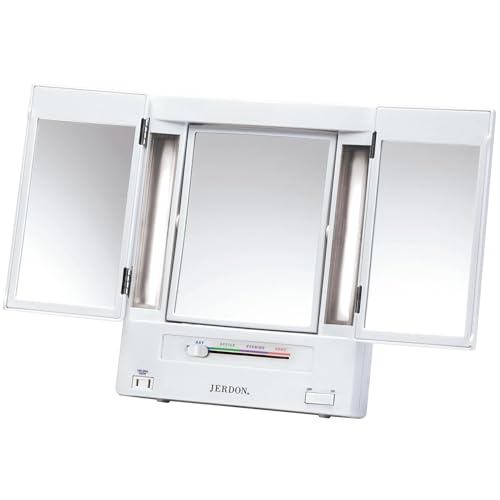
Tri-folds answer the angle question. Two hinged wings flank a central panel, opening to show the face front-on and in profile simultaneously, and folding flat for storage or travel between rooms. They are the hair stylist’s friend — partings, updos, earrings and the back of a style via a turn of the head — and the shared bathroom’s diplomat, since they vanish into a drawer when the next person needs the counter. The costs are footprint when open and dependence on hinge quality: wings that will not hold their angle are worse than no wings at all. If your routine is makeup only, a double-sided tabletop usually spends the same counter more efficiently; if hair shares the mirror’s working day, the tri-fold earns its width.
Lighted, Smart and Travel Mirrors
Lighted is less a type than a layer that any type can wear, and it is covered head-to-head elsewhere in this cluster; here, note only that built-in light matters most where room light is worst. Sensor and ‘smart’ designs add wake-on-approach convenience and app-adjacent polish at the premium tier — pleasant, genuinely useful for wet or product-covered hands, and never the reason to buy the mirror; the glass and light remain the product. Travel mirrors shrink the formula to a protected, folding case with modest magnification and battery or rechargeable light. They are judged by different rules — survival in luggage first, optical ambition second — and a good travel mirror plus a good home mirror beats one heroic mirror asked to do both jobs.
Top Picks at a Glance
Four formats cover nearly every routine. Badges here describe roles, not rankings, and the picks are presented in prose — check the current listing for live details before buying.

simplehuman Sensor Mirror
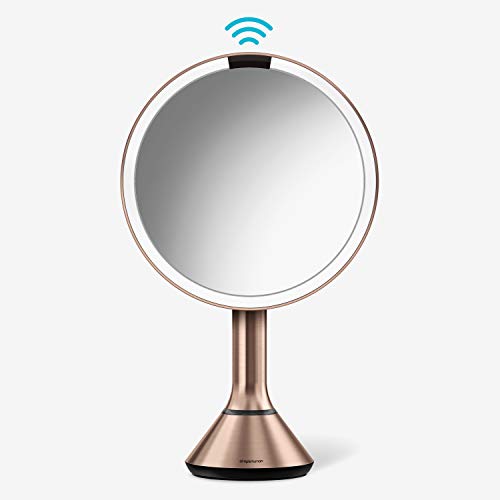
The simplehuman Sensor Mirror is a sensor-activated mirror from a design-focused home brand, built to light up as your face approaches and to mimic natural sunlight as closely as the brand can manage, in a brushed metal finish. Buy it as furniture-grade equipment, not as a gadget. The sensor convenience is real but secondary; the reason to spend at this tier is a reflection you can trust for colour decisions, in an object built to be looked at as much as looked into. It is the connoisseur’s answer, priced like one. Positioning: premium tier, priced by tier rather than by gimmick — check the current listing for the live figure. Best for: readers of this guide whose routine matches that shape. Not suited for: anyone whose space or habits contradict the format, however good the glass.

Conair Double-Sided Lighted Makeup Mirror
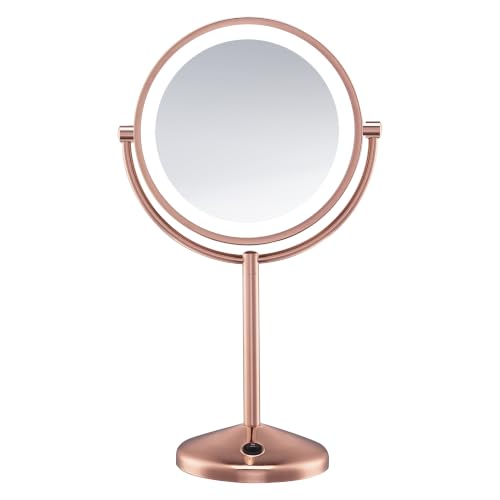
The Conair Double-Sided Lighted Makeup Mirror is a corded tabletop design from one of the longest-running names in personal care mirrors, built around a flip frame with a regular reflection on one side and a magnified view on the other, ringed by its own lighting. As a first mirror or a guest-bathroom extra, this is the sensible shape of purchase: a familiar format, a flip between the honest view and the magnified one, and light built in so a dim room stops being an excuse. Its corded nature suits a fixed spot beside an outlet. Positioning: entry-to-mid tier, priced by tier rather than by gimmick — check the current listing for the live figure. Best for: readers of this guide whose routine matches that shape. Not suited for: anyone whose space or habits contradict the format, however good the glass.
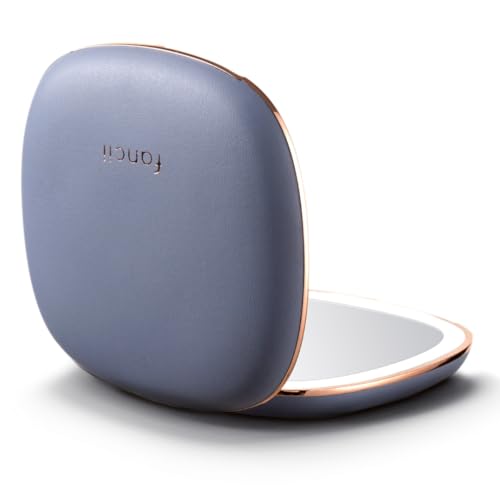
Fancii Mila LED Lighted Vanity Mirror
The Fancii Mila LED Lighted Vanity Mirror is a rechargeable LED vanity mirror from a beauty-tools brand known for portable, design-led mirrors, with touch controls and a clean, cord-free silhouette once charged. The appeal here is freedom from the cord. Charged, it goes wherever the light and the chair are best — a bedroom desk, a bathroom with no spare outlet, a suitcase. Touch controls keep the face of the mirror clean, and the design-led styling means it does not have to hide when guests use the bathroom. Positioning: mid tier, priced by tier rather than by gimmick — check the current listing for the live figure. Best for: readers of this guide whose routine matches that shape. Not suited for: anyone whose space or habits contradict the format, however good the glass.
KEDSUM Trifold Lighted Makeup Mirror
The KEDSUM Trifold Lighted Makeup Mirror is a folding three-panel lighted mirror that opens out to show your face and both profiles at once, then closes flat enough for a drawer, popular with shared bathrooms and smaller vanities. As a first lighted mirror it teaches good habits cheaply: check the front, check the sides, fold away. The centre panel does the daily work while the wings handle hair and profile days. Judge examples on hinge stiffness — the panels must hold the angle you set, not drift. Positioning: entry tier, priced by tier rather than by gimmick — check the current listing for the live figure. Best for: readers of this guide whose routine matches that shape. Not suited for: anyone whose space or habits contradict the format, however good the glass.
How Much Magnification Do You Need?
Think of magnification as a tool for moments, not for the whole routine. The magnified side earns its keep for the thirty seconds of tweezing, the eyeliner wing, the contact lens, the close shave along a jawline. For everything else — blending, contour, checking that both sides of your face agree — the regular reflection is the honest judge. Mirrors that pair both views in one frame, whether double-sided or tri-fold, respect that rhythm: detail, flip, verify. Problems start when a strongly magnified mirror is the only mirror in the room, because a face judged entirely at close range tends to get over-worked: too much product, too much plucking, colours chosen for a face nobody else will ever see that close. Choose the pairing first and the strength second, and treat the strongest options as specialist instruments for low vision or precision work rather than everyday defaults.
What Light Should You Look For?
The best makeup light imitates an overcast morning: bright, diffuse and coming from in front of you rather than above you. That is why ring-style and edge-lit designs exist — they put the light where the mirror is, so the face in the glass is the face that is lit. Bare, exposed bulbs at the sides can work beautifully too, in the classic dressing-room style, as long as they sit at face height and are shielded enough not to glare. Glare is the failure mode to avoid: a light you cannot look toward comfortably will push you to tilt your head, and a tilted head applies lopsided makeup. If a mirror offers more than one colour setting, treat the neutral daylight setting as home base and the others as previews — warm for evening venues, cooler for office light — rather than as your main working light.
Corded, Battery or Rechargeable?
Power is a quiet lifestyle decision disguised as a specification. Corded mirrors never run flat and suit a permanent vanity with an outlet nearby, but the cord must be routed where it cannot trail through sink water or across a wet counter, and it sets a limit on where the mirror can live. Battery mirrors free the placement completely and are the travellers’ friend, at the cost of batteries that fade at the worst moments and light that dims as they weaken. Rechargeable mirrors split the difference — cord-free day to day, topped up occasionally — and suit most modern routines best, provided you build the small habit of charging before the mirror is fully flat. Whichever you choose, keep cords and chargers dry, out of the sink basin and away from splashes, as a matter of unthinking routine.
How Big, and Mounted How?
Placement decides whether a good mirror feels good. The centre of the mirror should sit near eye level in the position you actually use it — seated at a vanity or standing at a sink — because a mirror you stoop or stretch toward will tilt your head and skew everything you apply. Light should fall on your face, not on the mirror: a window to the side is lovely, a window behind you turns you into a silhouette, and a bright window behind the mirror is fine because the glass simply borrows it. Leave working room in front of the mirror for brushes, bottles and elbows, and think about the second user if the space is shared. A mirror placed for a tall partner and used daily by a shorter one is a daily small frustration that an adjustable or tilting design quietly solves.
Wall-mounted mirrors ask for respect at installation, because glass plus gravity is unforgiving. The fixings must land in wall studs wherever possible; where a stud is not available, use proper wall anchors that are rated for the mirror’s weight and suitable for your wall material, and follow the anchor’s own instructions rather than improvising. A swing-arm mirror multiplies the load when it is extended, so the mount deserves more care, not less, than the mirror’s static weight suggests. Two placement rules are absolute. First, never hang a heavy glass mirror over a bed, a pillow area or anywhere a person sleeps or reclines beneath it. Second, check the mount periodically — a thirty-second wiggle test every few months catches loosening long before it becomes a fall. Done properly, a wall mirror is a decades-long fixture; done casually, it is the riskiest object in the bathroom.
How to Prioritise by Use Case
The precision routine. Magnification quality and glass clarity first, light second, everything else third; a specialist double-sided tabletop is your shape. The dim-bathroom routine. Light first — even, neutral, dimmable — with format chosen by whether you may drill; rechargeable tabletop if not, wall-mounted if you can. The hair-and-makeup routine. Angles first: a tri-fold with hinges that hold, sized by measuring its opened width against your counter. The shared, small-space routine. Footprint first: folding or wall-mounted, moderate magnification both partners can use, and a position that resets cleanly between people. Notice that no profile starts with finish or brand — those are tiebreakers between finalists that already fit, and using them earlier is how the wrong mirror wins.
The Picks in Detail

Zadro Dual Sided Vanity Mirror
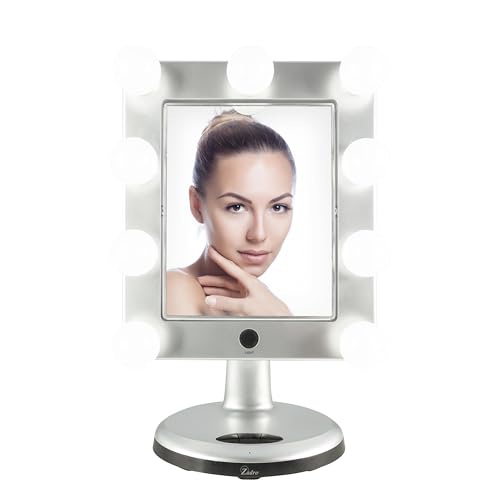
The Zadro Dual Sided Vanity Mirror is a dual-sided vanity mirror from a brand that has specialised in magnification mirrors for decades, typically finished in polished metal tones and aimed at a permanent dressing-table spot rather than travel. Consider it the specialist’s tabletop. If your routine is brow-heavy, liner-heavy or lens-heavy, a mirror from a magnification specialist is a rational place to spend the mid-tier money, provided the room’s light or its own illumination keeps the enlarged view honest. Positioning: mid tier, priced by tier rather than by gimmick — check the current listing for the live figure. Best for: readers of this guide whose routine matches that shape. Not suited for: anyone whose space or habits contradict the format, however good the glass.

Jerdon Tri-Fold Two-Sided Lighted Makeup Mirror
The Jerdon Tri-Fold Two-Sided Lighted Makeup Mirror is a corded tri-fold mirror from a long-established mirror maker, with side panels for angled views and magnification in the centre panel, designed to live on a dressing table full time. A corded tri-fold is the dressing-table traditionalist: always ready, never flat, with side views and a magnified centre for the full routine in one station. It suits a permanent setup where the mirror never travels and the routine is unhurried — hair, makeup and final profile check at one seat. Positioning: mid tier, priced by tier rather than by gimmick — check the current listing for the live figure. Best for: readers of this guide whose routine matches that shape. Not suited for: anyone whose space or habits contradict the format, however good the glass.
Read those two against the four at a glance and the pattern should be clear: every pick is a format decision wearing a brand name. The Conair-style corded tabletop is the dependable default station. The Zadro-style specialist serves magnification-led routines. The Fancii-style rechargeable goes where outlets and permission are lacking. The simplehuman-style premium buys light quality and sensor ease for daily, colour-critical work. The KEDSUM-style tri-fold is the entry door to angled views and fold-away storage, and the Jerdon-style corded tri-fold is the same idea as permanent furniture. Choose the row of that table that matches your use-case profile above, then compare models inside the row on glass, hinges and light — in that order.
First Setup and Care Essentials
Lighted mirrors add two small habits. Keep charging ports and battery compartments dry, and never clean a plugged-in mirror with a wet cloth around its cord or switch. If the light ever flickers, buzzes or behaves oddly, unplug first and investigate second — and for a hardwired model, that investigation belongs to an electrician, not to curiosity. Finishes deserve the same gentleness as glass: plated and brushed metals cloud under abrasive pads, and a soft cloth keeps them honest. None of this is burdensome; it is the small effort that separates a mirror that still delights in year five from one that quietly became bathroom clutter.
Setup deserves its own sentence in a buying guide because so many returns are placement errors in disguise: set the mirror at eye level from your real seat, give its light a first session at the hour you actually get ready, and run one full routine — including the plain-view check and a glance at a window — before deciding it is wrong for you. Installation for wall models follows the full method in how to install a makeup mirror safely, and the choosing logic behind this guide is expanded in how to choose a makeup mirror.
Mistakes to Avoid
Avoid buying the strongest magnification on the shelf, judging light from a product photograph, and measuring the mirror instead of the space it must live in. Avoid adhesive mounts for anything with real weight, cords routed anywhere near sink water, and hardwiring ambitions that belong to an electrician. Avoid, finally, the premium tier as a first purchase: the mid tier teaches you your own preferences — your working distance, your light taste, your format — and a second mirror bought with that knowledge is a pleasure, while a first mirror bought at the top of the market is a gamble with the stakes raised.
Foundation matching is the highest-stakes judgement a mirror hosts, and it is a judgement about undertone as much as depth. The reliable method: apply candidate shades in stripes along the jaw, let them settle for a few minutes while the product oxidises slightly, then judge in the most neutral light available — the mirror’s daylight-leaning setting, or a step to the window. The shade that disappears against both face and neck is the match; a shade judged only on the face will betray you at the jawline in daylight. A mirror with a colour cast of its own corrupts this test silently, which is why the white-card check at unboxing matters. Blush and bronzer submit to the same discipline: quantity judged at life size, placement judged in profile where possible, enthusiasm restrained by the knowledge that close views exaggerate everything.
The mirror’s neighbourhood decides whether the station works. Crowded counters push products into the mirror’s swing, tilt and light; a mirror hemmed in by bottles gets its glass splashed, its base knocked and its owner quietly annoyed. Give the station a border — a tray that defines the working set, storage behind or beside for the reserves — and the mirror’s sightlines stay clean. Vertical thinking helps small spaces: the wall above a vanity can hold the mirror while the surface holds only today’s tools. Cable discipline belongs to the same paragraph: a cord with a planned, dry route looks intentional and stays safe, while a cord improvised daily across a wet counter is an accident rehearsing. Organisation is not tidiness for its own sake; it is what lets the optical instrument do its job unobstructed.
Travel exposes what a home mirror quietly provides: light that exists, at a height that works, in a room you control. Hotel bathrooms offer none of these reliably, which is why frequent travellers develop mirror opinions out of proportion to the object’s size. A folding travel mirror with its own light and moderate magnification is insurance against the worst-lit bathroom in the itinerary, and it earns its luggage space on business trips and event travel where the face is part of the work. At home, the same folding design often becomes the second mirror — the guest room’s, the teenager’s, the one that lives in a drawer. Judged as insurance rather than equipment, travel mirrors should be bought for protection and battery manners first and optical ambition second.
Shape is partly taste and partly optics. Round and oval mirrors soften a room and centre the face pleasingly, which is why they dominate dressing tables; their working area concentrates in the middle, so a round mirror needs a little more diameter than a rectangular one to give the same usable width at the edges. Rectangular mirrors maximise usable area for their footprint and suit shared use and hair work, where width at the edges is real working space. Frameless designs disappear into modern rooms and clean easily; framed designs protect the glass edges — the most vulnerable part of any mirror — and carry the room’s style. There is no optical champion here, only honest trade-offs between area, protection and looks, and the right answer is the one whose compromises you will never notice because they match your habits.
Specifications, Translated
The category’s vocabulary, in plain terms. Magnification describes how much larger the close view makes things, with the standing warning that stronger means a smaller visible area and a shorter working distance. Colour temperature describes whether light leans warm like evening lamplight or neutral like an overcast morning; neutral is the working choice. Dimmable means the light can be lowered as well as raised, which protects both early-morning eyes and colour judgement. Sensor means the mirror wakes as you approach — convenience, not optics. Sealed edges mean the glass is protected against the bathroom’s steam at its most vulnerable point. None of these terms requires numbers to be useful, and a listing that explains them in plain outcomes — what you will see, at what distance, in what light — is generally a listing written by people who expect the mirror to be used rather than merely unboxed.
Buying for a Household, Not a Person
Single-user logic buys the sharpest tool; household logic buys the most negotiable one. Where several people will use the mirror, tilt range outranks almost everything, moderate magnification outranks strong, and a finish that tolerates everyone’s cleaning habits outranks a delicate showpiece. Teenagers joining the routine argue for sturdiness and against the household’s most precious glass taking up residence in the busiest bathroom. Guests argue for one simple, legible mirror that needs no instructions — the flip design explains itself, the sensor design delights, the twelve-mode design bewilders. None of this dilutes the main purchase; it simply asks who else the mirror will serve, and prices that service in at the buying stage rather than discovering it at the first argument.
Picture instead the slow Saturday version: nowhere to be until evening, hair to do properly, the full routine with time to enjoy it. This morning asks different things — angles for the hair, patience for the detail, light that stays pleasant company for an hour. The tri-folds and generous tabletops come into their own here, and the small compromises of footprint stop mattering because time has replaced space as the abundant resource. A household’s mirror must serve both mornings, which is why versatility — the flip, the fold, the dimmer — keeps beating specialisation in real homes, and why reviews that judge only the Saturday mirror or only the weekday mirror each miss half the truth.
Picture the shared-bathroom negotiation at its most honest: two people, one sink, overlapping mornings, different heights, different eyes, one mirror. The designs that survive this negotiation are the adjustable, the resettable and the forgiving — tilt that serves both heights, magnification moderate enough for both pairs of eyes, a position that returns to neutral between users. The designs that fail it are the precious and the fixed. If your household is this picture, let it outrank every other scenario in this article when you choose, because a mirror that starts two arguments a week is expensive at any tier, and a mirror that ends them is cheap at almost any.
Artists also maintain their tools like instruments, and the mirror is first among them: glass cleaned before work, not after complaints; hinges and arms checked as part of setup; a failing light treated as a stopped job rather than a nuisance to work around. The home translation is modest — a cloth that lives at the station, a weekly wipe, a charge topped up on a schedule rather than on a crisis — but the mindset is the transferable part. A mirror treated as an instrument returns instrument-grade reliability; a mirror treated as bathroom clutter returns clutter-grade surprises, usually at the least convenient hour of the week.
Video calls deserve their own sentence, because they have quietly become a daily mirror of their own — and a badly lit one, usually from below or above at a laptop’s convenience. Many people now keep the vanity mirror’s habits for calls: face lit frontally, camera near eye level, the plain view’s honesty applied to what colleagues will see. A lighted mirror near a desk earns a second career here, and more than one household has discovered that the makeup mirror bought for mornings is, by afternoon, the best-lit seat in the house for being seen. Tools that serve two rituals justify their footprint twice over.
Small ergonomic details compound. A mirror that tilts with one finger gets adjusted; a mirror that needs two hands and a wrestle stays at yesterday’s angle and quietly mis-serves today’s user. A base that yields counter edge for forearms to rest on steadies the whole upper body. Light controls reachable without breaking position — a touch surface, a dial at the frame’s edge — keep the working posture intact through adjustments. Even the chair participates: a stool that swivels lets the window check happen without standing, and a seat at the height that puts the mirror’s centre at eye level is worth more than any single feature on the mirror itself. Ergonomics is the category’s least marketed virtue and its most felt one, morning after morning.
Longevity, in the end, is mostly a biography of small handlings. The mirror set down gently ten thousand times outlives the mirror knocked ten times. The glass wiped with the right cloth keeps its clarity; the glass scoured in frustration clouds by degrees so slow the owner blames their eyes. Even the humble act of closing a folding mirror at night protects its faces from the bathroom’s drifting dust and spray. None of this requires virtue, only the recognition that a mirror’s lifespan is decided less by its purchase price than by the thousand unremarkable interactions that follow — which is, when you think about it, an encouraging specification, because it is the one entirely in the owner’s control.
The Shortlist Method
Convert this guide into action with a deliberately brutal method. Write your specification in one line — format, pairing, light need, power plan, space limit. Strike every product that fails any element of that line, without grief and without exceptions for beauty. From the survivors, compare exactly three things: the glass test results as reported by careful reviewers, the honesty of the light as described in outcomes rather than figures, and the feel of the moving parts as described by owners months in, not days. Buy the survivor that wins two of the three. The method feels reductive because it is, and that is its virtue: it prevents the category’s infinite middle from paralysing a decision that should take an evening. A mirror chosen this way is rarely the most exciting candidate — it is, far more reliably, the right one.
Sequence matters at the mirror. Skincare first, while the plain view judges hydration and redness honestly. Base next, still on the plain side, because quantity decisions belong to the life-size view. Detail after — eyes, brows, lips — on the magnified side, in passes, with flips between. Powder and setting last, judged at arm’s length, because that is the distance the day will see. A mirror that supports this sequence with an easy flip and honest light is doing quiet choreography work. A mirror that fights it — stiff hinge, warm-only light, a base that wanders — adds seconds of friction to every transition, and friction at transitions is where routines quietly fall apart.
Where a mirror fogs mid-routine, resist the hand-wipe: it smears oils across the glass and the smear outlasts the fog. A hairdryer’s warm air at a distance, or simply waiting with the door open, clears the surface cleanly. Anti-fog designs exist at the bathroom-mirror end of the market and heated, hardwired versions belong to the electrician-installed family, but for vanity mirrors the practical answer is sequencing — shower first, makeup after the room exhales — and a soft cloth for the final polish. Treat steam as weather: you do not fight it, you dress the mirror for it and schedule around it.
Children and teenagers enter the picture too, usually at the stage of first routines — skincare, braces checks, early makeup experiments. A household mirror at a sensible height with moderate magnification serves those years gracefully, and the safety rules scale with it: stable bases over tippy stands, mounts checked as part of household routine, and nothing heavy hung where anyone sleeps beneath it. The mirror that serves a household rather than a person should be bought a size up in sturdiness and a step down in specialisation, because its users will span more heights, eyes and habits than any single routine predicts.
Evenings invert the problem. Makeup applied in bright bathroom light for a dim venue will read stronger than intended under candlelight and restaurant warmth, while makeup applied in cosy lamplight may vanish under street lighting on the way. The mirror cannot solve the venue, but a colour-setting preview — apply in neutral, glance in warm — narrows the surprise. This is a small discipline with an outsized effect on photographs, which are, in the end, where most makeup is ultimately judged by its wearer.
A word about timing the purchase. This category rewards patience in two directions. First, buy after you have lived with the room: a month of mornings in a new home teaches its light, its outlets and its bottlenecks in a way no viewing-day impression can, and mirrors bought for imagined rooms are the category’s most-returned. Second, when a model is chosen, there is little reason to wait for a revolution — the category is mature, its improvements incremental, and a season spent with a good mirror outweighs a marginal future refinement. The exception is the renovation horizon: if the bathroom itself is about to change, let the mirror be the last purchase, fitted to the finished room rather than inherited by it. Bought in that order — room understood, specification written, shortlist struck, mirror last — the purchase tends to happen exactly once, which is the cheapest way any category can be bought.
Do not overlook the returns window as part of the purchase. In a category where fit is personal and light is room-specific, the ability to test a mirror across real mornings and send it back is a feature as real as any hinge — buy from sellers whose terms honour that, keep every part of the packaging until the verdict mornings are done, and treat the trial as part of the product you paid for. A mirror that cannot be trialled at home must be judged in the shop, where its light will lie to you under showroom brightness; a mirror that can be trialled can be judged at your own sink, at dawn, which is the only courtroom whose verdict matters.
The guide’s last word is about confidence. Readers sometimes finish a buying guide more anxious than they started, armed with twelve criteria and no hierarchy among them. So here is the hierarchy, one final time, in the order the evidence supports: the format your space dictates, the light your room lacks, the magnification your eyes need, the build your decade deserves, and the looks your room enjoys — in that order, and never reversed. Follow it and the specific model almost chooses itself; reverse it and no guide, however long, can save the purchase.
Seasoned buyers in this category share one habit worth copying: they decide the return question before the product question. Knowing in advance what would make you send a mirror back — a hinge that drifts, a light that flatters, a footprint that crowds — converts the trial mornings from vague impressions into a checklist with a verdict attached. Write those three deal-breakers down when you order, test exactly them on mornings one to three, and let the written list, not the mood of a particular dawn, decide. It is a small discipline, but it is the difference between a trial and a hope.
Keep the receipt, the packaging and the specification together until the trial mornings are complete — a small administrative trio that makes every outcome easy: keeping the mirror is filing them away, returning it is painless, and either way the decision was made by mornings rather than by mood.
Measuring, Matching and Checking: The Makeup Mirror Decision Worksheet
Most of the groundwork for choosing a makeup mirror is covered above, so this section turns to the stage where orders are actually placed: verifying fit, reading listings critically and checking the practical details that photographs tend to hide. Work through it with your measurements and your shortlist in front of you.
Start With Your Space and Your Routine
Look for the detail photographs in the listing, not just the wide shots, and zoom in on edges, joints, fasteners, controls and finishes, which is where build quality usually shows itself first. If the listing offers accessories for the makeup mirror, decide which ones solve a problem you already have, and set aside the ones that only solve problems the listing itself invented. A return is easiest when you have kept the packaging until you are sure, so give the makeup mirror a fair trial period in its real position before you break down boxes and dispose of padding. Decide in advance which single feature you would refuse to compromise on, and let that one priority settle ties between otherwise similar makeup mirror choices.
If a makeup mirror comes in several sizes or configurations, choose by the measured demands of your space and household rather than by the middle option, which is a common default that suits nobody in particular. Colour and finish samples in listings are taken under controlled light, so expect the makeup mirror to look different at home and favour options that sit comfortably with the tones already in the room. Apply the same checks to each shortlisted example, whether that is the Zadro Dual Sided Vanity Mirror; the Conair Double-Sided Lighted Makeup Mirror; the KEDSUM Trifold Lighted Makeup Mirror, because consistent testing is what makes the differences between models visible. Do not let a single impressive feature distract you from a basic mismatch in size, capacity or care needs, since basics decide satisfaction long after features stop being novel.
Storage is part of ownership, so decide now where the makeup mirror, its accessories and its seasonal extras will go when they are not in use, and measure that space too. A slight wobble, a stiff action or a small misalignment on day one rarely improves on its own, so address it during setup while adjustments are still easy to make. If the makeup mirror will be seen every day, its proportions matter as much as its function, so hold the listing dimensions up against a familiar piece nearby to judge the visual weight honestly. Take a break between shortlisting and ordering if you can, and return to the listings with fresh eyes, because fatigue makes almost any makeup mirror look acceptable late in a long search.
When Small Problems Appear
Where the makeup mirror has moving parts, work them through their full range during your first checks, listening and feeling for roughness that a photograph cannot show. When specifications are given for the makeup mirror, compare like with like across listings, since sellers measure and describe the same things differently and headline numbers are rarely the whole story. Consider the busiest version of the day, not the calmest one, and ask whether the makeup mirror still works when people are hurrying, carrying things or sharing the same space. Recheck any adjustable part of the makeup mirror after the first week of use, once materials have settled and the household has stopped being careful with it.
Set the assembled makeup mirror up fully before deciding it is wrong for the space, since partly built or badly positioned pieces often look worse than they will once finished and levelled. Ask how the makeup mirror will be cleaned on an ordinary week, with the products and time you actually have, not with a special routine you are unlikely to keep up. If a part of the makeup mirror can be replaced, refreshed or re-covered separately, that option can extend its useful life well beyond the point where a sealed design would be thrown out. Keep the care routine simple enough to repeat: a makeup mirror that needs ten minutes of attention weekly will usually get it, while one that needs an hour monthly often gets none.
Check the dimensions given in the listing against your own measurements rather than relying on the room name in a photograph, since staged photos routinely make Beauty & Personal Care pieces look smaller than they are. Build your shortlist in two passes: first remove every makeup mirror that fails a hard requirement such as size, capacity or placement, then compare what remains on quality and feel rather than on features alone.
A Short Decision Checklist
- Packaging kept until the makeup mirror has passed its first trial in place
- The main job the makeup mirror must do, written in one sentence
- What your current arrangement does badly that the makeup mirror must fix
- The measured space, including clearance to use and clean around the makeup mirror
- How the makeup mirror will be cleaned in an ordinary week
- The one feature you will not compromise on
- Where the makeup mirror and its accessories will be stored when not in use
- Delivery path, from the door to the final position
Taken together, these checks take only a little time, yet they answer the questions that decide whether the makeup mirror suits your home, your household and your routine, and they do so before money changes hands rather than after.
Frequently Asked Questions
What colour light is best for applying makeup?
The most neutral, daylight-like light you can get, because it is the light your face will be judged in most often. Warm light is flattering and forgiving — pleasant, but it hides undertone mistakes and encourages heavier application. Very cool light is honest to the point of cruelty and can make healthy skin look sallow. Neutral is the working referee. If a mirror offers several colour settings, make neutral your home base and use the warm and cool settings as previews of evening venues and office lighting, not as your primary judgement light.
Should a makeup mirror be corded, battery or rechargeable?
Match the power to the placement. Corded suits a permanent vanity with a nearby outlet and never runs flat, but the cord must be routed dry and clear of the sink. Battery models go anywhere and travel well, with light that fades as the cells weaken. Rechargeable designs are the modern default for most homes: cord-free in daily use, topped up occasionally, and happy on a desk or in a bathroom with no spare outlet. There is no wrong answer, only mismatches — a corded mirror with no outlet nearby is a return waiting to happen.
How do I stop magnified makeup from looking overdone in real life?
Build the flip into your rhythm. Apply each element on the magnified side, then immediately check it on the plain side or at arm’s length, and judge blending, colour strength and symmetry only in the true-size view. Magnification shows texture honestly but exaggerates quantity — everything looks like more up close. If a step looks perfect magnified, it is probably slightly too much. The plain view is where ‘enough’ lives, and stepping back to room distance for the final check keeps the face you present matched to the face you made.
Are tri-fold mirrors worth the extra counter space?
If hair is part of your routine, yes; if it is makeup alone, they are a luxury rather than a need. The side panels show profiles, partings, earrings and the back of a style — views a single mirror simply cannot give you — and they fold away to a slim slab when closed. Measure the opened width against your counter before buying, since a tri-fold at full stretch is wider than people expect. For a pure makeup routine at a small vanity, a double-sided tabletop usually spends the same space more efficiently.
Do I need magnification if I wear glasses?
Quite possibly — glasses are exactly why many people discover magnified mirrors. Eye makeup requires removing the glasses, and without them the plain mirror may sit outside your clear focus range. A magnified side brings the detail back into reach. Choose the strength by sitting at your real vanity distance and testing, not by ordering the strongest available: too much magnification shrinks the visible area and shortens the working distance uncomfortably. Pair it with strong, even light, since light and magnification solve the same problem together better than either does alone.
Can a lighted mirror replace good bathroom lighting?
It can compensate for it, which for renters and old bathrooms amounts to nearly the same thing. A lighted mirror puts even, frontal light exactly where makeup decisions happen, bypassing the overhead shadows that make ordinary bathroom lighting so treacherous. It will not light the whole room for cleaning or bathing, and it should not be asked to. Think of it as task lighting for your face. If you are renovating anyway, plan both: decent general light plus a mirror whose own light you control. Until then, the mirror is the cheaper renovation.