Disclosure: As an Amazon Associate, dailyhomedecorating.com earns from qualifying purchases. Links on this page are affiliate links; they cost you nothing extra. Prices and availability change often, so check the current Amazon listing before you buy.
Knowing how to choose a makeup mirror is really knowing how to answer four questions in the right order: where will you use it, how close do you need to see, what light do you actually have, and how will it be powered and kept safe. This how to choose a makeup mirror guide walks those questions as steps, because shoppers who start with products instead of questions reliably buy the wrong mirror twice — once on impulse, once on correction. By the end you will have a personal specification, a shortlist logic, and a clear sense of which features deserve your money and which are decoration.
Key Takeaways
- The deciding criteria, in order: placement, magnification pairing, light quality, power, then build.
- Always pair a magnified view with a true-size view; never let magnification be your only mirror.
- Judge light by evenness and neutral colour, not by brightness claims.
- Wall mounting is a safety project — studs or rated anchors, and never heavy glass over a bed.
- A mirror matched to your actual routine beats a premium mirror matched to someone else’s.
In this guide
How To Choose A Makeup Mirror: What You Need to Know Before Comparing
A makeup mirror is a small optical instrument that happens to live on furniture, and choosing one well starts with understanding what it must do. It must show your face at the distance you naturally work, in light that tells the truth, at an angle your neck can sustain for the length of your routine. Everything else — finish, brand, clever features — is secondary to those three jobs. Shoppers get into trouble by treating the mirror as decor first: the beautiful object that is too low, too dim or too strong becomes the daily irritant, while the plain object at the right height with honest light disappears into the routine, which is exactly what good tools do.
Makeup mirrors sort into a handful of families. Tabletop mirrors sit on a stand or base and suit a dedicated vanity or dressing table; they are the easiest to angle and the easiest to move. Handheld and compact mirrors trade size for portability and live in bags and drawers. Wall-mounted mirrors free the counter entirely and often swing out on an arm, which makes them naturals for small bathrooms — at the price of a fixed position and a proper installation. Tri-fold designs open side panels so you can see your profile and the back of a hairstyle, then fold flat. Lighted versions of any family add their own illumination; unlighted versions borrow the room’s light. The right family follows from where you actually do your makeup, which is a question about your home and habits, not about the mirrors themselves.
Distance is the hidden variable in every magnified mirror. A magnifying surface only stays in focus inside a fairly narrow band of distance, and that band shrinks as magnification rises. Sit too far back and the image blurs no matter how good the glass is, which is why people sometimes conclude a strong mirror is faulty when really their chair is simply in the wrong place. This is also why a magnified mirror suits a seated vanity, where your distance is repeatable, better than a shared bathroom where you lean over a sink at whatever range the taps allow. If several people will use the mirror, or your eyesight is changing, a moderate strength used at a comfortable, consistent distance will serve you better than an extreme strength used at the edge of its focus. Test your natural working distance before you commit to a strength.
Start With the Room, Not the Mirror
Stand where you actually do your makeup and look at what is already true. Is there a window, and where does its light fall at the hour you get ready? Is there an outlet within a sensible cord run that stays dry? Is the surface a deep dressing table, a narrow bathroom counter, or no surface at all? Each answer deletes whole families of mirrors, which is progress. A windowless internal bathroom argues for a lighted mirror. A counter already crowded with bottles argues for wall mounting or a folding design. A rented flat with tile walls argues for tabletop. The room is the brief; the mirror is the answer to it, and any product considered before the room has had its say is a guess.
Measure before you buy, and measure the unglamorous things: the depth of the counter from wall to edge, the swing of a cabinet door that might strike a wall-mounted arm, the distance from the mirror’s spot to the nearest outlet if the design is corded, and the height of anything already on the wall. A tri-fold needs its full opened width on the counter, not just its folded footprint. A swing-arm mirror needs its arc kept clear. And every mirror needs a cleaning path — if you cannot reach the glass comfortably with a cloth, it will live dusty and you will blame the mirror for what is really a placement mistake. Ten minutes with a tape measure prevents nearly every return in this category.
How to Choose a Makeup Mirror in Seven Steps
Step 1: Fix the Placement and Format
Decide tabletop, wall-mounted, tri-fold or travel before anything else, because format determines which other choices even exist. Tabletop is the flexible default and the renter’s friend. Wall-mounted frees the counter but commits you to a position and a proper installation. Tri-fold buys angles and folds away. Write the format down and shop only inside it for the rest of the steps; the fastest way to a bad purchase is comparing across formats, where every mirror wins on the criterion the others were never designed for. If two formats genuinely both fit your life, prefer the one that matches your most frequent routine, not your most elaborate one.
Step 2: Choose the Magnification Pairing
Magnification is the feature most people shop for and the one most often misunderstood. A plain mirror shows your face at life size, which is exactly what the world sees, and for foundation, blush and an overall check that honest view is the right one. A magnified side enlarges a small area so you can work on brows, lashes, liner and stray hairs with control. The trade-off is field of view: the stronger the magnification, the smaller the patch of face you see at once and the closer you must hold your face to keep the image sharp. Gentle magnification forgives distance and posture; strong magnification demands you lean in and stay still. Neither is better in the abstract. What matters is matching the strength to the task, and keeping a true-size view within a flip or a step back so detail work never replaces the whole-face check.
Step 3: Judge the Light Like a Photographer
Light is the other half of a makeup mirror, and the goal is not brightness for its own sake but evenness. Shadows are the enemy: a single overhead bathroom light carves hollows under the eyes and brow, and makeup applied under it compensates in the wrong places. A good vanity light wraps the face from the front, ideally from both sides or in a ring, so the skin you see is lit the way daylight lights it. Colour matters as much as quantity. Warm light flatters but lies kindly, cool light can make healthy skin look tired, and a neutral, daylight-leaning tone is the safest referee for foundation matching. Adjustable brightness helps because a morning routine, an evening touch-up and a dim bedroom all ask for different levels, and a mirror you can dim is a mirror you will not squint into. Judge lighting by how your face looks, never by numbers on a box.
Step 4: Decide How It Is Powered
Power is a quiet lifestyle decision disguised as a specification. Corded mirrors never run flat and suit a permanent vanity with an outlet nearby, but the cord must be routed where it cannot trail through sink water or across a wet counter, and it sets a limit on where the mirror can live. Battery mirrors free the placement completely and are the travellers’ friend, at the cost of batteries that fade at the worst moments and light that dims as they weaken. Rechargeable mirrors split the difference — cord-free day to day, topped up occasionally — and suit most modern routines best, provided you build the small habit of charging before the mirror is fully flat. Whichever you choose, keep cords and chargers dry, out of the sink basin and away from splashes, as a matter of unthinking routine.
Step 5: Read the Glass and the Build
Not all mirror glass is equal, and magnification exposes the difference. A well-made magnified surface keeps straight lines straight right up to a reasonable working distance; a poor one warps the image, so an eyeliner line that looks level in the glass is not level on your face. The simplest test is to hold a straight edge — a makeup brush handle works — across the reflection and move it slowly. If the reflected line bends, swims or doubles, the glass will mislead you on exactly the detail work you bought it for. Slight softness at the very edge of a strongly curved lens is normal physics; distortion in the centre, where you actually work, is not. Flat mirrors distort less by nature, which is one more reason the plain side of any pairing remains the final authority before you leave the house.
Then read the object itself. Hinges and flip mechanisms should move smoothly and hold position; arms should not sag under the mirror’s own weight; bases should sit flat and heavy enough not to skate when you flip the mirror. Metal in the moving parts outlasts plastic. Edges of the glass should be sealed, particularly for a steamy bathroom. None of this is visible in a product photograph, which is why the honest move is to buy from listings with clear construction descriptions and to test these points in the first minutes after unboxing, while a return is still easy. A mirror is bought for years of mornings; five minutes of sceptical handling at the start is the cheapest insurance in the category.
Step 6: Plan the Installation and Safety Before Checkout
Wall-mounted mirrors ask for respect at installation, because glass plus gravity is unforgiving. The fixings must land in wall studs wherever possible; where a stud is not available, use proper wall anchors that are rated for the mirror’s weight and suitable for your wall material, and follow the anchor’s own instructions rather than improvising. A swing-arm mirror multiplies the load when it is extended, so the mount deserves more care, not less, than the mirror’s static weight suggests. Two placement rules are absolute. First, never hang a heavy glass mirror over a bed, a pillow area or anywhere a person sleeps or reclines beneath it. Second, check the mount periodically — a thirty-second wiggle test every few months catches loosening long before it becomes a fall. Done properly, a wall mirror is a decades-long fixture; done casually, it is the riskiest object in the bathroom.
Step 7: Match the Tier to Your Real Friction
Price tiers in this category buy different things than people expect. The entry tier buys honest glass and simple light — perfectly serviceable mirrors whose frames, finishes and hinges feel plain rather than premium. The mid tier buys better light quality, smoother mechanisms, rechargeable convenience and finishes that survive a steamy bathroom with grace. The premium tier buys design, sensor convenience and light engineered to imitate daylight closely, in objects that look like furniture rather than tools. What money does not buy is a different reflection: a well-chosen entry mirror shows the same face as a premium one. Spend where your daily friction actually lives — if that is dim bathroom light, buy light; if it is a cluttered counter, buy the wall mount or the folding design; if it is eyesight, buy the right magnification in decent glass.
Gear for This Guide: Four Shapes of Right Answer
The mirrors below are not a ranking; they are the four shapes a correct answer most often takes, shown in prose while verification of live listings is pending. Match the shape to the specification your steps produced, then compare within that shape.

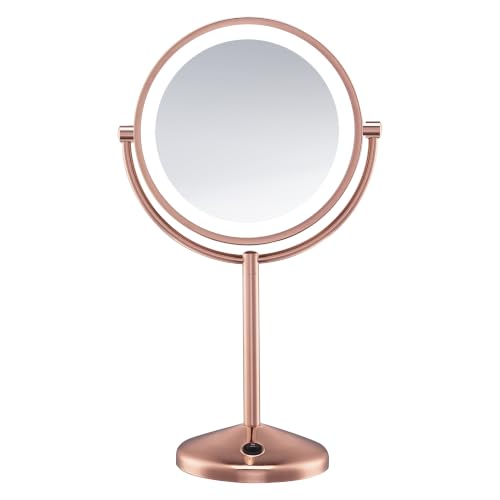
Conair Double-Sided Lighted Makeup Mirror
The Conair Double-Sided Lighted Makeup Mirror is a corded tabletop design from one of the longest-running names in personal care mirrors, built around a flip frame with a regular reflection on one side and a magnified view on the other, ringed by its own lighting. As a first mirror or a guest-bathroom extra, this is the sensible shape of purchase: a familiar format, a flip between the honest view and the magnified one, and light built in so a dim room stops being an excuse. Its corded nature suits a fixed spot beside an outlet. Positioning: entry-to-mid tier, priced by tier rather than by gimmick — check the current listing for the live figure. Best for: readers of this guide whose routine matches that shape. Not suited for: anyone whose space or habits contradict the format, however good the glass.
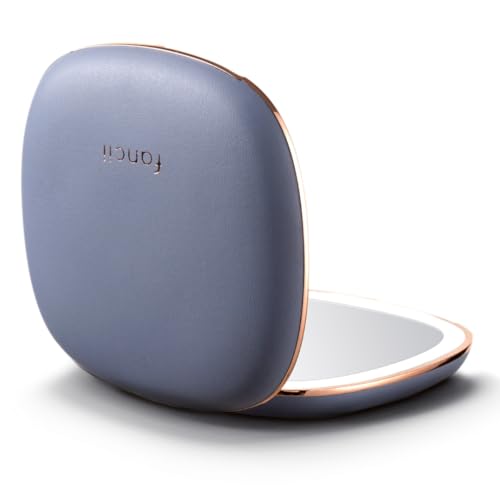
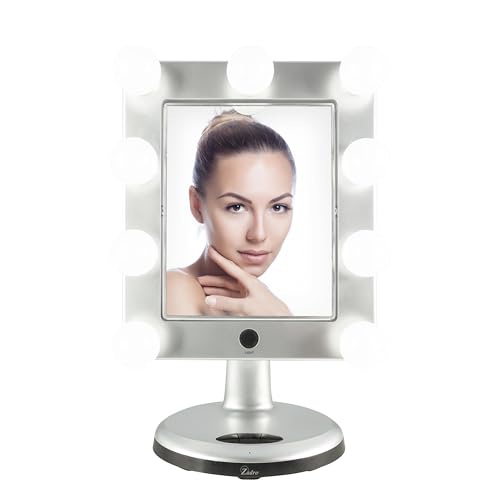
Fancii Mila LED Lighted Vanity Mirror
The Fancii Mila LED Lighted Vanity Mirror is a rechargeable LED vanity mirror from a beauty-tools brand known for portable, design-led mirrors, with touch controls and a clean, cord-free silhouette once charged. The appeal here is freedom from the cord. Charged, it goes wherever the light and the chair are best — a bedroom desk, a bathroom with no spare outlet, a suitcase. Touch controls keep the face of the mirror clean, and the design-led styling means it does not have to hide when guests use the bathroom. Positioning: mid tier, priced by tier rather than by gimmick — check the current listing for the live figure. Best for: readers of this guide whose routine matches that shape. Not suited for: anyone whose space or habits contradict the format, however good the glass.
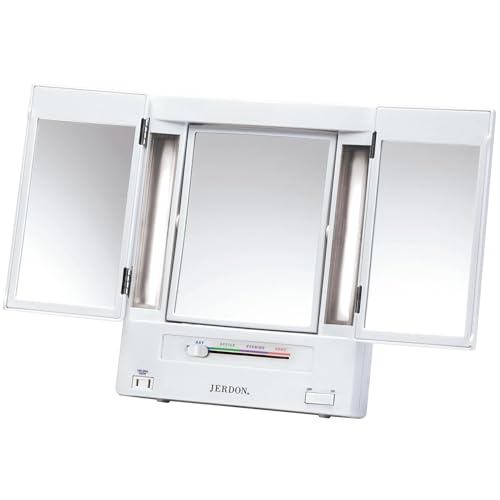
KEDSUM Trifold Lighted Makeup Mirror
The KEDSUM Trifold Lighted Makeup Mirror is a folding three-panel lighted mirror that opens out to show your face and both profiles at once, then closes flat enough for a drawer, popular with shared bathrooms and smaller vanities. The tri-fold format is the value play for angles: open the panels and your profile, your parting and the back of an updo all become visible without a second mirror or a doorway shuffle. Closed, it nearly disappears. For shared bathrooms and small counters, that disappearing act is the feature. Positioning: entry tier, priced by tier rather than by gimmick — check the current listing for the live figure. Best for: readers of this guide whose routine matches that shape. Not suited for: anyone whose space or habits contradict the format, however good the glass.

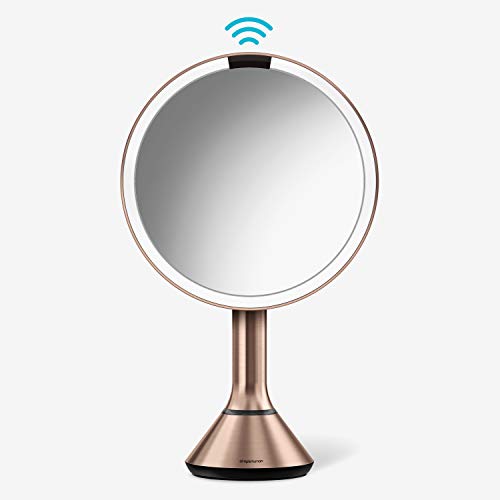
simplehuman Sensor Mirror
The simplehuman Sensor Mirror is a sensor-activated mirror from a design-focused home brand, built to light up as your face approaches and to mimic natural sunlight as closely as the brand can manage, in a brushed metal finish. The premium argument is light quality and effortlessness: the mirror wakes as you approach, aims to reproduce daylight faithfully, and asks nothing of your hands mid-routine. For someone who does makeup daily and values colour accuracy — matching foundation to neck, judging blush honestly — that light is the product. Positioning: premium tier, priced by tier rather than by gimmick — check the current listing for the live figure. Best for: readers of this guide whose routine matches that shape. Not suited for: anyone whose space or habits contradict the format, however good the glass.
Common Mistakes When Choosing
The first mistake is buying magnification by the biggest number, as if strength were quality; it produces a mirror that must be used nose-close and shows a fragment of face at a time. The second is judging light in a bright shop or a bright product photo, where every mirror looks luminous. The third is measuring the mirror and not the space — the opened tri-fold, the swinging arm, the cord’s dry route to the outlet. The fourth is treating wall mounting as a five-minute afterthought rather than the safety-relevant project it is. The fifth is buying for the routine you aspire to — the full contouring ritual — instead of the twelve-minute routine you actually perform, because a mirror serves the mornings you have, not the ones in the tutorial.
For anyone whose eyesight is changing — and that is most adults eventually — a makeup mirror is not vanity equipment, it is an accessibility tool. Magnification restores the close view that glasses complicate, because glasses must come off to apply eye makeup and the bare eye may not focus at mirror distance. This is the strongest, least frivolous case for a magnified mirror, and it argues for choosing strength by testing rather than by maximising: the goal is a comfortable working distance with your chin up and shoulders down, not the largest possible image at nose-to-glass range. Good light matters doubly here, since eyes need more light for the same clarity as the years pass. A mirror chosen on these terms stops being a beauty purchase and becomes part of how the morning works.
Pro Tips From the Other Side of Many Returns
Sit in your actual chair at your actual vanity and have someone measure from the surface to your eyes; that single number settles mirror height and arm length better than any product description. Test a candidate mirror at the same time of day you will use it, in the room’s real light, with your own products — a foundation match attempted under its light is the whole examination in one act. Keep the packaging until you have done three real mornings, because some flaws — a hinge that drifts, a light that buzzes at low dim — only appear in use. And when torn between two finalists, choose the one with the better plain reflection: you will forgive a modest magnified side, but the true-size view is the one you will trust every single day.
Worked Examples: Three Buyers, Three Right Mirrors
The renter with a dark bathroom. No drilling, no window, one outlet across the room. The specification writes itself: rechargeable, lighted, tabletop or folding, moderate magnification paired with a plain view. The Fancii-style rechargeable format fits because it asks nothing of the walls or the wiring and brings its own daylight-leaning light. The homeowner renovating a small ensuite. Counter space is the scarce resource and the walls are open during the renovation, so a wall-mounted swing-arm mirror on a properly anchored mount — installed while studs are findable — frees the sink permanently, with any hardwired lighting handled by the electrician already on site. The glasses-wearer at a dressing table. Eyesight is the brief: a double-sided tabletop with a magnification-specialist build, used seated at a repeatable distance, plus strong neutral light. Three different mirrors, each correct, none interchangeable — which is the entire lesson of choosing by specification.
For the value side of the decision, read whether a makeup mirror is worth it, and for the head-to-head on lighting see makeup mirror vs lighted makeup mirror.
A makeup mirror quietly reorganises the morning around a seat. Instead of a routine scattered between a bathroom mirror, a bedroom window and a phone camera, everything migrates to one station: products within reach, brushes in order, both scales of view a flip apart. That consolidation is an underrated benefit, because a routine with a home base gets faster and calmer at the same time. Lay the station out like a cockpit — daily products on the dominant-hand side, occasional items behind, a small tray for the tools in flight — and the mirror becomes the anchor of a workspace rather than an object on a surface. People who make the switch often report that the routine shrank by minutes without any step being cut; the minutes were in the walking, the leaning and the re-checking, and the mirror removed all three.
Foundation matching is the highest-stakes judgement a mirror hosts, and it is a judgement about undertone as much as depth. The reliable method: apply candidate shades in stripes along the jaw, let them settle for a few minutes while the product oxidises slightly, then judge in the most neutral light available — the mirror’s daylight-leaning setting, or a step to the window. The shade that disappears against both face and neck is the match; a shade judged only on the face will betray you at the jawline in daylight. A mirror with a colour cast of its own corrupts this test silently, which is why the white-card check at unboxing matters. Blush and bronzer submit to the same discipline: quantity judged at life size, placement judged in profile where possible, enthusiasm restrained by the knowledge that close views exaggerate everything.
Shape is partly taste and partly optics. Round and oval mirrors soften a room and centre the face pleasingly, which is why they dominate dressing tables; their working area concentrates in the middle, so a round mirror needs a little more diameter than a rectangular one to give the same usable width at the edges. Rectangular mirrors maximise usable area for their footprint and suit shared use and hair work, where width at the edges is real working space. Frameless designs disappear into modern rooms and clean easily; framed designs protect the glass edges — the most vulnerable part of any mirror — and carry the room’s style. There is no optical champion here, only honest trade-offs between area, protection and looks, and the right answer is the one whose compromises you will never notice because they match your habits.
Bathrooms are hostile environments for optics. Steam condenses on cool glass, moisture hunts the edges of the silvering, and the daily cycle of fog and dry repeats for years. A mirror that lives over a sink should be chosen and treated with that climate in mind: sealed edges, finishes that shrug off humidity, and ventilation doing its share — an extractor fan or an open door after showers slows the ageing of everything in the room, mirrors included. The fog itself has workarounds, from warming the room before a shower to the simple patience of doing makeup after the air clears, and many routines migrate to a bedroom vanity for exactly this reason. None of this is a reason to fear a bathroom mirror; it is a reason to buy one built for the climate it will actually live in.
Reading Product Listings Like a Skeptic
Listings in this category speak a dialect worth learning. Light claims should be read for what they omit: a listing proud of its light describes evenness, dimming and colour options, while a listing that shouts a single brightness figure is telling you the number because the quality will not speak for itself. Magnification claims deserve the same reading — the honest listings describe the pairing of views and the working distance, the loud ones print the largest number the range contains. Photographs flatter everything: glass looks flawless, hinges look machined, scale is anyone’s guess, so hunt the listing for the unglamorous facts — materials in the moving parts, how the mirror is powered and for how long per charge in the maker’s own words, what the mount includes, and what the maker says about bathroom use. Reviews by other buyers, read for patterns rather than verdicts, will tell you about hinge drift, charging habits and steam survival — the three things no photograph can.
The Two-Mirror Strategy
Many households end, sensibly, with two mirrors: a primary station mirror chosen without compromise for the main routine, and a secondary — folding, travel or handheld — for bags, guests and second bathrooms. Choosing in that order prevents the common error of buying one heroic mirror that must be perfect at everything and portable besides, a specification that produces expensive mediocrity. Let the primary be the best your main routine deserves, sized and lit for the room it will live in. Let the secondary be cheap, tough and cheerful. The pair together usually costs less than the heroic single, serves more of life, and means a broken or borrowed mirror never cancels a morning. If budget forces one purchase now, buy the primary and let the secondary arrive later as the easiest gift request you will ever make.
Picture the weekday morning the mirror actually serves. The alarm has done its worst, the light outside is either absent or unhelpful, and there are twenty minutes between the shower and the door. This is not the tutorial’s morning; nobody is blending for an audience of cameras. The mirror’s job in this morning is triage: even out the base, wake the eyes, make the brows agree, check the whole at life size, leave. A mirror that serves triage well — quick to its angle, honest in its light, flip ready — is worth more than a beautiful one that must be fetched, unfolded, plugged and persuaded. When you evaluate any design, run this morning against it in your imagination, because this morning, repeated two hundred times a year, is the product you are actually buying.
Picture the shared-bathroom negotiation at its most honest: two people, one sink, overlapping mornings, different heights, different eyes, one mirror. The designs that survive this negotiation are the adjustable, the resettable and the forgiving — tilt that serves both heights, magnification moderate enough for both pairs of eyes, a position that returns to neutral between users. The designs that fail it are the precious and the fixed. If your household is this picture, let it outrank every other scenario in this article when you choose, because a mirror that starts two arguments a week is expensive at any tier, and a mirror that ends them is cheap at almost any.
Small ergonomic details compound. A mirror that tilts with one finger gets adjusted; a mirror that needs two hands and a wrestle stays at yesterday’s angle and quietly mis-serves today’s user. A base that yields counter edge for forearms to rest on steadies the whole upper body. Light controls reachable without breaking position — a touch surface, a dial at the frame’s edge — keep the working posture intact through adjustments. Even the chair participates: a stool that swivels lets the window check happen without standing, and a seat at the height that puts the mirror’s centre at eye level is worth more than any single feature on the mirror itself. Ergonomics is the category’s least marketed virtue and its most felt one, morning after morning.
Artists also maintain their tools like instruments, and the mirror is first among them: glass cleaned before work, not after complaints; hinges and arms checked as part of setup; a failing light treated as a stopped job rather than a nuisance to work around. The home translation is modest — a cloth that lives at the station, a weekly wipe, a charge topped up on a schedule rather than on a crisis — but the mindset is the transferable part. A mirror treated as an instrument returns instrument-grade reliability; a mirror treated as bathroom clutter returns clutter-grade surprises, usually at the least convenient hour of the week.
Light behaves differently in each of those rooms, too. Bathrooms concentrate hard, reflective surfaces that bounce light unpredictably; bedrooms soften everything with fabric; hallways borrow whatever the nearest doorway offers. A mirror moved between rooms will seem to change character — the same glass, the same lamp, a different verdict — which is not the mirror being inconsistent but the room revealing its share of the reflection. This is why the final judgement of any mirror should happen in the room it will live in, at the hour it will work, and why moving a disappointing mirror before replacing it is the cheapest experiment in the whole category.
There is also the mistake of the single data point: one bad morning blamed on a new mirror, one good photograph credited to it. Mirrors should be judged across a week of varied mornings — early and late, rushed and slow, glasses and lenses — because their value is statistical, an average lifted across hundreds of repetitions. The buyer who understands this tests patiently and returns rarely; the buyer who judges on day one churns through the category collecting first impressions. Given that the whole promise of the product is consistency, judging it inconsistently is the one error that guarantees dissatisfaction regardless of which mirror eventually wins.
A Final Self-Interrogation Before You Buy
Close the choosing process with five questions answered in writing, because written answers resist the drift that showroom lighting and product photography induce. Where exactly will it live, measured, not imagined? Which view will you use most — and does the candidate serve that view best, or merely also? What light will it work in at your real hour, and does it bring its own answer to that light? How is it powered, and is that plan dry, reachable and honest? If it mounts, what exactly will it mount into? A candidate that survives those five answers is not a guess any more; it is a specification fulfilled. And if no candidate survives, the questions have done their job too — they have told you the format, tier or room needs rethinking, which is cheaper learned on paper than on a delivery.
Children and teenagers enter the picture too, usually at the stage of first routines — skincare, braces checks, early makeup experiments. A household mirror at a sensible height with moderate magnification serves those years gracefully, and the safety rules scale with it: stable bases over tippy stands, mounts checked as part of household routine, and nothing heavy hung where anyone sleeps beneath it. The mirror that serves a household rather than a person should be bought a size up in sturdiness and a step down in specialisation, because its users will span more heights, eyes and habits than any single routine predicts.
The packing rules are simple and worth stating: glass travels closed, padded, and away from hard edges in the case; cords and chargers travel in the same pouch every time so the kit is checkable at a glance; and a rechargeable mirror travels charged, because the first night is when it is needed. A mirror that survives a year of luggage has proven more about its hinges and case than any showroom handling can, which is why the folding designs that endure develop loyal followings entirely out of proportion to their price tier.
Evenings invert the problem. Makeup applied in bright bathroom light for a dim venue will read stronger than intended under candlelight and restaurant warmth, while makeup applied in cosy lamplight may vanish under street lighting on the way. The mirror cannot solve the venue, but a colour-setting preview — apply in neutral, glance in warm — narrows the surprise. This is a small discipline with an outsized effect on photographs, which are, in the end, where most makeup is ultimately judged by its wearer.
Cleaning the station is part of the same system. Products leak, powders migrate, and a mirror at the centre of it collects the evidence. A weekly reset — glass polished gently, tray wiped, expired products evicted — keeps the reflection honest, because a dusty mirror in a dusty station makes everything look softer than it is, including the face. The reset takes minutes and pays in judgement quality, which is the currency this entire category trades in.
One last choosing instrument costs nothing and outperforms most specifications: the borrow test. Borrow any makeup mirror — a friend’s, a hotel’s, the one in a relative’s guest bathroom — and live with it for three mornings, noting precisely what delights and what grates. Borrowed mirrors teach your own preferences with a clarity no listing can: you will learn your true working distance, whether you reach for magnification or ignore it, whether you crave more light or find bright light harsh at dawn. Those three data points, honestly recorded, narrow the entire market to a handful of candidates before you have spent anything. Choosing then becomes confirmation rather than exploration, and the mirror you finally buy arrives pre-understood — its format already familiar, its tier already argued for by experience. It is the slowest way to choose and, for an object you will use a thousand times, entirely worth the patience.
Finally, trust the hierarchy this guide has built: format before features, pairing before strength, light before looks, safety before speed. A mirror chosen in that order may not be the one that first caught your eye, and that is usually the sign the process worked — the eye is a decorator, but the routine is an engineer, and it is the engineer who shows up every morning. Keep the written specification, buy the mirror that fulfils it, and let the first three mornings — tested honestly, at your real hour, ending at a window — be the confirmation rather than the discovery.
From First Step to Final Check: Working Well With a Makeup Mirror
The main steps for the makeup mirror are covered above; what follows is the working discipline around those steps, covering preparation, order of work, the checks that catch mistakes early and the small follow-up habits that keep the result sound. It is written for real homes, where interruptions and imperfect spaces are normal.
Start With Your Space and Your Routine
Guests notice different things than owners do, so if the makeup mirror will be used by visitors, test it from a fresh user’s point of view, without the habits you have already built around it. Write down the three tasks you will do most often with the makeup mirror and score each shortlisted option against those tasks alone, ignoring features you are unlikely to touch. If the makeup mirror will be seen every day, its proportions matter as much as its function, so hold the listing dimensions up against a familiar piece nearby to judge the visual weight honestly. Think about the season in which the makeup mirror will work hardest, and judge it against that season rather than the mild week in which you happen to be shopping.
Check your work from a distance as well as up close, because proportions, levels and alignment in Beauty & Personal Care tasks are far easier to judge from across the room. If you are replacing an older makeup mirror, list what failed or frustrated you about it, and check each item on that list against the new listing before you order its successor. Apply the same checks to each shortlisted example, whether that is the Conair Double-Sided Lighted Makeup Mirror; the simplehuman Sensor Mirror; the Fancii Mila LED Lighted Vanity Mirror, because consistent testing is what makes the differences between models visible. Dust, moisture, sunlight and heat each age Beauty & Personal Care items in different ways, so match the finish and material of the makeup mirror to the conditions of the room or outdoor spot it will occupy.
When Small Problems Appear
Think about who else will use the makeup mirror, how often, and in what way, because a choice that suits one person perfectly can frustrate everyone else in the household. Compare how each option handles the in-between moments, such as being half full, partly open, moved aside or used in a hurry, because daily life happens mostly in those moments. Equally, list what your old makeup mirror did well, because replacements sometimes quietly lose a virtue you relied on, such as a size, a shape or a simplicity the new model has redesigned away. Set the assembled makeup mirror up fully before deciding it is wrong for the space, since partly built or badly positioned pieces often look worse than they will once finished and levelled.
Where the makeup mirror meets the floor, the wall or another surface, check what protects both sides, because scuffs and marks in those contact zones are the most common early complaint. Work in a steady order and finish one stage completely before starting the next, because half-finished stages are where mistakes with a makeup mirror hide and compound. A slight wobble, a stiff action or a small misalignment on day one rarely improves on its own, so address it during setup while adjustments are still easy to make. Read the listing for what it does not say as carefully as for what it does, because missing information about materials, assembly or care is itself a useful signal when you compare makeup mirror options.
A Short Decision Checklist
- The material and finish, matched to light, moisture and wear in its spot
- The main job the makeup mirror must do, written in one sentence
- The one feature you will not compromise on
- Assembly needs, tools required and whether help is needed
- Where the makeup mirror and its accessories will be stored when not in use
- What your current arrangement does well that the makeup mirror must not lose
- Who will use the makeup mirror most, and any limits they have
- Delivery path, from the door to the final position
Taken together, these checks take only a little time, yet they answer the questions that decide whether the makeup mirror suits your home, your household and your routine, and they do so before money changes hands rather than after.
Frequently Asked Questions
Do I need magnification if I wear glasses?
Quite possibly — glasses are exactly why many people discover magnified mirrors. Eye makeup requires removing the glasses, and without them the plain mirror may sit outside your clear focus range. A magnified side brings the detail back into reach. Choose the strength by sitting at your real vanity distance and testing, not by ordering the strongest available: too much magnification shrinks the visible area and shortens the working distance uncomfortably. Pair it with strong, even light, since light and magnification solve the same problem together better than either does alone.
Where should a makeup mirror go in a small bathroom?
Where it steals the least counter and borrows the best light. A wall-mounted swing-arm design frees the sink entirely and folds back when not in use, but it needs a stud or properly rated anchors and a clear swing path. If drilling is out, a slim tabletop or a folding tri-fold that lives in a drawer keeps the counter clear. Face the mirror toward the room’s best light where you can, keep cords out of the sink and off wet surfaces, and check that cabinet doors clear whatever you install.
Should a makeup mirror be corded, battery or rechargeable?
Match the power to the placement. Corded suits a permanent vanity with a nearby outlet and never runs flat, but the cord must be routed dry and clear of the sink. Battery models go anywhere and travel well, with light that fades as the cells weaken. Rechargeable designs are the modern default for most homes: cord-free in daily use, topped up occasionally, and happy on a desk or in a bathroom with no spare outlet. There is no wrong answer, only mismatches — a corded mirror with no outlet nearby is a return waiting to happen.
Is a makeup mirror better than a regular bathroom mirror?
For detail work, yes; for an overall check, they are equals. A bathroom mirror shows the whole face at life size and remains the honest final judge, but it fixes you at sink distance under whatever light the room happens to have. A makeup mirror moves the reflection to you, adds magnification for close tasks and, in lighted versions, brings its own even light. Most good routines use both: detail at the makeup mirror, verdict at the bathroom mirror before leaving.
What colour light is best for applying makeup?
The most neutral, daylight-like light you can get, because it is the light your face will be judged in most often. Warm light is flattering and forgiving — pleasant, but it hides undertone mistakes and encourages heavier application. Very cool light is honest to the point of cruelty and can make healthy skin look sallow. Neutral is the working referee. If a mirror offers several colour settings, make neutral your home base and use the warm and cool settings as previews of evening venues and office lighting, not as your primary judgement light.
Is a makeup mirror a good gift?
It is one of the safer beauty gifts because it improves a routine without presuming anything about skin, shade or taste. Choose versatile over extreme: a double-sided tabletop with gentle magnification and decent light suits almost everyone, while very strong magnification is a personal, eyesight-specific choice best left to the recipient. Rechargeable designs gift well because they need no outlet planning. If the recipient rents, avoid wall-mounted gifts that demand drilling. Include the receipt mindset — a mirror is a daily object, and the right one is the one that fits their counter, not your guess.