Where to buy
Check the latest price, availability and delivery on Amazon. Orders are placed on Amazon. We may earn a commission from qualifying purchases.
- Best overall for bedrooms: Philips Hue Go Portable Smart Table Lamp, White — Check on Amazon
- Govee RGBIC Smart Table Lamp 2, Touch Bedside Lamp with Matter and Alexa — Check on Amazon
- Odokee Sunrise Alarm Clock White Noise Machine (H03), Putty — Check on Amazon
- Brightech Lamina LED Table Lamp, Glass Shade, Gold/Brass — Check on Amazon
See 2 more Amazon options
- Dekala Sunrise Alarm Clock — Dual Alarms, FM Radio, USB Charging Port — Check on Amazon
- JALL Sunrise Alarm Clock White Noise Sound Machine (K6) — Check on Amazon
Read the full guide ↓
Disclosure: As an Amazon Associate, dailyhomedecorating.com earns from qualifying purchases. Links to Amazon on this page are affiliate links; they cost you nothing extra. Listing details such as price and availability change often, so check the current Amazon listing before you buy.
The best bedside lamps for bedrooms under $100 are not really lamps in the old sense, and this guide is built around that fact. Below $100, the products that genuinely improve a bedroom are the ones designed around sleep itself: lights that fade down slowly at night so you are not clicking from full brightness to darkness, lights that build up gradually before your alarm so waking is a slope instead of a cliff, displays that can go completely black, and controls you can work with your eyes half shut and your phone in another room. A conventional shaded lamp can do one of those jobs. The six products below — a portable smart lamp, an app-driven color lamp, two sunrise alarm clocks at different points in the tier, one honest budget clock and one proper reading lamp — were chosen because each of them does at least two, and because every feature in this guide was verified against a real listing or a maker’s own documentation rather than copied from a headline.
For most bedrooms we would begin with the Philips Hue Go, because its fade-out sleep routine is the single most sleep-friendly feature in this guide and it works from a button on the lamp itself. If you want a sunrise alarm clock — the category this budget does best — the Odokee H03 is the flexible one, and the JALL at the bottom of the guide proves the concept at the budget end of this tier. And if what you actually do in bed is read, skip the clocks entirely and go to the Brightech Lamina, the only pick here that is a lamp first and a gadget never. One famous name is missing from the picks, deliberately: the Philips SmartSleep HF3520, the benchmark wake-up light, was sitting above this guide’s budget on Amazon when we checked, so it is discussed honestly in its own section below rather than smuggled into an under-$100 guide. Below you will find a quick picks table, detailed notes on all six products, a comparison table, a buying checklist, the near-misses and what they teach about this budget, the mistakes shoppers make at this tier, and answers to the questions that come up again and again.
Quick Picks
Short on time, or comparing several options at once? Each row below names a buyer type and the lamp that suits it, with a link to the listing.
| Buyer type | Pick | Why it stands out | Link |
|---|---|---|---|
| Best overall for bedrooms | Philips Hue Go Portable Smart Table Lamp | Fades itself out at bedtime and brightens before your alarm — and you can carry it to the bathroom at 3 a.m. | Check on Amazon |
| Best smart lamp | Govee RGBIC Smart Table Lamp 2 | Full color and warm whites, Matter and Alexa built in, touch control on the lamp — no hub required | Check on Amazon |
| Best sunrise alarm clock | Odokee Sunrise Alarm Clock White Noise Machine (H03) | A 5-to-60-minute sunrise, 25 sleep sounds and a display that dims all the way to black | Check on Amazon |
| Best for reading in bed | Brightech Lamina LED Table Lamp | A real lamp: 800 lumens of warm 2700K light behind glass, with stepless dimming | Check on Amazon |
| Best for heavy sleepers and couples | Dekala Sunrise Alarm Clock, Dual Alarms | Two independent alarms, a 10-to-60-minute sunrise and a USB port for the phone | Check on Amazon |
| Best budget | JALL Sunrise Alarm Clock White Noise Sound Machine (K6) | Sunrise simulation, 25 soothing sounds and a Bluetooth speaker at the budget end of the tier | Check on Amazon |
How These Picks Were Chosen
The first filter was the budget for this tier. Every product below is a real Amazon US listing whose ASIN we confirmed against the listing itself, a maker’s manual or a specification mirror, and which sits within this guide’s under-$100 budget — check price on Amazon for the current figure. One famous product did not fit: the Philips SmartSleep HF3520 was above this guide’s budget on Amazon at the time of research, so it appears in the honest near-miss section below instead of in the picks. The same discipline removed the Hatch Restore 3 and the Lumie Bodyclock Shine 300, the two routine-driven clocks positioned above this tier. A guide that fudges its own budget in the first paragraph has nothing useful to tell you in the tenth.
The second filter was the bedroom itself, because this guide is for bedrooms rather than for nightstands in general. We weighted the things that decide whether a light helps or harms sleep: how low it dims (a lamp whose lowest setting is still a reading light will wake your partner and your brain), how warm it goes at night, whether it can brighten gradually before an alarm instead of switching on, whether its clock display can go fully dark, and whether the controls work at midnight without a phone — a physical button, a touch top, a dial. That is why sunrise alarm clocks take three of the six slots: at this price they are simply the most sleep-literate products sold for a nightstand, and why the charging-hub lamps that dominate the Best Bedside Lamp Under $40 guide appear here only as a USB port on the Dekala. If your bedroom problem is charging rather than sleeping, that guide and Best Bedside Lamp For Apartments Under $100 weigh the ports more heavily than this one does.
We did not use these products ourselves. We read maker listings, user manuals and specification sheets, and compared what could be verified: ramp lengths, sound libraries, dimming ranges, control methods and warranty terms. Two honesty rules follow from that. First, brightness figures in this category are maker figures measured however the maker chose — only Philips publishes a lux number for its wake-up lights, and no marketplace clock’s lumen claim has been independently standardized — so we report whose figure a number is and never rank clocks by claimed brightness. Second, where a listing was vague — a charging speed, a dimming floor — we say so in the review rather than guess, and the checklist below tells you what to confirm on the live listing before ordering.
The 6 Best Bedside Lamps for Bedrooms Under $100
Philips Hue Go Portable Smart Table Lamp, White
Who it suits: Sleep-routine builders and restless sleepers — anyone who wants light that fades out as they fall asleep, fades in before the alarm, and can be carried down the hall at 3 a.m. without waking the house.
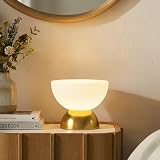
The Hue Go is a bowl of light: a smooth white bowl, about six inches across, with a rechargeable battery underneath and the light inside it. Its killer feature for a bedroom is the fade. Set a go-to-sleep routine and the Go dims itself gradually over the half hour or so you choose, which is a fundamentally different experience from clicking a lamp off and lying in sudden darkness with a busy brain — the light walks you down. In the morning the same trick runs in reverse as a gentle brightening before, or instead of, a harsh alarm. Crucially for this guide’s midnight rule, the Go does not demand your phone at the bedside: a button on the lamp itself cycles through preset scenes and brightness levels, so a trip to the bathroom is one press for a low glow, carried with you, rather than a phone screen at full brightness in a dark room. It works over Bluetooth with the Hue app straight out of the box, speaks the full Hue range of warm-to-cool whites and colors — check price on Amazon for the current figure.
The caveats are the Hue caveats, stated plainly. The best of the system — the polished wake-up and go-to-sleep routines, out-of-home control, syncing with Hue bulbs elsewhere in the house — runs through a Hue Bridge, which is sold separately; over Bluetooth alone you get in-room app control and the on-lamp button, which for one bedside lamp may honestly be enough, but budget for the Bridge if routines across the home are the plan. The battery is rated for up to about six hours of light by the maker, so in practice the Go lives on its charging base on your nightstand and goes walkabout for minutes at a time — plan on that, not on evenings of cordless use at full brightness. And its light is diffuse and ambient by design: lovely for a glow, wrong for a novel. Treat it as the bedroom’s sleep light, and pair it with a real reading lamp if you read for hours — the Lamina below, or the sensor-equipped reading lamps in Best Bedside Lamp For Bedrooms Under $300.
- Gradual fade-out and fade-in routines — the most sleep-friendly light behavior in this guide.
- On-lamp button cycles scenes and brightness with no phone, and the battery makes it a carry-anywhere night light.
- Full Hue white and color range over Bluetooth out of the box; a Bridge unlocks the complete routine system.
Honest limitation: The full routine features need a Hue Bridge sold separately, the roughly six-hour battery means it lives on its charger, and the diffuse bowl light is ambience, not reading light.
Choose it if your bedside light is really about falling asleep and waking gently. Skip it if you want one lamp that also lights a page — it is a glow, not a beam.

Govee RGBIC Smart Table Lamp 2
Who it suits: Smart-home bedrooms that want color, scenes and schedules without buying into a hub ecosystem — and anyone whose wind-down light is also the room’s evening personality.
Where the Hue Go is a routine machine wearing a bowl, the Govee Table Lamp 2 is a proper little smart lamp: a corded bedside cylinder with RGBIC color (different colors along the lamp at once, if that is your taste), the full run of warm-to-cool whites for saner hours, and control that does not depend on any one company staying interested in it — it works with Matter, Alexa and SmartThings, plus Govee’s own app, and a touch control on the lamp itself handles the basics in the dark. The app is where the bedroom features live: schedules and timers let you build a brighten-before-the-alarm routine and a dim-down evening scene, and the maker lists 64 scene modes and music sync, of which the scenes are occasionally useful and the music sync is a party trick you will use twice. On positioning, it sits in the middle of this tier while behaving like the top of the guide — check the current price on Amazon.
Two honest notes before the enthusiasm runs away. First, this is an integrated-LED lamp: the light source is sealed into the fixture, so when the LEDs eventually fade years from now, the lamp is finished — there is no bulb to change, and you should treat it as a long-lived electronic rather than a lifetime fixture, exactly as you would the smart clocks below. Second, Govee is an app-first company: the touch top covers on, off and a few presets, but the schedules, the fine dimming and the scene library all live in the Govee Home app, so the phone-free-at-midnight rule is only half satisfied — you set everything up in the app during the day and then live on the touch control and your schedules at night, which works well, but go in knowing the division of labor. For a modern bedroom that wants one colorful, schedulable light and no hub on the shopping list, it is one of the smartest choices in this guide; readers furnishing a whole design-led room should also see Best Bedside Lamp For Modern Homes Under $100, where looks lead the brief.
- Matter, Alexa and SmartThings support plus app schedules — smart features without a proprietary hub.
- Touch control on the lamp for the midnight basics; RGBIC color and 64 scenes for the evenings.
- Mid-tier positioning in this guide, with the feature set of a top-of-tier lamp — check price on Amazon.
Honest limitation: The LED is sealed in — no bulb to replace when it fades — and the deeper settings live in the app, so the phone stays involved at setup even if not at midnight.
Choose it if you want a schedulable smart lamp that plays with every platform and skips the hub. Skip it if you want a lamp you can re-bulb for a decade, or you dislike app-based setup on principle.

Odokee Sunrise Alarm Clock White Noise Machine (H03), Putty
Who it suits: Anyone whose main bedside problem is the alarm itself — hard mornings, dark winters, a partner on a different schedule — and who wants the sunrise to do the waking with no app and no account.
The Odokee H03 is the most complete wake-up light that verified under this budget. The maker’s documentation describes a sunrise that begins anywhere from 5 to 60 minutes before your alarm time — a wider, more adjustable ramp than most clocks at any price — rising toward a wake-up you can set as light plus sound, sound only, or light only, which is the correct menu for shared bedrooms: light alone for the early riser, sound alone for the partner who sleeps through light, both for the heavy sleeper. Around the alarm sits a real sleep toolkit: 25 sleep sounds, 12 night-light colors for the evening side of the day, Bluetooth speaker playback if your own audio beats the built-in library, and — the detail that earns it this slot — a clock display that dims all the way to zero, because a glowing green 2:47 a.m. is its own sleep problem. Everything runs from physical controls on the device; there is no app, no Wi-Fi and no subscription. Check price on Amazon for the current figure.
The honesty this pick requires is about pedigree, not features. Odokee is a young marketplace brand, not a Philips or a Lumie: it publishes an 18-month warranty, but there is no standardized lux figure for the H03’s peak brightness and no long support record to inspect, so the sunrise’s strength is something to test in your own room during the return window rather than take on faith — place it facing the bed, start with a 30-minute ramp, and keep a backup alarm for the first few mornings. The button logic on clocks like this also takes a night or two to learn by touch. None of that dents the central fact: on verified features for this tier — ramp range, sound library, display blackout, wake-mode choice — nothing else under $100 that we could confirm comes close, and if it wakes you kindly for a month of mornings, the pedigree question has answered itself.
- Sunrise ramp adjustable from 5 to 60 minutes, with light-only, sound-only or combined wake modes.
- 25 sleep sounds, 12 night-light colors and a display that dims to complete black.
- Physical controls only — no app, no Wi-Fi, no account, nothing to update at 2 a.m.
Honest limitation: A young brand with no published lux measurement and a short track record — verify the sunrise is bright enough for your room inside the return window.
Choose it if the alarm is the problem and you want the most adjustable sunrise under $100. Skip it if you want a decades-old brand behind the product, or a lamp that also reads well at full brightness.

Brightech Lamina LED Table Lamp, Glass Shade, Gold/Brass
Who it suits: Readers — the people for whom the bedside lamp’s first job is a clean pool of light on a page at 11 p.m., with dimming gentle enough not to end the evening for a sleeping partner.
Every other pick in this guide is a sleep device that also makes light. The Lamina is the reverse, and some bedrooms need exactly that. It is a small, handsome lamp — about ten inches tall, with a glass shade and a gold/brass finish that looks like furniture rather than electronics — and its specification is a reader’s specification: a maker-rated 800 lumens, which is genuinely bright for a bedside lamp, at a fixed warm 2700K, behind glass that softens the beam, with stepless dimming rather than three blunt steps. Stepless matters at a bedside more than anywhere: the exact level where one partner reads and the other sleeps is a specific number, and a dial you can nudge finds it in a way that low/medium/high never does. The dimming runs deep enough for a night-light glow, and because there is no clock, no app and no speaker, there is also nothing to glow, buzz or demand an update. Check the current price on Amazon, and check the listing for any coupon available at the time you order.
Now the trade, stated as plainly as the Fenmzee’s was in the $40 guide. The dimmer is an in-line control on the cord, not a touch base or a knob on the lamp — simple, reliable, and exactly the thing you may find yourself fishing for behind the nightstand at 2 a.m.; route the cord so the dimmer rests where your hand lands, and it stops being a flaw. There is no timer, no sunrise, no sunset fade: the Lamina will not walk you down to sleep or up to morning, and if you want it off at midnight without reaching for the cord, a schedule has to come from a smart plug you supply. And it does no charging — your phone keeps its own brick. What you get instead is the best light quality in this guide and a lamp that will still be a lamp when the smart picks are e-waste. If your bedroom already wakes and sleeps well and simply reads badly, this is your pick; if your nightstand is genuinely tiny, compare footprints against Best Bedside Lamp For Small Rooms Under $100 before ordering.
- Maker-rated 800 lumens at a warm 2700K behind a glass shade — the strongest reading light here.
- Stepless dimming that lands on exact partner-friendly levels and drops to a night-light glow.
- No clock display, no app, no speaker: nothing on the nightstand competing with sleep.
Honest limitation: The dimmer sits in-line on the cord rather than on the lamp, and there are no timers, routines or charging — it is a lamp, full stop.
Choose it if reading in bed is the main job and you want light quality over features. Skip it if you want the light to manage your mornings or your wind-down for you.
Dekala Sunrise Alarm Clock — Dual Alarms, FM Radio, USB Charging Port
Who it suits: Couples on different schedules and heavy sleepers — anyone who needs two proper alarms, a sunrise with some muscle behind it, and somewhere to plug in a phone, at the budget end of this tier.
The Dekala’s headline is in its manual, which is where we verified it: dual alarms, set independently, so the 5:30 a.m. gym alarm and the 7 a.m. school-run alarm stop fighting over one clock. Each alarm can ride on a sunrise that builds from 10% to 100% brightness over a period you set between 10 and 60 minutes, with a choice of natural wake sounds or the FM radio (auto-scanning the 76–108 MHz band), and a snooze of nine minutes that can repeat up to five times — a humane arrangement for people who snooze in installments. The evening side is covered too: eight soothing sounds with an auto-off sleep timer, and ambient light adjustable across 20 brightness levels for the wind-down hour. There is a USB charging port on the device, which makes this the only pick that answers the charging question at all. Check price on Amazon for the current figure, and the maker lists a two-year warranty, which is a longer promise than most marketplace clocks make.
The limitations are the category’s limitations, and one is specific. The USB port’s charging speed is not a headline spec anywhere in the maker’s materials, so treat it the way this site treats every lamp hub: overnight charging for a phone, not fast charging — the 5V-class trickle that refills a battery by morning and disappoints at dinner time. The interface is clock-menu logic — buttons and sequences rather than an app — which is either a blessed freedom from software or a fiddly first evening, depending on your temperament; set both alarms once, carefully, with the manual open. And like the Odokee, it is a marketplace brand whose brightness claims are its own. What it offers in exchange is the most complete conventional alarm clock in this guide at a budget price: two alarms, a real sunrise, a sleep timer and a charging port in a compact body about six and a half inches tall.
- Two fully independent alarms — the couples’ and shift-workers’ feature nothing else here matches.
- Sunrise adjustable from 10 to 60 minutes, natural sounds or FM radio, and a repeatable nine-minute snooze.
- A USB charging port and a two-year maker warranty — check price on Amazon.
Honest limitation: The USB port’s speed is unspecified — assume overnight charging only — and the button-menu interface takes one careful setup session to learn.
Choose it if two schedules share one nightstand, or you snooze like it is a sport. Skip it if you want app-based setup or a display guaranteed to vanish completely — check the Odokee’s blackout display above.

JALL Sunrise Alarm Clock White Noise Sound Machine (K6)
Who it suits: The sunrise-curious — anyone who wants to find out whether waking to gradual light works for them before spending real money, plus guest rooms, teenagers and dorm rooms.
As the budget pick in this tier, the JALL K6 works well as an experiment, and it is a well-designed one. Its manual describes the full sunrise idea in miniature: a light panel that builds from 10% to 100% over a ramp you can set between 10 and 60 minutes, 25 built-in soothing sounds for the falling-asleep side, 17 light modes (eight solid colors and nine RGB mood effects) for the evening, and a Bluetooth speaker so the nightstand can play your own audio instead of the built-in library. The snooze is unusually civilized for the price — adjustable between 5 and 20 minutes rather than a fixed nine — and the front display shows the time, the alarm state and the day of the week. Check price on Amazon for the current figure, and the maker backs it with a 365-day warranty. As a proof of concept — do I wake more kindly to light than to noise? — nothing in this guide answers the question at a lower point in the tier.
Keep the expectations set for a budget pick, because the compromises are real. The light panel is small, so the sunrise is a gentle brightening at the nightstand rather than a room-filling dawn; light sleepers and the sunrise-persuadable will feel it, while genuinely heavy sleepers should treat the sound alarm as the main event and the light as the warm-up act — or step up to the Dekala’s dual alarms. The build is budget plastic with small buttons, and the menu takes a setup session with the manual, like every clock here. None of that is a scandal for a budget pick; it is simply the honest shape of this end of the tier. Buy it to learn what you like — ramp length, sound or silence, color or plain warm white — and if sunrise waking turns out to be your thing, you will know exactly which of the Odokee, the Dekala or the over-budget Philips in the next section deserves an upgrade.
- A complete sunrise experiment at the budget end of the tier: ramps from 10 to 60 minutes and 25 sleep sounds.
- Bluetooth speaker playback and 17 light modes cover evenings as well as mornings.
- Adjustable 5-to-20-minute snooze and a 365-day maker warranty.
Honest limitation: The small light panel makes a gentle sunrise, not a room-filling one — heavy sleepers should rely on its sound alarm and treat the light as support.
Choose it if you want to test sunrise waking at the lowest sensible price. Skip it if you already know you need maximum light or dual alarms — that is the Dekala or the Odokee.

Comparison Table
| Product | Type | Best use | Link |
|---|---|---|---|
| Philips Hue Go | Portable smart lamp | Fading out to sleep and in to waking, anywhere in the house | Check on Amazon |
| Govee Table Lamp 2 | Smart color lamp | Scheduled color and warm light with no hub | Check on Amazon |
| Odokee H03 | Sunrise alarm clock | The most adjustable sunrise under $100, app-free | Check on Amazon |
| Brightech Lamina | Dimmable table lamp | Serious reading light with stepless dimming | Check on Amazon |
| Dekala Sunrise Alarm Clock | Dual-alarm wake-up light | Two schedules, one nightstand, plus USB charging | Check on Amazon |
| JALL K6 | Budget sunrise clock | Testing sunrise waking at the budget end of the tier | Check on Amazon |
How to Choose a Bedside Lamp for a Bedroom Under $100
- Name the job before the product. Waking, winding down and reading are three different lights wearing one name. Sunrise clocks (Odokee, Dekala, JALL) own the first, routine lamps (Hue Go, Govee) own the second, and a dimmable shaded or glass lamp (the Lamina) owns the third. Most bedrooms need two of the three; buy the one that fixes your worst hour first.
- Judge the dimming floor, not the ceiling. Every lamp here can get bright. Sleep is decided at the bottom of the range: can it drop to a glow you could fall asleep beside, without flicker or a sudden final step to off? Stepless controls and long fades beat three-step touch for exactly this reason.
- Demand a dark display. If the product has a clock, its display must dim to zero or near it — the Odokee’s full blackout is the standard to hold others to. A display that glows all night is a night light you did not choose, pointed at your face.
- Keep the phone out of the midnight loop. Setup in an app is fine; operation at 2 a.m. should not be. The Hue Go’s on-lamp button, the Govee’s touch top and the clocks’ physical controls all pass this test in different ways — what matters is that light, snooze and off are reachable by a sleepy hand.
- Pick a ramp length you will actually use. Sunrise ramps here run from 5 to 60 minutes. Thirty minutes is the well-trodden middle: long enough to matter, short enough to fit a real morning. Longer is not automatically gentler — final brightness and whether sound follows the light matter as much.
- Go warm at night. For the evening side of the day, 2700K and warmer is the territory of sleep; several picks go lower still. Daylight-white settings are for morning tasks, and a lamp that can only do cool white is a desk lamp in the wrong room.
- Decide about sealed LEDs now. The Govee and the clocks integrate their light sources: when the LED fades, the product is done. That is acceptable at this end of the tier if you treat it as years of service, and it is the honest trade for the features — but if a decade-long fixture is the goal, a socketed lamp from the Best Bedside Lamp Under $40 guide is the other road.
- Check the power story. The Hue Go’s battery is for carrying, not for living off-grid; the clocks are corded and differ in what survives a power cut — memory backup keeps the time, not the light show. If outages are common, confirm the backup behavior on the listing.
- Use the return window as a test lab. A sunrise clock succeeds or fails against your room, your eyelids and your partner. Run it for a week of real mornings with a backup alarm set, and judge the ramp, the display and the buttons by that week — not by the product photos.
The Benchmark That Missed the Budget
Honesty requires a section for the product this guide is not allowed to pick. The Philips SmartSleep Wake-Up Light HF3520 is the reference sunrise clock — the one Philips has refined for years, with a colored sunrise that moves from deep red through orange to bright yellow over 20 to 40 minutes, 20 brightness levels, a maker-rated 300 lux at peak, five natural sounds plus FM radio, two alarms, a tap snooze and a sunset fade for the evening. When we checked Amazon at the time of research, it was positioned above this guide’s budget. The rule is simple: on the days when it actually sits within the under-$100 budget, it deserves strong consideration over everything in this guide except the Lamina; while it sits above the budget, the Odokee gives you a wider ramp range and a blackout display within this tier. What you should not do is treat it as an under-$100 pick on days when it is not. It earns that description only on the days when it actually is under $100.
The same section, briefly, for the two routine clocks above the line: the Hatch Restore 3, positioned well above this tier, builds the most polished app-driven sleep routines in the category — and then asks for an optional Hatch+ subscription to unlock its full sound library, which is why it is a lifestyle purchase rather than a lamp. The Lumie Bodyclock Shine 300, also positioned well above this tier, offers the connoisseur’s dawn — ramps from 15 to 90 minutes and a three-year warranty — as a premium option well beyond this budget. All three are good products. None of them is under $100, and a guide that pretends otherwise would be selling you something. If your heart is set on one, the picks above are how you find out — at the budget end of the tier — whether the sunrise idea itself works in your bedroom before you move up to a premium option.
What a Bedroom Lamp Owes Your Sleep
Strip the marketing away and a bedroom light has four sleep duties. The first is a gentle landing: brightness that falls gradually at night, by fade or by fine dimming, because the jump from full light to darkness is itself a small shock your brain notices. The second is warmth: light at 2700K and below reads to your body as evening, while blue-heavy white reads as morning, whatever the clock says. The third is a humane morning — light that arrives before sound, rising over tens of minutes, so the alarm confirms a waking that has already begun rather than starting one from zero; the small body of dawn-simulation research behind these products suggests exactly that modest benefit, and no honest guide should promise more than “gentler,” because that is what the evidence and the owners agree on. The fourth duty is darkness: a lamp that is truly off at night, with no standby glow and no display burning through your eyelids.
Measured against those four duties, this budget is surprisingly well served — and the failures are instructive. The most common is the lamp that does three duties and ruins the fourth with an always-on display or a power LED; the second most common is the bright, cool, on/off lamp that does none of them and calls itself a bedside lamp because it is short. Everything in the picks was chosen to pass all four tests in at least its own way: the Hue Go and the sunrise clocks by design, the Govee by its schedules, the Lamina by being warm, deeply dimmable and honestly, completely off. Choose the pick whose version of the four duties matches your worst hour — the falling asleep, the staying asleep, or the waking — and the rest of the night tends to take care of itself.
Common Buying Mistakes
- Treating the Philips HF3520 as an under-$100 pick when its current listing sits above the budget — check the current price on Amazon and only consider it for this tier when it actually fits the budget.
- Trusting a marketplace clock’s brightness claims — there is no shared measurement standard, so a claimed figure cannot be compared across brands; judge the sunrise in your room, in the return window.
- Buying light alone for a heavy sleeper — gradual light wakes light sleepers kindly and heavy sleepers eventually; if you sleep through alarms, choose a clock with strong sound modes and dual alarms, and keep a backup alarm for the first week.
- Leaving the phone on the nightstand because the lamp “needs the app” — set routines up in the app, then live on buttons, touch controls and schedules at night.
- Forgetting the display — a clock face that cannot go fully dark is a night light aimed at your pillow.
- Expecting the Dekala’s USB port to fast-charge — its speed is unspecified; treat every clock and lamp port as overnight charging unless the maker states a wattage.
- Pointing a sunrise clock at the wall — the light needs a line to your face; a clock shoved behind books or turned away is an expensive ornament.
- Buying a sealed-LED lamp and expecting to change the bulb in five years — integrated light sources are the price of smart features at this tier; decide that trade with your eyes open.
- Judging a wind-down lamp by its brightest setting in a lit showroom photo, instead of by its lowest setting in a dark room, which is the setting your sleep will actually live with.
Final Recommendation
- Most bedrooms: Philips Hue Go Portable Smart Table Lamp.
- Smart light without a hub: Govee RGBIC Smart Table Lamp 2.
- The alarm is the problem: Odokee Sunrise Alarm Clock White Noise Machine (H03).
- Reading in bed: Brightech Lamina LED Table Lamp.
- Two schedules or heavy sleeping: Dekala Sunrise Alarm Clock, Dual Alarms.
- Testing the sunrise idea: JALL Sunrise Alarm Clock White Noise Sound Machine (K6).
Our top two are the Hue Go for the bedroom that wants its light to behave like a routine — fading out, fading in, and following you down the hall — and the Odokee H03 for the bedroom that wants its mornings rebuilt, with the widest ramp range and the darkest display we could verify under the budget. Between those poles, choose by your friction: the Govee if your home is already smart and hub-free, the Lamina if you read and everything else is noise, the Dekala if two alarms share one nightstand, the JALL if you are honestly just curious whether dawn works on you. And keep the benchmark in mind: the day the Philips HF3520 sits within this budget, it becomes a leading candidate on this page — until then, everything above earns its place within this tier. Check the current price on Amazon, confirm the ramp and display behavior on the listing, keep the box for a week of mornings, and buy the light that matches the sleeper you actually are.
Frequently Asked Questions
Does a sunrise alarm clock really make waking up easier?
For many people, modestly — and “modestly” is the honest claim. A light that rises over 20 to 40 minutes before the alarm gives your body a gradual cue instead of a jolt, and owners consistently report gentler mornings; the formal research on dawn simulation is small and mixed, so no clock here is a medical device and none will fix a sleep debt. What the picks above guarantee is the mechanical part: a smooth, adjustable ramp, sound that follows the light rather than replacing it, and controls you can test for a week of real mornings inside the return window.
Do I need a Hue Bridge for the Hue Go’s sleep routines?
For the full routine system, yes. Out of the box, the Go works over Bluetooth with the Hue app and its on-lamp button cycles preset scenes — enough for a fade-down glow and a carried night light. The polished wake-up and go-to-sleep routines, out-of-home control and syncing with other Hue lights run through the Bridge, which is sold separately. If one bedside lamp is the whole project, Bluetooth may genuinely suffice; if the bedroom is joining a Hue house, budget for the Bridge from the start.
Will a sunrise clock wake a heavy sleeper?
Light alone, not reliably — and any guide that promises otherwise is guessing. Heavy sleepers should choose a clock with serious sound behind the light: the Dekala’s dual alarms and repeatable snooze, or the Odokee’s combined light-plus-sound mode, with the ramp set long so the sound arrives after the light has done its work. Keep a conventional backup alarm running for the first several mornings while you learn what your body responds to.
Is an integrated-LED lamp a bad buy?
Not inherently — it is a trade to make knowingly. The Govee and the sunrise clocks seal their LEDs in, which buys slim design and smart features at prices a socketed lamp cannot match, at the cost of a finite life measured in years of nightly use. If you are furnishing for a decade and want to replace a bulb rather than a product, choose a socketed lamp like those in the under-$40 guide; if you want routines and ramps now, accept the trade and treat it as a long-lived electronic.
How dim should a bedside lamp go?
Dim enough that you can cross the room by it without your eyes adjusting — and, for the last half hour before sleep, dim enough to read a clock face by but not a book. In practice that means stepless or finely stepped dimming (the Lamina’s dial, the Hue Go’s fade) rather than a three-step switch whose lowest setting is still a reading light, and warm color while it does it. If a lamp’s lowest setting lights the whole room, it is a ceiling light with ambitions.
Can I run all of these without my phone at night?
Mostly, yes — that was a selection rule, not an accident. The Odokee, Dekala and JALL are physical-control devices with no app at all. The Hue Go’s button cycles scenes and brightness without a phone, though its routines are created in the app (and the fullest versions need a Bridge). The Govee splits the difference: touch control on the lamp for the basics, the app for schedules and scenes. In every case the pattern is the same — configure by day, operate by hand at midnight.
- Best Bedside Lamp Under $40
- Best Bedside Lamp For Bedrooms Under $300
- Best Bedside Lamp For Apartments Under $100
- Best Bedside Lamp For Small Rooms Under $100
- Best Bedside Lamp For Modern Homes Under $100