Disclosure: As an Amazon Associate, dailyhomedecorating.com earns from qualifying purchases. Links on this page are affiliate links; they cost you nothing extra. Prices and availability change often, so check the current Amazon listing before you buy.
Most makeup mirror reviews fail the reader the same way: they rank six near-identical mirrors by features nobody can feel. These makeup mirror reviews take the opposite approach — the field is organised by the job each design actually does best, every contender is judged on glass, light and build rather than on box copy, and the verdicts name who each mirror suits and who it will quietly frustrate. Read it as a comparison of formats first and brands second, because in this category the format is the decision.
Key Takeaways
- The field splits by job: detail specialist, cord-free all-rounder, angle-giving tri-folds, premium light, dependable default.
- Glass honesty and hinge quality separate contenders faster than any feature list.
- No single winner: the best-reviewed mirror is the one whose format matches your routine and room.
- All picks are presented in prose while live listing verification is pending — check current listings before buying.
- Judge any model in the first three mornings: straight-edge test, full routine, daylight check.
In this guide
Makeup Mirror Reviews: How the Field Was Judged
Four criteria governed every assessment in these reviews, in this order. First, the glass: a straight edge held across both the plain and magnified reflections, looking for bend, swim or doubling, and a white card beside the reflection to expose any colour cast, because a mirror that lies about lines or colour fails at its only job. Second, the light: evenness across the face, neutrality of colour, the presence of dimming, and whether the light flatters or informs — judged by applying real foundation under it and stepping to a window. Third, the build: hinges, flips, arms and bases worked repeatedly, because moving parts are where mirrors age. Fourth, the fit: what the format asks of a room — counter, wall, outlet, drawer — since a superb mirror in the wrong home is a return, not a recommendation. Price was read as tier only: entry, mid and premium, with value judged as cost per morning over years of use.
The Contenders, Reviewed by Job

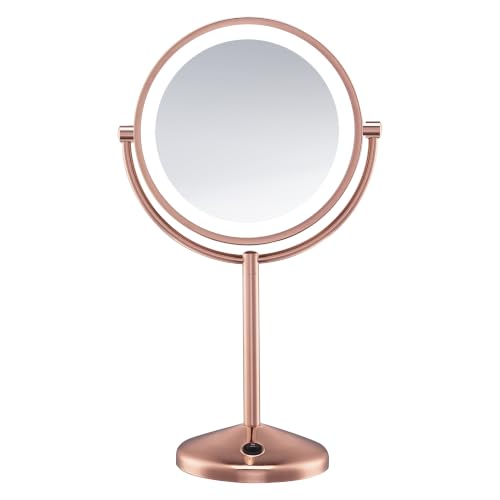
Conair Double-Sided Lighted Makeup Mirror
The Conair Double-Sided Lighted Makeup Mirror is a corded tabletop design from one of the longest-running names in personal care mirrors, built around a flip frame with a regular reflection on one side and a magnified view on the other, ringed by its own lighting. Where it earns its place is reliability of format rather than novelty. Generations of dressing tables have used exactly this layout because it works: sit down, flip to detail, flip back to truth. Judge it on glass clarity and hinge smoothness when you compare it with rivals. Positioning: entry-to-mid tier, priced by tier rather than by gimmick — check the current listing for the live figure. Best for: readers of this guide whose routine matches that shape. Not suited for: anyone whose space or habits contradict the format, however good the glass.
Review verdict. The dependable default. Its format is the category’s centre of gravity and its execution is honest: flip, light, sit, work. It will not thrill anyone, and it will satisfy almost everyone whose routine is makeup at a fixed station. Against flashier rivals it wins on the unglamorous axes — always ready, nothing to charge, a layout a decade of users has debugged. Its limits are the format’s limits: counter footprint and no profile view. As the first mirror in a household, or the spare that ends arguments in a guest bathroom, it is the safest pair of hands in the field.

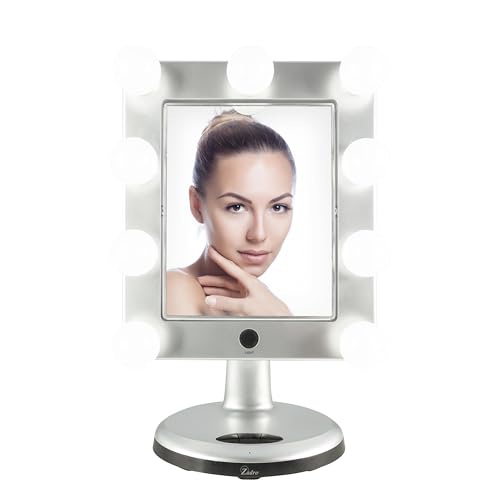
Zadro Dual Sided Vanity Mirror
The Zadro Dual Sided Vanity Mirror is a dual-sided vanity mirror from a brand that has specialised in magnification mirrors for decades, typically finished in polished metal tones and aimed at a permanent dressing-table spot rather than travel. Consider it the specialist’s tabletop. If your routine is brow-heavy, liner-heavy or lens-heavy, a mirror from a magnification specialist is a rational place to spend the mid-tier money, provided the room’s light or its own illumination keeps the enlarged view honest. Positioning: mid tier, priced by tier rather than by gimmick — check the current listing for the live figure. Best for: readers of this guide whose routine matches that shape. Not suited for: anyone whose space or habits contradict the format, however good the glass.
Review verdict. The detail specialist, and the connoisseur of the magnified view. Where the default treats magnification as one side of a coin, this contender treats it as the main event, and routines built on brows, liner and lenses can feel the difference in control. It asks a little more of its owner — a settled station, a routine that genuinely uses the close view daily — and repays that commitment every morning. Households whose makeup is a quick overall application will find its specialism wasted; households built on precision will find everything else in the field slightly blunt by comparison.
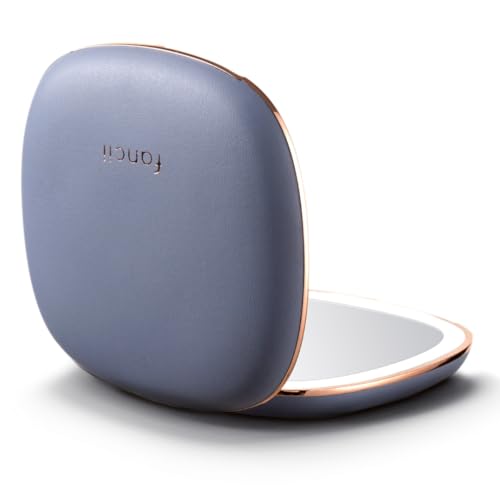
Fancii Mila LED Lighted Vanity Mirror
The Fancii Mila LED Lighted Vanity Mirror is a rechargeable LED vanity mirror from a beauty-tools brand known for portable, design-led mirrors, with touch controls and a clean, cord-free silhouette once charged. The appeal here is freedom from the cord. Charged, it goes wherever the light and the chair are best — a bedroom desk, a bathroom with no spare outlet, a suitcase. Touch controls keep the face of the mirror clean, and the design-led styling means it does not have to hide when guests use the bathroom. Positioning: mid tier, priced by tier rather than by gimmick — check the current listing for the live figure. Best for: readers of this guide whose routine matches that shape. Not suited for: anyone whose space or habits contradict the format, however good the glass.
Review verdict. The flexible modern all-rounder. Cord-free life changes where a mirror can work — the good chair, the good window, the suitcase — and this design makes that freedom feel designed rather than improvised. Its review hinges, fairly, on a habit: owners who charge casually and often will call it flawless; owners who let every device in their life run flat will meet its one weakness at the worst moment. For renters, travellers and the outlet-poor, it is the easiest recommendation in these reviews; for a fixed vanity beside a socket, its freedom is a pleasure you may not need.

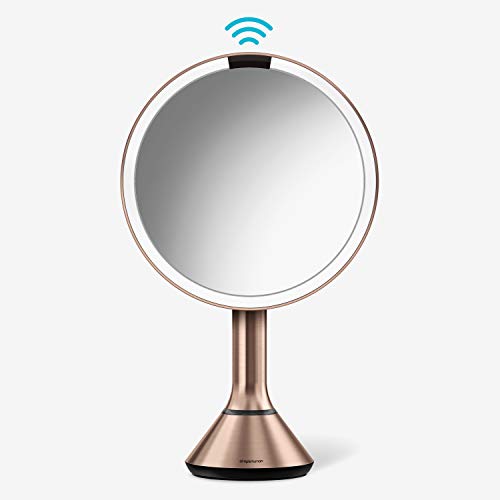
simplehuman Sensor Mirror
The simplehuman Sensor Mirror is a sensor-activated mirror from a design-focused home brand, built to light up as your face approaches and to mimic natural sunlight as closely as the brand can manage, in a brushed metal finish. Buy it as furniture-grade equipment, not as a gadget. The sensor convenience is real but secondary; the reason to spend at this tier is a reflection you can trust for colour decisions, in an object built to be looked at as much as looked into. It is the connoisseur’s answer, priced like one. Positioning: premium tier, priced by tier rather than by gimmick — check the current listing for the live figure. Best for: readers of this guide whose routine matches that shape. Not suited for: anyone whose space or habits contradict the format, however good the glass.
Review verdict. The premium benchmark, bought for light. Strip the sensor theatre away and the case remains: a reflection lit as close to daylight as the category manages, waking as you approach, in an object with furniture-grade presence. Colour-critical users — the foundation matchers, the blush calibrators — are its constituency, and for daily users the cost per morning argument is genuinely strong. Everyone else is paying for the last increment of light quality, which is a legitimate purchase and an optional one. It reviews at the top of the field on merit and at the top of the tier on price, and both facts belong in the same sentence.
KEDSUM Trifold Lighted Makeup Mirror
The KEDSUM Trifold Lighted Makeup Mirror is a folding three-panel lighted mirror that opens out to show your face and both profiles at once, then closes flat enough for a drawer, popular with shared bathrooms and smaller vanities. The tri-fold format is the value play for angles: open the panels and your profile, your parting and the back of an updo all become visible without a second mirror or a doorway shuffle. Closed, it nearly disappears. For shared bathrooms and small counters, that disappearing act is the feature. Positioning: entry tier, priced by tier rather than by gimmick — check the current listing for the live figure. Best for: readers of this guide whose routine matches that shape. Not suited for: anyone whose space or habits contradict the format, however good the glass.
Review verdict. The angle-giver at an entry tier, and the surprise of the field. Nothing else at its level shows you your own profile, parting and the back of a style, and for hair-led routines that single ability outweighs a column of features. The review conditions are hinge stiffness and counter width: panels that hold their angle, on a surface that can host them open. Shared bathrooms and small vanities that fold it away daily will love it; a buyer wanting a permanent, always-open station should look at its corded cousin instead.

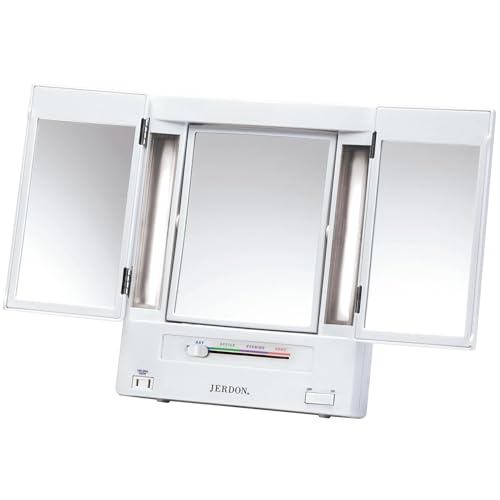
Jerdon Tri-Fold Two-Sided Lighted Makeup Mirror
The Jerdon Tri-Fold Two-Sided Lighted Makeup Mirror is a corded tri-fold mirror from a long-established mirror maker, with side panels for angled views and magnification in the centre panel, designed to live on a dressing table full time. A corded tri-fold is the dressing-table traditionalist: always ready, never flat, with side views and a magnified centre for the full routine in one station. It suits a permanent setup where the mirror never travels and the routine is unhurried — hair, makeup and final profile check at one seat. Positioning: mid tier, priced by tier rather than by gimmick — check the current listing for the live figure. Best for: readers of this guide whose routine matches that shape. Not suited for: anyone whose space or habits contradict the format, however good the glass.
Review verdict. The tri-fold as furniture. Where the folding entry design is a traveller between drawer and counter, this corded version is a resident: always open, always ready, the full styling station for households where hair and makeup share one seat and one mirror. It reviews best on a deep dressing table and worst on a narrow shelf, which is not a flaw but a measurement its buyer must honestly take. Between the two tri-folds, the choice is lifestyle — portability versus permanence — and these reviews decline to call either the winner.
Head-to-Head: What Actually Separates Them
Set side by side, the field divides cleanly. On glass, the specialist and the premium benchmark lead, with the default close behind and the tri-folds judged more on their hinges than their optics. On light, the premium design’s daylight ambition sets the standard, the cord-free all-rounder follows, and the corded formats trade sophistication for certainty. On space, the wall’s absence from this field is itself a finding — buyers whose counters cannot host any of these should leave this page for the swing-arm family entirely, accepting the installation project that comes with it. On value per morning, the entry tri-fold and the dependable default are remarkable, the specialist and all-rounder fairly priced for their constituencies, and the premium benchmark expensive in the way of all benchmarks: justified by daily use, indulgent without it.
Not all mirror glass is equal, and magnification exposes the difference. A well-made magnified surface keeps straight lines straight right up to a reasonable working distance; a poor one warps the image, so an eyeliner line that looks level in the glass is not level on your face. The simplest test is to hold a straight edge — a makeup brush handle works — across the reflection and move it slowly. If the reflected line bends, swims or doubles, the glass will mislead you on exactly the detail work you bought it for. Slight softness at the very edge of a strongly curved lens is normal physics; distortion in the centre, where you actually work, is not. Flat mirrors distort less by nature, which is one more reason the plain side of any pairing remains the final authority before you leave the house.
Which Reviewed Mirror Suits Which Routine
Precision-first routines belong to the specialist. Renters, travellers and the outlet-poor belong to the cord-free all-rounder. Hair-and-makeup routines belong to the tri-folds, split by whether the mirror must fold away or may live open. Colour-critical daily routines with the budget for it belong to the premium benchmark. Everyone else — the large, sensible middle — belongs to the dependable default, which is why it leads this page. If your routine matches none of these descriptions because it is two minutes long in a bright bathroom, the honest review verdict is that you need none of them, and the cluster’s value assessment in whether a makeup mirror is worth it will talk you out of the purchase with our blessing.
How to Test Any of Them in the First Three Mornings
Lighted mirrors add two small habits. Keep charging ports and battery compartments dry, and never clean a plugged-in mirror with a wet cloth around its cord or switch. If the light ever flickers, buzzes or behaves oddly, unplug first and investigate second — and for a hardwired model, that investigation belongs to an electrician, not to curiosity. Finishes deserve the same gentleness as glass: plated and brushed metals cloud under abrasive pads, and a soft cloth keeps them honest. None of this is burdensome; it is the small effort that separates a mirror that still delights in year five from one that quietly became bathroom clutter.
Morning one: the straight-edge and white-card glass tests, plus one full routine ending at a window. Morning two: the worst-case session — your earliest start, your room’s real light, glasses on and off if that is your life. Morning three: the shared test, if the mirror will be shared — the second user’s height, distance and verdict. A mirror that passes all three has earned its place; a mirror that fails one has told you so while returning it is still easy. This testing discipline matters more than any review, including this one, because the variables — your eyes, your light, your counter — are the ones no reviewer can hold.
The Reviews’ Bottom Line
The category is in good health: every format in this field has at least one execution worth owning, and the differences that matter are fit, glass and light rather than novelty. Buy the format your routine describes, test it like a sceptic for three mornings, and keep the plain-view check sacred. Do that and the specific badge on the mirror matters less than the mornings it improves — which is, in the end, the only ranking these reviews fully trust. The single-product deep dive lives in our makeup mirror review, and the format-versus-format lighting question is settled in makeup mirror vs lighted makeup mirror.
Finish interacts with the room’s climate as much as its palette. Polished and brushed metals shrug off bathroom humidity best and age into their surroundings; painted and wooden frames belong in drier rooms, where they bring warmth a metal cannot. Black frames ground pale rooms and show dust honestly; bright metallics bounce a little extra light around the glass, a trivial but real contribution. Whatever the finish, the test is tactile: edges smooth, corners finished, no sharp seam where fingers will travel daily during flips and tilts. A mirror is handled more than most furniture, and its finish is a daily handshake, not a photograph.
The packing rules are simple and worth stating: glass travels closed, padded, and away from hard edges in the case; cords and chargers travel in the same pouch every time so the kit is checkable at a glance; and a rechargeable mirror travels charged, because the first night is when it is needed. A mirror that survives a year of luggage has proven more about its hinges and case than any showroom handling can, which is why the folding designs that endure develop loyal followings entirely out of proportion to their price tier.
Skin looks different under every light it meets, and a good routine plans for the translation. Makeup applied for an office day should survive cool overhead light; makeup for an evening venue will live in warm dimness, where heavier definition reads as normal. Mirrors with multiple colour settings let you preview those translations at the vanity instead of discovering them in photographs. Use the settings as destinations, not as home: apply in neutral, preview in the venue’s setting, adjust only what the preview proves needs adjusting. The users who look consistently right in every room are rarely using different products — they are using the same products with a translation step built into the mirror routine.
Children and teenagers enter the picture too, usually at the stage of first routines — skincare, braces checks, early makeup experiments. A household mirror at a sensible height with moderate magnification serves those years gracefully, and the safety rules scale with it: stable bases over tippy stands, mounts checked as part of household routine, and nothing heavy hung where anyone sleeps beneath it. The mirror that serves a household rather than a person should be bought a size up in sturdiness and a step down in specialisation, because its users will span more heights, eyes and habits than any single routine predicts.
How These Reviews Handle Disagreement
Reasonable reviewers weigh this field differently, and the disagreements are instructive. Light maximalists rank the premium benchmark first and forgive its tier; value realists rank the dependable default first and forgive its plainness; travellers swear by the cord-free design and forgive its charging habit. These reviews have tried to make their own weighting explicit — glass first, light second, build third, fit always — so that a reader whose weighting differs can re-rank the field for themselves from the same findings. That transparency matters more than the order printed here, because the reader’s routine is the one being served. Any review that cannot tell you how to disagree with it is asking for trust it has not earned.
The Field in Five Years
Categories mature in predictable directions, and this one’s trajectory is visible: light gets more honest and more adjustable at lower tiers, charging gets faster and more universal, hinges and arms get smoother as the budget end absorbs the premium end’s engineering. What will not change is the optics at the category’s heart — glass, distance and the flip between scales — because those are physics, not fashion. The buying implication is reassuring: a good mirror bought now is not a placeholder for a revolution. It is a mature tool in a mature category, and the five-year risk is not obsolescence but the ordinary one of buying the wrong format for your room, which these reviews exist to prevent.
Picture the guest scenario: a friend staying over, a borrowed bathroom, a routine performed in someone else’s light with someone else’s mirror — or, more often, with no suitable mirror at all. Hosts who keep a simple, decent mirror in the guest space perform a small kindness that guests remember out of proportion to its cost, and the folding and rechargeable designs serve here precisely because they ask nothing of the room. It is a minor scenario in the arithmetic of buying, but it reveals the category’s social truth: a good mirror is hospitality equipment as much as beauty equipment, and the households that understand that are the ones whose spare rooms feel finished.
Picture the weekday morning the mirror actually serves. The alarm has done its worst, the light outside is either absent or unhelpful, and there are twenty minutes between the shower and the door. This is not the tutorial’s morning; nobody is blending for an audience of cameras. The mirror’s job in this morning is triage: even out the base, wake the eyes, make the brows agree, check the whole at life size, leave. A mirror that serves triage well — quick to its angle, honest in its light, flip ready — is worth more than a beautiful one that must be fetched, unfolded, plugged and persuaded. When you evaluate any design, run this morning against it in your imagination, because this morning, repeated two hundred times a year, is the product you are actually buying.
Small ergonomic details compound. A mirror that tilts with one finger gets adjusted; a mirror that needs two hands and a wrestle stays at yesterday’s angle and quietly mis-serves today’s user. A base that yields counter edge for forearms to rest on steadies the whole upper body. Light controls reachable without breaking position — a touch surface, a dial at the frame’s edge — keep the working posture intact through adjustments. Even the chair participates: a stool that swivels lets the window check happen without standing, and a seat at the height that puts the mirror’s centre at eye level is worth more than any single feature on the mirror itself. Ergonomics is the category’s least marketed virtue and its most felt one, morning after morning.
There is also the mistake of the single data point: one bad morning blamed on a new mirror, one good photograph credited to it. Mirrors should be judged across a week of varied mornings — early and late, rushed and slow, glasses and lenses — because their value is statistical, an average lifted across hundreds of repetitions. The buyer who understands this tests patiently and returns rarely; the buyer who judges on day one churns through the category collecting first impressions. Given that the whole promise of the product is consistency, judging it inconsistently is the one error that guarantees dissatisfaction regardless of which mirror eventually wins.
Longevity, in the end, is mostly a biography of small handlings. The mirror set down gently ten thousand times outlives the mirror knocked ten times. The glass wiped with the right cloth keeps its clarity; the glass scoured in frustration clouds by degrees so slow the owner blames their eyes. Even the humble act of closing a folding mirror at night protects its faces from the bathroom’s drifting dust and spray. None of this requires virtue, only the recognition that a mirror’s lifespan is decided less by its purchase price than by the thousand unremarkable interactions that follow — which is, when you think about it, an encouraging specification, because it is the one entirely in the owner’s control.
Light behaves differently in each of those rooms, too. Bathrooms concentrate hard, reflective surfaces that bounce light unpredictably; bedrooms soften everything with fabric; hallways borrow whatever the nearest doorway offers. A mirror moved between rooms will seem to change character — the same glass, the same lamp, a different verdict — which is not the mirror being inconsistent but the room revealing its share of the reflection. This is why the final judgement of any mirror should happen in the room it will live in, at the hour it will work, and why moving a disappointing mirror before replacing it is the cheapest experiment in the whole category.
Video calls deserve their own sentence, because they have quietly become a daily mirror of their own — and a badly lit one, usually from below or above at a laptop’s convenience. Many people now keep the vanity mirror’s habits for calls: face lit frontally, camera near eye level, the plain view’s honesty applied to what colleagues will see. A lighted mirror near a desk earns a second career here, and more than one household has discovered that the makeup mirror bought for mornings is, by afternoon, the best-lit seat in the house for being seen. Tools that serve two rituals justify their footprint twice over.
A Note on Star-Free Judgement
These reviews deliberately avoid the compressed verdicts — the single score, the tidy ranking — that dominate the category’s coverage, because mirrors fail and delight in dimensions a score flattens. A design can be optically superb and wrong for your counter; another can be ordinary glass in exactly your format. The findings here are therefore organised so the reader can re-weight them: glass findings stay glass findings, fit findings stay fit findings, and the verdicts name their constituencies rather than crowning a champion. If that makes the page slower to skim, it also makes it safer to buy from, and in a category where the wrong purchase is usually a fit error rather than a quality error, safety beats speed. The best review is the one whose logic still works when its ranking does not apply to you.
If the Budget Allows Exactly One Upgrade
Readers stretching from an old, basic mirror often ask where a single step up should be spent, and the field’s answer is consistent: spend it on the light if your room is dim, on the glass if your routine is detail-led, and on the format if your current mirror’s shape is the daily friction — in that diagnostic order. Upgrading everything at once is how the premium tier gets bought by people who needed one change. The contenders in these reviews were chosen so that each represents one of those single steps executed well, which is why the page resists declaring a hierarchy among them: they are answers to different single questions, and the reader’s own mirror history reveals which question is theirs.
A makeup mirror quietly reorganises the morning around a seat. Instead of a routine scattered between a bathroom mirror, a bedroom window and a phone camera, everything migrates to one station: products within reach, brushes in order, both scales of view a flip apart. That consolidation is an underrated benefit, because a routine with a home base gets faster and calmer at the same time. Lay the station out like a cockpit — daily products on the dominant-hand side, occasional items behind, a small tray for the tools in flight — and the mirror becomes the anchor of a workspace rather than an object on a surface. People who make the switch often report that the routine shrank by minutes without any step being cut; the minutes were in the walking, the leaning and the re-checking, and the mirror removed all three.
Bathrooms are hostile environments for optics. Steam condenses on cool glass, moisture hunts the edges of the silvering, and the daily cycle of fog and dry repeats for years. A mirror that lives over a sink should be chosen and treated with that climate in mind: sealed edges, finishes that shrug off humidity, and ventilation doing its share — an extractor fan or an open door after showers slows the ageing of everything in the room, mirrors included. The fog itself has workarounds, from warming the room before a shower to the simple patience of doing makeup after the air clears, and many routines migrate to a bedroom vanity for exactly this reason. None of this is a reason to fear a bathroom mirror; it is a reason to buy one built for the climate it will actually live in.
The year’s turning changes the mirror’s job. In summer, morning light arrives early and strong, and a mirror near a window may need its own light only for detail. In winter, the whole routine happens in the dark, and the mirror’s light becomes the sun’s understudy for months — the season when dim or warm-only mirrors are found out, and when the daylight check at the window moves to midday, after the makeup is already being worn. Households that get ready across seasons learn to distrust any judgement made in only one kind of light, which is the deep reason dimmable, neutral-leaning mirrors earn their keep: they hold the reflection constant while the year swings around it. Consistency, again, is the feature hiding inside all the others.
The mirror’s neighbourhood decides whether the station works. Crowded counters push products into the mirror’s swing, tilt and light; a mirror hemmed in by bottles gets its glass splashed, its base knocked and its owner quietly annoyed. Give the station a border — a tray that defines the working set, storage behind or beside for the reserves — and the mirror’s sightlines stay clean. Vertical thinking helps small spaces: the wall above a vanity can hold the mirror while the surface holds only today’s tools. Cable discipline belongs to the same paragraph: a cord with a planned, dry route looks intentional and stays safe, while a cord improvised daily across a wet counter is an accident rehearsing. Organisation is not tidiness for its own sake; it is what lets the optical instrument do its job unobstructed.
Professional makeup artists, who work on other people’s faces under deadline, organise their mirrors by principles worth stealing. Their light is ruthless about neutrality, because a face that must survive photography cannot be built on flattery. Their working distance is fixed and repeatable, often marked by habit into the furniture itself. They check the work at multiple distances — close for detail, arm’s length for quantity, across the room for the whole effect — because each distance reveals a different class of error. And they distrust any single mirror’s verdict, cross-checking against the room’s light before declaring a face finished. A home routine that borrows even two of these habits — the fixed distance and the multi-distance check — gains most of what the professional’s setup provides, at no cost beyond attention.
A closing observation from across the whole field: the contenders in these reviews disagree about almost everything — power, format, tier, theatre — except the reflection itself, which every serious maker in the category now delivers competently in the plain view. That convergence is why these reviews spent their length on fit, light and mechanisms rather than on declaring glass winners: the category has matured past the point where the basic promise is in doubt, and the buyer’s remaining risks are personal, not industrial. It also means the secondhand and hand-me-down market in these designs is unusually trustworthy, since a five-year-old example of any contender here, honestly kept, still does the central job. Buy for the decade, choose for the room, and the badge matters least of all — a conclusion the field’s own convergence forces on any honest set of reviews.
One pattern in the field deserves a final underline: every contender here is somebody’s perfect mirror and somebody else’s return, and the difference is almost never quality — it is the match between a fixed set of trade-offs and a particular household’s non-negotiables. That is why these reviews have repeated their constituencies like a refrain. The reader’s task is not to find the best mirror on the page but to find their own non-negotiables in it: the outlet that does not exist, the counter that cannot widen, the eyes that need the close view, the hair that needs the angle. Name those, and the field ranks itself.
And a practical closing note for buyers comparing these contenders live: listings change, finishes rotate and model names drift with the seasons, so anchor your comparison to the formats and findings here rather than to any single listing’s current wording. The format truths in these reviews — what a tri-fold does, what a sensor buys, what a specialist magnifier feels like at dawn — will outlast any season’s catalogue, and they are the part of the page designed to still be useful when the specific products have been refreshed around them.
For readers who arrived wanting a single name, the reviews will offer the closest honest thing: if your household matches the statistical middle of this category — a seated routine, a dim-to-average bathroom, detail work a few times a week, no strong feelings about cords — the dependable default at the head of the field is the mirror the evidence would hand you, and the specialist, cord-free, premium and folding contenders are the documented directions to trade from it when your household’s facts differ from the middle. That is not a dodge; it is what a field of genuinely different designs requires of an honest ranking.
Reviewing this field also changed one habit worth passing on: judge a mirror’s product photographs by its shadows. A photograph where the mirror’s own light models the face softly and evenly, without hot spots or dark chins, is evidence; a photograph where the mirror merely glows decoratively beside a plant is advertising. The contenders above earned their places under the first kind of scrutiny, and readers applying the same test to any new arrival in the category will sort the field faster than any feature table can.
Trust the findings, then, but verify them at your own sink — that partnership between a review and a reader’s three mornings is how this category is best bought, and it is the standard this page asks to be judged by.
Detail by Detail: Reading a Makeup Mirror Listing Like an Inspector
Listings present a makeup mirror at its best, so this section slows the assessment down and looks at the evidence an individual model offers: its construction, its finish, its listing detail and the checks you can run before and just after it arrives. The aim is a verdict based on inspection rather than impression.
Start With Your Space and Your Routine
If the makeup mirror will be seen every day, its proportions matter as much as its function, so hold the listing dimensions up against a familiar piece nearby to judge the visual weight honestly. If a part of the makeup mirror can be replaced, refreshed or re-covered separately, that option can extend its useful life well beyond the point where a sealed design would be thrown out. Decide in advance which single feature you would refuse to compromise on, and let that one priority settle ties between otherwise similar makeup mirror choices. Think about the end of the makeup mirror’s life with you as well, including whether it could move to another room, be passed on, or be stored without damage when your needs change.
A closer look at any single makeup mirror should start with the unglamorous evidence: the underside, the back, the inside and the fittings, because review photographs concentrate on the angles that flatter it most. Photograph the makeup mirror as delivered, before assembly or first use, so that any later question about condition, parts or finish can be answered from evidence rather than memory. Apply the same checks to each shortlisted example, whether that is the Jerdon Tri-Fold Two-Sided Lighted Makeup Mirror; the KEDSUM Trifold Lighted Makeup Mirror; the Zadro Dual Sided Vanity Mirror, because consistent testing is what makes the differences between models visible. When you compare delivery options for a makeup mirror, factor in where the item will be left and who will move it to its final spot, since the last few metres are where damage and strained backs happen.
When Small Problems Appear
Take a break between shortlisting and ordering if you can, and return to the listings with fresh eyes, because fatigue makes almost any makeup mirror look acceptable late in a long search. Start by writing down the job the makeup mirror has to do in your home, in one plain sentence, before you look at another listing, because a clear job statement turns a long shortlist into a short one. Read the listing for what it does not say as carefully as for what it does, because missing information about materials, assembly or care is itself a useful signal when you compare makeup mirror options. Write down the three tasks you will do most often with the makeup mirror and score each shortlisted option against those tasks alone, ignoring features you are unlikely to touch.
Dust, moisture, sunlight and heat each age Beauty & Personal Care items in different ways, so match the finish and material of the makeup mirror to the conditions of the room or outdoor spot it will occupy. A single makeup mirror can be well made and still wrong for your home, so keep two verdicts separate as you assess it: the quality verdict and the fit-for-your-life verdict. If the listing offers accessories for the makeup mirror, decide which ones solve a problem you already have, and set aside the ones that only solve problems the listing itself invented. A return is easiest when you have kept the packaging until you are sure, so give the makeup mirror a fair trial period in its real position before you break down boxes and dispose of padding.
Think about who else will use the makeup mirror, how often, and in what way, because a choice that suits one person perfectly can frustrate everyone else in the household.
A Short Decision Checklist
- Packaging kept until the makeup mirror has passed its first trial in place
- The main job the makeup mirror must do, written in one sentence
- The material and finish, matched to light, moisture and wear in its spot
- Assembly needs, tools required and whether help is needed
- What your current arrangement does badly that the makeup mirror must fix
- Where the makeup mirror and its accessories will be stored when not in use
- Delivery path, from the door to the final position
- The measured space, including clearance to use and clean around the makeup mirror
Taken together, these checks take only a little time, yet they answer the questions that decide whether the makeup mirror suits your home, your household and your routine, and they do so before money changes hands rather than after.
Frequently Asked Questions
Is a makeup mirror a good gift?
It is one of the safer beauty gifts because it improves a routine without presuming anything about skin, shade or taste. Choose versatile over extreme: a double-sided tabletop with gentle magnification and decent light suits almost everyone, while very strong magnification is a personal, eyesight-specific choice best left to the recipient. Rechargeable designs gift well because they need no outlet planning. If the recipient rents, avoid wall-mounted gifts that demand drilling. Include the receipt mindset — a mirror is a daily object, and the right one is the one that fits their counter, not your guess.
How long should a makeup mirror last?
A well-made one should last many years — glass and hinges have no natural expiry. What ages mirrors is environment and handling: steam creeping into unsealed edges, abrasive cleaning, knocks to the frame, and, in lighted models, batteries and charging habits. A mirror kept in a dry bedroom typically outlasts the same mirror over a steamy sink. Buy sealed edges, metal where parts move, and a finish suited to your room’s humidity, then clean gently and keep mounts checked. Treated that way, a makeup mirror is closer to furniture than to a consumable.
Is a makeup mirror better than a regular bathroom mirror?
For detail work, yes; for an overall check, they are equals. A bathroom mirror shows the whole face at life size and remains the honest final judge, but it fixes you at sink distance under whatever light the room happens to have. A makeup mirror moves the reflection to you, adds magnification for close tasks and, in lighted versions, brings its own even light. Most good routines use both: detail at the makeup mirror, verdict at the bathroom mirror before leaving.
Can two people share one makeup mirror?
Yes, if adjustability does the diplomatic work. Different heights want a tilting or height-adjustable design; different eyesight wants moderate magnification rather than one person’s strong prescription-like strength; different schedules want a mirror that moves or folds so the counter resets between users. A double-sided tabletop on a shared dressing table usually negotiates all of this gracefully. Wall-mounted mirrors share less well unless the mount height suits both users standing. When in doubt, choose the design that adjusts, because the users are not going to.
Do I need magnification if I wear glasses?
Quite possibly — glasses are exactly why many people discover magnified mirrors. Eye makeup requires removing the glasses, and without them the plain mirror may sit outside your clear focus range. A magnified side brings the detail back into reach. Choose the strength by sitting at your real vanity distance and testing, not by ordering the strongest available: too much magnification shrinks the visible area and shortens the working distance uncomfortably. Pair it with strong, even light, since light and magnification solve the same problem together better than either does alone.
Should a makeup mirror be corded, battery or rechargeable?
Match the power to the placement. Corded suits a permanent vanity with a nearby outlet and never runs flat, but the cord must be routed dry and clear of the sink. Battery models go anywhere and travel well, with light that fades as the cells weaken. Rechargeable designs are the modern default for most homes: cord-free in daily use, topped up occasionally, and happy on a desk or in a bathroom with no spare outlet. There is no wrong answer, only mismatches — a corded mirror with no outlet nearby is a return waiting to happen.