Disclosure: As an Amazon Associate, dailyhomedecorating.com earns from qualifying purchases. Links on this page are affiliate links; they cost you nothing extra. Prices and availability change often, so check the current Amazon listing before you buy.
These compost bin reviews compare the shortlist that matters for most households — three ways of collecting scraps in the kitchen and three ways of processing them in the garden — and they are organised around a simple truth about the category: there is no single best compost bin, because a compost bin is two products. The countertop caddy is judged on containment, washing and the rhythm of your cooking; the outdoor bin or tumbler is judged on capacity, turning and how it handles your garden’s material. So this page reviews six representative products in their pairs, scores each against the criteria its job actually involves, and ends with matched recommendations: which caddy with which processor, for which household. If you want the single-product deep dive instead, it lives in the companion compost bin review; this page is the comparison.
A note on method, because it shapes every judgement below. These reviews assess designs against the full working cycle of composting — filling, holding, emptying, washing, turning, balancing, harvesting — and against the failure modes that actually end home composting: smell, fruit flies, neglected filters, unbalanced loads and equipment that makes its own routine unpleasant. Tiers are described qualitatively, and every product is treated prose-first here, with its slot marked where a verified purchase link will sit at publishing. What no review on this page will do is crown a winner without a household attached, because in this category the household is half the product.
Key Takeaways
- Best everyday caddy: the OXO Good Grips, for households that empty daily and want the simplest wash.
- Best filtered caddy: the EPICA stainless bin, for households that empty every few days and need charcoal odour control.
- Best outdoor processor for most households: a dual-chamber tumbler — the FCMP for finish, the VIVOSUN for value.
- Best small-space processor: the compact Miracle-Gro tumbler, run in disciplined batches.
- Every pick fails without the same basics: sealed lids, regular washing, dry browns with the greens, and no meat, dairy or oils, ever.
Compost Bin Reviews: The Shortlist at a Glance
| Product | Role | Tier | Choose It If | Pass If |
|---|---|---|---|---|
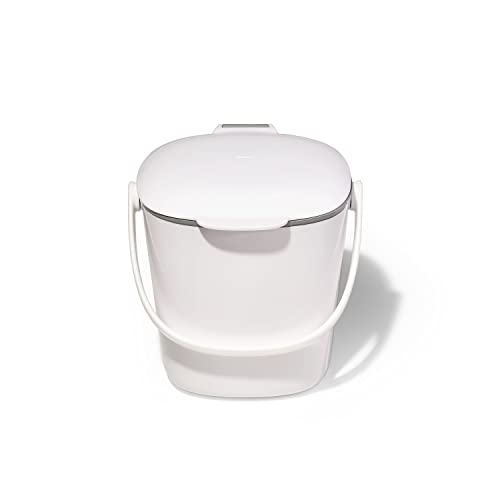
| OXO Good Grips Compost Bin | Countertop caddy | Mid | You cook and empty daily | Your scraps wait several days |
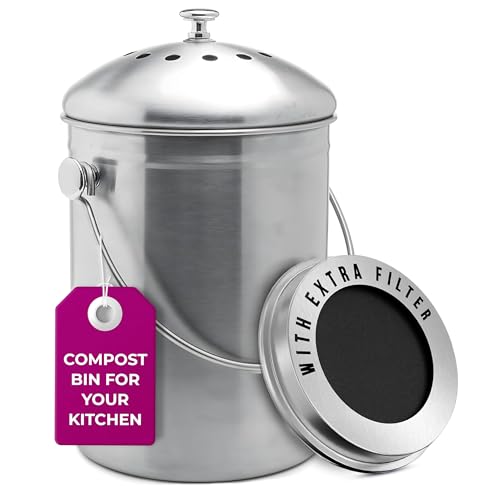
| EPICA Stainless Steel Compost Bin | Filtered countertop caddy | Mid | You empty every few days and want steel and a charcoal filter | Counter space is scarce |
| Joseph Joseph Totem | Integrated waste station | Premium | You want all waste streams in one unit | You only need the compost function |
| FCMP Outdoor Tumbler | Dual-chamber tumbler | Mid | You want continuous, tidy, rodent-free processing | Your waste is mostly bulky garden material |
| VIVOSUN Tumbler | Dual-chamber tumbler | Entry to mid | You want two chambers on a value tier | You dislike self-assembly |
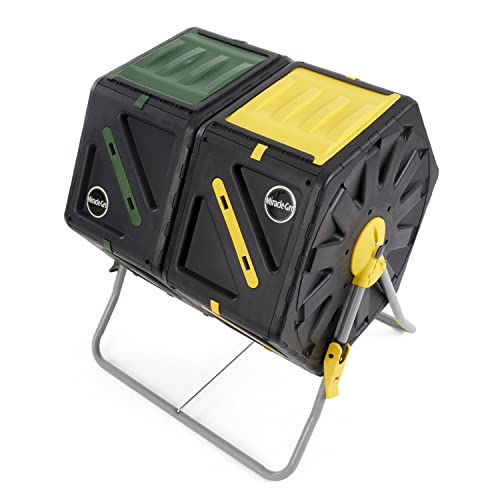
| Miracle-Gro Tumbler | Compact tumbler | Entry | Space is tight and batches suit you | You need volume |
Read the table with your own waste stream in mind. The caddy rows divide by emptying rhythm — daily, every few days, or built into a station — and the tumbler rows divide by scale and finish. The reviews below take each product in turn, in the order a household usually buys them: kitchen first, because the kitchen is where the habit forms, then the garden, where the volume lives. Each review follows the same pattern — what it is, how it performs across the working cycle, where it falls short, and the verdict with its best-for and not-suited-for lines — so the six can be compared honestly rather than by the loudness of their claims. The criteria behind the scores are the ones developed in the compost bin buying guide, and the value question behind all of them is examined in is a compost bin worth it.
In this guide
The Kitchen Picks Reviewed

OXO Good Grips Compost Bin — Best Everyday Caddy
The OXO is the caddy reduced to its essentials and then executed properly: a countertop container whose lid stays open while you scrape a board into it and closes to contain the contents, a smooth interior with nothing for residue to hide behind, and a size matched to the daily output of a cooking household. Across the working cycle its strengths are all in the first three stages. Filling is frictionless — the lid behaviour suits the one-handed reality of cooking better than designs that demand two hands or a pedal. Holding is adequate rather than exceptional: there is no charcoal stage, so containment relies on the lid and on the household emptying before biology gets ambitious, which for this product’s intended rhythm — daily, or every other day — is a fair design bargain. Emptying and washing are where it quietly wins the comparison, because the whole vessel can be rinsed at the sink in seconds and given a proper hot soapy wash as often as the routine demands, with no filter housing, seams or textures complicating the job. In a category where smell is a washing outcome, the easiest caddy to wash is, in practice, one of the best-smelling caddies to own.
Its limitations are the mirror of its simplicity. Households that empty weekly will outrun its containment and should buy filtration instead. It offers no answer to the household whose scraps include a lot of wet, heavy material beyond holding it briefly. And it is, like every caddy, a staging post: buyers expecting it to reduce or transform waste will be disappointed, because transformation is the outdoor unit’s job. None of that dents its verdict for its intended owner. Best for: daily cooks who empty often and value a wash-and-go caddy. Not suited for: slow rhythms, large volumes between emptyings, or anyone buying a caddy as a composter.

EPICA Stainless Steel Compost Bin — Best Filtered Caddy
The EPICA is the classic answer to the slower rhythm: a stainless steel countertop bin whose lid carries a charcoal filter, sized and sealed for scraps that wait several days between trips to the garden. Its performance across the cycle differs from the OXO’s at exactly one stage — holding — and that stage is the one its buyers are paying for. A fresh charcoal filter absorbs the gases a multi-day load of vegetable scraps and coffee grounds produces, and the steel body keeps the vessel itself neutral: it absorbs no odours, tolerates indefinite hot soapy washing, and returns to a clean state that plastic designs with textured interiors struggle to match after months of use. Filling is a more deliberate act than with the OXO — a fitted lid to lift rather than a stay-open flap — and emptying is helped by the carry handle, a small detail that matters on a wet morning with a full bin.
The honest limitations are threefold. The filter is a consumable, and the product’s odour performance declines in direct proportion to the owner’s forgetfulness; put the replacement on a calendar or the review’s praise expires with the charcoal. The bin asks for permanent counter space and repays it only if the household’s rhythm genuinely runs to days. And the classic styling that suits many kitchens will read as purely utilitarian in design-led ones, where the Totem below makes its case. Within its brief, though, this is the most complete traditional caddy in the comparison. Best for: households emptying every few days that want steel hygiene and filtered holding. Not suited for: daily emptiers paying for filtration they will not use, or minimal counters.
Joseph Joseph Totem — Best Integrated System
The Totem is reviewed here as what it is: not a caddy but a waste station that includes one. Its proposition is that the compost habit succeeds when it is built into the single place a kitchen sorts everything — general waste, recycling and food scraps in one vertical unit — and in households whose kitchens suit that proposition, it is the most elegant solution in this comparison. The compost caddy element lifts out for emptying and washing, is lidded and sized for frequent trips, and benefits from the station’s discipline: because all sorting happens standing in one spot, scraps reliably reach the caddy instead of the general bin, which is a real-world performance gain no standalone caddy can claim. The station’s other streams are beyond this page’s scope, but their presence is the point: this product is bought by households reorganising their kitchen waste entirely, and judged by them on the whole system.
The limitations are structural. It is the premium tier of this comparison by a distance, and the premium buys the station, not better composting — the caddy itself performs comparably to the standalone designs above. Its caddy capacity suits frequent emptying, so high-volume scrap producers will find it small. And adopting it means adopting its format and accessories. The verdict is therefore conditional in a way the others are not. Best for: kitchens being organised around one tidy waste point, where compost is one stream among several. Not suited for: buyers who only need compost collection, or who produce scraps in large daily volumes.
The Garden Picks Reviewed
FCMP Outdoor Tumbler — Best Outdoor Tumbler
The FCMP is the reference dual-chamber tumbler in this comparison, and its review is really a review of that format executed at an honest mid tier. Two chambers in one rotating drum solve the tumbler’s structural problem — continuous input versus batch finishing — in the only clean way available: one side fills while the other finishes. In use, the format rewards the rhythm this cluster keeps recommending. Balanced handfuls go in — greens with browns, never a wet green load alone — the drum gets its turns several times a week, moisture is judged by the handful test and corrected with water or dry browns, and the sealed body keeps the whole process rodent-free and visually tidy in gardens where an open pile would be a problem. Processing pace sits at the tumbler format’s usual position: noticeably faster than a static pile for kitchen material, measured in weeks-to-months rather than days, and entirely dependent on the owner’s turning and balancing discipline.
Build and ownership sit at the tier’s honest level. Assembly is a genuine task that rewards care and a level site; the drum’s fittings and frame are serviceable rather than luxurious, and a full drum is a real weight to rotate, so the household’s designated turner should be part of the purchase decision. Harvest through the drum door is straightforward when the batch is properly finished and crumbly, and frustrating when it is wet — which is a comment on the batch, not the door. Against the static bin it wins on tidiness, exclusion and pace, and loses on bulk capacity and forgiveness. Against its dual-chamber rival below it wins on finish. Best for: households wanting continuous, contained composting of kitchen scraps and clippings. Not suited for: bulky seasonal garden waste, or owners who will not turn and balance weekly.
VIVOSUN Tumbler — Best Value Dual Chamber
The VIVOSUN brings the dual-chamber layout down to an entry-to-mid tier, and the review question is what the saving costs. Functionally, the answer is: less than buyers fear. The two-chamber drum, aeration and rotating action deliver the same composting method as the FCMP — the microbes do not read badges — and an owner who feeds balanced handfuls, turns several times a week and manages moisture will produce the same category of finished compost from either machine. The differences are in the ownership texture around that method. Assembly asks more patience. Fittings, finish and the general sense of refinement sit a clear step below the FCMP’s. And the long-term durability story is less proven, which matters for equipment that lives outdoors under load; the sensible owner checks the unit over on delivery, assembles it carefully on a level base, and treats latches and doors with the respect that value-tier hardware deserves.
Set against the Miracle-Gro below, the VIVOSUN’s extra chamber is worth more than its price step suggests, because continuous input is how households actually live. Set against the FCMP, it is the rational choice when the budget is the binding constraint and the owner is handy enough to enjoy assembly. Best for: value-focused households committed to the dual-chamber method. Not suited for: buyers who want the most refined ownership experience, or who will resent an afternoon of careful assembly.
Miracle-Gro Tumbler — Best Compact Tumbler
The Miracle-Gro is the small-space entry in this comparison: a compact single-chamber drum from a mainstream garden brand, aimed at patios, small yards and first-time composters. Its virtues are accessibility and containment. It assembles and operates without drama, occupies a corner rather than a plot, and keeps a modest batch of kitchen scraps processing inside a sealed, rodent-excluding drum — the format’s core benefits, miniaturised. For a small household whose alternative is no home processing at all, that is a meaningful offer, and its batches of finished compost, while small, are genuinely useful for pots, containers and a modest bed or two.
Its constraints must be bought knowingly. A single chamber enforces batch discipline — fill it, close it, let it finish, empty it — and fresh scraps produced during a finishing batch need somewhere to wait, which usually means the caddy carries a longer holding role or a simple holding container joins the system. Capacity excludes garden waste in any volume; this is a kitchen-scrap machine. And small batches in cold weather finish slowly, testing beginner patience at exactly the wrong moment. The ownership pattern this review most often recommends is to start here if space demands it, learn the method on its forgiving scale, and add a static bin later if the garden’s ambitions grow — at which point the little drum settles happily into the kitchen-material role. Best for: small spaces, patios and beginners. Not suited for: volume, continuous input, or impatient first-timers in cold climates.
Head-to-Head: The Comparisons Buyers Actually Make
Three pairings account for most real decisions in this category. OXO versus EPICA is the kitchen decision, and it is a rhythm decision wearing a product decision’s clothes: empty daily and the OXO’s frictionless, filter-free washing wins; empty every few days and the EPICA’s charcoal stage and steel body win by a wider margin than any feature list suggests. Buyers who misjudge their own rhythm buy the wrong one of two good products, so judge the calendar before the caddy. FCMP versus VIVOSUN is the finish decision: the method, the chambers and the results are shared, and the step between them buys assembly ease, fittings and refinement. Households that will handle the drum weekly for years should weight that ownership texture honestly; households buying carefully on a budget lose nothing in compost quality by choosing the VIVOSUN. Tumbler versus static bin is the garden decision, and it is about input and temperament: the tumbler for a steady stream of kitchen material in a tidy, excluded drum; the static bin for bulky seasonal volume and maximum forgiveness. Many mature systems run both, which is why the best compost bins already listed on this site remain worth reading alongside these reviews, and why the profiles in compost bin pros and cons are stated by household rather than by product.
How These Reviews Rate Hygiene — the Criterion That Decides Ownership
Every product above was also rated on the criterion that predicts whether its owner is still composting in a year: how well its design supports the hygiene routine that keeps a system sweet. The routine itself is short and non-negotiable. The caddy’s lid stays closed; its charcoal filter, where fitted, is replaced on schedule rather than on smell; wet scraps get a layer of shredded paper or torn cardboard, which absorbs moisture, blocks fruit flies from the surface and starts the carbon balance early; the caddy is rinsed at every emptying, washed properly with hot soapy water on a regular cycle, and dried before refilling, because the biofilm on interior walls is the true source of kitchen compost smell. Outdoors, the same principle scales: a balanced pile with air moving through it smells earthy, a wet and sealed one smells like a swamp, and the correction is always browns and turning. Products score well on this criterion when their shapes, seals, filters and doors make the routine easy — smooth interiors, lids that open fully for washing, drums that open wide for harvest — and poorly when their textures and fittings obstruct it. That is why the OXO’s washability earns it a best badge despite its simplicity, why the EPICA’s filter housing matters as much as its steel, and why every tumbler review above mentions its door. Buy the product whose hygiene routine you can picture yourself performing on a wet Tuesday in February; that picture is the most accurate review of all.
The Criteria Behind These Reviews
Comparison pages earn their keep by stating their criteria, so here they are, in the order they were weighted. For caddies, the first criterion is containment over the product’s intended holding span: lid seal, filter provision where the rhythm requires it, and a shape that does not leak moisture or harbour residue at its seams. The second is washability, assessed as a year-long prospect rather than a first rinse — can every surface be reached, can the lid and filter housing be cleaned, does the material return to neutral after a hot soapy wash. The third is filling ergonomics: how the lid behaves mid-recipe, whether the opening accepts a chopping board’s worth of peelings in one scrape, whether the whole thing can be carried full, one-handed, through a door. The fourth is fit: footprint, styling and capacity against the household’s cooking volume. Features beyond those four — novelty mechanisms, decorative finishes — were weighted lightly, because a year of ownership barely notices them.
For the outdoor processors, the first criterion is method fit: chamber logic and capacity against the household’s actual input stream, continuous or batch, kitchen-led or garden-led. The second is turning and handling: the effort and posture of the routine the owner will perform weekly for years, including how a full, wet load behaves, because a drum that is unpleasant to turn becomes a drum that is not turned, and an unturned tumbler is the category’s most common failure. The third is containment and exclusion: seals against rodents, tidiness in overlooked gardens, and behaviour in wind and heavy rain. The fourth is harvest: how finished compost leaves the unit, at what height, through how wide an opening, with how much excavation. The fifth is build as a durability prospect — drum material, frame protection, the fittings a hand touches weekly — judged qualitatively, because honest reviewing does not invent lifespans. Static bins, where they enter these reviews as the comparison point, were judged on the same five, with capacity and forgiveness weighted up and pace weighted down, reflecting what their buyers actually want from them.
One criterion was applied to every product without exception: how the design behaves when its owner is busy, tired or away. Composting systems do not fail in the attentive fortnight after purchase; they fail in the third week of a work crunch, during a holiday, in a heatwave, in the February rain. Designs were credited for margins — a filter with capacity to spare, a drum that tolerates a missed week of turning without going anaerobic beyond rescue, a caddy whose wash can slip a cycle without consequence — and marked down for knife-edge designs that perform beautifully only under perfect operation. That single lens explains several of this page’s judgements, including why simple, washable, generously sealed designs outscore clever ones, and why the dual-chamber format, whose whole purpose is margin against the household’s irregular rhythm, anchors the outdoor recommendations.
Matched Recommendations: Which Caddy With Which Processor
Because the system is bought in halves, the useful recommendations are pairings. The daily-cooking family with a garden should pair the OXO — emptied into the garden on its daily rhythm — with the FCMP, whose dual chambers absorb a family’s continuous stream; households in that profile that cook in bursts rather than daily should swap the caddy half for the EPICA and keep the tumbler. The small-space household with no collection scheme should pair the EPICA, whose filter bridges the longer holding times that small systems impose, with the Miracle-Gro’s compact batches. The value-conscious household should pair the OXO with the VIVOSUN and put the saving toward the unglamorous accessories that make systems work — a browns store, a spare filter supply where relevant, a decent trug for harvest. The design-led kitchen pairs the Totem with whichever outdoor unit the garden dictates, usually the FCMP for its tidiness. And the keen gardener should invert the spending: a simple caddy, chosen for washability alone, with the garden budget going to capacity — a static bin from the wider listings, or the FCMP where exclusion matters. Every pairing shares the same operating conditions, which these reviews state once more because they decide more outcomes than any product choice: keep meat, dairy and oils out of the system entirely; keep browns visibly ahead of greens; keep moisture at the wrung-out-sponge point; wash the caddy like you mean it; and check the rules where you live before the outdoor unit is sited, since placement and contents are regulated in some areas and the time to learn that is before delivery, not after.
A Year With Each Type: Owner Patterns
Reviews compress time; ownership does not, so it is worth sketching the year each type actually delivers. The caddy owner’s year is a rhythm of small satisfactions and one recurring appointment: the wash. Households that fix the wash to an existing weekly moment report the caddy becoming invisible — simply where scraps go — while households that wash reactively, when smell prompts it, report a low-grade dissatisfaction that has nothing to do with the product and everything to do with the appointment never being made. The filtered caddy adds a second appointment, the filter change, and its owners divide into those who calendar it and those who rediscover it by nose; the product is identical in both homes and the experience is not, which is the sharpest illustration in this comparison of why these reviews judge design by the routines it supports. The tumbler owner’s year has seasons: spring enthusiasm as the first batch visibly transforms, a summer of steady rhythm, an autumn negotiation with leaf volume, and a winter in which the drum fills faster than it processes and patience is either framed as dormancy or felt as failure. The static bin owner’s year is the calmest — the pile asks little, gives seasonally, and forgives almost everything except being forgotten entirely — and its owners are disproportionately the gardeners who have composted longest, which this page reads as evidence rather than coincidence. The compact tumbler’s year is the most instructive: many of its owners graduate, adding capacity or a static bin, and the little drum’s second role, as the kitchen-material specialist beside a larger system, turns out to be the job it was born for. None of these patterns is a reason to avoid a type; all of them are reasons to buy the type whose year you would enjoy living.
Running Costs and Accessories, in Plain Terms
Honest comparison includes what ownership consumes. Filtered caddies consume charcoal filters on a cycle set by use and warmth; the cost is modest but perpetual, and it belongs in the EPICA’s column as surely as its steel belongs in the other. All systems consume browns: households whose gardens do not supply leaves, straw or shredded material will gather or acquire them, and a dry store — even a simple lidded container beside the outdoor unit — is the accessory that most improves any system’s balance and therefore its smell and pace. A harvesting trug or barrow, a small sieve for finishing, and a kitchen supply of shredded paper complete the realistic kit; none is exotic, and together they cost less than the step between tumbler tiers, which is why these reviews recommend budgeting for the kit before budgeting for finish. The Totem’s ownership includes its own format’s bags and accessories, a commitment its buyers should price as a system rather than a bin. Set against these consumptions is the output side of the ledger: finished compost the household does not buy in bags, arriving at the seasons the garden wants it. This page does not put figures on either side — prices change and gardens differ — but the shape of the exchange is consistent across the shortlist: small, steady consumables and a little equipment, in return for a waste stream diverted weekly and a soil amendment delivered seasonally. Households that find that shape attractive in the abstract tend to find it satisfying in the garden, and the reverse is also true, which is why the cluster’s value analysis in the worth-it article is worth reading before any of these picks is bought.
A Note on Static Bins in This Comparison
Attentive readers will notice that the purchasable shortlist above leans toward caddies and tumblers, while the static bin appears as the comparison’s reference point rather than as a slotted pick. That reflects this cluster’s brief — countertop and tumbler designs are where current buying concentrates — and not a judgement against the oldest design in the category. On the criteria stated earlier, a sound static bin outscores every tumbler here on capacity and forgiveness, matches them on output quality, and loses on pace, exclusion and tidiness. For a household with a generous garden, bulky input and no rodent pressure, it remains the rational processor, and the wider listings on this site cover it directly. Its absence from the slots should therefore be read as a scoping decision, and its presence throughout the comparisons as what it is: the benchmark of simplicity against which the tumblers’ extra mechanism must justify itself. Where a tumbler cannot point to tidiness, exclusion or pace that its buyer genuinely needs, the static bin wins the comparison by doing less, for longer, with nothing to break. Several of the profiles in these reviews — the keen gardener above all — should take that sentence as their recommendation and shop the static listings with the same criteria in hand: a sound lid, a workable harvest route, a site on soil, and capacity bought for the garden’s autumn rather than its average week.
Seasonal Notes Across the Shortlist
Because composting is a year-round system judged in four different weathers, these reviews close with the seasonal behaviour of each type, which buyers in temperate climates will live through in full. Spring flatters everything: warming piles wake up, caddies fill with the trimmings of lighter cooking, and even neglected systems show progress, which is why spring purchases so often disappoint by winter — the product did not change, the season did. Summer is the hygiene examination. Heat accelerates both decomposition and every failure of containment: filters work harder, fruit flies find any gap in a caddy lid within days, and tumbler loads dry at the edges while staying wet at the core, rewarding owners who turn and check moisture and punishing those who assume. The EPICA’s filter and the OXO’s washability both earn their keep in August in different ways — one by absorbing, the other by resetting — while the tumblers reward the households that kept their browns store stocked against summer’s green abundance. Autumn is the volume examination: leaves arrive as the perfect brown in overwhelming quantity, garden clear-outs test every chamber’s capacity, and the static bin’s forgiveness looks wiser than ever beside a drum that cannot accept a hedge. Wise owners treat autumn leaves as next year’s balance banked — stored dry, they are the browns that will civilise the following summer’s greens. Winter is the patience examination, already described in this cluster: slow biology, accumulating inputs, unattractive trips. The products that emerge from winter with their owners’ goodwill intact are the sealed, the filtered and the generously sized, and that — more than any spring demonstration — is the test these reviews have weighted throughout. A shortlist that survives all four examinations is not the one with the longest feature list; it is the one whose margins were bought, deliberately, in advance.
What These Reviews Recommend Against
A comparison page should also name the purchases it would talk a buyer out of, because the category’s disappointments cluster in predictable shapes. The first is the undersized premium: a design-led caddy bought for a high-volume kitchen, whose small capacity forces either constant emptying or overflowing misuse, and whose owner ends up blaming composting for a sizing error. The second is the oversized bargain: a large tumbler bought because the tier was attractive, installed where it dominates a small garden, and fed a stream too small to fill a batch — under-filled drums process poorly, and the owner concludes the method does not work. The third is the unfiltered caddy bought for a slow rhythm, the single most common mismatch in the category: the product is blameless, the calendar is wrong, and the fix — filtration, or a daily rhythm — was available at purchase for the price of honesty about one’s own habits. The fourth is any outdoor unit bought before its site was checked: against the rules where the household lives, against a landlord’s terms, or against the simple geometry of sun, slope and neighbours. And the fifth is the duplicate purchase — a second caddy for a second counter, a second drum bought in the first month’s enthusiasm — made before the first unit has taught the household its actual volumes. Every one of these is a buying error rather than a product failure, and every one is avoidable with the criteria and profiles on this page, which is ultimately what reviews are for: not to rank objects, but to prevent mismatches between objects and the lives they are bought into.
How to Read Compost Bin Listings Without Being Misled by Headlines
This section exists to look again after the first impression has faded, because the qualities that sell a product in the first hour are rarely the ones that decide whether it is still liked in month three. It adds a layer that a feature list cannot give you, grounded in the garden & lawn context this compost bin will actually live in. Where this guide names examples such as OXO Good Grips Compost Bin, EPICA Stainless Steel Compost Bin, Joseph Joseph Totem, use them as test cases for the checks below rather than as shortcuts past them.
Finally, plan the first fortnight. Decide where the compost bin will live from day one, what it replaces, what accessory or companion it needs straight away and what small job you will use to learn its habits while returning it is still simple. Keep the packaging until that learning period is over, note anything that surprises you, and deal with a mismatch early rather than adapting yourself around a poor fit for years. The households that end up happiest with a compost bin are rarely the ones that researched longest; they are the ones that checked fit honestly, bought for the ordinary week, and paid attention during the first days instead of assuming the decision ended at checkout.
One more angle is worth your time: the second-order costs. A compost bin changes what happens around it. It can demand a different cleaning product, a new storage habit, a moved piece of furniture, a rearranged cupboard or a standing arrangement with the people you live with. List those knock-on effects before you buy and decide whether you accept them as part of the deal. Sometimes the answer is an easy yes, and the compost bin earns its place by improving the whole routine around it. Sometimes the honest answer is that the supporting changes are the real project, and the purchase should wait until you are ready for them. Either answer is useful; the only bad outcome is discovering the knock-on effects by accident, one irritation at a time, after the decision can no longer be revisited.
It also helps to separate the problems a compost bin can solve from the problems it merely moves. If the underlying difficulty is space, the answer may be a smaller format or a different location rather than a more elaborate model. If the difficulty is time, look for the option that removes steps rather than the one that performs each step slightly better. If the difficulty is that several people want different things, a compromise design that everyone rates as good enough will usually outlast a specialist design that one person loves and everyone else avoids. Naming the real problem in one sentence, out loud, before you order, is a surprisingly powerful filter, and many shoppers find that the sentence itself points at a different compost bin than the one they started out researching.
Start with the unglamorous measurements. For a compost bin, the numbers that decide satisfaction are rarely the headline ones in a listing; they are gate width, path slope, storage in a shed that is already full and how far the work really is from the nearest tap or socket. Write the real dimensions of your space down, including the awkward constraints you normally work around without thinking, and hold every contender up against that sheet rather than against a showroom photograph. Then walk the route the compost bin will take on delivery day and during normal use. A choice that fits on paper but fights you every time it is moved, opened, cleaned or stored will lose its shine quickly, however strong its other qualities look in a comparison table.
Next, rehearse the week, not the ideal day. Picture the compost bin inside a Saturday catch-up after two weeks of growth, a quick tidy before visitors, and the wet week when everything is heavier and muddier. Most disappointment comes from buying for the best-case scenario: the tidy version of the household, the motivated version of yourself, the weather or the guest list you hope for rather than the one you usually get. If the compost bin only makes sense when everything goes to plan, it is the wrong size, the wrong format or the wrong purchase for now. If it still looks useful on the tired, rushed, slightly chaotic version of the day, it has passed the most honest test there is, and the remaining questions are about detail rather than direction.
Pay close attention to the recurring friction points, because they compound. With a compost bin, owners tend to run into blades, lines and fittings wearing quietly, parts clogging mid-job, and instructions that assume a flat, empty garden that nobody actually has. None of these is dramatic on its own, and that is exactly why they get underestimated at buying time. Ask how the design you are considering handles each one: can the wearing part be replaced, can the awkward part be reached without tools, does the job take two minutes or twenty. A compost bin that makes its own upkeep easy gets maintained; one that makes upkeep a project gets neglected, and neglected products perform badly in ways that then get blamed on the original purchase.
Use the listings as a checklist rather than as entertainment. For each compost bin you shortlist, note the exact variant, the included parts, what is sold separately, and which photographs show the item in a setting like yours rather than in a studio. If a model named elsewhere in this guide catches your eye, treat it as a worked example for this process: run it through the same measurements, the same weekly rehearsal and the same friction list before letting familiarity turn into preference. Consistency is the whole trick. Shoppers go wrong not by choosing the objectively weaker compost bin, but by judging one contender on features, the next on looks and the third on a single enthusiastic anecdote.
Think about who else has a vote. A compost bin is usually shared, moved, cleaned or complained about by more than one person, and the second user’s priorities are often the ones that surface after the return window closes. Check height, weight, reach, noise, heat, sharp edges or sheer visual presence, whichever apply, against the smallest, oldest or least enthusiastic person who will live with it. If you are buying for a household that includes children, pets, elderly relatives or lodgers, run the clumsy scenario too: the spill, the knock, the curious tug, the door left open. A robust compost bin choice survives other people; a fragile one only survives its buyer.
Frequently Asked Questions
Which compost bin is best overall?
There is no household-free answer, and these reviews distrust any page that offers one. The strongest all-round pairing for a typical gardening household is a washable or filtered caddy — the OXO for daily emptying, the EPICA for a slower rhythm — with a dual-chamber tumbler such as the FCMP or the VIVOSUN. Small spaces point to the compact Miracle-Gro; design-led kitchens to the Totem; bulky gardens to a static bin. Best is a match between a product’s strengths and a household’s waste stream, space and routines, and the matched recommendations above are this page’s honest version of a winner.
Are expensive compost bins worth it over cheap ones?
The tiers buy different things in the two halves of the system. In caddies, spending more buys filtration, steel and integration — worthwhile if your emptying rhythm is slow or your kitchen is on show, wasted if you empty daily into a collection. In tumblers, spending more buys finish, fittings and assembly ease rather than better compost; the method is identical across tiers, and a value dual-chamber run well outperforms a premium one run badly. Judge the step-up by whether it buys something your household will actually feel weekly, and remember that filters and other consumables are part of the true cost of the filtered designs.
Which compost bin is best for a small kitchen?
Start from the counter, not the catalogue: measure the space the caddy can permanently occupy near the prep area, then choose the design whose hygiene you can maintain in it. For daily cooks the OXO’s compact, stay-open-lid format is the easiest live-with option; for slower rhythms the EPICA’s filtered steel justifies its footprint by holding scraps for days without smell. If floor space exists but counter space does not, the Totem’s vertical station is the considered alternative. In every case the caddy is only the collection half — pair it with a collection scheme or a compact outdoor processor such as the Miracle-Gro.
Do tumblers really compost faster than bins?
For kitchen scraps, generally yes — because the tumbler makes turning effortless, and turning is what feeds the process air and redistributes moisture and material. A turned, balanced tumbler batch finishes in a span of weeks-to-months where a static pile works across seasons. But the advantage is conditional: an unturned tumbler of wet greens goes anaerobic faster than an open pile, and for bulky garden waste the static bin’s capacity beats the drum’s pace. The honest summary is that tumblers are faster at what they are for — steady kitchen material, tidily contained — and the wrong tool for seasonal garden volume.
How do these reviews judge smell?
As a system outcome, not a product claim. Every design here was assessed on how well it supports the routine that actually controls odour: a lid that seals and stays closed, a charcoal filter where the rhythm needs one, interiors that wash completely clean, and outdoor balance with air. No bin was credited with defeating biology, because none can — a neglected premium caddy smells, and a washed value one does not. When a review on this page praises a product’s odour performance, it means the product makes the effective routine easy to keep, which is the only form of odour control that survives a year of real use.
What if I only want the countertop bin?
Then buy the best caddy for your rhythm and let a municipal collection or a community scheme do the processing — it is a completely respectable configuration, and for many small households it is the right one. Choose between the OXO’s daily simplicity and the EPICA’s filtered holding by how often you will actually empty it, keep the washing routine regardless, and layer shredded paper over wet scraps. Your finished-compost supply becomes someone else’s, but your kitchen waste is diverted, your counter stays sweet, and you can add a processor later without replacing the caddy.
To condense six reviews into one sentence each: the OXO is the daily cook’s caddy, the EPICA the slower rhythm’s filtered answer, the Totem the kitchen that wants a system rather than a bin, the FCMP the dual-chamber standard, the VIVOSUN the same method at a value tier, and the Miracle-Gro the small garden’s honest starting point. Choose the sentence that describes your household, confirm it against the criteria and the seasonal notes, and then commit to the routine — because every product on this page is good enough, and the routine is what makes one of them right. If two sentences describe you, buy for the one that describes your worst month rather than your best, since composting systems are kept or abandoned in the worst month, and a shortlist chosen for February will sail through June without ever being noticed, which is precisely what successful household equipment is supposed to do. Then give the chosen pairing a full season before judging it, because composting is one of the few household purchases whose second season is reliably better than its first: the routines become reflexes, the pipeline of finishing material replaces the beginner’s wait, and the equipment — washed, turned and harvested into familiarity — stops being a purchase and becomes part of how the house simply works.
Related Guides
Within this cluster, read the single-product compost bin review for the deep dive, how to choose a compost bin for the step-by-step method, and is a compost bin worth it for the value case. In the garden, the finished product from every pick above goes to work in raised garden beds and soil for raised vegetable garden beds, with watering from rain barrels for the garden.