Disclosure: As an Amazon Associate, dailyhomedecorating.com earns from qualifying purchases. Links on this page are affiliate links; they cost you nothing extra. Prices and availability change often, so check the current Amazon listing before you buy.
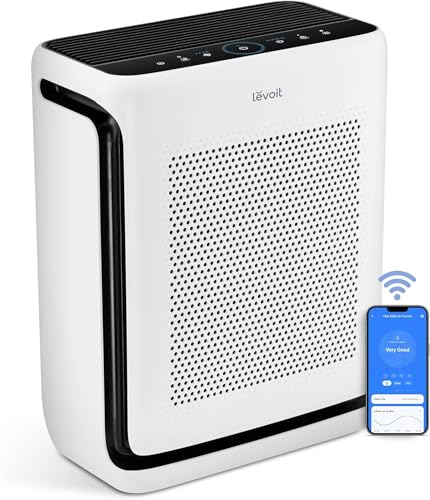
The Vital line’s second generation adds eyes to the pet brief, and this levoit vital 100s review covers the result: the Vital 100S, an AHAM-verified smart purifier with an air quality monitor, claimed for rooms up to 1,073 square feet, sold in white or black. Its founding sibling, reviewed beside this article, fights the pet room’s coarse war with a washable stage and a manual covenant; the 100S fights the same war with a cartridge and a sensor that notices the animals’ hours — the litter round, the post-walk shake, the evening zoomies — and governs them without being asked. The review’s question is the delegation question in pet dress: which pet household should hand the noticing over, and what, exactly, the noticing buys.

What the sensor notices in a pet house
A pet room’s air has a timetable, and it is not the human one. The day’s peaks arrive with the litter tray’s use, the door’s opening for the walk’s return, the shake at the threshold, the cat’s midnight athletics, the dog’s settling into the bed that sheds into the room’s air all night. A manual machine set at breakfast governs that timetable at one speed; the 100S’s monitor reads it and answers it — rising for the shake’s minute of weather, subsiding for the long quiet of the sleeping animals. The value is real and specific: the machine spends its voice and its filter life on the hours that need them. The cost is equally specific: no washable stage stands in front of the cartridge, so the coarse war that the founding Vital washes away monthly is absorbed, here, by the consumable itself. The review holds both facts open through every section, because the choice between the Vitals is precisely the choice between washing the war away and sensing through it.

Levoit Vital 100S-P (white) — the noticing pet machine
Best for pet households that want the machine to react to the animals’ hours itself
The listing’s specification: smart purification for pet allergy and dander, AHAM verification, coverage claimed to 1,073 square feet. Its parish is the pet household’s serious room — the family room where the animals live, the large bedroom the dog has annexed — and its covenant is the delegating one at its most animal-aware: the owner stocks the cartridge and reads the display; the machine reads the room. In white it takes the bright rooms; the black finish below takes the others. Verified delivery underwrites the delegation, and the combination — pet-first design, sensed governance, serious scale — is the Vital line’s current flagship offer.
- Model: Vital 100S-P
- Verification: AHAM VERIFIDE, per its listing
- Coverage: up to 1,073 sq ft claimed
- Sensing: smart air quality monitor
- Finish: white
Strengths
- Pet-first filtration that answers the animals’ timetable itself.
- Verified scale for the serious pet room.
- The room’s narrative, displayed for the owner’s reading.
Trade-offs
- No washable stage — the cartridge absorbs the coarse war whole.
- A premium over the founding workhorse for the sensing.
- Electronics age in a way a dial does not.
Best for: delegating pet households in bright rooms. Not suited for: the washer-by-choice — the founding machine’s congregation, linked below.

Levoit Vital 100S-P (black) — the same governor, darker rooms
Best for media rooms, studies and the black-furnished pet corners
The second verified listing is the identical machine in black, and its block exists because finish, in a machine that lives visibly in the animals’ rooms for a decade, is a real specification. The black 100S disappears against dark media furniture and shows the room’s dust — the pet household’s constant fall — less accusingly between cleans. Everything else in the white machine’s block applies without amendment: the sensing, the scale, the cartridge’s covenant. Choose by the room’s palette and by nothing else; the file records one machine in two coats, exactly as the Core line’s finishes were recorded in their reviews.
- Model: Vital 100S-P
- Verification: AHAM VERIFIDE, per its listing
- Coverage: up to 1,073 sq ft claimed
- Sensing: smart air quality monitor
- Finish: black
Strengths
- The full sensing brief in the discreet coat.
- Dust’s fall shows less between cleans.
- Verified scale, identical to the white.
Trade-offs
- The display’s glow reads stronger in a dark room at night.
- No washable stage, as with the white.
- A decade’s coat chosen in a minute at the till.
Best for: dark-furnished pet rooms. Not suited for: the bright Scandinavian animal corner — the white’s parish.

Levoit Vital 100 — the founding workhorse
Best for shedding households that maintain by hand
Reviewed in full beside this article: the washable pre-filter, the AHAM verification, the manual covenant, and the coarse war washed away monthly at the sink. It is this review’s comparison pole and its honest alternative — cheaper to keep across a shedding decade, blind to the animals’ timetable, and immune to electronic ageing. Pet households divide by temperament exactly here, and the two reviews are written as a pair: read both verdicts, locate your own household’s hands, and buy the machine they describe.
- Model: Vital 100
- Verification: AHAM VERIFIDE, per its listing
- Stages: washable pre-filter plus main filtration
- Control: manual — no app, no sensor
- Brief: the shedding room’s workhorse
Strengths
- The coarse war washed away for years.
- Nothing electronic to age or obsolete.
- The pet line’s founding economy.
Trade-offs
- Blind to the litter hour and the shake.
- The wash is a rite the owner must keep.
- One speed against a timetable of peaks.
Best for: liturgy-keeping shedding households. Not suited for: the delegator — this review’s subject’s congregation.
In this guide
A pet day, sensed
Six in the morning: the dog’s first shake at the door, a minute of weather the monitor answers and forgets. Eight: the household leaves, the animals settle, and the machine subsides to its listening watch — the long, cheap quiet that manual governance spends at full price. One: the cat’s litter round, noticed and answered. Five: the walk’s return, the threshold shake, the wet paws’ small weather, governed. Nine: the zoomies, the day’s last carnival, met at full voice and forgiven by ten. Midnight: the animals asleep, the room at its stillest, the machine at its quietest — having spent its day exactly where the day was. That is the whole of the sensing case in pet dress, and it is a strong one; the founding review’s sink is the whole of the other case, and it is equally strong. The cluster’s pet coverage exists to keep both cases at full strength and let the household’s temperament decide.
Final word
The Vital 100S is the pet line’s sensing flagship: verified, scaled for the serious animal room, and literate in the animals’ timetable in a way no manual machine can be. Buy it — in the room’s colour — if delegation suits your household and the cartridge’s covenant is acceptable; buy its founding sibling if your hands already keep the liturgy and the wash sounds like husbandry. Hair first was the founding insight. Noticing the hair’s hours is the successor’s, and the two reviews, read together, are the line entire.
The timetable, as the line’s real subject
Every sensed review in this cluster has circled the same discovery — that a room’s air has hours, and governance is the art of spending on them unevenly — but the pet room states it most purely, because its hours are not the occupants’ own. The animals keep their timetable without reference to the household’s convenience, and a machine that reads it serves two species’ schedules at once. That doubleness is the 100S’s quiet distinction in a range full of sensors: the Core machines read the family’s day; the Vital reads the menagerie’s. Households choosing between the lines should choose by whose timetable fills their serious room — the question is diagnostic, and both reviews exist to ask it.
Whose timetable fills the room
The diagnostic question deserves its own paragraph because it sorts the whole pet fleet: if the serious room’s weather is made by the animals — their beds, their trays, their hours — the Vital line owns it, and the only remaining choice is the covenant, wash or sense. If the room’s weather is made by the family, with animals as honoured guests, the Core line owns it, and the Vital’s pet-first design buys little. Households mis-sorted on that question own the wrong machine at any price, in any finish, and the pair of Vital reviews — this one and the founder’s — are written to sort the reader before the till does it for them.
Reading the monitor like a keeper: what the numbers do during a pet day
The smart monitor is this machine’s reason to exist, and a pet household gets the most from it by learning its dialect — which readings are events, which are weather, and which are the machine commenting on the household itself. A sharp, brief spike that decays within minutes is an event: the shake at the door, the litter tray’s excavation, a cushion beaten back into shape. The machine’s auto mode answers these correctly by reflex, and the owner’s only job is not to mistake the answering roar for a fault. A slow rise across an evening is weather: cooking drifting from the kitchen, the whole menagerie indoors against the rain, the room’s load accumulating faster than a low speed clears it. And a baseline that creeps upward across a fortnight, at the same hours and the same activities, is the machine filing a report on its own cartridge — the sensor reading a room that the filter can no longer quite bring back to its old zero.
That third reading is the one that repays the premium, because it converts filter replacement from a calendar guess into an observed fact, in the exact house whose load no manufacturer’s estimate could have predicted. Keepers of this machine learn to glance at the display the way the founder’s keepers learn to glance at the washable stage: as a diary. The difference is that this diary writes itself, in numbers, whether or not anyone washes anything — which is, in one sentence, the entire case for the sensing successor in a house whose people are busy and whose animals are not.
The cartridge’s life without a washable stage, stated plainly
The founder’s review in this cluster makes the washable stage’s case at length; this review owes its readers the equal and opposite accounting. Without a washable first line, the 100S’s cartridge meets the coarse war itself, and in a shedding house that meeting is expensive in a specific, predictable way: the cartridge’s outer layers load with hair and coarse dust first, throttling airflow long before the deeper media have spent their fine-filtration life. The keeper experiences this as a cartridge that ages unevenly — the machine working harder, the monitor’s baseline creeping, the replacement arriving sooner than the same cartridge would last in a pet-free room. Mitigations exist and they are household ones: the room’s own vacuuming cadence does more for this cartridge than any machine setting, a mat at the dog’s bed that is shaken outdoors weekly removes load the cartridge would otherwise eat, and the machine’s placement — near the source, as every article in this cluster advises, but not inside the litter tray’s kicked-dust radius — keeps the mineral fraction out of its diet.
None of that repeals the arithmetic; it disciplines it. A delegating household that chooses this machine should budget its cartridges at the pet-house rate rather than the brochure rate, and should hold the founder’s review in the other hand while doing so, because the comparison is the purchase: the wash, monthly, forever, against a cartridge bill that arrives more often and asks nothing else. Households divide on that exchange exactly as this cluster has always said — by temperament, by schedule, by whether the sink sounds like husbandry or like tax — and the 100S’s design assumes, correctly for its congregation, that a great many busy pet households will pay in cartridges what they cannot pay in attention.
Scheduling around animals: away hours, sitters and the machine’s manners
A connected machine in a pet house acquires duties its manual never lists, most of them concerning the hours when the house’s humans are absent and its animals are not. The useful schedule is not the energy-saving one. During the working day, when the dog sleeps and the cat conducts its own affairs, the machine’s auto mode is the right governor — quiet for hours, answering the tray and the shake without an audience. The hour before the household returns is worth a deliberate boost in many houses, because the day’s accumulated load is then at its peak and the family re-enters through it; a machine that has cleared the room in advance makes the homecoming smell like the house rather than like the dog’s day. Pet sitters, finally, are the schedule’s beneficiaries: a machine that governs itself needs no instructions beyond “leave it plugged in,” which is the whole of what a sitter can reliably be asked to remember about an appliance, and the returning owners can read the week’s story in the app’s history rather than in the room’s air.
One caution belongs to the connected features themselves. A machine that can be controlled from a phone can be controlled into the wrong state from a phone — switched off by a pocket, a child, or a well-meaning voice command in another room — and a pet house that relies on the machine should make a small habit of the display’s evening glance, the two-second confirmation that the governor is governing. The founder’s keepers check a stage; this machine’s keepers check a light. Both are the same act, in the end: the household verifying, once a day, that the arrangement it made for the animals is still the arrangement in force.
White or black, considered at the length a decade deserves
The two finishes of this machine are identical in every specification, and the pick blocks above assign them by palette; but a finish is worn for a decade, in the room where the household’s dust is most honest, and the choice rewards a slower look. White’s case is brightness and honesty: it takes the room’s light, suits the pale, fabric-heavy interiors most pet bedrooms are, and shows its own dust film plainly, which its keepers read as a prompt rather than an accusation — the machine asks to be wiped when it needs wiping, in writing anyone can read. Black’s case is discretion and camouflage: against dark furniture and in media rooms it disappears, and the same dust film that announces itself on white is, on black, merely a lightening at the edges that weeks can pass without the eye catching. Owners divide predictably — the household that cleans on a rhythm buys white and lets the machine join the rhythm’s evidence; the household that cleans on inspiration buys black and lets the machine keep its counsel between inspirations.
One consideration belongs to the animals rather than the room. A white machine in a dark-furred dog’s parish acquires, across a season, a visible tide line of hair at its intake that no one in the house will enjoy looking at; a black machine in a white cat’s house wears the same line in reverse. Match the coat to the animal as well as to the furniture, and the machine will look like a resident rather than a patient. It is a trivial paragraph in a long review, and it is the one its readers will think about every day for ten years, which is the correct definition of a non-trivial specification.
The sensor’s eye in a hair house: keeping the reader honest
An optical sensor in a pet room lives in the exact weather it measures, and its lens accumulates the house’s fine dust on the same schedule as everything else at its height. The symptom of a filmed lens is flattery — the display reporting a cleaner room than the nose believes — because less scattered light reaches the detector through the haze. The keeper’s response is the one this cluster’s discontinued-machine guides made familiar: a dry cotton bud, turned gently on the lens behind its small cover, at the same sitting as the cartridge change, restores the machine’s honesty in under a minute. No liquids, no sprays, no compressed air — the lens is a small, patient surface and asks only to be wiped by something softer than itself.
The deeper point is about trust, and it applies to every sensed machine in this survey. A sensor is an instrument, and instruments drift toward the reading their condition produces; a household that never cleans the eye is reading a diary written by the dust. The 100S’s keepers, who bought the machine precisely to delegate the noticing, should hold one noticing back for themselves: the quarterly glance that asks whether the display’s story still matches the room’s. When the two diverge, clean the lens before doubting the machine, and doubt the cartridge before doubting the sensor — the order this article’s monitor section established, and the cheapest diagnostic sequence in the whole pet range.
Puppies and kittens under a sensor’s government
The housetraining season, which the founder’s review treats as a posting for a washable stage, reads differently under a sensing machine, and the difference is worth a young animal’s household knowing. The sensor sees the season: every accident’s aftermath, every tray excavation by an animal still learning the geometry, registers as an event, and the machine answers each with a diligence that can startle a sleeping puppy and exhaust a cartridge at the season’s rate rather than the year’s. The keeper’s adjustments are small. Site the machine a little further from the pen or tray than an adult animal’s placement would suggest, so its readings describe the room rather than the tray’s microclimate. Expect the cartridge’s first season to be its shortest, and do not mistake that for a defect — it is the machine eating a young animal’s weather at full strength, which is what it was bought to do.
The cord discipline from the founder’s review applies unchanged and is repeated here because repetition is what safety advice is for: route the cable out of the chewing world entirely. What the sensor adds to the season is a record — the app’s history of the room’s bad nights is, among other things, a housetraining diary the household did not know it was keeping, and more than one keeper has used the declining frequency of the night’s spikes to judge, objectively, that the season is ending. Machines that notice things notice everything, including progress.
The 100S against the Core 400S for the pet family room
The pick blocks in the founder’s review posed the family-room question from the washable side; from this machine’s side it looks like this. The Core 400S is the family’s generalist keystone — sensed, app-governed, verified at family-room scale, and reviewed in full in this cluster — and in a room the family owns, with animals as guests, it is the better governor by design. The Vital 100S’s claim on the same room is the load’s character and the monitor’s tuning: a pet-first machine expects the animal events that a generalist treats as anomalies, and its parish is the room where the dog’s bed is furniture and the hair is a climate. The two machines’ specifications sit close enough that the decision cannot be made from them, which is precisely why this cluster keeps asking its unfashionable question — whose room is it? — and counting the animal’s furniture against the people’s.
There is a second, quieter difference that households discover after purchase and reviewers should state before it. The generalist’s app and the pet machine’s app are the same ecosystem, and a house that already runs Core machines will find the 100S joining a fleet it understands, with one account, one set of habits and one filter-ordering routine that differs only in the cartridge’s name. Fleet coherence is not a specification, but across a decade of evenings it is worth more than several that are. A pet household already in the Core ecosystem should weight it honestly; a household starting fresh should weight the room’s ownership more.
Multi-pet households: where the sensing earns hardest
One animal keeps a timetable; several keep a parliament, and the case for delegation strengthens with every member. A three-cat house has no single peak to govern by hand — the trays are used in rotation around the clock, the shedding is continuous and species-mixed, and the room’s load is a sum of small events that a manual machine meets at one compromise speed, too fast for the quiet hours and too slow for the busy ones. The sensor’s value in such a house is not sophistication but stamina: it answers the fortieth small event of the day with the same diligence as the first, at hours when no human is awake to turn a dial, and its history gives the keeper the first accurate picture anyone has had of when the house’s air actually works hardest — information that rearranges everything from the litter routine to the machine’s own placement.
Scaling within the line follows the founder review’s fleet logic with the sensor’s twist. The multi-pet open plan belongs to the 200S class; the 100S is the serious single room’s governor, and a house with two serious animal rooms is better served by two governed rooms than by one flagship overstretched between them — two mid-sized machines, each reading its own parish, will out-govern an acre of shared capacity that reads neither. The fleet’s file, as ever, holds both rhythms: cartridge dates, lens cleanings, and the rooms’ names, written once and kept where the machines’ keeper — the human one — will find it.
Regret cases: when the founder would have been the better buy
An honest review of a successor should name the households that write to say they bought the wrong Vital, and they fall into three recognisable groups. The first are the washers manqué: households that discovered, a year in, that they rather liked the idea of the sink ritual they had delegated away, and that the cartridge bills arriving at the pet-house rate felt like paying rent on a chore they would have enjoyed owning. The second are the display-blind, who never once read the monitor after the first month — for them the premium bought a light they ignore, and the founder’s blind honesty would have served the same room for less. The third are the connectivity-tired, for whom an account, an app and a firmware update in a pet appliance crossed a line they only discovered by living on the far side of it.
None of the three is a failure of the machine, and the review names them so that readers can recognise themselves before the purchase rather than after it. The test is the one the founder’s article set at its own beginning: imagine the two futures concretely — the monthly stage under the tap, the cartridge arriving in the post — and notice which one the imagination files under chores and which under costs. Households file them differently, both honourably. The 100S is for the households that file the wash under chores and the cartridge under costs, and for those households it is not the second-best Vital. It is the only one they would actually keep fed, connected and governing for a decade, which is the definition of the right machine.
Second-hand 100S machines: the connected checks
A used sensing machine carries a history a used manual one does not, and the buyer’s checklist grows by the connected items. The standard sequence comes first — fan through its speeds, hardest listening at the top; bay opened and the unit priced as a shell with a spent cartridge; housing and controls inspected — and then the smart questions. The machine must be removable from the previous owner’s account and addable to the buyer’s, a transfer that should be demonstrated, not promised, before money moves: a purifier still bound to a stranger’s app is a manual machine at a smart machine’s price. The display and sensor should be read against the room the meeting happens in — a reading that sits implausibly perfect in a dusty space suggests the filmed lens this article described, curable with a bud; a reading that never moves at all suggests the sensor itself, which is not curable at a used price.
With those checks passed, a used 100S is a rational purchase of the same kind as its founder’s used form, with the decade’s arithmetic shifted: its remaining life is bounded less by its fan than by its electronics’ support horizon, and the buyer should price that bound in rather than discover it. Ask for the machine’s age, run the app transfer, clean the lens, fit a fresh cartridge, and the second household inherits a governor with most of its judgement intact — plus, if the seller is the honest kind this cluster keeps recommending, a note of the cartridge’s name and the room it served, which is the used market’s equivalent of a service history.
The keeper’s card, connected edition
The whole method for this machine, compressed to the card its keepers keep, differs from the founder’s card in exactly the ways the machines differ. Site it near the animals’ furniture, clear of the tray’s kicked-dust radius and the water bowl’s splash, with its intake breathing freely. Leave the governing to auto, and glance at the display each evening as the household’s one retained duty — the two-second confirmation that the arrangement is in force. Clean the sensor’s lens with a dry bud at every cartridge change, and judge the cartridge by the baseline’s creep across a fortnight, not by the calendar’s guess. Vacuum the room on the household’s rhythm and shake the dog’s mat outdoors weekly; the cartridge eats what the house does not. Keep the fleet’s page — dates, rooms, cartridge names — in the room, not the cloud. And once a season, ask the founder’s question in the successor’s grammar: is the household still delegating happily, or has it become a washing household without noticing? The machine serves either answer, but it serves best the household that knows which one is true.
A year of the display: four seasons in one pet room
Spring is the monitor’s most eloquent season. The coat-blow weeks write themselves across the history as a rising tide of daytime events, and the keeper who watches it learns their own dog’s calendar more precisely than any breed book states it — this house’s blowout begins in the third week of March, crests for a fortnight, and is done by the time the windows open. Summer’s story is the open window: the display spends its days answering the street and the garden, and the household learns which hours the road’s dust makes expensive, and closes the windows for those hours with the machine’s evidence rather than a guess behind the decision. Autumn is the wet season’s signature — the post-walk spikes, taller and longer, as every return from the rain shakes a small weather system loose at the door — and the mat by the door, upgraded in October on the display’s testimony, halves them by November.
Winter is the closed house, the baseline’s season: with the windows shut and the heating stirring the rooms’ dust in its dry currents, the monitor shows the household its own accumulated load with nowhere to hide, and the cartridge changed at midwinter — on the baseline’s creep, not the calendar — restores the zero the family had forgotten the room could reach. Read across the year, the display has been a logbook, an argument and a calendar, and the keeper who has read it owns something the founder’s keeper owns by hand: an exact knowledge of their own house’s air. The two knowledges are the same knowledge. One is written at a sink, the other on a screen, and this pair of reviews exists so that each household can choose its own handwriting.
Senior animals under a sensor’s watch
The founder’s review follows the animals into their last years from the washable side; the sensing machine’s version of that chapter has its own character, and it is gentler than a reader might expect. An old dog’s day is a long quiet punctuated by small, significant events — the slow rise, the drink, the turn and resettling — and a machine governed by a sensor lives that day at the animal’s pace, subsiding to its listening watch for the long sleeps and answering the small events without the fanfare a fixed speed makes of them. The household’s part is mostly placement, as it was in the animal’s youth: the machine drawn a little closer to the bed where the old animal now spends the day, its readings thereafter a quiet log of the animal’s rhythm that more than one keeper has found themselves reading the way one reads a baby monitor — not as surveillance, but as company.
When the animal dies, the connected machine keeps a record the household may not want, and a sentence of practical tenderness belongs here: clear the app’s history or let it age out, as the household prefers, and do not let a graph make an argument nobody needs. The machine itself, wiped and rested, waits for the house’s next chapter exactly as its founder does. Sensors record; they do not grieve, and they do not insist. The keeper decides what the record was for, and the record, kept or cleared, has served its purpose if the animal’s air was governed while the animal was there to breathe it.
What the noticing is finally for
Close the substantive argument where the founder’s review closed its own: with the knowledge that accumulates in a congregation. Owners of this machine know their houses’ hours the way sailors know a tide table — when the room works, when it rests, what the weather at the door does to the water inside. They know the difference between a machine that filters and a machine that attends, and that attendance, delegated well, is not the absence of care but its automation — the household’s intentions, encoded once, executed at 3 a.m. by an instrument that does not sleep through the litter round. And they know the premium’s justification in its only honest form: not that the sensor is clever, but that the alternative governor — themselves, at a dial, forever — had other work.
That is the complete case. The Vital 100S reads the animals’ timetable, governs the serious pet room at verified scale, asks for cartridges and an occasional wiped lens, and gives back the household’s attention for the animals themselves, which is what the attention was always for. Readers who would rather spend the attention than the cartridges have the founder waiting in the pick blocks, recommended by this same review in the same breath. Between the two of them, the pet line covers its whole congregation — and a congregation fully covered, in this cluster’s accounting, is a range that has finished its work.
Hosting, guests and the borrowed nose
The allergic guest problem, which the founder’s review treats from the washable side, has a sensing version with one elegant advantage: the machine can be set to prove itself. Run at full speed in the guest room through the day before arrival, with the door closed and the display as witness, it brings the room to the cleanest state the house can offer and shows its work in the falling numbers — a courtesy the host can mention without ceremony, since guests with sensitivities plan around houses like this one and are generally more grateful for evidence than for reassurance. The rest of the hospitality is the household’s ordinary work, as the founder’s article sets out: the room reset, the animals kept out for the visit, the bedding laundered, and the honest word at invitation time that the house has animals in it, so the guest can plan with their own clinician’s advice where that is relevant.
During the visit itself, the machine’s auto mode is the right host: it answers the door’s openings and the room’s occupation without the guest being asked to operate anything, and its night speed is quiet enough that a light sleeper in a strange bed is not given a new sound to catalogue. Guests rarely comment on a purifier, which is the point — the successful appliance in a guest room is the one whose entire review, from the guest’s side, would be a single sentence about sleeping well. The 100S in a guest room earns that sentence as reliably as any machine in this survey, and it earns it while also governing the room for the animals’ visits the other fifty weeks of the year.
A note on firmware and the long decade
A connected machine’s quiet dependency is its maker’s update servers, and a buyer planning a decade should weigh the maker’s record as part of the purchase: Levoit’s ecosystem has kept its older connected models serviceable rather than stranding them, which is the behaviour this purchase is betting on. The hedge is the one the PUR131 article in this cluster teaches — learn the machine’s own panel as well as its app, so that the household’s competence never lives entirely in someone else’s cloud. Governed on its panel, the 100S loses convenience if the cloud ever thins; governed only through its app, it would lose more. The panel is a page of buttons. Learn it in the first week, while learning it is still a pleasure.
And on the dog’s opinion
Animals vote on appliances with their feet, and a machine that startles is a machine that gets avoided, unplugged by a paw’s owner in spirit if not in fact. The auto mode’s ramp matters here: a governor that rises gradually through an event reads to a dog as weather, where a governor that leaps reads as an occurrence. Keepers of nervous animals should spend the first week letting the machine answer small events at close quarters, with the animal free to leave, until the sound files itself in the animal’s mind under furniture rather than under threats. Most dogs complete the filing within days; the machine thereafter is part of the room’s trusted furniture, which is the only review that ultimately governs the room.
A last note on the two coats, from the field
Keepers who own both finishes — one in a bright room, one in a dark one, as mixed fleets often end up — report a small, consistent finding worth more than the palette advice it supplements: the white machine gets wiped more often, because it asks to be, and therefore tends to be the cleaner machine at any given inspection, while the black machine’s intake quietly accumulates the more honest record of the room. Neither is a defect. But a household choosing for a room it knows it neglects should choose white, and let the machine’s visible dust do the nagging the household will not do itself.
One house, read back: the display as a family’s evidence
End with a household whose year this review has been quietly describing. Two adults working long hours, one elderly Labrador, one young cat, a terraced house with a family room that is — by the furniture count this cluster insists on — the animals’ room with a sofa in it. The 100S arrived when the founder’s wash, honestly assessed, had begun slipping from monthly to whenever, and the cartridge arithmetic of the pet rate was accepted with open eyes as the price of the household’s actual life. What the family did not expect was the display’s second career as the house’s evidence: the October mat upgrade argued from its spikes, the litter tray’s relocation argued from its evenings, the midwinter cartridge argued from its baseline, each decision taken out of the realm of opinion by a small, patient instrument that had been watching the room all along.
The Labrador is eleven now, and the machine’s night watch is mostly her long sleeps, and the cat — who arrived as the season’s kitten and set the sensor its first examination — conducts her midnight athletics under its government as she did in her first month. The household’s verdict, if this review may borrow it for its close, is that they did not buy a purifier with a sensor. They bought back the hour a week the sink used to take, and they spent it on the animals, which is the only currency the whole arrangement was ever denominated in. The founder’s keepers spend the same hour at the sink and call it husbandry, and they are also right. That is the Vital line, whole: two honest ways to pay for the same governed air, and a household’s temperament — not a specification — to choose between them.
The temperament, chosen
That is the review’s last word and its first one, arriving at the same place by the long road: know which household yours is, and buy its machine. The questions below are the practical residue of the choice, and they are answered for the delegating household this article has served — the one that will read them, fittingly, while the machine reads the room.
Frequently asked questions
How does the 100S’s sensor change life in a dog owner’s hallway-adjacent room?
It answers the moments a manual machine misses entirely. The wet return from a walk, the shake at the door, the towel-down that fills the air with dander and damp — each is a ten-minute event that a sensed machine meets by rising on its own and settling after, while a fixed-speed unit either slept through it or roared all day in anticipation. Place the 100S where the hallway’s traffic crosses its intake, keep the sensor’s eye wiped during the monthly pre-filter wash, and let auto govern the ordinary week. The owner notices the difference not as cleaner air in the abstract but as the absence of the dog-day smell that used to greet them at the door.
What does the 100S ask of its owner that the plain 100 does not?
A little connectivity housekeeping in exchange for its vigilance. It wants the home WiFi password at setup, a place in the household’s app alongside any other smart machines, and the occasional firmware patience while it updates itself. In return it reports the room’s air, takes schedules and voice commands, and keeps its own filter diary. Households with unreliable broadband should know its sensing and auto running are local behaviours that continue without the cloud; what pauses in an outage is remote control, not governance. Owners who found the plain 100’s blindness restful will not miss what they never had; owners who kept wishing the machine would simply notice the dog will feel the difference in the first week.
Vital 100S or Vital 100?
Sensor or sink, as the pair of reviews framed it: the 100S notices the animals’ hours and spends accordingly, on a cartridge that absorbs the coarse war; the 100 washes the coarse war away and governs blind at one speed. Delegating households take the successor; liturgy-keeping households take the founder and save the difference for years. Both verdicts are written to be believed.
White or black?
By the room’s palette and nothing else — the listings are the same verified machine in two coats. The black shows the pet household’s constant dust less between cleans and suits dark furniture; the white suits the bright rooms. The file records one machine; choose the coat in the room’s light, not the listing’s photograph.
Does it help with pet odour?
Its sensing answers the odour’s hours — the litter round, the wet return — faster than any manual setting can, which is the pet room’s practical odour governance. A household whose problem is smell above all should still read the cluster’s carbon coverage; reaction speed and carbon mass are different weapons, and the honest reviews say which rooms need which.
What size room does it serve?
To 1,073 square feet claimed, AHAM-verified — the serious family room or the large annexed bedroom. The open plan’s whole weather belongs to the Vital 200S class named in the PUR131 succession; this machine’s parish is the one serious room, governed at its own timetable.
How does it compare with the Core 400S for a pet family room?
Both are sensed and verified at family-room scale; the Vital is the pet-first design and the Core the family’s generalist keystone, reviewed in full in this cluster. A room the animals own belongs to the Vital; a room the family owns, animals visiting, belongs to the Core. The border is the animals’ address, as the Vital 100 review posted it.
What is this review’s one-line verdict?
The pet line’s sensing flagship: verified, timetable-literate and scaled for the serious animal room, in the room’s own colour. Every washing brief belongs to its founder, and every generalist family room to the Core.