Disclosure: As an Amazon Associate, dailyhomedecorating.com earns from qualifying purchases. Links on this page are affiliate links; they cost you nothing extra. Prices and availability change often, so check the current Amazon listing before you buy.
This iqair atem x review is about the point where air purifiers stop being appliances and start being equipment. The Atem X is IQAir’s large-room flagship statement: a Swiss-designed, German-made tower on wheels, rated by its listing for rooms up to 1,650 square feet, built around the company’s HyperHEPA filtration — a grade of filter rated well beyond ordinary HEPA’s particle sizes — with WiFi control and a price that sits in a different conversation from everything else in this cluster. IQAir’s buyers are not comparison-shopping for a bedroom gadget; they are households with a serious brief — severe allergies in the family, wildfire smoke country, a medical recommendation, a large open-plan space that defeats lesser machines — asking whether the flagship earns its flagship money. This review works through what the Atem X is built to do, how it differs from its own siblings (the HealthPro Plus XE and the little Atem Desk, both linked below), what ownership costs beyond the sticker, and the honest cases for buying it and for not. Comfort framing applies throughout: this site reviews purifiers as household equipment, and any medical situation deserves a clinician in the conversation alongside the machine.
What the Atem X is
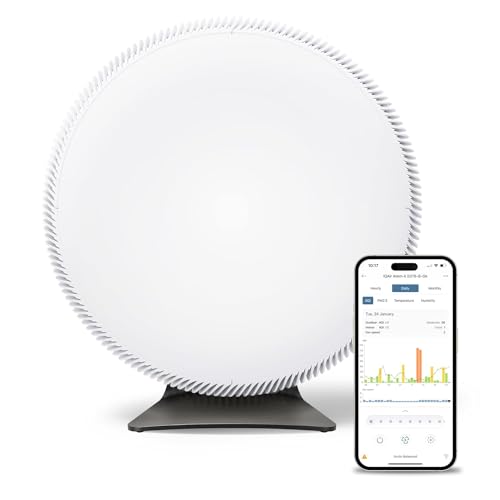
Start with the listing’s own claims, since they define the machine: HyperHEPA filtration, WiFi, coverage to 1,650 square feet, Swiss design and German manufacture, a brief spanning smoke, viruses, allergens, mould, dust and pet dander, and wheels. The wheels are not a detail — a machine of this class is furniture-weight, and IQAir’s decision to make its flagships mobile acknowledges that large-room purification is often a rotation: the living space by day, the main bedroom by night. HyperHEPA is the company’s signature: where standard HEPA is rated at 0.3 microns, HyperHEPA media is rated down to 0.003 microns — the ultrafine range where combustion particles and much of the airborne biological material live — and IQAir built its reputation in clinical and industrial settings before it addressed living rooms. The Atem X wraps that filtration in the company’s current design language — a tall, quiet-looking tower rather than the HealthPro’s more industrial cabinet — with app control for the households that want scheduling and monitoring. It is, in short, the statement piece: maximum filtration, maximum coverage, minimum compromise, priced accordingly.
In this guide
Who this machine is actually for
Three households justify an Atem X without argument. The first is the large-space household: open-plan living areas, vaulted rooms, the combined kitchen-family expanse where a 300-class machine’s clean air pools around itself and never reaches the far sofa. Coverage ratings are the whole game at that scale, and the Atem X’s 1,650-square-foot brief is a different sport from the cluster’s other machines. The second is the smoke-country household — wildfire regions where a bad August fills the house through every seal, and where ultrafine combustion particles are precisely the load; this site’s smoke coverage elsewhere treats the protocol, and the machine is its heavy artillery. The third is the household following professional advice toward maximum filtration for a vulnerable member — where the purchase is closer to equipment than to shopping, and where this review’s role is to confirm the machine matches the brief rather than to sell it. Households outside those three — a normal bedroom, a mild dust brief, a small flat — are respectfully directed down this cluster’s price ladder, where machines a fifth of the price will do their whole job.

IQAir Atem X — the large-room flagship
Best for large rooms, smoke country and maximum-filtration briefs
The Atem X as listed: HyperHEPA filtration with WiFi, Swiss design, German manufacture, coverage to 1,650 square feet, on wheels. Its ownership proposition is the absence of the usual asterisks — the coverage is real-room scale, the filtration grade is the company’s best, and the build is the kind that expects a decade. What the buyer must bring is the brief that justifies it and the budget that absorbs not just the machine but its filters across the years, which the running-cost section below addresses without flinching.
- Coverage: up to 1,650 sq ft per its listing
- Filtration: HyperHEPA, per its listing
- Control: WiFi / app
- Origin: Swiss design, German made, per its listing
- Mobility: wheeled
Strengths
- Filtration grade beyond standard HEPA — the ultrafine range is its home territory.
- Coverage that treats open-plan spaces as one room, because they are.
- Build and brand support measured in decades rather than product cycles.
Trade-offs
- The price is flagship in every sense, and the filters continue the theme.
- Oversized — in capability and presence — for ordinary bedrooms.
- Its benefits are invisible by nature; the buyer purchases assurance, not theatre.
Best for: the three households named above. Not suited for: a first purifier, a small flat, or a mild brief — the cluster’s Levoit ladder exists for them.

IQAir HealthPro Plus XE — the established flagship
Best for buyers who want the proven line with 3-stage filtration
The Atem X’s elder sibling is the machine that built the living-room reputation: the HealthPro Plus, here in its XE generation with WiFi, listed for rooms to 1,125 square feet with 3-stage filtration — pre-filter, gas-phase stage and HyperHEPA — and the same Swiss-made, medical-grade positioning, also on wheels. The Plus’s distinguishing virtue against the Atem X is its dedicated gas and odour stage, where the Atem X’s design leans harder on its particle filtration and form. Households whose load is chemical as well as particulate — city air, a workshop-adjacent home — have traditionally been HealthPro buyers, and the XE keeps that brief with modern controls. Choosing between the siblings is a load question before it is a price question, and this review’s comparison section below works it through.
- Coverage: up to 1,125 sq ft per its listing
- Filtration: 3-stage including HyperHEPA, per its listing
- Control: WiFi
- Origin: Swiss made, per its listing
- Mobility: wheeled
Strengths
- The 3-stage stack includes a serious gas phase the Atem X treats more lightly.
- A long-proven platform with a deep ownership record.
- Same flagship build, support and filter philosophy.
Trade-offs
- Smaller coverage rating than the Atem X for the big open plans.
- A more industrial cabinet — equipment aesthetics, honestly worn.
- Flagship running costs, as with the whole line.
Best for: mixed particle-and-gas loads in large rooms, and buyers who trust the established line. Not suited for: the largest open plans, or design-led rooms — the Atem X’s two edges.

IQAir Atem Desk — the personal-scale HyperHEPA
Best for a desk, a bedside or a single small room at IQAir grade
The family’s other end: a portable, lightweight personal purifier with a HyperHEPA filter, listed for small rooms to 150 square feet, in white. The Atem Desk exists for the buyer whose brief is one person’s breathing zone — a desk worker with a serious dust sensitivity, a bedside in a house whose main rooms the flagship covers — at the same filtration philosophy in miniature. It is not a cheap machine for its size, because HyperHEPA media is not cheap at any size, and its buyers are paying for the grade rather than the airflow. As a companion to an Atem X household it makes a coherent system; as a standalone for a mild brief it is the definition of over-specification, and this review says so with respect for both the machine and the reader’s money.
- Coverage: small rooms to 150 sq ft per its listing
- Filtration: HyperHEPA, per its listing
- Origin: Swiss design, German made, per its listing
- Form: portable, lightweight
Strengths
- The flagship’s filtration grade at a personal scale.
- Genuinely portable — it follows the person, not the room plan.
- The same build seriousness as its siblings.
Trade-offs
- Premium pricing for a small coverage area, by design.
- One person’s zone is its whole world — it will not do a room’s corners.
- Filters at IQAir prices for a desktop’s appetite.
Best for: personal breathing zones with a serious brief. Not suited for: whole-room duty or mild briefs on a budget.
Atem X versus HealthPro Plus XE: the sibling decision
Buyers cross-shopping the two flagships should decide on the load. Predominantly particles at maximum scale — smoke, dust, pollen across a big open plan — favours the Atem X: the larger coverage rating, the newer design, the filtration story told at its purest. A mixed load with a real gas component — traffic air, chemical sensitivities, a house whose smells are part of the problem — favours the HealthPro Plus XE’s explicit 3-stage stack with its gas phase. Room size arbitrates ties: past the Plus’s comfortable range, the X is the only sibling still speaking. Aesthetics arbitrate the remaining ties without shame: the X was designed to be looked at in a living space, the Plus to be respected in one, and a machine that lives in the family’s main room for a decade is allowed to be chosen partly by eye. What neither sibling offers is a budget path, and a household hesitating at the price of both should hear the review plainly: the correct move is down the ladder to a verified mid-range machine sized honestly, not a flagship bought resentfully and run reluctantly on its lowest speed.
Running costs: the flagship annuity
IQAir ownership is a subscription to excellent filters. HyperHEPA elements and the line’s other stages are premium parts with premium prices, replaced on the machine’s own indicators and the maker’s schedule, and a buyer should price a five-year filter plan before purchasing — not to be frightened off, but to buy with the whole number in view, as one does with a car rather than a kettle. The offsetting entries are real: the machines are built to be serviced rather than replaced, the brand’s support horizon is long, and a flagship run for a decade amortises its sticker across more clean air than two generations of mid-range machines. Electricity at high speed is non-trivial and at the lower speeds, where these machines spend their lives, modest. The honest summary: the Atem X is not expensive to buy and cheap to run, nor cheap to buy and expensive to run — it is a flagship in both columns, and its buyers should be people for whom the filtration is the point and the arithmetic is acceptable.
Placement and living with a tower on wheels
Large machines earn their coverage only where air can reach them: clear of walls by the manual’s margins, out of the corner’s dead zone where possible, and rotated on their wheels to the room the household is actually using — the flagship habit that separates owners who get the coverage they bought from owners who bought a monument for one room. Doors between the machine and a target room tax it heavily; an open-plan brief is its native country. Noise follows the class law — high speeds are audible machinery, lower speeds are the living settings — and the app scheduling exists so the machine can work hard at the empty hours and idle politely through the occupied ones. Households integrating an Atem X into a whole-home plan usually pair it with smaller machines in closed bedrooms rather than asking it to breathe through walls, which is the system design this cluster’s other reviews assume.
Final word
The Atem X is what the top of this market looks like when a clinical filtration company designs for the home without diluting itself: ultrafine filtration, genuine large-room coverage, serious build, flagship price. For the large-space, smoke-country and professionally advised households, it is not an extravagance but the correct tool, and this review recommends it to them without a asterisk. For everyone else, it is a magnificent answer to a question they do not have — and the cluster’s ladder, from the Atem Desk’s personal grade down through Levoit’s verified middle, exists so that every brief in this article’s mailbag meets its right-sized machine.
The evidence question: what a flagship buyer should verify
Serious money deserves the serious checklist, and IQAir’s buyers are entitled to ask for what the brand has historically been willing to show: certified filtration performance for its HyperHEPA media, test data behind the coverage claims, and the filter-life testing behind its replacement rhythm. This review’s standing advice for the whole category applies with flagship force — buy on verified delivery rates and filter specifications rather than on room-size marketing, and read the listing’s fine print for the exact model generation being sold, since flagship lines evolve (the XE suffix on the HealthPro is exactly such an evolution) and a listing’s photographs and text should agree about which generation is in the box. A buyer who does that homework will find IQAir among the more forthcoming manufacturers in the category, which is part of what the premium purchases: not just filtration, but documentation.
Scenarios: three households, three answers
The wildfire-season house
A family in a smoke-prone valley with a great room and two asthmatic children — stated here as a comfort scenario, with their clinician’s advice assumed to be in the conversation — is the Atem X’s textbook household. The machine lives in the great room through the season, runs high during smoke events with the house sealed, and rotates to the main bedroom on the worst nights. Its ultrafine rating addresses the combustion load specifically, and its coverage means one machine, correctly placed, rather than three mid-range units arguing with each other across an open plan.
The city penthouse with a gas problem
Traffic film on the sills, cooking from three cuisines a week, a large living space — and the load is as much chemical as particulate. This household is the HealthPro Plus XE’s, for its gas stage, and the Atem X review that sends them there has done its job. Flagship money spent on the wrong flagship is still misspent; the sibling decision section exists for this address.
The mild-allergy flat
A young professional, a one-bedroom flat, a spring pollen season that makes mornings unpleasant. The correct purchase is a verified 300-class machine at a fifth of the flagship’s price, and the Atem Desk is already generous for the desk corner. This review’s refusal to sell this reader an Atem X is not modesty; it is the entire basis on which the flagship recommendation to the first household can be trusted.
The purchase, sequenced for a flagship
Measure the room and total the honest volume, including the ceiling’s height, since coverage ratings assume standard ceilings and a vaulted space is a larger room than its floor confesses. Identify the load in writing — particles, gases, or both, and their sources — because that single line chooses between the siblings more reliably than any other deliberation. Price the five-year filter plan from the maker’s own channels and add it to the machine’s price; deliberate on that total, not on the sticker. Confirm the exact generation and contents on the listing at the moment of purchase. And plan the placement and the rotation route before delivery day, so the machine’s first week is its working life rather than its furniture audition. A flagship bought in that sequence is a household system; bought in any other, it is a very expensive way to learn the sequence.
Maintenance, in the flagship manner
The owner’s rhythm is light in the week and serious in the season: exterior dusted, intake faces kept clear, the pre-stage checked after any exceptional load — renovation, smoke event, a house party’s worth of candles — and the main filters changed on the machine’s indication rather than the owner’s optimism, since a HyperHEPA element run past its life taxes the fan and the air together. Keep the filter plan’s paperwork with the household’s other appliance files, order replacements ahead of the indicator rather than after it, and the machine will never spend a week of its decade waiting on a delivery. Flagship maintenance is not more work than a mid-range machine’s; it is the same work at higher stakes per part, which argues for the calendar rather than the memory.
Frequently asked questions
Where exactly should an Atem X stand in a very large room?
Centrally along the longest wall, not tucked into the corner the furniture plan leaves spare. A machine rated for spaces up to 1,650 square feet still breathes through intakes that need clearance on every side, and a corner placement starves one flank while the far end of the room waits longest for each pass. Give it open floor around the base, keep its discharge path unobstructed by shelving or a sofa back, and let its wheels earn their keep during the first fortnight: try two or three positions, run the same dusty afternoon in each, and keep the spot where the room settles fastest. In an L-shaped great room, park it near the inside corner of the L, where both wings feed it, rather than at either short end.
How does the Atem X behave during a wildfire-smoke week indoors?
It becomes a sealing partner rather than a solo act. Close the windows, tape nothing, but do shut trickle vents and run the X continuously at a working speed instead of saving it in short bursts, because smoke infiltrates around the clock while outdoor air stays loaded. Its HyperHEPA stage is built for the ultrafine fraction that dominates combustion haze, the fraction that slips deepest and lingers longest indoors. Expect the filter to age faster during a bad fortnight than across a whole mild season, and plan the replacement around the event rather than the calendar afterwards. Once outdoor air clears, a few hours of open windows plus a high-speed purge resets the room properly. In a smoke week, also keep interior doors open so the X can draw from the whole floor rather than only its own room.
What does HyperHEPA actually mean?
It is IQAir’s filtration grade rated for particles down to 0.003 microns — a hundred times smaller than standard HEPA’s 0.3-micron rating point — covering the ultrafine range where smoke and combustion particles concentrate. The practical meaning: a machine built for loads that ordinary HEPA machines address only partially. Whether your household’s load needs that range is the buying question this review keeps returning to.
Is the Atem X worth it over a mid-range purifier?
For the three briefs named in this review — very large rooms, serious smoke exposure, professionally guided maximum filtration — yes, because mid-range machines cannot do those jobs at any number of units’ convenience. For an ordinary bedroom or a mild allergy-season brief, no: a verified 300-class machine does the whole job for a fraction of the purchase and running cost. The X is a specialist tool, priced like one, and honest reviewing consists of keeping the two readerships separate.
Atem X or HealthPro Plus XE?
Particles at maximum scale and the newer design: Atem X. A mixed load with serious gas and odour content: the HealthPro Plus XE’s 3-stage stack. Room size breaks remaining ties — the X is rated for the larger area — and both share the brand’s build, wheels and filter philosophy. There is no wrong sibling here, only a wrong match to a load.
How loud is a machine this size?
At its working lower speeds, a background presence suitable for living rooms and, for most sleepers, bedrooms; at maximum, unmistakably a machine earning its coverage rating. The scheduling answer — hard work in empty hours — is built into its app control. Buyers for whom silence is the first criterion should hear any flagship in person where possible, because this class trades in airflow, and airflow has a voice.
What do replacement filters cost over the years?
Flagship money, on the machine’s indicated rhythm — enough that this review instructs buyers to price a multi-year filter plan from the listing and the maker before purchasing, as part of the real cost. Owners consistently report the filters’ long service lives soften the per-year figure; the sticker of each element is nonetheless the line’s known toll, and it should be paid knowingly.
Can one Atem X serve a whole house?
A whole open-plan floor, yes, within its rating. A whole house of closed rooms, no — no single machine breathes through doors, and the wheeled design’s honest answer is rotation plus smaller machines in the closed bedrooms. Buyers planning whole-house coverage should design the system — flagship for the open volume, companions for the bedrooms — rather than asking any tower to be a central plant.
How long do IQAir machines last?
The brand’s ownership culture is measured in decades — the machines are built to be maintained, with filters and parts available across long horizons, and second-hand HealthPros of considerable age remain in service. That longevity is a real component of the value case: the flagship’s price divided by fifteen years of service is a different number from the same price divided by a gadget’s four. Buyers should still confirm parts support for the specific generation they purchase.
Does it have an air quality sensor and auto mode?
The XE-generation machines bring the line’s controls up to date with WiFi and app management per their listings; the precise sensor and auto behaviours of the exact unit should be confirmed on the listing at purchase, since generations differ. A buyer for whom a particular control feature is decisive should treat the listing’s specification as the contract — flagship money buys the right to that care.
Can it remove cooking and pet odours?
Particles from both, yes — dander and smoke are its home loads. Odour gases are the gas stage’s department, which is why this review steers odour-led buyers toward the HealthPro Plus XE’s 3-stage stack or advises confirming the Atem X configuration’s gas provision on its listing. No purifier of any price repeals ventilation, and a kitchen’s first defence remains its extractor; the flagship is the second line, at flagship standard.
Is it suitable for a baby’s room?
Its filtration would serve, but its scale is a living room’s — a nursery is better served by a right-sized machine from the line’s smaller members or the cluster’s quiet mid-range, with the flagship defending the open-plan volume the family lives in. The comfort framing applies as always: for any health-led nursery decision, the clinician’s advice outranks a review’s, this one included.
How does it compare with the Jaspr or other design-led premium machines?
The premium shelf has more than one philosophy: some rivals sell design and simplicity at high prices with conventional filtration, while IQAir sells filtration pedigree with design catching up. This site’s Jaspr review covers the design-led case; the Atem X is the engineer’s flagship. A buyer choosing between them is choosing what the money is for — and should insist, either way, on the verified delivery numbers this article’s evidence section describes.
What room shape suits it best?
One large, open volume — the great room, the loft, the open-plan ground floor — where its coverage rating describes reality. L-shaped and partitioned spaces tax any single machine’s claim, and the honest plan for them is the flagship plus a companion, or two mid-range machines placed as the plan dictates. Coverage ratings assume the air can circulate; architecture always gets a vote.
Is the WiFi worth using, or a gimmick?
For this class, genuinely useful: scheduling the hard work into empty hours, checking the machine’s state during a smoke event from another room, and managing filter life without kneeling at the cabinet. It is not the reason to buy the machine — the filtration is — but owners of large homes report it is the feature they use daily, which is the definition of a control system earning its place.
Should a business or clinic buy it instead of a home?
Its design brief is the home, and its listings say so; commercial spaces bring duty cycles, regulations and service contracts that belong to the manufacturer’s commercial line and advice. A small practice or studio with a domestic-scale room will find the machine physically suitable — and should still take the conversation to the maker, whose background is exactly that world, rather than to a home review.
What is the delivery and setup like for a machine this size?
Plan for furniture logistics: a large box, a two-person lift despite the wheels, and placement decided before it lands, since wheeling it through the house is easy and carrying it up stairs is a team event. Setup itself is the class’s usual — filters seated per the manual, app paired, first run on high to clear the packaging air of the room it will serve. The unboxing is the last time the machine should surprise its owner.
Does it help with dust visibly?
Yes — the most quotidian of its virtues and the one owners mention first: surfaces in its room stay cleaner measurably longer, because the airborne fraction that becomes settled dust is being intercepted continuously. It is a modest, daily, visible return on an invisible capability, and for many households it is the benefit that justifies the machine to the sceptical partner who did not attend the filtration seminar.
How does the Atem Desk fit a flagship household?
As the personal outpost: the desk of the household member whose sensitivity is highest, the bedside of the guest room, the machine that travels to a rented desk or a dorm room with the family’s student. Systems thinking suits this brand — a flagship for the volume, personal units for the breathing zones — and the Desk is priced as a component of such a system rather than as a standalone bargain.
What if my home is smaller than the rating?
Then the machine loafs — turning the air more often than sizing doctrine requires, at lower speeds, more quietly, with filters ageing by calendar rather than by load. Oversizing is not harmful to the air, only to the budget, and a household expecting to move to a larger home has a legitimate future-proofing argument. A household staying put should buy its actual size and bank the difference.
Is there a cheaper way into this filtration grade?
The Atem Desk is the line’s own answer at personal scale, and the second-hand market in HealthPro machines is the veteran’s route — bought with the filters assumed spent and priced accordingly, a used flagship plus a fresh filter set can deliver the grade at a mid-range total. Both routes demand the buyer’s homework this review has modelled; the grade itself does not come cheaper than its media.
How does it handle a house party or a renovation week?
By being run like the equipment it is: high speed during the event, placement moved to the load, and filters forgiven for ageing a month in a week. Renovation dust is a pre-filter’s sacrifice — check and clean it after such a week rather than letting the expensive stages eat plaster. Flagships earn their keep in the exceptional weeks; the ordinary weeks are any good machine’s game.
What does the warranty and support picture look like?
Confirm the exact terms on the listing and the maker’s site at purchase — flagship brands compete on support, and the current terms are part of the product. The structural point stands across generations: a manufacturer whose machines are serviced for decades staffs a support operation to match, and owners’ long-horizon reports are the brand’s quietest advertisement. Keep the purchase record with the filter plan; flagship ownership is a file, not a memory.
Can it run alongside a humidifier in winter?
Yes, placed apart — the humidifier’s mist should not blow into any purifier’s intake, where its mineral content becomes the filter’s dust load. Opposite sides of the room, each doing its own work, is the standard arrangement in the dry-heating months, and the flagship’s app scheduling can give the purifier its hardest hours when the humidifier rests.
Why do owners describe it as an investment?
Because its returns are the kind that compound invisibly — seasons survived comfortably, a great room that stays habitable through smoke weeks, dust’s slow tax visibly reduced — and because the machine itself retains function and value across a horizon gadgets do not reach. The word is justified when the brief is real; applied to a mild brief, it is the vocabulary of rationalisation, and this review has tried to keep the two households’ dictionaries separate throughout.
What is the one-line verdict?
The finest large-room purifier in this cluster for the households whose load demands it, at a price that demands the load be real. Everything above is the working-out: HyperHEPA for the ultrafine world, coverage for the open plan, a sibling for the gas-led, and a long ladder down for everyone else — each rung honest, each priced as marked.
Does it need a dedicated circuit or special power?
No — it is a domestic appliance on a domestic socket, however serious its filtration. The practical electrical note is placement: a socket within the cord’s honest reach of the chosen position, without a trailing extension across the room’s traffic, since a flagship’s decade in a room deserves a permanent arrangement rather than a temporary one.
How often should it be moved on its wheels?
As often as the household’s geography argues — daily rotation between a living space and a bedroom is a designed use, not an abuse. The wheels exist because the maker expects it; the owner’s part is a route without thresholds that jar the machine and a moment’s care at the destination’s socket. Households that rotate report the flagship feels like two machines; households that never move it should ask, at purchase, whether a fixed mid-range pair was the truer answer.
What should I do in its first week?
Run it high in its main room for the first day to establish the baseline, then settle into the scheduling pattern the household will actually keep, and write the filter plan’s dates into the household calendar while the purchase is fresh. Check the room’s dust behaviour at week’s end — the visible evidence arrives early with a machine of this delivery — and adjust placement once, decisively, rather than weekly and forever.
Is it overkill for pollen season alone?
For a normal room, yes — a season’s pollen is the mid-range’s home fixture. For a very large room whose pollen sufferer is severe, the flagship’s coverage and grade make their seasonal case, with the other forty weeks as the bonus. The question is never the season’s intensity alone; it is intensity multiplied by volume, and the product of those two is the flagship’s address.
How do I justify it to a sceptical household member?
With the load, not the logo: the room’s volume against every lesser machine’s rating, the smoke week’s diary, the clinician’s note if there is one, and the five-year total set beside two generations of mid-range replacements. Scepticism answered in arithmetic usually retires; scepticism answered in adjectives becomes permanent. And if the arithmetic does not close the case, the sceptic is right — buy down the ladder and revisit when the brief changes.
Does it replace ventilation or an extractor?
Never. Purifiers process the air that is in the room; sources — cooking, combustion, moisture — are controlled at their origin by extraction and ventilation, and no flagship’s filtration repeals that order of operations. The Atem X is the finest second line in this cluster; a household that buys it instead of fixing a source has purchased the world’s best mop for a running tap.
What is the resale market like?
Unusually strong for an appliance, because the machines endure and the filters reset their performance — a used Atem-class machine with a fresh filter set is functionally formidable, and the market prices it so. Sellers should expect the brand to hold value; buyers of used units should do the generation-and-filters homework this review prescribes and will be rewarded with the grade at a discount the new market never offers.
A closing scenario: the house that grew into it
Many flagship households did not start as one: a mid-range machine served the flat, the house arrived with its open plan, a smoke season rewrote the brief, and the ladder was climbed rung by rung until the Atem X ended the argument. The review’s ladder metaphor is the honest biography of the category — buy the machine your current brief demands, keep the evidence of its limits, and let the flagship be the conclusion of a story rather than its opening chapter.
How do I read its coverage claim against my room?
Take the rating as the ceiling for a standard-ceiling, reasonably open room at the machine’s higher speeds, and discount for vaulted ceilings, partitions and the lower speeds you will actually live with. A room at half the rating is the flagship’s comfort zone — generous turnover, quiet operation, filters ageing slowly. A room at the rating’s edge is a machine working for its living, and the review’s sizing counsel — buy with headroom — applies at the top of the market exactly as at the bottom.
What if I move abroad or the voltage differs?
Flagships are region-specific electrical goods; a household relocating should sell into the strong second-hand market and buy the destination’s version rather than convert and hope. The filters and the app travel; the motor’s voltage does not. It is a small, practical note that belongs in a decade-horizon purchase’s file.
Does it make sense as a single purchase for a new homeowner?
Only if the new home is the large, open kind and the brief is already written — otherwise the new homeowner’s correct sequence is the ladder: a verified mid-range machine now, the evidence of a year, and the flagship when the house has testified about its air. New homes surprise their owners in every system; air is one of the cheaper surprises to postpone.
What distinguishes it in a sentence?
Ultrafine filtration at open-plan scale from the company that built its name in clinical air — the Atem X is the point where the consumer category and the professional one shake hands, and its price is simply that handshake, itemised.
How quiet must a bedroom rotation be?
If the machine will sleep in the bedroom, audition its night speed against the household’s lightest sleeper — in a shop if possible, in the return window if not. Flagship airflow at low speed is engineered for living spaces, and most households adapt within nights; the minority who do not should plan the rotation the other way — the flagship works the bedroom hard before bedtime and retires to the landing for the night.
What paperwork should the owner keep?
The purchase record, the generation’s exact model designation, the filter part numbers with their change dates, and the warranty terms — the flagship file. It serves the support calls of year seven, the resale of year ten, and the simple question of which element is due, answered from paper rather than from the machine’s disassembly.
Can pets damage it?
It is a floor tower in a house with animals; the intake faces will collect hair and should be brushed on the household’s rhythm, and a cat will regard its top as a seat with the confidence cats bring to all furniture. Nothing about the machine is fragile in the domestic sense — it was built for a decade of rooms — and the pre-filter exists precisely to take the household’s abrasion before the expensive stages do.
Final thought before the links
Reviews of flagship machines tend toward either worship or resentment of the price. This one has aimed at the third position: respect for the engineering, clarity about the brief, and a ladder left standing for everyone the flagship is not for. The Atem X does not need every reader; it needs the right ones, fully informed — and it has them, if this article has done its work.
How does it fit an allergy-season protocol?
As the protocol’s engine: windows shut on high-count days, the machine on a working speed in the room the sufferer occupies, outdoor clothes changed at the door, and the bedroom given the machine’s night rotation or its own companion unit. This site’s allergy coverage writes the protocol in full; the flagship’s contribution is delivery at a scale and grade that makes the protocol’s other steps worth taking. Comfort, again, is the claim — management of a room’s air, not a treatment of a person.
What if the price falls — do I wait?
Flagship pricing in this line moves like furniture pricing, not like phone pricing: occasional promotions, no annual collapse. A household with a live brief — a smoke season approaching, a renovation ending — gains more from the machine’s service than from a speculative discount’s patience. Buy when the brief is ripe and the homework is done; the calendar is a weaker adviser than the load.
Is one flagship better than two mid-range machines for the same money?
For one big open room, the flagship — its grade and its single-point delivery beat a pair of lesser machines sharing the volume. For two closed rooms, the pair, because doors defeat central plants of any grade. The floor plan decides, as it decides nearly everything in this category, and a buyer who sketches theirs before shopping has already made the decision correctly in most cases.
What does “medical grade” mean on the listing?
It is the manufacturer’s positioning of the filtration and build toward clinical standards — a claim about the equipment’s pedigree rather than a certification of the home’s air or anyone’s health. This site repeats it as the listing’s language and frames its own assessment in comfort terms throughout: the machine manages a room’s particles to an exceptional standard, and what that means for a person’s condition is a clinician’s conversation, not a listing’s.
How do I clean its exterior and intakes?
A soft cloth, a vacuum’s brush at the intakes, and nothing wet near the controls — the manual’s version of the universal rule. A flagship’s cabinet is furniture-grade in its finish and should be kept like furniture; the filters inside do the air’s cleaning, and the owner’s cloth does the cabinet’s, and confusing the two departments helps neither.
Where does it sit in this cluster’s ladder?
At the top, deliberately — the reference point against which the Levoit flagships’ value and the Jaspr’s design case are both measured. A cluster of reviews needs its ceiling defined honestly, and the Atem X defines this one’s: maximum grade, maximum coverage, maximum price, and a recommendation that follows the brief rather than the budget’s pride.
What is the strongest argument against it?
That most homes’ air problems are solved at a fifth of its price, and the remaining fifth of performance — the ultrafine margin, the coverage headroom — is invisible in daily life. The argument is true for most homes, and this review has made it repeatedly. The flagship’s defence is that “most” is not “all”, and the households in the remainder know their brief when they read it described.
And the strongest argument for it?
That when the brief is real — the smoke week, the great room, the vulnerable sleeper — there is no substitute for delivery and grade, and the machine provides both with a decade’s support behind them. Equipment is expensive exactly when it is necessary; the Atem X is priced like the occasions it was built for.
Does it integrate with smart-home systems?
Its WiFi and app control are the integration surface its listing promises; the depth of voice-assistant and platform support varies by generation and region and belongs on the buyer’s checklist beside the voltage. A smart-home household should confirm the exact unit’s integrations at purchase, as with any connected appliance expected to serve a decade of changing platforms.
A last word on who reads this far
A reader six thousand words into a flagship purifier review is a reader with a brief — or a reader doing diligence for one. Either way, the article’s closing advice is the checklist it built: measure the room, name the load, price the filters, choose the sibling, place it well. Do those five things and the Atem X will be what its best owners say it is — the machine that ended the argument.
One more consideration: the room’s other occupants
A flagship’s low-speed hum is a household sound, and its placement is a negotiation among everyone who shares the room — the partner who reads beside it, the dog who sleeps against its intake, the teenager who will unplug it to charge something unless the socket plan forbids it. Machines serve households, not specifications, and the placement section’s advice includes the social geography for a reason.
And if the brief changes?
Machines outlast briefs: the smoke-country family moves, the children grow, the great room becomes a quiet one. The flagship’s resale strength and its wheels are the hedges — it rotates to the new brief’s room or sells into a market that values it. Few appliances forgive a changed life as gracefully, which is the final line of the value case.