Disclosure: As an Amazon Associate, dailyhomedecorating.com earns from qualifying purchases. Links on this page are affiliate links; they cost you nothing extra. Prices and availability change often, so check the current Amazon listing before you buy.
Finding the best bikini trimmer is a strangely underserved shopping problem. The products are small, the differences between them are intimate and practical — how a head handles curves, whether a device can go in the shower, how it is powered, what its attachments actually do — and the marketing language around them is a fog of euphemism that helps nobody choose. This guide clears the fog. It compares three verified trimmers from the two brands that dominate this shelf, explains the wet-and-dry, rechargeable-versus-battery and attachment questions that actually decide satisfaction, and gives a calm, comfort-first routine for using whichever one you choose.
The framing throughout is grooming comfort, full stop. A bikini trimmer is a personal-care appliance for tidying the bikini line and trimming hair to a chosen length; this page makes no medical or skin-health claims for any device, promises no outcomes beyond what a trimmer mechanically does, and will repeatedly suggest the unfashionable truth that technique, patience and sharp, clean equipment matter more than any feature list. If you have a skin condition or any concern about grooming a sensitive area, that conversation belongs with a clinician or dermatologist, not a shopping guide — what follows is about choosing and using an appliance comfortably.
Key Takeaways
- Wet-and-dry use is the headline feature worth paying for: shower use softens the routine and makes rinsing the device trivial.
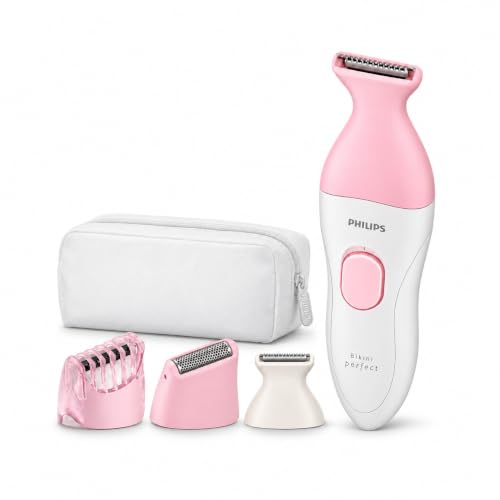
- The Philips BikiniPerfect Advanced is the kit choice — rechargeable, with three attachments for trimming, shaping and close work along the bikini line.
- The two Panasonic models split the difference: a compact AA-battery travel trimmer with four attachments, and a three-blade cordless model with travel cap and charging stand.
- Attachments are the real product: combs set length, precision heads shape edges, and foil heads finish closer — know which jobs you actually do before paying for all of them.
- Comfort comes from preparation, light pressure, sharp clean blades and unhurried technique, in any price tier.
In this guide
Quick Picks
Best complete kit: Philips BikiniPerfect Advanced — rechargeable, wet and dry, three attachments covering the bikini-line jobs from bulk trim to detail.
Best for travel: Panasonic ES-WV62-H — cordless, AA-battery powered, four attachments, sized for a washbag and indifferent to foreign sockets.
Best for a close finish at home: Panasonic ES-AWL6AG — a three-blade cordless wet-and-dry shaver-trimmer with a travel cap and its own charging stand, in a mint finish.
How We Chose These Trimmers
Three filters built this shortlist. Verifiability came first: each pick is a current listing we could check, described in this guide by the features its listing actually names — attachments, power source, wet-and-dry capability — rather than by borrowed review folklore. Brand accountability came second: in a category full of anonymous lookalikes with mystery blades and no replacement parts, Philips and Panasonic offer named models, real manuals and companies that answer for their products, which matters for an appliance used on skin. Third, the three picks were chosen to be genuinely different answers — a rechargeable kit, a battery travel tool, a stand-kept home shaver-trimmer — so the comparison teaches the category’s real decision rather than ranking three clones.
Equally deliberate is what the guide omits: no prices, because they move; no promises about skin outcomes, because an appliance listing cannot make them honestly; and no disposable-razor or waxing detours, because the question asked was about trimmers. Within that discipline, what remains is the useful core — mechanics, attachments, power, and technique.

Philips BikiniPerfect Advanced — the Kit That Covers the Whole Job
Badge: Best for a first serious trimmer and for anyone who does more than one grooming job.
- Model: Philips BikiniPerfect Advanced women’s trimmer kit, HP6376/61
- Power: rechargeable
- Use: wet and dry, per the listing
- Attachments: three, for the bikini line jobs described in the listing
The BikiniPerfect Advanced is built around a simple observation: “bikini grooming” is three jobs wearing one name. There is the bulk job — shortening longer hair to a manageable, even length. There is the shaping job — defining a neat edge along the line with control. And there is the finishing job — tidying the last strays close along that edge. A single fixed head does all three badly; a kit with three attachments does each with the tool shaped for it, and that is this product’s whole argument. The listing positions it exactly there, as a kit for the bikini line, and the rechargeable, wet-and-dry design wraps the attachments in the two conveniences that most change daily life with the device: no battery drawer archaeology, and full permission to use and rinse it in the shower.
Rechargeable power deserves its reputation in this category. A trimmer that lives charged is a trimmer that gets used for the two-minute tidy as readily as for the full session, and grooming kept up in small instalments is gentler and easier than grooming rescued monthly. Wet-and-dry use compounds the convenience: warm water, unhurried privacy, hair that behaves better damp, and a device that rinses clean under the tap instead of demanding a brush-and-tap ritual at the sink. For most buyers choosing one trimmer to own for years, this combination — kit breadth, rechargeable readiness, shower permission — is the complete answer, and the alternatives below earn their places by beating it on specific axes rather than overall.
Strengths
- Three attachments map onto the three real jobs: trimming length, shaping edges and finishing close.
- Rechargeable design means the trimmer is ready for small, frequent tidies, not just planned sessions.
- Wet-and-dry use allows shower grooming and simple rinsing after.
Trade-offs
- A kit has parts to keep together; travellers may prefer a single compact unit.
- Rechargeable convenience depends on remembering a charging rhythm, unlike a battery spare in the drawer.
- Readers who only ever do one simple trim job are paying for attachments that will stay in the pouch.
Best for: the buyer who wants one complete, home-based kit for all bikini-line grooming. / Not suited for: minimalists and frequent travellers who value a single pocketable tool above breadth.

Panasonic ES-WV62-H — the Travel-Ready Battery Trimmer
Badge: Best for washbags, gym kits and anyone who hates chargers.
- Model: Panasonic bikini trimmer, ES-WV62-H, white
- Power: AA battery operated, cordless
- Use: wet and dry, per the listing
- Attachments: four, in a travel-size format
The ES-WV62-H makes the opposite power argument from the Philips and makes it well. An AA battery is the world’s most available power source: it waits in the device for months without self-discharge drama, it can be replaced in a hotel room in any country, and it frees the trimmer from cables, stands and socket geography entirely. Panasonic wraps that freedom in a travel-size body with four attachments — a generous count for the format — and wet-and-dry capability, so the little unit is not a compromise tool but a complete one that happens to pack small. The listing’s own framing, a bikini shaver for women with wet and dry use in travel size, is precisely the product’s honest identity.
Who is it for? The frequent traveller whose grooming cannot depend on adapters; the gym-bag user who tidies after a swim or a workout shower; the second-home and caravan household where a drawer of AA cells already powers half the building; and the reader who simply prefers the honesty of a device that is either working at full strength or asking, unambiguously, for a fresh battery. Its grooming manners mirror the category’s: use the combs to set length first, the closer heads for the line, light pressure throughout, and rinse it under the tap when you are done. Small is a feature here, not a limitation — the trimmer goes where the grooming actually happens, which for busy lives is rarely a dedicated vanity session.
Strengths
- AA power is universally replaceable, travel-proof and free of charging schedules.
- Four attachments in a genuinely compact body cover the standard jobs without a kit bag.
- Wet-and-dry design suits gym, pool and hotel showers as readily as home.
Trade-offs
- Battery power means an ongoing, if tiny, consumable cost and waste stream.
- The compact body offers less to hold for users who prefer a fuller grip for control.
- Power delivery fades as a battery tires, unlike a freshly charged rechargeable at its peak.
Best for: travellers, gym and swim regulars, and charger-averse minimalists. / Not suited for: buyers who want a stand-kept, always-charged home appliance.

Panasonic ES-AWL6AG — the Three-Blade Home Finisher
Badge: Best for a close, smooth-edged finish in a home routine.
- Model: Panasonic bikini trimmer, ES-AWL6AG, mint
- Design: three-blade cordless wet-and-dry electric razor-trimmer, per the listing
- Includes: travel cap and shaver charging stand, per the listing
- Character: home-based, stand-kept, finish-focused
The second Panasonic answers a different reader: the one whose grooming goal leans toward the close finish — the tidy, smooth-edged result along the line — and whose routine lives at home. Its listing leads with a three-blade design, the architecture shavers use when the brief is closeness with glide, and pairs it with the two accessories that define a home appliance rather than a travel tool: a charging stand, so the trimmer lives charged and visible on the counter rather than forgotten in a drawer, and a travel cap, so the home favourite can still be packed safely when it must. The mint finish is a small, telling detail — this is a product designed to be left out in a bathroom without apologising for itself.
In the trio’s division of labour, the ES-AWL6AG is the finisher. A sensible routine pairs length management first — combs and trims, whether from this device’s trimming side or from a kit like the Philips — with this model’s closer work along the line, in the shower or at the sink, with the light touch that foil-and-blade systems reward. Readers whose grooming is a weekly home ritual rather than a travel improvisation will find its stand-kept readiness and close-finish brief the most satisfying of the three, while travellers should honestly prefer its AA-powered sibling.
Strengths
- Three-blade design is aimed at the close finish along the bikini line.
- Charging stand keeps it charged, visible and part of the bathroom rather than lost in storage.
- Travel cap protects the head when the home favourite does go in a bag.
Trade-offs
- A stand claims permanent counter space, which small bathrooms may resent.
- Finish-focused design is more than the simple length-trim user needs.
- As a rechargeable, it shares the category’s dependence on a charging rhythm.
Best for: home-routine groomers who prioritise a close, neat finish. / Not suited for: travellers and minimalists, who are better served by the AA-powered model.
How to Choose Among the Three?
Answer three questions and the choice makes itself. Where does your grooming happen? Mostly at home points to the Philips kit or the stand-kept Panasonic; mostly away points to the AA traveller. What is the job’s shape? If you trim length, shape edges and finish close at different times, a kit’s attachments pay rent; if your routine is one repeatable pass, a simpler device serves better and clutters less. And how do you feel about charging? Readers who keep phones, brushes and razors on stands will keep a trimmer charged without thinking; readers whose drawers are graveyards of flat rechargeables should take the battery model’s honesty as a kindness. There is no wrong answer among the three — there is only the answer that matches a life, and a mismatched excellent trimmer is just an excellent trimmer in a drawer.
Attachments, Translated From the Euphemisms
Because listings speak in code, here is the plain dictionary. A trimming comb is a guard that holds the blade at a set distance from the skin, so hair is cut to a chosen, even length — the tool for the bulk job and for a natural, tidy result rather than a bare one. A precision or shaping head is a narrower cutter for edges and details, trading coverage for control. A shaver or foil head cuts much closer at the surface for a smooth-edged finish along the line. A bikini comb or dedicated bikini attachment is shaped or angled for the area’s curves. When a listing counts attachments, map each one to a job you actually do; a kit whose third head you will never use is a two-head kit wearing a bigger number. The Philips’ three and the little Panasonic’s four both map sensibly onto the standard jobs, which is part of why these models, and not higher-count mystery kits, anchor this guide.
A Comfortable Trimming Routine, Step by Step
Step one: prepare the ground
Work after or during a warm shower where the device allows wet use: hair is softer, skin is clean, and you are unhurried and private. If hair is long, that is what the comb is for — never ask a finishing head to open the batting. Assemble the attachment for the first job and keep the others within reach rather than mid-routine in another room.
Step two: length first, with the comb
With the trimming comb fitted, work slowly against the direction of growth with the skin held gently taut by your free hand, letting the comb set the length evenly across the area. Check the result in good light before going shorter anywhere; you can always take more off, and the reverse operation has not been invented.
Step three: shape the edges
Swap to the precision head for the line itself. Short, deliberate strokes beat long ambitious ones; define one side, then match it, stepping back to judge symmetry from a normal distance rather than at inspection range, where nobody will ever actually view the result.
Step four: finish close, lightly
For the close finish along the line, use the shaver head with the lightest pressure in your repertoire and short strokes, letting the blades do the work. Pressure is the beginner’s error everywhere in grooming: it buys nothing, drags everything, and turns a comfortable routine into a sore one. If an area resists, re-soften it with warm water and return rather than pressing your case.
Step five: rinse, dry, done
Rinse the device as its instructions direct — wet-and-dry models make this a pleasure — shake and air-dry it before storage, and give the skin the same plain courtesy: rinse, pat dry, and leave it alone. Fragranced extras and elaborate aftercare are marketing’s department, not comfort’s; if skin protests beyond the ordinary, that is a question for a professional, as this guide has said from the start.
Care, Hygiene and Blade Life
A trimmer is a small machine that works in a warm, damp room against skin; its care rules follow from that sentence. Rinse or brush it after every use as the manual directs, dry it before it goes away, and store it dry — a steamy shower shelf is a home for the device during use, not necessarily for its life. Keep attachments together and capped where caps are provided, both for hygiene and because a bare foil head in a washbag is a foil head being damaged. Blades and foils are consumables: when a device starts needing pressure or extra passes to do what it once did in one, the edge, not your technique, has retired, and the maker’s replacement parts are the correct purchase. Replace on that evidence rather than on a calendar, and never share a personal trimmer — a rule so basic it is embarrassing to print and important enough to print anyway.
Common Mistakes
The universal mistake is hurry: grooming squeezed into the last five minutes before the pool, the date or the holiday flight, with predictable consequences for both result and temper. The second is skipping the comb and sending a close head into long hair, which clogs, pulls and teaches the user to blame a good device. The third is pressure, discussed above and worth repeating because it survives every guide ever written. Fourth is the blunt blade kept a year past its evidence, defended as thrift while it taxes its owner in passes and irritation. Fifth is storage in the damp, which ages blades and batteries alike. And the sixth is buying by attachment count or by the most breathless listing language, rather than by the three honest questions — where, what job, which power — that this guide’s comparison is built on.
Final Recommendation
Most buyers should start with the Philips BikiniPerfect Advanced: the complete kit, rechargeable and shower-ready, that covers every job the category contains. Choose the Panasonic ES-WV62-H instead if your grooming travels, and the Panasonic ES-AWL6AG if your home routine prizes the close finish and a stand-kept appliance. Whichever arrives, give it the unhurried routine, the light hand and the clean storage described above, and it will repay you in the only currency this category honestly trades in: a small task made simple, comfortable and entirely unremarkable.
Continue reading: quiet nights and better sleep · the helmet for the ride to the pool · a reading ritual for bath nights · clearing cooking smells after a big night in · bathroom air and moisture basics · keeping bedroom air fresh
The Pre-Holiday Audit and Other Seasonal Wisdom
Bikini trimmers live a seasonal life, and the household that audits theirs before the season beats the household that discovers its failures during it. In the weeks before the swimming and holiday months, run the checklist this guide has built in pieces: charge or re-battery the device and confirm it holds its strength through a full session rather than a hopeful minute; inspect the cutting parts against the evidence test — pulling, pressure, extra passes — and order replacements while delivery is a convenience rather than a rescue; rinse, dry and re-pouch the kit so the travel model and the home model are each where the season will look for them. The same audit, inverted, belongs at the season’s end, when the device goes back to its drawer: clean, dry, charged or de-batteried as its maker advises, so that next year’s first session begins with an appliance rather than an archaeology project. None of this takes ten minutes. All of it together is the difference between a category that feels effortless — the entire promise of these small machines — and one that reliably ambushes its owner at the exact moment she is packing a bag, which is when every neglected appliance in history has chosen to announce itself.
Learning Your Own Preferences: The Three-Session Rule
New owners judge a trimmer too quickly, in both directions, so this guide offers its standard rule: three sessions before verdict. The first session is education — the hand learns angles, the ear learns the device’s pitch, the routine exists only as this page’s instructions. The second is calibration — combs compared, order of heads settled, the bathroom’s logistics arranged. The third is the device as it will actually be lived with, and it is the only honest evidence for the keep-or-exchange decision. Owners who abandon a trimmer after one awkward session are usually abandoning their own inexperience, which the device would have cured by the third; owners still struggling at the third session own real information, and should act on it without the sunk-cost loyalty that keeps unsatisfying appliances in drawers for years. The rule generalises, as the best household rules do: it is the same patience this site recommends for a purifier’s first week, a helmet’s first month and a subscription box’s first three parcels. Judge tools by their settled performance in your life, not by their first audition — and let the three picks on this page, each strong in its own treaty of compromises, be judged exactly that way.
The Bathroom Shelf: Placing the Trimmer Among Its Neighbours
No personal appliance lives alone, and the trimmer’s shelf-mates explain its final lessons. Beside it stand the other small electrics of the morning — the toothbrush on its charger, the shaver in its stand, the hair tool with its cord in a permanent negotiation with the sink — and the shelf’s ecology rewards the same virtues everywhere: a power source that matches the household’s charging habits, a footprint the room can afford, a cleaning ritual short enough to survive a busy week. The stand-kept Panasonic was designed for this ecology explicitly, earning its counter space by readiness; the Philips kit answers with the pouch, trading the shelf for the drawer; the little Panasonic answers by disappearing, the minimalist’s eternal trump. A buyer choosing among the three is therefore also furnishing a bathroom, and should let the room vote — measure the counter, count the sockets, open the drawer — before the body’s preference is even consulted. It is the same doctrine this site applies to purifiers, helmets and subscription boxes, in larger type: the best product is the one that fits the life and the room it must live in, and a trimmer that fits both will be used, kept sharp and kept clean for years, which is the whole of the law in this small, private category.
What Changes at Forty, Fifty and Beyond: A Trimmer’s Long Service
Personal grooming is a lifetime habit, and a guide that only addressed its readers’ first purchase would miss the category’s longer arc. Skin changes across the decades — its patience, its texture, the gentleness it rewards — and hair changes with it, so the routine that served at twenty-five deserves review rather than mere repetition at fifty: lighter pressure still, more patience with preparation, a closer eye on the blade’s condition, since ageing skin forgives a dull edge least of all. The devices age alongside their owners in the kinder direction: the kit bought for a first flat becomes the stand-kept appliance of a settled bathroom, and the travel model accumulates a geography of hotels and holidays that makes it, improbably, a sentimental object. Households replacing a trimmer after long service should let the old one’s biography write the new one’s brief — which heads were used, which power source never failed, which drawer it truly lived in — because that evidence, as this guide has said of every category it touches, outranks any listing’s adjectives. Comfort, in the end, is a practice refined over years; the three trimmers on this page are simply its current, well-made instruments, ready to be refined with.
The Two-Minute Tidy: In Defence of the Small Session
Let the guide’s last argument be for the habit its rechargeable pick was built to serve. Grooming culture quietly assumes the appointment — the long session, the full routine, the before-and-after — but the owners who stay effortlessly tidy across a season are usually practitioners of the opposite art: the two-minute tidy, taken in the shower when the need is first noticed, with the comb, at the moment the job is smallest. Small sessions are kinder in every dimension this page has measured: less to take off, so less to get wrong; less time under any blade, so less asked of the skin; less dread, so less avoidance, so smaller jobs still — a virtuous spiral whose entry fee is a device that is charged, rinsed and within reach. That is the deepest reason the Philips kit anchors this guide’s recommendations and the stand-kept Panasonic its home ritual: both are architectures for readiness, machines designed to be caught in the act of being available. The travel Panasonic keeps the same faith on the road. Buy whichever readiness suits your rooms, keep it where the two minutes happen, and the best bikini trimmer will have done for you what the best tools in every category on this site do — it will have made a task so small that it stops being a task at all.
Frequently Asked Questions
Is wet-and-dry use really worth it?
For most users, yes — it is the feature that changes behaviour. Shower use means softer hair, easier clean-up and a device that rinses clean in seconds, and grooming that fits into an existing routine happens more regularly and more calmly than grooming that needs its own appointment.
Rechargeable or battery: which is better?
Neither in the abstract. Rechargeables suit home routines and stand-keepers; AA power suits travellers and anyone whose rechargeables reliably die in drawers. The Philips and the stand-kept Panasonic take the first side, the compact Panasonic the second, and your own habits are the referee.
What do the different attachments actually do?
Combs set an even trimming length, precision heads shape edges with control, and shaver or foil heads finish close along the line. Map a kit’s attachments to the jobs you genuinely do; a head you never fit is not a feature, it is storage.
How do I avoid an uncomfortable result?
Prepare with warm water, take length down with the comb first, hold skin gently taut, use the lightest pressure you can, and stop passing a blunt blade over the same ground. Sharp, clean equipment and an unhurried ten minutes prevent most of what people blame on their skin or their device.
How long do blades and foils last?
Judge by performance rather than by calendar: when the device needs pressure or repeated passes to do what it once did cleanly, the cutting parts have dulled and the maker’s replacements are due. Rinsing, drying and capped storage stretch that interval considerably.
Can I take a bikini trimmer in hand luggage?
Electric trimmers are generally treated like other small personal-care appliances by airlines and security regimes, but rules vary and change; the AA Panasonic removes one variable by carrying no lithium cell, and checking your airline’s current guidance before you fly is the reliable move for any model.
Where Trimmers Sit Among the Other Methods
Readers often arrive at this category from another one, so the honest map helps. Disposable and cartridge razors cut at the surface and give the closest result with the least equipment, at the price of consumables forever and a technique that punishes haste on curves. Waxing and sugaring remove hair from the root and last longer between sessions, with an appointment’s cost, pain and planning attached. Depilatory creams dissolve hair chemically and divide users sharply by tolerance and patience. Electric trimmers occupy the pragmatic middle: they cut above the surface to a chosen length, quickly, privately, with no appointments and no chemistry, and their result is a neat trim rather than bare skin unless a shaver head finishes the line. Understanding that a trimmer’s native result is tidiness — with closeness available at the edges from the right head — prevents the disappointment of buyers who expected a trimmer to be a waxing substitute. It is a different, kinder tool for a slightly different job, and for a great many people’s actual goals, it is the right one.
Scenarios: Matching the Device to the Life
The swim-season regular
For the swimmer, the aqua-aerobics regular and the beach-holiday household, grooming is seasonal maintenance with deadlines set by the pool timetable. The routine that serves them is the frequent small tidy rather than the heroic monthly session, which favours the rechargeable Philips at home: charged, shower-ready, and quick with its comb for the standing appointment. The travel Panasonic earns its place in the same life a few times a year, in the holiday washbag, where its battery indifference to foreign bathrooms is worth more than any specification.
The minimalist
One device, one job, no kit. The minimalist should resist the complete-kit argument entirely and buy the compact Panasonic, use its comb, and let the other attachments be the household’s smallest drawer of might-have-beens — or choose the stand-kept model if the one job is the close finish. Minimalism in this category is not deprivation; it is the recognition that a device used weekly beats a system used wistfully.
The sensitive, cautious beginner
For the first-time buyer made nervous by the whole subject, the advice is to begin with length only. A comb-guarded trim, in the shower, with no close work at all, is achievable on day one with any of the three picks, is fully reversible by time, and teaches the hand its pressure and angles. Closer work can be added in later sessions as confidence and knowledge of one’s own skin accumulate — and any sign that grooming and your skin disagree belongs, as ever, in a professional conversation rather than in a product swap.
The shared bathroom
Households sharing one bathroom add logistics to grooming: counter space for a stand, a shelf where a personal device is unambiguously personal, and charging sockets that are contested territory at 7 a.m. The stand-kept Panasonic argues for its footprint by being visibly one person’s appliance; the Philips kit argues for a pouch and a drawer; the little Panasonic disappears entirely, which in a crowded bathroom is its own diplomacy. Choose with the room, not just the body, in mind.
Troubleshooting the Ordinary Complaints
When a trimmer pulls instead of cutting, the causes queue in a familiar order: hair too long for the head being used, a blade past its prime, a battery at the end of its strength, or a head clogged mid-session. The fixes queue correspondingly — comb first, rinse the head, fresh power, and finally replacement cutting parts. When results come out uneven, the culprit is usually angle: a comb held at a wandering tilt cuts a wandering length, and the cure is the free hand keeping skin taut and the device at one consistent attitude, in overlapping passes judged in good light. When a device dies young, storage is the first suspect — a life spent wet in a steamy cubicle ages everything — followed by the charging habits that rechargeable cells quietly record. And when a trimmer is simply hated from the first week, believe the evidence early: the shape, weight or head system does not suit its owner, and exchanging a disliked personal appliance is cheaper than the years of avoidance that follow keeping it.
The Consumables Ledger and the Environment
An electric trimmer’s environmental pitch is the absence of a weekly consumable: no cartridges in the bin, no cans, no strips. Its honest ledger still has entries — a battery’s eventual replacement, blades and foils on their cycle, the AA cells of the travel model, and the device’s own end of life years out. Readers who weigh this side of purchases can act on the details: rechargeable models with replaceable cutting parts outlast sealed throwaway designs; AA users can choose rechargeable cells where the device’s maker permits them; and a trimmer kept dry, clean and sharp is an appliance that stays out of the waste stream for the longest possible time. Durability, in this small category as in large ones, is the greenest specification — one more argument for the named brands and real manuals that this guide’s shortlist insisted on.
Buying the Second One: What Experience Teaches
Almost nobody’s second trimmer is a repeat of their first, because the first teaches its owner which of this guide’s three questions actually governed their satisfaction. Kit owners who used one head for two years become minimalists; minimalists who took up swimming become kit owners; travellers come home and buy the stand. There is no failure in that evolution — it is the normal biography of a personal appliance — but it suggests a strategy for the first purchase: buy the model that matches your current life honestly, from a brand whose parts you can get, and let the second purchase, years later, be made by the expert the first one trained. The three picks here were chosen so that whichever expert you become, one of them is already the answer you will reach for.
Anatomy of a Trimmer: What Is Inside the Little Machine
A trimmer is three systems in a trench coat. The cutting system is a pair of toothed blades sliding past each other thousands of times a minute, or, in a shaver head, an oscillating cutter beneath a perforated foil; hair enters the teeth or the foil’s holes and is sheared. Everything about comfort in this category is downstream of that shearing being clean — sharp edges, correct alignment, and a motor strong enough to keep the blades moving at speed when the hair resists. The power system is the second act: a rechargeable cell trades the AA’s instant replacement for a stand or cable ritual, and its motor holds its pace until the charge genuinely fades, while a battery model announces its tiredness gradually, which experienced users read as a cue rather than a fault. The third system is the housing — the seals that make wet use honest, the grip shaping that keeps a wet hand in command, the head release that decides whether cleaning is a pleasure or a penance. When you hold the three picks in this guide, you are holding three different treaties among those systems: the Philips kit spends on breadth, the travel Panasonic on power freedom, the stand Panasonic on the cutting system’s closeness. Listings that recite features without revealing the treaty are hiding the only thing worth knowing.
Decoding the Listing Language
A few phrases recur across the whole shelf and deserve permanent translation. “Wet and dry” means the device is sealed for shower use and rinsing; it does not mean it should live underwater or be stored dripping. “Cordless” says nothing about the power source — it covers both the rechargeable and the battery models here — so read one line further. “Attachments included” counts everything in the box, occasionally including the pouch and the cleaning brush in the arithmetic of the unscrupulous, which is why this guide mapped heads to jobs rather than repeating counts as virtues. “Gentle” and “for sensitive skin” are comfort claims, not clinical findings, and should be weighed as design intentions rather than evidence. “Bikini” itself, in a product name, usually signals a compact head, a guard set tuned for the area, and marketing permission to say so — useful shorthand, provided the mechanics underneath are the named-brand mechanics this shortlist insisted on. A reader fluent in these translations can walk the whole category in minutes, which is exactly the fluency the fog of euphemism exists to prevent.
Gifting, Households and the Diplomacy of Personal Appliances
Trimmers are occasionally gifts, and the etiquette is narrow but navigable: they are appropriate where the relationship and prior conversation make them welcome — a partner who has complained about their current device, a teenager equipping a first bathroom with a parent’s guidance — and tone-deaf as surprises for anyone else. The giftable virtue of the stand-kept Panasonic is that it presents as a handsome bathroom appliance; the kit’s virtue is completeness for someone setting up home; the travel model’s is that it asks nothing of the recipient’s sockets or shelves. In households, the rule that survives all diplomacy is the one printed earlier: a personal trimmer is personal. Families equipping several bathrooms should buy in multiples without embarrassment — the category’s modest size makes a one-per-person policy the cheapest hygiene rule in the house — and label or colour-code where identical models multiply, as the two white-and-mint Panasonics here conveniently allow.
Grooming Away From Home: Hotels, Gyms and Festivals
The away-from-home routine compresses the home one and adds other people’s plumbing. In a hotel, the shower is the studio and the travel Panasonic is in its element: no adapter hunt, no stand to balance on a glass shelf, and a rinse under the tap that leaves no evidence. At the gym or pool, timing is the etiquette — the quiet corner of the changing room, your own towel as the work surface, and the device rinsed and capped before it returns to a shared bench’s vicinity. Festivals and camping strip the routine to its skeleton: the battery model again, a mirror, patience, and the acceptance that field grooming is maintenance, not artistry. Across all three settings the same two rules travel: keep the device personal and keep it clean, in that order, and the little machine will serve in a tent as faithfully as in a marble bathroom — one of the genuine democratising virtues of a category this small and this sensibly priced by its serious makers.
The Rhythm of Ownership: A Year With a Trimmer
Month one is courtship: the new device is charged on schedule, rinsed with ceremony, and its attachments are all still in the pouch in the order the factory intended. The households that keep a trimmer happily for years are the ones whose month six still resembles month one in the ways that matter — the rinse that takes twenty seconds, the dry shelf, the pouch that goes back to the same drawer. Somewhere in the first season, most owners quietly retire one attachment to the back of that drawer and promote a favourite; that is not the kit failing, it is the kit completing its real job, which was to let you discover your own routine with every option present. Once a year, on no particular anniversary, the honest owner audits the cutting parts against the evidence test from this guide — pressure, passes, pulling — and spends the small money on fresh blades or foils before the old ones start taxing every session. Batteries get their own small audit: the rechargeable that no longer holds a useful charge is telling you about chemistry, not character, and the AA drawer that has been empty twice at the critical moment gets restocked on the third warning. None of this is onerous; all of it together is the difference between an appliance that is owned and one that is merely possessed, and it is why the named brands in this guide, with their parts and manuals and stands, tend to still be in service when the anonymous alternatives have become drawer archaeology.
What We Would Buy, Stated Plainly
Guides should end their comparisons without fog, so: if this page’s reader is the median reader — home-based grooming, a wish for the full menu of jobs, no strong feelings about chargers — the Philips BikiniPerfect Advanced is the purchase, and it is not close. If the reader’s grooming happens in departures lounges and gym showers, the AA Panasonic is not a compromise but the correct tool, chosen with the same confidence. If the reader’s pleasure is the polished home ritual and the closest finish the category offers, the stand-kept three-blade Panasonic was designed by people who understood that reader personally. The worst purchase available is none of these: it is the anonymous kit with the double-digit attachment count and no maker’s name to order a blade from, bought because its listing shouted loudest. Against that purchase, every section of this guide has been one long argument — for mechanics over adjectives, for parts over promises, and for the quiet confidence of a small machine from a company that expects to hear from you again.
Before You Check Out: A Last Honest Checklist
Run the purchase past five final questions. Does the listing name the exact model, and does that model appear in this guide or in the maker’s own catalogue? Can you find the replacement cutting parts for it with one search, today, rather than as a hope? Does its power source match the life you actually lead — stand, socket or battery drawer? Do its attachments map onto jobs you performed in the last three months, rather than jobs an advertisement performed this morning? And have you left room in the plan for the unglamorous accessories of success — a pouch or place to keep it, a charging spot or a stocked battery drawer, and ten unhurried minutes in your week? Five yeses describe a purchase that will still look wise in a year. Any no is not a veto; it is a signpost to the model among the three picks that answers it, which is precisely what a shortlist is for. Choose, groom gently, keep the little machine clean and dry and sharp, and let this most private of appliances do its work so uneventfully that you forget it was ever a decision at all — the highest praise a bikini trimmer, like a good referee or a good foundation garment, can ever earn.
A Note on Expectations, Because the Category Needs One
Every disappointment in this category traces back to an expectation the tool never agreed to. A trimmer will not make grooming permanent, clinical or effortless; it will make it quick, private, repeatable and under your control, which is a more modest and more durable set of gifts. Results vary with hair, skin, angle and patience, and the same device will delight one owner and merely satisfy another for reasons no listing can arbitrate. That is why this guide has spent its length on fit between device and life rather than on crowning a universal champion, and why its final advice is procedural rather than commercial: buy a named model whose parts exist, learn its heads in the order length-shape-finish, keep your hand light and your blades sharp, and judge the purchase after a season of real use rather than after a single session. Judged that way, all three trimmers on this page have long and honourable service ahead of them — and so, comfortably, does their owner.