Disclosure: As an Amazon Associate, dailyhomedecorating.com earns from qualifying purchases. Links on this page are affiliate links; they cost you nothing extra. Prices and availability change often, so check the current Amazon listing before you buy.
Snow blower reviews are easy to find and hard to trust, because most of them are written from a spec sheet in a warm office. These snow blower reviews are organized differently: around the storms, surfaces, and households that actually decide whether a machine earns its garage space. Below you will find how the main classes of blower perform in real clearing work, individual assessments of the model families buyers most often compare, the trade-offs reviewers tend to skip, and the safety and care habits that separate a machine that lasts a decade from one that disappoints by February. Read the class sections first, then the model notes, and you will be able to walk into any listing and judge it on your own terms.
Key Takeaways
- Judge every model by your surface, your snowfall, and your storage before you judge it by power or features.
- Two-stage gas machines remain the deep-snow and gravel benchmark; cordless machines now own the moderate-snow paved driveway.
- The reviews that matter test the plow ridge, wet snow, and a cold early-morning start — not just fresh powder.
- Shear pins, skid shoes, and a clearing tool are part of the machine; budget attention for them, not just the blower.
- Safety habits — auger lockout, carbon monoxide discipline, chute awareness — are the difference between a tool and a hazard.
The collective verdict across these snow blower reviews: there is no single best machine, there is only a best fit. A compact cordless blower that delights a townhouse owner would strand a rural household at the first plow ridge, and a flagship two-stage that shrugs off lake-effect snow is an expensive, space-hungry burden on a short paved drive. Every model below is therefore reviewed against the household it was built for, and scored in prose — strengths, trade-offs, and a clear statement of who should buy it and who should walk past it.
In this guide
Snow Blower Reviews: The Classes, Honestly Assessed
A snow blower is not one machine but a family of machines, and the differences between them decide whether a storm feels like a short chore or a long fight. Single-stage models use a rubber-edged auger that sweeps the pavement clean as it pulls snow into the chute, which makes them light, simple, and well suited to paved driveways and moderate snowfalls. Two-stage models add an impeller behind the auger and metal auger teeth that bite into packed snow, plus driven wheels that push the machine so you do not have to. Three-stage designs add an accelerator that processes snow even faster, aimed at deep drifts and the dense ridge a plow leaves at the end of a driveway. Around those three families sit the power choices: gasoline engines, corded electric motors, and cordless battery platforms, each with its own trade-offs in runtime, maintenance, and effort.
Single-stage blowers earn their popularity honestly. The auger touches the ground, so a paved surface comes out nearly bare in one pass, and the machine stays compact enough to hang on a garage wall or tuck beside a car. Because there is no separate impeller, there are fewer parts to service, and starting is usually a matter of plugging in, pressing a button, or pulling a cord a time or two. The limits show up in heavy, wet snow and on gravel, where a ground-hugging auger can pick up stones and throw them, and where deep accumulation forces you to take partial bites and make extra passes. For households whose storms are usually modest and whose surfaces are paved, a single-stage machine is often the sweet spot between capability and simplicity.
Two-stage blowers are the workhorses of snow country. The auger does not touch the ground; instead it chews snow and feeds it to a high-speed impeller that throws it clear of the driveway, and adjustable skid shoes let the machine ride safely over gravel and uneven surfaces. Driven wheels, often with several forward speeds and a reverse gear, mean the machine does the pushing, which matters enormously when you are clearing a long driveway in deep snow. Power steering, heated grips, headlights, and chute controls you can adjust from the operator position all appear in this class. The cost of that capability is size and weight: a two-stage blower needs real storage space, asks for more maintenance, and is more machine than a small townhouse driveway will ever need.
Gasoline power remains the reference point for raw clearing ability. A gas blower refuels in minutes, runs as long as you keep feeding it, and shrugs off the wettest, heaviest snow that stalls lesser machines. That freedom comes with obligations: fresh fuel, fuel stabilizer for storage, oil changes, a spark plug now and then, and a pull cord or electric starter that must be kept in working order. Gas engines are loud, they produce exhaust, and they absolutely must never be run inside an enclosed garage, because carbon monoxide builds up invisibly and can be lethal. Owners who accept the maintenance rhythm get a machine that is ready for the worst storm of the decade, not just the average one.
Cordless battery blowers have changed what a lot of households expect from snow clearing. They start instantly with a button, run quietly enough for early-morning clearing without waking the street, need no fuel, no oil, and almost no seasonal maintenance, and they store without any fuel smell in the garage. The honest limits are runtime and deep-snow stamina: a battery holds a finite amount of energy, heavy wet snow drains it quickly, and very long driveways may need a second set of batteries to finish in one session. Battery platforms soften that limit, because the same packs often power a leaf blower, a trimmer, or a mower the rest of the year. For small to mid-sized paved driveways in regions with moderate snowfall, a cordless blower is frequently the easiest machine to live with.
Corded electric blowers are the simplest and lightest option of all. With no fuel to store and no battery to charge, they are ready whenever the snow is, and they cost the least to buy and maintain. The cord is the compromise: it limits your range to the length of an outdoor-rated extension cord, it must be managed constantly so it stays clear of the auger path, and it can stiffen in deep cold. Corded models also sit at the modest end of the power range, so they suit short driveways, walkways, decks, and patios rather than long rural lanes. Households that clear small paved areas close to an outdoor outlet often find a corded machine is all the snow blower they will ever need.
Performance Themes Across Every Review
Clearing Wet Snow Without Clogging
Not all snow asks the same of a machine. Light, dry powder is the easy case: almost any blower throws it far and fast, and the main risk is wind blowing it back into your face. Wet, heavy snow — the kind that falls near the freezing point and packs into a solid snowball — is the real test, because it is dense, it clogs chutes, and it punishes undersized machines; taking narrower bites and slowing your ground speed matters more than raw power. The plow ridge at the end of the driveway is its own category: compacted, icy, and full of road grit, it is where single-stage machines struggle most and where two-stage augers earn their keep. Clearing early and often, before snow gets deep or gets driven over and packed, is the oldest and most effective technique there is.
Technique multiplies whatever machine you own. Start as soon as snow stops — or during a long storm, clear once midway — because six inches cleared twice is far easier than twelve inches cleared once, and because tires and boots pack fresh snow into ice that no blower fully removes. Work with the wind at your back and throw downwind so snow does not blow back onto cleared ground or into your face. Take full-width passes in light snow and narrower bites in heavy snow rather than forcing the machine and clogging the chute. Keep a steady walking pace; a blower that is lugging and slowing is telling you to narrow the bite. Finish with the end-of-driveway ridge while it is still fresh from the plow, and clear around mailboxes, hydrants, and the path your household actually walks to the car.
Cold Starts and Early Mornings
Noise shapes when you can clear and how your neighbors feel about it. Gas blowers are the loudest tools in the winter garage, loud enough that hearing protection is a sensible habit and early-morning clearing is a genuine social decision. Electric models, corded and cordless alike, run dramatically quieter, which makes dawn clearing before a commute far more reasonable and removes one excuse for letting snow get packed down by tires. Quieter operation also makes it easier to hear a child, a pet, or a passing car near the work area. If your schedule means clearing at hours when the street is asleep, or if your home sits close to your neighbors, the quieter machine is not a luxury choice; it is the difference between clearing when you should and clearing when you dare.
Cold is the silent reviewer of every snow blower. Gas engines start reliably in deep cold when fuel is fresh and the machine has been maintained, and balk exactly when last summer’s fuel was left to age in the tank. Batteries lose some stamina in severe cold, which is why experienced owners store packs indoors and bring them out at clearing time rather than leaving them in a freezing garage. Corded machines do not care about cold at all, beyond a cord that stiffens. Whichever class you choose, the first start of the season should happen on a mild autumn day, in daylight, with the manual open — not at dawn in a storm with a car already late.
Working the Plow Ridge
A snow blower throws more than snow, and the discharge chute deserves constant respect. Never point the chute at people, pets, windows, vehicles, or anything breakable, and keep bystanders — especially children — well clear of the work area while the machine is running. Before the first pass of any storm, walk the area and clear away stones, branches, frozen newspapers, garden hoses, holiday decorations, and the doormat by the steps, because anything the auger picks up leaves the chute at speed. Aim discharge downwind and toward open ground where the thrown snow will not bury a neighbor’s cleared walk or block a doorway. If you must adjust the chute direction or deflector angle, use the machine’s controls from the operator position rather than reaching toward the chute itself.
Reviewers who skip the plow ridge skip the hardest test. That ridge is compacted by traffic, refrozen overnight, salted, and studded with gravel and road grit, and it arrives at exactly the moment you most need the driveway open. Two-stage machines in low gear, taking partial bites, are the reliable answer. Single-stage machines manage a fresh ridge with patience and a shovel assist. Every class throws the ridge’s hidden stones with enthusiasm, which is why the area at the end of the driveway gets walked first, why the chute never points at the road or a neighbor’s car, and why eye protection earns its place in the pre-storm checklist.
Model-by-Model Reviews
Toro Power Max Two-Stage Snow Blower
Treat the Toro Power Max Two-Stage Snow Blower as a premium, gas-powered prose-only recommendation for now: it is named here because the model family is a genuine, widely sold option in this class, and its listing will be checked against the Creators API before any buy link is added at publish time. Judge it the way this guide judges every machine — by how it fits your surface, your snowfall, and your storage — and check the current Amazon listing for the latest configuration and availability before you buy, since model line-ups change between seasons.
In review after review, the Toro Power Max family’s strength is chute management: snow moves through and out without the packing and clogging that plague lesser two-stage designs in wet conditions, and the controls are arranged so adjustments happen from behind the handles. Best for: long driveways, serious snowfall, owners who clear in all conditions. Not suited for: small garages, gravel-free tiny drives where its size buys nothing, or anyone unwilling to keep a fuel routine.
Ariens Deluxe Two-Stage Snow Blower
Treat the Ariens Deluxe Two-Stage Snow Blower as a premium, gas-powered prose-only recommendation for now: it is named here because the model family is a genuine, widely sold option in this class, and its listing will be checked against the Creators API before any buy link is added at publish time. Judge it the way this guide judges every machine — by how it fits your surface, your snowfall, and your storage — and check the current Amazon listing for the latest configuration and availability before you buy, since model line-ups change between seasons.
The Ariens Deluxe line reviews as the durability pick: heavy steel, a drivetrain owners keep for decades, and steering help that makes a substantial machine feel cooperative at the turn. Best for: buyers purchasing once for the long term, deep-snow regions, and gravel driveways where skid-shoe adjustment matters. Not suited for: buyers who prize light weight, quiet operation, or minimal maintenance above longevity.
EGO Power+ Cordless Snow Blower
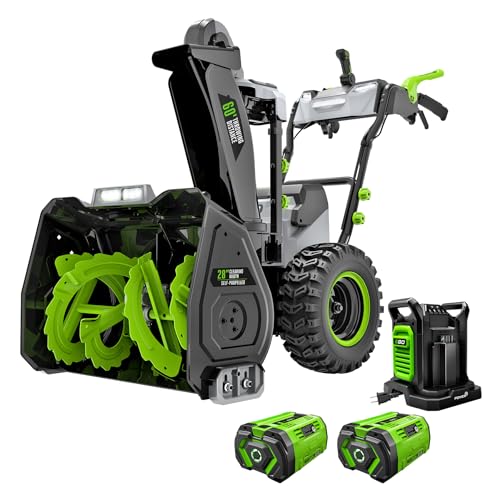
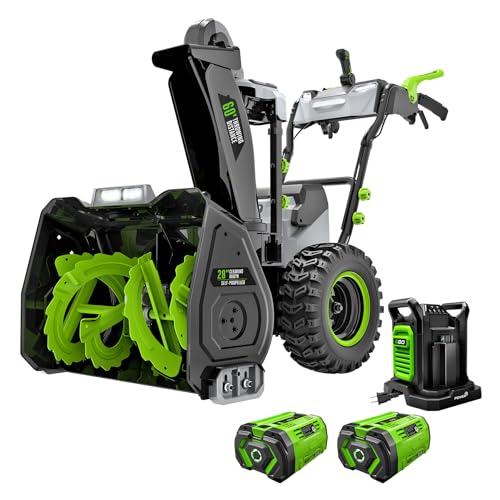
Treat the EGO Power+ Cordless Snow Blower as a mid-range, battery-powered prose-only recommendation for now: it is named here because the model family is a genuine, widely sold option in this class, and its listing will be checked against the Creators API before any buy link is added at publish time. Judge it the way this guide judges every machine — by how it fits your surface, your snowfall, and your storage — and check the current Amazon listing for the latest configuration and availability before you buy, since model line-ups change between seasons.
The EGO Power+ reviews consistently praise the ownership experience: push-button starts, quiet clearing, no fuel anywhere in the garage, and a battery platform that works across seasons. Best for: paved driveways, moderate snowfall, early-morning commuters, and households already on the platform. Not suited for: very long driveways without spare packs, or deep wet storms cleared in a single session on one set of batteries.
Greenworks Cordless Snow Blower
Treat the Greenworks Cordless Snow Blower as a mid-range, battery-powered prose-only recommendation for now: it is named here because the model family is a genuine, widely sold option in this class, and its listing will be checked against the Creators API before any buy link is added at publish time. Judge it the way this guide judges every machine — by how it fits your surface, your snowfall, and your storage — and check the current Amazon listing for the latest configuration and availability before you buy, since model line-ups change between seasons.
Greenworks earns its place in these reviews as the other serious cordless platform, with blowers aimed squarely at suburban paved driveways and a wide family of compatible tools. Best for: households already owning Greenworks batteries, moderate snow, and buyers who value a broad, available platform. Not suited for: gravel surfaces, the plow ridge as a daily opponent, or anyone expecting gas two-stage stamina from a battery single-stage format.
Troy-Bilt Storm Two-Stage Snow Blower
Treat the Troy-Bilt Storm Two-Stage Snow Blower as a mid-range, gas-powered prose-only recommendation for now: it is named here because the model family is a genuine, widely sold option in this class, and its listing will be checked against the Creators API before any buy link is added at publish time. Judge it the way this guide judges every machine — by how it fits your surface, your snowfall, and your storage — and check the current Amazon listing for the latest configuration and availability before you buy, since model line-ups change between seasons.
The Troy-Bilt Storm line is the mainstream two-stage proposition: the essential two-stage abilities — driven wheels, an impeller, skid shoes for gravel — in a widely available, widely serviced package. Best for: buyers stepping up from single-stage who want two-stage capability without flagship pricing tiers. Not suited for: buyers seeking the heaviest build in the class, or properties so small that any two-stage is surplus.

Snow Joe Corded Snow Blower
Treat the Snow Joe Corded Snow Blower as a entry-level, corded electric prose-only recommendation for now: it is named here because the model family is a genuine, widely sold option in this class, and its listing will be checked against the Creators API before any buy link is added at publish time. Judge it the way this guide judges every machine — by how it fits your surface, your snowfall, and your storage — and check the current Amazon listing for the latest configuration and availability before you buy, since model line-ups change between seasons.
Snow Joe’s corded machines review as the simplest possible step up from a shovel: light, inexpensive to own, always ready, and honest about their limits. Best for: short paved driveways, walkways, decks, and patios near an outdoor outlet. Not suited for: long driveways beyond cord range, deep or wet snow as a routine, or any surface where the cord cannot be kept clear of the auger path.
Strengths and Trade-Offs of the Current Field
Strengths
- Every power class has matured: gas is stronger and easier to start, batteries last longer, and corded machines are lighter than ever.
- Chute controls, steering assistance, and lighting have moved from flagship extras to common features.
- Buyers can now match a machine precisely to surface and snowfall instead of overbuying by default.
Trade-offs
- Capability still costs size and weight; the machine that handles everything is the machine that fills the garage corner.
- Battery convenience still trades against runtime in the worst storms, exactly when runtime matters most.
- More features mean more to adjust, inspect, and maintain; simplicity remains a genuine virtue in this class.
You will walk behind this machine for every storm, for years, so how it treats your body matters as much as how it treats snow. Adjustable handle height keeps your back neutral instead of hunched. Power steering or easy-turn systems matter more with every pound of machine weight, especially at the end of each pass where you pivot and start again. Heated grips sound like a luxury until your third pass in a biting wind. Weight distribution matters on slopes, and a machine that pulls itself forward with driven wheels turns a workout into a walk. If you can, push the machine around a showroom floor, work its chute control through a full swing, and check that every lever falls naturally under gloved hands, because you will operate all of it with gloves on, in the dark, in falling snow.
The purchase is only the first cost of ownership, and the others arrive quietly. Gas machines consume fuel, oil, stabilizer, plugs, belts, and shear pins, and they occasionally consume a service visit when a carburetor gums up after a careless summer. Battery machines concentrate their cost in the packs: a second set doubles your runtime and your flexibility, and packs eventually age and need replacing, though they often earn their keep across a whole platform of tools. Every machine needs storage space, a clearing tool, spare shear pins where applicable, and eventually a scraper bar or skid shoes. None of this is a reason to avoid buying; it is a reason to buy the machine whose ongoing costs match the way you actually live, rather than the one that merely looked simplest on the shelf.
How These Reviews Compare the Alternatives
The honest baseline for every snow blower decision is the shovel already in your garage. Shoveling costs nothing to buy, nothing to maintain, and nothing to store, and for a short walkway in a light-snow climate it remains a perfectly rational choice. Its costs are paid in time and in your back: a moderate driveway in a moderate storm is a long, heavy session, wet snow is genuinely strenuous, and the heart-attack statistics around snow shoveling are not a myth. A blower converts that labor into a walk, clears a wider path in a fraction of the time, and throws snow clear instead of asking you to lift it onto an ever-taller bank. The households that benefit most are the ones with longer driveways, heavier snow, older backs, or mornings that start with a commute deadline.
An electric snow shovel is best understood as a powered hand tool rather than a small snow blower. It uses a spinning paddle or auger in a narrow head to scoop and toss snow forward or to the side, and you supply the pushing, the lifting, and the steering, much as you would with a manual shovel. That design keeps it light, inexpensive, and easy to store on a hook, and it shines on steps, decks, patios, short walkways, and the narrow strip between parked cars. Its limits are reach and depth: the head is narrow, the throw is short, and deep or heavy snow turns the work back into labor, pass after shallow pass. It is a specialist, and judged as a specialist it is a very good one.
Set against a plow service, every machine in these reviews wins on control and timing and loses on effort; set against doing nothing and hoping for melt, they win on safety and access. The alternative that most often deserves a second look is the one already in your garage: if your clearing is genuinely small, a good shovel plus an electric snow shovel for the steps may cover your winter at a fraction of the commitment, a comparison we work through directly in snow blower vs electric snow shovel.
Who Should Buy, and Which Class
Households with long, gravel, or sloped driveways in serious snow country should start their reading at the two-stage gas models and treat everything else as a compromise. Suburban households with paved driveways and moderate snow should start with cordless single-stage and two-stage battery models, and only move to gas if their worst storm honestly demands it. Small properties near an outlet can stop at corded and spend the savings on boots and a good clearing routine. Every household, whatever it buys, should read our snow blower buying guide before ordering, and weigh the ownership case in is a snow blower worth it if the decision itself is still open.
Matching machine size to property is the decision everything else hangs on. Start with the honest measurements: how long and wide is the driveway, is it paved or gravel, how steep is any slope, and how much walkway, patio, and deck comes with it. Then be honest about your snow: how much falls in a typical storm, how much falls in the worst storm you actually intend to handle yourself, and how wet it usually is. A compact machine on a small paved driveway clears quickly and stores easily; that same machine on a long gravel lane in lake-effect country will exhaust its owner and itself. Buy for your worst realistic storm, not your worst imaginable one, and remember that clearing twice during a big storm with a right-sized machine beats wrestling an oversized one out of a crowded garage.
The classic buying mistakes repeat every winter. The first is sizing for the average storm and being helpless in the big one, or sizing for the storm of the century and fighting an oversized machine out of a small garage all season. The second is ignoring surface: a single-stage auger on gravel is a stone-throwing machine, full stop. The third is forgetting storage and discovering in November that the new blower and the car do not actually fit together. The fourth is buying a battery platform you own nothing else on, when a rival platform already runs your mower and trimmer. The fifth is waiting for the first forecast: shelves empty fast, and the household that shops in autumn chooses, while the household that shops during a storm takes what is left.
Setup, Care and Maintenance Essentials
A snow blower asks for a short list of care in exchange for years of reliable starts. Before the season, check the auger and impeller for damage, inspect belts and shear pins, confirm the skid shoes and scraper bar are set correctly, and make sure you own spare shear pins, because they are designed to break to protect the gearbox and they always break mid-storm. Gas machines add oil changes, fresh fuel discipline, and an occasional spark plug; electric machines mostly ask that cords, batteries, and connections stay clean and dry. During the season, knock packed snow out of the housing after each use so it does not freeze into a block overnight, and never store the machine with wet snow still packed around the auger. Ten minutes of care after a storm is what separates a blower that starts on the first pull from one that does not.
The single most important safety rule in this entire guide is the auger lockout: before clearing any clog, turn the engine or motor fully off, remove the key or disconnect the power source, and wait until every moving part has stopped completely. Never put your hands in the discharge chute or the auger housing, for any reason, at any time — a clogged impeller can hold stored tension and spin without warning even after shutdown, which is exactly how the most serious snow blower injuries happen. Every reputable machine ships with a clearing tool for a reason; keep it clipped to the machine and use it, with gloves on, for every blockage. If a clog will not clear with the tool, that is a job for a service shop, not for your fingers.
Carbon monoxide is the quiet hazard of gas-powered snow clearing. Never run a gas snow blower inside an enclosed garage, shed, or any space where exhaust can collect, even with the door partly open, and never warm the engine up indoors before heading out. Start the machine outside, in the open air, and if you need to pause and step into the garage, shut the engine off first. Keep the exhaust pointed away from doors, windows, and vents while you work near the house, and make sure your home has working carbon monoxide detectors on each level. Headache, dizziness, or nausea during or after clearing snow is a warning sign to take seriously: get into fresh air and seek help rather than pushing through the last few passes.
Storage is the hidden cost of snow equipment, and it is worth planning before you buy. A two-stage gas blower needs a floor footprint roughly like a large lawn mower, plus room to maneuver it in and out without scraping the car. Single-stage and cordless machines are far more forgiving: many hang on wall hooks or stand in a corner, which is why they suit small garages, sheds, and townhouse storage closets. Off-season, clean the machine before you put it away, treat fuel or remove batteries according to the manual, and store batteries indoors at a moderate charge rather than in a freezing or sweltering garage. A machine that is easy to store is a machine that stays accessible, and accessibility is what gets a driveway cleared at six in the morning instead of argued about.
Final Verdict
Read together, these snow blower reviews point one way: the market now offers an honest machine for every kind of winter, and the failures buyers report are almost never about the machine — they are about the match. Fit the class to your surface, fit the size to your worst realistic storm, fit the power source to the way you live, and keep the safety habits non-negotiable. Do that, and whichever model you choose will review well in the only venue that counts: your driveway, at dawn, with snow still falling. For the single-model deep dive, see our featured snow blower review, and for safe operation once the machine is home, how to use a snow blower.
What Long-Term Owners Report
Longevity in this category is less about the badge and more about the pattern of care, which is good news for buyers: the machine’s lifespan is largely in your hands. Housings rust where paint chips go untended and where wet snow is left packed against steel. Engines suffer from old fuel far more than from hard work. Batteries age fastest when stored empty, frozen, or baking. The owners who report decades of service share unglamorous habits: a dry storage spot, an end-of-season cleaning, fresh fuel or sane battery storage, and small problems fixed in October rather than discovered in January. Choose any reputable machine, keep those habits, and the question stops being how long it will last and becomes how long you will live with snow.
Every new owner has a first-storm learning curve, and planning for it is part of using the machine well. The first session teaches what no manual can: where your driveway’s low spots hold slush, which direction the wind actually blows across your lot rather than the forecast’s, how the plow ridge on your street is built, and exactly how wide a bite your machine likes in your typical snow. Smart owners treat the season’s first light snowfall as a rehearsal — full routine, low stakes — and save their ambitions for later storms. By the third session the routine is muscle memory: lanes, chute, ridge, details, shutdown, in an order that feels less like operating equipment and more like a walk you happen to take with a machine.
Ownership runs smoother where service lives nearby, and that geography deserves a place in any serious assessment. Belts, shear pins, skid shoes, and cables are wear items any competent small-engine or outdoor-equipment shop can supply for major brands, while obscure machines can wait weeks for a part in the middle of the season — the worst possible weeks to wait. Before buying, find the nearest dealer or service point for the brand you favor, confirm they stock its common parts, and ask what their January turnaround looks like. A slightly less exciting machine with a good shop ten minutes away will out-serve a marvelous one supported from another time zone, every single winter you own it.
A snow blower quietly changes your standing on the street. The household that can clear its own ridge can also, in ten spare minutes, clear the ridge of the elderly neighbor whose plow service came at dawn, or open the driveway of the family that just brought a baby home. These small rescues are the currency of winter neighborhoods, and owners consistently report them among the machine’s unlisted benefits: favors given are favors banked, and the street where two or three households own capable machines is a street where nobody is ever truly snowed in. None of this appears in a buying guide’s tables, but it belongs in an honest accounting of what the machine is for.
Details Reviewers Underrate
Throwing distance sounds like a spec-sheet contest, but what matters in a real driveway is control, not maximum range. You need enough throw to clear the full width of your driveway from a sensible number of passes, and enough chute control to place snow precisely: low and close when the wind is up or the neighbor’s walk is near, high and far when you are building the season’s bank along open ground. A chute you can rotate and tilt quickly from the operator position, without stopping and walking around the machine, is worth more than a few extra feet of theoretical distance. Deflector control also protects windows and cars, because the safest throw is the one aimed exactly where you intended, every single pass.
The accessories that matter are the unglamorous ones. A fitted cover keeps a stored machine clean in a working garage. A drift cutter helps in regions where snow piles higher than the housing along driveway edges. Tire chains or upgraded tread answer specific slope problems on specific properties. A spare drive belt, kept with the shear pins, turns a mid-season failure into an evening’s repair instead of a service queue. What does not matter much: cosmetic extras and novelty attachments that add weight, cost, and storage bulk without touching the core job. Spend on the items that keep the machine clearing — pins, belts, covers, traction — and let the rest wait until a real storm proves you need it.
Under the Surface: The Snow Blower Details That Decide Long-Term Satisfaction
Listings present a snow blower at its best, so this section slows the assessment down and looks at the evidence an individual model offers: its construction, its finish, its listing detail and the checks you can run before and just after it arrives. The aim is a verdict based on inspection rather than impression.
Start With Your Space and Your Routine
Keep the care routine simple enough to repeat: a snow blower that needs ten minutes of attention weekly will usually get it, while one that needs an hour monthly often gets none. The best snow blower for a rented home may differ from the best for an owned one, because fixings, marks and alterations carry different consequences in each case. When something about the snow blower starts to annoy you, note whether the cause is the product itself, its position, or the way it is being used, since each cause has a different and usually cheaper fix. Storage is part of ownership, so decide now where the snow blower, its accessories and its seasonal extras will go when they are not in use, and measure that space too.
A single snow blower can be well made and still wrong for your home, so keep two verdicts separate as you assess it: the quality verdict and the fit-for-your-life verdict. Small problems are easiest to solve in order: check position first, then adjustment, then cleaning, and only then conclude that the snow blower itself is at fault. Apply the same checks to each shortlisted example, whether that is the Greenworks Cordless Snow Blower; the Toro Power Max Two-Stage Snow Blower; the Ariens Deluxe Two-Stage Snow Blower, because consistent testing is what makes the differences between models visible. Start by writing down the job the snow blower has to do in your home, in one plain sentence, before you look at another listing, because a clear job statement turns a long shortlist into a short one.
Keep the fittings, spare parts and instructions that come with the snow blower together in one labelled place, because the part you need in a year is always the one that was put somewhere safe. Take a break between shortlisting and ordering if you can, and return to the listings with fresh eyes, because fatigue makes almost any snow blower look acceptable late in a long search. Photograph the snow blower as delivered, before assembly or first use, so that any later question about condition, parts or finish can be answered from evidence rather than memory. Where the snow blower has moving parts, work them through their full range during your first checks, listening and feeling for roughness that a photograph cannot show.
When Small Problems Appear
If you shop with someone else, agree the must-haves together before looking, so that the snow blower you choose is a shared decision rather than one person’s compromise discovered later. When you examine a snow blower in detail, work from the largest element to the smallest, checking overall proportions first, then construction, then finish, and only then the small features sellers emphasise. If the listing offers accessories for the snow blower, decide which ones solve a problem you already have, and set aside the ones that only solve problems the listing itself invented. Where the snow blower meets the floor, the wall or another surface, check what protects both sides, because scuffs and marks in those contact zones are the most common early complaint.
Write down the three tasks you will do most often with the snow blower and score each shortlisted option against those tasks alone, ignoring features you are unlikely to touch. A slight wobble, a stiff action or a small misalignment on day one rarely improves on its own, so address it during setup while adjustments are still easy to make. Think about who else will use the snow blower, how often, and in what way, because a choice that suits one person perfectly can frustrate everyone else in the household. Dust, moisture, sunlight and heat each age Seasonal & Holiday items in different ways, so match the finish and material of the snow blower to the conditions of the room or outdoor spot it will occupy.
If the snow blower needs assembly, read the instruction preview if one is offered, count the steps honestly against the time you have, and check whether a second pair of hands is recommended. A closer look at any single snow blower should start with the unglamorous evidence: the underside, the back, the inside and the fittings, because review photographs concentrate on the angles that flatter it most. Compare how each option handles the in-between moments, such as being half full, partly open, moved aside or used in a hurry, because daily life happens mostly in those moments. Colour and finish samples in listings are taken under controlled light, so expect the snow blower to look different at home and favour options that sit comfortably with the tones already in the room.
A Short Decision Checklist
- How the snow blower will be cleaned in an ordinary week
- The material and finish, matched to light, moisture and wear in its spot
- The one feature you will not compromise on
- Delivery path, from the door to the final position
- Who will use the snow blower most, and any limits they have
- The main job the snow blower must do, written in one sentence
- The measured space, including clearance to use and clean around the snow blower
- Assembly needs, tools required and whether help is needed
Taken together, these checks take only a little time, yet they answer the questions that decide whether the snow blower suits your home, your household and your routine, and they do so before money changes hands rather than after.
Frequently Asked Questions
How do I know which snow blower reviews to trust?
Trust reviews that test the hard cases: wet snow, the plow ridge, a cold early-morning start, and a full driveway rather than a swept test patch. Be skeptical of any review that never mentions clogging, shear pins, storage, or safety, because real ownership includes all four. The most useful reviews state plainly who a machine is not for; a blower described as perfect for everyone is a blower the reviewer did not push.
Which class gets the best reviews overall?
There is no class-wide winner, only best fits. Two-stage gas machines review best for deep snow, gravel, and long driveways. Cordless machines review best for paved suburban driveways and for ownership ease. Corded machines review best for small areas near an outlet. When a review names a winner without naming the driveway it won on, treat the verdict as incomplete and look for the fit discussion instead.
Do reviewers recommend buying the biggest blower I can afford?
Good reviewers recommend the opposite: buy for your worst realistic storm, not your worst imaginable one. Oversized machines cost more to buy, store, maneuver, and maintain, and their extra capability sits unused in ordinary winters. Undersized machines are the true false economy, because they fail in exactly the storms that matter. The right size clears your biggest plausible storm with effort to spare and your ordinary storm with ease.
What do reviews say about snow blower safety?
Every responsible review repeats the same core rules. Shut the machine fully off and remove the key before clearing a clog, and use the clearing tool rather than your hands. Never run a gas blower in an enclosed garage because of carbon monoxide. Keep the discharge chute pointed away from people, windows, and cars, and clear stones and debris from the area first. Machines are safe when these habits are automatic and dangerous the one time they are skipped.
Are expensive snow blowers actually better in reviews?
Higher tiers buy build quality, steering and chute conveniences, lighting, and longevity, and reviews consistently find those things real. What higher tiers do not buy is a different category of clearing: a mid-range two-stage still clears a driveway a flagship clears, just with more effort at the turns and more patience in wet snow. Pay for durability and ease if you clear often; save the difference if your winters are light and your driveway short.
When do new snow blower models get reviewed?
New models appear in late summer and autumn, and the first wave of reviews follows the first real snow. Early reviews based on a single light storm are worth less than later ones that include wet snow and a plow ridge. If you are buying in autumn, last season’s thoroughly reviewed models are often the safer choice, and they are also the ones most likely to be available when shelves thin out.
Related Guides
Keep reading with these companion guides from this site: the snow blower pros and cons, weighed fairly; how to choose a snow blower in clear steps; best leaf blower vacuums for the rest of the yard year; entryway rugs for winter traffic; quilts for winter warmth indoors.