Disclosure: As an Amazon Associate, dailyhomedecorating.com earns from qualifying purchases. Links on this page are affiliate links; they cost you nothing extra. Prices and availability change often, so check the current Amazon listing before you buy.
This how to choose an under sink organizer guide starts with the cabinet as it actually is: a dark box wrapped around a trap, possibly a garbage disposal, and a small crowd of bottles that has outgrown the space. It is a fitting exercise disguised as shopping: six steps that start with an empty cabinet and a tape measure, and end with a shortlist that your own plumbing has already approved.
Key Takeaways
- Measure around the plumbing first: pipes, disposal and water lines decide what fits, and buying before measuring is the classic failure in this category.
- Never force or bend plumbing to fit an organizer, and check for drips after rearranging bottles near pipes.
- Group products by job, keep daily items front and top, and leave air at the front so the system survives real habits.
- If children are in the home, fit a cabinet child lock and keep the most hazardous chemicals highest or out of that cabinet.
- Choose the smallest system that makes everything reachable, visible and dry; capacity beyond the real bottle census is wasted money and space.
In this guide
What You Need to Know Before Comparing
Three facts govern every comparison in this category. First, the space is not a box: it is the remainder left by a trap, often a disposal, and the supply lines at the back, and that remainder is a different shape in every home. Second, access beats capacity: a smaller system whose back row reaches you outperforms a larger one whose back row hides. Third, the cabinet is a damp, chemically splashy place above the most leak-prone joints in the kitchen, so materials, cleanability and leak visibility are performance features, not afterthoughts. Hold those three facts and the marketing language of the category becomes easy to translate.
How to Choose an Under Sink Organizer in Six Steps
Step 1: Empty the cabinet and run the census
Take everything out, clean the floor, and inspect it for old water damage while it is visible. Then count the inventory and group it by job: dishwashing, surfaces, weekly deep-clean, refills and rare specialists. Be honest about the last two groups. Products unused for a year are candidates for exile to a garage shelf or a high cupboard, and expired products are candidates for disposal. The census, not the cabinet’s size, is what the organizer must serve, and every later step gets easier when the census is real.
Step 2: Map the plumbing
With the cabinet empty, map the obstacles: the trap’s position and lowest point, the disposal’s footprint and its hoses, the supply lines and valves at the back. Note which side of the cabinet each feature claims. This map is the territory every design must fit, and it explains why two kitchens with identical cabinets can need completely different organizers. Draw it rather than remembering it.
Step 3: Measure the clear zones
Measure the flat floor on each side of the plumbing, the height from the floor to the lowest pipe, the depth from the door to the back wall without pressing on lines, and the door opening itself. Write the numbers on the sketch. These clear-zone measurements, not the cabinet’s headline dimensions, are the ones to compare against any product, and they are the step whose absence causes nearly every return in this category.
Step 4: Decide the access style
Choose how the back row will reach you. Sliding tiers multiply space and suit longer inventories with height to spare. A framed drawer suits households that value bottles staying upright and orderly. A rolling caddy suits deep cabinets and vanities by removing the reach problem entirely. Expandable wrap-around shelves suit eccentric plumbing. Door racks supplement any of them for the daily few. Let cabinet depth and census length arbitrate; there is no universal winner, only a winner for a mapped cabinet.
Step 5: Check material and cleaning honestly
Match the material to a damp, splashy life: plastic that wipes and rinses, coated steel whose coating will survive, mesh that lets damp items dry. Then check the cleaning routine part by part: what lifts out, what rinses under a tap, what would need a brush and patience. Choose the routine you will keep, because the organizer’s third year depends on it more than on any feature list.
Step 6: Plan safety and the leak check before buying
Decide the hazardous-storage plan in advance: a cabinet child lock if children are in the home, the strongest chemicals highest or out of the cabinet, everything in original labelled packaging. And schedule the post-installation drip check, on the day and the day after, because rearranging bottles near pipes can disturb a joint. A choice that includes these plans is a finished decision; one without them is a purchase waiting for its sequel.
Gear for This Guide
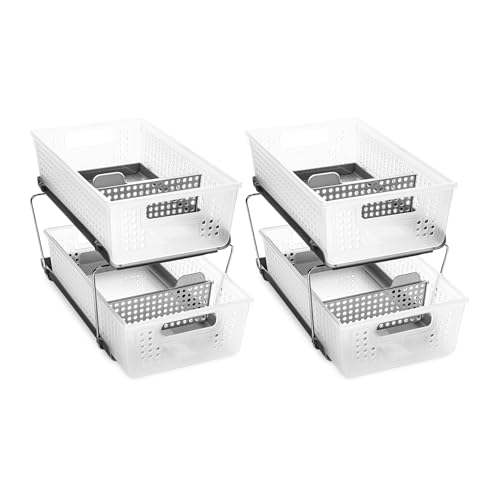
madesmart 2-Tier Organizer
Tier: mid-tier. Check price on Amazon when listings are linked at publication.
The madesmart 2-Tier Organizer is the classic sliding-basket design that most people picture first: two stacked trays, the lower one sliding forward so bottles at the back stop being a rumour. In daily use its strength is visibility. Dish soap, sponges and scrub brushes live on top where a wet hand can find them, while taller refill bottles stand below. The plastic construction wipes clean after the inevitable detergent drip, and the open sides mean a slightly-too-tall bottle can lean rather than jam. It suits a standard kitchen cabinet with a centred drain, because the frame is compact enough to leave a working gap for the trap. It is less happy in a very shallow vanity, where the second tier can crowd the basin underside.
YouCopia RollOut Caddy
Tier: mid-tier. Check price on Amazon when listings are linked at publication.
The YouCopia RollOut Caddy is built around wheels and a handle, and that changes the whole relationship with the space. Instead of reaching past the bottles you can see to the bottles you cannot, you pull the caddy out like a small wagon, take what you need, and roll it home. It is especially kind in deep cabinets and in bathroom vanities where the kneel-and-reach routine is at its worst. The open caddy format handles odd shapes well: trigger sprayers, tall refill jugs and the plunger-adjacent oddments that never fit a shelf. Its trade-off is structure; without tiers it does not multiply vertical space the way a stacked unit does, so it pairs best with a modest bottle count.
Spicy Shelf Under Sink Shelf
Tier: mid-tier. Check price on Amazon when listings are linked at publication.
The Spicy Shelf Under Sink Shelf is an expandable U-shaped shelf that wraps around the drain, and its party trick is adjustability: the width expands and the legs adjust so the shelf hugs cabinets that fixed frames cannot. Because the shelf is a platform rather than a bin, it suits households storing flat or boxy supplies, stacked cloths, and rows of similar bottles that read better in a line than in a basket. It is a strong answer for wide double-door cabinets where a single small organizer would leave dead space on both flanks. The platform approach means items are not contained, so a knocked bottle can travel; households with enthusiastic toddlers reaching into cabinets may prefer walls and baskets.
Puricon Under Sink Organizer
Tier: entry-tier. Check price on Amazon when listings are linked at publication.
The Puricon Under Sink Organizer represents the stacked sliding-basket family at an accessible tier: two tiers, a sliding lower basket, and a footprint small enough to sit on one side of the trap while the other side keeps the garbage disposal or a cleaning bucket. For renters and first apartments it is often the sensible first step, because it imposes order without demanding the cabinet be emptied, measured to the millimetre and rebuilt around it. The lighter construction is the honest trade-off; load it with the heaviest glass bottles you own and a premium steel frame will feel calmer. Used within its weight comfort zone, it organises perfectly well.
Measure Around the Plumbing First, Every Time
Before any design, brand or tier discussion, there is one job that decides whether an under sink organizer succeeds or gets returned: measure around the actual plumbing. The classic failure in this category is buying before measuring. A cabinet door opening is not the space you have. The space you have is what remains after the drain trap curves down and back, after the garbage disposal takes its bulky share, after hot and cold supply lines and their shut-off valves claim their corners, and after the dishwasher discharge hose loops through on its way to the disposal or the drain.
So empty the cabinet completely, get a torch and a tape measure, and map the obstacles like a floor plan. Note where the trap sits: centred, or pushed to one side? Note how low the trap arm runs, because that height decides whether a second tier can slide beneath it or whether the upper tray will collide every time it moves. Note the disposal, if you have one: its body is wider than the drain above it, and it often claims the entire half of the cabinet it hangs in. Note the water lines and valves, which usually live at the back wall and punish any organizer deep enough to press against them.
Then measure the clear zones that remain: the flat floor to the left of the plumbing, the flat floor to the right, the height from the cabinet floor to the lowest pipe, and the door opening itself, which is narrower than the interior on framed cabinets. Write the numbers down rather than trusting memory, and sketch the cabinet as a simple rectangle with the pipes drawn in. That sketch, compared honestly against any organizer you are considering, prevents nearly every disappointment in this category. An organizer that fits the cabinet but not the plumbing does not fit.
One more discipline belongs in this section because it is a safety matter, not a convenience one: never force or bend plumbing to fit an organizer. Pipes, traps and supply lines are not obstacles to be persuaded. If a frame only fits when a trap is pushed aside or a hose is kinked, the organizer is the wrong size, full stop. Forcing a joint can start a slow leak that soaks a cabinet floor for weeks before anyone notices. And after you rearrange bottles near pipes, check for drips: run the tap, run the disposal if you have one, then feel each joint with a dry hand and look with a torch. Do the same check a day later. Bottles get bumped during a tidy-up, and a bumped valve or a nudged trap can weep quietly.
Cleaning Chemicals, Children and the Under-Sink Cabinet
This needs saying plainly, because an organizer changes how chemicals are stored. Most under-sink cabinets hold the household’s strongest cleaning products: drain openers, bleach-based sprays, oven cleaners and dishwasher pods that look, to a small child, exactly like sweets. If there are children in the home, fit a cabinet child lock on the under-sink doors. An organizer is not a safety device; in fact, by making bottles tidier and easier to pull out in a sliding basket, it can make them easier for a determined toddler to reach.
Keep the most hazardous items highest and, where the layout allows, out of that cabinet altogether. A high shelf in a utility cupboard or a locked box elsewhere in the home is a better home for drain opener than the top tier of an organizer at toddler eye level. Within the cabinet, put the strongest chemicals at the back of the highest tier you have, keep everyday items like washing-up liquid at the front, and never decant chemicals into drink bottles or unlabelled containers. Keep products in their original labelled packaging so any adult, babysitter or grandparent knows instantly what they are holding.
The lock itself should be one you will actually use. Magnetic locks are invisible from outside and suit households that open the cabinet twenty times a day; simple latches cost less patience but get left unlatched more often, and an unlatched lock is decoration. Whichever style you choose, test it from a child’s height and with a child’s determination before you trust it, and re-check it after any reorganisation, because a new organizer can change how the door sits and whether the latch still catches.
Mistakes to Avoid
The first mistake is the one this guide has already underlined: buying before measuring, or measuring the cabinet and forgetting the plumbing. The second is filling every centimetre. An organizer packed to the door is as unusable as the chaos it replaced; leave air around the front row so a hand can enter without a excavation permit. The third is storing by bottle shape instead of by job, scattering the products used together across three zones and reassembling the hunt you were trying to end.
The fourth mistake is ignoring the leak check after the tidy-up. Bottles get set down on valves, baskets nudge traps, and a slow drip can run for a month behind a tidy row. Run the water, check the joints dry-handed, and look again the next day. The fifth is treating the under-sink cabinet as the only storage in the kitchen and forcing a warehouse into a cupboard; moving the rare and the hazardous elsewhere is not defeat, it is the system working. The sixth is skipping the child lock because the cabinet looks organised now. Tidiness is not safety, and the lock conversation belongs in every household with small children, every time the cabinet changes.
Pro Tips
Photograph the empty cabinet with the tape measure in frame; the photograph settles arguments at the shelf edge better than memory. Keep the sketch after buying, because the next organizer, the next home’s first organizer, and any plumber’s visit all start from it. Buy for the census plus a small margin, never for the census at its tidiest. And when two designs both fit, choose the one that comes apart for cleaning more easily; in year three that is the difference that remains.
Worked Examples
The family kitchen with a disposal. The map shows the disposal claiming the left half, a centred trap, and a clear right zone of modest width with good height. The census is long. The right choice is a compact sliding two-tier on the clear side, a drip tray under the few bottles that must stand near the disposal, a door rack for the daily spray if the swing clears the trap, and a child lock fitted the same day. A wide wrap-around shelf, tempting on paper, would press against the disposal’s hose run and is rejected by the sketch.
The small rental flat. The plumbing wanders, the census is short, and the lease forbids fixings. The right choice is a rolling caddy for the daily and weekly groups, a washable tray under the refills, and no frame at all. The system leaves no marks, moves house in a box, and the measuring habit transfers to the next kitchen unchanged.
The bathroom vanity. The well is small, the trap is high, and the inventory is jars, bottles and a hair dryer with a wandering cord. The right choice is a compact caddy that leaves the cabinet entirely, with the warm dryer parked away from aerosols, and the cleaning spray for the room kept in its own small zone at the back. Tiers would crowd the basin underside; the sketch says so before the money does.
First Setup and Care Essentials
Set up on a completely empty, dry cabinet. Wipe the floor, check it for old water damage while it is empty and visible, and lay a washable tray or liner where bottles will stand. Place the organizer empty, confirm it slides or sits without touching any pipe, then load it by zone: daily items front and top, weekly items behind and below, tall bottles where the clearance was measured for them. Load gradually and test the door swing and any drawer glide with the real weight in place, because a frame that glides empty can drag loaded.
Care is a short monthly ritual: lift out the top tray or the front row, wipe drips before they set, rinse baskets that have caught detergent sediment, and run the dry-hand leak check along the trap and valves while you are down there anyway. Once or twice a year, empty the cabinet fully and audit the inventory; expired products, duplicates and the bottle bought for a single job in a previous home are the silent capacity thieves. The organizer’s job is to make that audit easy, and a design you can empty in two minutes is one you will actually audit.
Layout Patterns That Work in Real Cabinets
The split-level kitchen. The most common successful layout in a standard kitchen cabinet puts a sliding two-tier unit on the clear side of the trap, a washable drip tray on the plumbing side for the few bottles that must live there, and the daily spray on a door rack if the swing clears. Its virtue is that each zone has one job and the plumbing keeps a respectful margin on every side. It survives busy households because nothing in it needs to be moved to reach anything else, and the monthly wipe takes minutes because every component lifts or rolls out.
The deep-cabinet rescue. In a deep cabinet, the winning pattern is a rolling caddy for the working inventory and a single fixed shelf or tray at the very back reserved for true refills, the bottles that leave the cabinet monthly rather than daily. The caddy carries the daily and weekly groups out into the light, and the back stops pretending to be everyday storage. This pattern concedes that depth cannot be made convenient, only honest, and it is the layout most often praised by owners with unreliable knees.
The vanity parking space. A bathroom vanity works best when the organizer leaves: a caddy that parks under the sink and comes out whole for the morning routine, with hair tools given a heat-aware spot away from aerosols and small jars corralled so cords cannot drag them out. The cabinet itself stays nearly empty, which makes its plumbing the most visible in the home and its leaks the fastest caught. Small space, simple plumbing, total access: the pattern fits the room exactly.
The rental reset. For a rental, the pattern is freestanding and reversible: a compact tier or caddy sized from the clear zone, bins for the groups, nothing screwed, glued or forced. It respects the lease, survives the move, and, because older rental plumbing wanders, it is chosen from the sketch rather than the cabinet’s headline size. Owners of this pattern consistently report that the system, more than the specific product, is what they carry to the next home.
The family fortress. Where small children are in the home, the layout is a safety plan first and a storage plan second: a fitted cabinet lock on the doors, the most hazardous products moved out of the cabinet to a high or locked store, the remaining chemicals at the back of the highest tier, and the harmless daily items, sponges, cloths and liners, at the front where small hands that defeat a latch anyway find nothing dangerous. The organizer’s zones make the safety geography obvious to every adult in the house, which is precisely why it works.
The minimalist tray. The final pattern is a refusal, and a respectable one: a single washable tray grouping the whole short census, a hook for the brush, and nothing else. It suits the small flat, the tiny census and the cabinet whose plumbing leaves no honest room for frames. Its lesson generalises across every pattern in this guide: the right system is the smallest one that makes everything reachable, visible and dry, and every larger pattern has to justify its extra size against this one’s simplicity.
Notes From Real Cabinets
There is a particular archaeology to an unorganised under-sink cabinet. The front row is the present: the spray in daily use, the washing-up liquid, the sponge. Behind it lies a stratum of good intentions, the specialist cleaners bought for specific jobs, each used twice. At the very back, in the dark beside the trap, sits the oldest layer: bottles whose labels have faded, a brush missing its handle’s other half, and at least one container nobody in the household can identify. An organizer’s real job is not tidiness for its own sake. It is ending the archaeology, so that every layer is reachable and every bottle has to justify its place by being findable.
Think about how often the cabinet is opened and by whom. In a busy family kitchen it might be opened a dozen times a day by several people with different habits and different heights. A system that only works when one careful person maintains it will decay within a month. The robust choice is the one that stays roughly right when a teenager stuffs a bottle back in the wrong place: zones wide enough to forgive, categories obvious enough to guess, and nothing balanced so precisely that one careless return collapses the order. Designing for the household you have, rather than the household in a catalogue photograph, is the difference between a system and a weekend project.
Bathroom vanities deserve separate thought from kitchen sinks, even though the products share a category name. A vanity cabinet is usually smaller, the plumbing is usually simpler, and the contents are different: hair tools with cords, skincare in small jars, cleaning supplies for one small room. Heat matters here, because a hair dryer put away warm should not rest against aerosol cans or plastic that softens. Cords matter too; they snag on basket edges and drag small items out with them. A rolling caddy often wins in a vanity precisely because it leaves the cabinet entirely, turning a cramped cupboard into a simple parking space.
Renters face a version of this problem with extra rules. Anything that screws into a door or a cabinet wall may be forbidden, and anything permanent is money left behind at the end of the lease. Freestanding organizers, tension and over-door designs that leave no marks, and simple bins all respect those limits. The measuring discipline matters even more in a rental, because the plumbing in older buildings wanders into layouts no catalogue anticipates, and returns from a small flat are a chore nobody needs. The good news is that everything learned in a rental cabinet transfers; the zones and the census work in any kitchen.
The garbage disposal changes the map more than any other single feature. Its body hangs low and wide, it vibrates in use, and its power cord and dishwasher hose both need their own untroubled routes. Bottles stored touching a disposal get gently rattled with every use, which walks them slowly out of position and occasionally tips a tall, top-heavy spray bottle into the trap. Leave the disposal a clear margin, put nothing on the side where the hose curves, and treat the disposal’s half of the cabinet as a half at most. Many successful layouts are simply a good organizer on the non-disposal side and a single drip tray on the other.
Consider the door itself as storage territory with rules. The inside face of the door is the first thing you see and the easiest thing to reach, which makes it prime land for the two or three items used every single day. But door storage swings, and everything on it must clear the trap and the front edge of any floor organizer through the whole arc of the swing. Test with the fattest bottle you plan to hang, not the thinnest. Hinges also limit the lower corner of most doors. Within those rules, door racks are the cheapest capacity in the whole cabinet, because the space they use was doing nothing at all.
Water is the cabinet’s permanent resident risk. Every under-sink space has joints, and every joint will eventually weep, usually slowly and usually at the back where nobody looks. This is why visibility is a genuine feature and not a marketing word. An organizer that lets you see the cabinet floor and the trap at a glance turns leak detection into something that happens during normal use. Dark, enclosed, over-stuffed systems hide the evidence until the floor swells. When you compare designs, ask how quickly you would notice a slow drip under each one; the honest answer should influence the choice as much as capacity does.
Grouping by job rather than by product type is the organising idea that survives contact with real life. The dishwashing group, the surfaces group, the laundry-transfer group that lives under the kitchen sink only because the utility room is full: each group in its own zone or basket means a task takes one reach, not three. It also exposes duplication kindly. When all the glass cleaners stand together, the household can see it owns three, and the census for the next shop writes itself. An organizer is really just the physical form of those groups, which is why choosing the groups comes before choosing the frame.
Height zoning is the quiet skill in this category. The top tier or the front of a platform is the cabinet’s high street: expensive in effort terms, reserved for what is used daily. The floor at the back is the suburbs, fine for refills and the descaler that appears monthly. Trouble starts when the geography inverts, when the daily spray migrates to the back and a refill jug takes the front. Sliding baskets and drawers exist largely to flatten this geography, making the back temporarily front. If your cabinet is deep and your knees are vocal, that flattening is worth more than raw capacity, and it should steer the whole purchase.
There is also a case for doing less. Some cabinets, especially in small flats, hold six bottles and a sponge, and for them a full framed organizer is furniture in search of a problem. A single washable tray, a small caddy for the daily group, and the discipline of the census will outperform a two-tier frame that crowds the trap. The honest guides in this category should say so, and this one does: the best organizer is the smallest system that makes everything reachable, visible and dry, and no larger. Bigger systems earn their size only when the bottle census demands it.
Seasonal change is a real load on this small space. Winter brings grit and salt that need their own cleaners near the door; summer brings barbecue and garden products that migrate indoors; a new baby or a new pet rewrites the chemical inventory entirely, and should rewrite the safety arrangements in the same week. A system with a little spare capacity absorbs these changes without a rebuild. One filled to the brim on day one has nowhere to put the new arrival except in front, blocking the door swing and starting the slow slide back into archaeology. Buy for the census plus a margin, not for the census at its absolute peak tidiness.
Finally, judge any organizer by its worst day, not its first day. On the worst day the sink is full, a pan is leaking something orange, a child is asking a question at volume, and the cabinet must give up the right bottle in one reach with one wet hand. Designs that pass that test share traits: obvious zones, nothing stacked on anything else, handles and glides that work with wet fingers, and no part of the system that requires two hands and a clear counter to operate. Keep that scene in mind while comparing, and the glossy features sort themselves into the genuinely useful and the merely photogenic quite quickly.
Labels deserve a moment of respect in any system. Not decorative labels, but honest ones: a strip of tape on a basket edge naming its group, a marker note on a refill bin. In a household where several people use the cabinet, labels end the quiet arguments about where things live, and they help a guest or a babysitter find the surface spray without a guided tour. Labels also expose drift. When the basket marked for dishwashing supplies contains a plant mister and a tube of filler, the system is telling you the census has changed, and the twice-yearly audit has something concrete to work with.
The sponge and brush problem is small and constant. These are wet objects stored in a dark cupboard, and they will make any organizer smell like a pond if they are put away dripping into a closed tray. The layouts that cope best give washing tools an open, draining home: a hook, a mesh pocket, a tray with somewhere for water to go that is not the cabinet floor. It is a tiny criterion, easily overlooked in a comparison table, and it decides whether the cabinet greets you pleasantly or reproachfully every single morning. Judge every design by where the wet sponge sleeps.
Bin liners and rolls are the awkward citizens of this cabinet: bulky, light, and prone to unrolling themselves into the plumbing. A surprising amount of under-sink frustration is liner frustration. The fixes are mundane and effective: a door-mounted holder if the swing allows it, a vertical slot at the side of a tiered unit, or simply a tall narrow bin that keeps the roll upright and contained. When you map your clear zones, reserve a named home for the rolls, because if you do not, they will choose the trap, and they will win.
Think about the heaviest thing you store. A full refill jug of detergent or a cluster of glass bottles concentrates real weight on one basket, one glide, one shelf leg. Designs differ honestly here, and the difference is not visible in photographs. Load any candidate mentally with your heaviest realistic row before judging its glide or its slide; a basket that glides beautifully empty and drags loaded will be left half-open and resented within a month. Weight honesty is also why the census matters: five glass bottles are a different purchase from fifteen plastic ones, even at the same count.
There is a rhythm to restocking that a good layout supports. New purchases should land in a known place, refills behind or below the in-use bottle, so stock rotates instead of stratifying. The archaeological cabinet fails at rotation completely, which is how households end up with three opened bottles of the same cleaner, each a third full. A simple rule helps: nothing enters the cabinet without a zone, and a new bottle of something already open goes to the back of its group, not the front. The organizer makes the rule physical; the household only has to keep it roughly.
Guests and grandparents are the usability auditors nobody hires. A system that only its creator can navigate will be dismantled, politely, by anyone house-sitting for a weekend. The test is simple: could a newcomer find the washing-up liquid, the surface spray and a bin liner in under a minute, and return each to an obvious home? Zones grouped by job, a little labelling, and air at the front pass that test. Cryptic stacking and precision arrangements fail it. Since real households include other people, design for the newcomer and the system will also be kinder to you on your tiredest evenings.
The cabinet under the kitchen sink often inherits jobs from the whole house: the toolkit overflow, the light bulbs, the batteries, the tape. Each inheritance is reasonable and together they crowd out the cabinet’s actual purpose. A firm boundary helps: this cabinet is for sink-related work and cleaning, and everything else needs a better home found deliberately, not someday. The organizer purchase is a natural moment to enforce the boundary, because the census forces every object to argue for its place while the cabinet stands empty and the argument can still be won.
Humidity from the dishwasher and the sink itself keeps this cupboard damper than any other storage in the kitchen. Cardboard packaging softens and slumps, paper labels peel, and anything stored in its shipping box slowly becomes part of the sediment. Decanting is forbidden for chemicals, which must stay in their original labelled packaging, but for dry goods such as liners, cloths and sponges, moving them out of cardboard into the organizer’s trays or a washable bin removes a whole category of decay. It is unglamorous advice, and it visibly extends the tidy life of the cabinet.
Consider the sound of the system. A drawer that glides, a caddy that rolls, a basket that slides: these are pleasant. A wire rack that rattles against a disposal, a door holder that clatters at every close, a frame that scrapes the trap: these are small daily irritations that teach the household to avoid the cabinet. You cannot hear a product in a listing photograph, so reason from construction: contact points against pipes are both a plumbing risk and a noise source, and clearance, chosen generously at the measuring stage, is silence bought in advance.
The Careful Way Through: Checks That Keep a Under Sink Organizer Task on Track
The main steps for the under sink organizer are covered above; what follows is the working discipline around those steps, covering preparation, order of work, the checks that catch mistakes early and the small follow-up habits that keep the result sound. It is written for real homes, where interruptions and imperfect spaces are normal.
Start With Your Space and Your Routine
A slight wobble, a stiff action or a small misalignment on day one rarely improves on its own, so address it during setup while adjustments are still easy to make. If you shop with someone else, agree the must-haves together before looking, so that the under sink organizer you choose is a shared decision rather than one person’s compromise discovered later. Households with children or pets put different demands on a under sink organizer than the listing photographs suggest, so judge edges, stability and cleanability against your real household, not a styled one. A return is easiest when you have kept the packaging until you are sure, so give the under sink organizer a fair trial period in its real position before you break down boxes and dispose of padding.
Check your work from a distance as well as up close, because proportions, levels and alignment in Food Storage & Organization tasks are far easier to judge from across the room. Where the under sink organizer has moving parts, work them through their full range during your first checks, listening and feeling for roughness that a photograph cannot show. Apply the same checks to each shortlisted example, whether that is the YouCopia RollOut Caddy; the Puricon Under Sink Organizer; the Spicy Shelf Under Sink Shelf, because consistent testing is what makes the differences between models visible. The best under sink organizer for a rented home may differ from the best for an owned one, because fixings, marks and alterations carry different consequences in each case.
When Small Problems Appear
Decide in advance which single feature you would refuse to compromise on, and let that one priority settle ties between otherwise similar under sink organizer choices. Set the assembled under sink organizer up fully before deciding it is wrong for the space, since partly built or badly positioned pieces often look worse than they will once finished and levelled. If two options look nearly identical, compare the parts you will touch every day, since those contact points decide whether a under sink organizer feels solid or flimsy after the novelty wears off. Take a break between shortlisting and ordering if you can, and return to the listings with fresh eyes, because fatigue makes almost any under sink organizer look acceptable late in a long search.
If the listing offers accessories for the under sink organizer, decide which ones solve a problem you already have, and set aside the ones that only solve problems the listing itself invented. When you have finished, run one deliberate test of the under sink organizer doing its ordinary job, and fix small issues immediately while the steps and the tools are still fresh in your mind. If a part of the under sink organizer can be replaced, refreshed or re-covered separately, that option can extend its useful life well beyond the point where a sealed design would be thrown out.
A Short Decision Checklist
- Who will use the under sink organizer most, and any limits they have
- What your current arrangement does well that the under sink organizer must not lose
- Delivery path, from the door to the final position
- Packaging kept until the under sink organizer has passed its first trial in place
- The measured space, including clearance to use and clean around the under sink organizer
- How the under sink organizer will be cleaned in an ordinary week
- The main job the under sink organizer must do, written in one sentence
- The one feature you will not compromise on
Taken together, these checks take only a little time, yet they answer the questions that decide whether the under sink organizer suits your home, your household and your routine, and they do so before money changes hands rather than after.
Frequently Asked Questions
What should I measure before choosing an under sink organizer?
Measure the clear zones around the plumbing, not the empty cabinet. Empty the space, then note the trap’s position and lowest point, the garbage disposal’s footprint if fitted, and the supply lines and valves at the back wall. Record the flat floor left and right of the pipes, the height from the floor to the lowest pipe, and the door opening, which is narrower than the interior on framed cabinets. Sketch it as a rectangle with the pipes drawn in. That sketch, compared honestly with any organizer, prevents nearly every bad purchase in this category, because fit is decided by the plumbing, not the box.
How do I choose between sliding baskets and a rolling caddy?
Let depth and census decide. Sliding baskets add a second tier and bring the lower row to you, so they suit longer inventories in standard cabinets with the height to spare under the trap. A rolling caddy adds no tier but removes the reach problem entirely, which wins in deep cabinets and bathroom vanities where the back row is effectively storage for things you have forgotten you own. If the census is short and the cabinet is deep, choose wheels. If the census is long and the height allows, choose tiers. Some cabinets happily run both, one on each side of the trap.
What if my garbage disposal takes up half the cabinet?
Then organise the other half properly and give the disposal clear margins. Its body, power cord and dishwasher hose need untroubled routes, and bottles resting against it get vibrated out of position with every use. A compact two-tier unit or a caddy sized from the clear side’s measurements, plus a drip tray under anything that must stand on the disposal side, is the layout that works in most kitchens. Door-mounted racks can add a little daily-item storage, provided the loaded door still swings clear of the trap through its whole arc. Never solve the space problem by pressing storage against the disposal or its hoses.
How do I keep cleaning chemicals safe around children?
Fit a cabinet child lock on the under-sink doors, and do it as part of the same project as choosing the organizer, not as an afterthought. The organizer arranges chemicals; only the lock secures them, and a sliding basket can make bottles easier for a toddler to reach. Keep the most hazardous products highest and, where the layout allows, out of that cabinet entirely, in a high cupboard or a locked box elsewhere. Keep everything in original labelled packaging, never decant into drink bottles, and test the lock at child height once the organizer is in, because the door may sit differently.
Can I install an organizer without touching the plumbing?
Yes, and you should: a correct installation never touches the plumbing at all. Freestanding tiers, caddies, expandable shelves and bins all work by occupying the clear floor around the pipes, with clearance to spare. If a design only fits when a trap is nudged, a hose is bent or a valve is pressed, that design is the wrong size for your cabinet, and forcing it risks a slow leak that can soak a cabinet floor for weeks unnoticed. After setting everything in place, run the tap and the disposal, check every joint with a dry hand, and repeat the check the next day.
How do I stop the cabinet sliding back into chaos?
Build the system so the tidy action is the lazy action. Group products by job, give each group one obvious zone, and leave air at the front so a bottle can be returned one-handed without moving anything else. Keep the daily group at the front or on top, and let refills and rare products take the back and the floor. Then run the small rituals: a monthly minute to wipe drips and check the trap for leaks, and a twice-yearly empty-out to repeat the census and evict duplicates and expired bottles. Systems fail when returning an item is hard; design so that it never is.
Related Guides
Keep reading with the rest of this cluster, and browse the wider storage guides linked below.
under sink organizer buying guide
under sink organizer pros and cons
is an under sink organizer worth it
best rugs for a kitchen sink area
best storage baskets for every room