Disclosure: As an Amazon Associate, dailyhomedecorating.com earns from qualifying purchases. Links on this page are affiliate links; they cost you nothing extra. Prices and availability change often, so check the current Amazon listing before you buy.
Learning how to choose a spice rack is mostly learning to ignore the photograph and interrogate your own kitchen, because the right rack is the one that fits your jars, your spare volume and your storage conditions — in that order. This guide works through the decision as numbered steps: count and sort the collection, choose the storage location by climate before choosing any product, measure like a surveyor, settle the jar question, and only then compare designs. One principle outranks every step: heat, light and steam degrade spices, so the convenient spot beside the stove is the worst home a rack can have, and a dark drawer or cabinet is the destination this whole method steers toward.
Key Takeaways
- The deciding criteria, in order: storage climate, fit, jar compatibility, then access style.
- Count the real collection — packets and duplicates included — before looking at a single product.
- Measure internal dimensions; drawer height and cabinet depth are the classic traps.
- Decide decanting before choosing a format, not after the format arrives.
- Leave headroom: a rack filled on day one guarantees overflow clutter by month two.
The short answer. Choose the location first — a drawer or cabinet away from the oven, out of sunlight — then choose the format that location supports, sized to the collection you counted, in a design that accepts the jars you own. Every step below exists to make one of those clauses concrete, and the worked examples at the end show the method landing on different racks for different kitchens, which is the sign of a method working rather than a favourite being pushed. The category overview behind the steps is in our spice rack buying guide.
In this guide
What You Need to Know Before Comparing
Spice racks divide into a handful of families, and the family matters more than the brand. Drawer systems — angled trays and liner strips — lay jars on their sides or at a tilt inside a kitchen drawer, labels facing up. Tiered cabinet risers work like stadium steps inside a cupboard, lifting back rows above front rows. In-cabinet organisers such as drop-down or pull-out frames try to bring deep cabinet contents forward. Door-mounted and wall-mounted racks move storage onto vertical surfaces that would otherwise go unused. Countertop racks, including revolving carousels, keep everything visible at the cost of counter space and light exposure. Expandable shelf risers stretch to fit a cabinet width and add a second level. Each family solves a different kitchen’s problem, and each creates a different storage climate, which is why choosing the family comes before choosing the product.
Everything in this guide starts with one uncomfortable fact about spice storage: the enemies of flavour are heat, light, moisture and air, and the typical kitchen rack is placed within reach of all four. Ground spices and dried herbs do not spoil in a way that makes them dangerous in normal home use; they fade. The volatile aromatic compounds that make cumin smell like cumin and paprika taste like paprika evaporate and oxidise, and warmth speeds that process up considerably. A jar sitting beside a hob lives through daily cycles of rising steam and cooking heat, and a jar on a sunny countertop spends its days in direct light. Neither jar is being stored badly in the sense of being dirty or disorganised — both are being stored in the worst possible microclimate in the room, purely because that spot is convenient.
Two background ideas complete the foundation. First, jar orientation governs label visibility: jars stored upright are read by their caps and shoulders, jars laid in a drawer are read by their bodies, and a mismatch between your jars’ labelling and your rack’s orientation makes a good system feel broken. Second, systems differ in what they assume: open platforms assume nothing and organise loosely; slotted and matched systems assume uniform jars and organise tightly. Neither assumption is a flaw — but buying a system whose assumption you will not meet is the single most common choosing error, ahead of even the placement error. Hold both ideas in mind through the steps.
How to Choose a Spice Rack in 7 Steps
Step 1: Count and sort the collection you actually own
Empty everything onto the worktop — every jar, tin and packet, including the ones in the overflow drawer and the bag of market purchases. Combine duplicates, discard anything that smells like dust rather than itself, and count what remains. Then sort the survivors into three piles: the daily handful, the regular rotation, and the occasional jars. This count and this sort drive everything downstream: capacity comes from the count, placement within the system comes from the sort, and the packet pile — if you have one — immediately rules formats in or out, because packets need open baskets or decanting, never slots. Choosing before this step is shopping; choosing after it is deciding.
Step 2: Choose the location by climate, not convenience
This is why storage location matters more than rack design. A drawer or a cabinet interior is dark by default, stays close to room temperature, and is shielded from the steam plume that rises off a boiling pan. A rack that puts spices into that dark, cool, dry environment starts with an advantage no amount of clever tiering on a countertop can match. When you compare two racks, compare first where each one will actually live. A plain drawer insert in a cabinet away from the oven will preserve flavour better than a beautiful revolving countertop rack parked next to the kettle, and any honest assessment of a spice rack has to weigh the storage conditions it creates, not just the access it provides.
Walk the kitchen with the climate rule in hand and shortlist locations in this order: a drawer near the prep zone but not in the oven’s flank; a cabinet section on an interior wall away from the cooker; the inside of a cabinet door; a shaded pantry shelf or counter. Reject, explicitly and in advance, the strip beside the hob, the wall the afternoon sun crosses, and the shelf above the kettle’s steam. If two locations survive, prefer the one whose volume is doing least today. This step is the whole guide in miniature — cooks who get it right can get several later steps slightly wrong and still end up happy; cooks who get it wrong cannot be rescued by any product.
Step 3: Measure the location like a surveyor
Measure before you shop, and measure the right things. For a drawer system you need the drawer’s internal width, depth and — the one people forget — its internal height, because a jar lying at an angle still has to clear the drawer front when it closes, and the runners and the underside of the worktop steal space you cannot see on a tape measure held above an open drawer. For a cabinet riser you need the shelf width, the depth from the cabinet face to the back panel, and the vertical gap to the shelf above, because a tiered riser loaded with tall jars must still slide in and out. For a door rack you need the door’s thickness, the clearance between the door and the shelves it swings past, and confirmation that the hinges carry the extra load without complaint. Write the numbers down and take them shopping; a rack that is a fraction too wide is not a bargain, it is a return.
Add two measurements people skip: the swing test for doors — open the candidate door fully and note what the rack would meet — and the hand test for cabinets, where the top tier of a loaded organiser must still admit your fingers around a jar beneath the shelf above. Write every number in one place. From here on, products are eliminated by arithmetic, not vibes, and a listing that will not tell you its dimensions has told you something important about itself.
Step 4: Settle the jar question
Decide early whether you will decant. Racks fall into two camps: those designed around a matched set of jars they supply or assume, and open platforms — risers, shelves, liners — that accept whatever jars you already own. Decanting into uniform jars looks tidy, makes labels consistent, and lets a drawer system hold more, but it costs time at every refill, creates a funnel-and-spillage ritual, and leaves you storing half-empty original containers somewhere else anyway. Keeping supermarket jars avoids all of that but means mixed heights and widths that waste space in rigid trays. Neither answer is wrong; the mistake is buying a rigid, jar-specific system while intending to keep a mismatched collection, or buying an open riser and then being annoyed that the result does not look like a magazine photograph.
Make the decision explicitly, in writing if the household shares cooking: keep original jars, decant fully, or standardise gradually as jars empty. Then let the answer filter formats — open risers, liners and expandable shelves for the keepers; slotted organisers and matched carousels only for the committed decanters; anything at all for the gradualists, who should still prefer open formats while the collection is mixed. The expensive mistake is the unmade decision: a rigid system bought by a household that quietly intended to keep its jars, discovered on delivery day.
Step 5: Pick the format the location and jars dictate
Now — and only now — formats. A chosen drawer points to liner strips or an angled tray, with the SpiceLiner style of cut-to-fit liner the most forgiving execution. A chosen cabinet section points to a stepped riser for mixed jars — the Copco style — or a divided in-cabinet organiser, the YouCopia SpiceStack style, for standard jars and households that want per-jar order. A wide or odd cabinet points to an expandable shelf, the SWOMMOLY style. A chosen door points to a fitted door rack, with the fixings conversation of Step 7 attached. A shaded pantry counter, and only that, admits the carousel, the Kamenstein style. Notice that the products arrived last and chose themselves — that is the method working as designed. The head-to-head assessments are in our spice rack reviews.
For drawers: SpiceLiner Spice Drawer Liner
The liner execution of the drawer format: cut-to-fit strips that cradle mixed jars on their sides, labels up, forgiving of variety and trivially washable. Entry tier. Best for: the Step 2 drawer winner with a mixed collection. Not suited for: drawers whose internal height fails Step 3.

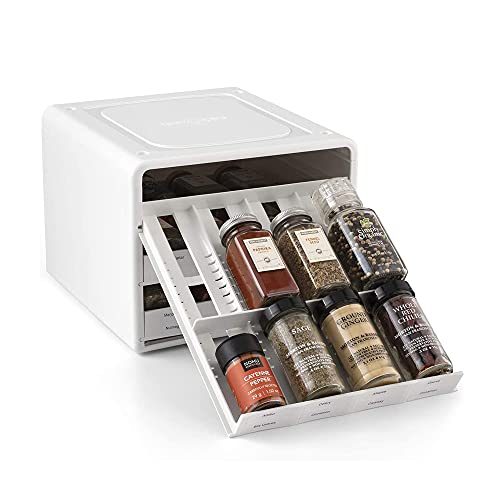
For cabinets and standard jars: YouCopia SpiceStack
The divided in-cabinet execution: stepped, slotted rows that present standard jars and keep order self-maintaining. Mid tier. Best for: cabinet winners with uniform jars. Not suited for: the unmade jar decision of Step 4.
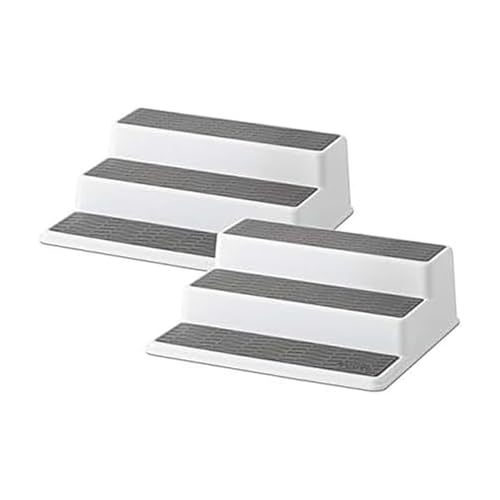
For cabinets and mixed jars: Copco Non-Slip 3-Tier Spice Rack
The open riser execution: three non-slip steps, any jars, no assembly, the smallest commitment that fixes the back row. Entry tier. Best for: mixed collections and first systems. Not suited for: deep cabinets with dead space behind.
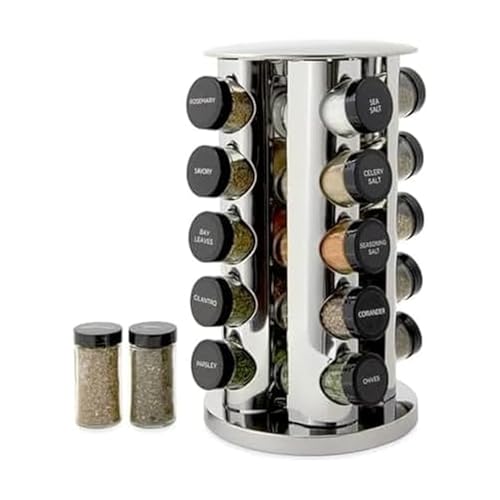
For shaded counters only: Kamenstein Revolving Spice Rack
The carousel execution: matched jars, one-handed spin access, superb presentation — admitted by this method only when Step 2 certifies the counter as cool and shaded. Mid-to-premium tier as a set. Best for: pantry counters. Not suited for: beside the hob, whatever the photograph suggests.
Step 6: Size for the count, plus headroom
Take the Step 1 count and require the chosen design to hold it with visible room to spare — a few empty slots or a step’s worth of space. Headroom is not indulgence; it is the buffer that absorbs the recipe-driven jar, the market souvenir and the gift set without spawning counter overflow. If the design you love holds exactly your count, it is the wrong size of a good idea: step up a format, add a level if the design stacks, or plan the overflow’s home — a small tray in the same cabinet — as part of the system rather than as its failure mode.
Step 7: Check installation, upkeep and the exit
Wall-mounted and door-mounted racks carry a load that surprises people. A full set of glass spice jars is genuinely heavy, and a rack concentrates that weight on a small number of fixings that then get tugged every time a jar is pulled out. Into plasterboard without proper anchors, screws will work loose; into a hollow door skin, over-door hooks are safer than screws but the rack must clear the door frame and the shelves behind it through the whole swing. Follow the fixing instructions for your wall type, use the anchors supplied or better ones rated for the material, and test the loaded rack with a firm pull before trusting it above a worktop where people stand. A spice rack failure is a shower of glass and paprika — preventable, and entirely a fixings problem rather than a rack problem.
Spice storage gets dirty in a specific way: fine powders escape every time a jar is opened, and they settle into tray corners, liner grooves and the threads of lids. A rack you cannot easily empty and wash will slowly become a rack you avoid emptying at all. Prefer designs that lift out in one piece, tolerate a sink of warm soapy water, and dry without trapping moisture in joints or fabric. Wipe jars before they go back, check lids for powder in the thread that stops them sealing, and treat the quarterly empty-and-wash as part of the system rather than an admission of failure. This maintenance reality is a genuine point of difference between designs, and it is one glossy product photographs never show.
Finally, check the exit: can the system be removed, resized or retired without damage or waste if the household’s cooking changes? Risers and liners exit free; door racks exit at the cost of screw holes; matched jar sets exit into a cupboard of uniform jars looking for a second career. Prefer reversible commitments while you are still learning your own habits — which, if this is your first system, you are.
Common Mistakes
- Buying capacity for the collection you wish you had: count your actual jars first, including the duplicates and the half-used packets, and buy for that number plus a little headroom — not for an aspirational forty-jar set you will never assemble.
- Placing the rack beside the hob for convenience: it is the warmest, steamiest spot in the kitchen and the fastest way to fade every jar on it. Convenience at cooking time should come from a small working set near the stove, with the main collection stored cool and dark.
- Ignoring jar orientation: a tray that lays jars down hides cap labels; a riser that stands them up hides body labels. Buy the rack that matches how your jars are labelled, or budget the time to relabel.
- Filling every slot on day one: leave gaps. Collections grow one impulse purchase at a time, and a rack with no spare slots forces a second, worse system to start growing beside it.
- Choosing the product before the location: the rack arrives, the only free spot is beside the hob, and the kitchen has bought a flavour-fading machine. Location is Step 2 for a reason.
- Trusting listing dimensions over your own tape: usable internal space is always less than the number on the cabinet’s outside, and the difference is where returns come from.
- Relabelling nothing after choosing an orientation-changing format: cap-labelled jars in a body-read drawer system will annoy you daily. Budget the relabel or choose the format that reads the labels you have.
Pro Tips
Four tips from households whose systems survived. Put the daily handful where the hand lands first, even at the cost of alphabetical purity — systems serve cooks. Photograph your loaded system once it works; the photo is the reset button after a holiday or a house-sitter scrambles it. Keep the system’s spare labels, liner offcuts and fixings in a labelled bag inside the system itself, because the day you need them is the day you will not remember the drawer they retired to. And review the collection, not the rack, at the quarterly wash: most ‘the rack stopped working’ stories are actually ‘the collection quietly doubled’ stories, and the cure is a sort, not a purchase. The value framing behind all of this is in is a spice rack worth it.
Labels are the unglamorous half of every spice system. A rack that stores jars cap-up needs readable labels on the caps or shoulders; a drawer system that lays jars down needs the label on the body where your eye lands; a riser needs labels on the front face. Whatever the orientation, label on the surface you actually see in the two seconds you are scanning, in lettering large enough to read at arm’s length in ordinary kitchen light. Include the opening date as described earlier. Uniform printed labels look smart, but a consistent handwritten system you actually maintain beats a beautiful label set that stops being updated the third time a new spice arrives without a matching sticker.
Worked Examples
The narrow galley kitchen
Count: a modest collection with packets. Location audit: no spare drawer, one cabinet with a door whose inside face is free, counters all within the hob’s weather. The method lands on a fitted door rack for the jars plus a small basket in the cabinet for the packets — vertical volume spent, worktop untouched, climate acceptable behind the cabinet door. Fixings checked against the door’s construction at Step 7; swing tested with the shelves behind loaded. A carousel was the household’s first instinct and the method’s clearest rejection.
The keen baker with a deep pantry
Count: large, grouped by baking and cooking families, packets included. Location audit: deep pantry shelves, cool and dark, volume plentiful. The method lands on expandable shelf risers across two pantry shelves — open platforms for the mixed jars and packets, staging room for batch days, headroom for a collection that grows every season. Organisation by cuisine group rather than alphabet, because that is how this cook reaches. The deep-shelf dead-zone risk is answered by putting the least-used family at the back, on purpose, in writing.
The family kitchen, drawer available
Count: dozens of jars, standard supermarket sizes, duplicates combined at Step 1. Location audit: one wide drawer near the prep zone, not in the oven’s flank — the audit’s dream answer. The method lands on a liner conversion: labels up, one pull, the whole collection surveyed by any family member, daily handful at the front breaking alphabetical order by design. The jar decision was ‘keep originals’, which the liner forgives; the quarterly wash is a lift-out rinse. This is the configuration the deep dive in our spice rack review treats as the benchmark, and the worked example shows why: every step’s answer pointed the same way.
Troubleshooting a Choice That Is Not Working
Sometimes the steps were followed and the system still grates — or life changed the kitchen after the choice was made. Diagnose before replacing, because most failures are local. If jars are hard to find despite the system, the fault is labelling or logic, not hardware: relabel for the orientation you have, or switch the organising logic once, decisively, and give it a month. If the system is always full, the fault is capacity or collection discipline: add a level if the format stacks, convert the overflow into a deliberate satellite tray in the same cabinet, or run a sort that retires the jars nobody has opened in a year. If refills are being dodged, the fault is ritual: drop the decanting step the household is avoiding and let the format forgive original jars, even at the cost of the matched look. If the spices taste flat, the fault is placement and no new rack fixes it — move the system you own into the dark before spending anything. Hardware is the last suspect, not the first, and it is genuinely guilty mainly when the fit was wrong from the start: the drawer that never cleared, the tier the hand cannot reach. Those two are Step 3 failures, and the cure is the measurement, done this time with the jars in hand.
The Seasonal Re-Audit: Keeping the Choice Right
A choice made well in one season deserves a five-minute audit in the next, because collections and kitchens drift. At the quarterly wash, ask the audit questions in order. Has the collection grown past the headroom — and if so, is the growth real cooking or souvenir accumulation? Has any jar’s home migrated — the working set creeping toward the hob again, as working sets do — and should the migration be blessed by swapping it with fast-turnover stock, or reversed? Has the household’s cooking shifted — a new cuisine, a baking phase — in a way the organising logic should follow? And is every jar still dated, or has the habit lapsed on the newest arrivals? The audit is short because the system is sound; its job is to catch drift while drift is still a five-minute conversation rather than a re-purchase. Kitchens that run it keep their first good system for years, which is the method’s real destination: not the perfect rack, but the chosen one, kept chosen.
Two More Worked Examples
The sunlit farmhouse kitchen
Count: a serious collection in mixed jars, several of them gifts in beautiful bottles. Location audit: the kitchen is famously bright, every counter sunlit by mid-morning, cabinets deep and old. The method’s climate step does heavy work here — it eliminates the countertop entirely, however much the room begs for a photogenic carousel — and lands on a divided in-cabinet organiser in the deepest, darkest cabinet, with the beautiful gift bottles given a deliberate home on the cabinet’s top shelf rather than forced into slots. The jar decision was gradual standardisation, and the organiser was chosen with dividers wide enough for the transition years. A year on, this is the kitchen that reports the flavour difference most strongly, because it is the kitchen whose old storage was brightest.
The new-build flat, first kitchen
Count: small but growing fast, bought recipe by recipe. Location audit: drawers plentiful, cabinets standard, budget and habits both unproven. The method counsels restraint here — this is the profile the riser exists for. A simple stepped riser goes into the cabinet nearest the prep zone, jars stay in their originals, and the household is instructed, by this guide if by nobody else, to live with it through a full season of cooking before upgrading anything. The expected outcome, and the common one, is that the riser either proves sufficient — in which case the method saved a system-sized spend — or teaches the household exactly which drawer the eventual liner conversion should claim, with the count and the habits to size it by.
Choosing With Another Cook in the House
The steps in this guide are written for a single decision-maker, and most kitchens have two or more stakeholders whose habits the system must survive. Bring them in at the steps where their vetoes live. The jar decision — Step 4 — belongs to whoever refills: a decanting system imposed on the household member who actually does the shopping and storing will be quietly routed around within a month, and the routed-around system is worse than a humbler one that had buy-in. The organising logic belongs to whoever cooks most on weeknights, because they collect the retrieval dividend and pay the search costs. The location decision belongs to the household jointly, because volume grievances compound. None of this requires a summit; it requires asking three short questions before the order rather than discovering the answers across the following season. Systems fail socially before they fail mechanically, and the choosing method that ignores the household is only finished on paper.
The Method Applied to the Hard Cases
No drawer, no door, one cabinet
The constrained kitchen still has moves. Inside the single cabinet, a riser doubles the shelf’s useful levels and a small tray corrals the packets; the cabinet door’s inside face, if the shelves behind clear it, takes a slim rack for the daily handful. What the method forbids is despair-buying the countertop carousel because it is the only format that asks nothing of the cabinetry — it asks everything of the worktop and the spices instead. Constraint handled by doubling and corralling beats constraint surrendered to the counter, every time.
The inherited collection
Collections acquired whole — a parent’s jars, a housemate’s leavings, a gift of someone else’s system — break Step 1’s assumptions, because half the jars are strangers. The method adapts: sort by smell before sorting by name, retire anything that has faded to dust regardless of its label’s promises, and let the survivors’ count, not the inheritance’s size, drive capacity. Inherited matched sets deserve one extra question — whether the jars’ lids still seal — because a beautiful inherited carousel with perished seals is a display piece, and the method’s climate step applies to it exactly as it applies to a new purchase.
The cook whose collection is mostly packets
Packet-dominant collections — common in households that cook across several cuisines bought from specialist grocers — invert the format ranking. Slotted systems are simply out; the candidates are basket tiers, open shelves with a corralling tray, or a drawer given to a shallow box in which packets stand filed like envelopes, labels forward, which is the packet cook’s version of labels-up and works startlingly well. Decanting packets into jars is the other honest answer, and it should be chosen, if at all, for the storage benefits — sealed jars beat opened packets for keeping character — rather than to satisfy a rack’s slots. Let the contents choose the system; that sentence is the whole guide, and the packet kitchen is merely where it is easiest to forget.
Across all three hard cases the method’s shape holds: climate first, count honestly, jars before formats, formats before products, headroom always. Hard cases do not need a different method; they need the same method applied without the shortcuts that easy kitchens survive. That robustness — not any single recommendation in it — is the guide’s actual claim on your attention.
The Method in Your Pocket
Carry the guide as five questions, in order, and let each one eliminate before the next one charms. Where will it live — and is that place dark, cool and dry? What do I actually own — counted, sorted, packets and all? What are the space’s true internal numbers? Am I keeping my jars or decanting — decided, not drifting? And only then: which product, in the format those answers leave standing, with headroom to spare? Five questions, asked in that order, are the difference between choosing a spice rack and being chosen by one. The kitchens in the worked examples asked them and landed on liners, risers, door racks and deliberate restraint; the kitchens in the cautionary tales asked the last question first. The method cannot want the dark drawer for you. It can only keep pointing at it — as it has, from the first step of this guide to this final line — and trust that a cook who has read this far about where spices live already cares about how they taste.
The Choosing Conversation, Compressed
Everything in this guide can be rehearsed as a conversation with the kitchen itself, and it is worth staging once, in words, before any money moves. Ask the collection what it is: it answers with a count, a packet pile, two duplicates and a jar that should have been retired years ago. Ask the kitchen where it can keep secrets from the sun and the steam: it answers with a drawer doing light duty and a cabinet on the quiet wall, and it pointedly does not answer with the bright counter, however the counter campaigns. Ask the jars whether they will change for the system or the system must take them as they are: most households’ jars answer, with one voice, as they are. Ask the household who refills and who cooks: they answer with names, and the names settle the ritual and the logic. Then, and only then, ask the market what it has — and discover that the market’s thousand options have quietly become about four, and the four are ranked by a tape measure. That is the whole method, and its modesty is its strength: it does not promise the perfect rack, only the end of choosing badly — which, in a category whose failures are all failures of fit rather than of manufacture, is the only promise worth making.
After Choosing: The Method’s Last Step Is a Date
The guide ends with an appointment rather than a purchase. Thirty days after the system is installed — loaded, labelled, dated and lived with through ordinary weeks and at least one ambitious cook — sit the method down with the kitchen one more time and audit the choice against the steps that made it. Did the location stay dark and convenient, or has the working set crept hob-ward? Did the count hold, or has overflow begun its quiet colonisation of the counter’s end? Did the jar decision survive contact with the household’s real refills? Is the logic the logic, still, a month in? Most choices pass this audit with a tweak or two, and the tweaks are cheap precisely because they are early. The choices that fail it fail informatively — a measurement that was fiction, a ritual that was theatre — and even they are cheaper to correct at thirty days than at three hundred. Choosing, done properly, is not an event but a short process with a purchase in the middle; the date in the diary is what makes it one. Set it when the box arrives, and let the method finish its work.
The Guide’s Promise, and Its Limit
A method should state what it cannot do, and this one cannot do three things. It cannot create a dark drawer in a kitchen that has none — it can only refuse to let that kitchen pretend the bright counter is one. It cannot make a household maintain what it will not maintain — it can only steer that household toward the formats whose upkeep is a rinse rather than a ritual. And it cannot guarantee that the collection you counted is the collection you will own in two years — it can only insist on the headroom that lets a growing collection stay a pleasure instead of becoming an overflow. Within those limits, the promise stands: follow the steps in order and you will not buy the wrong rack, because the wrong rack is always the one chosen out of order — product before place, format before jars, size before count. Choose in order, and the spice rack becomes what it should have been all along: a small, settled, unremarkable piece of kitchen furniture that makes dinner taste the way the ingredients intended.
One last encouragement, addressed to the reader who has followed the method this far and feels the decision is somehow still large: it is not, and it was never meant to be. A spice rack is among the smallest, most reversible, most forgiving purchases in the house — a liner can be lifted out, a riser can move to the pantry, a system can be re-homed to a relative whose kitchen it fits better. The method in this guide is thorough not because the stakes are high but because the mistakes are so avoidable, each one a skipped question rather than a bad product. Ask the questions, make the small decision, and get back to the cooking — which was, from the first step to this last line, the entire point of organising the spices at all.
A Worked Example in Miniature: The Studio Flat
The smallest worked example in the guide, kept for last because it proves the method scales down as gracefully as up. The studio’s kitchen is a wall: two cabinets, three drawers, one counter that is also the dining table’s understudy. The count is honest and small — a working set bought for the handful of dishes its cook actually makes, plus two gift jars. The climate audit eliminates the counter instantly; the drawers are audited and found to be spoken for by cutlery, clothes-that-are-not-clothes, and the household’s entire administrative life. The surviving home is the inside face of one cabinet door, and the swing test — performed with the shelves behind it loaded, as Step 3 insists — passes by a margin the cook describes as ‘a finger’s width and a promise’. A slim door rack takes the working set; the gift jars, too wide for it, live in a small tray on the cabinet shelf, a deliberate satellite rather than an overflow. Total new hardware: one rack. Total system: complete. The studio’s lesson is the guide’s lesson at minimum scale — the method does not ask how big the kitchen is, only whether its questions are answered in order.
Choose in order, and dinner is the judge — it will deliver its verdict quietly, meal after meal, in jars found without searching and flavours that arrive intact.
The tiered logic this guide applies to jars applies, with the measurements changed and the climate argument relaxed, to the other vertical stores in the house — the modular wine racks in the dining room obey the same rules of fit, headroom and honest counting, and choosing them by this guide’s order of questions works for exactly the same reason it works here.
Getting It Right in Practice: A Careful Working Check for the Spice Rack
The main steps for the spice rack are covered above; what follows is the working discipline around those steps, covering preparation, order of work, the checks that catch mistakes early and the small follow-up habits that keep the result sound. It is written for real homes, where interruptions and imperfect spaces are normal.
Start With Your Space and Your Routine
Where the spice rack meets the floor, the wall or another surface, check what protects both sides, because scuffs and marks in those contact zones are the most common early complaint. Do not let a single impressive feature distract you from a basic mismatch in size, capacity or care needs, since basics decide satisfaction long after features stop being novel. Take a break between shortlisting and ordering if you can, and return to the listings with fresh eyes, because fatigue makes almost any spice rack look acceptable late in a long search. Measure the space where the spice rack will live, including the clearance needed to use it, move around it and clean behind or beneath it, and keep those numbers beside you while you compare options.
Keep the area around the spice rack clear while you work and for a short while afterwards, so that nothing is knocked, spilled or leaned on before everything has settled, dried or been secured. Keep the care routine simple enough to repeat: a spice rack that needs ten minutes of attention weekly will usually get it, while one that needs an hour monthly often gets none. Apply the same checks to each shortlisted example, whether that is the Copco Non-Slip 3-Tier Spice Rack; the SpiceLiner Spice Drawer Liner; the YouCopia SpiceStack, because consistent testing is what makes the differences between models visible. Seasonal checks suit most Food Storage & Organization items well, so tie a quick inspection of the spice rack to a job you already do, such as changing clocks or clearing gutters.
When Small Problems Appear
Plan where the packaging and any old item being replaced will go on delivery day, a small step that prevents a rushed, careless first setup of the new spice rack. Start by writing down the job the spice rack has to do in your home, in one plain sentence, before you look at another listing, because a clear job statement turns a long shortlist into a short one. Photograph the spice rack as delivered, before assembly or first use, so that any later question about condition, parts or finish can be answered from evidence rather than memory. If a part of the spice rack can be replaced, refreshed or re-covered separately, that option can extend its useful life well beyond the point where a sealed design would be thrown out.
Where the spice rack has moving parts, work them through their full range during your first checks, listening and feeling for roughness that a photograph cannot show. When you have finished, run one deliberate test of the spice rack doing its ordinary job, and fix small issues immediately while the steps and the tools are still fresh in your mind. Think about who else will use the spice rack, how often, and in what way, because a choice that suits one person perfectly can frustrate everyone else in the household.
A Short Decision Checklist
- How the spice rack will be cleaned in an ordinary week
- What your current arrangement does badly that the spice rack must fix
- Where the spice rack and its accessories will be stored when not in use
- Delivery path, from the door to the final position
- The main job the spice rack must do, written in one sentence
- The material and finish, matched to light, moisture and wear in its spot
- What your current arrangement does well that the spice rack must not lose
- Who will use the spice rack most, and any limits they have
Taken together, these checks take only a little time, yet they answer the questions that decide whether the spice rack suits your home, your household and your routine, and they do so before money changes hands rather than after.
Frequently Asked Questions
What is the most important factor when choosing a spice rack?
Where it will live. Storage location decides the conditions your spices age in — dark, cool and dry in a drawer or cabinet, versus heat, light and steam on a typical counter — and that difference outweighs every product-level difference between racks. After location, fit and jar compatibility decide satisfaction. Cooks who choose location first and product last almost always end up happy; cooks who fall for a product and then hunt for its home are the returns statistics.
Should I choose a drawer or countertop spice rack?
A drawer, whenever a drawer exists. It offers the best label visibility in the category — every jar readable in one pull — and the best storage climate, dark and temperature-stable. A countertop rack wins only on raw reach speed, by seconds, and pays for it with worktop space and light exposure; beside a hob it adds heat and steam. The countertop exception is a genuinely shaded pantry counter, where a carousel’s convenience can be enjoyed without the storage penalty.
How do I measure for a spice rack?
Measure the host space internally, three ways, and write it down. For a drawer: internal width, depth, and height — the height decides whether angled jars clear the front when it closes. For a cabinet: shelf width, usable depth to the back panel, and the vertical gap to the shelf above, tested with your hand around your tallest jar. For a door: thickness, the loaded swing arc, and clearance to the shelves behind. Then compare products by arithmetic, and distrust any listing that will not state its dimensions.
Do I need matching jars for a spice rack?
Only for rigid formats — slotted organisers and jar-set carousels — which are designed around uniform jars and bill you in decanting labour at every refill. Open formats — risers, drawer liners, expandable shelves — accept the jars spices arrive in, mixed sizes and all, at the price of a less uniform look. Decide which household you are before the format decides for you; the gradual path, standardising jars as they empty, suits most people better than a single decanting day.
How big a spice rack should I choose?
Big enough for the collection you counted in Step 1, plus deliberate headroom — a few empty slots or a step of spare room. Collections grow one jar at a time, and a rack at capacity forces the next jar onto the counter, where the overflow crowd that the rack was bought to abolish starts again. If your honest count is small and stable, choose small without apology: a riser or a tray is a complete answer at that scale, and the method’s job is fit, not upselling.
What if my kitchen has no drawer or cabinet to spare?
Use vertical and door volume: a fitted rack inside a cabinet door, or a wall rack on a cool interior wall away from the cooker and the sun’s path — with fixings matched to the wall, because a loaded rack of glass jars is heavy and concentrates its load. If neither exists, the honest answer may be a small tray in the least-bad cabinet and a brisk rotation of stock, revisited when the kitchen changes. A rack forced into a warm, bright spot is worse than no rack.
Related Reading
Continue with the category’s balanced ledger in spice rack pros and cons, and apply vertical-storage thinking elsewhere with closet organiser shelves and freestanding wine racks.