Disclosure: As an Amazon Associate, dailyhomedecorating.com earns from qualifying purchases. Links on this page are affiliate links; they cost you nothing extra. Prices and availability change often, so check the current Amazon listing before you buy.
This spice rack review takes a position most roundups avoid: the rack itself is the smaller half of the story, and where the rack makes your spices live is the larger half. So this review assesses the spice rack as a class — using the in-cabinet organiser format, represented here by the YouCopia SpiceStack style of tiered in-cabinet storage, as the benchmark design — and judges it on build, on real cooking use, and on the storage conditions it creates for the spices themselves. Alternatives appear where a comparison genuinely clarifies the verdict, because a rack that wins on access can still lose on flavour.
Key Takeaways
- Verdict: a well-chosen spice rack is worth it for access and inventory control; the in-cabinet and in-drawer formats beat countertop formats on flavour preservation.
- Best for: households with a drawer or cabinet to spare and a jar collection that has outgrown a single shelf row. Not suited for: anyone planning to park it beside the hob.
- Heat, light and steam fade spices faster than time alone does — placement is a performance feature, not a footnote.
- Uniform jars help rigid systems; open risers and liners forgive a mismatched collection.
- Wall and door racks are only as good as their fixings: a full set of glass jars is heavy.
Short verdict. Buy a spice rack for the same reason you would buy any good storage: to make the right thing easy to find and easy to put back. The benchmark in-cabinet format does that job well, keeps jars in the dark where they belong, and asks little beyond a shelf you can give up. Skip the whole category if your collection is five jars — a small tray does that job — and skip any format whose only possible home in your kitchen is the warm, bright strip of counter beside the cooker.
In this guide
Spice Rack Review: What a Spice Rack Is and Where It Fits
A spice rack is, at its simplest, a way of defeating the single-row problem. A kitchen cabinet shelf holds jars in a line; the jars at the back might as well be in another building, because reaching them means moving the jars at the front, and moving jars mid-recipe with wet or floury hands is how collections quietly become chaos. Every rack design is an attempt to bring the back row forward — by stepping jars up on tiers, laying them down in a drawer at an angle, hanging them on a door, or spinning them on a carousel. Judged purely as access machinery, almost all of them work. The differences that matter are what else each design does: how much space it consumes, what climate it stores your spices in, how it handles jars that do not match, and how much upkeep it demands.
Everything in this guide starts with one uncomfortable fact about spice storage: the enemies of flavour are heat, light, moisture and air, and the typical kitchen rack is placed within reach of all four. Ground spices and dried herbs do not spoil in a way that makes them dangerous in normal home use; they fade. The volatile aromatic compounds that make cumin smell like cumin and paprika taste like paprika evaporate and oxidise, and warmth speeds that process up considerably. A jar sitting beside a hob lives through daily cycles of rising steam and cooking heat, and a jar on a sunny countertop spends its days in direct light. Neither jar is being stored badly in the sense of being dirty or disorganised — both are being stored in the worst possible microclimate in the room, purely because that spot is convenient.
Where does a rack fit in a real kitchen’s priorities? Below knives, pans and a board you like, but above most decorative storage, because spices are ingredients you use daily and ingredients whose quality silently declines in bad storage. A cook who buys decent spices and stores them beside the hob is paying for flavour and then evaporating it. The rack’s job is therefore double: retrieval and preservation. This review scores both, and weights preservation more heavily than most, because access problems announce themselves immediately while flavour loss is invisible until a dish tastes flat and nobody knows why.
Design, Build and Setup
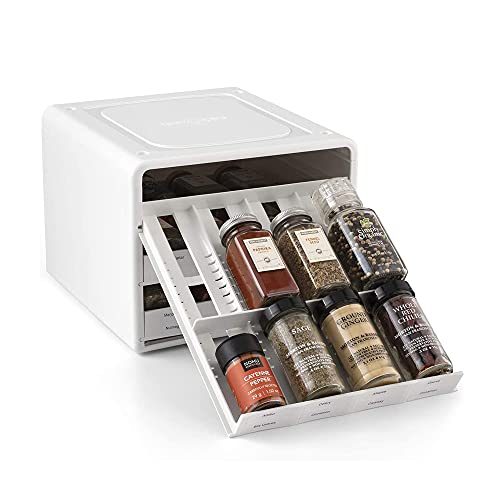
The benchmark in-cabinet organiser format — tiered trays that sit inside a cabinet and present jars in stepped rows, the format the YouCopia SpiceStack represents — is built from moulded plastic with dividers that keep jars from rolling or clattering. The design virtues to look for in this class are boring and decisive: dividers tall enough that a jar cannot tip over its neighbour when the tray is pulled forward, a base that does not flex under a full load of glass, and edges that do not trap powder in seams you cannot reach with a cloth. Setup is genuinely minutes: the unit arrives assembled or near it, sits on the shelf, and loads jar by jar. There is nothing to fix, drill or level, which is precisely the appeal compared with door and wall formats.

YouCopia SpiceStack — the in-cabinet benchmark
As the reference design for this review, the SpiceStack format earns its place by solving the cabinet problem without asking for tools: stepped storage inside the cupboard, jars visible in rows, and the whole collection behind a closed door in the dark. Its trade-offs are the format’s trade-offs. It standardises around typical supermarket jar sizes, so oversized or unusually shaped jars may not sit as intended; it gives up a block of cabinet volume that could have held other things; and because it lives behind a door, it adds one motion — open, scan, reach — compared with a countertop rack. In the tier language this site uses for prose-only picks, it sits in the mid tier: not the cheapest way to step jars up, not a premium furniture piece either, and priced by its convenience rather than its materials. Best for: cabinet-rich kitchens with standard jars. Not suited for: collections of oversized or novelty jars, or kitchens with no cabinet volume to spare.
What to check before buying any design in this class, in place of a spec sheet: whether the dividers suit your tallest and widest jars (take two jars to the listing photos and compare proportions honestly); whether the footprint matches your shelf’s usable depth rather than its nominal depth; whether the material is a single moulding you can wash whole; and whether the design still works half-empty, because collections fluctuate and a rack that only behaves when full is a rack that will annoy you in the months after a clear-out. These checks sound obvious and are skipped constantly, which is why the returns rate on kitchen organisers is what it is.
Measure before you shop, and measure the right things. For a drawer system you need the drawer’s internal width, depth and — the one people forget — its internal height, because a jar lying at an angle still has to clear the drawer front when it closes, and the runners and the underside of the worktop steal space you cannot see on a tape measure held above an open drawer. For a cabinet riser you need the shelf width, the depth from the cabinet face to the back panel, and the vertical gap to the shelf above, because a tiered riser loaded with tall jars must still slide in and out. For a door rack you need the door’s thickness, the clearance between the door and the shelves it swings past, and confirmation that the hinges carry the extra load without complaint. Write the numbers down and take them shopping; a rack that is a fraction too wide is not a bargain, it is a return.
Performance in Real Use
Weeknight cooking, against the clock
The honest test of a spice rack is a Tuesday evening: something is already in the pan, the recipe wants three spices you did not set out, and one hand is not available for a search party. In this scenario the in-cabinet tiered format performs well — door open, rows visible, jars identifiable by cap and label at a glance, each removable without disturbing its neighbours. A drawer system is arguably faster still, because the whole collection presents itself in one pull with every label facing up. The countertop carousel is fastest of all in pure reach terms. But the differences are seconds, and seconds are not the whole story: the rack you use under time pressure is also the rack you must put jars back into under time pressure, and designs with a definite slot or step for each jar get refilled correctly by a distracted cook, while open shelves drift back into a crowd within a fortnight.
The big cook: batch cooking and baking days
On a batch-cooking day the demands invert: you want many jars out at once, grouped on the worktop, and the rack becomes a staging system rather than a dispenser. Tiered cabinet formats handle this gracefully because jars lift out cleanly and the empty steps show you exactly what is missing when you tidy up — a quiet inventory feature nobody advertises. Drawer liners stage well too, with the caveat that an open drawer full of jars is an obstacle in a small kitchen’s traffic flow. Where racks struggle on big days is capacity honesty: a system bought exactly to today’s count forces the overflow — the new jar of sumac, the gifted smoked paprika — onto the counter, and overflow is how second, worse systems begin.
Small kitchens and shared kitchens
In a small kitchen the winning rack is the one that uses volume nobody else wanted: the inside of a cabinet door, a narrow drawer, the dead depth at the back of a deep cupboard. The benchmark in-cabinet format needs a cabinet you can dedicate, which small kitchens may not have; that is a genuine limitation, not a quibble. In shared kitchens the calculus changes again — a visible, obvious system gets used correctly by everyone, while a personal system hidden in a drawer gets raided and refilled wrong. Label discipline, discussed below, matters more than hardware here.
Labels are the unglamorous half of every spice system. A rack that stores jars cap-up needs readable labels on the caps or shoulders; a drawer system that lays jars down needs the label on the body where your eye lands; a riser needs labels on the front face. Whatever the orientation, label on the surface you actually see in the two seconds you are scanning, in lettering large enough to read at arm’s length in ordinary kitchen light. Include the opening date as described earlier. Uniform printed labels look smart, but a consistent handwritten system you actually maintain beats a beautiful label set that stops being updated the third time a new spice arrives without a matching sticker.
Flavour preservation over months
This is why storage location matters more than rack design. A drawer or a cabinet interior is dark by default, stays close to room temperature, and is shielded from the steam plume that rises off a boiling pan. A rack that puts spices into that dark, cool, dry environment starts with an advantage no amount of clever tiering on a countertop can match. When you compare two racks, compare first where each one will actually live. A plain drawer insert in a cabinet away from the oven will preserve flavour better than a beautiful revolving countertop rack parked next to the kettle, and any honest assessment of a spice rack has to weigh the storage conditions it creates, not just the access it provides.
Over a season of use, the in-cabinet and in-drawer formats show their advantage in the only blind test that matters: the same spice, bought the same day, stored in two places. The jar kept dark and cool keeps its aroma when the lid comes off; the jar kept by the hob smells progressively more like dust. No rack can restore a faded spice, and no rack marketing should imply otherwise — but a rack that stores in the dark is quietly doing preservation work every hour of every day, while a rack on the counter is doing the opposite. This is the single largest performance difference in the category and it has nothing to do with build quality.
Strengths and Trade-offs
Strengths
- Retrieval: stepped, slotted or angled storage ends the back-row problem and makes the whole collection visible in one look.
- Inventory control: an empty slot or step is a visible reminder of what ran out, which quietly improves shopping and cuts duplicate buying.
- Preservation, in the right format: cabinet and drawer racks store spices dark, cool and dry by default.
- No installation for the main formats: risers, trays and in-cabinet organisers work the day they arrive.
- Tidiness that maintains itself: a definite place per jar is the only organising system that survives a busy month.
- Scalability in open formats: risers and liners accept new jar shapes without a matching-set rule.
Trade-offs
- Space cost: every rack consumes volume — a cabinet block, a drawer, a door — that something else was using or could use.
- Format lock-in: rigid systems assume jar sizes; an unusual collection fits badly and decanting to fix that costs ongoing effort.
- Placement temptation: the most convenient spots (beside the hob, on a sunny counter) are the worst for the spices themselves.
- Upkeep: powder settles into trays and grooves; a rack that is hard to empty and wash will slowly be emptied less.
- Door and wall formats transfer the problem to fixings: the rack is fine, the plasterboard may not be.
- Capacity ceilings: a full rack has no answer for the next jar, and overflow restarts the clutter the rack was bought to end.
How It Compares
Three alternatives frame the benchmark. The Copco Non-Slip 3-Tier riser is the open-platform approach: stadium steps on a cabinet shelf, any jars you own, nothing to assemble, nothing format-specific to go wrong — but no dividers, so jars can slide and crowd, and the back row is visible rather than truly presented. The SpiceLiner approach replaces hardware with a liner: cut-to-fit strips in a drawer that cradle jars on their sides, labels up — the best label visibility in the category and the best storage climate, at the price of a drawer. The Kamenstein revolving countertop rack is the convenience candidate: a carousel that spins the collection to your hand, often sold with jars included — the fastest access of all, paid for with counter space and the worst light and heat exposure of any format if it lands, as it usually does, near the cooking action.
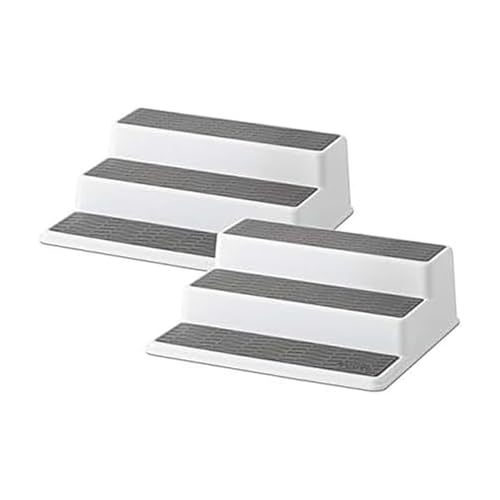
Copco Non-Slip 3-Tier Spice Rack — the open riser
Choose the riser format when your jars are a mismatched, evolving set and you want the simplest possible intervention: steps on a shelf, done. It is the entry tier of the category in effort as much as anything, and for many kitchens it is honestly enough. Best for: renters and first organisers with standard cabinet shelves. Not suited for: deep cabinets where a fixed riser still leaves a dead zone behind it.
SpiceLiner Spice Drawer Liner — the drawer conversion
The liner format is the connoisseur’s answer: it turns a drawer into the best spice environment in the kitchen — dark, cool, labels-up, one pull to survey everything. Its costs are the drawer itself and a little fitting time with scissors. Best for: cooks with a spare drawer near — but not beside — the prep zone. Not suited for: kitchens where every drawer is already contested territory.
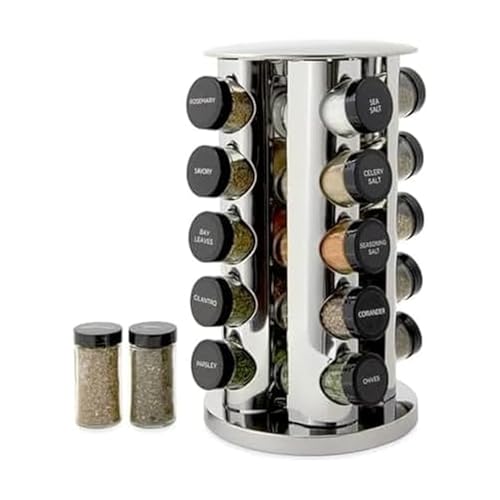
Kamenstein Revolving Spice Rack — the countertop carousel
The carousel is the format this review is hardest on, and the criticism is about placement, not manufacture: as a piece of access machinery it is excellent. If your kitchen has a cool, shaded stretch of counter away from the hob — a pantry counter, a butler’s-pantry shelf — a carousel there is defensible. Beside the stove, it is a flavour-fading machine with good bearings. Best for: shaded counters and cooks who value one-handed access above all. Not suited for: the strip of counter beside the cooker, which is where it will inevitably be proposed.
Who Should Buy It, Who Should Skip It
Buy a spice rack if your collection has passed the size where a single shelf row works — roughly the point where you have bought a duplicate of something because the original was hiding at the back — and if you have a drawer, a cabinet section or a door that can host it in the dark. Buy it, specifically, in the format that matches your jars and your kitchen’s spare volume, having measured both. The checklist before you commit: count the jars, including packets and duplicates; measure the intended home three ways; decide the decanting question honestly; pick the organising logic you will actually maintain; and confirm the placement is cool, dark and dry rather than merely near.
Skip it if your collection is small and stable — a handful of jars in a tray or a small box is a solved problem, and a rack would be furniture in search of a purpose. Skip door and wall formats if you cannot verify the fixings or the door clearance; a falling rack is worse than no rack. And skip any purchase made purely for the photograph: the racks that look best in listings, countertop carousels in bright kitchens, are the ones this review has spent the most words warning about, because the photograph never shows what the placement does to the contents over the following six months. For the wider method behind these judgements, our spice rack buying guide walks the whole decision, and how to choose a spice rack turns it into steps.
Setup, Care and Maintenance Essentials
Setup day is the day the system is won or lost. Empty the intended drawer or cabinet completely, wash the rack or liner before first use, and load the collection in your chosen order — not in the order the jars come to hand. Decant or relabel anything whose visible surface will not identify it in the orientation the rack imposes. Put the working handful — the salt-adjacent daily spices you reach for constantly — in the most accessible positions, even if that breaks alphabetical purity; systems serve cooks, not the other way round. Then cook with it for a month before reorganising: most early dissatisfaction is unfamiliarity, and most genuine flaws announce themselves clearly within that month.
Spice storage gets dirty in a specific way: fine powders escape every time a jar is opened, and they settle into tray corners, liner grooves and the threads of lids. A rack you cannot easily empty and wash will slowly become a rack you avoid emptying at all. Prefer designs that lift out in one piece, tolerate a sink of warm soapy water, and dry without trapping moisture in joints or fabric. Wipe jars before they go back, check lids for powder in the thread that stops them sealing, and treat the quarterly empty-and-wash as part of the system rather than an admission of failure. This maintenance reality is a genuine point of difference between designs, and it is one glossy product photographs never show.
Once the rack is in, choose an organising logic and stick to it for at least a month before judging it. Alphabetical order is the easiest to search and the easiest for other household members to maintain, because there is exactly one right place for everything. Grouping by cuisine — the curry spices together, the baking spices together — matches how recipes are actually cooked and keeps a whole flavour family in one grab. Grouping by frequency puts the daily handful at the front and the once-a-year jars at the back, which is efficient but drifts as habits change. Most households end up with a hybrid: frequency at the front, alphabetical within groups. The rack does not care; your future self, mid-recipe with wet hands, cares a great deal.
Final Verdict
The spice rack, as a class, passes this review — with a condition attached to the verdict that matters more than the verdict itself. As access machinery, tiered in-cabinet organisers, drawer systems and simple risers all do the job they promise, and the benchmark in-cabinet format does it with the least fuss and no tools. As storage, only the formats that keep jars dark, cool and dry are actually looking after the ingredients, and that is why this review recommends cabinet and drawer formats first, treats the countertop carousel as a special case for shaded counters only, and counts placement as a performance feature. Buy the format your kitchen can host in the dark, size it for the collection you counted, and the rack will quietly earn its keep at every meal. The balanced ledger is in our spice rack pros and cons, the value question is tackled head-on in is a spice rack worth it, and the model-by-model survey sits in our spice rack reviews. The same vertical-storage thinking applies elsewhere in the house — see modular wine racks and closet organiser shelves for the rack logic applied to bottles and wardrobes.
A Month With the Benchmark: What Settles and What Grates
Reviews written on day one are really first impressions with better formatting, so this section records what a month of daily use does to the verdict on the in-cabinet benchmark format. What settles first is the scan: within a week, the eye learns the rows the way it learns a keyboard, and retrieval stops being a visual task at all — your hand goes to the jar while your eyes stay on the pan. That automaticity is the format’s deepest virtue and it cannot be photographed, which is why listings undersell it and owners oversell it at dinner parties. What settles second is the inventory effect: the empty step where the cumin lives becomes a household fact, noticed by whoever cooks, and restocking stops depending on one person’s memory.
What grates, over the same month, is smaller and more specific. The top tier’s jars are the ones a shorter cook reaches for on tiptoe in a high cabinet, and the honest fix — putting the occasional jars up top and the daily handful low — sounds obvious and is somehow always discovered in week three rather than at setup. Powder accumulates exactly where predicted, in the divider corners, and the first wash teaches the lesson the cleaning section preaches: a unit that lifts out whole gets washed in the time a kettle boils, and the job never grows teeth. And the capacity question arrives on schedule, in the form of a gift set of three jars in beautiful, non-standard bottles that fit nowhere — the format’s jar assumption made visible. They live, after some negotiation, in the cabinet beside the rack, and the system’s survival of that exception is itself a finding: a good format bends at its edges without collapsing.
Jar by Jar: How Different Contents Behave
Not all spices use a rack equally, and a serious review should say so. The daily ground spices — the paprikas, cumins, corianders and curry blends of weeknight cooking — are the rack’s natural citizens: reached for constantly, used in quantities that empty jars on a rhythm, and the biggest beneficiaries of both the access and the dating habit. Whole spices behave differently: they keep longer, arrive in awkward bags as often as jars, and tolerate the back of the system happily, which makes them ideal tenants for the top tier or the deep end of a drawer. Baking spices cluster by project rather than by day, and households that bake seriously often end up running a sub-system — a small tray of baking jars within or beside the main rack — which is not a failure of the system but the system correctly reflecting how the cooking actually goes.
Herbs deserve a specific note, because dried leafy herbs are the most light-sensitive contents in the collection and the most commonly stored worst — in a clear jar on a sunny sill, in more kitchens than would admit it. For herbs, the dark-format argument is at its strongest, and the benchmark’s closed-cabinet home earns its keep most clearly. At the other extreme, salt and pepper mills live outside every system in this review, by the hob, where they belong: they are tools as much as ingredients, their contents are robust, and exiling them to a rack in the name of tidiness is the kind of system-purity this review has argued against throughout. A rack that serves the cooking will always have a few sanctioned exceptions at its borders.
The Second Kitchen Test: Cooking for a Crowd
The benchmark format’s other examination is the feast day — a holiday meal or a houseful of guests — when the collection is raided by multiple cooks, some of whom did not build the system. This is where legibility pays: a guest cook can find the cinnamon in the stepped rows without a briefing, and can put it back in the only place it fits, which is more than can be said for any shelf in any kitchen. The failure mode that does appear is staging congestion: with six jars out on the worktop and two cooks moving, jars get parked in wrong steps during the rush, and the system’s owner faces a five-minute re-sort at the end of the night. Five minutes, after the biggest cooking day of the season, is a cost this review records gladly — it is the chaos of the old shelf row, compressed into a tidy-up shorter than loading the dishwasher.
One more crowd-day observation belongs in an honest review: the rack changes what gets cooked. When the whole collection is visible, cooks — owners and guests alike — reach beyond the habitual four spices, because the jar they can see is the jar they remember exists. The neglected sumac gets used; the za’atar bought for one recipe finds a second life. This is not a claim any manufacturer can print, and it is not guaranteed, but it is reported by enough households that a review should note it: visibility is a mild but real creative force in a kitchen, and a rack is, among other things, a visibility machine.
Durability and Living With the Materials
A month cannot judge years, but it can judge the things that predict years. The moulded trays of the benchmark format show no flex under a full load of glass and no stress whitening at the divider roots — the two places cheap mouldings announce their futures early. The surfaces wipe clean without the powder staining that plagues matte finishes, and nothing in the design traps water after washing, which matters more than it sounds: a rack that dries slowly in a humid kitchen is a rack quietly growing musty in its joints. Wire formats age differently — coatings chip where jars strike, eventually — and wooden drawer inserts age best of all in pure material terms while asking the most in care. The fair summary is that nothing in the mainstream of this category is fragile, and the ownership differences that matter are the ones this review has weighted all along: format, placement, jar fit and cleanability. Buy those right and the object itself will outlast your interest in reviewing it.
What This Review Did Not Test, and Why It Matters Less Than It Sounds
An honest review names its blind spots. This assessment is of the spice rack as a class and of the in-cabinet benchmark format in depth; it is not a laboratory comparison of every brand’s moulding tolerances, and it does not pretend that one household’s cabinet depth generalises to all kitchens. It also does not test decade-scale durability, because no honest review of a current product can. What it can do — and has tried to do — is identify the variables that decide satisfaction and show how the formats score on them, so that a reader whose kitchen differs from the test kitchen can re-run the judgement with their own measurements. The variables are stable even when the products churn: storage climate, jar fit, label orientation, cleanability, capacity honesty. A review that teaches you those will still be useful when every model named in it has been replaced by a successor, which is more than can be said for a review that merely ranks this season’s boxes.
There is one more blind spot worth naming, because readers will feel it: this review cannot tell you whether your household will maintain a system. It can stack the odds — slotted order, visible inventory, low-ritual refills — but the human variable stays human. That is why the review’s buying advice ends where it does, with the suggestion to start at the format your kitchen can host in the dark and your habits can sustain on a tired Thursday, rather than the format that photographs best on a rested Sunday. The benchmark in-cabinet system happens to be strong on both counts, which is why it carries this review — but the principle outranks the product, and a reader who applies the principle to a different format has used this review exactly as intended.
The Verdict, Restated for Three Readers
For the cabinet-rich household with standard jars: buy the benchmark format without further deliberation; it is the rare purchase whose daily experience matches its promise, and your remaining decisions are organising logic and where the daily handful sits. For the drawer-rich household: the benchmark is your second choice, and a good one, but the drawer conversion reviewed alongside it is the format your kitchen was built for — take the labels-up visibility and the best storage climate in the category. For the counter-only household: this review’s verdict is the uncomfortable one — the rack you want is the rack your kitchen cannot host well, unless the counter in question is shaded and far from the hob. Spend the money on a riser inside whatever cabinet exists, or on better spices to put in the dark cabinet you already own, and let the carousel wait for a kitchen that can treat it kindly.
Scoring Summary, in Words
Close the review with the scores rendered as sentences rather than numbers, because the sentences carry the conditions and the numbers would hide them. Access: excellent in the benchmark format, a half-step behind the drawer on scan speed and a half-step ahead of it on volume. Storage conditions: as good as domestic storage gets, provided the cabinet is not the one directly above the oven — a siting detail worth checking, since the cabinet over a hob lives in the steam plume’s second home and quietly forfeits the format’s main advantage. Jar forgiveness: moderate, and the review’s chief reservation — standard jars welcome, oddballs tolerated at the edges, gift bottles exiled. Upkeep: excellent, a lift-out wash measured in minutes. Capacity honesty: good with headroom bought deliberately, poor without it, like every format in the category. Overall: the benchmark earns its role — the format to measure others against for cabinet kitchens — with its reservation printed in the same size type as its praise.
One Detail the Photographs Never Show: Sound
A closing observation from the month of use, offered because no listing will ever mention it: racks have a sound, and the sound is part of the experience. Glass on a hard shelf row clatters; glass in divided trays clicks softly and stops; glass in a drawer on liner strips is nearly silent. In a kitchen used early by one household member while others sleep, or late by a cook who values the quiet of a house at rest, the divided and lined formats earn an unlisted point that owners mention with surprising warmth. It changes no verdict in this review — the rankings were settled by climate, fit and access long before acoustics — but a review that spent a month with the benchmark owes its readers the small true things alongside the large ones, and this is the smallest and truest: the right rack makes the kitchen quieter at exactly the moments quiet is worth most.
If You Read Nothing Else in This Review
The whole assessment compresses to a paragraph, and it is this one. A spice rack is access machinery plus a storage climate, and it should be bought as both. The in-cabinet benchmark format reviewed here is the strongest all-round execution for a standard kitchen: stepped, divided, dark, washable, and boring in all the ways that predict a decade of unremarkable service. Its rivals each win a province — the drawer liner wins visibility and climate outright, the riser wins effortlessness, the carousel wins the shaded counter — and the review has tried to give each province its due without surrendering the capital. But the sentence to carry out of the page is not about any product. It is that the rack beside the stove is a flavour-fading machine whatever its build quality, and the rack in the dark is a preservation device whatever its price tier — and a review that let you leave believing the hardware mattered more than that geography would have failed you, however many products it ranked along the way.
Under the Surface: The Spice Rack Details That Decide Long-Term Satisfaction
Listings present a spice rack at its best, so this section slows the assessment down and looks at the evidence an individual model offers: its construction, its finish, its listing detail and the checks you can run before and just after it arrives. The aim is a verdict based on inspection rather than impression.
Start With Your Space and Your Routine
Look for the detail photographs in the listing, not just the wide shots, and zoom in on edges, joints, fasteners, controls and finishes, which is where build quality usually shows itself first. Check the dimensions given in the listing against your own measurements rather than relying on the room name in a photograph, since staged photos routinely make Food Storage & Organization pieces look smaller than they are. Measure the space where the spice rack will live, including the clearance needed to use it, move around it and clean behind or beneath it, and keep those numbers beside you while you compare options. Compare how each option handles the in-between moments, such as being half full, partly open, moved aside or used in a hurry, because daily life happens mostly in those moments.
Pay attention to how the spice rack is described for the parts you cannot see, and treat vague language there as a reason to ask questions rather than as reassurance. Consider the busiest version of the day, not the calmest one, and ask whether the spice rack still works when people are hurrying, carrying things or sharing the same space. Apply the same checks to each shortlisted example, whether that is the Kamenstein Revolving Spice Rack; the Copco Non-Slip 3-Tier Spice Rack; the YouCopia SpiceStack, because consistent testing is what makes the differences between models visible. When something about the spice rack starts to annoy you, note whether the cause is the product itself, its position, or the way it is being used, since each cause has a different and usually cheaper fix.
When Small Problems Appear
The best spice rack for a rented home may differ from the best for an owned one, because fixings, marks and alterations carry different consequences in each case. Recheck any adjustable part of the spice rack after the first week of use, once materials have settled and the household has stopped being careful with it. Equally, list what your old spice rack did well, because replacements sometimes quietly lose a virtue you relied on, such as a size, a shape or a simplicity the new model has redesigned away. Finally, judge the spice rack against the life you actually lead this year, not the tidier or more ambitious life in the listing photographs, and the choice will usually make itself.
Set the assembled spice rack up fully before deciding it is wrong for the space, since partly built or badly positioned pieces often look worse than they will once finished and levelled. A closer look at any single spice rack should start with the unglamorous evidence: the underside, the back, the inside and the fittings, because review photographs concentrate on the angles that flatter it most. Small problems are easiest to solve in order: check position first, then adjustment, then cleaning, and only then conclude that the spice rack itself is at fault. Start by writing down the job the spice rack has to do in your home, in one plain sentence, before you look at another listing, because a clear job statement turns a long shortlist into a short one.
A Short Decision Checklist
- Packaging kept until the spice rack has passed its first trial in place
- The measured space, including clearance to use and clean around the spice rack
- The material and finish, matched to light, moisture and wear in its spot
- Delivery path, from the door to the final position
- Who will use the spice rack most, and any limits they have
- How the spice rack will be cleaned in an ordinary week
- What your current arrangement does well that the spice rack must not lose
- Where the spice rack and its accessories will be stored when not in use
Taken together, these checks take only a little time, yet they answer the questions that decide whether the spice rack suits your home, your household and your routine, and they do so before money changes hands rather than after.
Frequently Asked Questions
Where is the worst place to keep a spice rack?
Beside the hob, and it is not close. That spot combines rising steam, radiant heat and, in many kitchens, the brightest light — the three forces that fade ground spices fastest. It is also, unfortunately, the spot most cooks instinctively choose, because it is where the hand wants the spices to be. The compromise that actually works is a main collection stored cool and dark a step or two away, with a tiny working set of the few spices you use daily kept near the cooking action and treated as fast-moving stock rather than long-term storage.
Is a drawer or a cabinet better for a spice rack?
Both store spices in the dark at room temperature, so both beat any countertop placement. A drawer wins on visibility — one pull shows every label — and loses on the opportunity cost of the drawer itself. A cabinet format wins on volume and on not competing with cutlery and utensils, and loses a little on scan speed. Choose by which space your kitchen can genuinely spare, and by jar orientation: drawers suit labels on jar bodies, cabinets suit labels on caps and shoulders.
Do I need to decant my spices into matching jars?
Only if you choose a rigid system designed around uniform jars. Open formats — risers, liners, expandable shelves — accept the jars spices arrive in, at the price of a less uniform look and slightly less efficient packing. Decanting buys tidiness and consistency; it costs time at every refill and leaves part-used original containers to store. Households that cook a lot and refill often usually end up happier with open formats, while smaller, stable collections suit a matched set.
How long do spices stay good on a rack?
A rack does not extend a spice’s life by itself; the storage conditions do. Kept dark, cool, dry and sealed, ground spices hold their best character for months and remain usable well beyond that, fading gradually rather than spoiling. Whole spices keep noticeably longer than ground. The practical habit is dating jars when you open them, using older jars first, and trusting your nose: a spice that smells faint and dusty at the jar will taste faint and dusty in the dish, wherever it was stored.
Can a door-mounted spice rack damage the door?
It can if it is screwed into a hollow door skin without suitable fixings, or if the loaded weight makes the door sag on its hinges over time. Over-door hook designs avoid screws entirely but need clearance checks: the rack must clear the frame at the top and the shelves behind the door through its full swing. A full set of glass jars is heavier than most people expect, so treat the fixing question as seriously as the rack question — the failure mode is a door that will not close or, worse, a rack that lets go.
What size spice rack should I buy?
Size for the collection you counted, plus modest headroom for growth — not for the collection in the listing photograph. Count every jar, packet and duplicate you actually own, measure the drawer’s or cabinet’s internal dimensions rather than guessing from the outside, and leave a few slots empty on purpose. A rack filled to capacity on day one guarantees that the next jar starts a second, worse storage system on the counter, which is the clutter outcome the rack was bought to prevent.
Related Reading
Keep exploring organised storage: freestanding wine racks apply tiered, visible storage to the dining room, while storage baskets cover the open-storage end of the spectrum for the rest of the kitchen.